|
|

 Spain and the Holy Roman Empire Spain and the Holy Roman Empire France and its own religious civil war France and its own religious civil war Dutch independence Dutch independence Elizabethan England Elizabethan England Italy Italy The Polish-Lithuanian Commonwealth The Polish-Lithuanian Commonwealth Russia ... and Ivan "The Terrible" Russia ... and Ivan "The Terrible" The textual material on the page below is drawn directly from my work,
|
|
A Timeline of Major Events during this period
1547 A young Ivan IV ("The Terrible") comes to power in Russia as Tsar (1546-1584)
|
|
| By
the mid-1500s the breakdown of the unity of Christianity and the
weakening of the hold of the medieval church on the political hearts of
Europe were affording a number of rising princes and kings a new
opportunity: the immediate accumulation of vast amounts of wealth
through the confiscation of church lands. Many of these new
rulers got involved in the Reformation seemingly only for the
opportunity it gave them to grab land and wealth from the church, even
to make themselves the head of the church in their own lands. At
the same time, political sovereigns as "kings" were taking full control
over their royal domains in bringing their barons under tighter royal
grip. And also at the same time, Christian Europe was dividing itself not only along Protestant and Catholic lines, it was doing so also along Secular versus Christian lines themselves. Thus it was that the political unity of "Christian Europe" was fracturing … deeply. Spain and the Holy Roman Empire
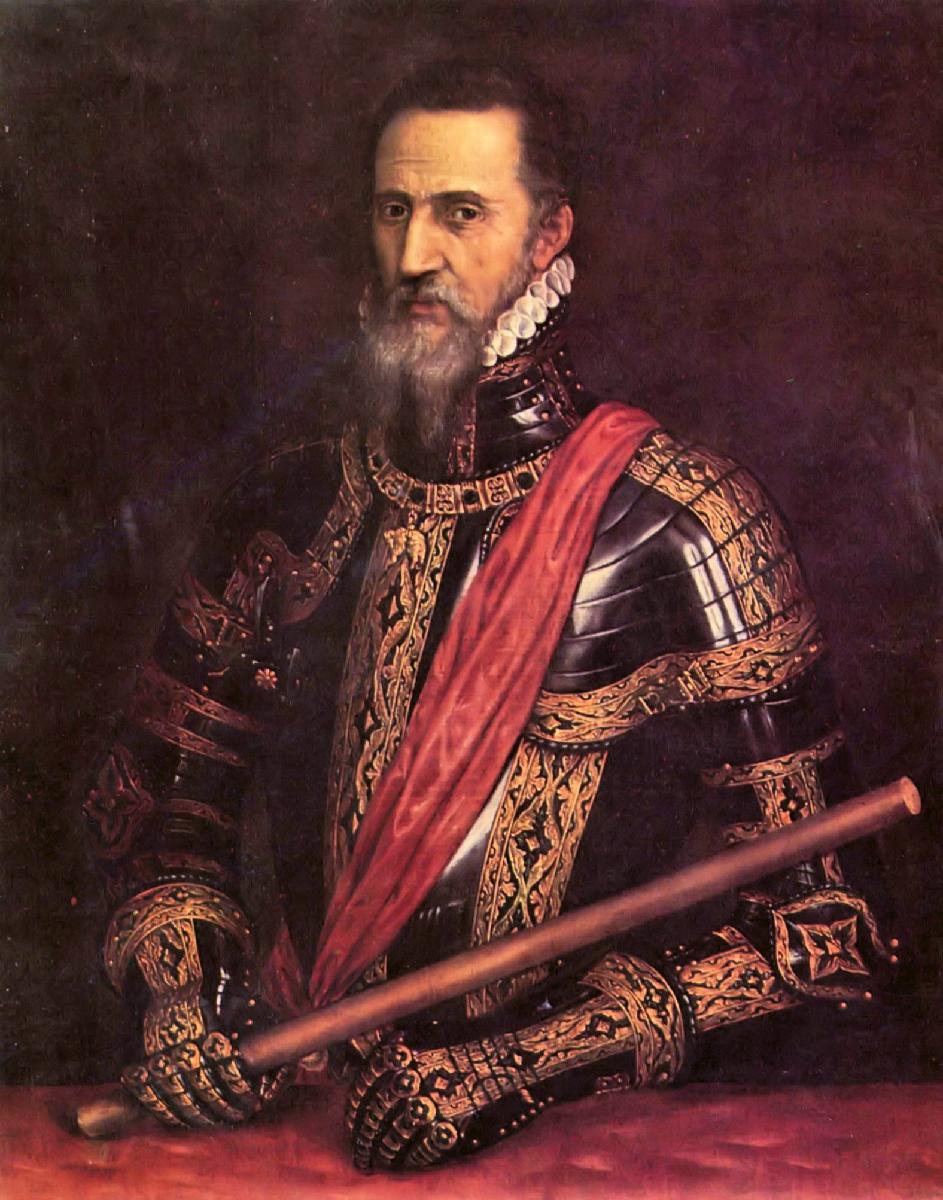
Philip II. Philip, unlike his Flemish father, was thoroughly Spanish: rich, powerful and arrogant ... in keeping with the dominant place Spain occupied in European affairs. During his reign, Philip's rule extended even to England (at least briefly during his four-year marriage to Mary ... also known as Bloody Mary for her persecution of English Protestants), to the Netherlands, to America, even to East Asia (the Philippines ... named after him). Problems with the Dutch. But he was not without major problems during his reign. The Dutch, many of whom had become strongly Protestant (Calvinist), were wealthy and independent-minded enough that they were able to hold off successive attempts of Philip to force them back under Catholicism (actually the Spanish did reclaim the Southern half of the Netherlands i.e., Belgium). This badly drained Philip's treasury and led to a number of financial crises during his reign. Defeat of his mighty Armada by the English (1588). Philip's fleet, bringing to Spain the gold from America, was constantly raided by English pirates under authorization of Elizabeth, Queen of England (who had also allied with the Dutch rebels). Philip was so infuriated by all this (plus Elizabeth's murder of her Catholic rival, Mary, Queen of Scots in 1587) that in 1588 he sent a huge naval force (the Mighty Armada) against the English, with the intention of destroying English independence ... and bringing the country back under full Catholic rule. God apparently had other plans. Instead his fleet was caught by foul winds and weather which the English exploited and sent the fleet, or the portion that survived, in miserable retreat (few made it back to Spain). Protestant Europe took great notice of the side which God seemed to have favored. Nonetheless, Philip rebuilt his fleet and the war with England continued ... until both Elizabeth and Philip were dead (beginning of the 1600s). It was a standoff ... but one which spoke well of English power ... and rather poorly of Spanish greatness. It in fact marked the beginning of the decline of Spanish power. |

Habsburg Map 1547
Wikipedia - "Charles
V, Holy Roman Emperor"
Spanish King Philip II of
Habsburg
(reigned
1554 - 1598)
The son of Charles V and equally ardent
(and even more cruel) "defender of
the (Catholic) faith"
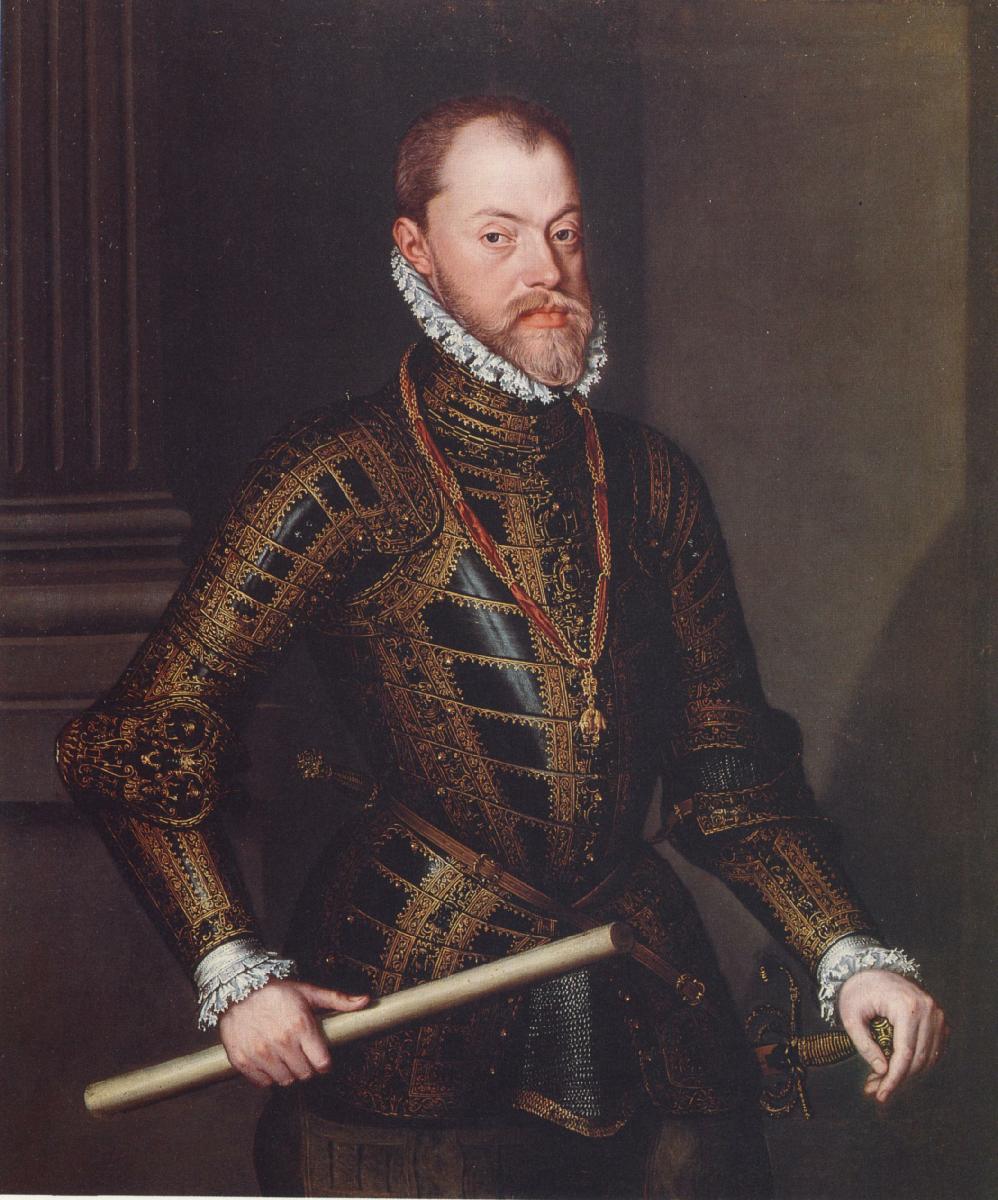
Spanish King Philip II - by Alonso
Sanchez
Coello (c. 1570)
Glasgow Museums and Art
Galleries
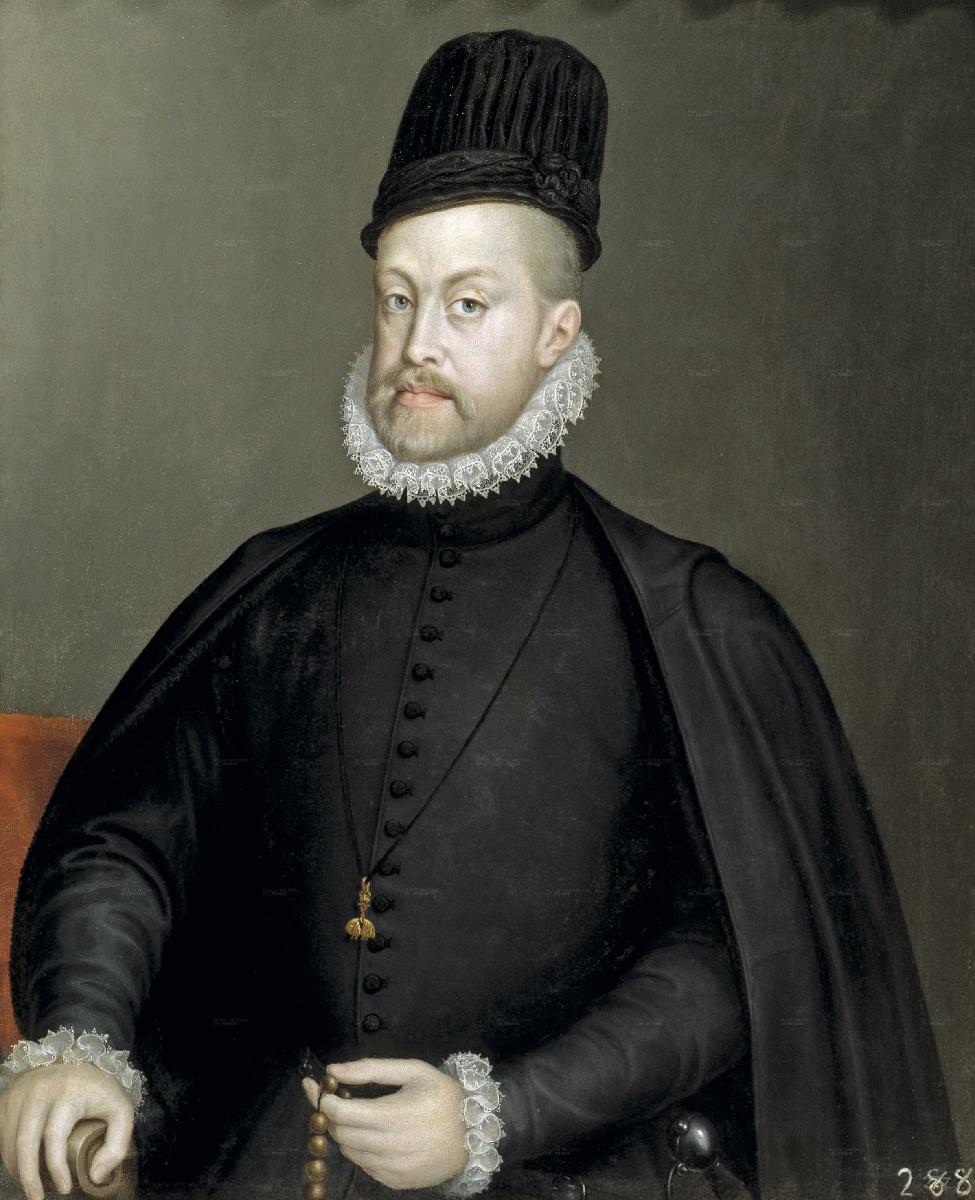
Philip II King of Spain (1554-1558)
- by Sofonisba Anguissola (after 1570)
Madrid, Museo del
Prado
The Defeat of the Great Spanish Armada - August 1588

Spanish Armada, battle in
August 1588 (English School, late 16th century)
Attempted invasion of England,
part of the Anglo-Spanish wars
National Maritime Museum,
London
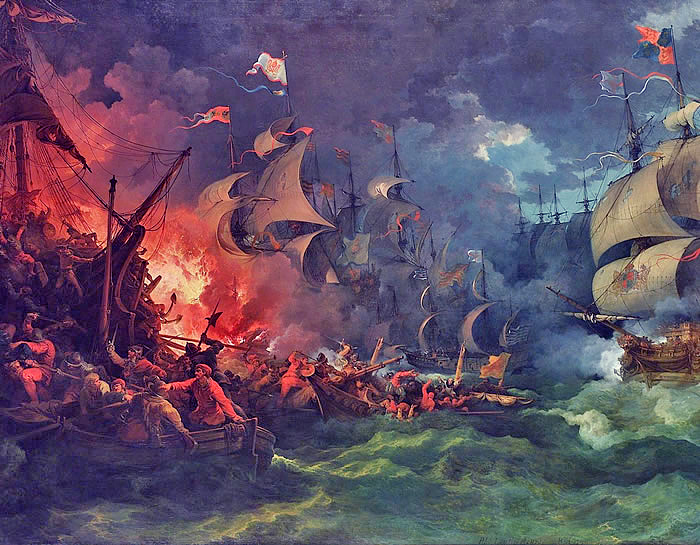
Defeat
of the Spanish Armada – Philippe-Jacques de
Loutherbourg -1796
depicts the battle of Gravelines
- 8 August 1588

English Defeat of the
Spanish Armada - 1588
Ewing Galloway
|
|
Catherine de' Medici (or Medicis)
Francis died in 1547 and his son Henry, married to the strong-willed Catherine de Medici, ruled France during the next dozen years. He, like his father, was a great patron of the arts ... but unlike his father seemed more interested in peace than in war. He did attempt to hold back by force the growth of Protestantism in France, but the Calvinist Huguenots grew rapidly in number in France during his reign, Calvin's Reformed Movement reaching even into significant portions of the French nobility. But Henry died early in a jousting accident. His sons were very young and his wife, Catherine, thus took over as Regent of France. In one role or another she would subsequently retain control over French politics, even as her sons reached majority and one by one briefly took the French throne.  Henry II and Catherine de' Medici The St. Bartholomew's Day Massacre
Catherine was a devout Catholic and eventually took upon herself the challenge of curbing or even eliminating the Huguenot threat to Catholic France. The pinnacle of her success (and her ruthlessness) was when all nobility was invited to Paris in 1572 to celebrate the wedding of her daughter Margaret and the distant (and Protestant) cousin Henry IV of Navarre (of the Bourbon line). It was a well-laid trap. A few days after the wedding, on St. Bartholomew's day, Catholics caught the Huguenots off guard and proceeded to the slaughter of most of the Huguenot nobility ... and then thousands of other Huguenots throughout the land (the groom Henry IV managed to escape). It effectively achieved what Catherine had purposed: it crippled greatly (though did not eliminate totally) the huge Protestant position in the country (though later she would attempt compromise with them). |
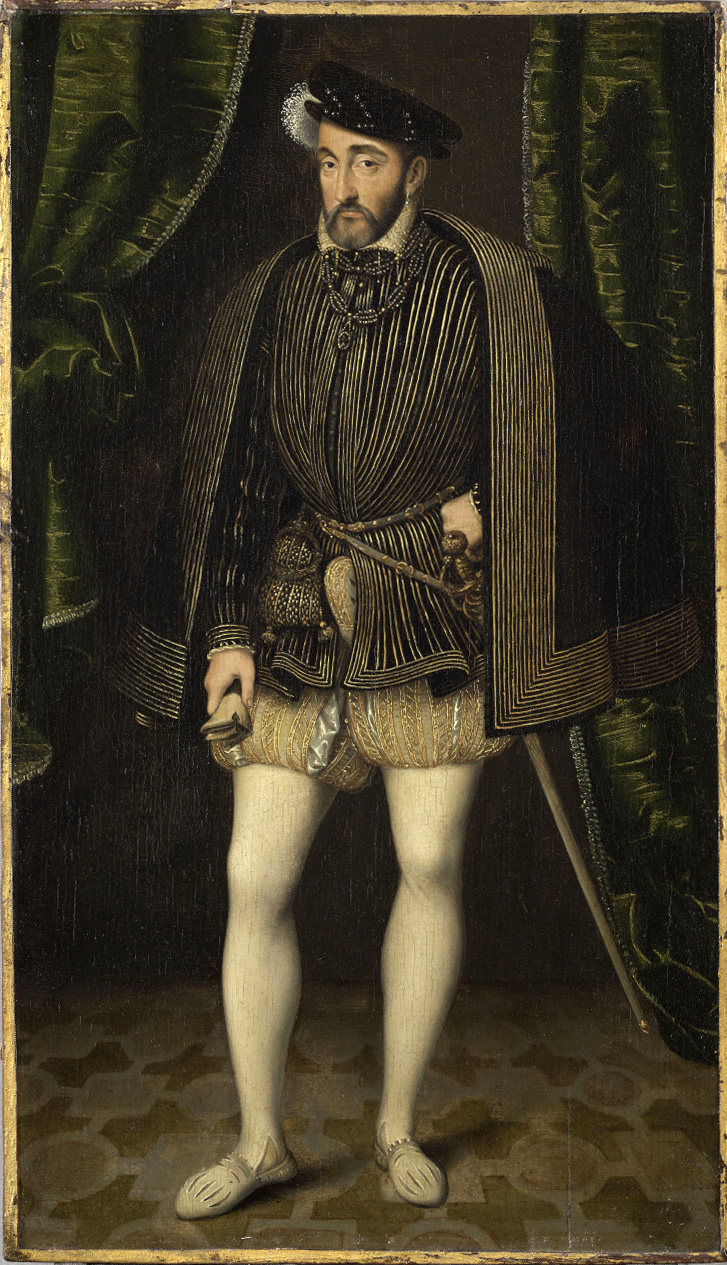
Henry II of France (ruled
1547-1559) - by François Clouet
Louvre Museum - Paris
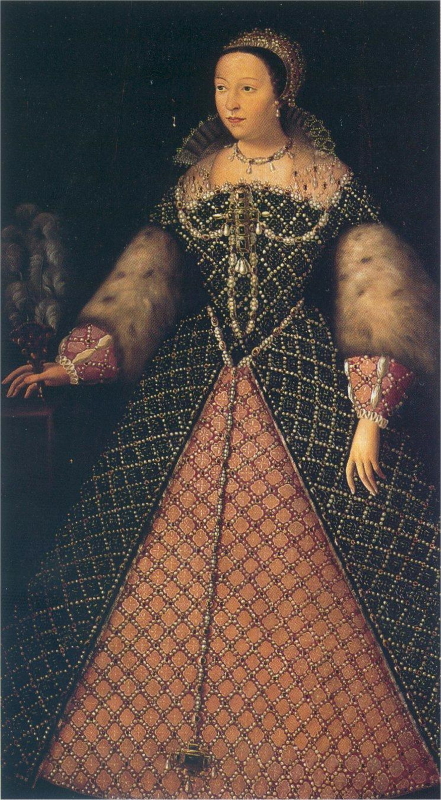
Catherine de' Medici (1519-1589)
- wife of Henry II
Queen consort of King Henry
II of France from 1547 to 1559
Throughout Henry II's 12-year
reign, he excluded Catherine from influence
and instead showered favors
on his mistress, Diane de Poitiers
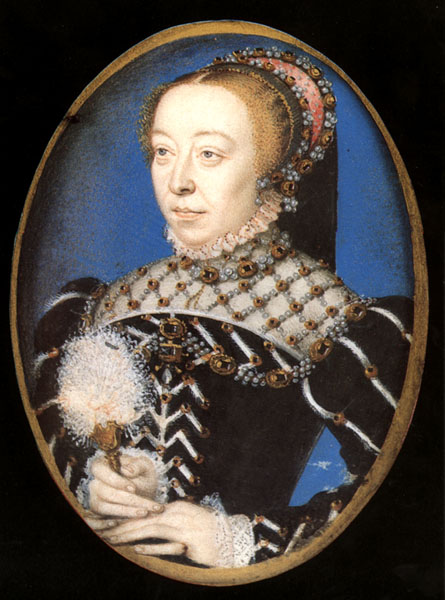
Catherine de Médicis - by
François Clouet (c.
1555)
The dominating mother of
her sons: the weak kings, Francis II (1559-1560),
Charles IX (1560-1574),
and Henry III (1574-1589)
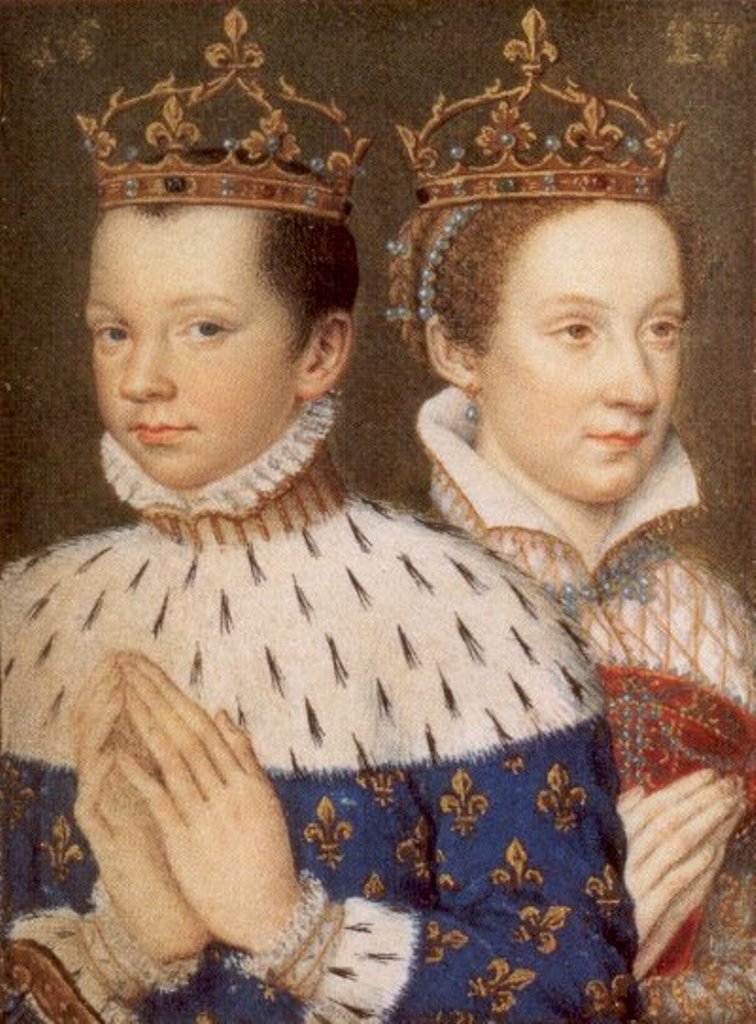
Francis II of France and Mary Stuart Queen of France and Scots -
François Clouet
Francis (age 15) with his
wife Mary (age 17) shortly after Francis became king in 1559.
But Francis
would die the following year.
And Mary would return to England as a very young
widow
... eventually becoming the future Catholic Queen "Bloody
Mary"
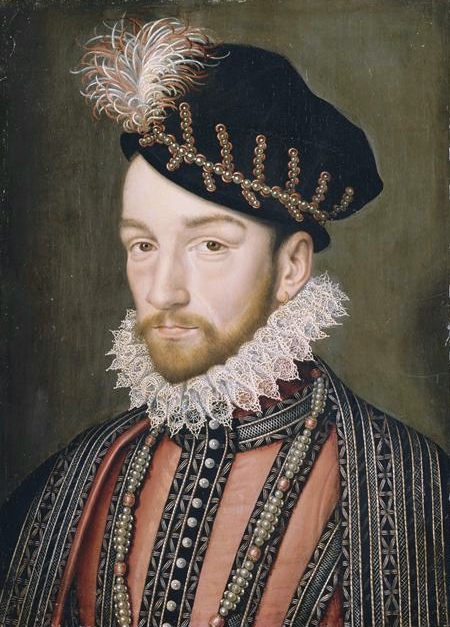
Charles IX of France (ruled
1560-1574) - François Clouet
Second
son of Henry II and
Catherine de Medicis.
He was 22 years old in August
1572 (and in theory the ruler of France)
when his mother ordered the massacre
of France's leading Protestants
Versailles, Musée national
du château
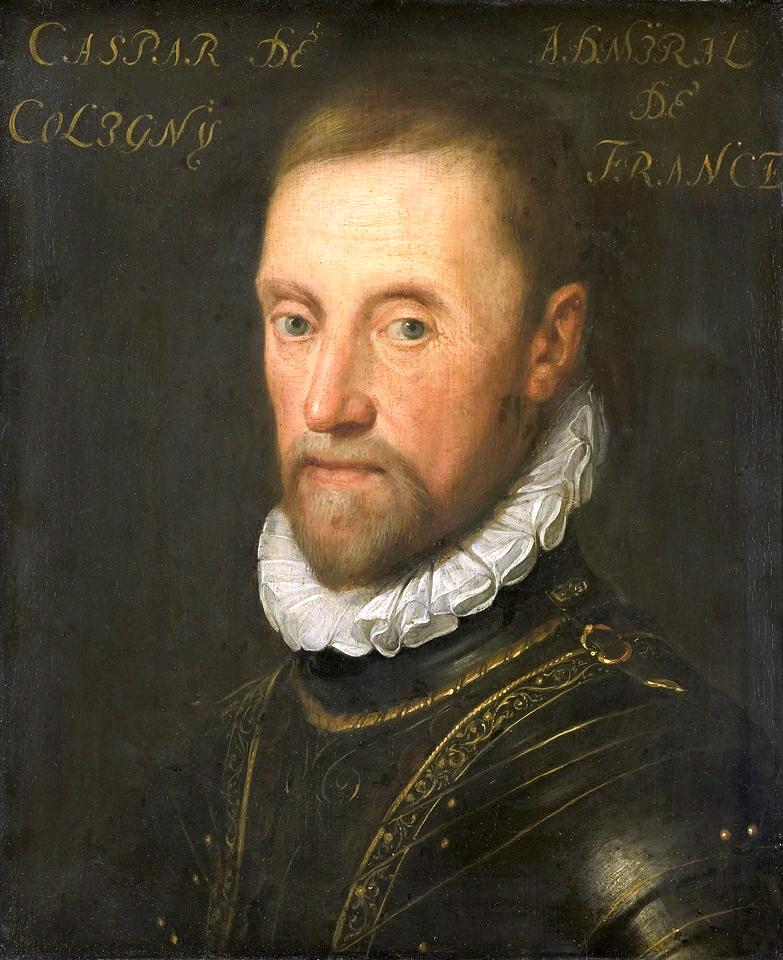
Admiral Gaspard de Coligny
(1517-1572)
Leader of the Protestant
Party (Huguenots)
- by the atelier of Jan Antonisz. van Ravesteyn
Rijksmuseum,
Amsterdam
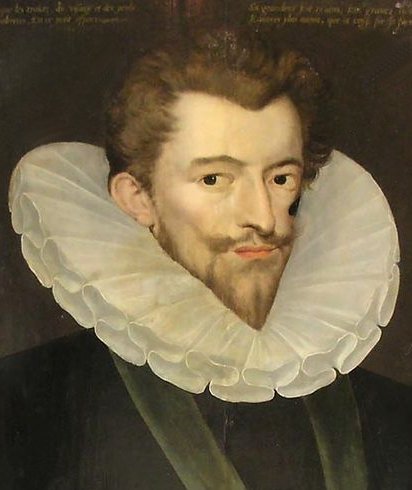
Henry, 3rd duke of
Guise
Leader of the Roman Catholic
Party
Musée Carnavalet,
Paris
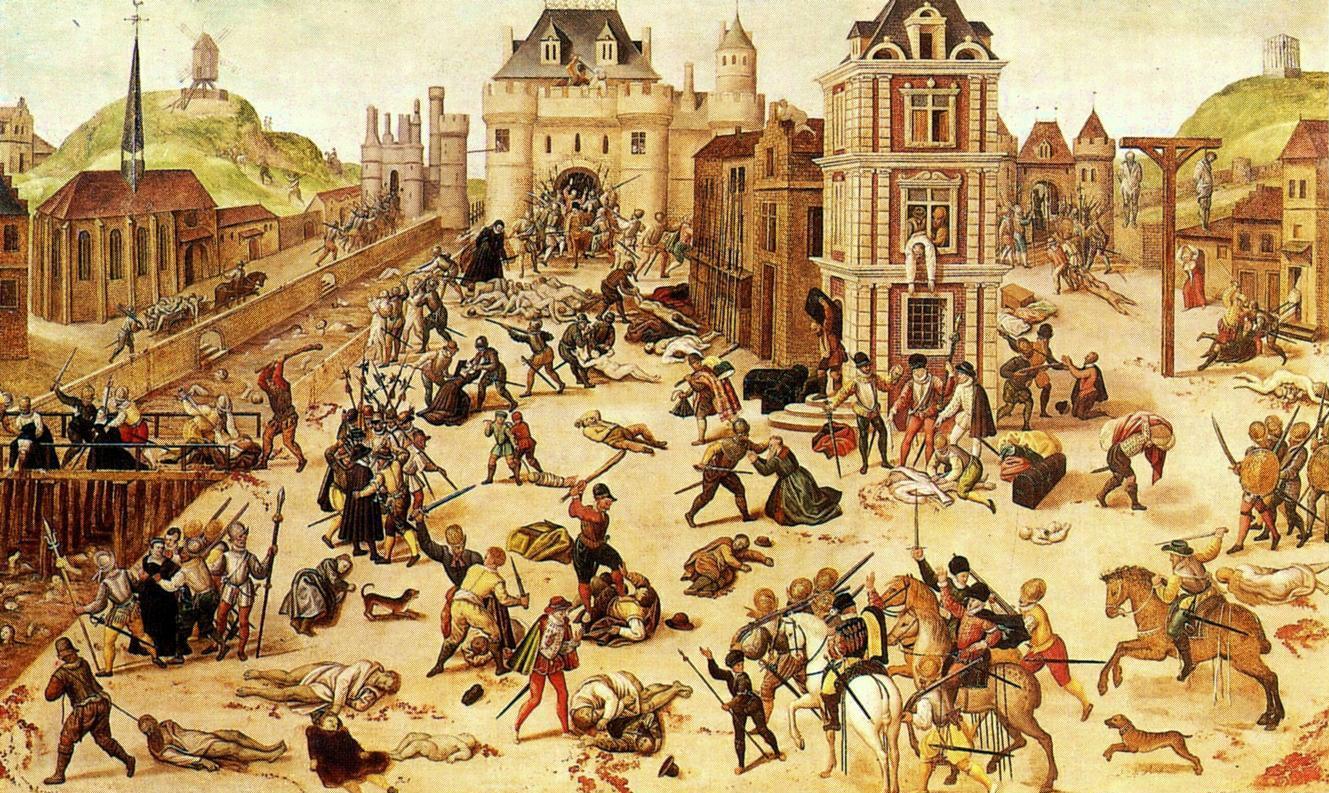
An Eyewitness Account of
the Saint Bartholomew's Day Massacre, 24 August 1572
- by François Dubois
Many Huguenots were in Paris
to celebrate the wedding of Henry Bourbon of Navarre with
Marguerite de
Valois (daughter of French king
Henry II) - an opportunity for the Catholics
to slaughter thouands of unarmed
Protestants, both in Paris and around
the countryside.
Musée cantonal des Beaux-Arts,
Lausanne

Detail (from the picture above) of
the Saint Bartholomew's Day Massacre - by François Dubois
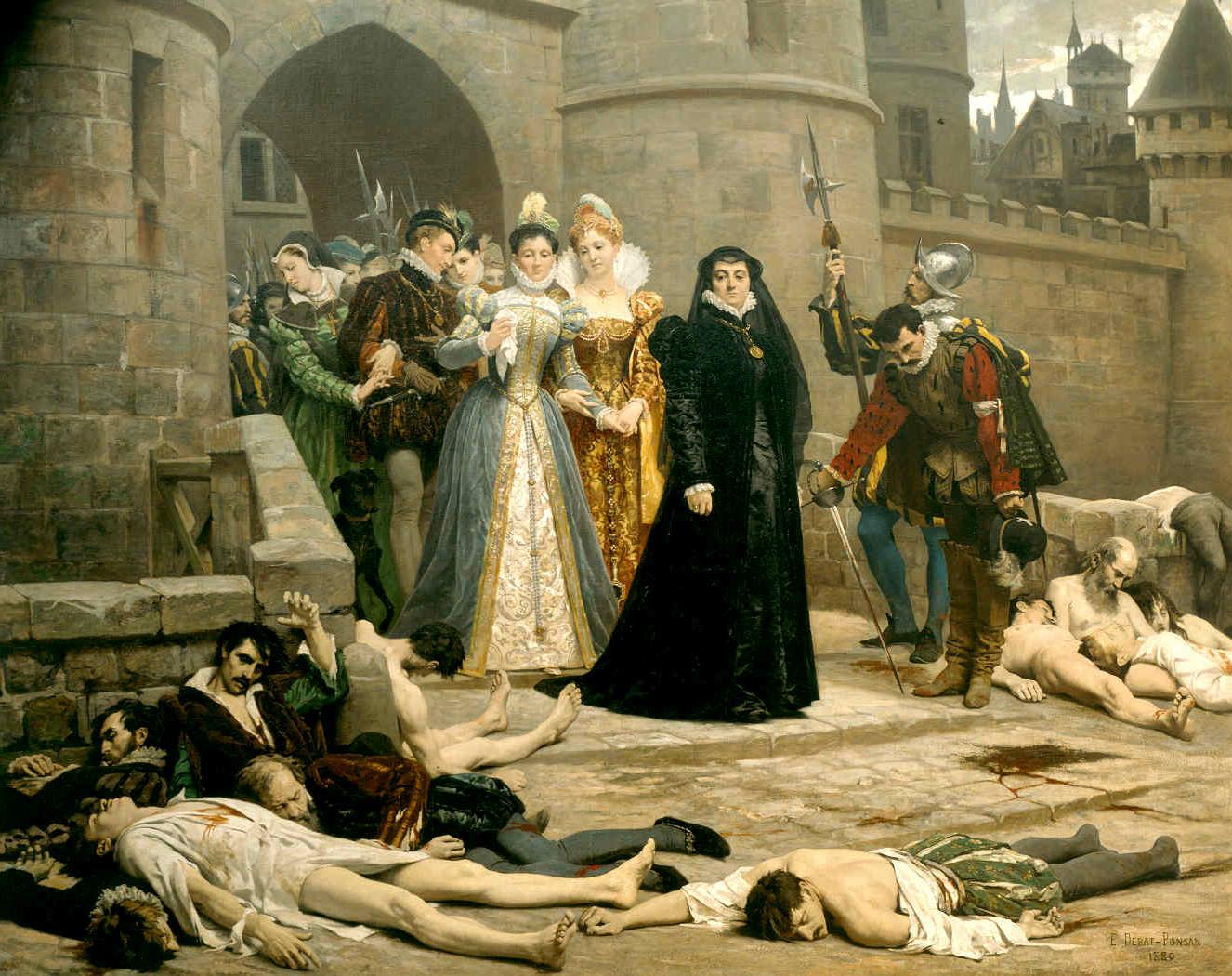
A morning before the Gate to the
Louvre - by Édouard
Debat-Ponsan (1880)
Catherine de Medici inspects the productivity of the Saint Bartholomew's Day
Massacre - 1572
Clermont-Ferrand, Musée d'art
Roger-Quillot

The siege of the
Protestant town of La Rochelle by the Catholic Duke of Anjou, 1573 -
tapestry
Musée d'Orbigny
Bernon
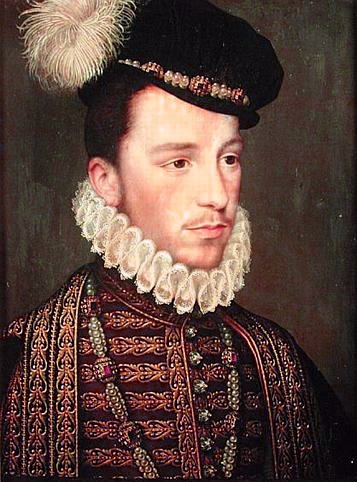
Henry III of France (as the
Duke of Anjou) (ruled 1574-1589)
3rd son of Henry II and
Catherine de Medicis; younger brother of his predecessors
Francis II and
Charles IX. Childless, he was the last
of 3 centuries of Valois rule in France
The Louvre Museum -
Paris

The fanatical Dominican friar
Jacques Clément assassinating Henry III (1589)
He was assassinated just
prior to an attempt to retake Catholic Paris for the Huguenot cause;
Just before his death Henry named his Huguenot brother-in-law Henry of Navarre
as the next French
king.
The Louvre Museum -
Paris
|
Henry IV of Navarre
But the one thing Catherine wanted the most was not to be achieved ... the passing on of the throne to another Valois offspring. Instead in 1589 when both Catherine and her last son died, the crown passed to Henry IV of Navarre. The Bourbon distant cousins were now the rulers of France. But after four years as king, Henry – finding the capital city Paris still holding out against him because of his Protestantism – decided that it was politically prudent to abandon his Protestantism and remake himself as a Catholic. However he did not completely abandon the Protestants, issuing in 1598 the Edict of Nantes, granting religious toleration to the Protestants and finally bringing the wars of religion in France to an end. Henry conducted very successful diplomacy with the powers around him (including even an alliance with the Ottoman Turks), put the royal treasury in good order (thus lightening the financial burden of the monarchy on the French), conducted numerous public works benefitting all levels of French society, and in general took the rather unusual path of truly caring about the welfare of his subjects, commoners as well as nobles. France prospered greatly during his reign. He would thus be remembered as "The Good King." But a fanatic Catholic assassinated him in the streets of Paris in 1610, bringing this period to an end. |
A Protestant Turned Moderately
Catholic in Order to Bring Peace and Unity to His Realm.
Founder of the Bourbon Dynasty of France
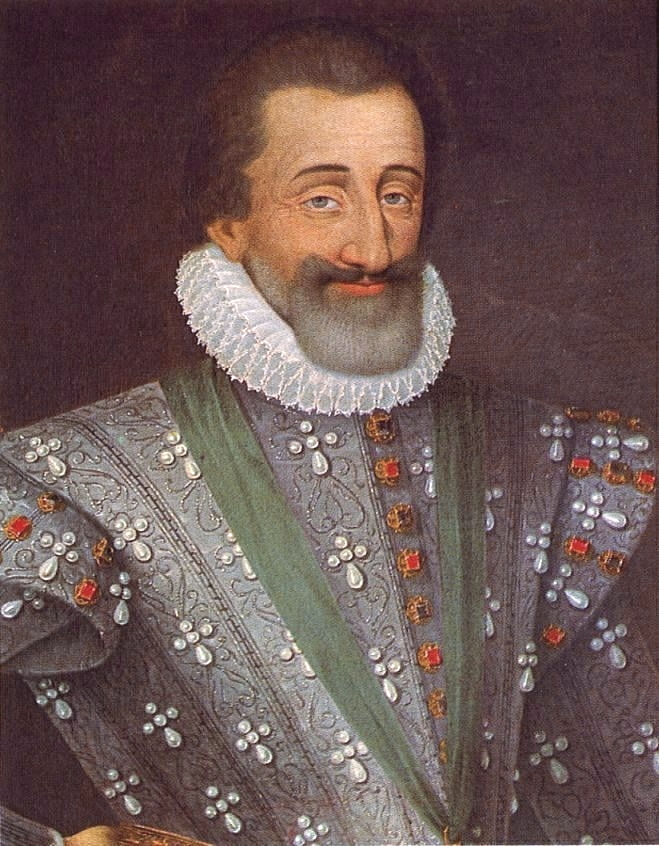
Henry IV, King of Navarre
(1572-1610) and France (1589-1610)
The first monarch of the
Bourbon branch of the Capetian dynasty in France
He was murdered in 1610
by a fanatical Catholic, François Ravaillac
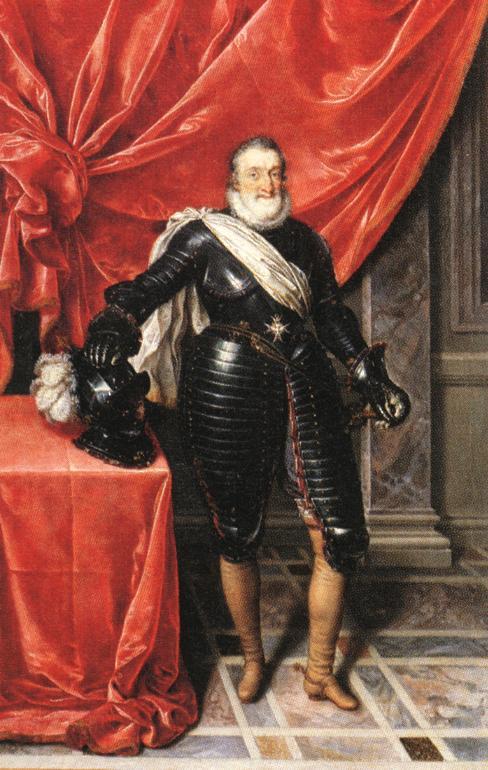
Henry IV - by Frans Pourbus
the younger
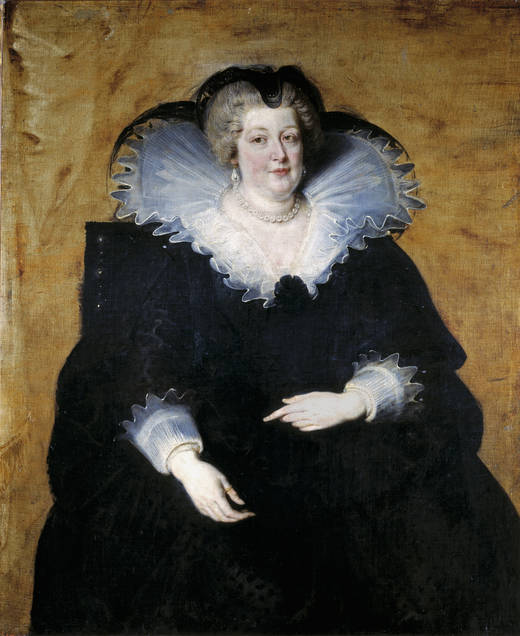
Marie de Médicis, wife of Henry
IV and Queen of
France (1600-1610)
- Peter Paul Rubens (c. 1622-1625)
also Regent of France (1610-1614) for her son, the
future Louis XIII
Museo
del Prado, Madrid
|
|
The industrious Dutch
The northern or Dutch-speaking part of the immense Habsburg Empire had benefitted greatly from the Spanish plunder of America ... not because the Dutch were involved directly in the plunder itself. That was the contribution that the Spanish conquistadores (conquerors) made to the wealth of the Empire. But the money did not seem to stay in Spain ... but rather seemed inevitably to make its way north to the lands of the Dutch ... principally to Flanders and the commercial cities of Antwerp (at that time the largest commercial city in Europe), Bruges, Ghent and Flemish towns. Whereas the Spanish quickly spent their wealth in acquiring the trappings of aristocratic status (lands, fine houses, furnishings, clothing, servants, etc.) the Dutch put the money to work, investing in the manufacture and trade in those very goods desired by their Spanish associates. In other words, the Spanish spent their wealth, the Dutch invested theirs. The Calvinist work ethic
Whereas Spanish culture was caught in the embrace of medieval aristocratic norms ... especially in its avoidance of manual labor (such labor being the clear indicator of inferior social status) the Dutch were heavily Protestant Calvinist. Calvin had taught that labor in the vineyard of God was the surest way to show honor to God. According to Calvin, labor exalted the human spirit rather than degrade it. As a consequence the Dutch developed what we would call a very strong work ethic. And it truly paid off for them. Indeed, the economic success of the Dutch cities was dazzling to behold. Thus, little by little, such wealth led to an increase in Dutch industrial and maritime power ... drawing them on their own terms into the political games of the European monarchs. The Spanish reaction
But this urban Calvinist (Protestant) work ethic also brought suspicion and ultimately reaction from the feudal Spanish (Catholic) portion of the Empire. The intensely Spanish Catholic King Philip II resented the Protestant ways of his father Charles IV’s homeland ... and was even more determined than his father Charles to force religious conformity within his realm. He thus went after Calvinism in the Netherlands with an unrelenting zeal. He replaced local municipal rule with royal agents answering to him through his half-sister Margaret of Parma, he reorganized a Catholic hierarchy to supervise the religious life of the region, and he set up a Dutch Inquisition to chase down heretics. However, so oppressive was Philip's hand in the Netherlands that local Dutch nobility quickly came to be the rallying points of resistance by the frustrated Dutch. They refused to cooperate in enforcing Philip's orders. The Duke of Alba
Ultimately Philip sent the Spanish Duke of Alba (or Alva) and 10,000 troops to crush what had by 1567 become outright rebellion. However, the North's leading nobleman, the Prince of Orange, escaped Alba, sent a petition to Philip reminding him of the chartered rights of the Dutch cities that were being violated (not that Philip would be moved by such an appeal) and then organized a military response to Alba. It was bad timing for Philip ... because he had other major problems (such as France and the Turks) facing him at the time. Peace was made, then broken, then made again. But Spain was in trouble – nearly bankrupt from fighting crises on multiple fronts. Meanwhile, Alba met with some success in the southern Dutch provinces (today's Belgium) by seizing and executing the noblemen leading the resistance there ... along with thousands of other individuals. This greatly weakened the South's ability to resist the Spanish hold over the land. Ultimately, Alba undertook the cruel strategy of surrounding and starving the Dutch cities one by one – killing thousands of the citizens of those cities in the process ... as for instance in Antwerp where possibly as many as 10,000 died during the 1576 "Spanish Fury" massacre. But thus did he finally succeed in breaking the independent spirit of the southern portion of the Dutch lands.1 But a kindlier Spanish governor however replaced him, letting Flemish Protestants leave the Catholic South. Thousands took the opportunity, emptying the Flemish cities of their industrious Protestant citizenry, who moved to the Dutch North in droves ... to the lands the Spanish seemed unable to conquer.2 Catholics at the same time were allowed to leave the North in something of an exchange, though the flow of Catholics south proved to be a mere trickle in comparison to the floods of Protestants moving north. The new Dutch Republic
By 1579 the Northern Dutch provinces were effectively independent ... but without a proper leader. A king (or queen) was needed ... but Elizabeth of England refused, and the Duke of Anjou did not work out for the Dutch. Thus in 1583 the Dutch Estates-General declared their Dutch union a Republic. Flanders falls to Spanish rule ... and declines rapidly
But Philiop had no intentions of giving up his Dutch holdings, and sent a new Spanish army north ... seizing the remaining Southern Provinces and their main cities. Antwerp again fell to the Spanish ... and over half of the city's population fled to the North – as did most of the Flemish population of Bruges, Ghent and nearly all of Niewport and Dunquerque. As a consequence, Flanders nearly died economically ... and Antwerp ended its status as the commercial center of northern Europe. That honor now moved north to Amsterdam, turning it from a small village into what Antwerp had formerly been: the most active commercial center in Europe. But other northern Dutch cities benefitted as well. The Northern Dutch secure their independence
At this point English Queen Elizabeth stepped in to give assistance to the Northern Dutch. Also the Dutch Republic came under the capable leadership of the younger Prince of Orange (his father having been assassinated a few years earlier). Finally, with the Protestant Henry IV taking the kingship in France and Philip's determination to punish the English for their piracy (and Protestantism), Philip at this point gave up on his program of forcing the Dutch back under his personal control. He had bigger problems. 1Also, unwanted Calvinist fanaticism coming from the North did not help matters in the Southern Netherlands where Catholic sympathies were still strong. 2The fact that much of the urban coastal North had been built on land reclaimed from the sea by means of dikes and water pumps ... allowed the North to easily reflood those same lands ... making the movement of Spanish troops there almost impossible. |
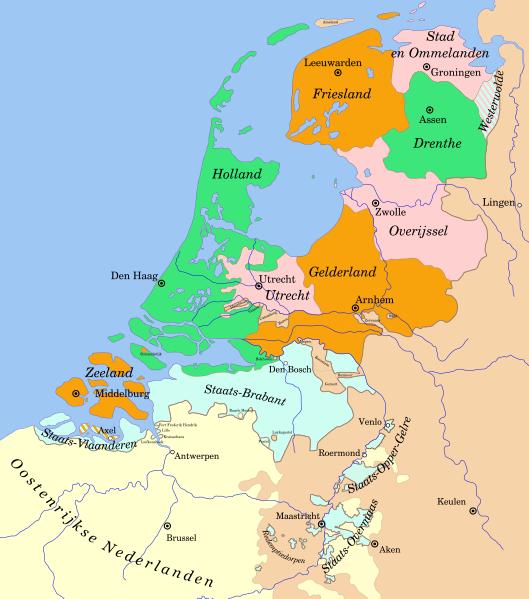
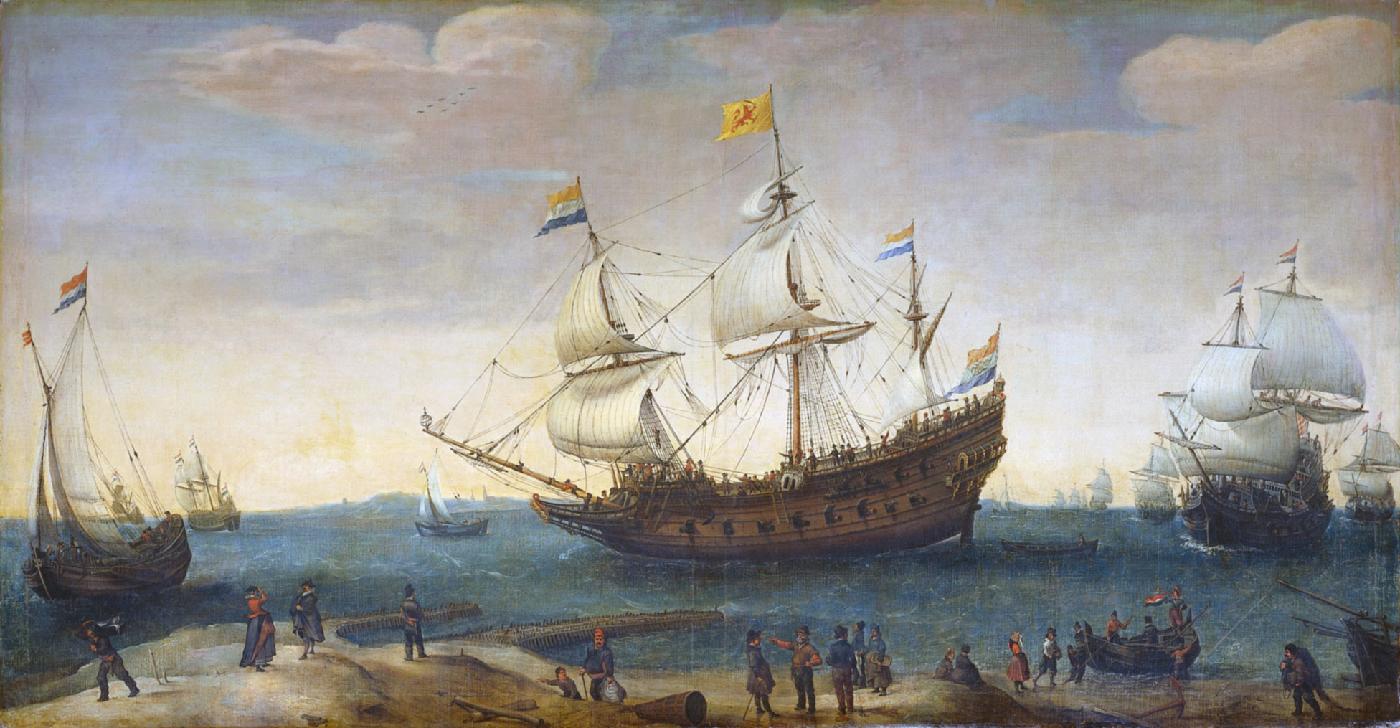

Image of the Dutch Reformation
iconoclasm (Beeldenstorm)
From: De eerste jaren
der Nederlandsche Revolutie (1555-1568), J. ten Brink. Elsevier,
Rotterdam 1882
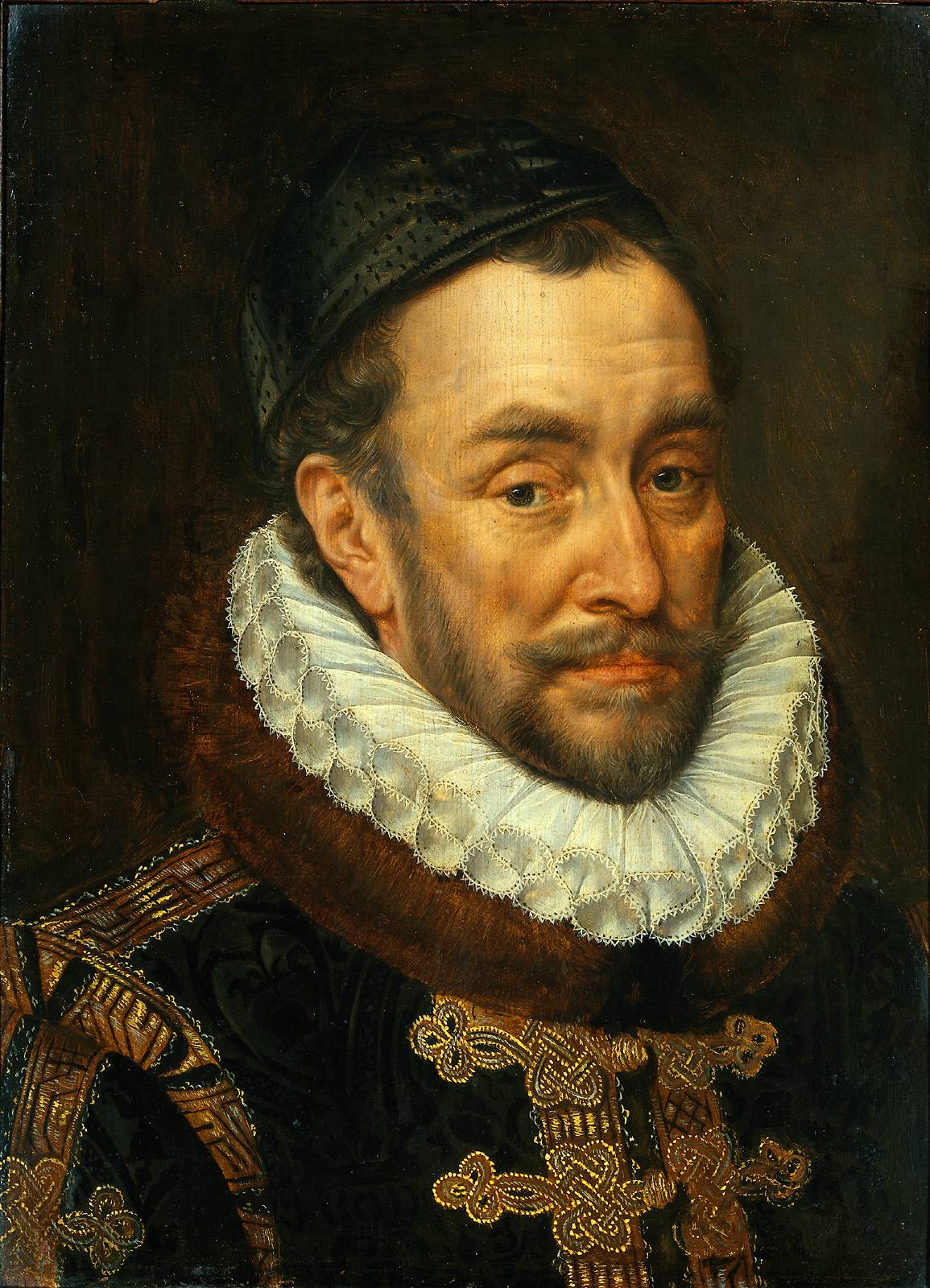
William I of Orange-Nassau – by Adrien Thomasz Key (c. 1580)
Amsterdam,
Rijksmuseum

The Relief of Leiden – by Otto van Veen (1574)
| The "Gueux" or "Sea Beggars," under the command of William of Orange, were able to liberate Leyden on 3 October 1574 - after a 12-month seige by the Spanish who were determined to force the city back under Catholic Habsburg control. Thousands of the townsmen had died of starvation. Only by the breaking of the dikes and the flooding of the land surrounding the city, and the use of flat-bottomed boats, were the Dutch able to break through Spanish defenses to relieve the city. |
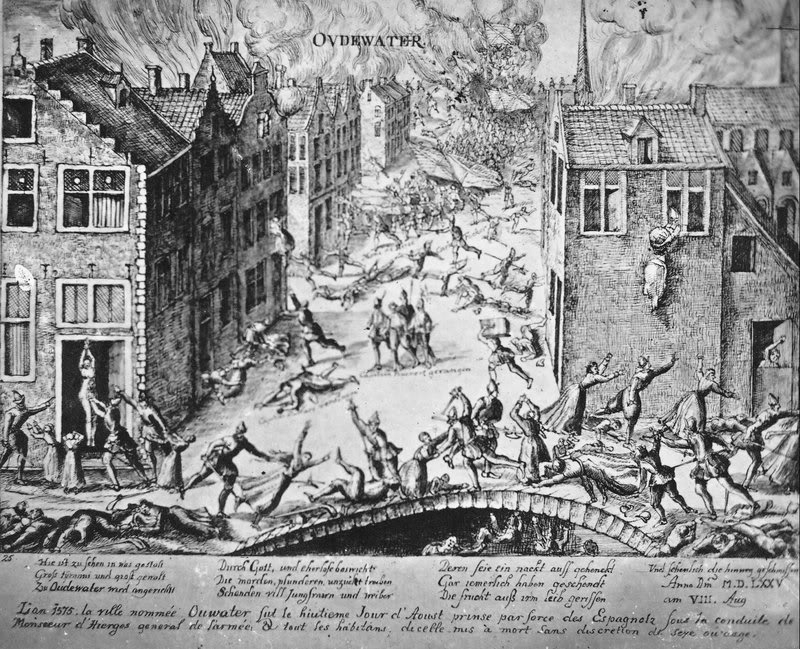
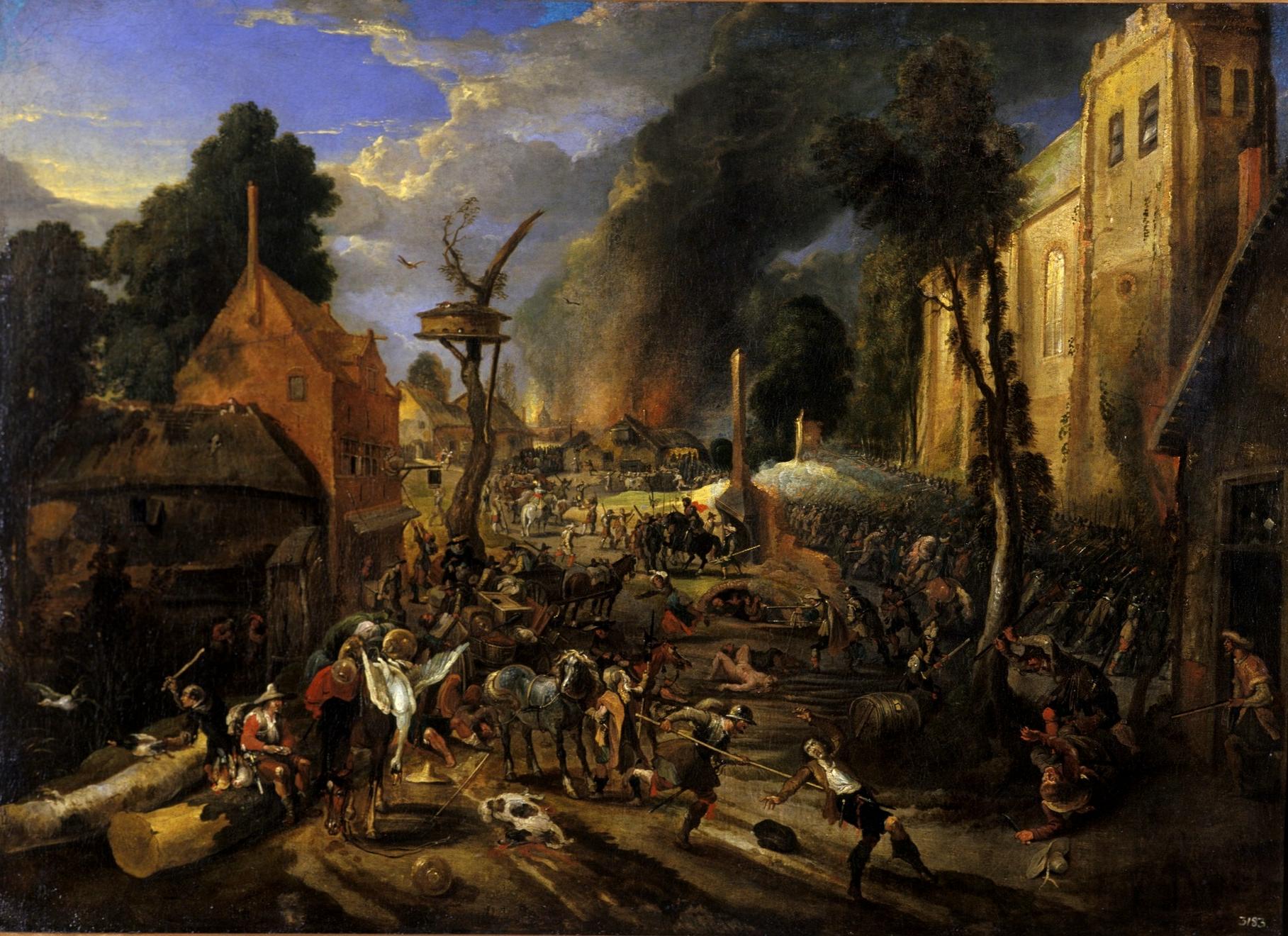
The Spanish slaughter of the Dutch citizens of Oudewater - 1575
| The town of Oudewater was conquered by the Spanish on 7 August 1575, and most of its inhabitants were killed. |
|
|
The regency of Edward VI (reigned 1547-1553)
When Henry died in 1547 his young son Edward came in line to receive the kingship of England. But he was a mere youth and England was placed under the rule of a number of adult advisors who tried to guide the monarchy through the treacherous path created by the split in Christendom. But the sickly Edward died before he reached his majority, and his half-sister Mary came to the throne. "Bloody May" (r. 1553-1558)
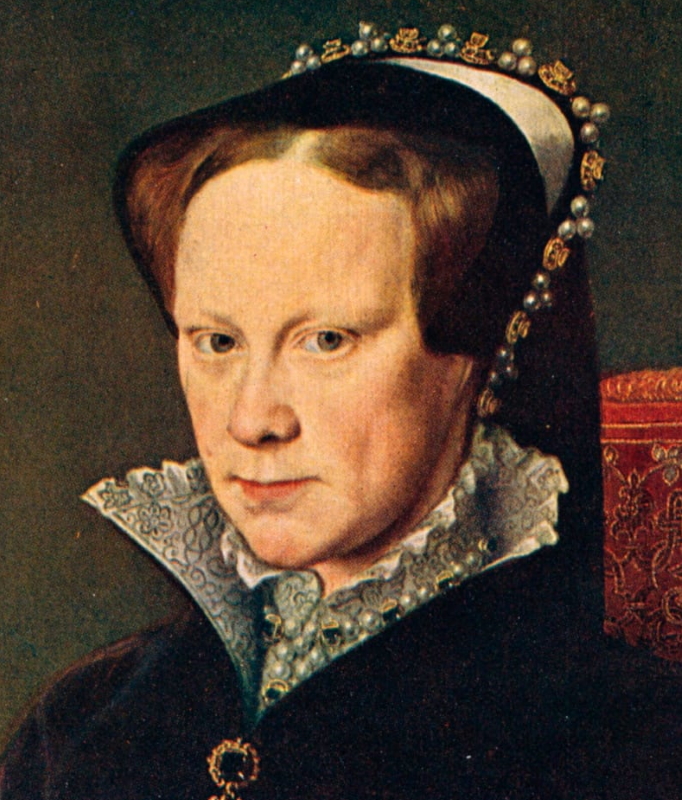 As
a feudal bargaining chip, Mary earlier had been proposed in marriage to
a number of European monarchs. But when her father Henry divorced
her mother not only did she lose her value, she had good cause to fear
for her life. She – and soon her half-sister Elizabeth – would
both become outcasts as their father moved on in his marriages.
Mary took refuge in her deep Catholic faith, which she saw as her sole
protection. Finally in 1553 she found her faith rewarded when she
became English queen. She married Philip II of Spain and with him
attempted to restore the Catholic faith – on her part in England.
The Pope however was of no particular help to her, demanding the return
of the Church's lands confiscated by her father. This she was
unable to do. As
a feudal bargaining chip, Mary earlier had been proposed in marriage to
a number of European monarchs. But when her father Henry divorced
her mother not only did she lose her value, she had good cause to fear
for her life. She – and soon her half-sister Elizabeth – would
both become outcasts as their father moved on in his marriages.
Mary took refuge in her deep Catholic faith, which she saw as her sole
protection. Finally in 1553 she found her faith rewarded when she
became English queen. She married Philip II of Spain and with him
attempted to restore the Catholic faith – on her part in England.
The Pope however was of no particular help to her, demanding the return
of the Church's lands confiscated by her father. This she was
unable to do.But she did make a move to kill off the most influential of her Protestant opponents at home, such as Cranmer, Ridley and Latimer (and several hundred others) – earning her the title "Bloody Mary." She also attempted to undermine the industrial and commercial wealth of the new nobility by placing various restrictions on their operations. She cowed the Protestants – but at the same time heightened their sense of outrage against Catholicism. Then, never a very healthy person, Mary died of a disease after only a quite short rule of five years. Elizabeth (r. 1558-1603)
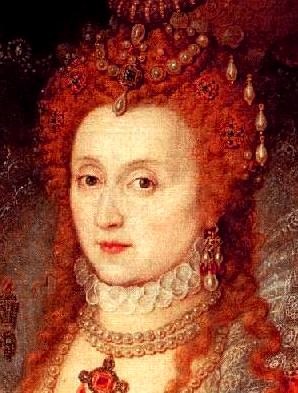 Elizabeth
now faced the same perilous dynamic ... though she played her hand very
differently than Mary. At 25 she was attractive and a natural
object of marriage in the dynastic system of Europe. But
Elizabeth was not about to become a pawn in a male-dominated game
(though that would change as the 1500s rolled along and a number of
European women came to be major players by their own rights in the
political game). She had no desire to surrender England as dowry
in marriage, enhancing some European king's landholdings. And
thus she would remain all the way to her death the “Virgin Queen.” Elizabeth
now faced the same perilous dynamic ... though she played her hand very
differently than Mary. At 25 she was attractive and a natural
object of marriage in the dynastic system of Europe. But
Elizabeth was not about to become a pawn in a male-dominated game
(though that would change as the 1500s rolled along and a number of
European women came to be major players by their own rights in the
political game). She had no desire to surrender England as dowry
in marriage, enhancing some European king's landholdings. And
thus she would remain all the way to her death the “Virgin Queen.”As far as her personal loyalties in the Protestant-Catholic debate splitting Europe, she gave little indication as to where she stood. She once had been under the protection of the Protestant Catherine Parr, the last of Henry's wives and many supposed her to be a Protestant in her accession to the throne. But outwardly she appeared neutral ... at least initially. Thus she tried to mediate between her Catholic and Protestant subjects. But efforts from abroad to pressure her to return England back to Papal supervision tended to hurt badly the position of the English Catholics. Also, she found herself increasingly having to look to the industrial/ merchant class of England for support ... a class that was becoming increasingly Protestant. Elizabeth ... and her cousin, Mary - Queen of Scots
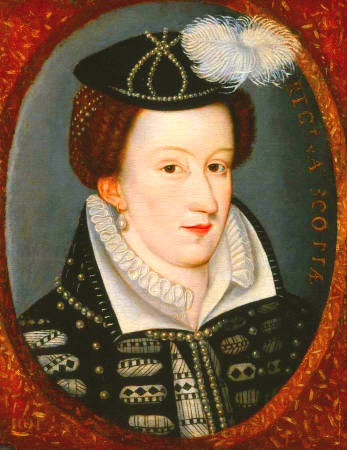 Furthermore
she found herself being dragged into the Protestant-Catholic battle
going on to the north of England in Scotland. Another young Mary,
very pro-Catholic, was waiting to receive the crown as Queen of Scots,
with her own mother Mary of Guise meanwhile serving as regent ... the
Guises being the group heading up the Catholic anti-Huguenot party in
France. Opposed to the two Marys were a large number of Scottish
noblemen, led by the tough Calvinist John Knox. Furthermore
she found herself being dragged into the Protestant-Catholic battle
going on to the north of England in Scotland. Another young Mary,
very pro-Catholic, was waiting to receive the crown as Queen of Scots,
with her own mother Mary of Guise meanwhile serving as regent ... the
Guises being the group heading up the Catholic anti-Huguenot party in
France. Opposed to the two Marys were a large number of Scottish
noblemen, led by the tough Calvinist John Knox.For Elizabeth, Scotland constituted a major problem with its strong French influence there. Although Knox seemed to have Scotland well in hand after Mary of Guise died suddenly in 1560, the younger Mary – who was now Queen of Scots – remained a thorn in Elizabeth's side. She was Elizabeth's cousin ... with strong claims of her own to the throne of England. However Mary's poor political skills proved to be her undoing in Scotland, and in 1567 she was forced to flee Scotland to England – where Elizabeth immediately put her under house arrest. Now she intrigued all the more against Elizabeth. Finally having enough of her cousin's interference, Elizabeth had her put to death in 1587 ... part of the reason for Philip II to send his Armada to crush English arrogance (as he saw things). The Puritans
Although clearly England was heading in a Protestant direction, the speed of this movement was not fast enough for some of the reformers. This latter group eventually received the title of contempt as "puritans" by other reformers. Both reforming groups were Calvinist, so Protestant theology was not the issue, at least not initially. Mostly the arguments originally occurred over style and ritual: for instance the wearing of fancy vestments (surplices or lace gowns) by the clergy – which the Puritans opposed fervently. Questions arose over free prayers (which the Puritans supported) versus recitations from the Book of Common Prayer (supported by the more traditionalist reformers). Puritans wanted the elimination of everything from Christian practice that did not have a direct warrant in Scripture. Clearly liturgical prayers and fancy vestments did not have such Scriptural warrant. Then too Puritans insisted on the importance of the preaching/teaching ministry at a time when the vast number of churches performed on Sundays only liturgies drawn from the prayer book. Elizabeth herself saw no need for the preaching ministry. But for the Puritans this was a major matter. Tempers heated up when the bishops pushed the use of the Prayer Book as a matter of great principle (and threatened persecution) ... which then led the Puritans to the question of "why bishops at all?" Geneva under Calvin, Scotland under Knox and the Huguenots in France had eliminated this religious hierarchy. Calvinist congregations were largely self-supporting and united their churches not through a top-down episcopal hierarchy but through bottom-up gatherings of representatives of the churches at the Presbytery (region) and Synod (larger or national) level – a system termed Presbyterianism. Overall ... at the time of Elizabeth's death in 1603 ... little had been resolved concerning the challenges raised by the Puritans. |
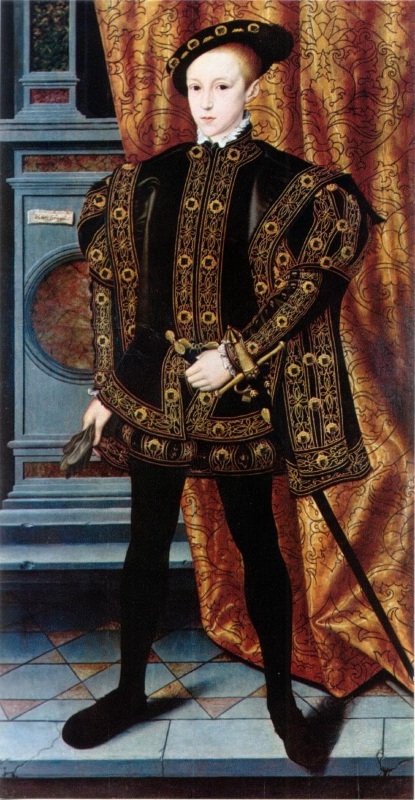
Edward VI of England
(1537-1553)
- Attributed to William Scrots - 1550
Mary I of England - or "Bloody Mary" (Reigned 1553 - 1558)
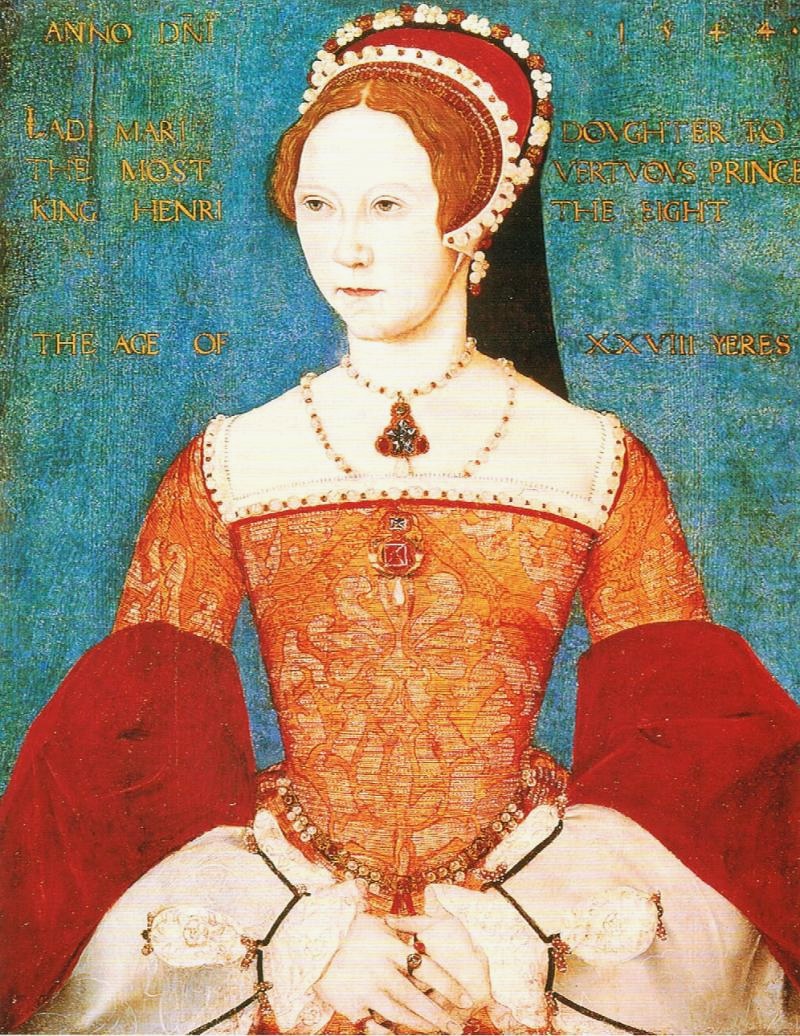
Edward's half sister, Mary
Tudor, daughter of Catherine of Aragon
(Later Mary I of England) - by Master
John in 1544.
National Portrit Gallery,
London
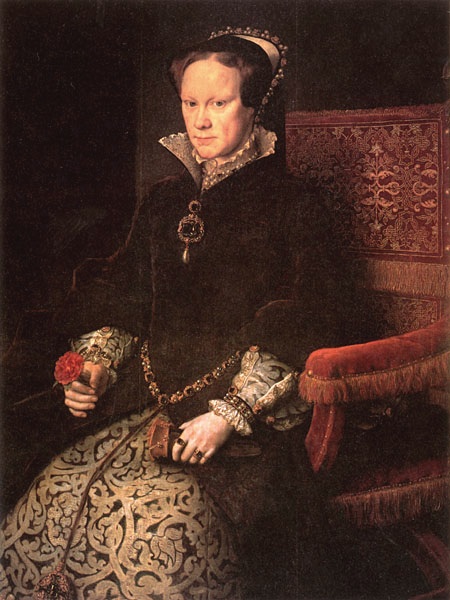
Queen Mary I of England -
by Antonius Mor - 1554
reigned 1553-1558
Museum of Prado,
Madrid
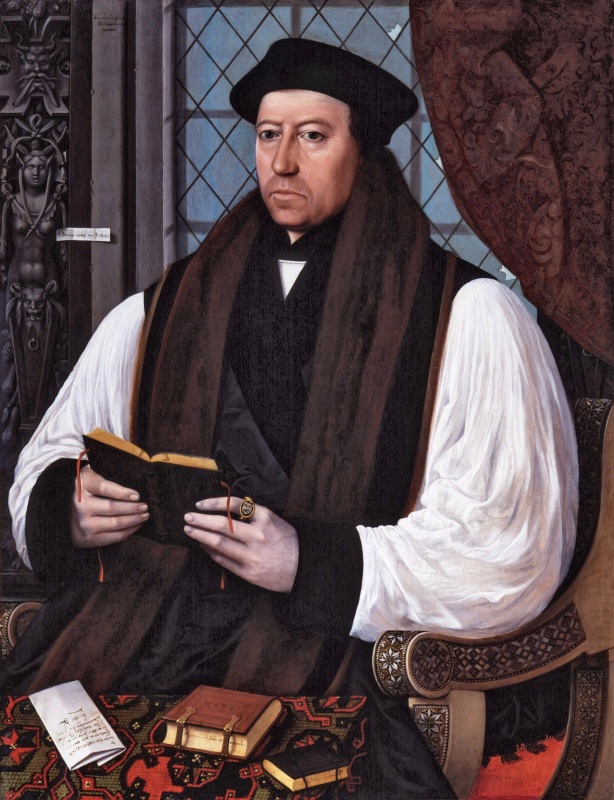
Thomas Cranmer - Protestant
Archbishop
of Canterbury (1489-1556) - by Gerlach Flicke (1545)
an unyielding opponent of Catholic Queen
Mary
National Portrait Gallery,
London

Thomas Cranmer's execution,
burning in 1556 – John Foxe's Book of Martyrs (1563)
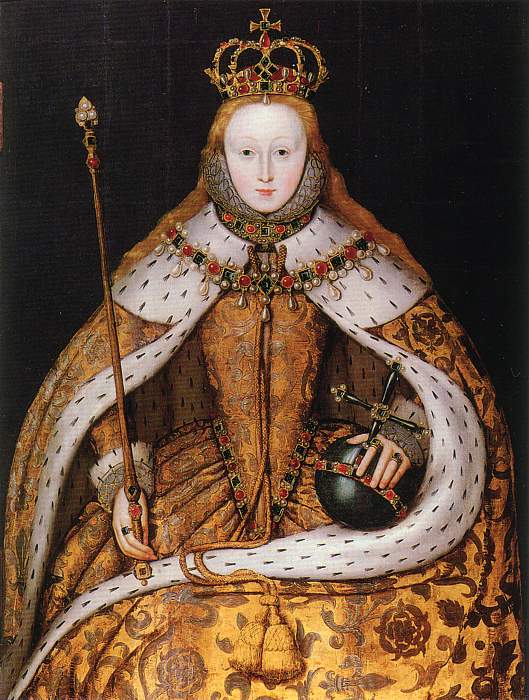
Coronation portrait of Elizabeth
I of England - by unknown painter, 1558.
National Portrait Gallery,
London

A Fete at Bermondsey or A
Marriage Feast at Bermondsey - c. 1569
This painting illustrates
a panorama of society in the reign of Elizabeth I of England
Hatfield House
Elizabeth's later years
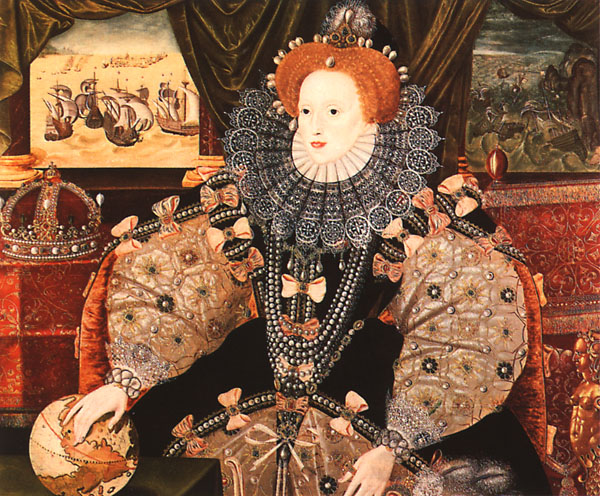
Elizabeth I of England (the
Armada portrait) - by George Gower, ca 1588
Woburn Abbey
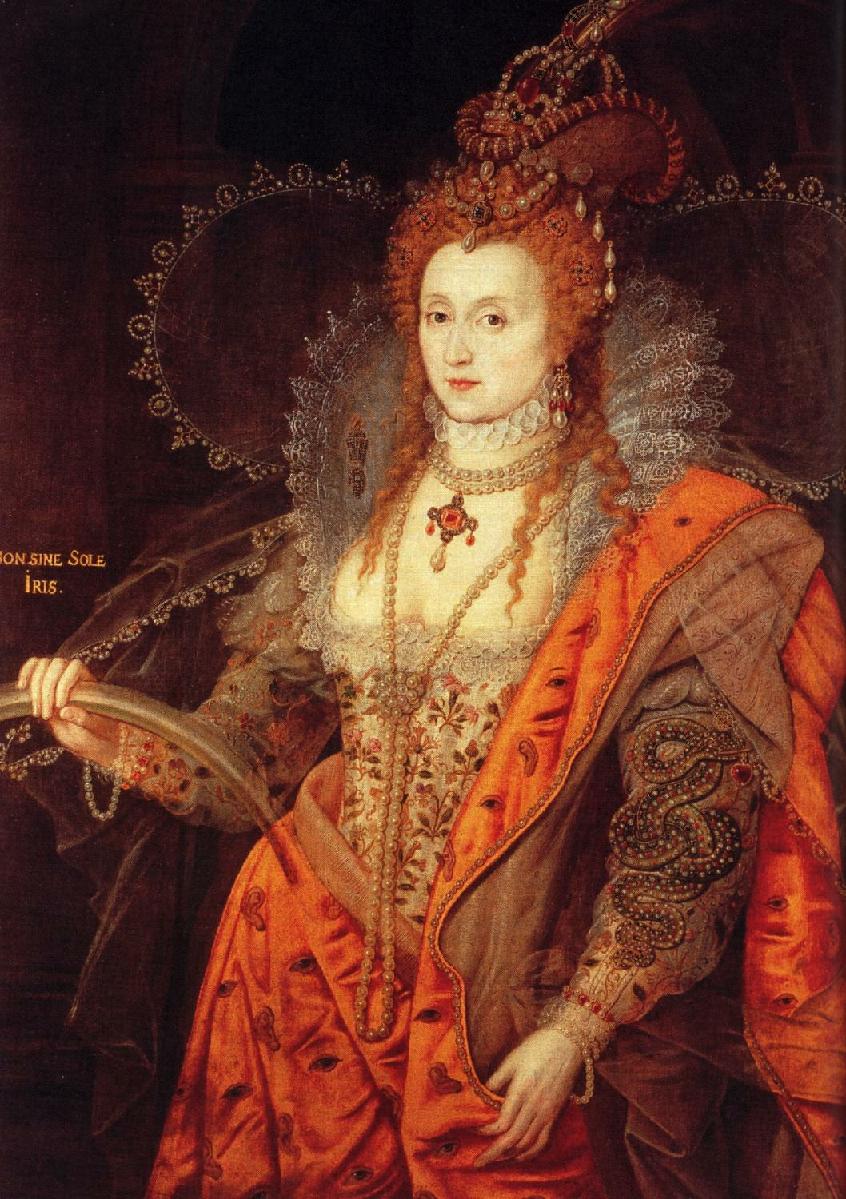
Elizabeth I - Rainbow Portrait
- c.1600
Hatfield House
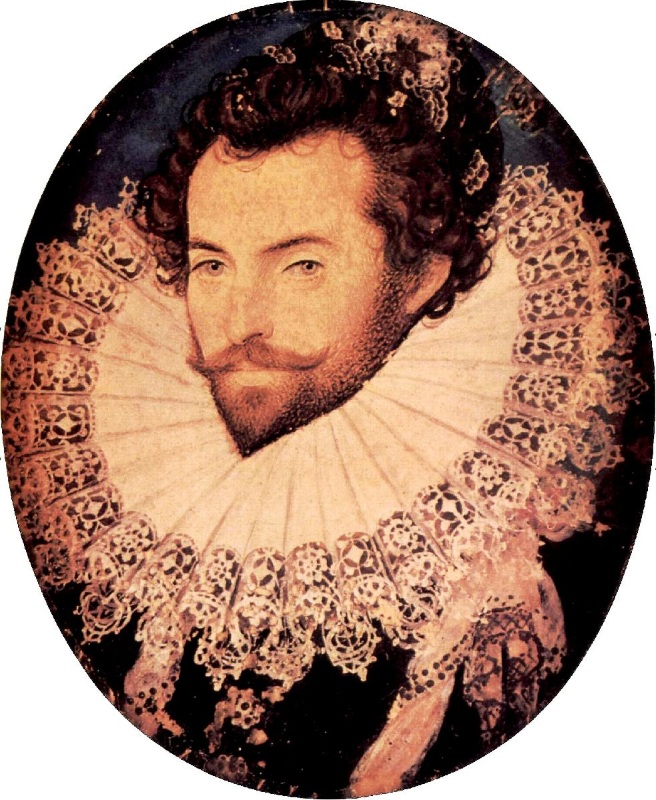
Portrait of Sir Walter Raleigh
- by Nicholas Hilliard - ca. 1585
National Portrait
Gallery
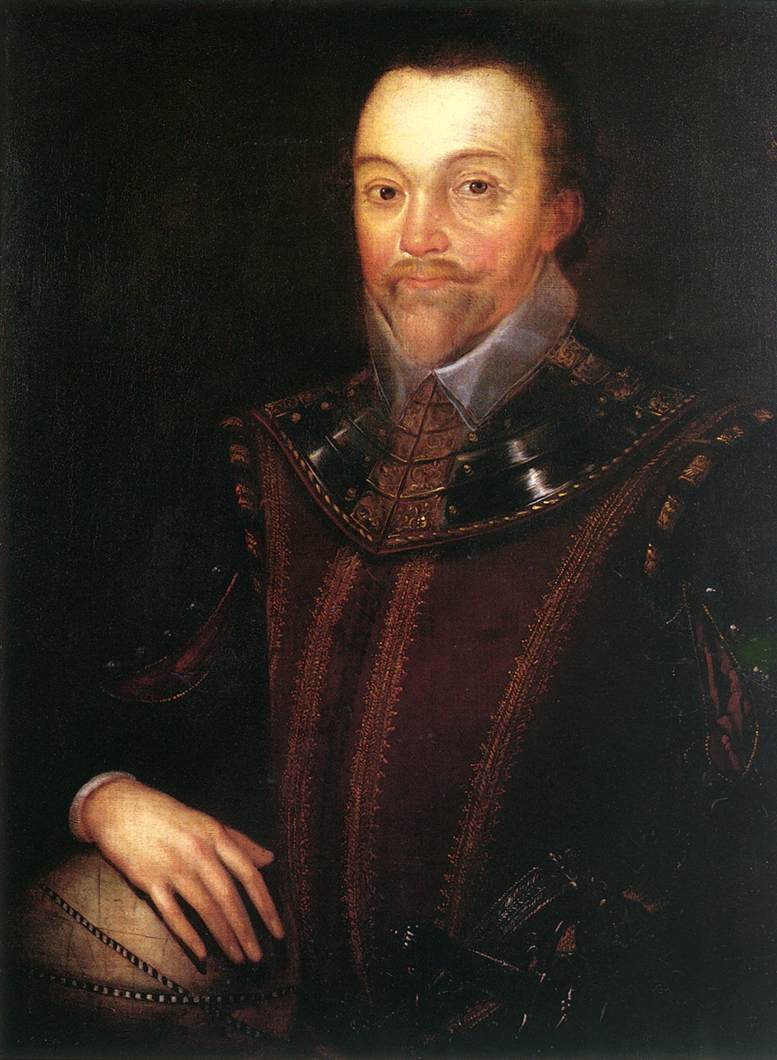
Sir Francis Drake - by Marcus
Gheeraerts the Younger
Buckland Abbey,
Devon
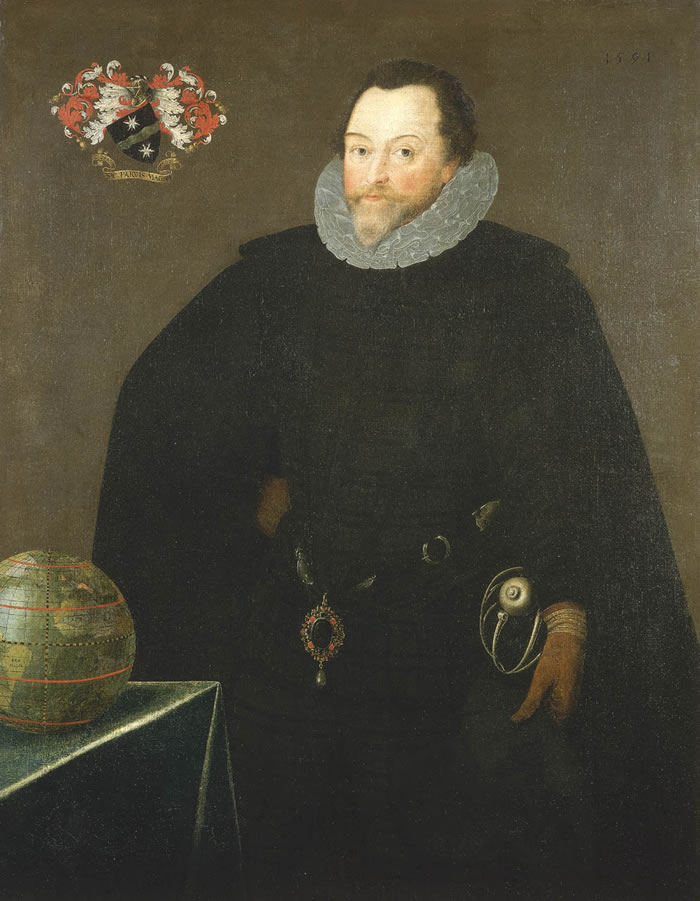
Sir Francis Drake wearing
the Drake Jewel or Drake Pendant at his waist
– by Marcus Gheeraerts the
Younger - 1591
National Maritime Museum,
London
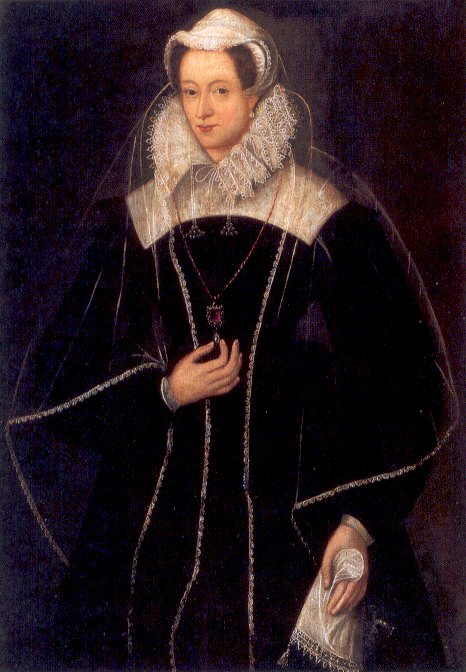
Mary I of Scotland in captivity,
c.1580, unknown artist.
National Portrait Gallery,
London

Mary Queen of Scot's execution
(by the orders of Queen Elizabeth)
at Fotheringhay Castle – February
8, 1587.
This is a narrative woodcut;
the inscription is in Dutch
National Portrait
Gallery of Scotland
|
| Much
to the distress of Machiavelli, the Italians found themselves unable to
answer the challenges to Italian independence posed by the intrusions
of the rising monarchs to the west (Spain) and north (France) of Italy
(and occasionally the other Habsburg power, the Holy Roman or Austrian
Empire). Italy became the playing ground for the military matches
between these non-Italian powers ... aided and abetted by Italian
city-states who foolishly hoped that an alliance with one or the other
of these greater powers would increase their own hand in Italy.
It did quite the opposite, making the Italian city-states political
dependents, either of Spain or of France. Italy itself thus appeared to be totally unable to do anything to fend off these intruders. Consequently the southern half of the Italian peninsula below Rome fell into the hands of the Spanish. And the French moved with increasing boldness to take lands directly (Nice) and to dominate or control directly much of Northern Italy. From 1494 to 1559 foreign wars fought in Italy became a regular and highly destructive feature of Italian life. The once powerful city-states of Italy at this point simply ceased to be able to control further their own destiny. Most shocking of all, in 1527 Spanish and German troops sacked Rome at will during one of Charles and Francis" feuds – making the Pope look even more helpless in the larger scheme of things. Finally, the drift of the vital East-West trade out of the Mediterranean and instead onto the high seas of the Atlantic, Indian and Pacific Oceans drew away from Italy its earning powers, transferring them to the European city-states and monarchies bordering the Atlantic. From its grandeur as the leading European cultural/economic center during the 1400s Renaissance, Italy in the 1500s fell into grim decline that it could not slow up, much less halt. By the year 1600 Italy was only a dim reflection of its former glory. |
|
| ince
medieval times Poland and Lithuania had been closely connected through
the person of the King of Poland, who was also the Duke of
Lithuania. In 1569 this East-European union became formalized as
the Polish-Lithuanian Commonwealth, making it at that time one of the
largest and most populous of the European states. The ethnic
makeup of the Commonwealth was diverse ... as was its religious
makeup. Catholics and Protestants lived side by side in a
relative degree of tolerance unusual for the times, especially unusual
with the Wars of Religious raging around the borders of the
Commonwealth. The Commonwealth was based on a constitutional monarchy where the king’s power was greatly limited by the power of the rather independent nobles ... a power exercised through their ruling council, the Sejm. But with foreign (Swedish) sovereigns occupying the Polish-Lithuanian throne after 1572, huge troubles descended on the Commonwealth as the Catholic branch of the House of Vasa (governing Poland-Lithuania) found itself constantly at war with the Protestant Lutheran branch of the House of Vasa (governing Sweden). Sadly, the Polish Vasa kings tended to be more interested in their personal standing within Vasa family disputes than with the issues facing their Polish-Lithuanian subjects. Thus with a distracted monarchy and a powerful set of subordinate noblemen angling for power, the Commonwealth found itself increasingly divided and politically weakened. |
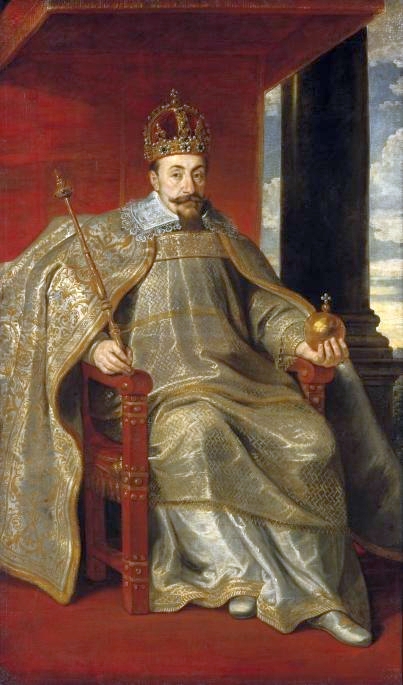
Sigismund III Vasa - Pieter Claesz Soutman (c.
1626)
Elected King of
Poland and Grand Duke of Lithuania - 1587-1632
... as well as King of Sweden
1592-1599
Munich, Alte Pinakothek
|
|
Ivan's predecessors
Ivan was the grandson of the Grand Prince of Moscow, Ivan III – whose 43-year reign saw Moscow expand its territory against the Republic of Novgorod and then throw off the yoke of the Golden Horde ... and establish a highly autocratic Russian state (against much opposition from the Russian noblemen or boyars ... and also from some of his brothers.) The strong-handed Ivan III passed his reign on to his son Vasilli III, who continued the expansion of Moscow against other Russian city-states (most importantly Smolensk), against Lithuania (which dominated Eastern Europe from the Baltic to the Black Sea ... including Kiev) and Lithuania's ally Poland (immediately to the West and then South of Lithuania) ... and against the Khanate of Crimea. So that when Vasili passed his reign on to his own son Ivan, Ivan IV already had a legacy of heavy-handed Russian expansion through the ever-strengthening Grand Prince of Moscow's personal government. Ivan IV "The Terrible"
But in fact he could be even more brutal than his predecessors ... though at the same time he was a patron of the arts, science, literature and commerce, was personally devout, quite intelligent, and an excellent diplomat ... and in general very popular with the Russian commoners. But he suffered from bouts of paranoia which turned into insane rage ... at one point in a fit of rage accidently killing the son he was grooming to succeed him. Despite his struggle with insanity, he actually succeeded in a number of ways in building up his Russian economic and political power base. He worked hard to build economic relations across the Baltic and North Sea with England, leading to the creation in 1555 of the Muscovy Company in England .. the forerunner of the English trading corporation that will be at the heart of an eventual English rise to power. He took protective interest in Eastern or Byzantine Christianity in the Middle East. And he moved boldly eastward conquering the Khanates of Kazan (1552) and Astrakhan (1556), securing the Volga region for Russia. His reign was constantly troubled by the strong neighbors to the west, the close allies Lithuania and Poland and also Sweden. Wars on that front were constant ... producing little by way of rewards for Ivan. And like his father and grandfather, he had on-going problems with the nobility or boyars – who resented his absolutist hold over Moscow. In 1565 He created a personal body guard of some 1000 soldiers (eventually 6000), the Oprichniki by which he targeted opposing boyars for execution. ... and by which Ivan sacked and burned the fabulous Novgorod (1570) when, during a great plague which ripped through the city, he grew suspicious that the Novgorod noblemen were about to turn to Lithuania for help. He turned the oprichniki loose on the Novgorod population, slaughtering countless numbers (2000-3000?) ... leaving the once noble city unable to ever rise to greatness again. Likewise, his problems with the Crimean Tatars was ongoing. Relations finally came to a head in 1572 over the slave raids conducted by the Tatars deep into Russian lands. A huge Tatar army heading north was met by a Russian army half the size. But the capable streltsy (soldiers carrying firearms) routed the Tatar army so thoroughly that it broke both Tatar and Ottoman Turkish ambitions to advance into central Russia. However, in that same battle, the oprichniki failed so miserably against the Tatars that Ivan ordered the oprichniki unit dissolved. Finally in the latter years of Ivan's rule, Russians pushed eastwards toward the Ural mountains, then crossed those mountains ... and continued moving eastward into Siberia. Ivan authorized the Stroganov family to settle to the east of the Ural Mountains. Employing a small force of Cossacks they brought the tribes under Russian domination ... and under Tsarist, not Stroganov, authority. With the help of Ivan's streltsy sent to work with the Cossacks, Ivan thus towards the end if his life (1584) came into the position of being the Tsar of Siberia. |
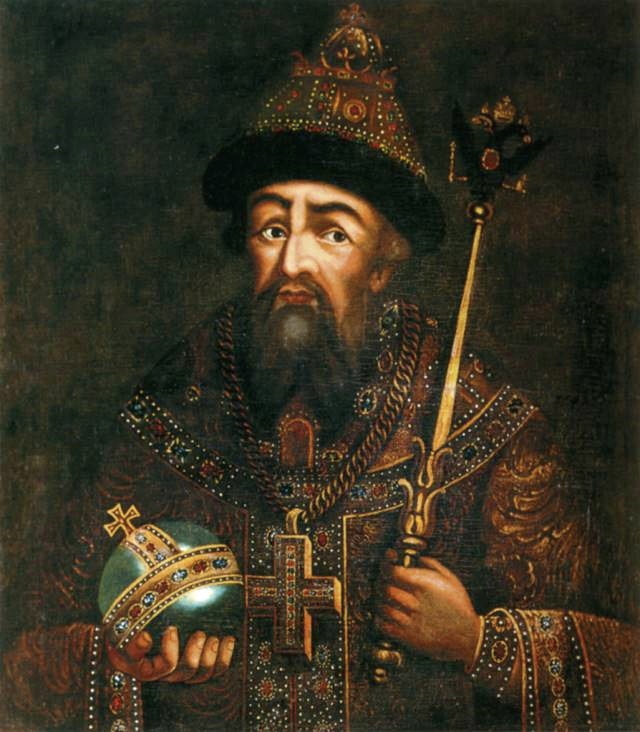
Russian Tsar Ivan IV - "the Terrible"
(Grand
Prince of Moscow 1533-1547; Tsar of All the Russians
1547-1584)
Moscow,
State Historical Museum
 Miles
H. Hodges
Miles
H. Hodges



