1719-1720
 Dutch Reformed pastor Theodorus Jacobus Frelinghuysen accepts
a pastoral call from Raritan in New Jersey and arrives in America to begin that
call in 1720. He is deeply committed to
the Heidelberg Catechism, which stressed the importance of personal pietism,
conversion, repentance, moral self-discipline ... and church discipline. He works hard to spread this view of
Christianity among a number of Dutch Reformed churches in the Raritan area (at
the same time also training a number of young men for the ministry) ...
stirring the wrath of more “orthodox” pastors – who consider his approach too
emotional. And they particularly
dislike his hardline approach that emphasizes that Christians are not truly converted
to the faith unless they go through some kind of spiritual conversion ... one
that causes them to see clearly the sins that remain in their lives – and the
need for repentance – which then truly leads them to live a righteous life. Dutch Reformed pastor Theodorus Jacobus Frelinghuysen accepts
a pastoral call from Raritan in New Jersey and arrives in America to begin that
call in 1720. He is deeply committed to
the Heidelberg Catechism, which stressed the importance of personal pietism,
conversion, repentance, moral self-discipline ... and church discipline. He works hard to spread this view of
Christianity among a number of Dutch Reformed churches in the Raritan area (at
the same time also training a number of young men for the ministry) ...
stirring the wrath of more “orthodox” pastors – who consider his approach too
emotional. And they particularly
dislike his hardline approach that emphasizes that Christians are not truly converted
to the faith unless they go through some kind of spiritual conversion ... one
that causes them to see clearly the sins that remain in their lives – and the
need for repentance – which then truly leads them to live a righteous life.
1726 
 The “Log College” is started up by pastor William Tennent
(with the assistance of his eldest son, Gilbert Tennent) in Neshaminy, Pennsylvania as something of a Presbyterian
seminary (up to that point only Harvard and Yale count as American
seminaries) ... to prepare pastors supporting the New Side in the growing controversy
within the Presbyterian Church between the New Siders, part of the revival group,
and the Old Siders, who consider a rising revivalist spirit as most unchristian. The “Log College” is started up by pastor William Tennent
(with the assistance of his eldest son, Gilbert Tennent) in Neshaminy, Pennsylvania as something of a Presbyterian
seminary (up to that point only Harvard and Yale count as American
seminaries) ... to prepare pastors supporting the New Side in the growing controversy
within the Presbyterian Church between the New Siders, part of the revival group,
and the Old Siders, who consider a rising revivalist spirit as most unchristian.
Later
1720s
Gilbert Tennent, while serving as a Presbyterian pastor
in New Brunswick, New Jersey, becomes a close friend with Frelinghuysen ...
their ideas about the proper Christian life being quite similar.
1729
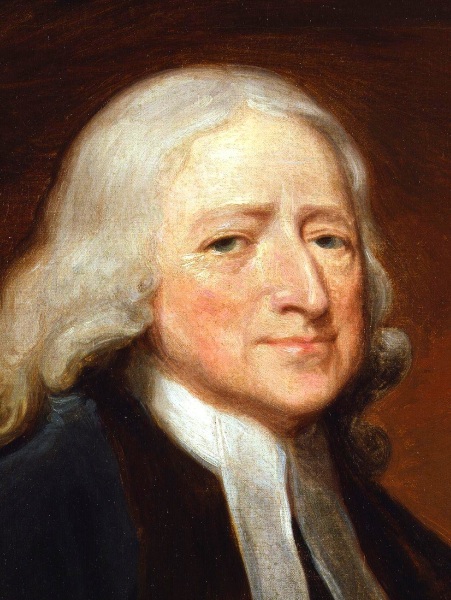 
John Wesley (a recently ordained Anglican priest and teaching
fellow at Oxford), his brother Charles, and two friends start up what others
mockingly termed "the Holy Club" at Oxford ... to study and worship together. The mockery extends further, others calling
their program "Methodism" ... in reference to the way they schedule regular
prayer, fasting (Wednesdays and Fridays), bible study (but also outreach to the
sick, poor, to orphans, and to people in prison). No doubt, Wesley’s approach to the Christian
life has been shaped deeply by the rigor and discipline he and his brother had been
raised under by their father, a rector of the Church of England, and their
mother, a highly self-disciplined Christian (herself the daughter of a
Christian pastor).
These "Methodists" were also termed "enthusiasts" in
reference to the fact that their Christianity was not standard in the way the
Church of England worship conducted itself most ritually ... but was rather emotional in the
way it went deep into personal feelings.
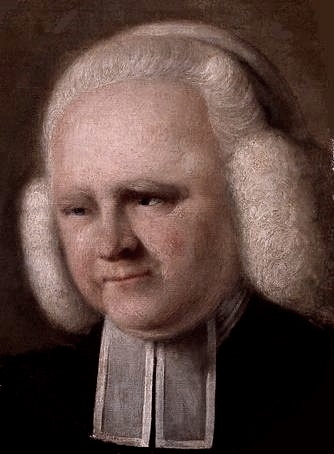 But their numbers at Oxford would grow ... and importantly include the
strongly Calvinist George Whitefield − who comes to Oxford in 1732 as a
servitor, a penniless student who pays his educational costs by meeting the
needs of fellow students. But their numbers at Oxford would grow ... and importantly include the
strongly Calvinist George Whitefield − who comes to Oxford in 1732 as a
servitor, a penniless student who pays his educational costs by meeting the
needs of fellow students.
And most amazingly, Whitefield’s Calvinist views and the Wesleys'
Arminian views on Christianity do not seem to disrupt their close relationship
... at least not at the time!
[Note: Calvinism
(following Paul’s line of thought in his Biblical writings, especially his
Letter to the Romans) believes that personal salvation is given by God to people,
not on the basis of their good works but on the basis of the faith that the
Holy Spirit has freely given them. In
short, Calvinism does not believe that a person can "earn" something that is
simply given purely by the grace of God.
Arminianism believes that a person has to work with God to gain
salvation ... and without such human cooperation, salvation will never be
achieved. 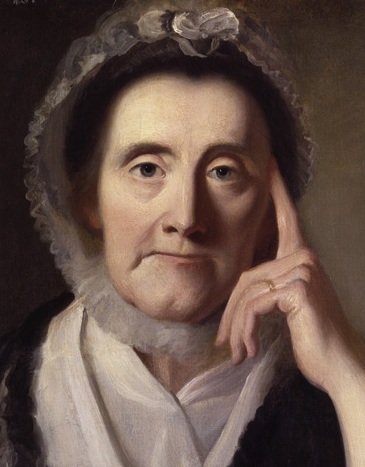 Sadly, Whitefield and Wesley
will eventually split over this all-important theological matter ... although
some kind of personal respect for each other’s ministry will remain intact. Consequently, Whitefield’s Christianity was
more emotionally based, while Wesley’s was more self-disciplined based. Sadly, Whitefield and Wesley
will eventually split over this all-important theological matter ... although
some kind of personal respect for each other’s ministry will remain intact. Consequently, Whitefield’s Christianity was
more emotionally based, while Wesley’s was more self-disciplined based.
Interesting also, this division would
eventually produce a group called Calvinistic Methodists – (or Presbyterianism,
similar to the Presbyterianism in Scotland ... and the Middle Colonies of
America) led by Whitefield and supported importantly by Selina Hastings, the Countess of Huntington ... a
movement that eventually becomes quite strong in Wales.]
1733-1734
 Jonathan Edwards, preaching on justification by faith,
starts up a revival in his church in Northampton, Massachusetts. Jonathan Edwards, preaching on justification by faith,
starts up a revival in his church in Northampton, Massachusetts.
By 1734 it has reached a huge number of people,
especially youths, bringing in some 300 youths to full membership in the
church.
1735
Jonathan Edwards’ revival spreads south ... bringing out the first of the opposition against his "unorthodox"
Christian leadership ... those claiming that his preaching is mere fanaticism. And most tragically, Edward’s strong stand on the
matter of God's gifting of personal salvation leads numerous people to despair
about the authenticity of their "conversion" ... some even committing suicide. Ultimately this leads to a setback in the
momentum of Edward’s revival. But
Edwards does not let up in his dedication to a very needy spiritual revival.
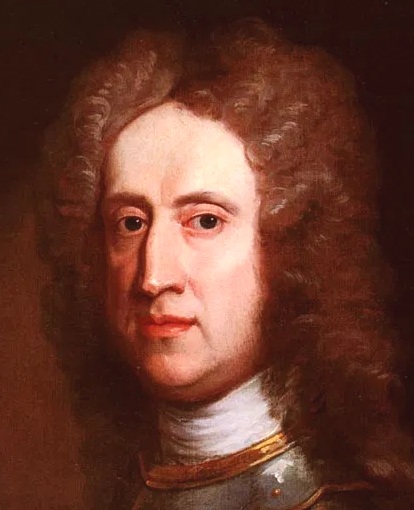 At the request of General James Oglethorpe, the Wesleys sail to
America (leaving in October and arriving
the next February) – to Oglethorpe's new Georgia colony ... which is supposed to
be a colony dedicated to helping those in need of a new start in life (notably
debtors). It is during this voyage to
America that Wesley encounters some Moravians ... whose deep Christian faith
and pietism strikes the heart of Wesley deeply ... especially when a storm hits
the ship and everyone panics – except the Moravians, who simply meet the issue calmly
with prayer and song. Wesley hungers for
that same kind of strong personal faith ... something that he realizes has
nothing to do with proper religious performance. At the request of General James Oglethorpe, the Wesleys sail to
America (leaving in October and arriving
the next February) – to Oglethorpe's new Georgia colony ... which is supposed to
be a colony dedicated to helping those in need of a new start in life (notably
debtors). It is during this voyage to
America that Wesley encounters some Moravians ... whose deep Christian faith
and pietism strikes the heart of Wesley deeply ... especially when a storm hits
the ship and everyone panics – except the Moravians, who simply meet the issue calmly
with prayer and song. Wesley hungers for
that same kind of strong personal faith ... something that he realizes has
nothing to do with proper religious performance.
The Wesleys' friend Whitefield, meanwhile, becomes the leader of the Holy
Club at Oxford.
1736
Wesley's intentions are to evangelize neighboring Indian tribes .. but
finds himself short of support – at a time he has also pastoral duties
in Savannah’s Christ Church. In general,
whatever he hoped he was to achieve in Savannah ... the results turn out to be well short
of his goal, his high-church strategy not reaching the hearts of the Georgian
commoners (or the Indians?). 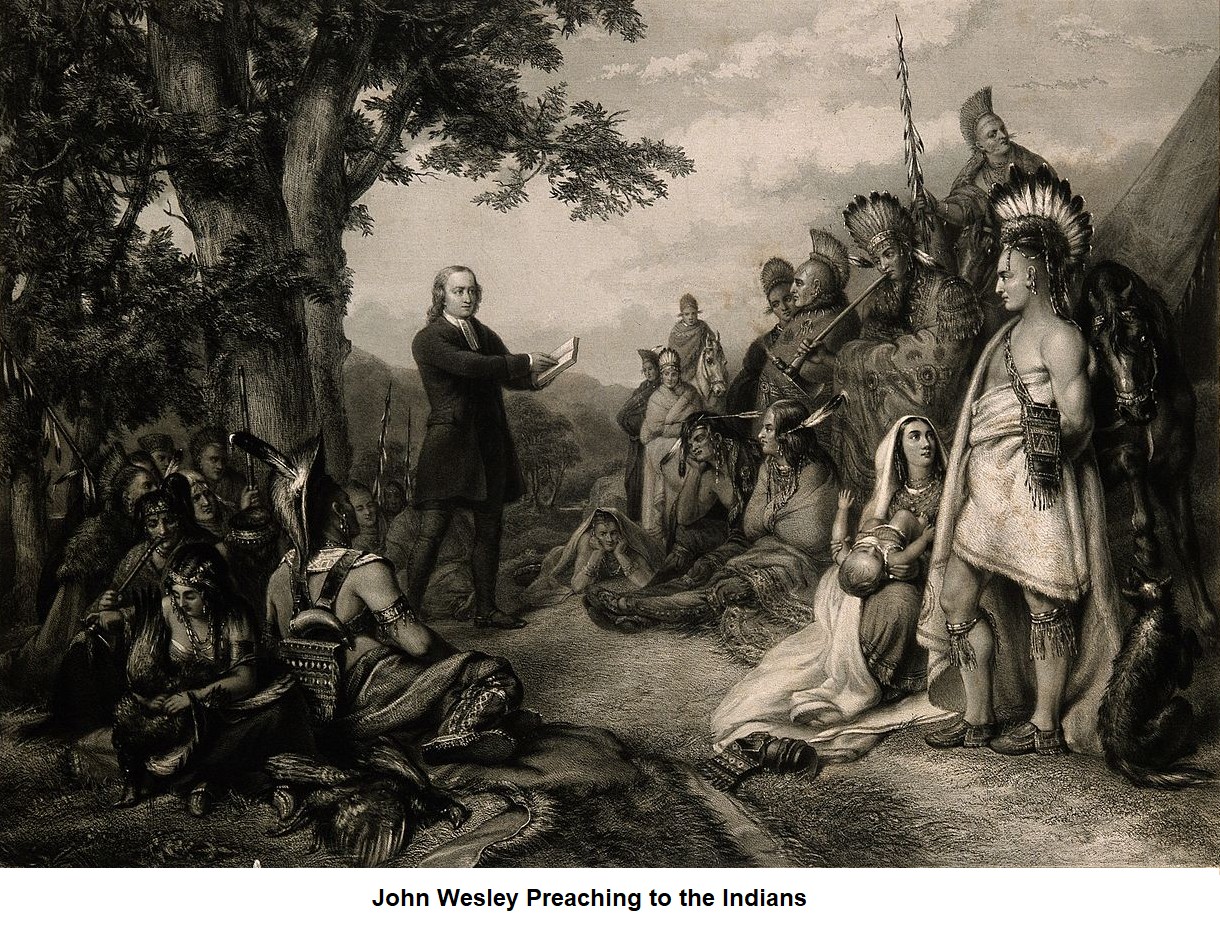
Meanwhile, back in England, Whitefield – who had long struggled with the idea of his own
conversion – undergoes that conversion ... in finally coming to understand that it
is God, by his own grace, that saves ... not Whitefield’s own works – no matter
how good those works might be. At this
point he is ordained as a deacon in the Church of England ... although not
assigned any particular church ... leading Whitefield to take his new Christian
enthusiasm not only to prisons and infirmaries and even soldiers’ quarters to
pray and encourage (preach) but ultimately to churches here and there, his powerful testimonies and sermons filling
them to capacity (actually an overflow).
His impact is powerful.
1737
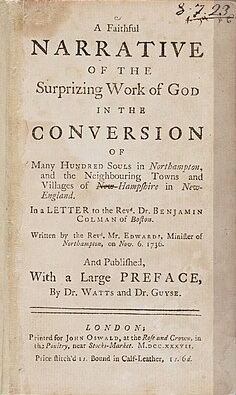 Being the scholar that he was, Jonathan Edwards publishes
the results of his study of the process of conversion: A Faithful Narrative of the Surprising
Work of God in the Conversion of Many Hundred Souls in Northampton Being the scholar that he was, Jonathan Edwards publishes
the results of his study of the process of conversion: A Faithful Narrative of the Surprising
Work of God in the Conversion of Many Hundred Souls in Northampton
Whitefield’s ministry continues to grow in England as the
number of people he reaches with his prayers and preaching are now found across
a large part of England. This includes also
General Oglethorpe who becomes a big Whitefield supporter.
Meanwhile in Georgia, things go very wrong for Wesley in
a relationship that almost starts up with a young woman, a controversy then developing
when he denies her communion ... and then subsequently finds himself facing
legal proceedings. At this point (December)
he simply flees back to England. During
the trip back he becomes depressed about his lack of the faith he feels is
necessary to be the pastor God has intended him to be.
1738
Back in England, Wesley finds his way to a Moravian
fellowship ... where the pastor (who is about himself to head to Georgia) helps
Wesley with his questions ... and the Moravian fellowship (a Moravian church on
Aldersgate Street) which then most abruptly speaks to
Wesley’s heart – producing for him the life-changing "Aldersgate Experience" (May 24).
Gilbert Tennent leads a number of New-Side Presbyterian pastors to
split from the Presbytery of Philadelphia ... to form a Presbytery of New Brunswick.
Whitefield arrives at Oglethorpe’s Georgia colony in
America (May), where his friend John Wesley had previously served as pastor (Christ Church)
in Savannah. While there, Whitefield feels
called to found an orphanage ... which he supposes is to be his life work. But he also continues his habit of visiting
the sick and praying, teaching and preaching lengthily. He then returns later that year to England to
receive a priest’s orders ... and to raise funds for his orphanage.
1739
But while in England, Whitefield is invited to make his appeal for support of the orphanage – and to preach – at various
churches in Bristol. Quickly, his unusual preaching style comes to be admired greatly by
some ... and detested equally by others. Then,
with the churches filled to capacity, Whitefield ultimately decides to
undertake open-air
preaching – at first to protesting miners ... something others view as
rather
scandalous. But he sees how important such open-air preaching can be
... and how it reaches people who would never come to church. And soon he finds himself preaching to thousands
in the streets and fields... even as many as ten thousand at a single presentation. 
It is at this point, determined to head back to America, that he convinces his friend Wesley
not only to take over Whitefield’s Bristol ministry but to continue the open-air
preaching Whitefield had started up ... and to expand that even to London. A
hesitant Wesley overcomes his strong sense of religious orderliness ... to step
out in faith at such an unusual ministry.
And for Wesley it proves to be as grand a success as it has been for
Whitefield. At the same time, Whitefield
impresses the Countess of Huntington, who becomes a major
supporter of his.
 Whitfield returns to America later that same year ... to
Philadelphia – where Ben Franklin becomes deeply impressed by Whitefield’s
preaching style, beginning their 30-year friendship (lasting up until
Whitefield’s death in 1770). Indeed, Franklin takes it upon himself to see
that Whitefield’s sermons (some 40 of them) are published on the front page of
Franklin’s newspaper, the Pennsylvania Gazette ... as well as some of the correspondence between the two. Whitfield returns to America later that same year ... to
Philadelphia – where Ben Franklin becomes deeply impressed by Whitefield’s
preaching style, beginning their 30-year friendship (lasting up until
Whitefield’s death in 1770). Indeed, Franklin takes it upon himself to see
that Whitefield’s sermons (some 40 of them) are published on the front page of
Franklin’s newspaper, the Pennsylvania Gazette ... as well as some of the correspondence between the two.

Whitefield now finds himself also preaching not only in
Pennsylvania, but New Jersey, New York, Maryland, Virginia, and the Carolinas.
1740
Whitefield then (January) heads to Georgia, where he sets
up his Bethesda Orphan House ... (Bethesda: "House of Mercy") some 500 acres purchased
to serve a community of orphans as a place to grow up in the security and discipline
of a strongly gospel-based social-spiritual environment. And it is Whitefield himself who goes out to
discover and "bring home" his first group of orphans, some 40 of them.
He also persuades Moravian Brethren in Georgia to build
a similar orphanage for negro children ... on land he had purchased in Pennsylvania
(today’s Nazareth). Unfortunately, they
come to some kind of theological disagreement and Whitefield is not able to
complete the development. But ultimately
the Moravians take it upon themselves to complete the task.
Whitefield continues his revival preaching across the
colonies ... heading again to Pennsylvania, New Jersey and New York. ... then
back to Savannah, then on to Boston. He is
now reaching huge crowds (in the tens of thousands) that gather to hear this
increasingly famous preacher. It is esteemed today that certainly half of
the entire population of the colonies came to be familiar with his preachings
... or at least his writings – his sermons put to print. Certainly the name was also at least known to
all colonials − favorable or unfavorable as they might be to his ministry.
Whitefield and Gilbert Tennent work closely together on a
preaching tour of New Jersey and Staten Island.
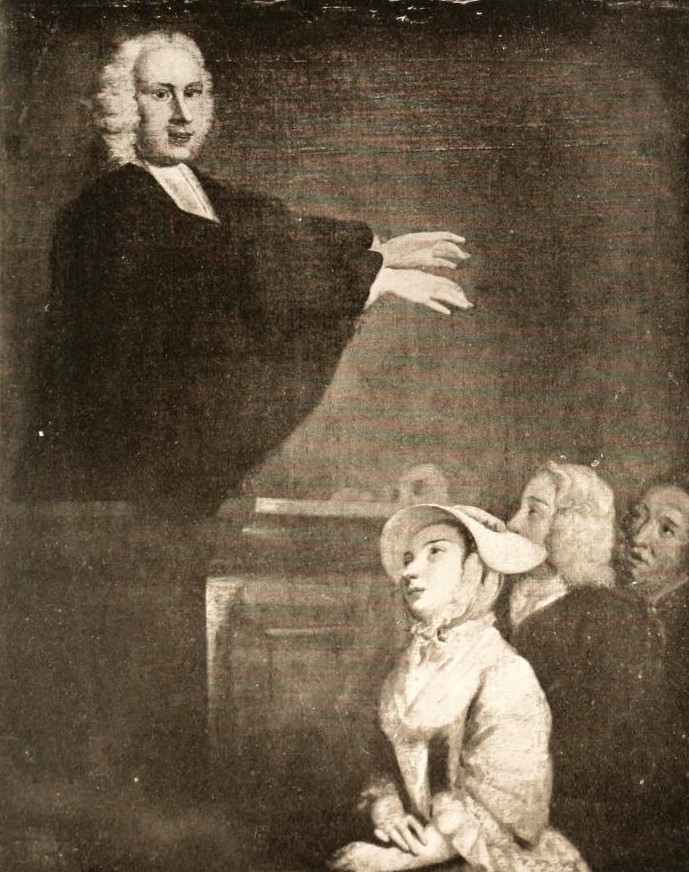 And in New England, Edwards is an early supporter of
Whitefield’s ministry, doing what he can to help Whitefield ... particularly
when Whitefield comes to Boston and then Northampton that fall. In
Northampton, Whitefield preaches a sermon
reminding both Edwards and his congregation of the revival they had
gone through in previous years, bringing Edwards to tears and
the congregation to
something similar. And in New England, Edwards is an early supporter of
Whitefield’s ministry, doing what he can to help Whitefield ... particularly
when Whitefield comes to Boston and then Northampton that fall. In
Northampton, Whitefield preaches a sermon
reminding both Edwards and his congregation of the revival they had
gone through in previous years, bringing Edwards to tears and
the congregation to
something similar.
Yet Whitefield could be most business-like in all this,
with William Seward supporting him in getting advanced publicity out in anticipation
of a Whitefield revival ... and making sure that all the costs of this endeavor
were met.
And thus
revivalism gets back on its feet in New England. But opposition against such revivalism also
becomes intense.
And Edwards writes more works in defense of revival or
evangelical Christianity.
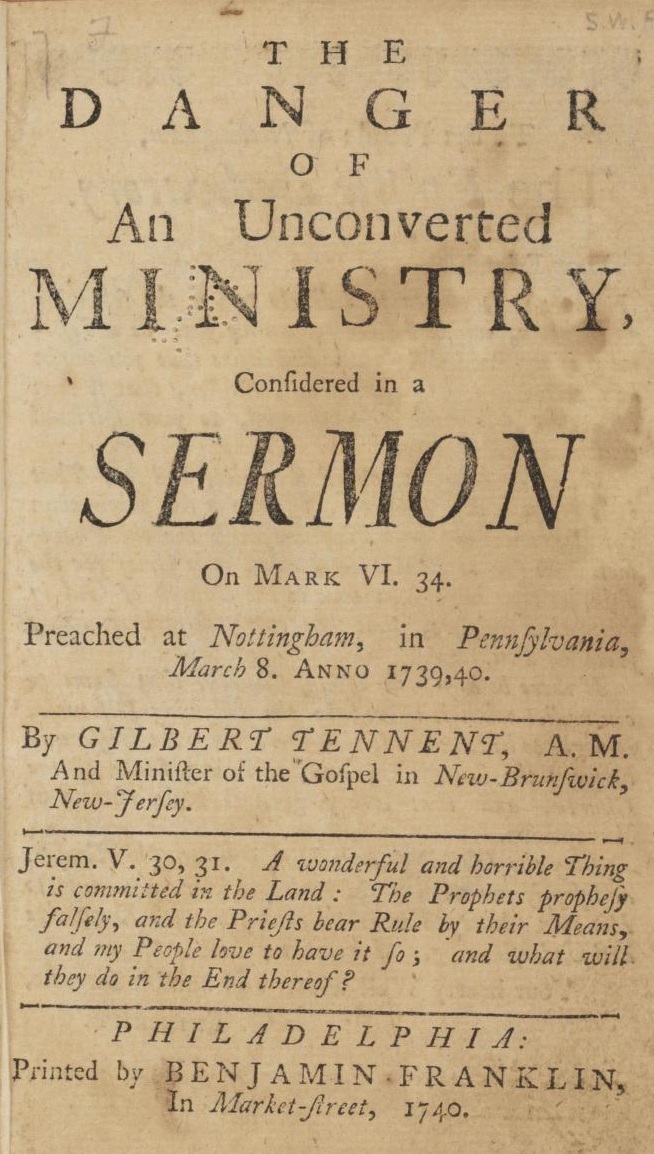 Also, a sermon of Gilbert Tennent’s (and printed by Ben Franklin), The Danger of an Unconverted Ministry,
succeeds in stirring the wrath of the Old Siders in the Presbyterian Synod
(Tennent claims that those who preach without having experienced true spiritual
conversion were simply Pharisees!). Also, a sermon of Gilbert Tennent’s (and printed by Ben Franklin), The Danger of an Unconverted Ministry,
succeeds in stirring the wrath of the Old Siders in the Presbyterian Synod
(Tennent claims that those who preach without having experienced true spiritual
conversion were simply Pharisees!).
That winter Tennent also undertakes his own tour of New
England, where revival is now well underway.
Meanwhile, the Synod of Philadelphia votes to cut ties
with Tennent’s Presbytery of New Brunswick ... thus severing ties with Tennent
and his New Side associates.
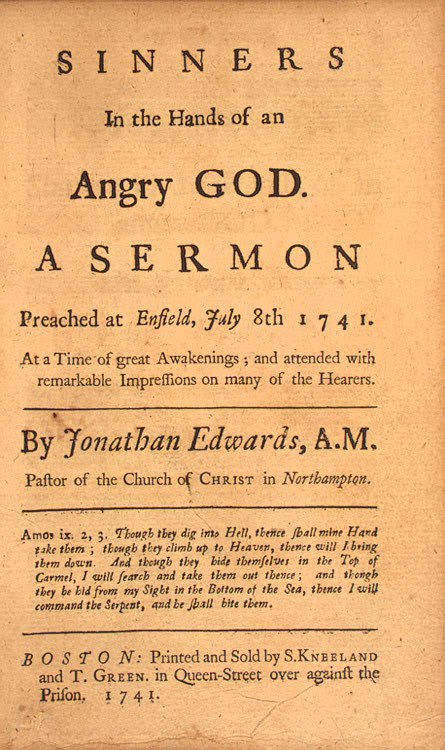 And too, Jonathan Edwards stirs the wrath of religious traditionalists with a powerful sermon preached at a revival
in Enfield Connecticut, Sinners in the Hands of an Angry God. And too, Jonathan Edwards stirs the wrath of religious traditionalists with a powerful sermon preached at a revival
in Enfield Connecticut, Sinners in the Hands of an Angry God.
But
it has the effect on his congregation to get the faithful to truly seek
a dynamic relationship with God ... through Christ and
Christ alone (again ... not through their own good works).
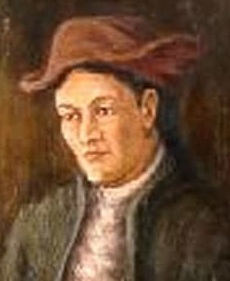 A young David Brainerd,
who experiences a deep conversion experience in 1739, finds himself
the next year unable to complete his Yale education
... because of his tuberculosis – and then because of his outspoken
opposition to those who are trying to block the revivalism sweeping Yale
students. Thus without a Yale degree, he finds himself ineligible
for ordination as a pastor. A young David Brainerd,
who experiences a deep conversion experience in 1739, finds himself
the next year unable to complete his Yale education
... because of his tuberculosis – and then because of his outspoken
opposition to those who are trying to block the revivalism sweeping Yale
students. Thus without a Yale degree, he finds himself ineligible
for ordination as a pastor.
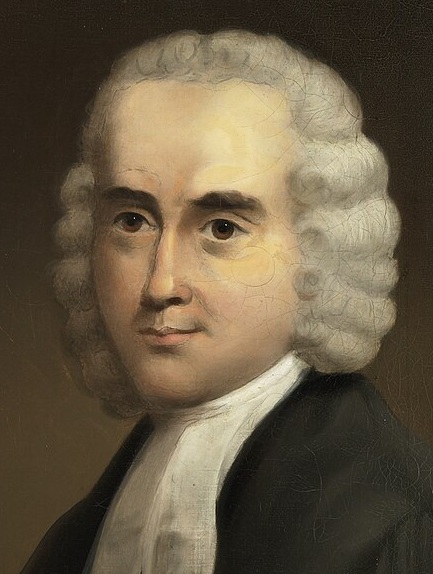 But New Jersey’s leading
Presbyterian pastor, Jonathan Dickinson, convinces Brainerd instead to simply go
among the neighboring Indians ... to bring them to Christ. The Society in Scotland for Propagating
Christian Knowledge will support him. But New Jersey’s leading
Presbyterian pastor, Jonathan Dickinson, convinces Brainerd instead to simply go
among the neighboring Indians ... to bring them to Christ. The Society in Scotland for Propagating
Christian Knowledge will support him.
Meanwhile, in England, in his open-air preaching, Wesley disregards the parish
boundaries that were supposed to define where it was that a pastor had pastoral
authority ... and preaches where he feels the need to do so ... further angering Church
of England pastors and officials. Also, Wesley is finding that pastors who
share his view on a number of key theological matters – especially the need for
the Christian world to undergo some kind of deep spiritual revival – are quite unable to
secure pastorates ... due to the opposition of the Church of England. Ultimately, finding
himself and his colleagues cut off by the Church of England, Wesley simply sets
up Methodist congregations here and there and assigns fellow Methodist
lay pastors to lead them. Thus Methodism as a distinct Christian community or "denomination" is born in England.
1741
Whitefield returns from America to England ... to a crowd of tens of
thousands (he had a very strong voice!).
But he remains very interested in his American connections ... and keeps
that connection strong with his publishing an autobiography that touches deeply
the hearts of the readers back in America.
But most sadly, Whitefield and John Wesley find their
friendship finally broken over this matter of Whitfield’s Calvinism and Wesley’s
Arminianism ... when Wesley comes out strongly against Whitefield’s
Calvinism – even publishing a pamphlet denouncing strongly Whitefield's theology ...and sending the pamplet to America. Whitefield is furious.
But in any case, Whitefield pushes strongly
his preaching in England, Scotland and Wales.
1742
Whitfield continues his preaching in England ...
and then even more extensively in Scotland. And Wesley also is continuing his open-air preaching ... advancing considerably his Methodist movement. 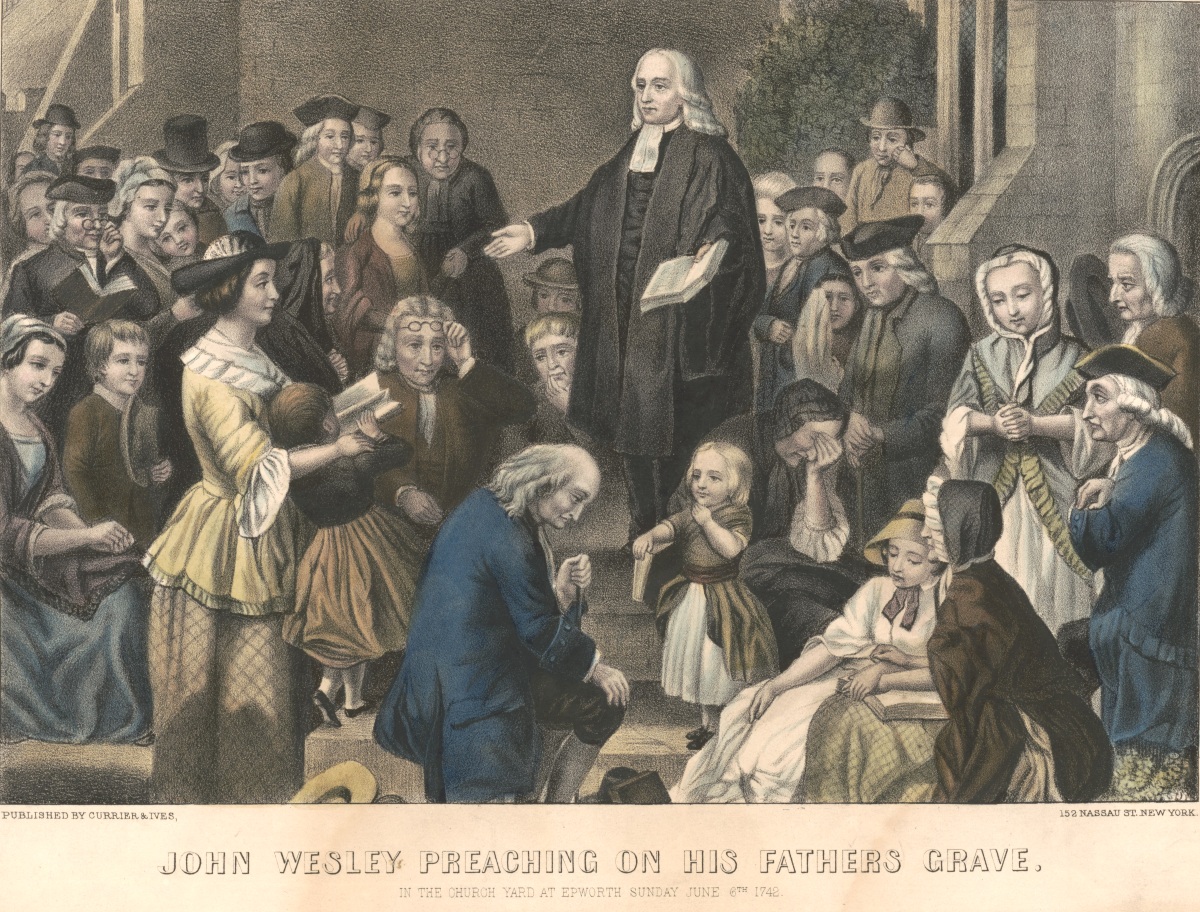
1743
Whitefield helps found the Welsh Calvinistic-Methodist
Association and becomes its first moderator or leader.
Brainerd begins his work among the Delaware Indians (just
northeast of Bethlehem, Pennsylvania) ... and is ordained by the Newark Presbytery. This begins his strong, but brief missionary
work among the Indians ... despite offers extended to him for a pastorate among
the Anglo population. 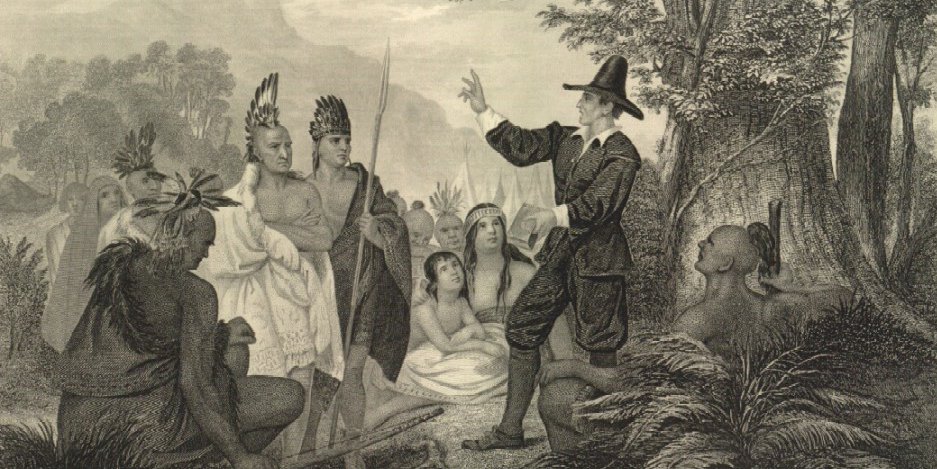 Ultimately,
because of Brainerd's dedication to the ministry among the Indians, his
example inspires many young Americans to take up a similar missionary
role.
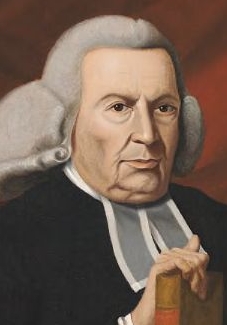 Charles Chauncy, pastor of Boston’s prestigious First
Church (Congregational) writes a strong rebuttal to all this revivalism, Seasonable
Thoughts on the State of Religion in New England ... in his effort to keep
Christianity moving along "rational" rather than "emotional" lines. Charles Chauncy, pastor of Boston’s prestigious First
Church (Congregational) writes a strong rebuttal to all this revivalism, Seasonable
Thoughts on the State of Religion in New England ... in his effort to keep
Christianity moving along "rational" rather than "emotional" lines.
1744
Whitefield now returns to America, his
third such visit, arriving in October ... as actually a rather sick man. But he finds an even greater reception awaiting
him. Thus he will preach across the colonies
... three times a day before thousands of eager listeners. His influence will become even greater (the
best-known preacher in America at the time)
But the opposition to his
preaching style will also grow even stronger. Indeed, over the years Whitefield will find himself frequently under physical attack ... when women
with scissors go at him, he is peed on by someone in a tree, stones and dead cats are thrown at him, and
he is assaulted by someone who comes at him with a
brass-headed cane.
And his visit to very Catholic Ireland (1757) gets him
physically mauled by an angry mob when he comes out strongly against
the Catholic religious hierarchy. But Whitefield has no intention
of ever backing down from his ministry.

Whitefield will continue his American preaching for the
next three years ... and build the spirit of revival in America to even
greater heights.
Meanwhile, back in England, the Wesleys, John and Charles, along with four clergy and
four lay preachers take action to establish the first Conference of the Methodist movement in England ... with John Wesley as its
president − and the Conference as the Methodist church’s ruling body.
1745
The
Presbytery of New Brunswick joins with the Presbytery
of New York to form the New York Synod ... a move of the New-siders to
free themselves from the restrictions of the Philadelphia Synod, made up
heavily of Old-Siders.
1746
In part due to Yale’s earlier refusal to readmit
Brainerd, the College of New Jersey (ultimately Princeton) is started
up in the Home of Jonathan Dickinson. This new college is supported by the New York and New Jersey
Presbyterian Synods ... and a number of individuals who were graduates of
Tennent's Log College.
1747
Classes begin in May of 1747
... with a sick Brainerd in attendance − because he is too ill to continue his
missionary work. The elderly William Tennent, founder of the Log College, dies that same month. Finally, a very sick Brainerd – moves to Massachusetts and spends the last few
months of his life with Jonathan Edwards in Northampton – where he finally dies of his tuberculosis. Sadly, Edwards' daughter Jerusha, who nursed Brainerd during
that time, contracts Brainerd’s tuberculosis, and dies the following year
(1748)
Theodorus Jacobus Frelinghuysen dies. But his ministry is continued by his sons
Theodorus Frelinghuysen and John Frelinghuysen.
(They would eventually, in 1766, receive a royal charter to found Queens
College in New Brunswick ... which eventually – in 1825 − is renamed Rutgers
University).
1748
But now back in England (1748-1751) Whitefield finds his
ministry strongly supported financially by Lady Huntington, easing the strain
and stress of his heavy schedule ... once again spread across England and Wales (touching on every county in the process),
Scotland (making some 14 or 15 trips there), but also Ireland (twice). But his ministry at the Moorfields Tabernacle in
London also becomes quite substantial. (turning out the thousands to hear him preach)
1749
Edwards publishes a book, The Life of David Brainerd
... which inspires numerous missionaries in the years ahead (even into the next
century)
Franklin undertakes to convert the huge preaching hall (and
Philadelphia’s biggest building at the time) built originally in 1740 to
accommodate Whitefield’s preaching in Philadelphia now into a public school for
boys ... in accordance with a curriculum Franklin has designed − one focused on
educating young leaders in the fields of academics, commerce and public
service. Eventually (1755) this school
will be chartered as the College of Philadelphia ... to then (1799) ultimately
become the University of Pennsylvania.
1750
Edwards is voted out of his pulpit by his congregation
... by a large majority in fact. Edward’s
constant call to repentance was becoming a tiresome theme to people who
believed themselves by their earlier conversion to have been freed from the
spiritual dangers that Edwards keeps pointing out.
1751-1752
A visit (his fourth) by Whitefield to America is cut
short because of the financial problems he finds facing him in his Bethesda
Orphan House. He heads back to England
to find more financial support.
1753
Tennent goes to England to raise funds for the College of
New Jersey (the future Princeton) ... effectively to build what would become
the university’s central building, Nassau Hall. 
1754-1755
In his fifth American visit, Whitefield again preaches across
the full spread of the colonies from Boston to Savannah.
1758
The Old Side/New Side split comes to an end as both sides
finally seek reconciliation. Tennent, by this
point, has been long regretting his own hand in the Presbyterian split, has
tamed the rigor of his sermons, and has been doing all he could to bring about
this reconciliation. Consequently the Old Side Synod of Philadelphia and New
Side Synod of New York merge into a single synod (with both names!).
1763-1765
In Whitefield’s sixth trip to America he finds the going
more difficult because of health problems ... but also easier because he is
getting less resistance to his preaching.
His popularity in America merely continues to grow.
1769-1770
Whitefield’s health is merely
worse in his seventh visit to America ... even though he preaches to huge
crowds in Charleston and Philadelphia.
But in arriving in New Hampshire his health finally fails and he dies
the next day (September 30th, 1770) after a lengthy sermon the night
before. Some 6,000 attend his funeral
in Newburyport, Massachusetts.
EVALUATING WHITEFIELD'S IMPACT |
The amount of energy that Whitefield brought to his ministry is mind-boggling!
It is estimated that over a period of 35 years he preached approximately 18,000 sermons – and an additional 12,000 talks – a huge portion of that in America. In doing this, Whitefield made 13 ocean crossing from England to
America and back (seven visits) ... that alone a very dangerous
challenge given storms that easily develop in the Atlantic and the fact
that sailing ships were by no means very secure in the face of such
challenges. And each of those voyages averaged around 12 weeks in
length.
And once in America, he
constantly moved back and forth by horseback across the colonies from
Maine in the North to Georgia in the South, regularly preaching (often
several times a day) to crowds of five or six thousand ... even
reaching 20,000 in number from time to time. Ben Frenklin
calculated that at a sermon he attended (and carefully obsserved and
measured), the very strong-voiced Whitefield had preached to around
30,000 participants.
But Whitefield was also very active
in ministry on the other side of the Atlantic, preaching in England and
Wales ... where the turnout of listeners was much the same in size.
And he also frequently visited Scotland ... where the
turnout was also quite great.
The slavery issue. However ... what seems so strange to us today is how a strong Christian
like Whitefield could be so supportive of the institution of slavery ...
working hard to get Georgia to end its ban on slavery. Certainly, Whitefield made it very clear during
an early visit to America (1740) about how much he hated the way slaves were
treated in South Carolina, Virginia and Maryland. So why was he insistent that slavery be
allowed in Georgia?
Actually, Whitefield preached readily to
slaves. And that was the point. The way
at the time that the gospel
might be spread to America’s Black population would be if a charity
colony
like Georgia (Oglethorpe's understanding of the role Georgia was to
play) should open the way to bring slaves in ... where Whitefield could
then
reach out to them. 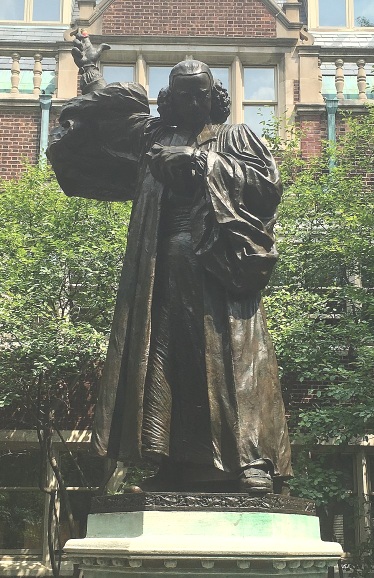 Remember also that at
that time, slavery was simply assumed to be a natural part of any social order
... one reaching back to ancient times. Remember also that at
that time, slavery was simply assumed to be a natural part of any social order
... one reaching back to ancient times.
Ultimately, after slavery was permitted in Georgia in 1751, Whitefield was finally able
to bring numerous Black orphans to his Bethesda orphanage ... where they were raised
as strong Christians ... and as a clear
example of how those categorized as slaves ought to be treated. Actually, that was quite "progressive"
thinking for the times. But that hardly
meets today’s standards on the matter.
Note:
enraptured by the George Floyd protests, the
University of Pennsylvania administration decided recently (2020) to
remove a
statue of Whitefield placed there in 1919 ... because of Whitefield’s support
of slavery. They
did so despite the fact that other Founding
Fathers owned slaves ... including their well-beloved Franklin.
However, Franklin is excused from this Progressisvist shaming
because he later becomes an abolitionist. But that would not
be until the mid-1780s ... when Franklin finally comes out strongly
against the institution of slavery. Given
Whitefield's deep interest in helping Blacks to a better life, there is
plenty of reason to believe that by the mid-1780s he too would have
become something of an abolitionist ... when the debate about slavery
was finally a major issue − a major issue because of the need for a newly independent America to define itself and all its stood for.
But unfortunately for Whitefield's legacy, he had died 15 years
earlier ... when abolition was not yet an issue. Thus it was
that, despite his considerable work among Blacks, he was unable to
prove himself to the more enlightened ones of today's world. It's
a huge shame that U Penn took down the visible reminder of the impact
one person, Whitefield, had in getting America to understand that as
a spiritually-revived people they had a special calling to live
Biblically, under God's lead ... and not under the controlling hand of
a distant English king (George III). Calvinism versus Arminianism.
Sadly, Whitefield and Wesley would end their close friendship
over the simple matter of Calvinism versus Arminianism. The issue
was purely one of exactly how a person is brought to a right
relationship with God in Christ. Calvinists emphasized the fact that
salvation is a gift of God ... not a product of human choice (based
strongly on Paul's Letter to the Romans, particulaarly Chapters 7, 8
and 9). But Arminianists see such Calvinism as putting a limit on
God's love, because clearly not everyone comes to Christ. But
that is a shortcoming not of God's grace failing to reach a very broad
circle of humankin, but instead a shortcoming of a person's own lack of
interest ... or even awareness of God's grace. Now
both Whitefield and Wesley were strong believers in the necessity of
missionary activity. Wesley understood such evangelism as a
means of breaking through a person's disinterest or unawareness of
God's grace ... and thus bringing them to salvation. Whitefield
understood such evangelism as a challenge to listeners to take
seriously their own sinful blocking of God's grace ... and to open
their hearts to God's grace. In other words, Whitefield believed
that his preaching was itself not producing salvation but
was merely an invitation to such salvation. Salvation itself was
a matter strictly between an individual and God. In
the end, their work was much the same ... despite these tbeological
differences. In other words, they were both trying to help people
find themselves in a right relationship with God. But
logic, theological logic, can easily get in the way of such things.
In March of 1739, Wesley preached and published a sermon, Free Grace
... a strong rebuttal to Calvinism's "predestination" (salvation by
God's choice alone). Then on Christmas Eve 1740, Whitfield
answered Wesley's challenge with his own defense of the Calvinist
position. on salvation. Sadly,
it took a long time for Whitefield and Wesley to back down from their
antagonistic theology ... to simply acknowledge their differences and
find ways to work together again in their evangelism. This
thankfully was the case in 1755 when Whitefield was welcomed to preach
in Wesley's churches in England. And finally, at Whitefield's death in 1770, John Wesley would deliver a funeral sermon to a huge gathering (in London, of course). A new Christian denomination ... or just a Christian movement?
Whitefield also did not follow the line of Christian development
set out by Wesley. Wesley established churches as a followup to
his preaching ... thus creating a "Methodist" church or denomination
... putting his "Methods" in place through the founding of numerous
churches. Whitefield did not do that – at least not to the same extent –
although he did take leadership of what was to become the
Calvinistic Methodist Movement ... with its own church in London
(located close to Wesley's head church!). But Whitefield would
step down from even that role in 1749. Largely, he left
"churching" to the locals ... especially in America. | 
 The basic principles of the Great Awakening
 A chronology of the events constituting the Great Awakening
  Evaluating Whitefield's impact