|
OFF
TO A BAD START: THE ILL-FATED ALLIED LANDING
AT
DIEPPE (NORMANDY) - AUGUST 19, 1942
|

|
|
|
Opening up the European front against Hitler
Both Roosevelt and Churchill agreed that though both countries had a
vital interest in defeating the Japanese in Asia, their priority would
be to concentrate on defeating Hitler in Europe. With Germans at
the gates of Moscow and Leningrad (St. Petersburg) during the winter of
1941-1942, the Russian situation looked desperate. Stalin
immediately began pushing the Americans and British to open up a front
in the West so as to take some of the German pressure off the
Russians. He was also growing suspicious that his new Western
Allies were holding off confronting Hitler directly in the hope that
while they dallied, both Germany and Russia would exhaust themselves in
mutual conflict – a suspicion Stalin held deeply because it was exactly
the strategy he had employed (in reverse) with the Molotov-Ribbentrop
treaty!
The Dieppe Raid (1942)
Thus it was that six thousand troops, mostly Canadian, were deposited
on the beach at Dieppe along the English Channel in Northern
France. The goal, as pressed by British General Louis
Mountbatten, was basically to capture Germans for
intelligence-gathering purposes and to test tactics and strategies in
anticipation of such a raid on a much larger scale. It was also
undetaken not only under pressure coming from Stalin ... but also under
pressure of the Western press which was damanding some kind of dramatic
response to the difficulties the Allies were facing in Northern Africa.
But the raid itself proved to be a disaster. The element of
surprise failed – as German aircraft spotted and bombed the raiding
party as it was gathering off the southern coast of England.
Also, the distances the RAF had to fly to give air cover to the landing
– in contrast to the ability of the Luftwaffe to quickly and steadily
refuel and rearm their planes right there at Dieppe - crippled the
needed Allied air cover. Consequently, the raiding party itself
couldn't even get off the beach. By 10:30 in the morning the
Allies had to call off the raid.
Tragically, 3,623 of the troops that got ashore were either killed,
wounded or captured. Another 1000 didn't even get ashore but were
still waiting in the landing craft when the Allies pulled back from
Dieppe.
The failure of the Dieppe Raid would henceforth make the Allies very
much more cautious about any such future venture, one which, to the
great distress of Stalin, would have to wait another two years before
it would be attempted again.
|
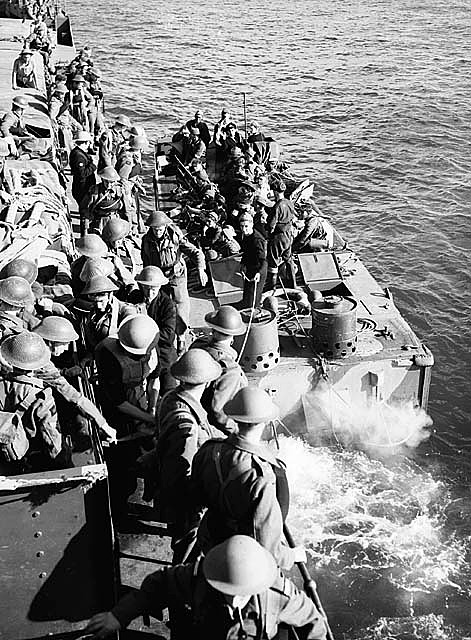
Troops of the Cameron Highlanders of
Canada in landing craft prior to raid on Dieppe
Library and Archives Canada
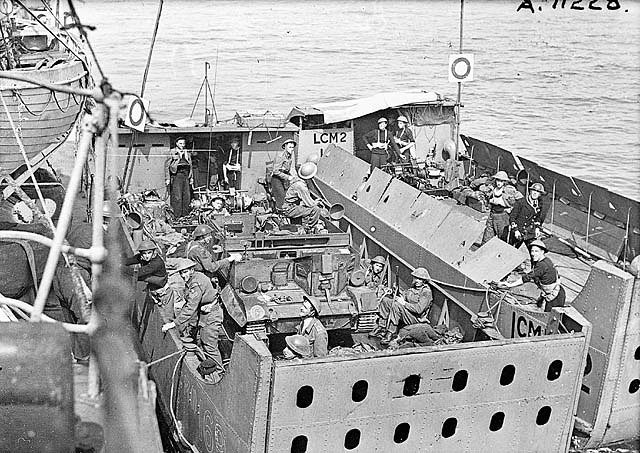
Troops of the Cameron Highlanders of
Canada in landing craft prior to raid on Dieppe
Library and Archives Canada
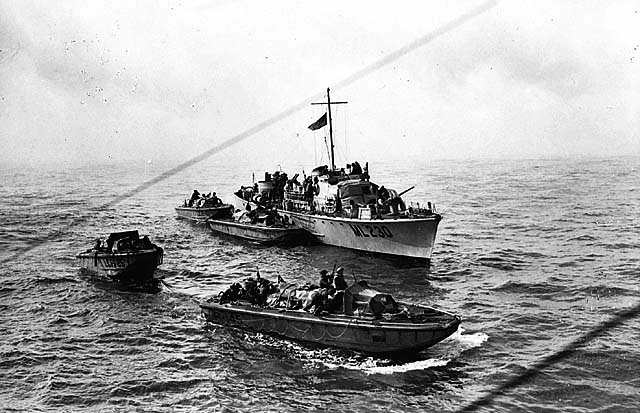
Personnel landing craft draw away from
a motor torpedo boat
to start their run-in to the beaches
during the raid on Dieppe
Library and Archives Canada
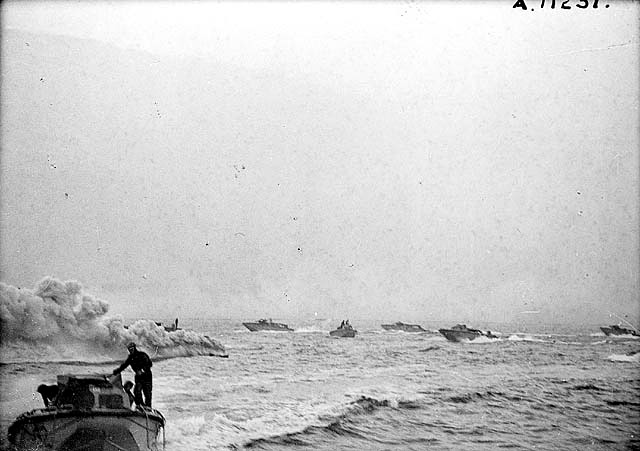
Landing craft taking part in Operation
Jubilee, the raid on Dieppe
Library and Archives Canada
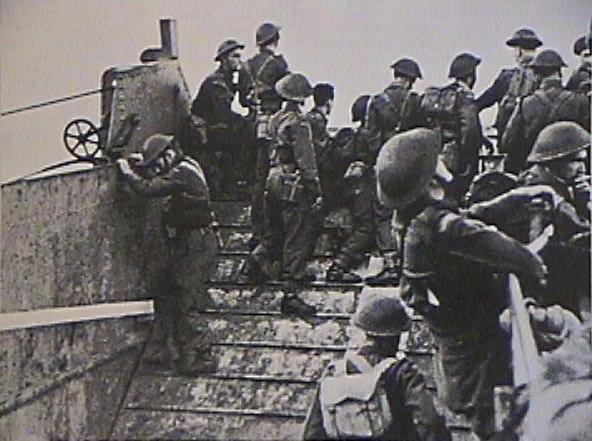
Last minutes of calm before the massacre.
Futher waves of troops head toward
the carnage on the beaches,
under the partial cover of a smokescreen.
Library and Archives Canada
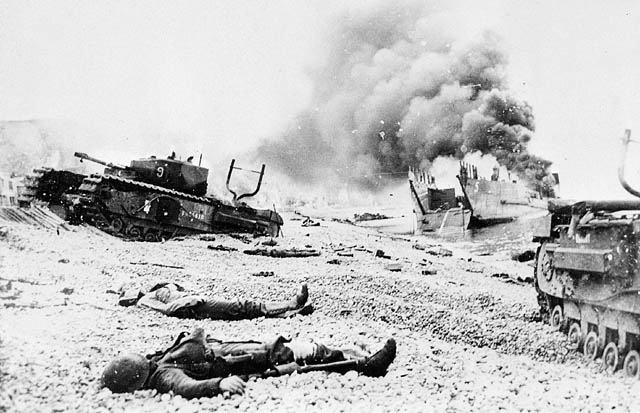
Bodies of a Canadian soldier and a U.S.
Army Ranger lying among damaged
landing craft and 'Churchill' tanks
of the Calgary Regiment following Operation "Jubilee"
Library and Archives Canada
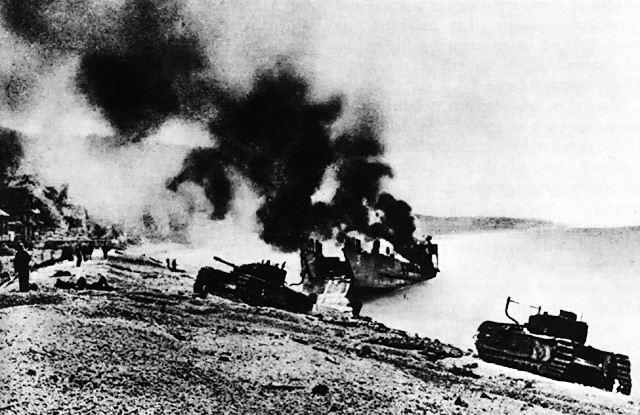
British landing craft on the Dieppe
beach
Library and Archives Canada
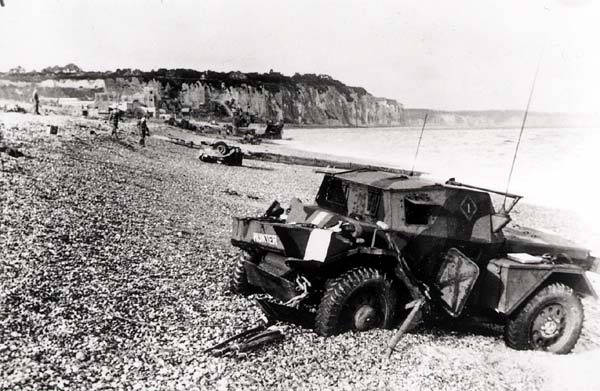
Dieppe's pebble beach and cliff immediately
following the raid on August 19th, 1942.
A scout car has been abandoned
Library and Archives Canada
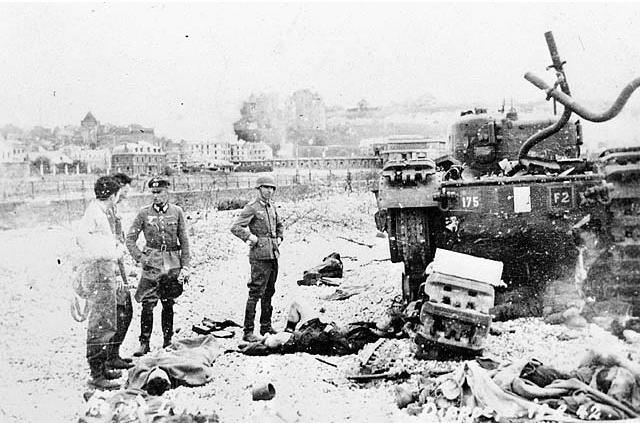
German Officers standing on Dieppe beach
among Canadian dead and wounded
Library and Archives Canada
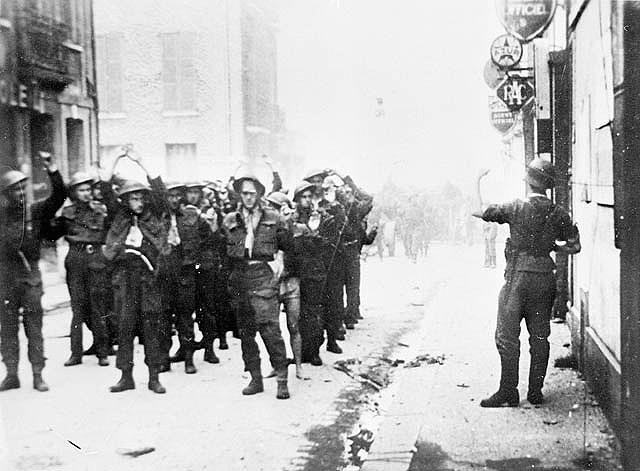
Canadian prisoners being paraded through
Dieppe
Library and Archives Canada
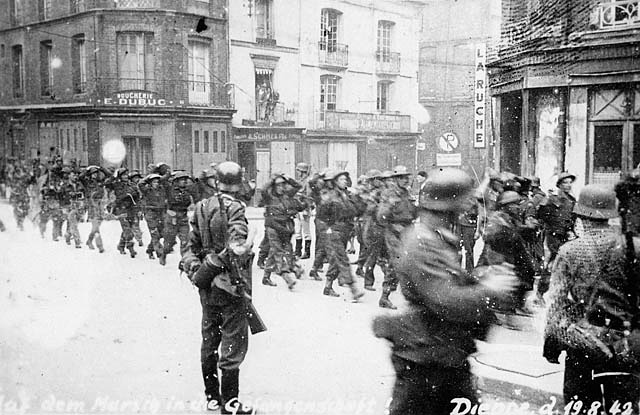
Canadian prisoners being paraded through
Dieppe
Library and Archives Canada
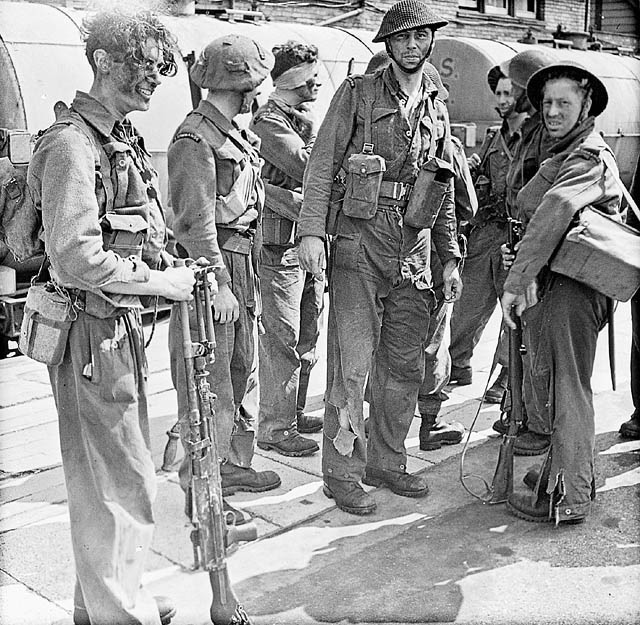
Canadians that made it back
Library and Archives Canada
|
|
THE
BRITISH HOLD ... AND THEN BEGIN A ROLL-BACK ...
OF
THE GERMANS AND ITALIANS IN EGYPT AND
LIBYA
|
|
|
Late October 1942 – The British
make a determined effort at al Alamein (Egypt)
to stop the German advance
across North Africa toward the strategic Suez Canal
|
Egypt
Attention was thus turned to the "soft underbelly" of the German (and
Italian) Fascist domains: North Africa. The Germans had joined
the Italians in an offensive against the wearied British, aimed at
Egypt and in particular the Suez Canal which the Germans hoped to
capture, cutting the shortest supply line between Britain and her
allies in India, Australia and New Zealand. The "Desert Fox"
Erwin Rommel was given command ... and began to give demonstration of
his high reputation as a fighter as he pushed eastward from Libya into
Egypt against the British.
But the British knew that they absolutely must not let Egypt fall to
the Germans and Italians. In the night of October 23rd (1942) the
British 8th Army, commanded by Alexander and led by Montgomery, began
their counterattack at Alamein on Rommel’s Afrika Korps. The
British broke through the Axis center and by November 4th had encircled
huge numbers of German and Italian troops – and had a broken Afrika
Korps falling back rapidly across northern Libya to avoid total
annihilation. At the Libyan port of Tobruk alone, nineteen
thousand Italians and six thousand German troops were taken prisoner. |
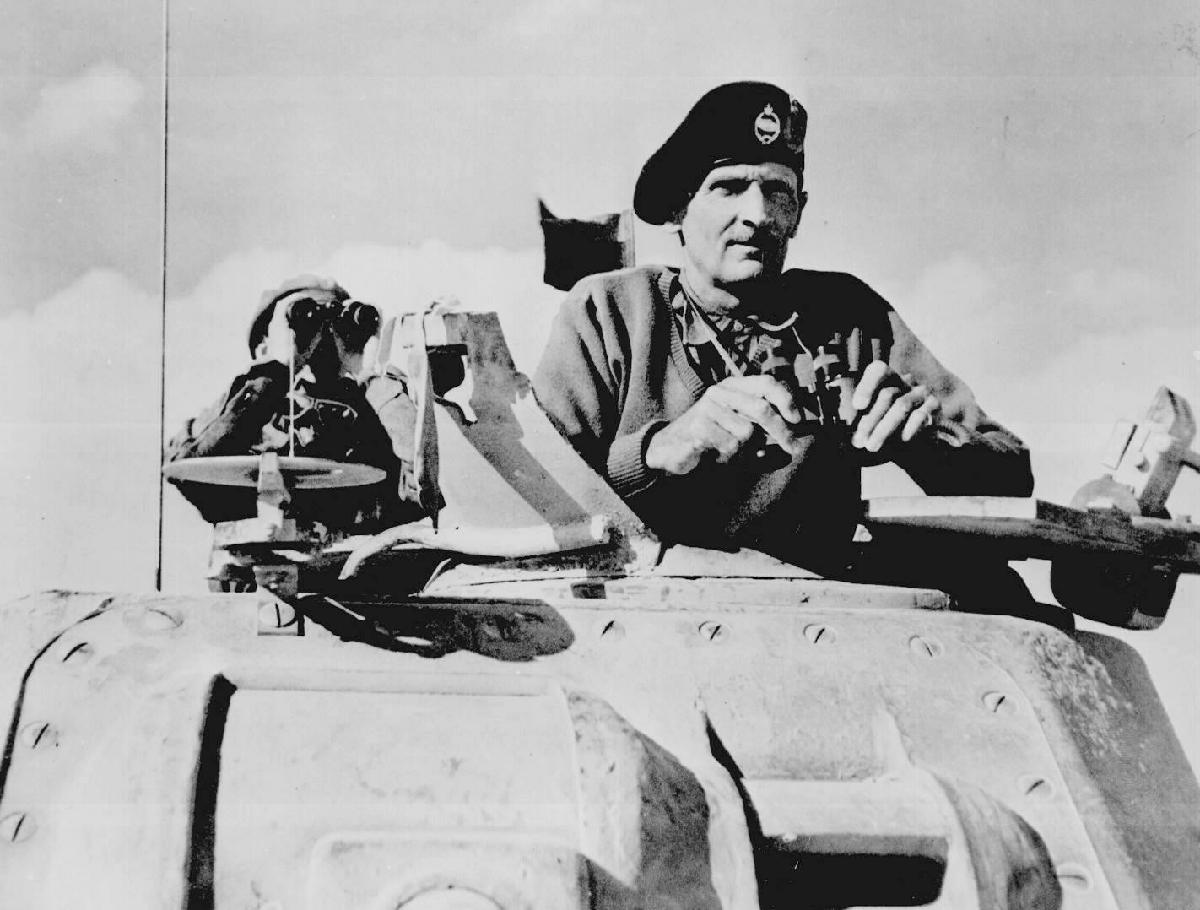
"General Bernard L. Montgomery watches
his tanks move up." North Africa, November 1942.
National Archives
208-PU-138LL-3.
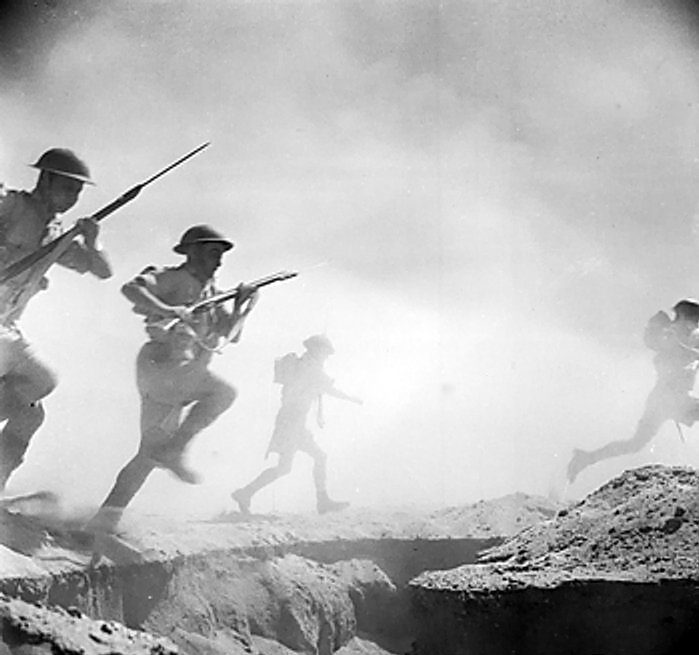
British troops on the
offensive
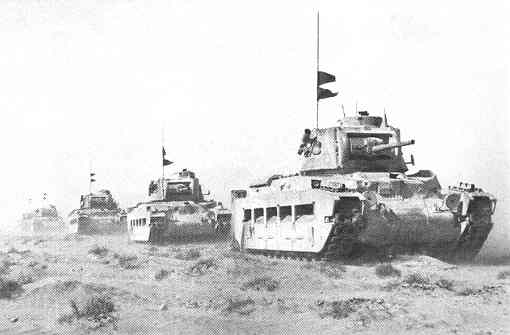
British tanks in North
Africa
National Archives
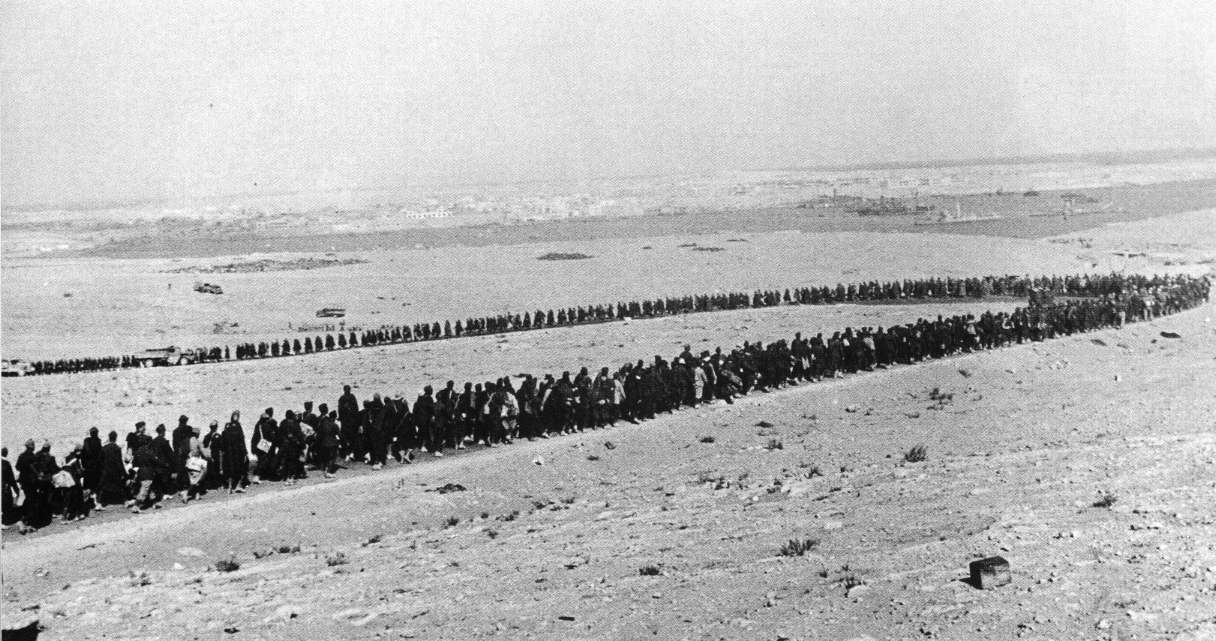
19,000 Italians and 6,000
Germans taken prisoner at the Libyan port of Tobruk
British War Office
|
|
THE
AMERICANS AND BRITISH PUSH EAST FROM THE WESTERN PORTION OF
NORTH AFRICA
|
|
|
Meanwhile, on the Western
shores of North Africa (Morocco and Algeria), Americans and
British troops
open up a another front against both the Vichy French and the Germans.
This is the Americans' first
military action in the European theater.
|
French North Africa
Meanwhile at that same time (November 8th) British and American troops
landed in French North Africa, at Algiers and Oran in Algeria and a few
hours later at Rabat and Casablanca along the Atlantic coast of
Morocco. They had been hoping to find the French accommodating to this
Allied intrusion. The French Vichy government, under the thumb of
Hitler, however turned out to be not at all accommodating – and
"Operation Torch" met with serious Vichy French resistance in French
Morocco and French Algeria. Only in the town of Algiers, where the
French Resistance overthrew the local Vichy French government, did the
French cooperate with the Allies. But by a strange coincidence,
Admiral François Darlan - former second in command of Vichy France and
still head of the French navy – happened to arrive in Algiers for a
visit with his son the day before the Allied assault on the 8th ... and
when captured agreed with the Allied commanders to bring the Vichy
French government in Africa over to the Allied side ... as long as he
was recognized as head of that government. The deal was agreed on, and
Oran surrendered to the Allies on the 10th of November and all of
Morocco on the 11th.
The Germans, hearing of this development and furious at what they saw
as treachery, seized control of Vichy French territory on the French
mainland. But French Admiral Auphan (replacing the ‘traitor’ Darlan)
guessed that the Germans planned to seize the French fleet at Toulon,
and on November 27th gave the orders to have all ships scuttled (77
ships sunk before the Germans could stop the action; though some of
them would be salvaged and restored as fighting ships for the Italians.)
Then Darlan was assassinated on December 24th by a French Resistance
fighter, throwing confusion into the whole French affair. Yet the
assassination solved for the Allies the greatest part of the problem of
which French leader the British and Americans needed to be working
through: Darlan, Henri Giraud or de Gaulle? With Darlan’s death, De
Gaulle agreed to cooperate with Giraud. Thus General Giraud was
recognized by the Allies as the new head of the newly allied French
government in Africa. Nonetheless divisions within the ranks of the
French between de Gaulle and other French generals such as Giraud and
Philippe Leclerc would remain an on-going problem in trying to work
with the French.
As the Allies pushed further East along the North African coast,
heading into French Tunisia, the Germans gathered there a large force
to oppose them. This German group was joined by the forces of German
general Rommel, who in the face of British advances under General
Montgomery had been retreating west along the North African coast from
Egypt through Libya. Here in Tunisia the Germans and Italians knew
that they had to take a strong stand – or lose their position along the
entire southern Mediterranean. At first the Allies were forced back in
the West (the still largely inexperienced Americans took a heavy
beating at the Kasserine Pass) – but then on May 6th the Americans and
British regrouped at Bizerte and Tunis and, having already cut off the
German and Italian escape route by sea, soon had them completely
surrounded. On the 13th the Germans and Italians surrendered ... and
as a result the Allies found themselves in possession of a quarter of a
million German and Italian prisoners.
|
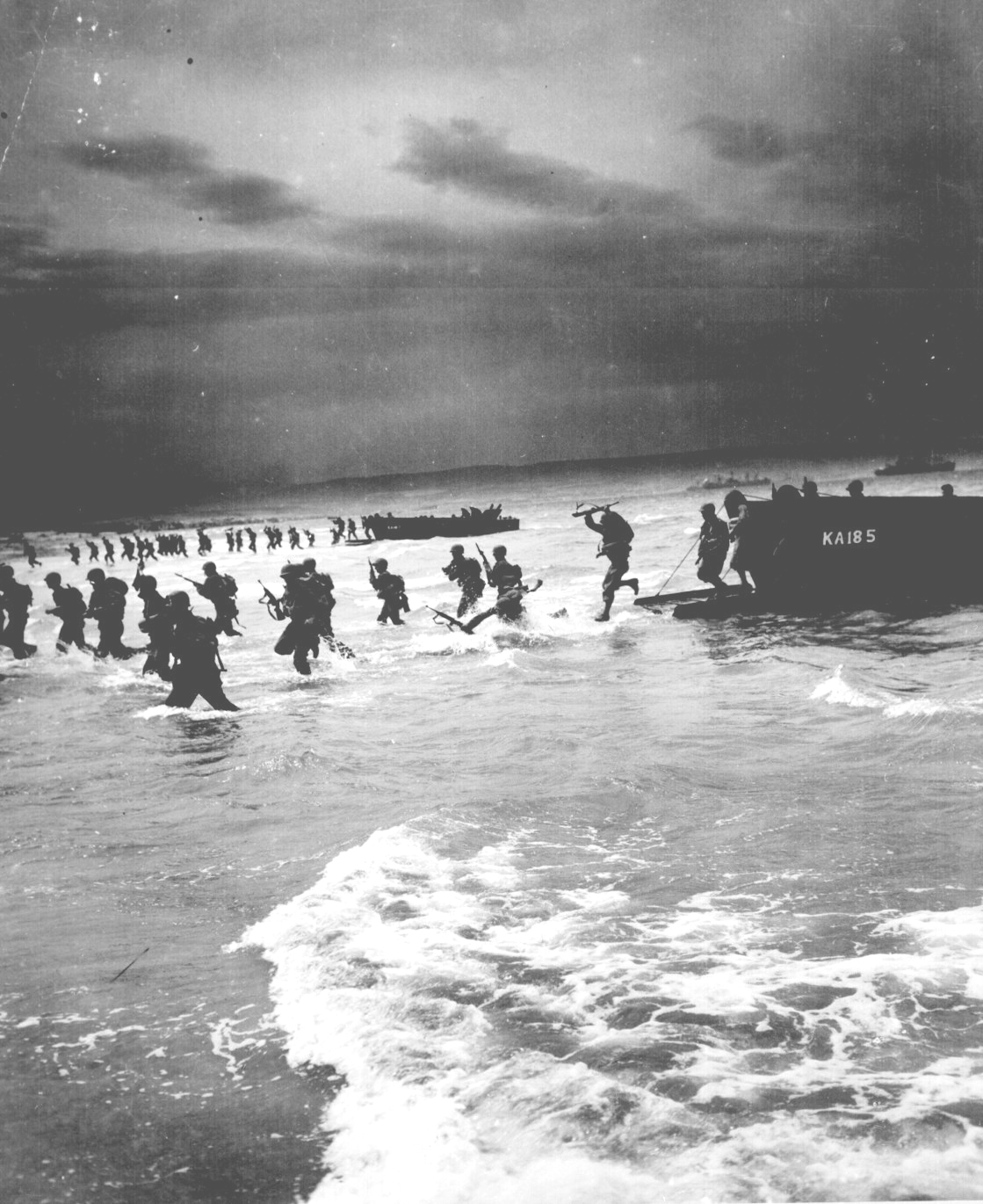
"From Coast Guard-manned "sea-horse"
landing craft, American troops leap forward
to storm a North African beach during
final amphibious maneuvers." James D. Rose, Jr.
National Archives 26-G-2326.
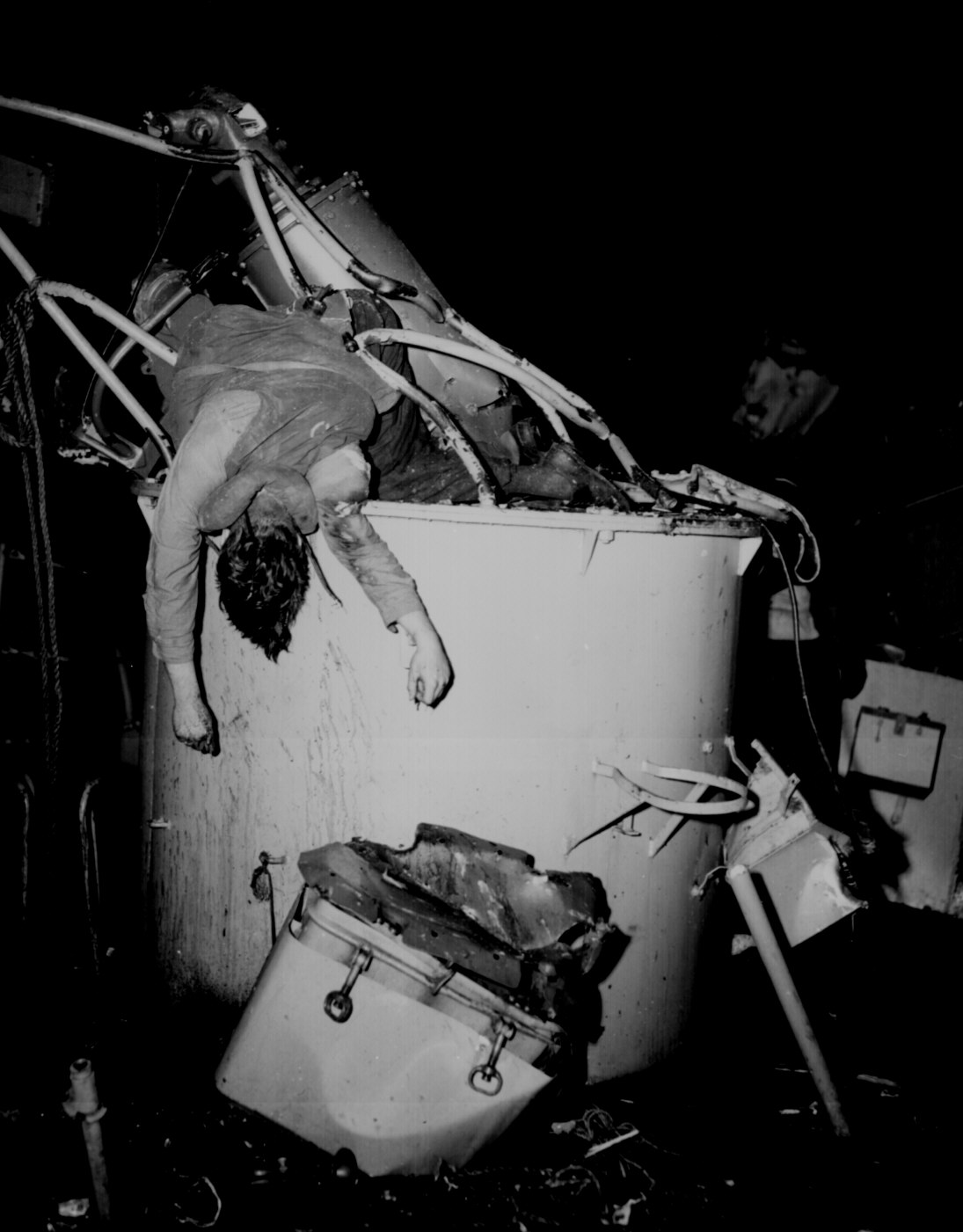
"A Coast Guard seaman died at his battle
station aboard the USS Menges, torpedoed
by a nazi sub in the Mediterranean.
He represents the old Coast Guard expression,
`You have to go out, but you don't
have to come back.'" PhoM1c. Arthur Green.
National Archives 26-G-2330
Plans are laid out for action in North Africa (aimed at the Italian "soft underbelly")
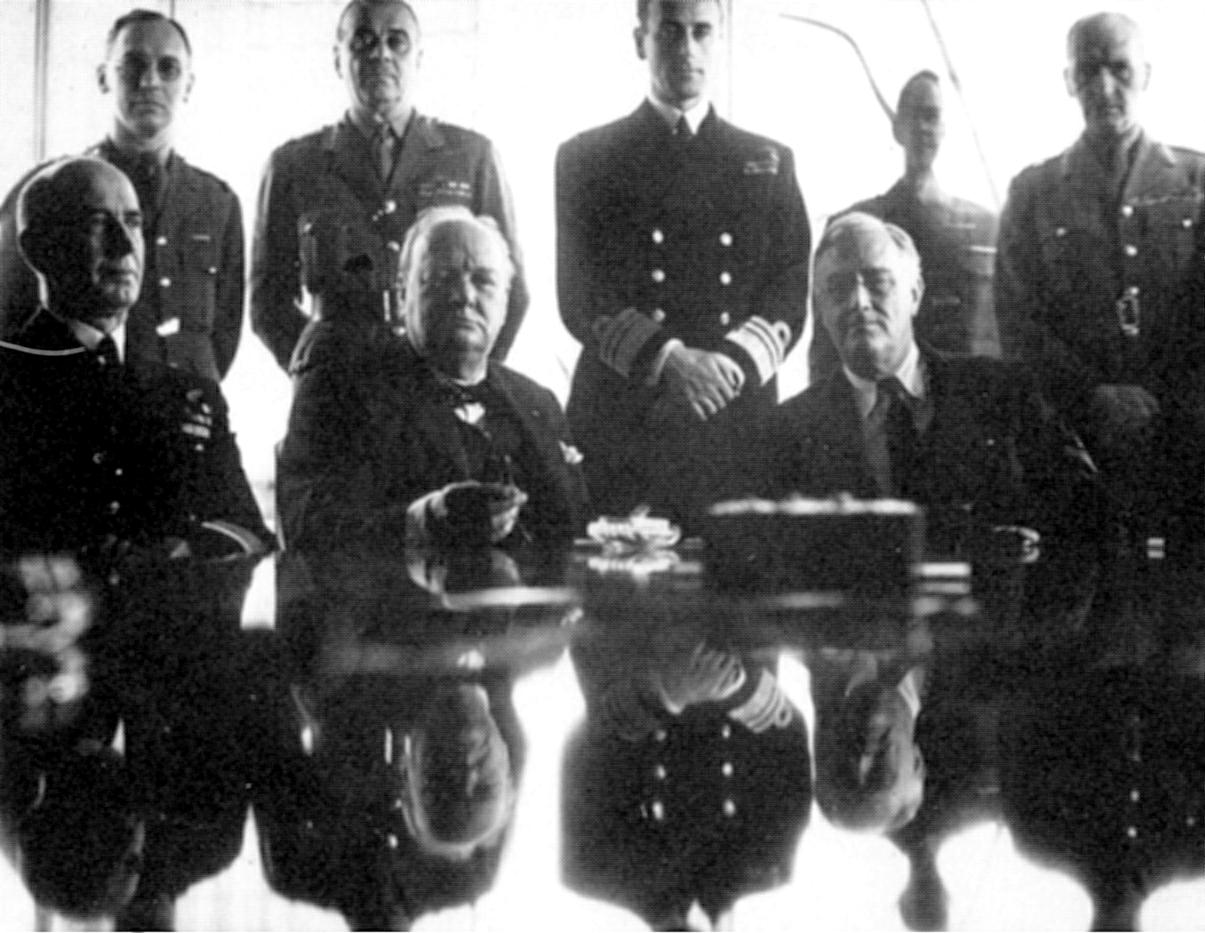
U.S. - British Conference at Casablanca - January 1943
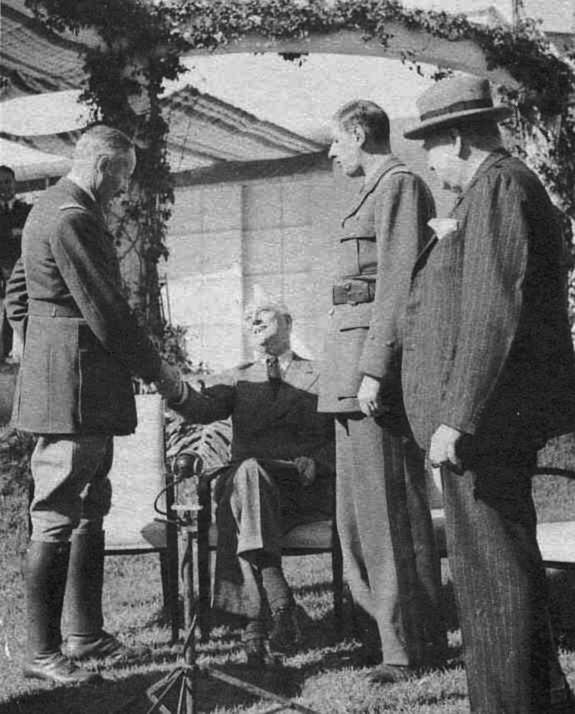
Giraud, Roosevelt, De Gaulle,
Churchill - Casablanca Conference - January 1943
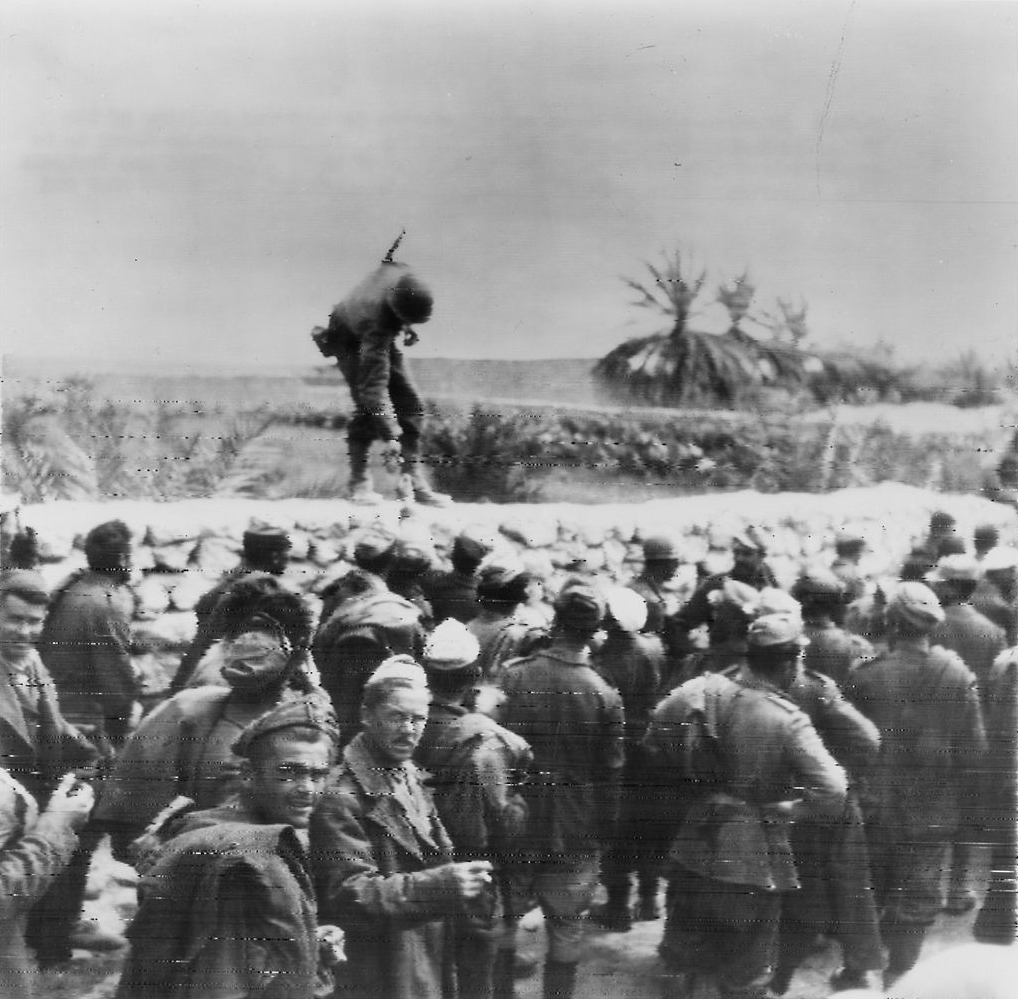
Captured Italian troops at El Guettar, Tunisia - 1943
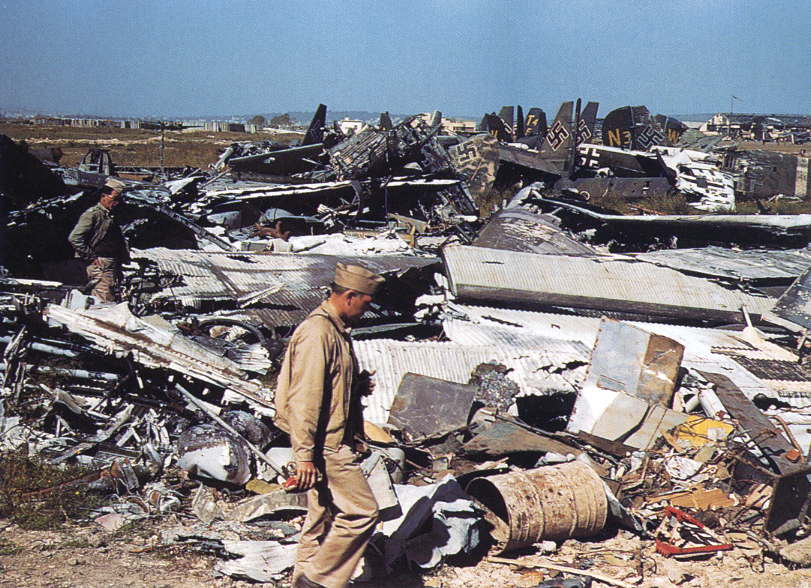
A GI surveying the wreckage
of German planes at Tunis in May 1943
(at this
point North Africa was now cleared of all Axis forces)
By mid 1943 the British and
Americans have cleared Africa of German and Italian forces;
the Russians, meanwhile
are making great advances in their own country against the Germans,
as the latter are forced
to fall back in order to survive
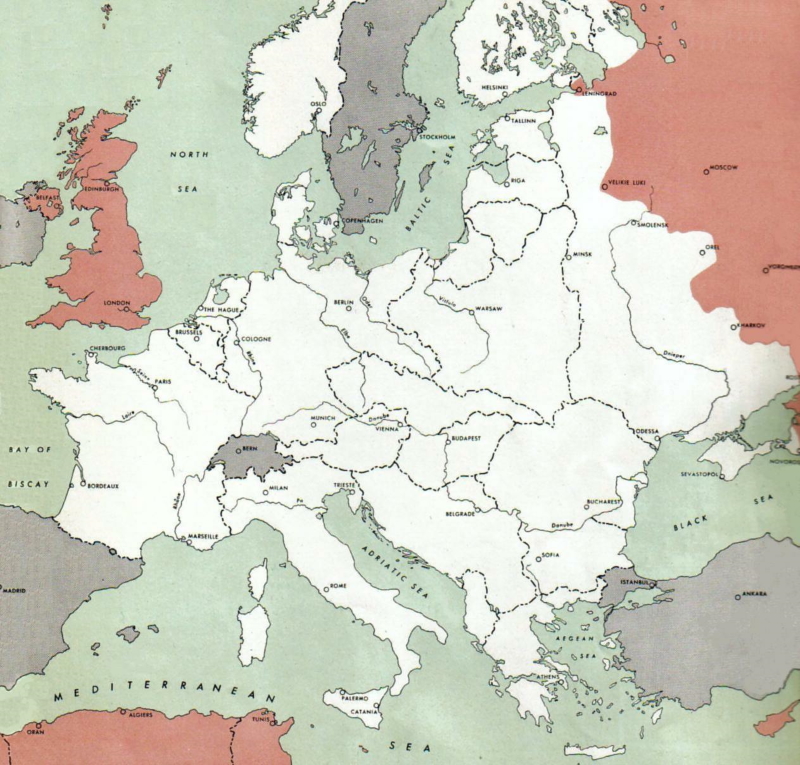
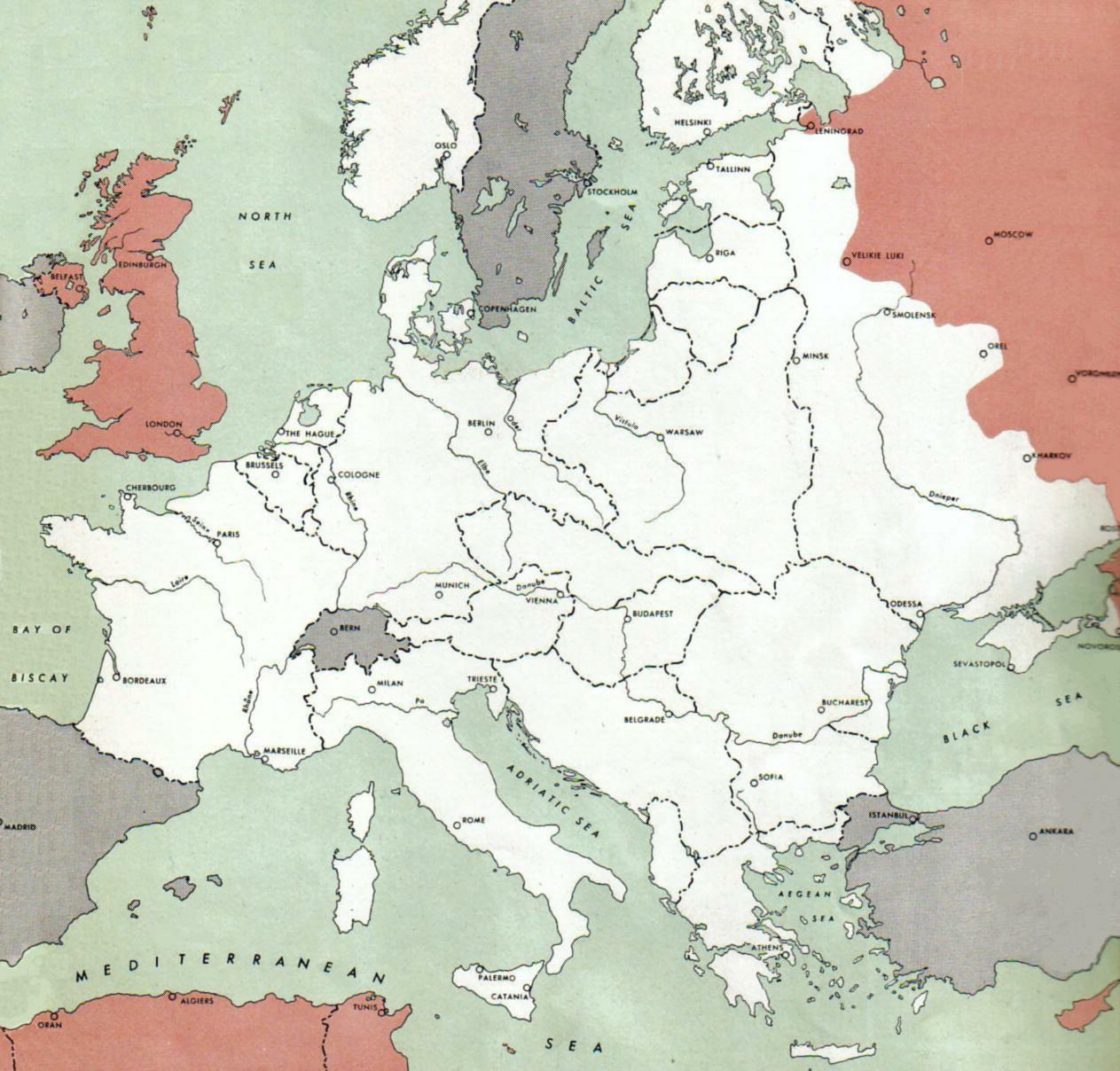
The battlefronts as of July
1, 1943
|
|
THEN
THE ALLIES TURN FROM AFRICA
NORTH
TO THE ISLAND OF SICILY (SUMMER OF 1943)
|
|
|
Sicily,
just opposite Tunisia, was the Allies’ next target. On July 10th
British and American troops came ashore on Sicily’s southern coast, and
having caught the Italians and Germans by surprise, by the 12th had
themselves securely established just inland from there. From this
point it was a matter of simply throwing Allied forces against the Axis
troops and pushing them back ...gaining ground slowly. Within two
weeks, the Italians and Germans were holding only the more mountainous
northeastern corner of the island. By the 17th of August they had
seized the town of Messina, just opposite the mainland of Italy, the
last holdout of the Axis troops. Sicily was theirs.
But the Axis, seeing another entrapment similar to the one in Tunisia,
had begun to evacuate their troops from Sicily on the 11th, moving them
to the mainland of Italy. They were able to get most of the
German troops away from Sicily but had the much larger part of the
Italian troops captured before completing what they could of the
evacuation. |
The Battle for Sicily
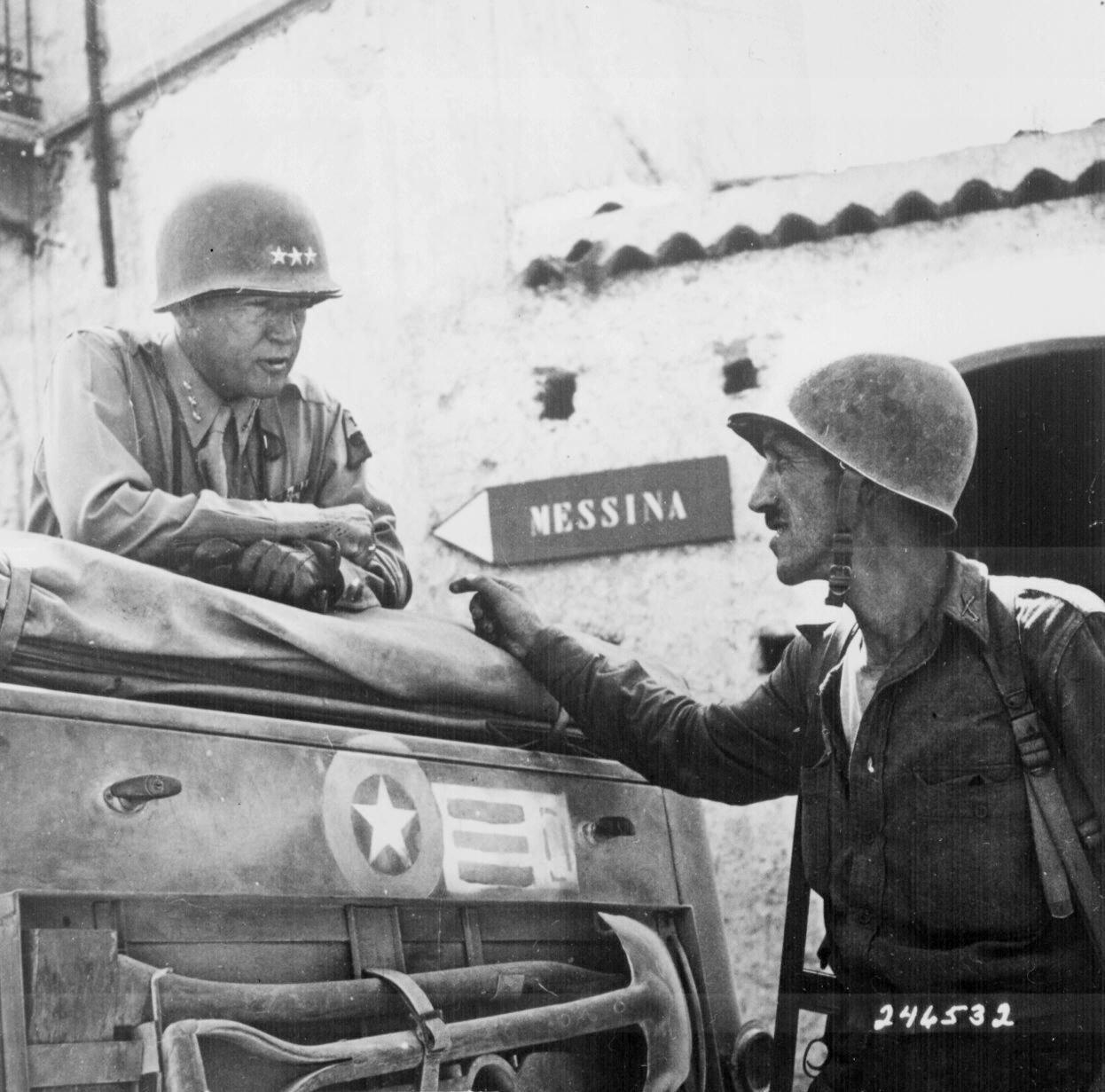
"Lt. Col. Lyle Bernard, CO, 30th Infantry
Regiment, a prominent figure
in the second daring amphibious landing
behind enemy lines on Sicily's north coast,
discusses military strategy with Lt.
Gen. George S. Patton. Near Brolo." 1943.
National Archives
111-SC-246532.
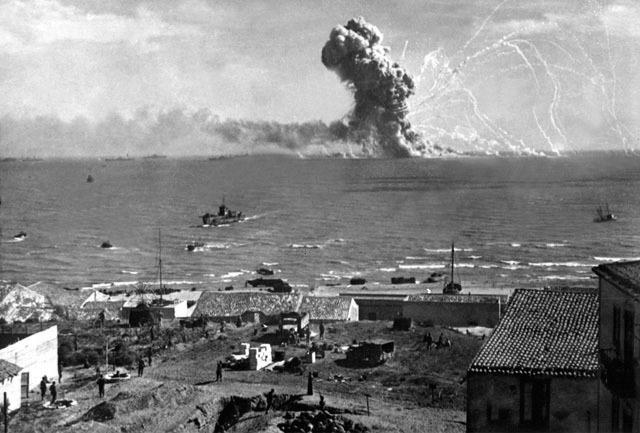
American ammunitions cargo
ship hit by a bomb from a German plane - July1943
National Archives

"Private Roy Humphrey is being given
blood plasma by Pfc. Harvey White,
after he was wounded by shrapnel, on
9 August 1943 in Sicily." Wever.
National Archives
111-SC-178198
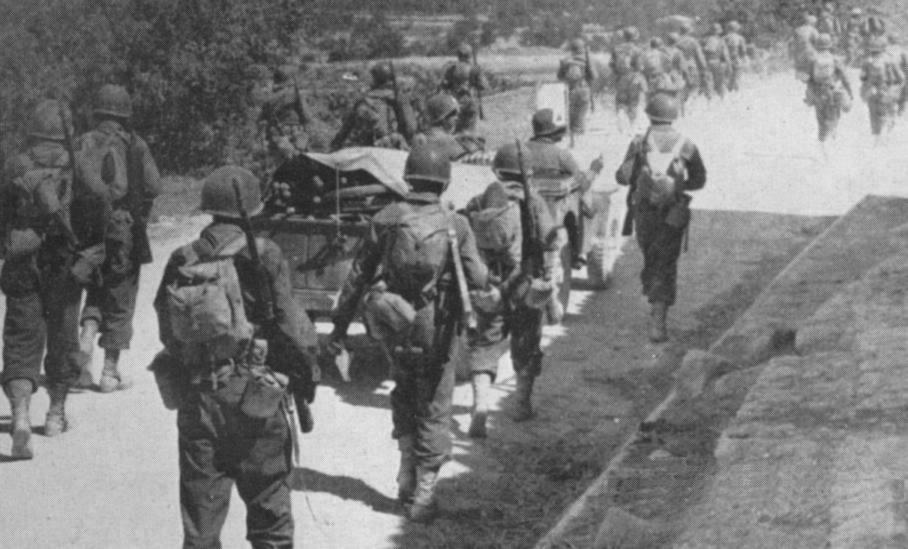
US troops marching toward
Northern Sicily
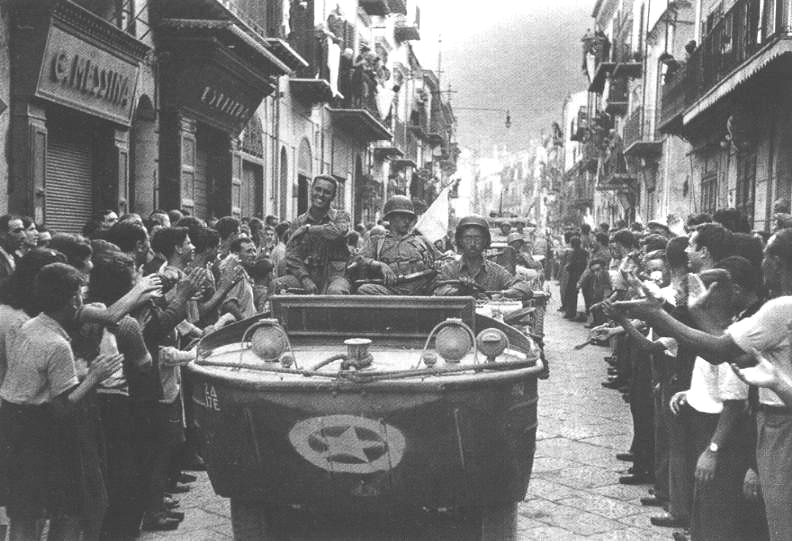
GIs entering Palermo,
Sicily
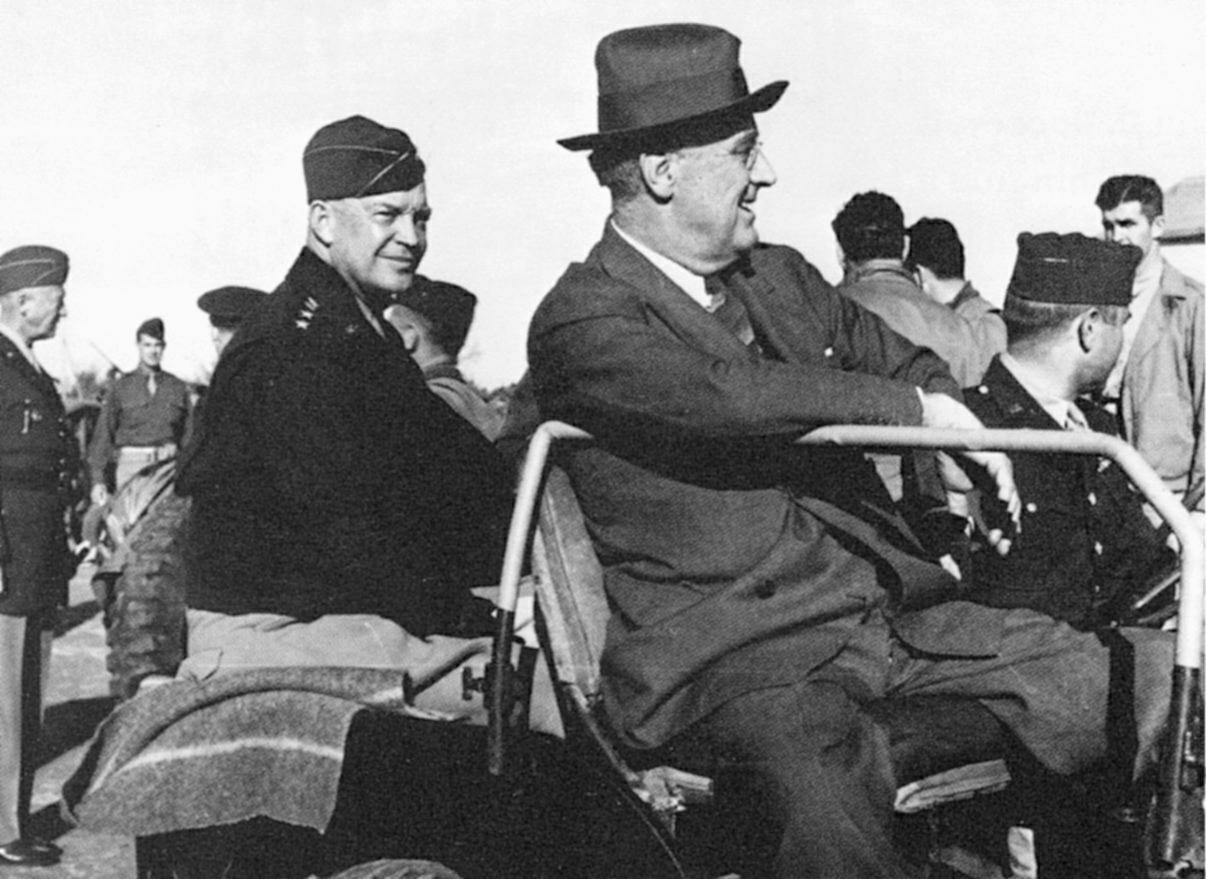
Roosevelt meets with Eisenhower
in Sicily - 1943
|
|
FROM
SICILY THE ALLIES THEN JUMP TO SOUTHERN ITALY
(SEPTEMBER
1943)
|
|
|
|
Mussolini overthrown
The
Fascist Grand Council in Rome had seen the writing on the wall with the
beginning of the Allied assault on Sicily ... and on July 24th (1943)
voted Mussolini out of power. He was arrested the next day and
then moved around as a prisoner from place to place to avoid being set
free by either the Germans or pro-Mussolini Italians.
On September 3rd, the British crossed the Messina straits to Reggio
Calabria, located along the southern shore of Italy ... on the very
same day that the Italians
indicated that they desired an armistice with the Allies. This
created massive confusion among the Axis powers, forcing German troops
to have to focus on disarming their former Italian allies at the same
time the Americans and British were preparing their Italian campaign.
On September 8th a full Italian armistice was announced ... taking the
Italians out of the contest. Now the Germans were forced to fight
in Italy on their own against the advancing Allied armies. But
Italy was very mountainous and therefore much easier to defend against
advancing enemies. The Allies would discover this fact rather
immediately.
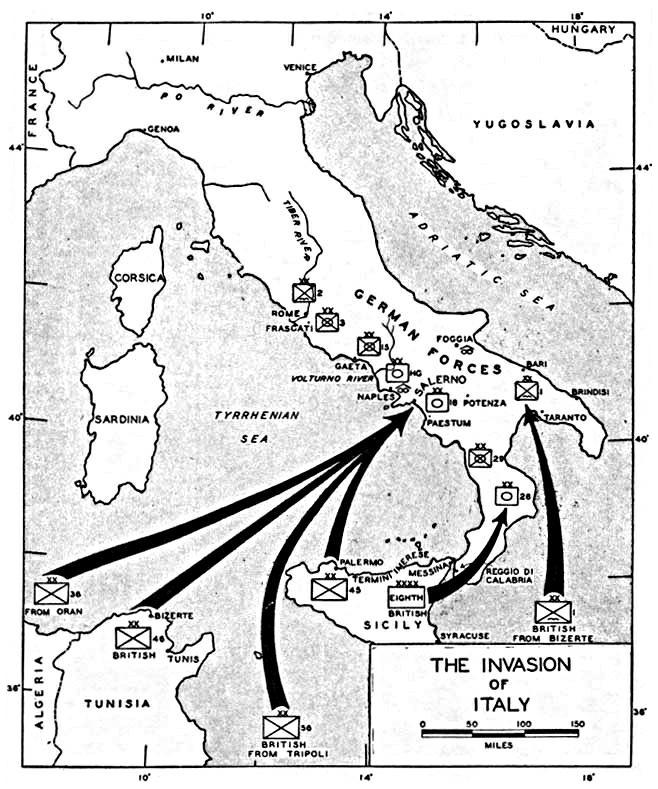
On the 9th of September Americans sent troops ashore at Salerno, about
halfway up the Italian West Coast between Rome and the southern tip of
the Italian peninsula, thus bypassing German troops located in the
Italian extreme south. They were hoping for light resistance, but
found the Germans to be waiting for them. Hard fighting
nonetheless secured the Americans the town and then they moved north to
capture the important port of Naples. Then they ran into the first
of the strong defensive lines German General Kesselring had placed
across the Italian peninsula, west to east. At this point the
progress against the Germans became murderously slow.
Likewise the British jumped north to the port of Taranto, with the
intentions of moving northward along the Italian east coast ... and at
first encountered little German opposition. The British then
began a rapid advance according to plans until they finally ran into
the same line of defense in the east that the Americans had encountered
in the west. Here too things for the British slowed up almost to
a complete halt.
|
The Battle for Italy ("Operation
Avalanche") begins in early September 1943
with the main attack at Salerno
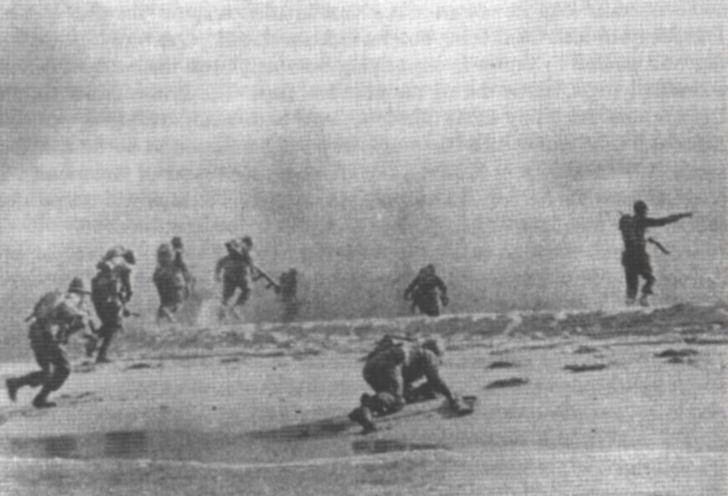
Behind a screen of smoke,
Thunderbirds hitting the Salerno beachhead, September 1943
Courtesy of the 45th Infantry
Division Archives
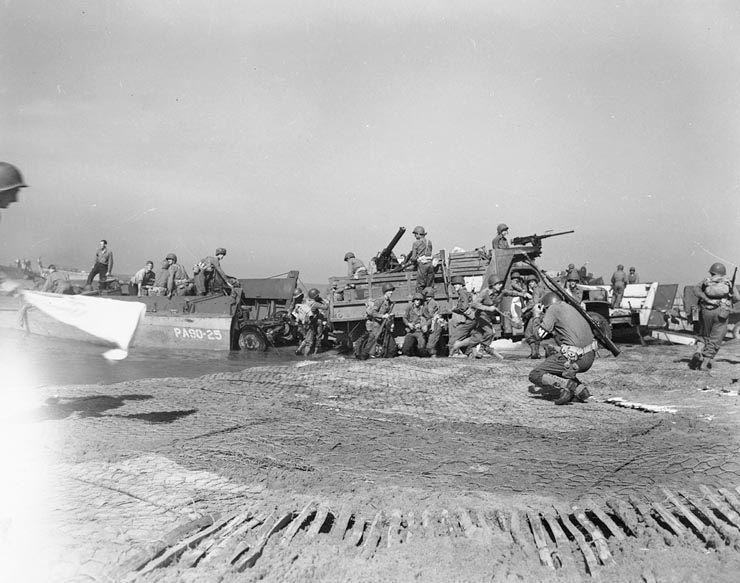
Artillery being landed during
the invasion of mainland Italy at Salerno, September 1943.
The military policeman (MP)
in the foreground is ducking from a near-by German shell hit.
US Navy
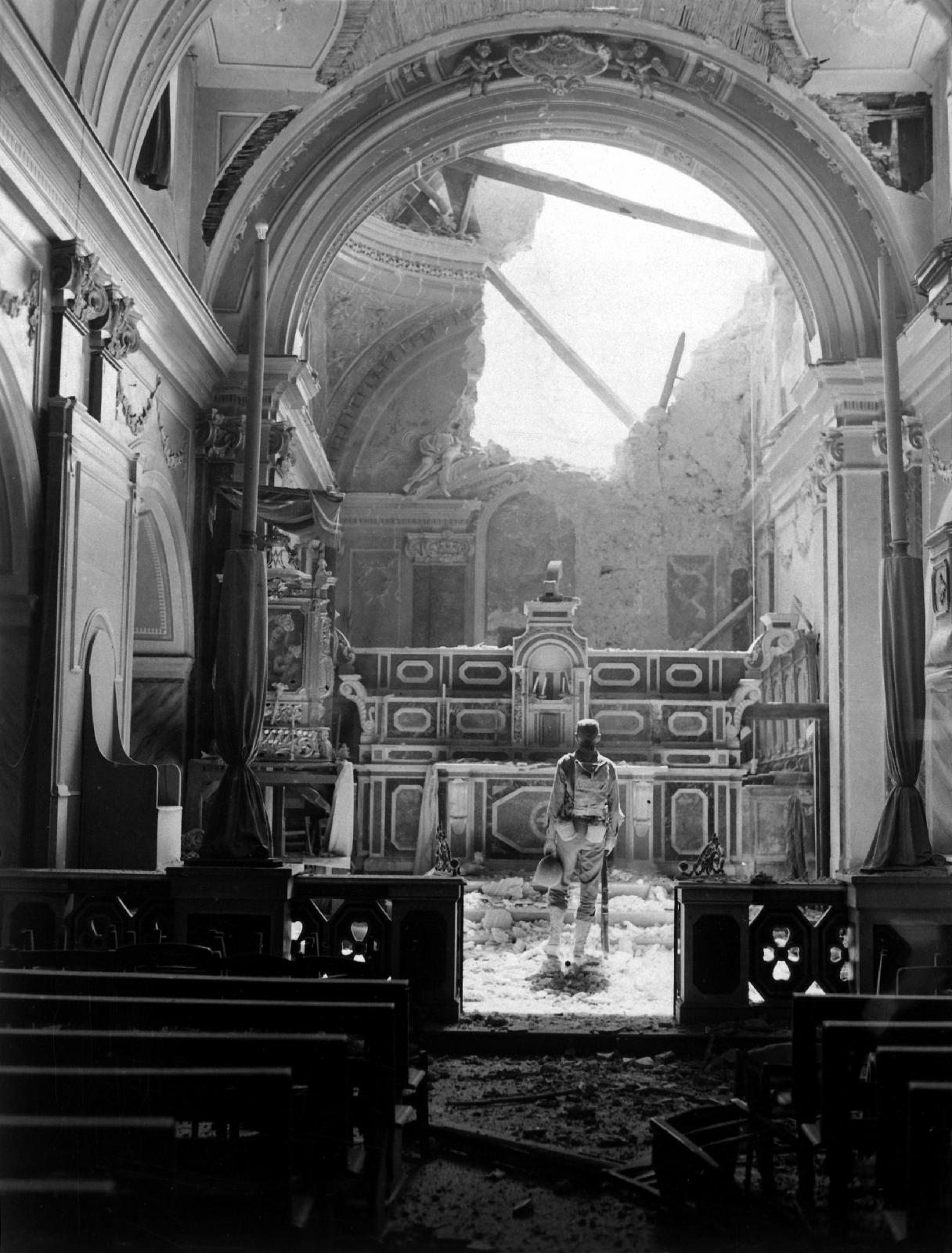
"Pvt. Paul Oglesby, 30th Infantry, standing
in reverence before an altar in a damaged Catholic
Church.
Note: pews at left appear undamaged,
while bomb-shattered roof is strewn about
the sanctuary.
Acerno, Italy." Benson, September 23,
1943.
National Archives
111-SC-188691
But American and British
progress is slow against Germans well-entrenched in the mountains of Italy
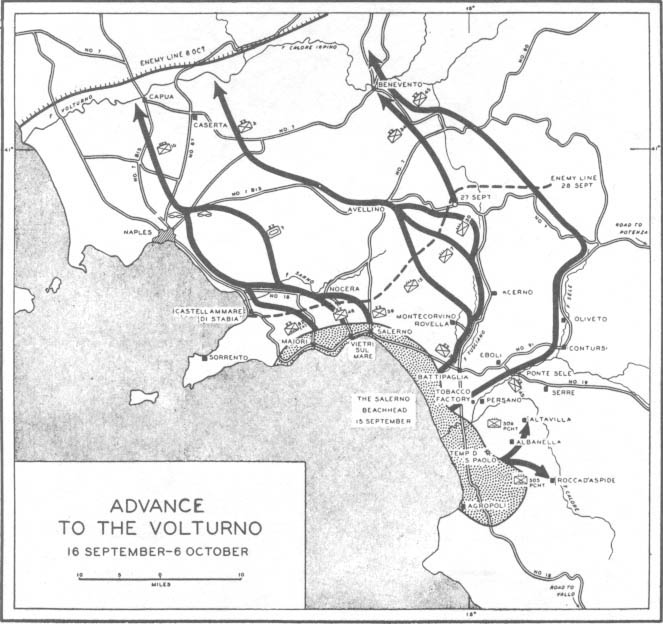
Allied Advance from Salerno
to the Volturno 16 September to 6 October 1943
Historical Division US War
Department
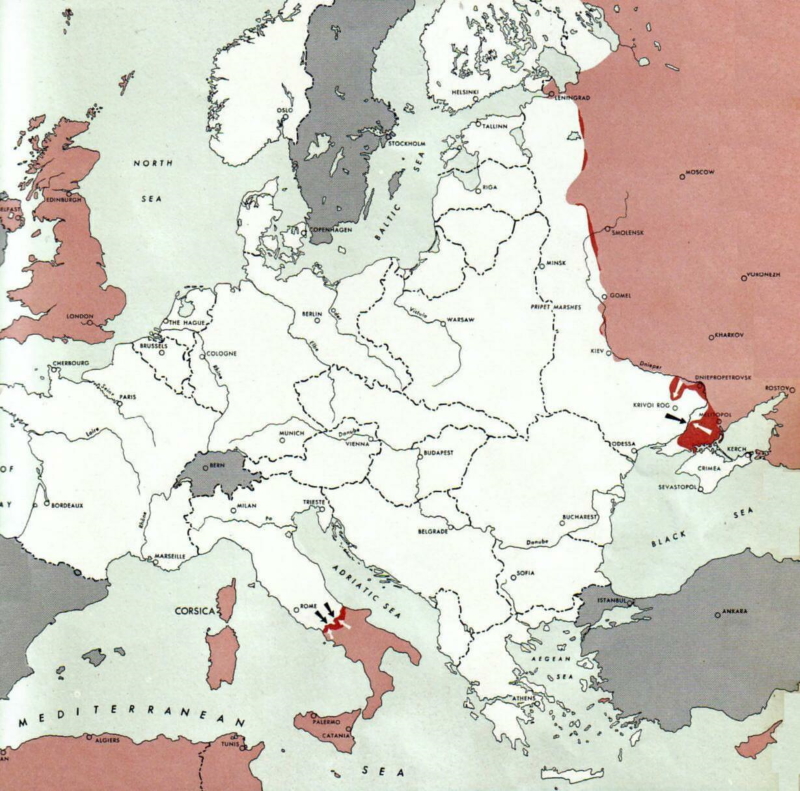
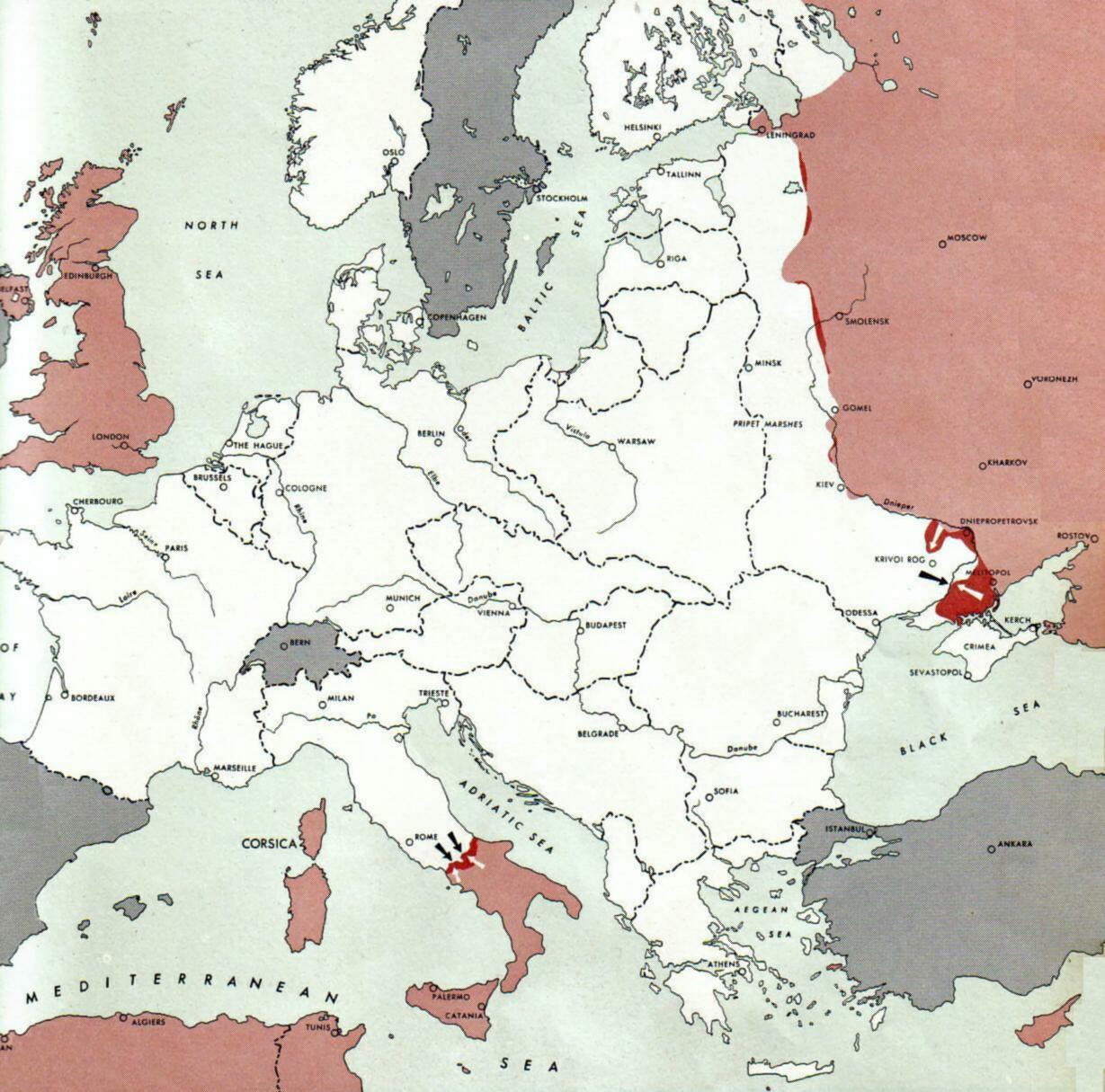
The battlefronts as of November
1, 1943
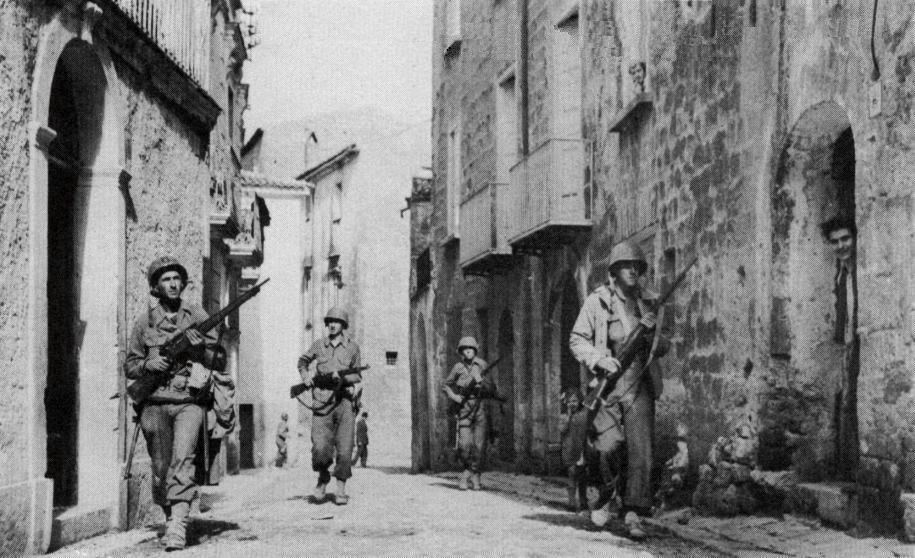
179th Infantry looking for
snipers in Caiazzo, Italy
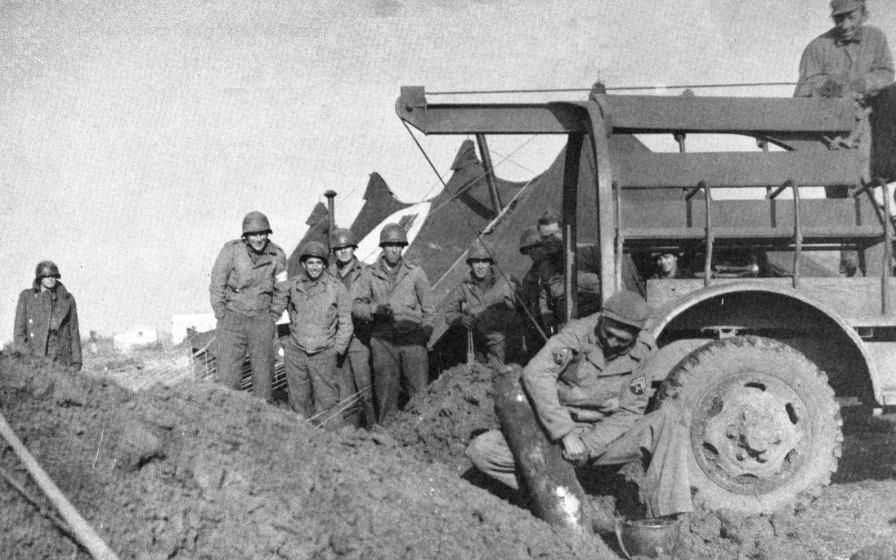
A German dud is dug out of
the ground near the 120th Med. Bn.
clearing station at Presenzano,
Italy - December 1943
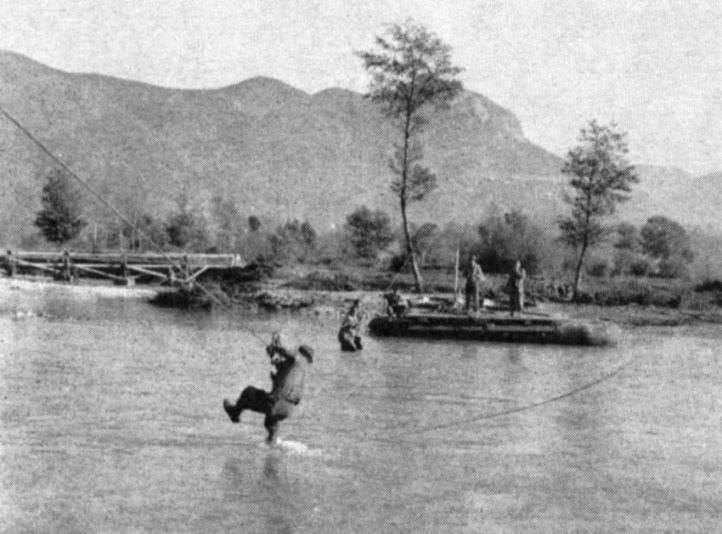
Engineers starting construction
of a Volturno River crossing
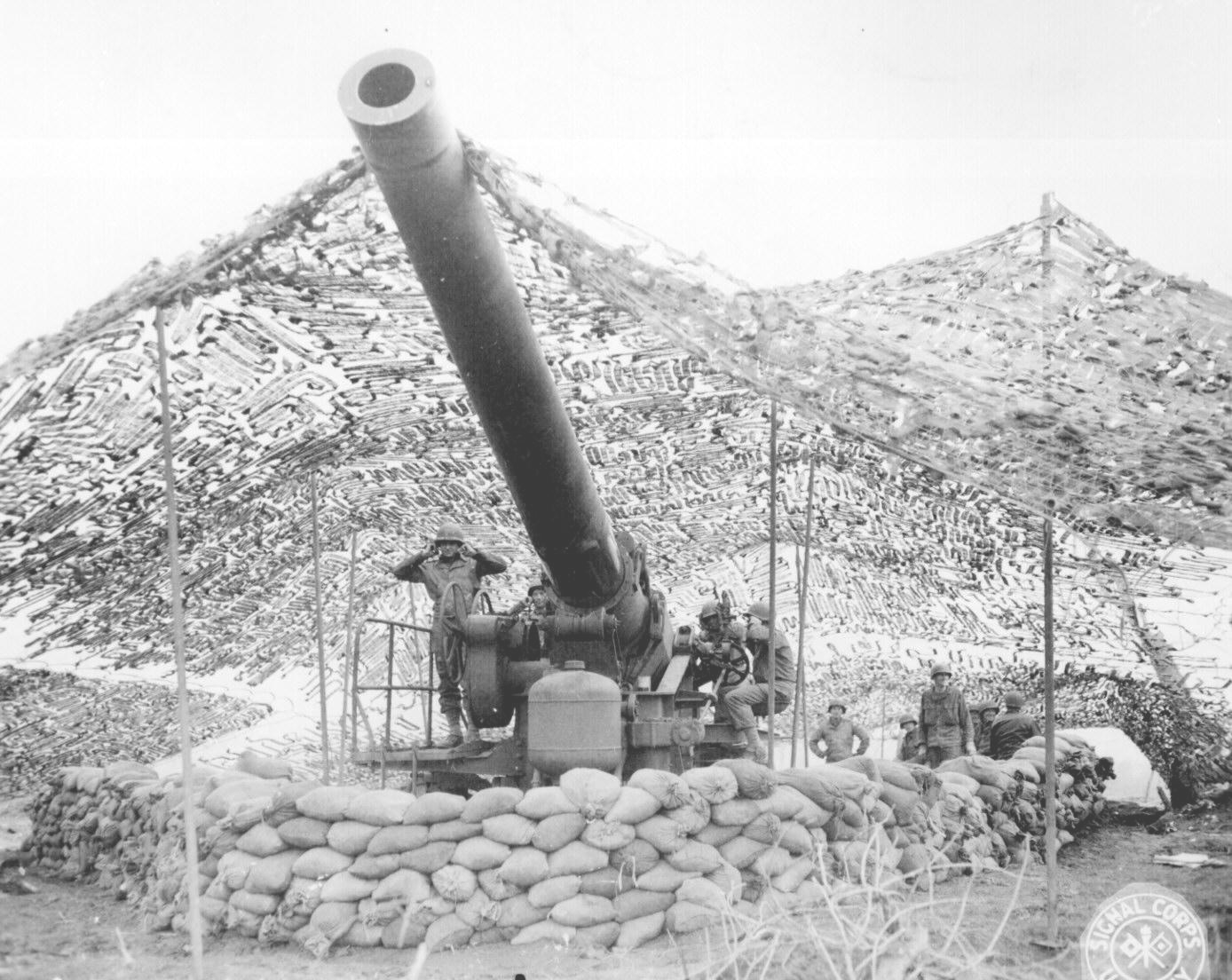
"Front view of 240mm howitzer
of Battery `B', 697th Field Artillery Battalion,
just before firing into
German held territory. Mignano area, Italy." Boyle, January 30, 1944.
National Archives
111-SC-187126
|
|
THE
GERMAN GUSTAV LINE ... AND MONTE CASINO
JANUARY-MAY
1944
|
|
|
Indeed,
German General Albert Kesselring established not one line of defense
across the peninsula but several, one behind the other.
Consequently, progress for the Allies against the Germans in Italy over
the next year and a half turned out to be slow, painfully slow.
In fact, the Allied advance was so slow that by the beginning of 1944,
they had reached only as far north as the area where the ancient abbey
of Monte Cassino was located, perched atop another of Italy's
mountains.
Tragically, they reduced this beautiful site to ashes, presuming
Germans to be well situated there – although actually the Germans
decided to take advantage of this precious position only after the
Allies had destroyed the abbey. And in the end, all this did
little to move the battle line further north. |
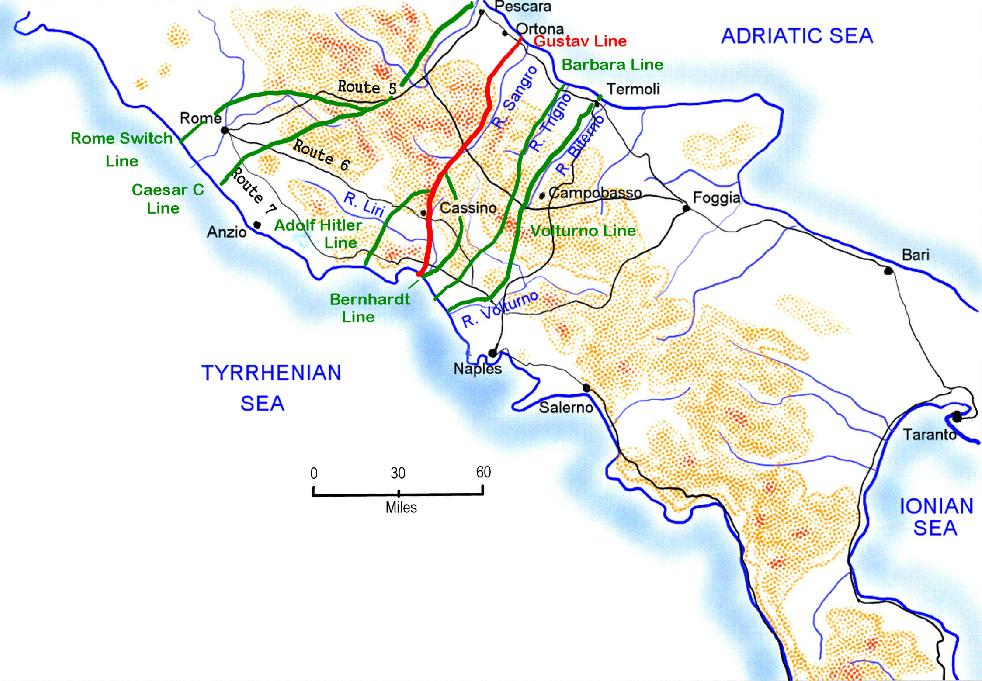
The Italian mountains and rivers gave
the Germans a number of places
to try to hold back the Allied advance
up the Italian peninsula
Stephen Kirrage
The Battle of Monte Casino
- as the Allies look for a break through the Gustav Line - January
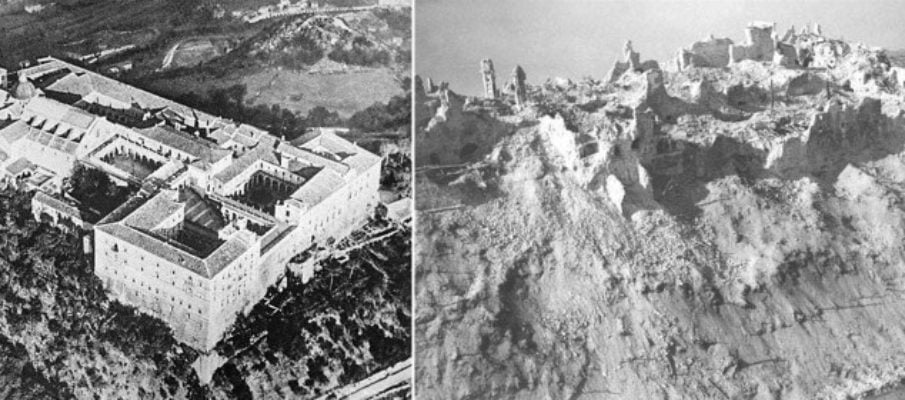
The ancient abbey of Monte Cassino - before and after the Allied shelling
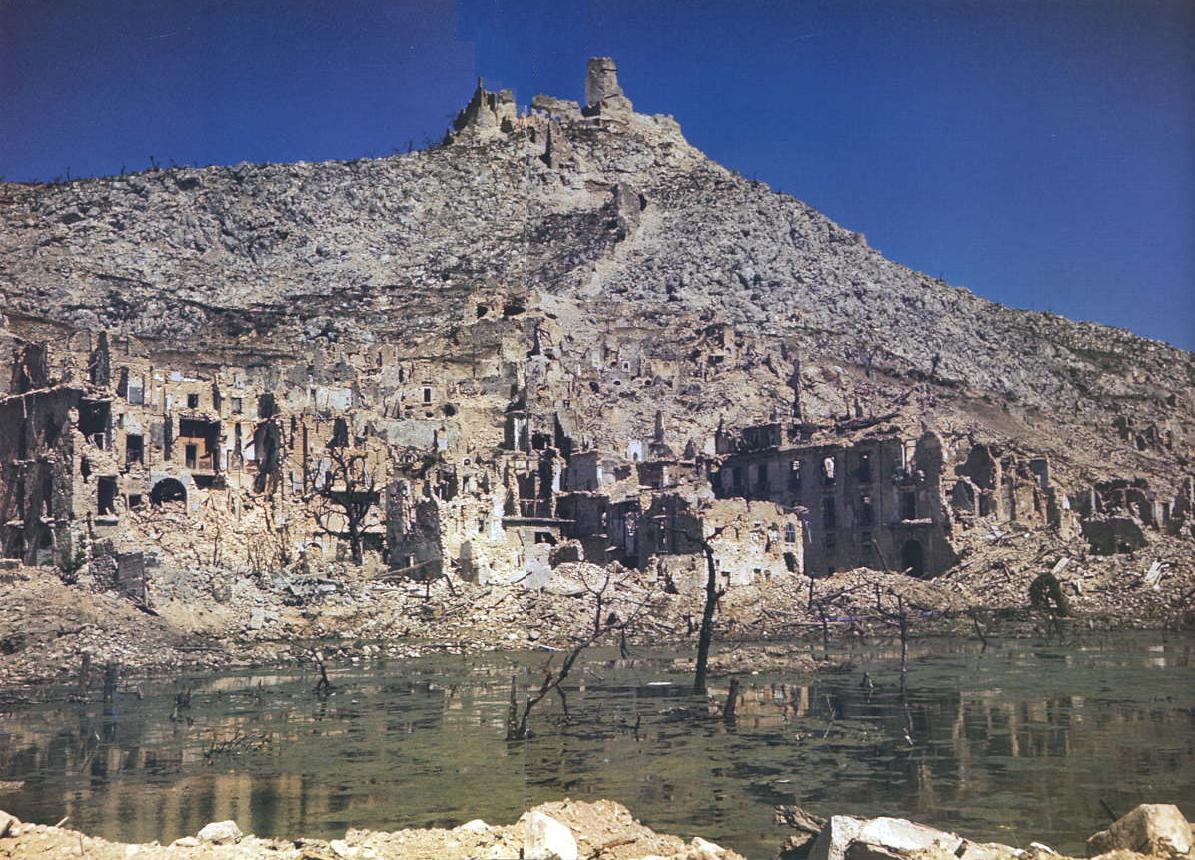
The abbey and town
of Monte Casino - destroyed by Allied shelling
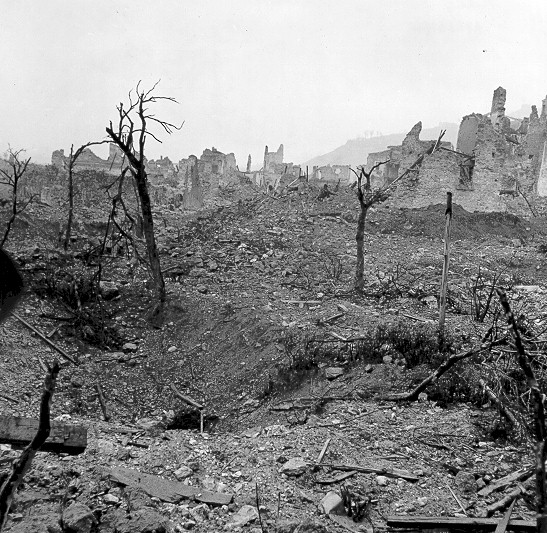
The town of Monte Casino
in ruins
|
|
ANZIO
(JANUARY-MAY 1944)
|
|
|
| Thus
it was that the Americans decided to do a coastal swing behind the
German defenses by sending troops ashore further north at Anzio in
mid-January of 1944. But once ashore, they foolishly delayed the
push deeper into the surrounding countryside because the American
commander insisted on securing more troops and supplies before pushing
inland. This gave the Germans ample time to move troops into a
strong defensive position around the Allied coastal position at Anzio …
thus creating another Gallipoli-like scenario. Tragically for the
Allies, it would not be until four months later (May) – and a huge
number of dead and wounded – that the Allied forces would be able to
break out of their position at Anzio.
|
The Battle of Anzio (or "Operation
Shingle") - launched January 22, 1944 -
to try to get behind
Kesselring's well-defended Gustav Line
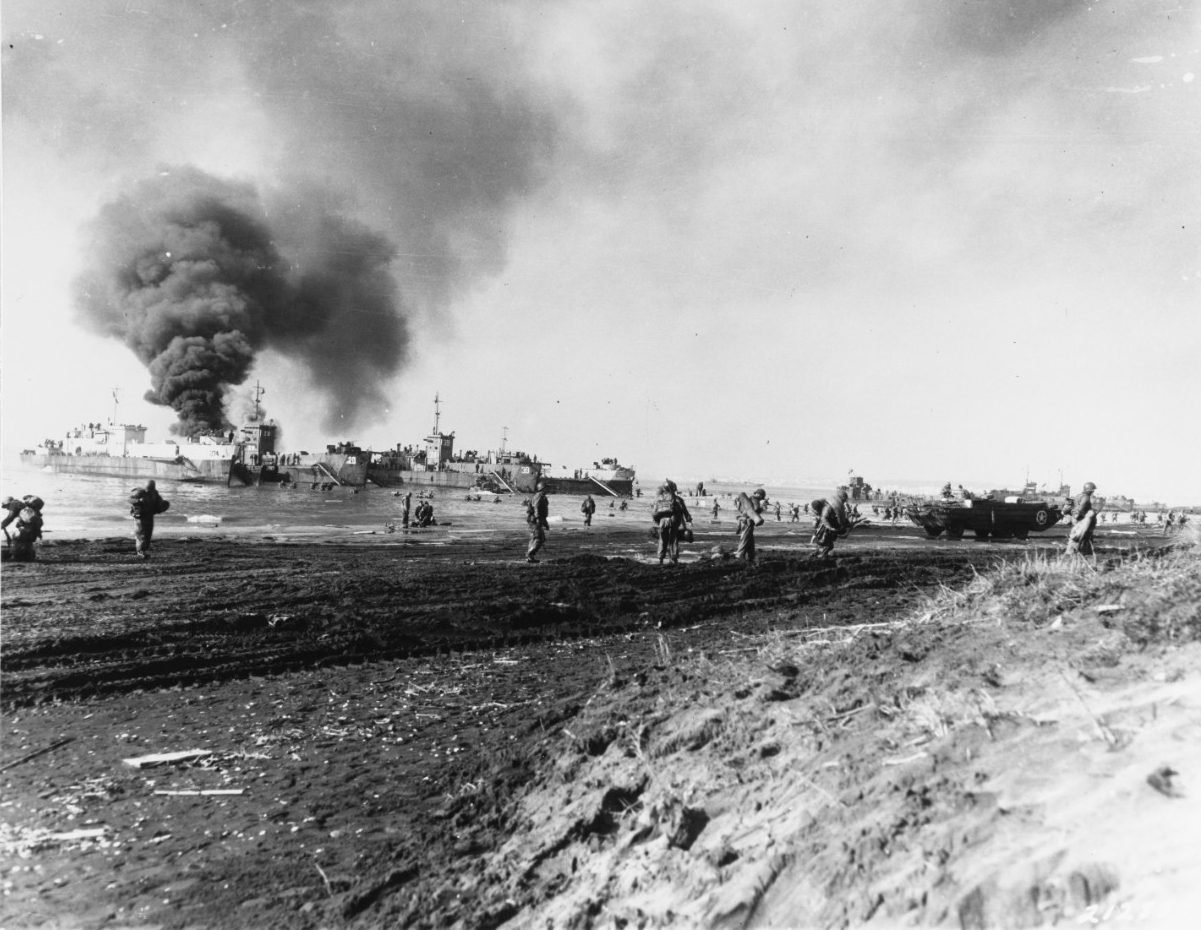
The landing at Anzio - January 1944
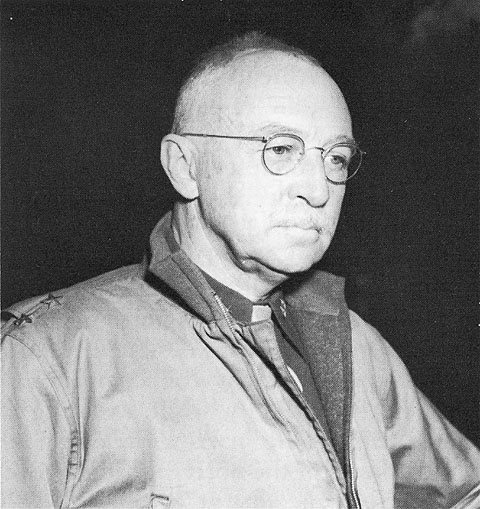
American General John P. Lucas - the
cautious commander of Operation Shingle at Anzio
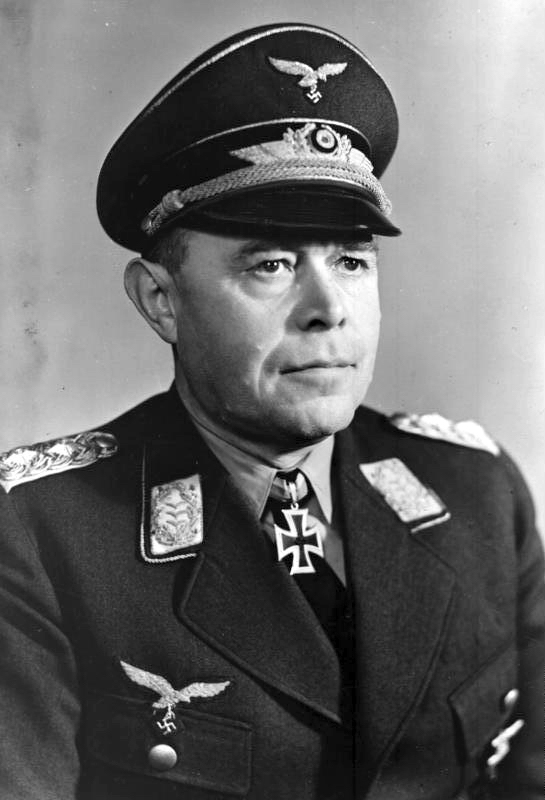
German General Albert Kesselring - who quickly threw up very
strong German defenses at Anzio
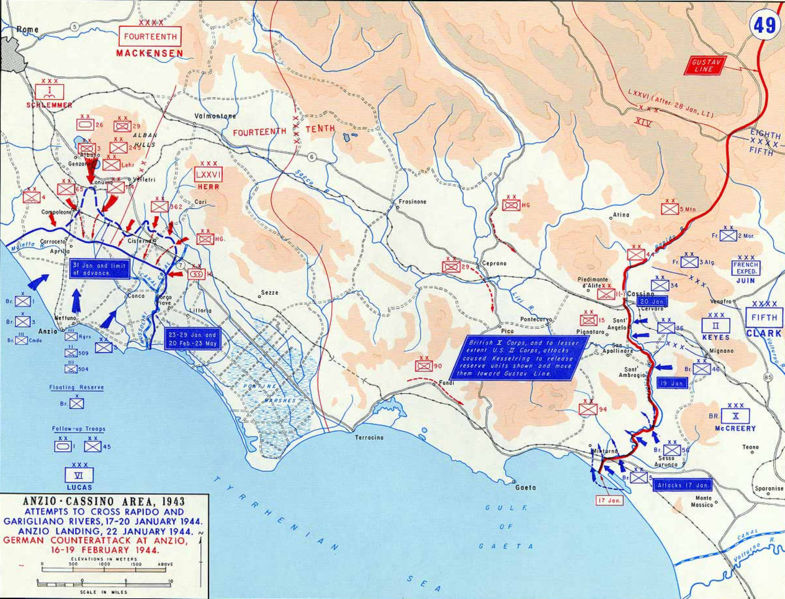
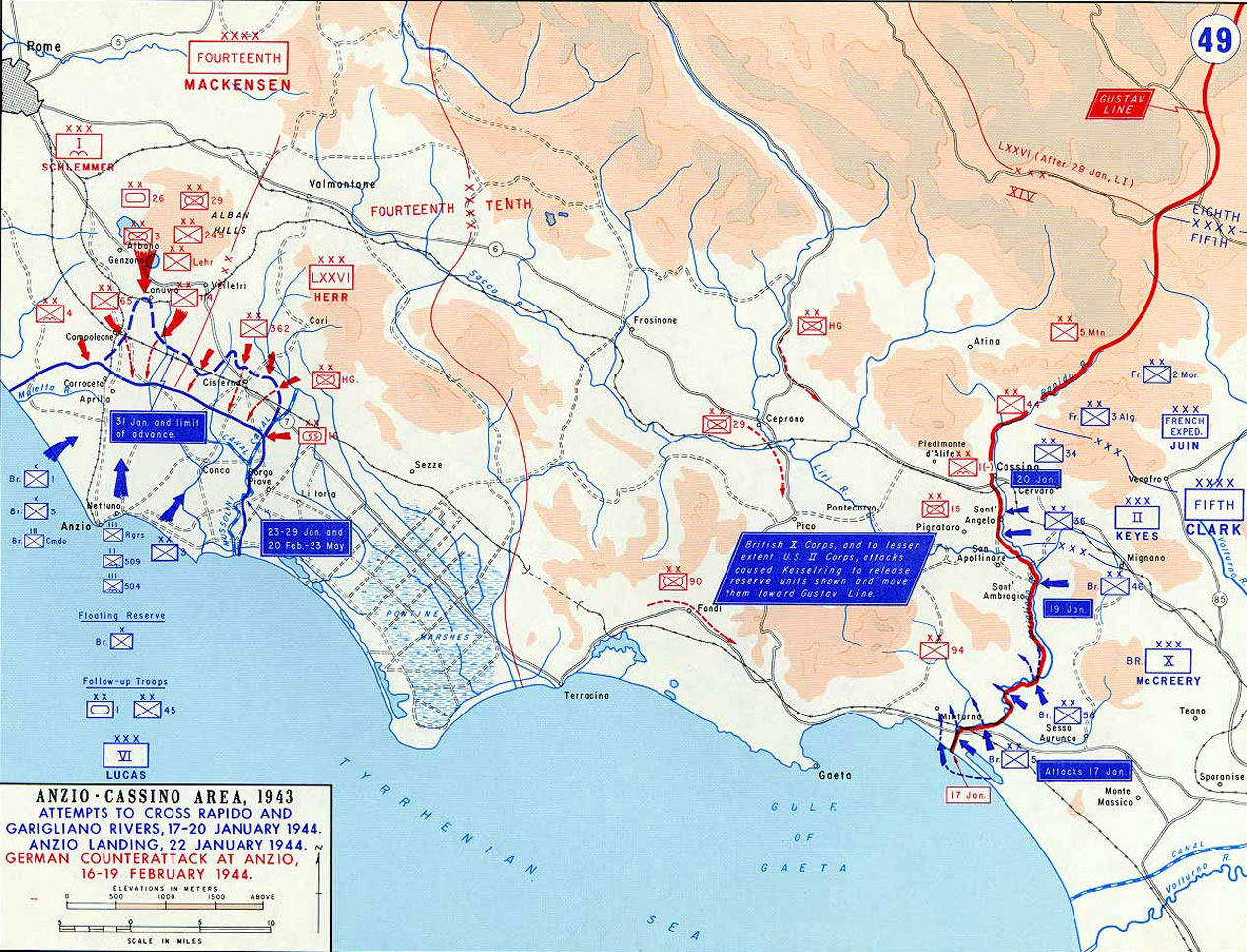
The two lines of Allied advance in Central
Italy - February 1944
www.military.com
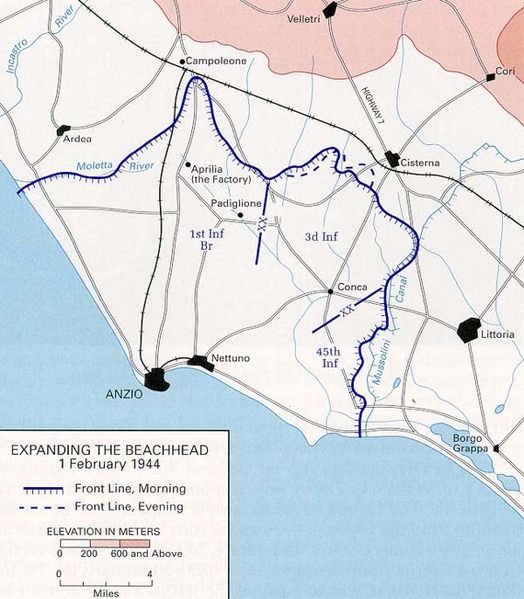
Allied Force dispositions at Anzio,
1st February 1944
U.S. Army Center of Military
History
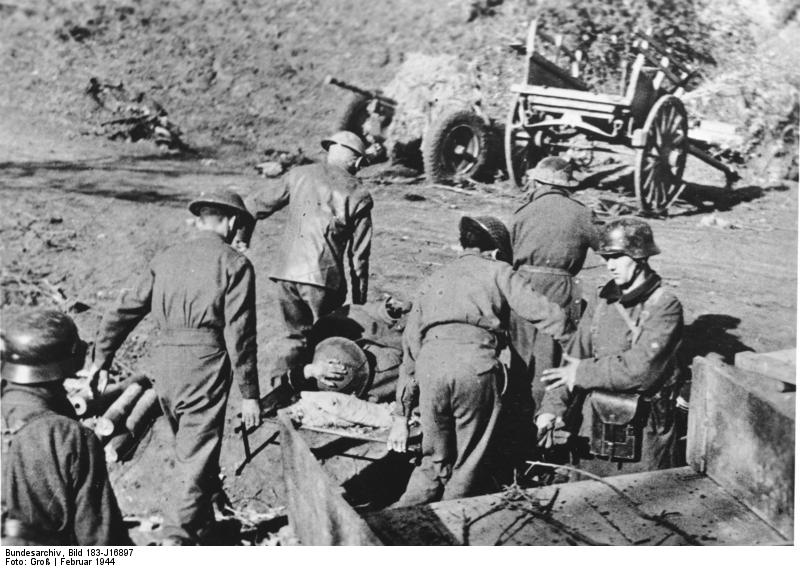
British POWs near Nettuno
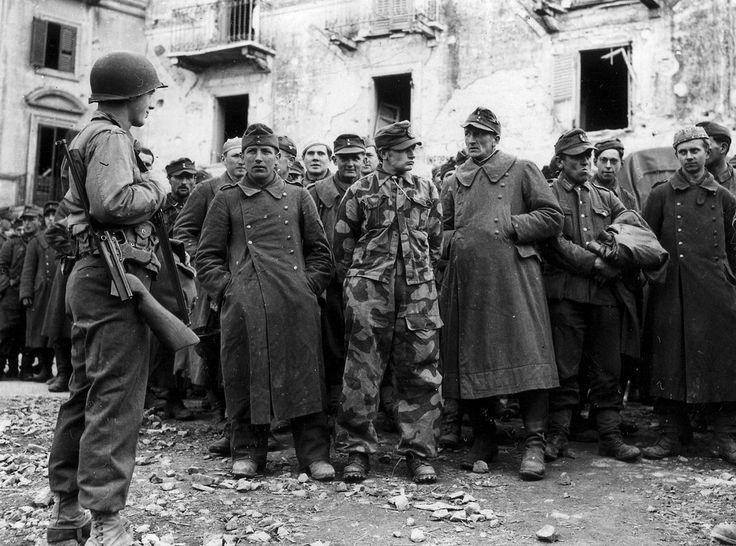
Anzio - Captured Germans
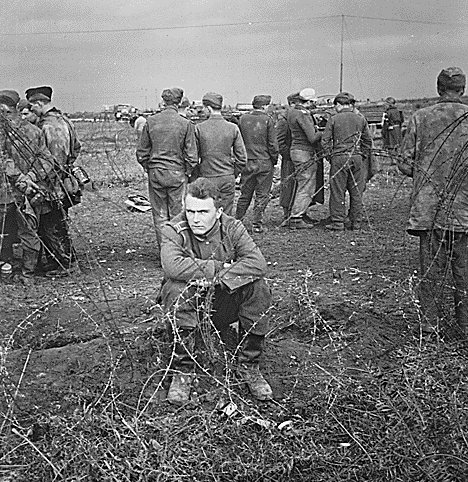
German POW from Decima
Mas after the fights at the Anzio Front
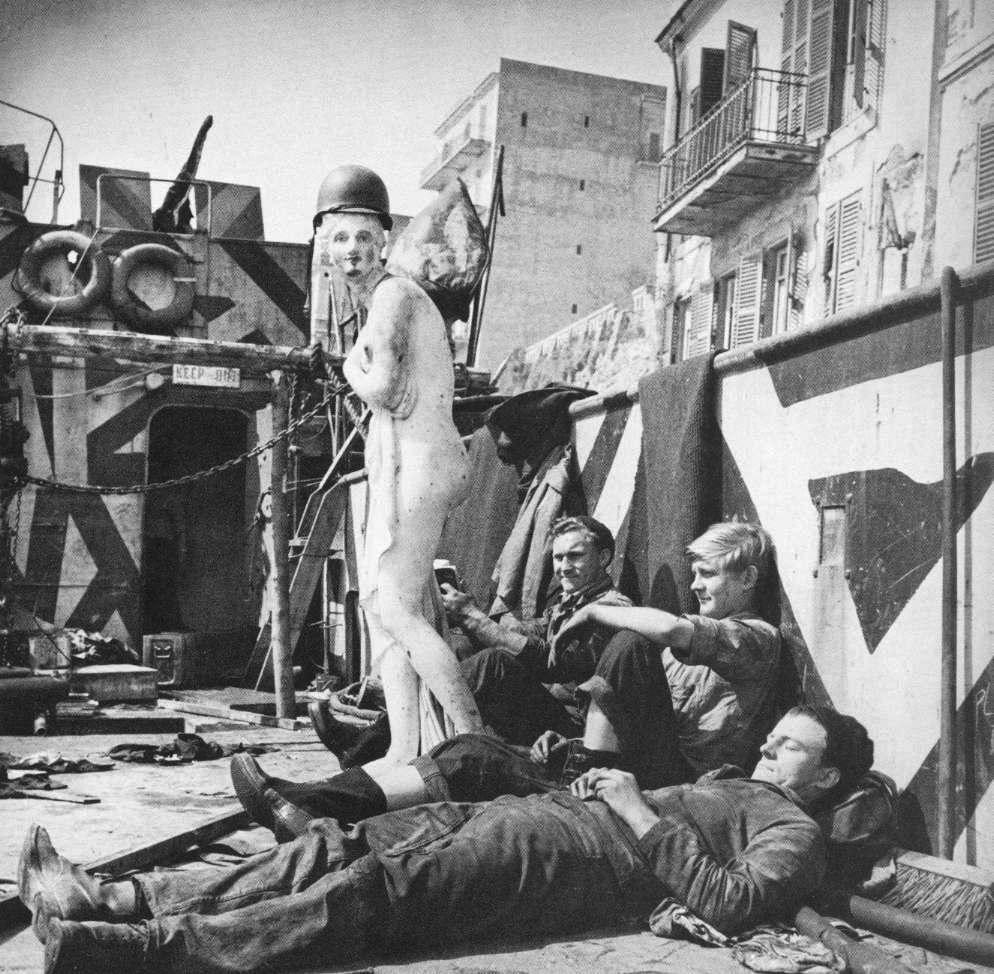
GIs with a marble trophy
from Anzio
|
|
THE
TUSKEGEE AIRMEN
|
|
|
One of the most amazing dramas
comes out of Italy in the form of the Black Air Corps,
the Tuskegee Airmen
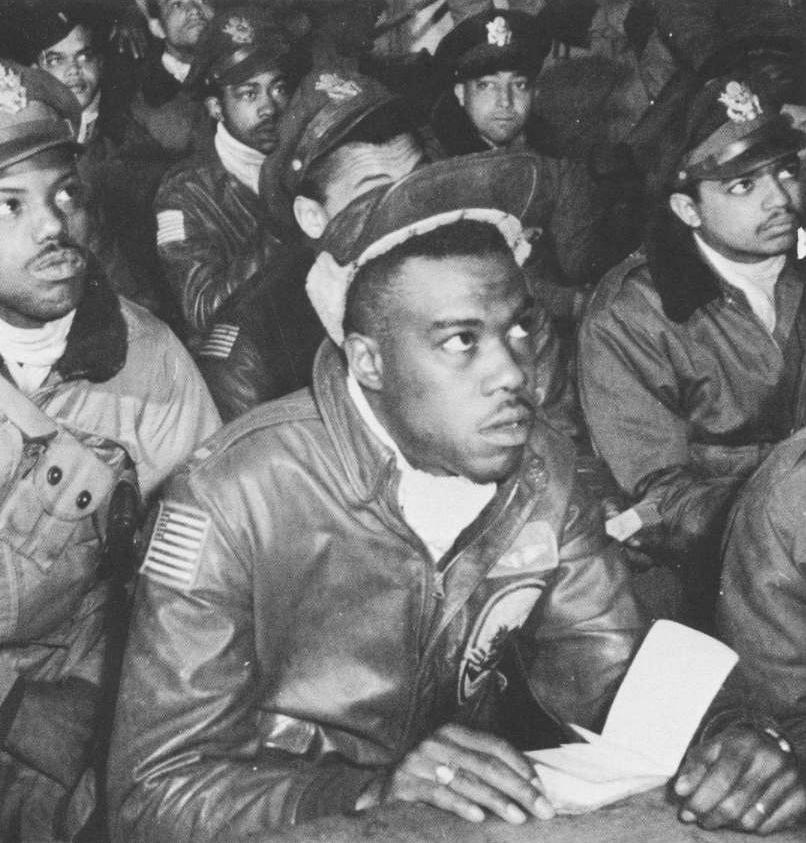
Tuskeegee airmen getting
a briefing in Italy
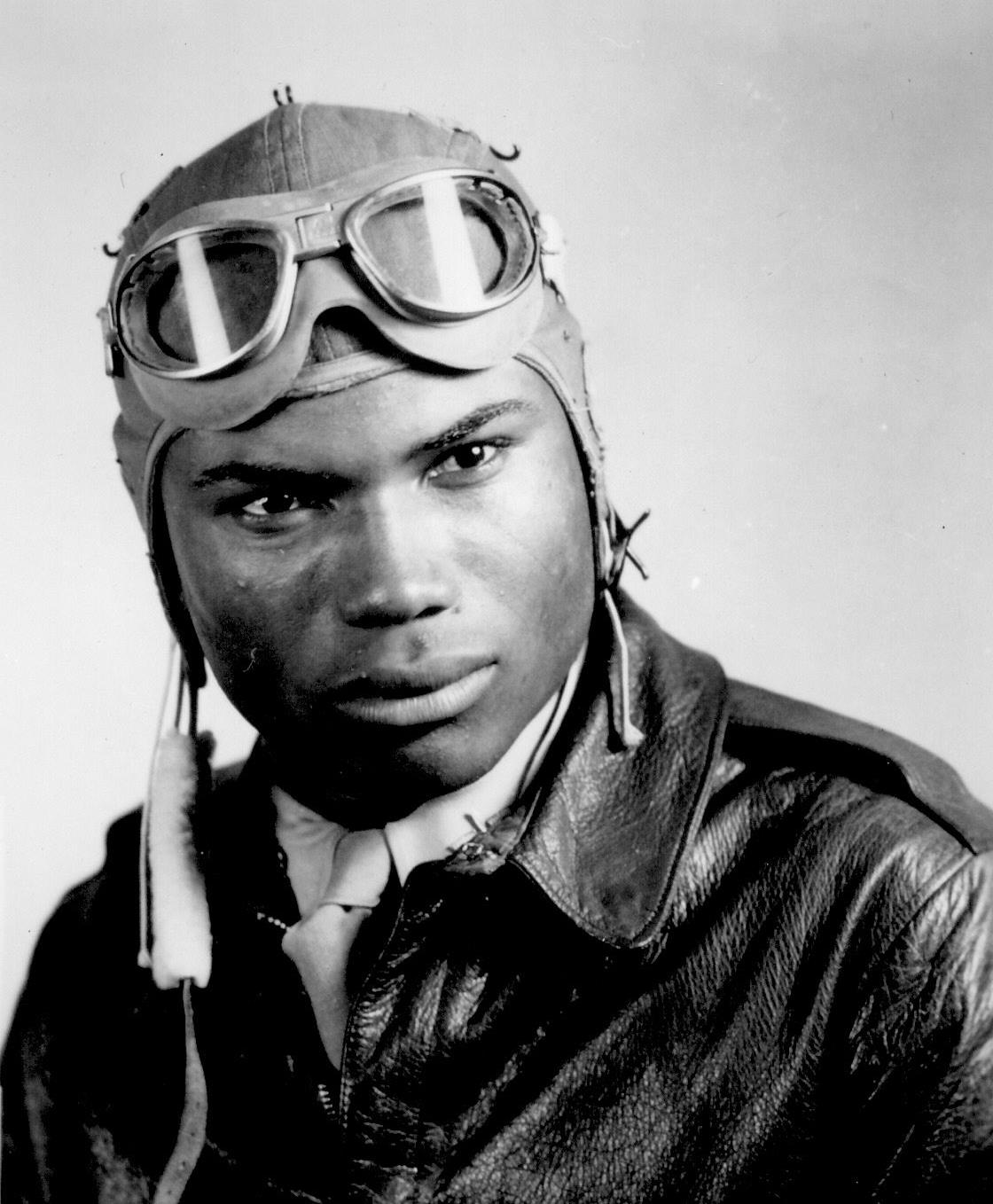
"Howard A. Wooten." Graduated December
1944 from Air Corps School,
Tuskegee, AL. - December 1944.
National Archives
18-T-44-K-17
|
|
THE
LIBERATION OF ROME
|
|
|
Then,
rather than heading east into the mountains to position themselves
behind the Germans who were making a strong defense at Monte Cassino –
thereby encircling and capturing a huge German army, the decision was
made to head the American troops north towards Rome instead. The
capital was captured fairly easily (just two days before the massive
landing of Allied troops on the Normandy beaches of France) ... a great
emotional success, but another military blunder because it allowed the
Germans to slip north out of the potential trap and reposition
themselves in another well dug-in line north of Rome.
Indeed, the Germans were able to defend northern Italy unrelentingly
until the war was finally ended with the German surrender to the Allies
the following year (May 1945). |
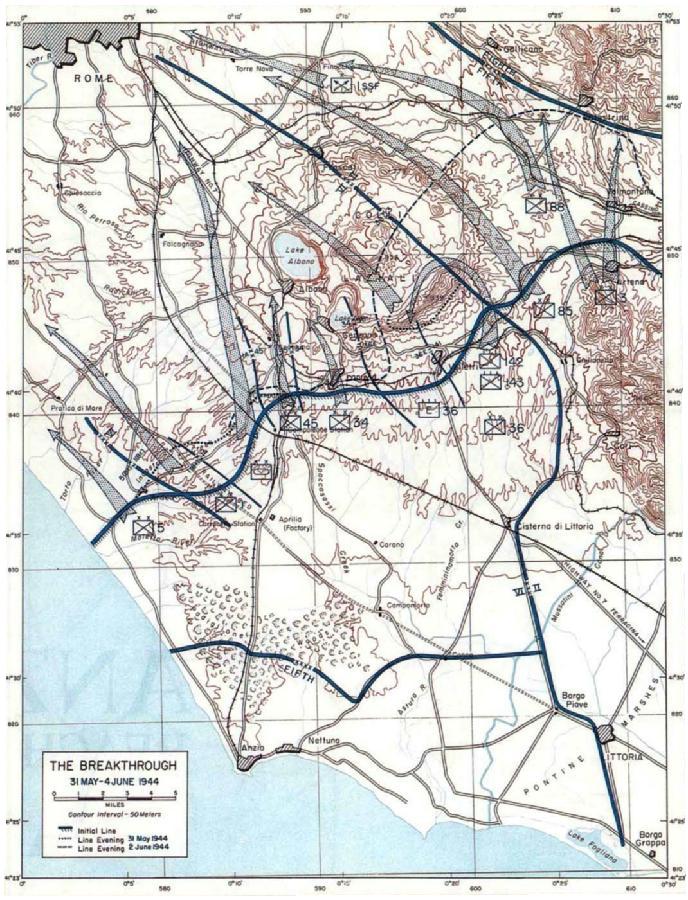
The Breakthrough from Anzio to Rome
- May-June, 1944
Rome falls to the Allies on June 4,
1944
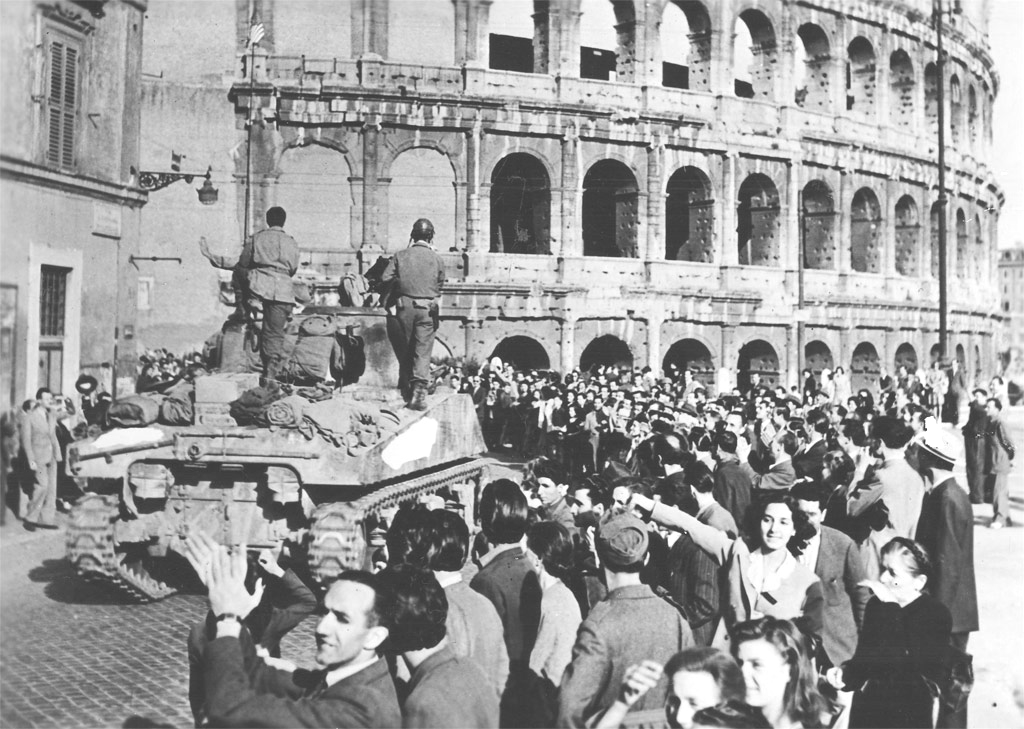
American tank rolls past the Roman
Collosseum - June 1944
|
|
HITLER
AND MUSSOLINI
ARE
HAVING MAJOR TROUBLES OF THEIR OWN
|
|
|
Yet another and nearly successful
attempt is made on Hitler's life (Operation Valkyrie,
masterminded
by Henning von Tresckow and Claus von Stauffenberg, July 20, 1944)
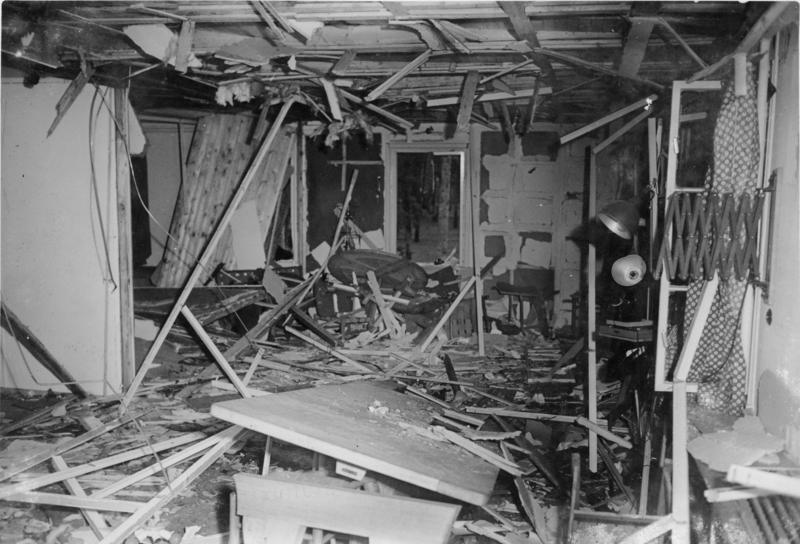
The destroyed Wolfsschanze
('Wolf's Lair') barracks after the 20 July plot
Deutsches Bundesarchiv
|
Mussolini arrested ... and rescued
Mussolini was moved around as a
prisoner from place to place to avoid being set free by either the
Germans or pro-Mussolini Italians. But the Germans learned of his
location at one point (a ski resort high in the northern Apennine
Mountains). They sent special- forces to the site and were able
to retrieve him and bring him back to his friend Hitler (who himself
was suffering from another assassination attempt that had nearly
succeeded). Mussolini was then declared by the Germans to be the
head of the Italian Social Republic ... a puppet state comprising the
northern part of Italy still in German hands. |
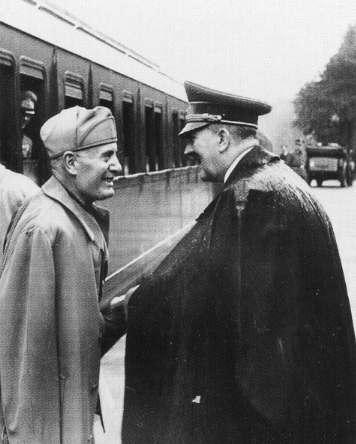
A wounded Hitler greets
Mussolini upon the latter's escape from Italy - July 1944
 Miles
H. Hodges
Miles
H. Hodges




 Off
to a bad start: The ill-fated Allied landing at Dieppe - Aug. 19 1942
Off
to a bad start: The ill-fated Allied landing at Dieppe - Aug. 19 1942
 The
British begin a roll-back of Germans and Italians in Egypt
and Libya
The
British begin a roll-back of Germans and Italians in Egypt
and Libya Americans
and British push East from Morocco and Algeria (Nov. 1942)
Americans
and British push East from Morocco and Algeria (Nov. 1942)
 The Allies turn from Africa north to the island of Sicily (summer of 1943)
 From
Sicily the Allies then jump to Southern Italy (Sep. 1943)
From
Sicily the Allies then jump to Southern Italy (Sep. 1943)
 The
German Gustav Line ... and Monte Casino (January-May 1944)
The
German Gustav Line ... and Monte Casino (January-May 1944)
 Anzio
(January-May 1944)
Anzio
(January-May 1944)
 The
Tuskegee Airmen
The
Tuskegee Airmen
 The
liberation of Rome
The
liberation of Rome
 Hitler
and Mussolini are having major troubles of their own
Hitler
and Mussolini are having major troubles of their own