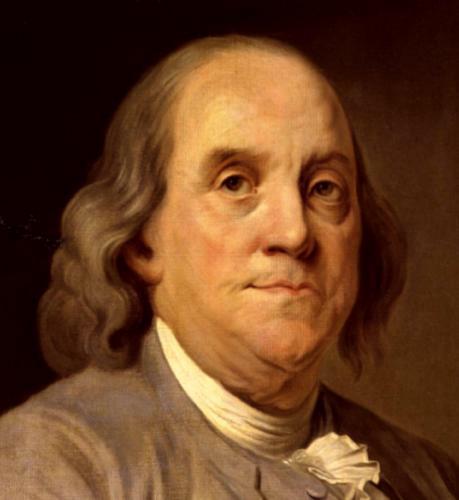
 "A Republic ... if you can keep it." Those were the famous words of
Ben Franklin in response to the question posed to him at the end of the
quite closed 1787 Constitutional Convention, called to construct a
political system designed to continue the unity of the 13 newly
independent American states now that the war with Britain had passed.
"A Republic ... if you can keep it." Those were the famous words of
Ben Franklin in response to the question posed to him at the end of the
quite closed 1787 Constitutional Convention, called to construct a
political system designed to continue the unity of the 13 newly
independent American states now that the war with Britain had passed.
A "republic" drawn from the Latin res publica or "thing of the
people." Okay. That was hardly surprising, because America
had long been governed not by some king, royal bureaucracy, or
privileged aristocracy but by the people themselves directly, or
through their regularly elected representatives.
But ... "if you can keep it." What did he mean by that?
Although his questioners were probably aware of the fact that societies
rise and fall in history, they were probably not as well informed as
the highly educated Franklin about how that process actually
works. Franklin was undoubtedly well aware of the writings of the
ancient Greek Aristotle, who made it very clear that societies thrive
solely on the moral foundations that direct the thoughts and actions of
any people ... regardless of how their society is shaped politically,
whether governed by a single individual, a small group of people, or
the people themselves. He was also well aware of how the ancient
Romans lost sight of the rule of law and their Republic thus turned
into an Empire ruled by ambitious generals. In short, he
was very aware of how a successful republic depended heavily on the
durability of its legal-moral foundations ... ones not to be messed
with by ambitious political figures.
But why should Franklin have any doubts? Weren't the Americans themselves exemplary moral creatures?
Look. He just went through a hot summer locked in conference with a group of
politicians − mostly lawyers − who argued most cleverly and almost
constantly as they defended their own states' particular interests in
how this unity system should actually turn out. The arguing
became so bad that Franklin had to rise to the occasion and remind them
of the higher moral obligations that they should be serving. And
he was very precise in mentioning that those came from God alone,
through prayer and spiritual consultation, using Biblical text to make
his point. He reminded them that in the dark days of the recent
war with England, the American leaders had every day looked to God in
prayer to direct them. If now they thought themselves better able
than divine guidance to build this new political system ... they ought
not to expect much of worth to result. After all, weren't they
tiring of this endless round of rational argument?
His challenge to go higher finally worked for them. Thus resulted our Constitution.
So how do you think Franklin would feel if he could see how much
"progressive lawmaking" by ambitious politicians, rather than the
people's observance of the eternal laws of God revealed in a loving
Christ, shapes the American Republic today?
Miles
Hodges is a writer, historian and political analyst who explores the
question of why societies behave as they do ... especially in this
matter of their rise and fall.