|
|
|
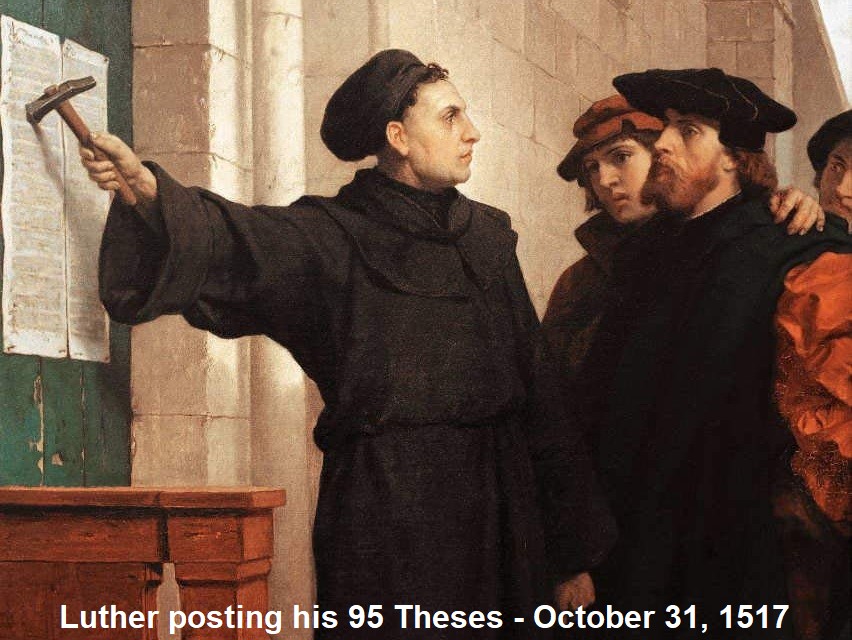
by Miles H. Hodges – The Spiritual Pilgrim October 31, the eve of All Saints Day, has a grand importance, not only in the opportunity of Americans to pass out candies to young Trick-or-Treaters at their door. More importantly, and almost forgotten, this day marks the beginning of the Protestant Reformation, something that would reshape deeply Western civilization ... and the founding of America. Luther’s
Protestant Reformation On that
day in 1517, the Augustinian friar and Biblical scholar Martin Luther posted
his 95 Theses on the door of the Wittenberg Chapel, challenging the Church to
defend itself on each of these 95 matters.
He was especially irate over the Church’s policy of having Christians
purchase indulgences from the Church in order for their sins to be forgiven ...
and thus earn their way to heaven. That
was a religious practice far, far away from Biblical standards. Challenging the Church and its
doctrines was a dangerous thing to do.
Earlier efforts to bring Christianity back to its original, and rather
simple Biblical roots, brought would-be reformers condemnation (Jan Wyclif for
daring in the late 1300s to translate the Bible into an English version more
understandable for the English commoner) and even death at the fiery stake (Jan
Hus in 1415 for doing the same in Czech for his congregation). So dangerous was the idea of
reform that nothing of that order was then undertaken for the next
century. But quite clearly to any serious
observer, the Church was becoming increasingly corrupt ... lavish amounts of money sent to Rome
to build the pope the most exquisite cathedral in Europe, for instance. This event of Luther’s posting soon spread like wildfire when the document was translated into German ... and then other languages. However, not only Church
authorities but also political authorities were outraged at such impertinence. And thus Luther was finally called by the
Emperor Charles V to give account of his doings in before the Diet or council
of Worms in April of 1521. Luther
refused to recant on any of his points ... and then was quick to get
away while "safe conduct" was still offered (Hus was killed
despite the similar offer of
safe conduct). He was "kidnapped" and
brought into hiding in the Wartburg Castle of a German prince, Frederick III of
Saxony. Whether or not Frederick was
truly supportive of Luther's religious mission, he certainly was supportive of
the way that what Luther was doing challenged the feudal system of Church and
Empire, which controlled all European life. So in Wartburg Castle, Luther quickly
translated the entire Bible into German.
He then the next year returned to Wittenburg ... where he preached quite
openly, protected by the general mood of the town's citizens. The Protestant Reformation was now up and
running. But Luther was only interested in
Biblical reform, not social or political reform ... something also burning in
the hearts of the German commoners.
Apart from setting up his own governing system of bishops and priests
(who were now allowed to marry), he would go no further in social or
organizational reform. He had no
interest in reforming the feudal political system that governed Germany. And thus he came out angrily when
in 1525-1525, thousands of German peasants rose up in rebellion against the
feudal political system, these peasants demanding the rights of
self-government. The fact that these
peasants also attacked monasteries and churches only worsened their cause in
Luther’s eyes. Luther demanded that the
feudal lords crush, even brutally, such evil ... which is exactly what they did.
So that's where Lutheranism stood on the matter of Reformation. Calvin’s
Protestant Reformation It would be some ten years later,
when the Frenchman John Calvin published his Institutes of the Christian
Religion (1536) that the Reformation would take another turn ... and go
deeper, much, much deeper, into Protestant Reform. And this would take place in Geneva,
Switzerland where Calvin, on his flight from France after his work displeased
intensely French king Francis I, was convinced to stay (also in 1536) ... to
continue church reforms started in Switzerland by Ulrich Zwingli (Zwingli
having been killed in a battle in 1531). It is important to note at this
point that urban Europe was developing everywhere, especially along the sea
coasts and rivers but also in strategic places here and there ... for strong
commercial reasons. And urban Europe
just did not fit into the feudal system.
That's because it was given a high degree of political independence by
local lords, princes and even kings ... because what these authorities could expect from the cities was
much-needed taxes, not something that the rural feudal system with their lords
and ladies offered in any significant way.
But such political independence
required a high degree of self-discipline in the form of town charters and
social rules ... and officials carefully defending those rules. In an important way, these cities were
organized along lines similar to ancient Republican Rome governed by elected
officials, not by hereditary lords.
Indeed, in many cases they actually identified their cities and their
domains as "republics." Thus urban Europe's joining the
Protestant Reformation, as Geneva and other cities were most eager to do, was
to break from the traditionalist Church-Empire domain in a truly revolutionary
fashion. Such Protestant Reform was
going to create a very strong model of a new European society. And Calvin was understood to be the perfect
designer not just of a religious revolution, but also a social-political revolution. At
first his social-political as
well as religious reforms pushed the Genevans a bit too much ... and he
was
asked to leave in 1638 (he went on briefly to Basel and then
Strasbourg). But in 1641 was called on to return to Geneva, where
reform was breaking
down. Calvin did ... and truly took
control of matters at this point. Calvin
intended that Geneva was to look as much as possible like what the Bible described
as true community: a mutual and quite
equal fellowship of Christian believers.
Pastors were to keep them on track as such through their weekly sermons. And their political officials were there to
represent them (through a regular voting process) rather than dominate them. The word got out as to what was
going on in Geneva. And those interested
in similar reform in their own societies flocked to Geneva to become part of
this new dynamic, to learn precisely how just such a Christian society actually
worked, and then take the lessons back home to their countries of origin. Thus they came from England. And there in Geneva translated and printed
their own "Geneva" Bible (based heavily on Wycliff’s version). And then they eventually returned to England
to seek similar reforms, to purify the English church by bringing it back to Biblical
standards ... receiving the mocking term "Puritans” in jest from English
traditionalists. Most interestingly, these Puritans seemed quite content to accept this label "Puritan" for themselves
and their reforms! They also came to Geneva from
Scotland (under the leadership of John Knox) ... and eventually returned to
Scotland as "Presbyterians." They came
from the Netherlands and returned as Dutch Reformed. They came from Germany and returned as German
Reformed. They came from France and
returned as Huguenots. In fact they came
to Geneva from many points in Europe.
Needless to say, the Genevan printing presses were hard at work
publishing Bibles translated into Europe's different languages. Most sadly, Luther refused to
work with the Calvinists ... over the single matter of what exactly was the
precise character of the holy communion's celebration of the body and the
blood! In any case, Lutheranism, unlike
Calvinism, did not seem to have much of a broader appeal than Luther’s native
Germany (mostly rural Germany, at that). The impact of the
Protestant Reformation in America Which now brings us to America
... and the critical impact the Protestant Reformation, especially the
Calvinist or Puritan variety, was to have on the way the English colonies – at
least in New England – were founded in the early 1600s. Indeed, just as there was a
Lutheran-Calvinist divide within the Protestant Reformation, there was a
similar divide in colonial America ... between Puritan New England and the more
traditionalist Anglican-Christian Virginia. Virginia. The Virginians arrived first to America, in
1607, a large group of men who came to the new colony to find wealth in gold
that the New World (thanks to the Spanish) was famous for. But other than set up a fortification at
Jamestown, they showed little interest in working with each other, instead being focused solely on making themselves rich. Such
social ignorance ultimately led to the death of the vast majority of this group
... deaths continuing until the decision in 1610 to abandon the effort. Thankfully the effort was saved by a new
shipment of settlers and a new governor who arrived just as they were
leaving. So Virginia lived on. But the idea never changed that
Virginia was a feudal-based settlement that would open the door for the truly
ambitious to acquire personal wealth ... and thus an increase in social
position (the more property and the more workers toiling in service to the
local lord the better). Thus very
quickly a dual-status status system of lord and worker, operating along rather
feudal lines, was quick to develop in Virginia.
At first indentured workers were brought in for a contracted period of
time to work the lands of this rising colonial nobility. Then slavery replaced that indenture system
... as slaves constituted a permanent underpinning of workers to farm the
tobacco fields that provided the wealth of this new nobility. Slavery in fact became something of an
emotional, even spiritual underpinning of the Virginia social ideal ... a
questionable process to be defended at all costs. An urban Virginia did not develop
to challenge the feudal foundations of Virginia ... because a commercial center
(a town or city) was not needed. The
deep Virginia rivers allowed tobacco to be loaded on a ship right at the docks
of these huge plantations ... and thus shipped directed to England or elsewhere
overseas. The South's first true city,
Charleston, was not founded until 1670 to finally serve the South as a seaport
for the export and import of a wider range of goods. But even then, Virginia and the Carolinas
remained mostly rural, feudal societies in their mentality. And as far as religion, Virginia
and the South was based on Anglican traditionalism, the one that opposed the
Puritans and their Reformation program.
The King was the head of the church, and the English archbishops,
bishops, and priests worked in accordance with a top-down instruction set. Sadly, priesthood was not a high-status
occupation, America never got a bishop of its own under the Anglican system,
and priests had to be confirmed in their roles in England, not America. It was in fact not until 1693 that the
Virginians got around to establishing their first college (William and Mary) to
educate and prepare young men for the priesthood ... and other social roles. New England. In contrast to Virginia, the English came to
the more northern colonies principally for religious reasons: to set up a model Protestant society, one
that would serve as a “City on a Hill” or “Light to the Nations” ... to show
the world (Geneva-style) what a truly Christian society was supposed to look
like. The first such English group to
come came less out of such high idealism but merely to escape the persecution
they were suffering as "Separatists."
The Separatists constituted a small group of Puritans who simply had
given up on the effort to "purify" the Anglican church and wanted simply to be
left alone to worship privately as they wished.
Sadly, other Puritans scorned them as "quitters." But worse, while King James disliked the
Puritans, he at least tolerated them somewhat.
But for the Separatists he had no mercy, and intended to destroy them
and their proceedings. Consequently, a group of them
were finally successful in escaping England in 1608 ... to arrive in the
Netherlands where the Dutch Reformed movement was strong. But fitting in to Dutch society proved to be
difficult for most of them. They were
mostly of a farming background and brought no skills useful to a very highly
commercial Netherlands. And over time
they realized that they were losing their children to Dutch ways. And the Spanish army was doing everything it
could to force the Netherlands back under Catholicism. Thus in 1620 came the decision of
this small religious group to head to the New World and try to set themselves up there. They received from KIng James a grant to settle in the
northern portion of Virgina, James believing that this was
just another taxable commercial enterprise.
But they got delayed in their departure and with a season shift in the
winds were blown well north of Virginia ... to what was simultaneously (also
in 1620) branded as "New England" by the Plymouth Council. In trying to set up their Plymouth
Colony there, these Separatist "pilgrims" to America lost half their members that first dreadful
winter. But the remainder most miraculously
survived ... and unlike Jamestown, then left the dying season behind them
completely. Indeed,
working together closely as a Christian community, they prospered greatly
... but quietly. Meanwhile back in England, a
strongly anti-Puritan Charles I took the throne in 1625 ... and soon the deeply
hated Puritans understood that they too would have to become "Separatists" if they were going to survive. Thus in
1630, John Winthrop succeeded in putting together a group of Puritans to settle the lands
adjoining Plymouth, constituting themselves as the Massachusetts Bay
Colony. Some 1,000 in seven ships joined
Winthrop in the move that year to New England ... to then be joined by thousands
more (some 20,000 in total) over the next dozen years. And there in New England they prospered
quickly and most amazingly. Their prosperity, however, was
not intended to be done quietly, out of sight of the authorities, but was very
specifically designed to be another Calvinist showpiece of Christian living ...
a society living strictly according to Biblical standards. Thus New England (joined soon by the Middle
Colonies ... reaching down to William Penn’s Pennsylvania) understood quite
clearly its divinely-appointed role as that Biblical "City on a Hill" ... that "Light to the Nations." Thus America (at least the
Northern portion of the colonies), because of the impact of the Protestant
Reformation, became something of a wonder to the world ... as a very special
society, Biblically self-disciplined and self-governing.
This was an awesome startup for America. The Protestant legacy in
America. Sadly, like the division in
the Protestant Reformation between Luther and Calvin, a distinctly divided
culture separating the New England and Middle Colonies "North" and the Virginia
and Carolina "South" would over the generations grow deeper in hostility, supposedly
solely over the matter of slavery, but in fact over two very different ideas
about what American society was supposed to look like. Most tragically it would cause the North and
South to fall into America's bloodiest war, 1861-1865 ... in part over the
matter of preserving the Union (which the South was no longer interested in)
and in part to end slavery. The North
won, though it would take some doing to get America back as a single society. Thus it did not take long for the industrial revolution that followed that horrible Civil War to want to put absolute power into the hands of a few industrial multimillionaires. Thankfully, anti-trust rules broke up such monopolies ... and kept Middle America still in charge of things. Thankfully, God would intervene with a number of "Great Awakenings" to get America ready to take on some spiritually draining challenges (our War of Independence, our Civil War, our Great Depression, our World War Two) ... spiritual awakenings which most miraculously prepared us to not lose faith in the face of the kinds of confusion and fear that such events can easily produce for those who live in a rational bubble. Now again it has been several generations since America was called on to take on such monumental challenges. And most naturally, we have found ourselves in deep cultural drift again. America's awesome Protestant legacy is once again being challenged by any society's natural instincts to want to come under monopoly standards (monopoly being more than just a board game!), with corporate America working closely with top-down legislative, judicial and bureaucratic governance to buy up Middle America's options in life (out of control medical costs, turning private homes into corporate rentals, etc.). But I am praying that God is not finished with America ... and will come once again to our spiritual assistance and get us back on the path of self-discipline and self-government. We have let political and industrial greed take far too much control of American life. We need to get American society back in the hands of its ordinary citizens. In short, we need another Protestant Reformation! And I am praying precisely for just that! Please join me in such a prayer! Miles Hodges is a writer, historian and political analyst who explores the question of why societies behave as they do ... especially in this matter of their rise and fall. |