|
|
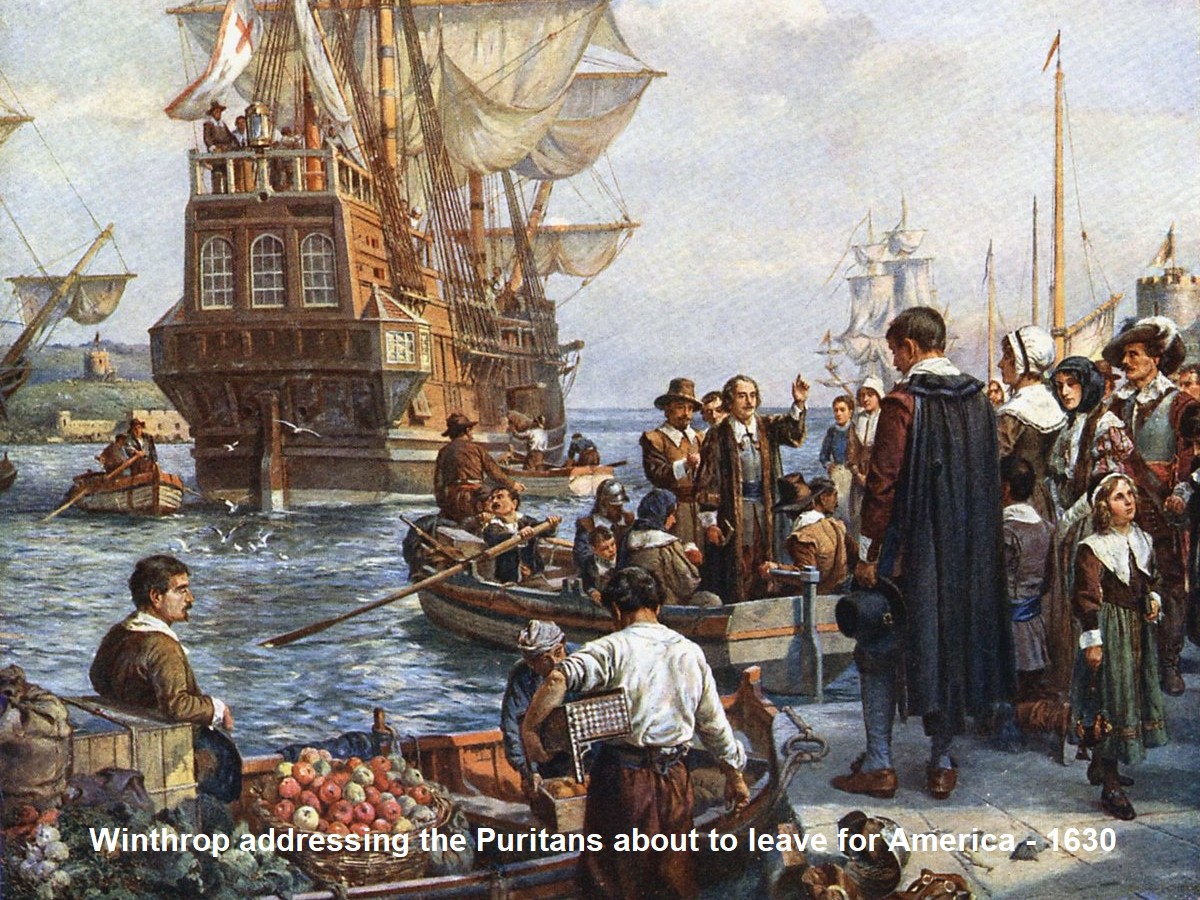
by Miles H. Hodges – The Spiritual Pilgrim The covenant with God. America has long been a very unique society ... self-governing since its founding in the early 1600s – at a time that the rest of its world was largely feudal in political character, that is, governed from the top-down by a small but very elite ruling class. This self-governance was not a result of political accident however. It was by very careful design ... especially the New England colonies of Plymouth, Massachusetts Bay, Providence and Connecticut. And that was because these English colonies were very self-understanding that, as "covenant societies" and thus products of divine design, they were under contract with God, he to be their guiding Heavenly Father and they to be his faithful sons and daughters. God would take care of them ... as long as they remained faithful. John Winthrop. This was spelled out clearly by Massachusetts Bay Colony co-founder John Winthrop ... when in 1630, as some 1000 English were about to leave with him for America, Winthrop delivered a sermon reminding them of the exact nature of this contractual program: Thus stands the cause between God and us. We are entered into covenant with Him for this work. We have taken out a commission. . . . Now if the Lord shall please to hear us, and bring us in peace to the place we desire, then hath He ratified this covenant and sealed our commission, and will expect a strict performance of the articles contained in it; but if we shall neglect the observation of these articles which are the ends we have propounded, and, dissembling with our God, shall fall to embrace this present world and prosecute our carnal intentions, seeking great things for ourselves and our posterity, the Lord will surely break out in wrath against us, and be revenged of such a people, and make us know the price of the breach of such a covenant. The articles of the covenant they had taken out with God were very clear: they were to demonstrate to the world exactly what it was that our Creator God expected of us as a people of his design: to work together in equality, harmony, and true concern for each other. But if they failed in that enterprise and fell into the self-focused greed that more naturally drives human life, then God would pull back his support, and his wrath (disease, poverty, infighting, tyranny, etc.) would be their fate. It was therefore very important to "keep covenant" with God. Critiquing the Puritan legacy.
It is quite the "thing" today to portray the Puritans and
everything they stood for as involving simply ugly authoritarianism ... forcing
people to live under very strict social standards. Most sadly, today's
Boomer world and its legacy (which doesn't like the idea of social
standards anyway ... at least long-standing traditional social standards) just
does not get the picture of what it was that the Puritans were about and what
they were up against. Their world and our world today are two very
different worlds. Thus they set up villages composed of a
number of small but self-sustaining homesteads, all of roughly equal
size and social stature, in line with their ideas of their basic
equality ... because in God's eyes they were all sons and daughters of
his on a very equal basis. They were self-governing in how they
directed their respective communities ... but also well-led by Godly
individuals. They were even quick to set up Harvard College in 1636 to
train their own Christian leadership. And that leadership was found
principally in each village's pulpits ... commisioned to preach in a
way that would keep this amazingly self-governed society on track in
the face of its many challenges ... on track especially as they saw
that God (through his Biblical instructions and their prayers) expected them to live. Roger Williams and Anne Hutchinson. Two individuals are always
brought up as examples of how tyrannical the Puritans happened to be. But Roger Williams was well received in 1631,
offered one pulpit after another. But none
of these congregations (Boston, Plymouth, and Salem) were "pure" enough to his
thinking ... nor was the colony’s connecting religious faith and political
participation to his liking. Finally
they told him it was time to set up his own colony where his own purity standards
could be planted. Actually, he and Winthrop
remained in close contact ... when Williams soon discovered the problems of keeping
people on line with his Providence Colony’s social goals. It wasn’t all that easy. Then there was Anne Hutchinson, who led a small group focused
on their own version of purity ... found in Anne’s eyes only in her beloved
pastor John Cotton. The other pastors in
the Massachusetts colony she claimed were not fit to preach ... even actually
serving the anti-Christ. She knew this
because the Holy Spirit kept her informed of things ... especially about the
curse that was to fall on the colony.
This all became so disruptive that the colony’s Council told her to
cease her attacks. She tried ... but
just could not stop herself. Finally she
was ordered to leave. She and her family
moved to Williams' Providence Colony.
But when her husband died, she moved to the Dutch colony on Long Island
... where she and her children were killed in an Indian attack. It seems that the curse got a bit confused as
to where it was supposed to hit. The Quakers. Certainly the execution of four Quakers was a
horrible thing that the Puritans did. It
was done in response to a ruling that the Council made about the very
disruptive behavior of the Quakers, who came to Massachusetts in the later
1650s. They were not allowed in the
colony ... and kept returning when kicked out. Finally the death penalty was declared to any
Quaker who returned to the colony after having been thrown out. Sadly this punishment was carried out in the
period 1659-1661. And this was not just because of the intense "quaking" they
would experience when overwhelmed by the Holy Spirit ... but the fact that they
were very loud in their claim that the Christianity practiced in the Puritan churches
was the result of very false teachings ... even interrupting church services to
make their point. One Quaker woman even came
into a service naked in order to symbolize the nakedness of the Puritans'
preachings and teachings. When that death penalty was finally carried out, the colonists themselves reacted so strongly against such punishment that the ruling was set aside. But by then it stood as a very dark mark on their Puritan legacy, The famous Salem Witch Trials (1692-1693). Some thirty years later the Massachusetts
colony went through another episode of very bad behavior, one so famous that
Salem, Massachusetts is proud to proclaim itself as "Witch City" ... as if
doing so not only clears them of any connection with their Puritan past but also
makes them seem to be the most excellent example of a very "free-thinking"
people. Rightly so, seeing the event of some 20 people accused of
practicing witchcraft being put to death (and some 5 others dying in prison) as
a result of widespread hysteria hitting Massachusetts (not only Salem but other
towns as well) was a most horrible thing.
But this was hardly the result of their Puritanism. In fact by the late 1600s, the American
colonies, much like Europe, was going through a sense of post-Christian "enlightenment"
... that is, living now by human reason rather than by "religious superstition." The only problem was that what they then put
their faith in was not working well for them ... and they simply fell easy victims
to rather primitive social thought. This
had nothing to do with Puritanism. At this point, the failure of life in Massachusetts to
live up to the expectations of human reason was widespread (but also impacting
Europe in much the same way ... including the suspicion that witchcraft was
behind the chaos and social confusion of the times). Actually, constant Indian attacks, the overworking
of Massachusetts' soil by a heavily expanded population, and a general loss of
economic and spiritual goals all contributed to a very negative mindset hitting
the people. And thus it did not take
much, some ridiculous rumors started by some girls about witches being present
in the colonies, to set things off. Indeed, it took the colony’s authorities in Boston to
bring the hysteria to a halt (mid-1693). And people then began to repent of their
behavior ... although it was too late to undo the past. But this past was picked up in the crazy Joe McCarthy era
in early 1950s when the playwright Arthur Miller was accused of being a
Communist ... and fought back simply by publishing his play, The Crucible,
attempting to relate the evil of the McCarthy era with the evil era of the Salem
Witch Trials. The play did not catch on
in the 1950s, but was brought back out in the mid-1960s as a very popular play
(soon required reading in most schools), one by which Boomers and their intellectual
mentors found that they could portray most clearly the "authoritarianism" of
their quite Christian World-War-Two-Veteran parents. And this Crucible picture of a very evil Puritan New
England has ever since remained in modern minds the unquestioned version of
Puritanism and all it stood for. The Puritan legacy. Actually, the Puritans were not anywhere near
as evil as they are portrayed today.
They made their mistakes. But
they also left a powerful social legacy of grassroots social cooperation that
shaped the development of America deeply ... and made it so very different from
the rest of the very feudal European world they had left behind. That legacy actually underpinned the awesome Great
Awakening that broke out within the colonies in the 1730s-1750s ... and the spirit
that then led the Americans to resist the effort of British royalty in the
1770s and early 1780s to take away their freedoms and place them under British
royal or feudal authority. More importantly, what can we say about this Puritan
legacy today? Are we still an
egalitarian, mutually caring, and freely serving people? Or has the very greed that Winthrop warned
about become our character as a people today? Miles Hodges is a writer, historian and political analyst who explores the question of why societies behave as they do ... especially in this matter of their rise and fall. |