|
|
|
by Miles H. Hodges – The Covenant Nation Because of both the isolated way
Americans went at life removed from the rest of the world by two great oceans ‒
and because of America’s obvious success politically, economically and socially
in the days of the early Cold War (the 1950s and early 1960s) ‒ it became quite
natural to Americans to expect that the rising "Third World" of Asia,
Africa and Latin America would want to imitate the American social example ...
now that these peoples were freed from the failed imperialism of their former
European colonial masters. There of course was some concern
that these newly emerging Third-World nations might mistakenly take up the
political-economic-social course of the Communist "East" ‒ which the
Soviet Russians were aggressively promoting abroad. But we were certain that with a small amount
of American assistance, these newly emerging nations would make the right
choice and go "American." In fact, American President Kennedy had made this a priority as he took office in early 1961 … in setting up the Peace Corps, enlisting American youth as volunteers to go abroad to these Third World nations to present in the villages and towns the "American Way" as a wonderful assist in their own national development. 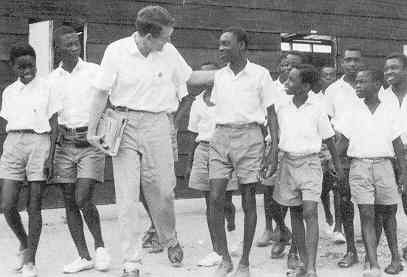 But things usually had an
“interesting” outcome in pursuing this particular “go-the-American-way”
strategy! A story illustrating the point I graduated from college in 1963 and
went on to Washington, D.C. to take up graduate study at Georgetown University
… and helped pay for living expense by soon working part-time (20 hours a week)
at the Peace Corps Headquarters on K Street.
Kennedy had recently been killed … but the Kennedy spirit was still very
evident at this important Peace Corps command center (Kennedy-relative Sarge
Shriver was still in charge at this point). Interestingly, the Peace Corps was
formed to "sell" the American way abroad in the heat of the very
competitive Cold War. But actually,
those that headed off to Asia, Africa or Latin America in Peace Corps service
would come to make much of the same discovery I had made in my year as a
university student in Geneva. They would
end up receiving as much social-cultural education from the societies they were
assigned to … as the social-cultural education they were supposed to be selling
to these same societies! In fact, a very funny story spread
quickly around Peace Corps headquarters in my early days there. It had been only recently that the first of
the volunteers had completed their overseas assignments and had returned home
to America to resume their lives (much changed by the experience, of course!). This story is about one of those returnees. He had entered Peace Corps training
right out of college (a typical humanities major), was taught the local dialect
and some of the social ways of the Indian village he would be heading to … and
how to raise chickens for commercial purposes!
He was supposed to show his Indian hosts how to do commercial ventures
the American way … that is, through a process of industrial capitalism rather
than through older patterns of industrial socialism (which the Communist world
was actively promoting). And at the time of the completion of
his two-year service there, it certainly appeared that his work had been most
successful. He had been cautious in his
introducing new social patterns to the village … taught to work slowly with the
local elders in getting them onboard with his program. But little by little, he got the village to
set up chicken coops to house the chicks sent by the Indian government to get
the project up and running … the chicks in turn developing and then producing a
fast-growing offspring. Thus by the end
of his time in India, he and the villagers had put in place a rather large
chicken farm … ready to get into the business of selling this vital product. On his return to the States he went
off to grad school … but with the memory of his time in India still much on his
mind. At the end of a year back in
America he decided that he simply had to return to India to see how his efforts
had paid off for the villagers he had come to love so dearly. Thus he bought an air ticket to India … and
let his friends there know of his plans to visit them. The day came that he arrived back at
the village … and the villagers poured out in huge numbers and in great
enthusiasm to greet their wonderful American friend. The village had obviously set itself up for a
grand celebration for his return.
Banners here and there announced the matter clearly. But as he passed the chicken coops …
he was shocked to see them completely empty.
He tried to hide the fact that he was greatly alarmed by the
discovery. But finally he brought
himself to ask … what happened to all the chickens? “Oh Sahib,” they answered! “Your efforts here will always celebrated in
great honor to you … because soon after your departure, our village was able to
offer the surrounding villages a great chicken feast … one that grandly
ennobled our village in the eyes of others.
The honor we now possess will always be remembered to have come from
your very hands. Isn't that just
awesome!” And so it was … that the American
effort, combined with the local social culture – which did not change much from
that very effort – did have a great effect on the political landscape, at least
for that village and its neighbors. And
that was a very good thing … though not exactly as the planners back in D.C.
expected things to develop! But that's
how life works. And the village loved the young
American … and he continued to love them – having learned to accept the way
that they went at life differently. In
fact, he may have been one of the Peace Corps returnees to enter deeply into
the communal lifestyle that he brought back from his Peace Corps experience.
Lessons to be learned
In short, unless we have spent some
considerable amount of time living among others who differ from us socially,
morally, spiritually, we will have a very hard time of it if we insist on doing
things solely from our own worldview, our own understanding of things.
Miles Hodges is a writer,
historian and political analyst who explores the question of why societies behave
as they do ... especially in this matter of their rise and fall. |