|
|
|
by Miles H. Hodges – The Covenant Nation Congress shall make no law
respecting an establishment of religion, or prohibiting the free exercise
thereof; or abridging the freedom of speech, or of the press; or the right of
the people peaceably to assemble, and to petition the Government for a redress
of grievances. That’s the
First Amendment to the American Constitution ... put there as a guarantee that
Congress (the new government we were putting in place back in 1787) would not
get in the business of trying to regulate the people’s religion, speech,
writings, gatherings, or ability to appeal to the government over this or that
matter. The deal was that the states
would most likely not accept the new Constitution unless a number of political
protections (consequently, the Ten Amendments to the Constitution) were firmly
put in place. And notice, this
is not only the First and foremost of those Ten Amendments or protections but
also notice which item it is that comes up first on the list: religion.
That’s because religion was understood to be without a doubt the
people’s most important, most fundamental of all human rights, because all
human life is built on “religion” ... that is, built on what people believe to
be True about life. The government was
thus to stay out of the business of trying to regulate such an important human
right. The
Constitution clearly does not intend to endorse any particular religion ... not
even Christianity – although Christianity was largely what most Americans had
in mind when the word “religion” came up.
To these Framers or Founding Fathers of the Constitution, no such public
endorsement was needed. Christianity
came naturally to them. It required no
government support or protection. In
fact, given the ugly political history of religion, that was the last thing
these Founding Fathers wanted. Their
Christian faith could take care of itself quite nicely without government
involvement. But also note,
this First Amendment was not intended to keep their religious faith out of
their public affairs. Prayer to God, in
fact, was a common way America’s political leaders went about their
business. But here too, they would need
no legal endorsement to go to prayer in their public meetings ... for that came
to them not only as a basic right but even as a basic necessity. Indeed, thanks to Franklin’s warning in 1787 about
the impossibility of getting past their partisan politics to come to an agreement
on this new Constitution, they needed to remember how it was by and through
daily prayer that they got through the dark days of the recent war fought against
English royal tyranny. Ultimately, they
understood that prayer was the tool they needed in order to achieve their higher
goals. It was becoming quite obvious
that their well-presented logical or rational arguments were serving merely to divide
them into contending parties – not unite them.
So it was that
the wise Franklin was well appreciated for his having reminded them how self-serving
human logic and faith in God’s provision were certain to produce very different
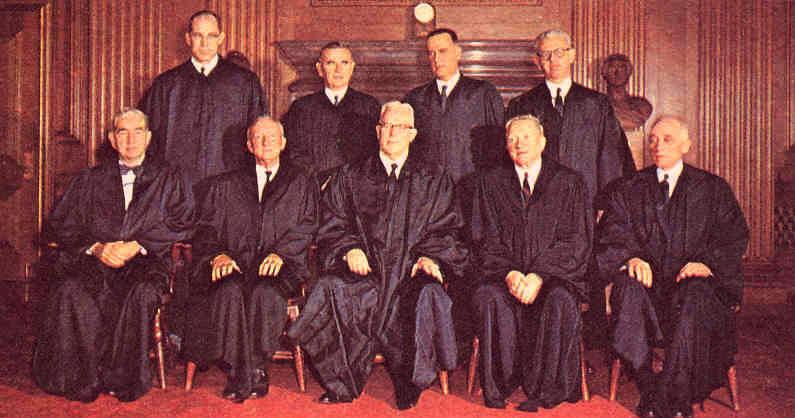
results. So why have things shifted so dramatically today ... to the point that it is now a common understanding that the First Amendment forbids religion in public affairs? That’s because in the early 1960s the Supreme Court – thanks to the pressures of the very Secular American Civil Liberties Union (ACLU) – ignored the very specific wording of the Amendment− “or prohibiting the free exercise thereof” − and proceeded to prohibit religion in public life, most particularly in the realm of the education of America’s youth. The ACLU claimed that the government’s allowing the practice of any form of religion (except their Secularist worldview) in the public schools entailed its “establishment.”
Then in the
early 1970s, the Supreme Court again violated the Constitution by establishing
Secularism as the only worldview allowed to undergird American education. How could the Supreme Court be so blatant in
establishing Secularism as the only worldview (thus “religion”) to undergird
American education. Most clearly, the
Constitution absolutely forbids such religious “establishment.” The response was that Secularism is not a
religion. It is simply Truth ... “truth”
as Secularists understand such matters.
Yes, but forty years earlier, in the 1933 Humanist Manifesto, the
Secularists (including members of the ACLU) made it quite clear that in pushing
for their Secular-Humanist agenda they were trying to plant a new religion in
America. Ooops! But the problem was solved when a new Humanist
Manifesto II was published in 1973 ... which dropped the “religion” part
and stated instead that they were simply after “truth.” Say what you
will. Truth and Religion are one and the
same thing. And such religious Truth was
what the Constitution was trying to protect.
Furthermore, in America religious Truth is supposed to be the people’s
jurisdiction ... not the jurisdiction of public officials in black robes. But ... good luck trying to get such powerful
individuals come to that understanding. But God is not
done with America. A new spirit of
revival (a new “Great Awakening”?) seems to be underway in America ... especially
among members of the Gen-Z generation.
So there is reason to believe that simply through that very spirit,
America will find its way back to the original moral-spiritual grounding – and
the fundamental laws that go with this – that America was built on ... and by
which America rose to become an awesome society. Miles Hodges is a writer,
historian and political analyst who explores the question of why societies behave
as they do ... especially in this matter of their rise and fall. |