|
by Miles H. Hodges – The Covenant Nation
Simple (and skewed) social assumptions
arising from knowing personally only a single social context
I love dearly what I discovered about the fact of my being an American … when I
was a student at the University of Geneva in Switzerland back in the beginning
of the 1960s. It was a marvelous time of
self-discovery, finding myself deeply involved in friendships with a variety of
non-American friends … most of them German but in fact from all around the
world … though here too, mostly European. 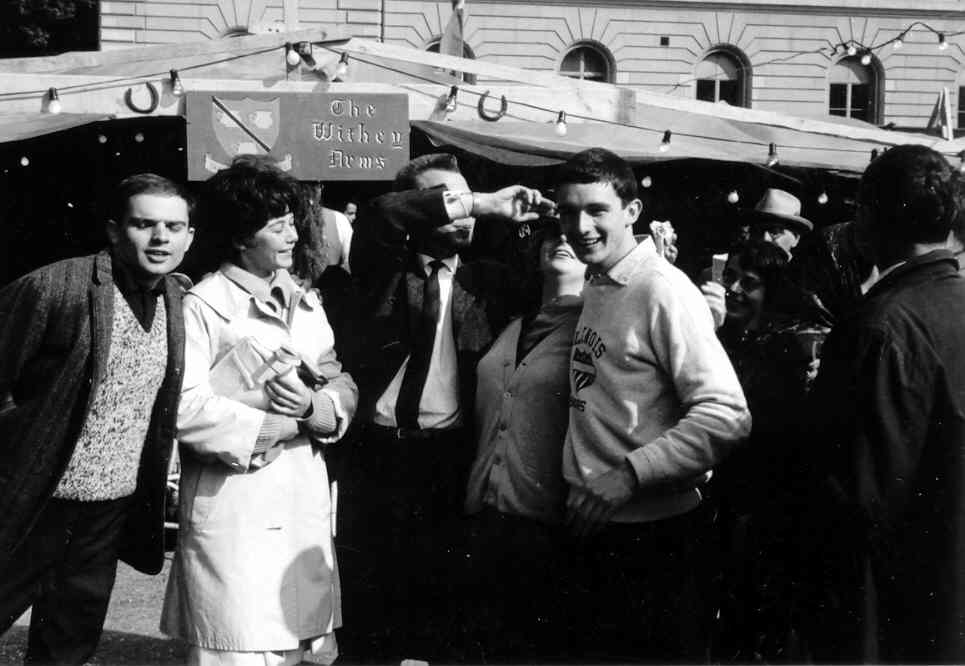
Me
(on the right) with my German friend Adam (on the left) and other
German and British friends at the University's International Fair -
June 1962
What I discovered in these awesome
friendships was what an American I truly happened to be … something I
previously really could not get a grasp on, growing up in America (in fact, in
a small town in Illinois) … where everybody else was of course also
"American." At home in
America, there was really nothing to compare with in order to see what made me (and
the world immediately around me) distinctly "American."
Actually, it had been quite natural for
me to suppose that the way I and my friends back home went at life was simply
the way everyone everywhere went at life … unless there was something terribly
wrong and dangerous if others didn't go at life this same way. To us, the goals and rules of society that we
lived by in our America (which I will eventually come to term “Middle America”)
were presumably some kind of exemplary social universal – well-proven as such in
the way America stood at the top of the global summit economically ... and
presumably also politically and socially.
But this simplistic understanding of
life and its dynamics would come under deep challenge the summer of 1960, which
I spent traveling in Europe with my parents and sister … and had engaged in
conversations wherever I could with the locals.
I found being in the varied cultures of Europe to be quite exciting ... and
obviously very different from my American world in the way they directed the
lives of the various European national communities.
Consequently, I wanted to know as
much as possible as to how these Europeans went at life. I could see the vital differences – which of
course worked well for them – and it stirred deeply my desire to dig deeper
into this matter.
Thus it was that I came to realize
that in merely sitting at home in America (which was certainly a pleasant
enough experience!) I would simply continue to understand the world and its
human social dynamics only from the single "American" viewpoint. But this would provide me only a form of limited
understanding of the more complex causes of human social behavior ... anywhere
and everywhere else in the world. I
wanted to reach well beyond this American intellectual boundary that seemed to
so easily offer itself as the universal answer to life … which I was coming to
realize was not the only way to go at life.
The Geneva experience
Thus it was that I made a purposeful
return to Europe for the school year of 1961-1962 … to be able to dig more deeply
into this matter of why our national identities made us the distinct nationals
that we all happened to be in this 20th century … when nationalism
was the driving force of world politics.
Specifically, I wanted to understand exactly what were the sources or
causes of these differences … and what made them such effective (or sometimes
not so effective – or even disastrous) approaches to life.
I shared a large studio apartment
with four other guys (Swiss, Hungarian, Bulgarian, French) and learned a lot
from them … about life on both sides of the Iron Curtain (the Hungarian was a
strongly anti-Communist refugee and the Bulgarian was a more loyal
Soviet-supported Bulgarian) and also what the French grand irritation with the
Americans (summed up in De Gaulle's larger anti-Anglo attitudes) was all
about. But it was mostly from my German
friends, that were my closest companions, that I understood the way that life
could go in such very different directions.
They were all about my same age …
and thus had started out life with World War Two well underway … their towns
and homes under constant bombardment from American and British bombers. And then they experienced the ultimate
humiliation of the loss of the war and the subsequent division and occupation
of their country by their former enemies, which included Americans, of
course. Then they went through the
national self-examination in the years that followed … hearing of their parents’
monstrous treatment of their neighboring nations … but especially of the Jews,
wherever they could find them. They thus
came to understand their German parents to have been monsters rather than
glorious examples.
Now that was quite a social
inheritance to grow up with. But I found
my young German friends to be energetic (very adventuresome, in fact), quite
happy, and fairly normal in the way (in a German way, of course) that they went
at daily life. Politics was of no
interest to them. They found their
thoughts anchored elsewhere … simply in the challenges of daily life – both at
work and at play (they were not university students but young technicians
living and working in Geneva).
Thankfully, I was fluent in German
as well as French … so I was not just getting some kind of carefully calculated
pro-American "self-presentation" coming from them … but instead the
opportunity to get in the very middle of the way they went at things on a daily
basis.
Patriotism does not need to come at a social cost to others
Now here is probably the most
important point of this whole experience.
Not only did I learn about how there were other ways to go at life – but
I also discovered how very much an "American" I truly happened to be
… and how that was just fine! I loved
being an American. In a sense I guess you can say I was proud to be an American
… finding out how deeply I loved the world I was born and grew up in. It was majorly influential in shaping the
person I happened to be.
But I learned that such
"patriotism" came at no cost to my own respect and admiration of
other nations and their peoples – and their own spirit of patriotism. In short, being patriotic was not some kind
of social sin. I learned that you could
love yourself and the world you came from … without losing any love for others
and the world they came from.
Patriotism did not need to be a
zero-sum game in which the weight and extent of one's own spirit of patriotism
came at the expense of one's regard for the weight and extent of the national
spirit of others. In no ways did
diminishing the national spirit of others enhance our own.
The sad tragedy of believing that national
self-humiliation somehow elevates a person morally and socially.
I also realized at the same time
that the diminishing of our own national spirit did not in any way increase or enhance the national spirit of anyone
else ... or “humbly” increase or enhance our own standing as moral angels.
I point this out, because this is a
huge problem today in America … where many Americans loudly proclaim that any
demonstration of a spirit of patriotism is actually horrible Fascism in poor
disguise. That "brilliant" insight into social dynamics is not only
stupid in the extreme … it is majorly destructive of any healthy social
order. Societies cannot survive on
self-humiliation, much less self-hatred.
Again … there is no shame in loving
the nation, the culture, that you grew up in.
It comes at no cost to others … unless you make it such a cause – as
incredibly stupid and self-destructive national wars fought in the 20th
century certainly happened to be.
And it was here that my German
friends showed me that you did not need to get caught up in hostile national
antagonisms in order to prove yourself to be the proud national that you
were. My friends were quite German,
proud (though certainly not haughty) to be so … but at no cost to those around
them, Swiss, French … or even American!
We got along beautifully, they being fully German and I being fully
American. In fact, we laughed about it
quite a lot … the social-cultural differences at times being most amusing.
Love is key
This then became for me a lesson I
would never forget. Love of country can
be a very noble thing ... if it comes with the understanding that it is equally
noble for others to possess that same love of their own social inheritance and
social structure. We can all live very
peaceable on this planet if we would remember to keep that spirit of mutual
respect for the differing ways that we have been taught to go at the larger
world.
That’s how God himself intended for
us to go at life ... clearly outlined as such by the love his Son Jesus brought
to our world through his own shining example.
In short, self-love ‒ both personal
and social ‒ is not categorically a sin ... but instead can be ‒ even should be
‒ a source of strength offering us the quiet confidence and self-security
necessary to be able to extend freely that same love to others.
Miles Hodges is a writer,
historian and political analyst who explores the question of why societies behave
as they do ... especially in this matter of their rise and fall.
|