|
|

 The national election of the year 2000 The national election of the year 2000  George "W" Bush George "W" Bush The Bush Administration The Bush Administration  No Child Left Behind No Child Left BehindThe textual material on this webpage is drawn directly from my work America's Story – A Spiritual Journey © 2021, pages 409-413. |
|
|
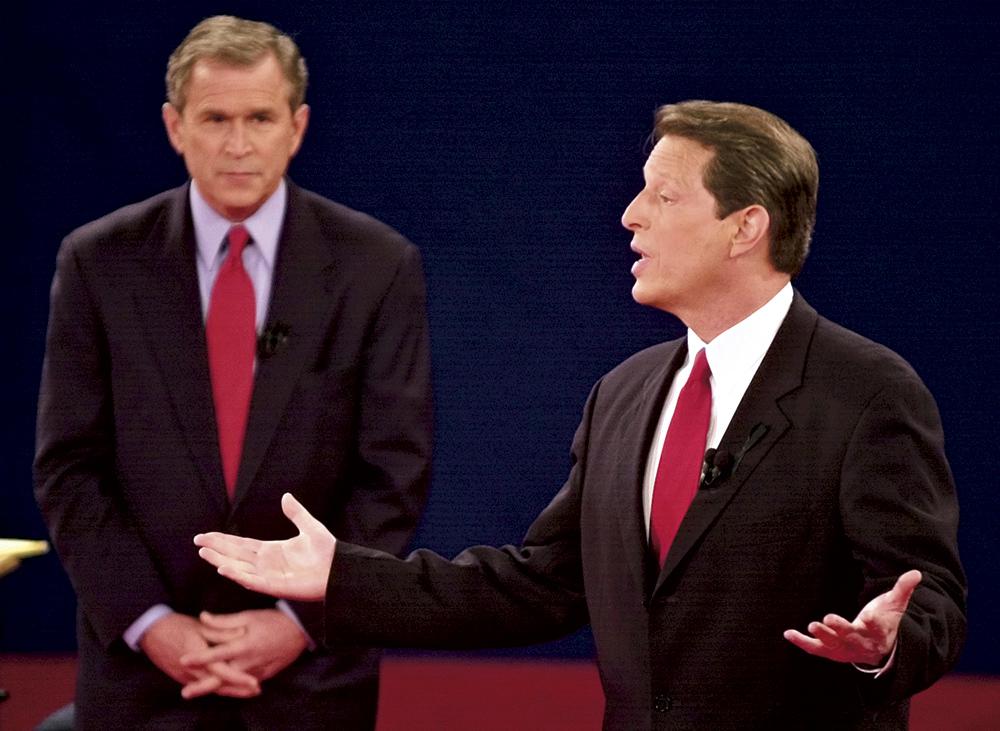
The Presidential electoral campaign of 2000 seemed to offer America an assurance that the politically mature path it had been on since the grand catastrophe of the 1960s and 1970s would continue. The two Boomer candidates competing against each other both came from political families well known to the American public – both the Bushes and the Gores. The Democratic candidate, Al Gore, had served eight years in the U.S. Senate – before being brought on board in 1993 to serve eight more years as Clinton's Vice President. George Bush (we will call him "Bush, Junior" because he differs from his father, the former President, only in dropping one of his father's middle names) was a newcomer to the national scene, but was in his sixth year serving as Texas governor as of the 2000 national election. Both seemed excellent choices. 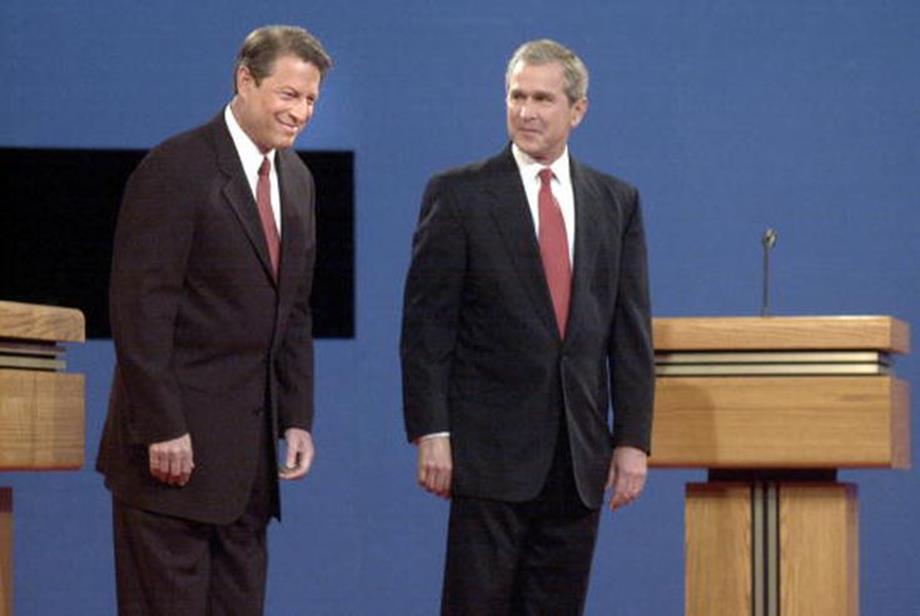 The Bush – Gore presidential debates
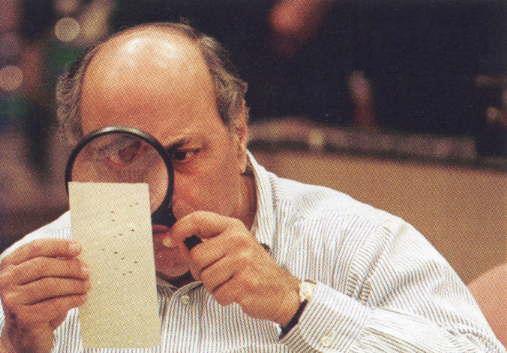
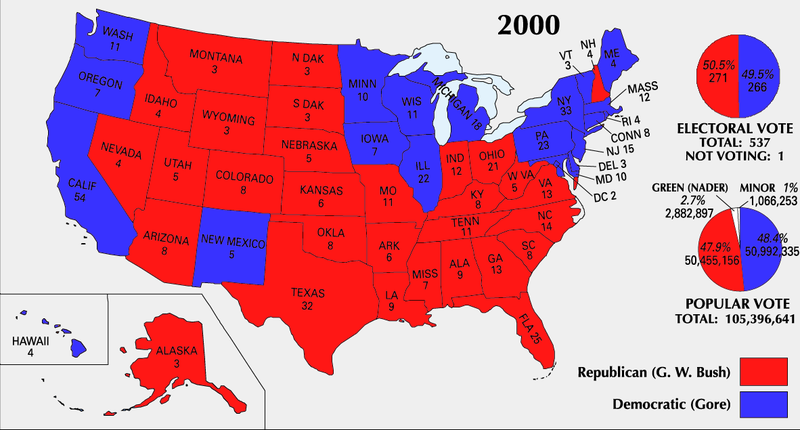
Indeed, the election was a very close one, Gore actually winning the total popular vote – but losing the electoral vote by only 4 votes. The Florida vote was so close (a mere several hundred votes separating the two candidates) that it went through a long period of recounts – only to have the Supreme Court validate the decision of the Florida Secretary of State (a Republican) that Bush had won that state's electoral vote – and thus the national election.
A dispute arises over
the closeness of the vote in Florida –
In keeping with long-standing American political tradition, Gore was gracious in accepting the final decision of the Supreme Court on the vote and stepped aside politely to let Bush take leadership of the nation.
|
|
| Bush, Jr. was, like Bill Clinton, born in
1946, and most certainly qualified as a Boomer, political idealism and
all. We already know about his family
background, and can safely say that although born of a traditional Connecticut
dynasty, he was raised clearly as a Texan, and was most affirmative of that
fact.
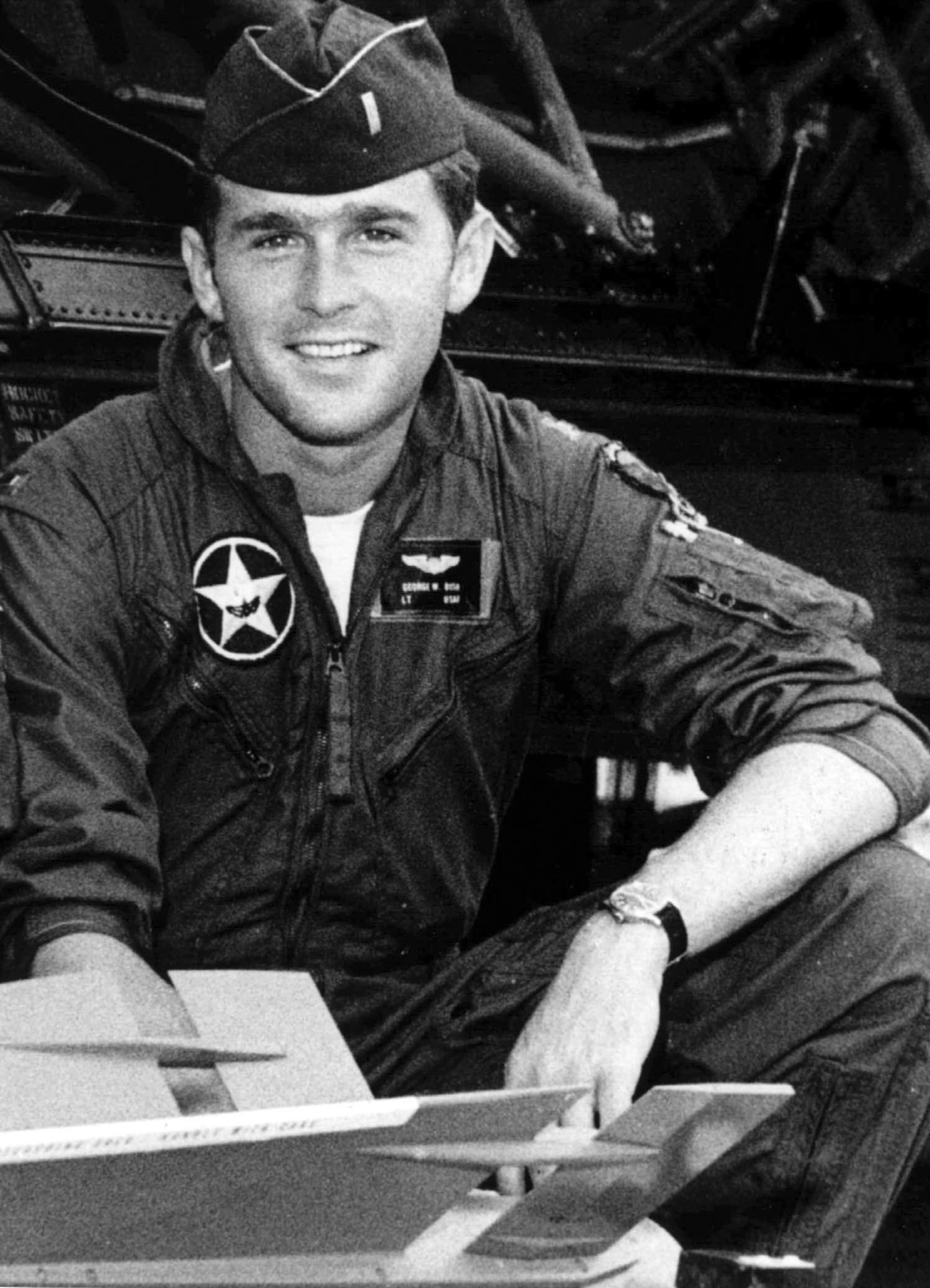
He not only saw the world as something that needed to be conquered, but also had a tough generation or two to follow – and measure up to in his own development. And it would always leave the haunting question to Bush, Jr., who would be left to wonder if it was on the basis of his own merits, or on the merits of his father and grandfather, that he was experiencing success in life. That's one of the truly tough things that comes with being born to enormous social privilege. He would of course be raised a Christian, but would have that faith tested deeply early on, when at age seven he had to watch his younger sister die of leukemia. And oddly enough, even his family name could not open the doors for him to study at Houston's prestigious St. John's School. That was hugely disappointing. But ironically, he was instead enrolled in the even more prestigious Phillips Academy up East in Andover, Massachusetts. So, was that God's doing, or was it due to the fact that both his father and grandfather went there as well? 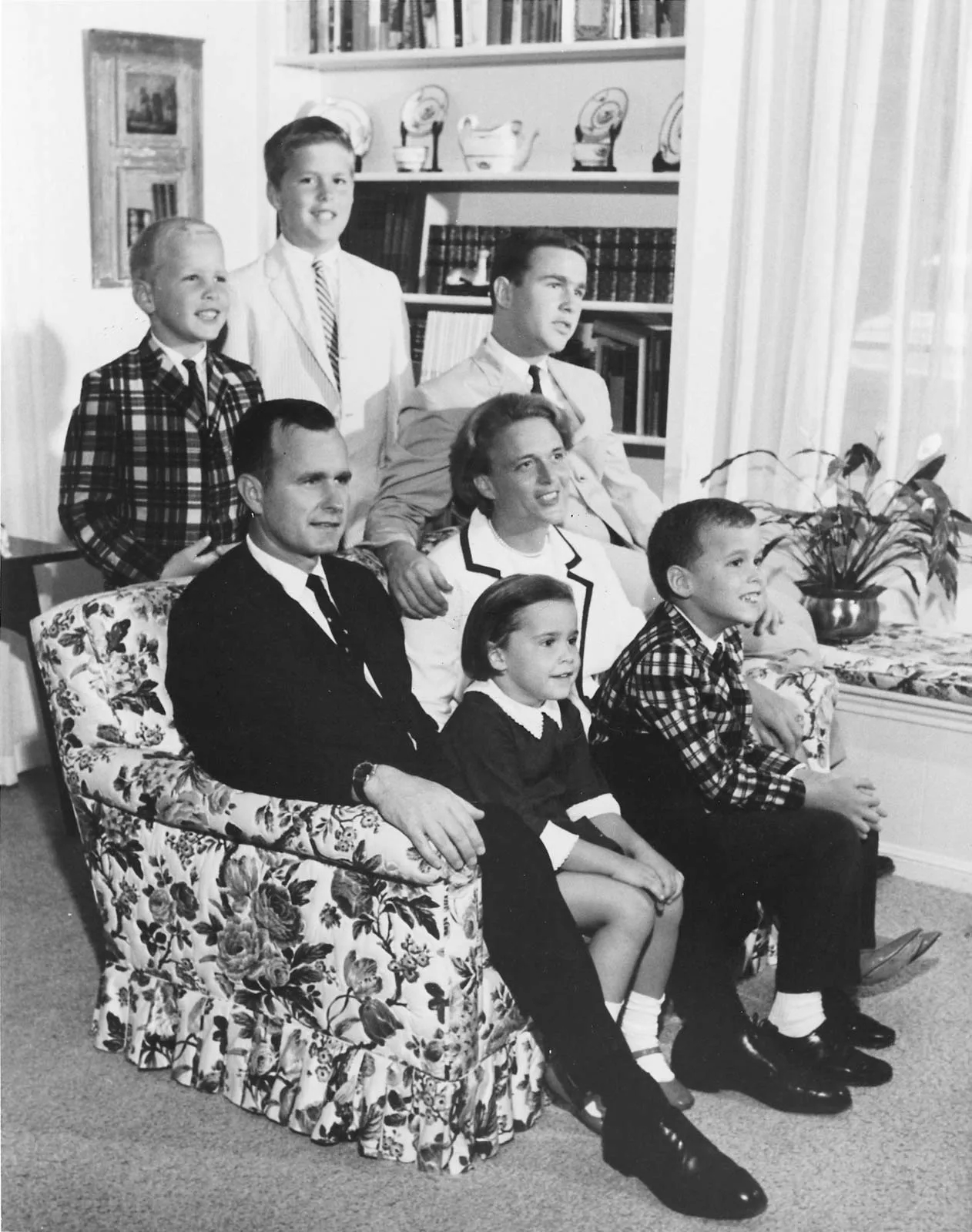 The Bush Family – Houston, Texas, 1964 "W" is seated on the arm of the chair; his brother Jeb (future Florida Governor) standing in the middle Interestingly, he rather enjoyed being the Texan amidst the polished up-East aristocrats, playing the "good-old-boy" Texan to the hilt! It gave him important social standing, which his mediocre grades did not! He became a leader thereby, and took this social profile along with him when he later (1964) entered Yale University (also a family legacy and certainly responsible for his admission, achieved in spite his poor academic record). And at Yale he kept up the profile as a smoking, drinking, fraternity boy, popular with the girls in the nearby girls' colleges. And certainly not because of his grades, he was even admitted to Yale's prestigious Skull and Bones Society (like his father). However, he never became truly fascinated with the "polished" up-East world, and returned to Texas in 1968 and joined the Texas Air National Guard (family connections opening the way for him into this highly-sought-after unit).[1]
First Lieutenant George W.
Bush in the Texas Air National Guard Then he went through his ten "nomadic
years" – as he termed them. But
those years included getting an MBA at Harvard Business School (1975), starting
up his own oil business on his return to Texas, and then bringing that era to a
wonderful conclusion in meeting, and three months later marrying (1977) a
former 7th grade classmate, Laura Welch. This began the process of settling him down,
especially when in 1982 twin daughters were born.
George W. and Laura Bush
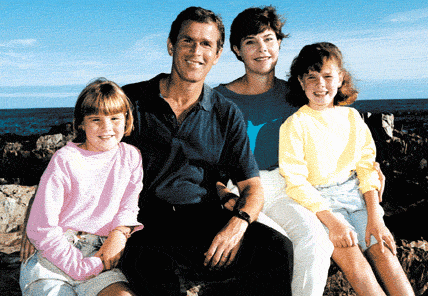
with their daughters Jenna and Barbara, 1990 It was in meeting the traveling evangelist Arthur Blessitt in 1984 – and the following year, Billy Graham – that made Bush's Christianity more than a mere church-going formality. In his new "born-again" life, he took up Bible and devotional reading and a life of prayer, and ended his drinking and eventually his smoking. In fact, so immersed in this evangelical world was Bush that, in helping out in his father's presidential campaign (1987), he was assigned the task of developing invaluable liaison work with various American evangelical ministries. Finally however, he was able (1989) to establish credibility by his own right, investing money from his oil business in the Texas Rangers baseball team, in the process, putting his name out front in Texas public affairs.[2]
The family in 1993 Thus in 1994 he took up the challenge of running for public office as Texas governor (he had failed back in 1978 at a run for Congress) against the Democratic Progressivist and incumbent governor, Ann Richards, a daring thing to do. But it was a big year for the Republicans nationally (thanks to Gingrich) and Bush defeated her soundly, gaining 54.5% of the vote to her 45.9%. Besides taking a typical Republican stance on such
items as cutting taxes, as governor he also presented himself as a "compassionate
conservative" (in Boomer-talk, meaning sensitive to the injustices in the
world), supporting educational reform, Hispanic community development (he loved
to demonstrate his Spanish linguistic abilities), and community action programs
through groups set up to work locally on social reform. And here is where his Christian faith played
a big role, when he looked especially to "faith-based" groups to take
the lead in developing and administering the local social programs.
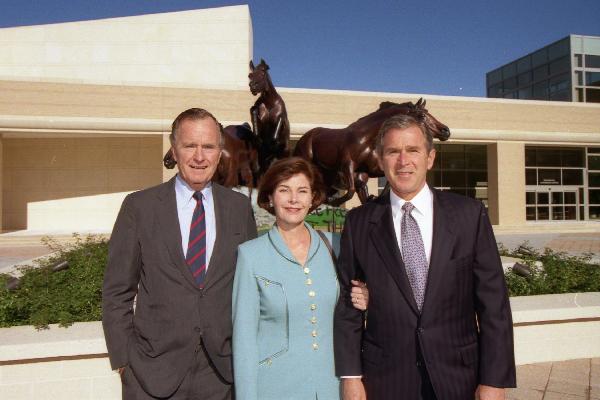
Former President Bush with
son and daughter-in-law, Governor George W and Laura Bush,
at the George Bush Presidential
Library Dedication in College Station, Texas – 6 November 1997 Now as his second term was coming to a close, he took up the idea of a run for the U.S. presidency. It seemed to be a familiar world, and he felt quite confident that he could win the contest. And what he brought to the field of competing Republican candidates was his own record as a "compassionate conservative" governor, ready to see things run from Washington on much the same basis.
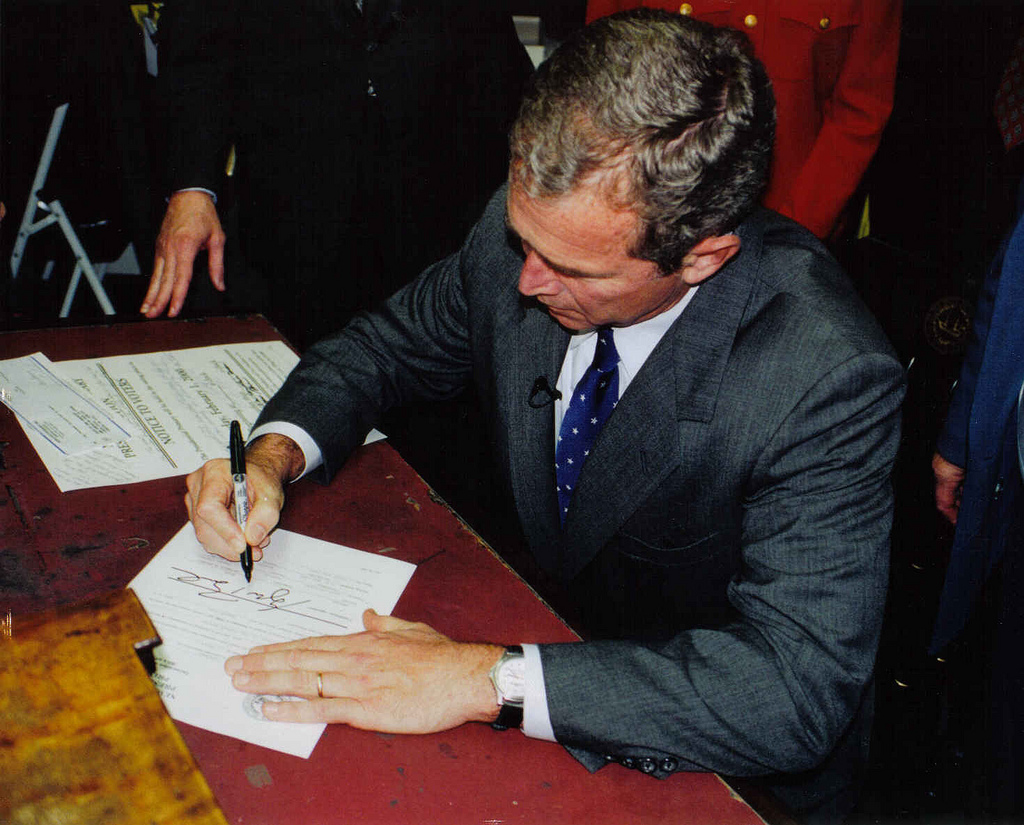
Bush in Concord, New Hampshire signing to be a candidate for president – 1999 Eventually the Republican field was thinned down to just Bush versus John McCain, a war hero and Arizona
senator. The campaign against McCain got ugly. But Bush came out on top in the contest. Now in taking on his Democratic Party opponent, Al Gore, one of
Bush's lines of attack was all the costly and dangerous "nation-building"
that the Democrats had involved America in during Clinton's presidency (and –
more importantly at the moment – Gore's vice-presidency).[3] [1]During his 2000 presidential campaign, his joining the Air National Guard was cast simply as a way of avoiding the draft – and dangerous military service, such as his opponent Al Gore had undergone. Maybe. But Bush actually proved himself to be an excellent fighter pilot in training exercises, though he never saw actual active duty. [2]And becoming a
multi-millionaire when he sold his interests in the team nine years later, just
prior to his run for the U.S. presidency. [3]But ironically, Clinton's nation-building (in Haiti, Bosnia and Kosovo) had actually been quite cautious and relatively restrained in extent, in stark contrast to what Bush's nation-building (Afghanistan and Iraq) would soon come to be, especially as it became the all-consuming focus of much of Bush’s presidency! And the reason why this should be the case was never very clear. |
|
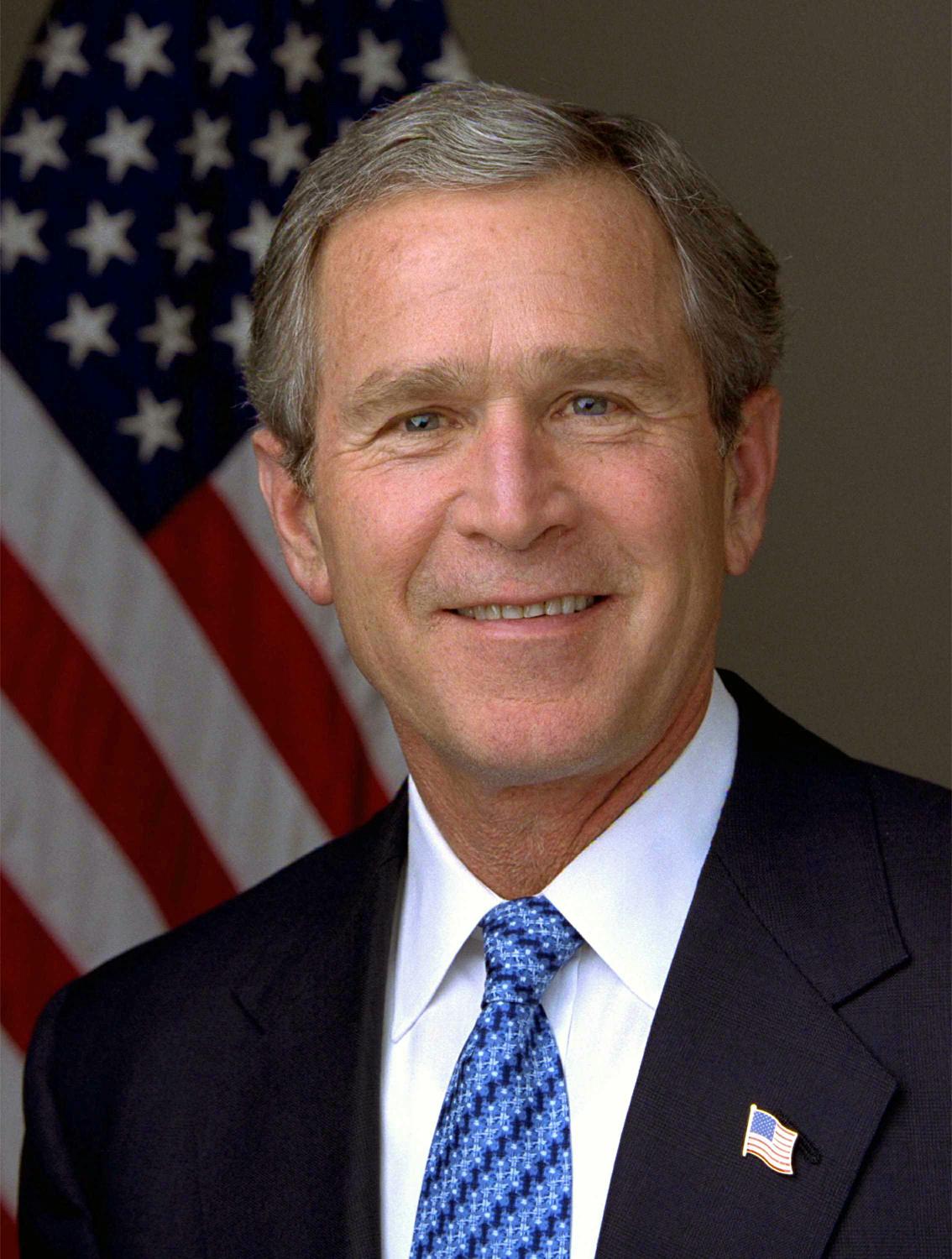
Official photograph portrait of U.S. President George W. Bush (1946 – ) Bush had appointed a very diverse cabinet, knowingly or unknowingly likely to have conflicting views on strategic issues, especially those concerning foreign affairs.
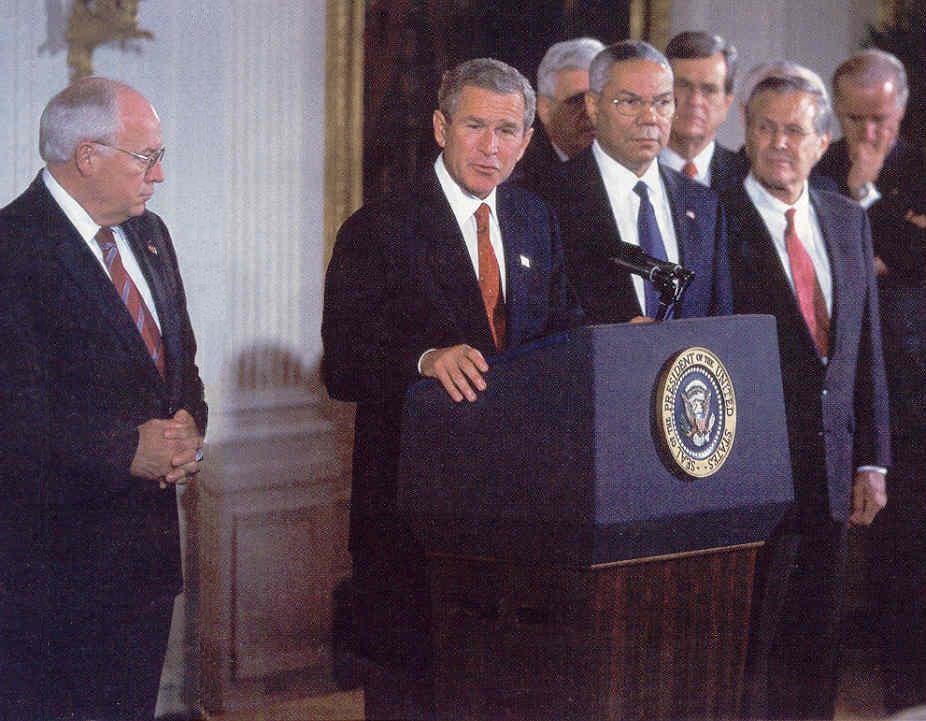
President Bush and part of
his inner team
Chief
among the voices that would have a strong impact on the way Bush saw and went
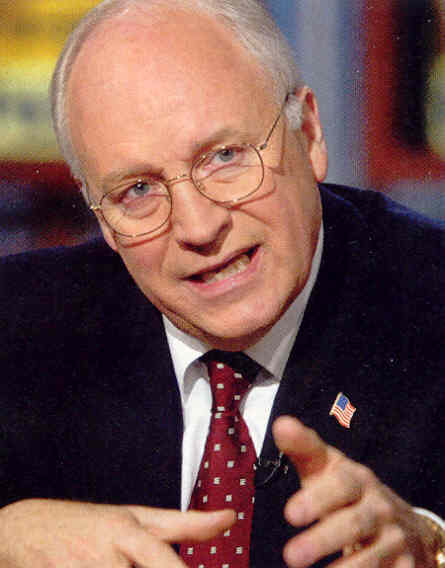
after things was actually not an appointee, but his vice president, Dick Cheney. Cheney had served presidents as far back as
1974, rising to be Ford's very youngish chief of staff. He then became a congressman (1978-1988),
rising to the ranks as Republican minority whip, before being appointed by the
elder Bush as his Secretary of Defense.
He then retired to private service in some conservative think tanks
before becoming chief executive officer (CEO) of the Halliburton energy giant
(1995). Cheney would serve as something
of a sounding board for Bush, Jr., Bush meeting with him privately after
cabinet meetings to get Cheney's opinion on matters, something Bush valued
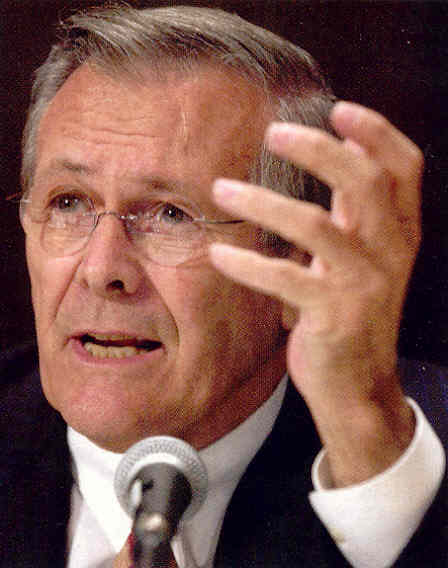
greatly. Then there was Donald Rumsfeld, who had also served on Ford's cabinet (Secretary of Defense) and close Cheney associate since then. In fact it was on Cheney's advice that Bush, Jr. appointed him as his own Secretary of Defense. Together, those two would dominate Bush's foreign policy thinking, for better or worse.
Vice President Dick
Cheney Secretary of Defense Donald
Rumsfeld True,
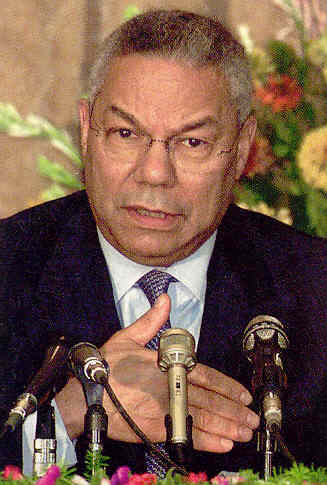
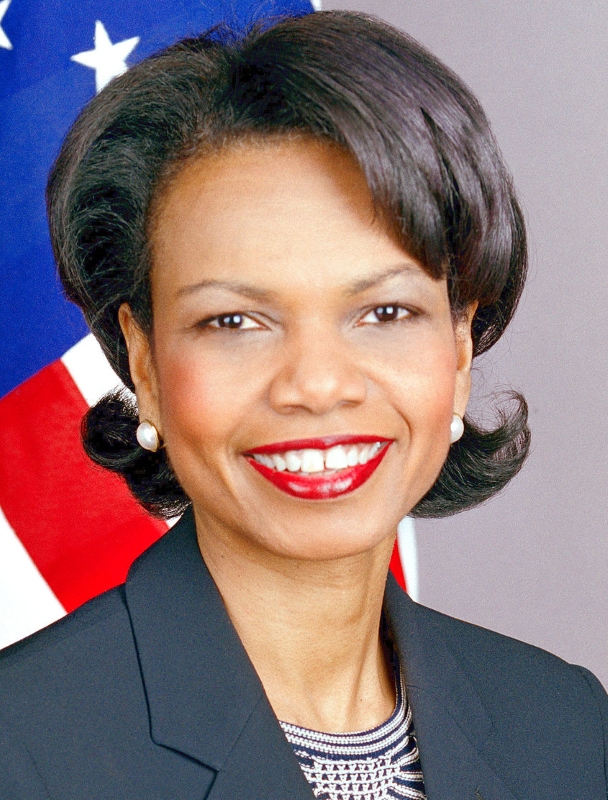
Bush had a Secretary of State, General Colin Powell, a veteran military advisor
as Reagan's National Security Adviser and Bush, Sr's Chairman of the Joint
Chiefs of Staff. But knowing the military quite well – its capabilities and its
limitations, he typically advised a much more cautious approach to foreign
policy matters than did the Cheney-Rumsfeld team. And allying with Powell was Bush's own National Security Advisor, former Stanford University professor and then university provost, Condoleezza Rice. But the Cheney-Rumsfeld duo did not pay much attention to her, Rumsfeld at times treating her as if she were merely some university grad student offering limited advice on matters.
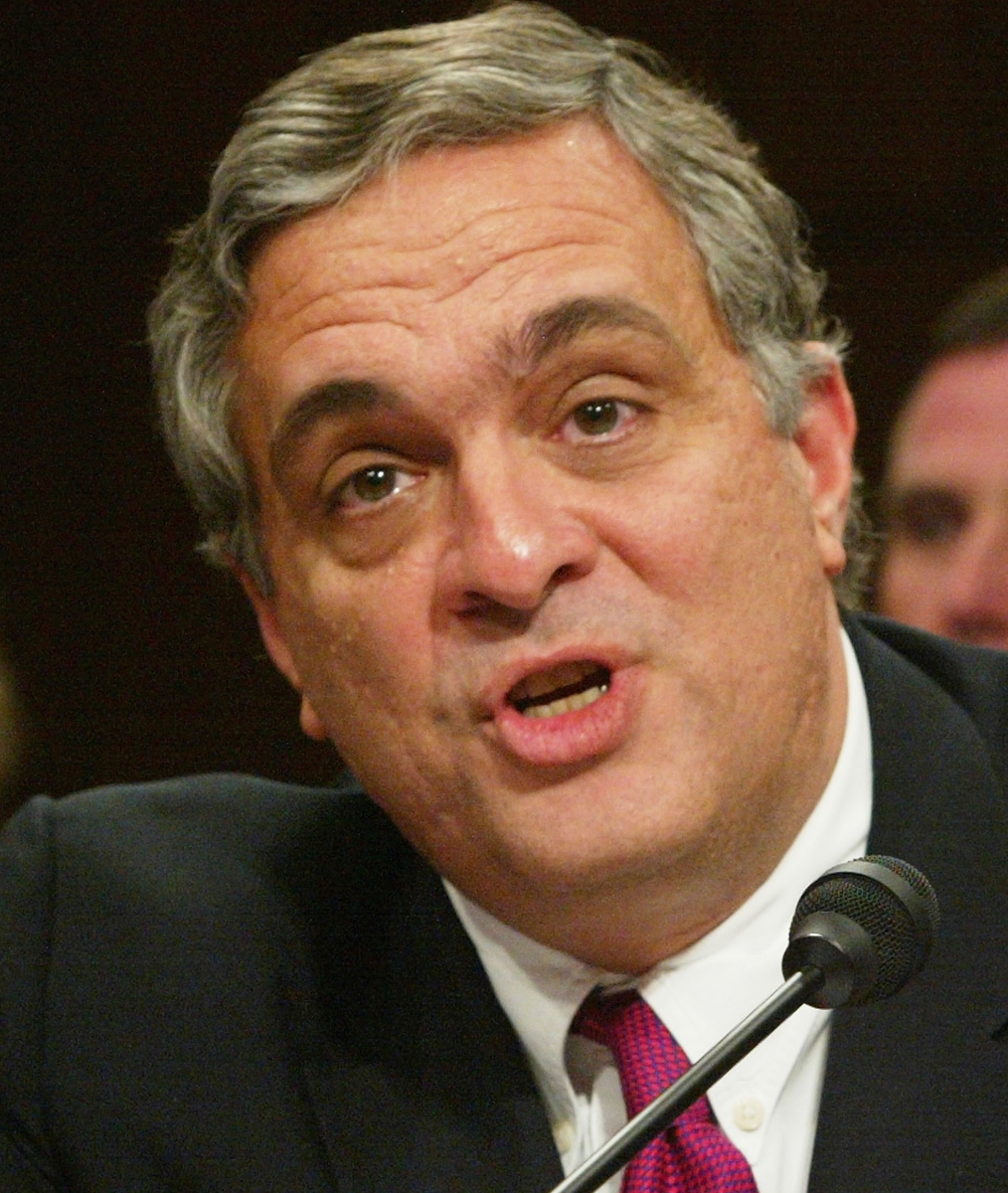
US Secretary of State Colin Powell National Security Advisor Condoleezza Rice Then there was George Tenet, Director of the Central Intelligence Agency, a carryover from the Clinton Administration (the CIA and its officers were expected to be "non-political"). He too would find himself up against Rumsfeld in taking on the key issue of America's "war on terror."
This
would be the team that would have to somehow work together to support its
president, as he came to face major foreign policy issues that arose after the
11th of September during his first year in office. |
|
|
Actually
Bush presumed that his real work as a "compassionate conservative"
president would be in the realm of domestic affairs, and had taken on the
challenge of national education reform with the same zeal that he had done so
when Texas governor. But educational
policy had long been a state and local matter, not one of Washington's
business. But Bush was able to put Republican support behind him (Democratic
support was considered to be automatic in such matters) and thus found huge
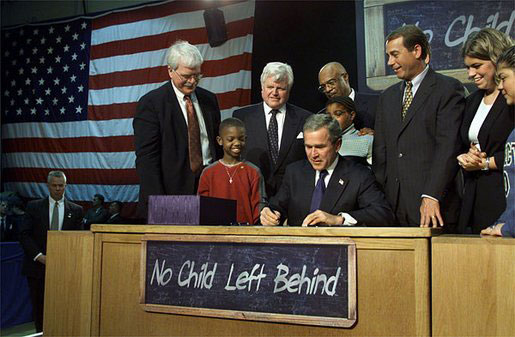
support in Congress for his "No Child Left Behind" (NCLB) Act. This program called for states to undertake
standardized testing, and receiving federal financial support if they did so
... with the expectation that those testing scores would also improve every
year in the process.[4]
President George W. Bush
signs into law the No Child Left Behind Act – Jan. 8, 2002 [4]Not surprisingly, over the years, complaints grew that Bush's program had teaching now shaped by the single consideration of improving test scores, making the education process itself very mechanical and not terribly effective in creating truly well-educated youth. In 2015 the program was finally replaced by one supporting the states, as they themselves saw the need for educational reform. |

 Miles
H. Hodges
Miles
H. Hodges