Man's insatiable desire to play God.
But holding to that critical piece of Puritan wisdom or insight has not
been easy for America (much as it was difficult for the ancient
Israelites). Since the Fall of Adam and Eve, man has wanted to
play God himself, has wanted to plan and control outcomes in life.
God's gift of human reason – given to help man not only take joy
in life itself but also find ways to greet challenges placed in front
of him on a virtually daily basis – man has instead used to try to
redesign life itself so that he hopefully did not have to deal with the
complexities of the immediate problems he was facing, so that he would
not have to leave up to God the matter of determining what life was
ultimately all about and where it all was headed.
This tendency to want to plan and control is particularly
obsessive among those who have made it their life-work to live by their
powers of reason alone: intellectuals, seated at their desks,
rationally planning out their lives, and, if possible, the lives of
others as well. They not only want to get their own lives planned
and controlled by reason (their reason, of course), they typically want
to bring the rest of society along in support of this same endeavor:
to have others also live by way of their rational planning.
Having others following their lead validates everything they see
themselves as being: wise, noble, important.
Thus the "man of reason" does not like to hear anything about
a God who lives beyond man's measured world, beyond his pleasant
intellectual bubble that he has placed himself in – while trying to
bring others with him into that same bubble. To him, the very
notion of God stands as some kind of threat to his well-reasoned plans
for life. Thus he wants the idea of a presiding God eliminated from his
world.

This
tendency is not new. It is certainly not just American. It is a
tendency that all of us struggle with. And, if allowed to
continue to develop as a rational process, it will always find itself
increasingly hard to be put aside (like alcohol and drugs). And
ultimately, it will come to curse and destroy such a world – and those
who attempted to design it. The 20th century alone has borne witness to
this tragic reality, repeatedly.
But God, thankfully (or hopefully), is not done with the human
race, and from time to time, through the prophets of old, Jesus
himself, the Christian saints of history, the religious reformers, and
more recently the voices of the various Awakenings, God has shaken a
self-blinded human race to the core, putting it back on the path that
he originally destined humankind to go down.
The call for America to understand this was what so strongly motived Lincoln in his Second Inaugural Address.
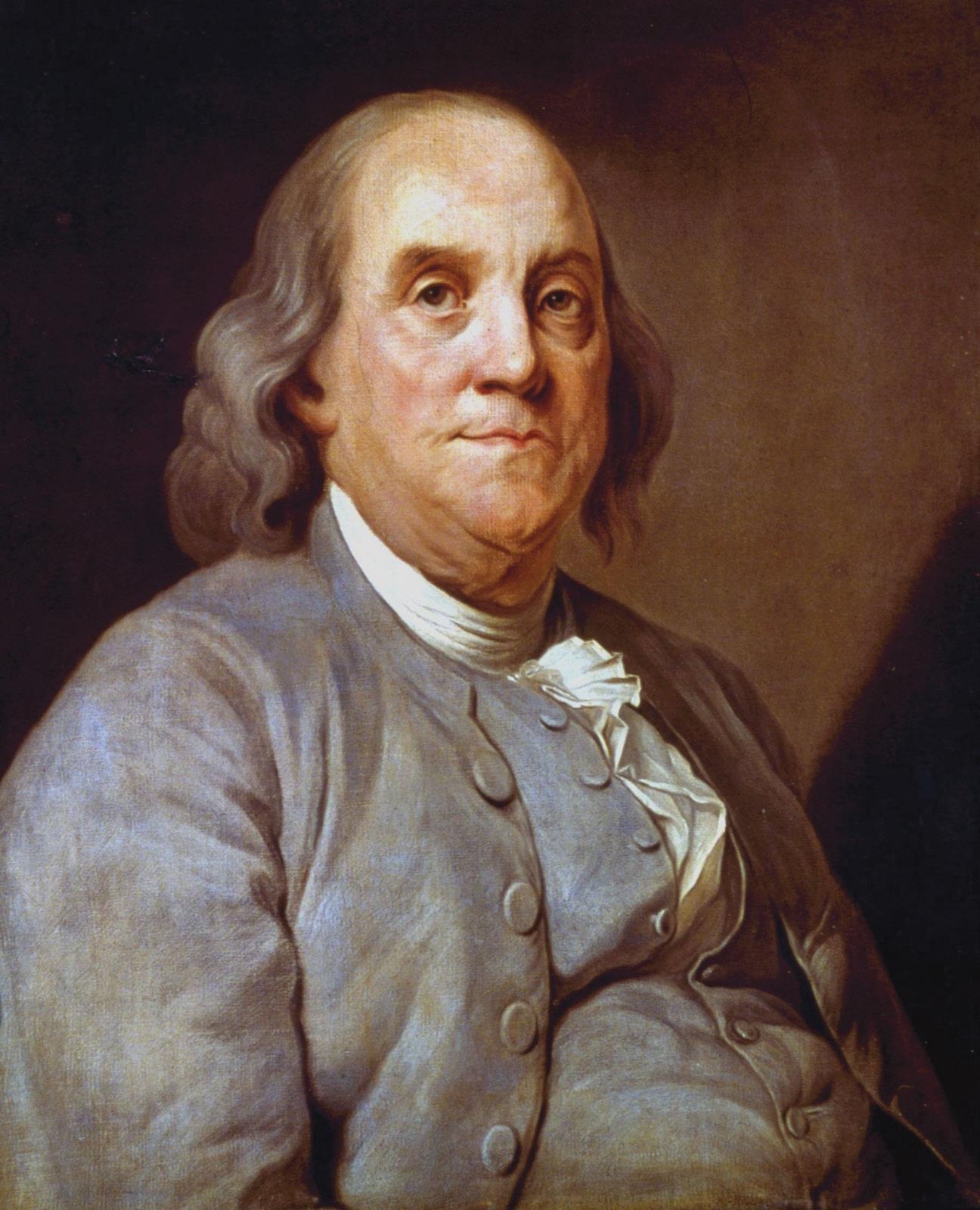
This is what the ultimate practical-philosopher Franklin
understood – as the Framers in 1787 attempted to put together a new
Constitution through solely a purely rational process. Franklin
reminded them that it was to God that they were to look in overcoming
the multiple roadblocks they found themselves facing in the process,
not to human reason. He asked them if they had so soon forgotten
how it was to God that they looked repeatedly, during the recent war
with England when the dark days offered little logic as to how they
were to move forward?
Tragically, soon after this (the early 1790s), the French would
ultimately prove what should have been understood without a shadow of a
doubt because of the American example just put before them – that
planning to rebuild society on nothing more that human reason was a
program destined for devastating failure.
The challenge over the past fifty years of Human Reason to the Covenant.
And so things went, back in the 1960s and 1970s in Vietnam. And
so things went, in the early 2000s in Afghanistan and Iraq. And so
things went, more recently in Libya and Syria. And so it has also
gone on so many of the streets of America itself. Rational (and
extremely expensive) social programming by the experts has not made a
dent in solving the many social problems facing America since the
1960s, either at home or abroad. Compassion, not plans, should
have been employed – a moral challenge that moral leadership should
have focused on instead of all that ideologically-inspired "rational"
social planning.
It has been a long and disappointing fifty years since
Rational (or Secular) America began to move away from the longer
Christian moral-spiritual tradition – the very moral-spiritual
tradition that had just brought the country to unprecedented
greatness. Almost immediately after having in the late 1940s and
1950s achieved superpower status – and a highly respected Christian
model to place before much of the democracy-aspiring world – America
began in the 1960s its move away from that very traditional Christian
moral-spiritual order ... in order to head down the alluring but highly
deceptive Secular road of Human Reason.
America was not quite perfect. But there were those
power-brokers and their intellectual advisors who were certain they
understood the rational process by which to bring America to
perfection. Indeed, it was this very idea of rational social
engineering that formed the core of Johnson's Great Society Program.
It was also the basis for the Vietnam program Johnson attempted
to put into play at the same time.
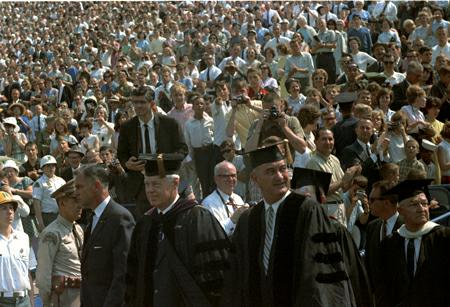
LBJ at the University of
Michigan, May 22, 1964 –
announcing the outline of
his "Great Society" Program
LBJ Library – University
of Texas
Evaluating the grand engineers of Human Reason.
Not surprisingly, behind this new momentum were those with the highest
and most prestigious educations, especially in the legal field.
Lawyers are, by training and professional calling, defenders
of someone's need for reason, that is, reason in support of their
client's personal and social interests. Lawyers are hired to
develop reasonable lines of personal or social defense, ones then
presented usually in a court of law – against someone else's interests,
the adversaries also reasonably defended by a countering lawyer!
How a judge or jury is supposed to find the Truth behind very
skilled but intensely conflicting rational arguments offered by
opposing lawyers is always a wonder. Legal skill rather than
simple truth is designed to always be the winner in a dynamic such as
this!

In short, reason and truth are not the same things. Anyone can
reason – and we all do, constantly. But finding truth is actually
a very different endeavor. But try to get the world to understand that!
Try just to get a clever six-year-old to understand that!
We start to use reason rather skillfully in support of
self-interest at a very early age!
This beautiful world of human reason can be found especially
at the pinnacle of America's legal world. No, not Congress.
The federal courts! And at the summit of that world of federal
courts is found the ultimate citadel of Reason, the U.S. Supreme Court.
Americans presume that black-robed Supreme Court justices see
truth above mere personal political interest.

Actually, these
justices are just as political, just as ideological, in their reasoned
approach to the law as any other American lawyer. And they are
highly political, because they are highly powerful. It is no
wonder that life-time appointments to this small but unrestricted or
absolute source of American political authority are now fought over
with such intensity.
In short, the Supreme Court has made itself the Central Committee, the Politburo[4] of American democracy.
[4]The
name of the small group that, from behind the walls of Moscow's Kremlin
citadel, "rationally" governed the lives of the citizens of the former
Soviet Union – and of the captive countries of Communist Eastern Europe
as well.

 Why this matter of God is so important
 Human Reason v. Godly or Divine Reason