Leaders, not social designs, shape the moral-social order.
Modern writers of American civics textbooks typically present the
general character and specific features of a social order, or in our
case the American social-political order, as the product of a vast
amount of legal engineering. The social order is presented as the
sum total of well-designed legal structures, laws, political offices,
civil and social institutions, that direct the behavior of the members
of a society. In other words, it is good laws and good political
structuring that make the good society. It is all very
mechanical, all very personality-neutral in its operation.
Understanding social dynamics from this viewpoint, it becomes
imperative for those involved in social engineering (social-political
reformers found in public office, in academia, in the press, even in
the field of entertainment, etc.) to lay out on paper and in their
public proposals the blueprints for a truly great society, one whose
political offices are designed to work along highly rational lines.
We saw how the social commentator John Locke, for instance,
was invited in the 1600s to set out a rational social-governmental plan
by which to direct the development of the new Carolina colony.
But so perfect was it in design that it was quite useless in
dealing with the messy circumstances which this new society faced in
actually getting up and running. Then also, we saw how the highly
academic President Wilson had precise plans for democratizing global
society –which tragically fell apart in the face of political reality.
More recently, President Johnson and his advisors had beautiful
plans and programs to bring America to perfection as the "Great
Society," all of which crumbled in the face of unanticipated social
dynamics. And then there was the American effort to rebuild a
war-torn Afghanistan and a post-Saddam Iraq through implementing
constitutional reform.
Beautiful social plans did not automatically make for
beautiful social results. But this is a hard reality almost
impossible to get the world of intellectual and bureaucratic social
planners to understand.
Thus unfortunately, Americans have been taught that "the
office makes the man." Political office supposedly empowers,
directs and limits the behavior of anyone filling that office. If
the office is well-designed, then anyone holding that office and
operating under its directives should fulfill quite nicely the
responsibilities society has conferred on him or her.
That principle perhaps holds true at the lower, more
bureaucratic level, of the social order (whether a nation, a
corporation, a military organization, a university, etc.). But it
is not bureaucrats that inspire or direct the behavior of larger
society.
Indeed, as has been very clear from the American example
itself, societies are actually highly leader-dependent in who or what
they happen to be. Sadly, Americans –so enraptured with the
rather mechanical idea (even ideal) of legal-mechanical
constitutional-democracy –find it almost impossible to acknowledge the
key role that individual leaders play in the successes (and failures)
of societies. Tragically, Americans love to overthrow
authoritarian leaders in the name of promoting their ideal of
legal-mechanical constitutional-democracy –then always shocked and
confused to see how, instead, their efforts to do so typically throw a
society into violent social disarray.
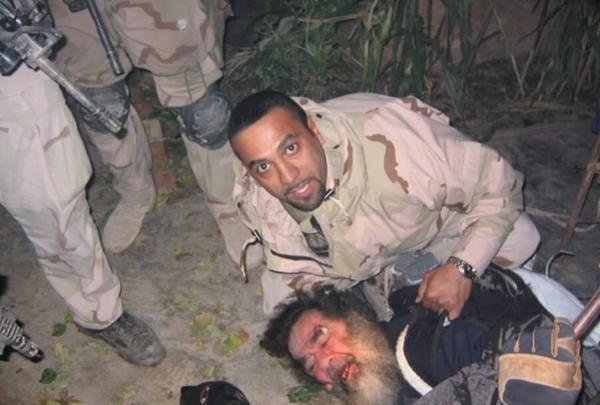
Iraqi dictator Saddam Hussein caught hiding (and soon executed)
– December 2003
But to anyone who has looked seriously at how human history
has worked over the countless generations of human life on this planet,
it is always very clear how a single individual can shape the character
and operation of society.
History is full of such examples. Chinese history, for
instance, is really the study of personal dynasties, ones that have
arisen out of a period of confusion when the Chinese society is torn
apart by warring warlords, until one of these warlords is able to
establish ascendancy over the others, and thus begin a new dynasty, and
a new period of peace and social development.
The Hebrew Bible is really a story of ancient Hebrew
patriarchs and prophets, Abraham, Moses, Joshua, David, Nathan, Elijah,
Elisha, and the huge impact they personally had on the shaping of the
Hebrew nation.
Western history is filled with the stories of how such
individuals as Alexander the Great, Julius Caesar, Constantine,
Charlemagne, Luther, Calvin, Louis XIV, Napoleon, etc., had a huge
impact on the defining of the social order of their days.
More recently we have also seen how Hitler, Stalin, Gandhi, Churchill, Mao shaped our world (in ways good or bad) in their days.
And certainly in American history, note the enormous impact
that Washington, Jackson, Lincoln, Wilson, the Roosevelts, Truman,
Johnson, Reagan, Obama, or for that matter virtually every American
President in one way or another, each had in shaping American society.
Leaders stand as living-breathing examples of the moral ideals that
the people need to embrace in order for their society to succeed.
Society's best leaders actually serve society as the very living
symbol, even reality, of the moral order and its particular social
design. These leaders are not political dictators forcing the
people to adhere to strict social policy that they are imposing on
society (though some will certainly try to lead this way).
Great leaders do not dictate. They inspire. They
themselves become the visible idea, the very embodiment of the ideal
features of that society –from the lofty goals or social ideals that
the leader represents personally, to the choices to be made or the
procedures to be followed which the leader inspires the society to
embrace in order for it to be able to reach those lofty goals.
This is what brings a society to success, even grand success (or
tragically also, massive disaster if wrongly directed), because such
leadership is not just accepted. It is followed enthusiastically
by the rest of society.
Thus it is that truly "the man makes the office" –not the
reverse. We have seen how the office of U.S. president changes in
character and political effect as it changes hands, from one individual
to the next. True, the office empowers an individual legally.
But how (and if) that power is used depends entirely on the
personal makeup of the individual holding that office.
This idea that the greatness (or failure) of any society is
determined heavily by the personal character of the person acting as
society's leader is illustrated very clearly in history.
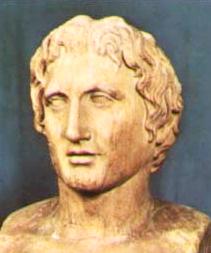 Alexander the Great was no holder of any particular imperial
office (though he was the son of the conquering Macedonian King Philip
II), but the one himself who defined by his enormous activity what his
huge empire was to become.
Alexander the Great was no holder of any particular imperial
office (though he was the son of the conquering Macedonian King Philip
II), but the one himself who defined by his enormous activity what his
huge empire was to become.
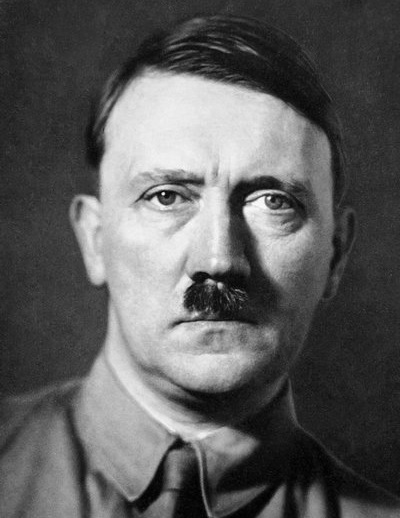 Hitler was brought to power as Germany's Chancellor in 1933.
But what happened next to Germany had little to do with the
mechanics of the German Weimar Republic or the office of Chancellor.
In fact, that German constitutional order was quickly put aside
by the German people themselves in order to build a German Third Reich
or Empire around the very person of their Führer (Leader) Hitler.
For better or worse (in this case horribly worse) the German
nation redefined itself around the personality of a single individual.
The same can also be said of Stalin's Russia and Mao's China.
And we must add, this is exactly what is happening today under Xi
Jinping's leadership in China and Putin's leadership in Russia.
Hitler was brought to power as Germany's Chancellor in 1933.
But what happened next to Germany had little to do with the
mechanics of the German Weimar Republic or the office of Chancellor.
In fact, that German constitutional order was quickly put aside
by the German people themselves in order to build a German Third Reich
or Empire around the very person of their Führer (Leader) Hitler.
For better or worse (in this case horribly worse) the German
nation redefined itself around the personality of a single individual.
The same can also be said of Stalin's Russia and Mao's China.
And we must add, this is exactly what is happening today under Xi
Jinping's leadership in China and Putin's leadership in Russia.
With respect to America, in the break with King George III's
royal rule in 1776 there really was at that point no precise social or
political order presiding over or unifying the thirteen different
colonies (now new states) as a whole, because the thirteen colonies had
for so long simply and ably looked after themselves. But with
rebellion against George III underway, these new states would have to
find for themselves a higher path, one that could bring them together
for success in this Herculean task. Thankfully, there were a
number of old well-established social habits that they shared mutually,
ones built on America's long-standing moral order, ones that allowed
the Continental Congress to function (even though not yet officially
approved by all the states).
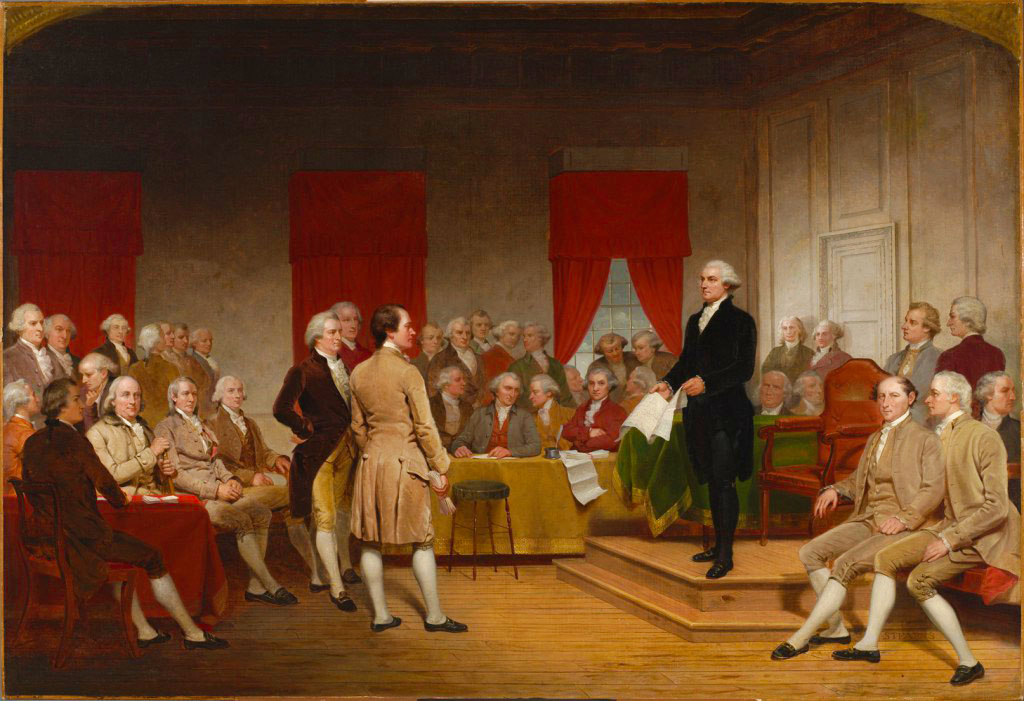
But the ultimate dynamic that moved America forward from its
status as a group of thirteen English colonies to the status of
thirteen newly independent but united states was importantly found
above even that. It was in America's actual leadership. And here
is where George Washington looms large as the foundation on which the
independence movement relied for its existence and its durability.
As Washington stood firm and unbending before the huge challenge
of breaking the determination of the British to force the American
states back into submission, so also did these states find inspiration
not to bend or yield.
Then not only did he lead the country through the dark days of
the rebellion, Washington went on after that to shape greatly what the
"United States" was to look like in the way he went at the role of
serving as the republic's first president.
That's how social orders are put into place, and thrive (or not).
 Miles
H. Hodges
Miles
H. Hodges

 The role of personal and social morals
 Leadership as key to a society's moral order