<


AMERICA'S STORY - A PREFACE


CONTENTS

The rise and fall of societies

The parable of the four generations

The Christian component in this dynamic

The purpose and character of this study

The student syllabus


The textual material on this webpage is drawn directly from my work
        America's Story – A Spiritual Journey © 2021, pages 1-11.

THE RISE AND FALL OF SOCIETIES

The larger, three-volume study, entitled America – the Covenant Nation,[1] has been brought together in these pages as a somewhat summarized version, not as detailed, but with all the major ideas and key points of the larger study presented here nonetheless.  You may indeed consult the larger study if you are interested in going deeper into these matters.

This work is the result of years of personal study that began back in the early 1960s when I was a student at the University of
Geneva in Switzerland.  This was a period when America dominated so much of the world that it was natural for Americans to believe that everything about American politics and culture was the proper model for that larger world.  But I found myself in Geneva not only in deep company with students from all around the world – an eye-opening experience in that alone – but also in closest friendship with a group of young Germans, friends going at life on the basis of a start on life amidst a rain of American and British bombs on their homes and neighborhoods, and then growing up watching their parents deal with a world that had for a brief time seen great glory and then the most humiliating of defeats.  Listening to them I got a vivid picture of what it was as a people to go through the proverbial rise and fall of a society.  It was a very condensed but very vivid example of how history itself works over the long run – and in the case of the Germans in the short run.

But in their coping power, my German friends also showed me a resiliency that made me realize that there was an amazing dynamic to life operating deeper than merely the one providing generous material blessings to Middle American life.  I certainly continued to enjoy those blessings of Middle American life.  But from that point on, I would continue on in my journey in life with a keen understanding that there were also other ways to go at that life, some of them quite awesome, but also some of them quite terrible.  And getting an early taste of this strange dynamic, I wanted very much to dig deeper into the cause of that dynamic, the forces that made for social success – and for catastrophic failure.

After graduating from the University of Illinois in 1963 I moved on to Georgetown to do masters and doctoral studies.  It was a great place to learn the lessons of a tough political "Realism" or
Realpolitik,[2] both at the university and by working part-time in the Washington bureaucracy itself (Peace Corps Headquarters and the World Health Organization's regional headquarters).  And it being the 1960s – the age when the Kennedy dream died and Johnson attempted to replace that dream with massive bureaucratic action designed to bring into being the Great Society at home and a democratic Vietnam abroad – I got to see another example of the rise and fall of a grand social dynamic. [3]

Indeed, in August of 1968, I left behind me an angry, violent, and highly self-destructive America – which I got to experience up very, very close in the rioting, pillaging and burning going on around me in Washington – to head off overland in a VW "squareback" from Belgium to Nepal and back (via France, Italy, Greece, Turkey, Iran, Afghanistan, Pakistan and India) and then ultimately to find myself in much quieter surroundings in Belgium to do my doctoral research (that is, after working nine months for IBM as a programmer/ analyst in their Brussels office).

Here in Brussels I continued my search into the dynamics of a deeply divided society – Belgium struggling with the problem of being composed of two distinct and frequently mutually antagonistic cultural groups: the French-speaking South and the Flemish (Dutch) speaking North.  But it was the end of 1960s and the beginning of the 1970s, and Belgium was finding a higher cause for its existence:  serving as the political center of a rising United Europe, relocated to Belgium thanks to French President de Gaulle who tried to undercut the European-unity momentum when it first located itself in France!  I saw clearly how a higher social cause, such as was developing in Belgium, has the amazing power to bring people together to greater social strength.  A friend of mine, Newt
Gingrich – who was also doing his doctoral research in Brussels at the same time – would spend lunches and much of the afternoons discussing with me what it would take to bring a deeply divided America back to a similar sense of unity.

Upon returning to the States, I got a job as an assistant professor in the political science department at the University of South Alabama, set up an international studies program at the university, and then proceeded to teach young people what I had already observed up close about social dynamics, both at home and abroad.

And naturally the one question that kept coming up from my students was what I thought about the status of America itself in this matter of the rise and fall of a society – especially as America at the time was finding itself going through another national trauma, as a Democratic Congress was doing its best to cripple and take down a Republican White House.  This question dug especially deeply because I had made it a key point to emphasize the importance of the role that the national leader had in shaping the moral foundations of any society.

And America at that time seemed to be caught up in a major battle over that very issue.


[1]America, The Covenant Nation – A Christian Perspective, Bloomington, Indiana,  2020, in three volumes:  (1) Securing America's Covenant with God: From America's Foundations in the Early 1600s – To America's Post-Civil War Recovery in the late 1800s; (2) America's Rise to Greatness under God's Covenant: From the Late 1880s to the end of the 1950s; and (3) The Dismissing of America's Covenant with God: From the Early 1960s to the Present.  See thecovenantnation.com for details.

[2]A German term referring to “Political Realism,” popularized by Prussian Chancellor Otto von Bismarck, who in the 1870s used all the political tricks in the book to finally bring together a single or united German nation, one drawn from the multitudes of smaller German states formerly making up a deeply divided German society.

[3] Also, in my first years at Georgetown I researched and assembled a 250-page master’s thesis on the social-political dynamics going on at the time in South Africa, noting that the actual dynamics of that country had little to do with the Black-White dynamics unfolding at the time within America itself, something that Americans looking at South Africa had seemingly little ability to understand.  I predicted that South Africa was not going to go the way of the Euro retreat taking place at the time in the rest of Africa, but that the social situation would remain unchanged for at least this present generation  At the time I was accused (by some … though not by my thesis supervisor who liked my work very much and encouraged me to stay on for doctoral studies) of being a “Fascist.”  But I was simply analyzing the social-political dynamics, not offering ideological advice!


THE PARABLE OF THE FOUR GENERATIONS

In answer to those student questions I told them a story, a parable about a society as it developed across four generations – a narrative that seemed to summarize all of this political, social, cultural and spiritual dynamic that goes into the rise and decline of any society.  It is the story of four generations of a leading, guiding, governing family – and of the society they are supposed to be directing ... and that society's rise and fall across those four generations. It is a tale well worth retelling here as we dig into the question of America's own social dynamics.

 The First Generation.  In this story, a small society forms around the mastery or leadership of a very strong-willed individual, a young man who climbs out of very tough – actually brutal – circumstances.  And in overcoming those circumstances he achieves a self-discipline in the face of dangerous challenges, one which so strongly impresses a gathering circle of young warriors that he is able to turn this group into a similarly disciplined band of conquerors.  The warrior-leader is very generous to those who would follow his lead bravely, against even the most dangerous of challenges.  But he could also be equally unforgiving of those who would fail to live up to his very precise warrior code or his high expectations of a very brave performance in carrying out the warrior duties of those who would dare join him. 

But what drives this leader is not just some hunger to force others under his direction for the sheer joy of it.  That can come to certain people as a big ego-high.  But usually that same urge will blind and ultimately destroy such wannabe leaders.  No, what drives this First-Generation leader is vision, a higher vision or sense of call that comes from some source other than the approval of the immediate world around him.  It comes typically from a sense, even at a very early age, that Heaven itself has a special commission for this young man to build a society that will serve the greater will of Heaven, God, Providence, Allah, Zeus, Tian – or whatever name is given to this Higher Power.  It is the ability of our young warrior to keep his eyes on this higher call that allows him not to fall victim to the flattery of those who would try to use him for their own personal gain.  He is immune to such human willfulness.  Thus such vision – with its call to bold action as well as an unshakable resolve to keep himself and others under the inflexible moral discipline required to see that vision come to reality together – makes him the powerful leader that he is.

He also occupies a special place in history because his arrival on the social scene is timed with developments well beyond his own political-social designs.  In fact, he himself is no such political-social designer.    Instead, he is an individual fully capable of taking on fearsome challenges immediately in front of him as they arise to confront him on an almost daily basis.  He does not design life, like some lofty intellectual working at a desk and living in a bubble of beautiful ideals and wonderfully rational plans designed to achieve utopia.  His world is tough, messy, and unpredictable.  But he is fearsomely brave as he pursues this political-social call placed on him by the very power of Heaven.  He resolves simply to keep moving forward, even in the face of the most discouraging circumstances. [1]

And thus it is that this man of valor is able to inspire others to join him on this path of overcoming – and ultimately this path of social conquest.  He is thus able through sheer doggedness to produce social greatness.

And in our parable, that conquest would include even the great civilization just over the next mountain range, a civilization that is in deep trouble because it is no longer led by such powerful leaders as our First-Generation founder.  This once-great civilization has fallen into deep moral decay, one that inevitably comes along with the rise to power of the Fourth and final Generation.  This civilization finds itself caught at this point in time in the throes of social collapse.  It is ripe for conquest by some kind of rising power outside itself.  And that is where the First-Generation leader finds himself and his men headed in history.

Timing is, of course, also key to success in history.

The Second Generation.  The son (the Second Generation) of the original founder-warrior will also have grown up in tough circumstances, though only because of the disciplined social environment established by his father, not because of a threatening political world immediately around him.  By the time he is a rising young man, much of that has already been cleared away by his father's early successes.  However, the father's grand vision, in which he understood rather clearly the ultimate destiny of his small but growing society, has had the father over the years preparing his son to take up the responsibilities that one day will be passed on to him.  The First-Generation father therefore has had his Second-Generation son train and join him in battle, learning the responsibilities of leadership.  There is, after all, a world to be conquered by both of them, father and son.

And that conquered world one day will need to be administered by a competent ruler.  But it will fall to the son, not the father, to be just that individual.  Anticipating this, the father perhaps will have, early along the way, sent his son off to live and study for a number of years within that larger civilization, one that is destined to be ruled by his own rising dynasty.  This certainly occurred in the case of Philip II of Macedon, when he sent his son Alexander off to Greece to study under Aristotle.  As a result, the son will know and understand the ways of the larger world that one day will be his responsibility to rule.

The son will also know of the Heavenly Commission upon which his society was originally founded by his father, though perhaps only secondarily, through what his father has told him about it.  The son will respect that Higher Power and will take its ruling principles into account in his governance.  But he will also be shaped by his knowledge of the political codes and moral rules of the society he is about to inherit, its wise counselors, its civilized ways.  All of this will come as a blend of the son's own vision and self-discipline. He is more the person of Reason, like the civilized world he has come to know, than of dangerous risk-taking, something required by the social conditions his father grew up in.

Typically, the era of the Second Generation will be understood by historians as constituting the political height of that society or civilization, the one created or restored through the conquering efforts of the First Generation, and the considerable administrative talents of the Second Generation.[2]  

The Third Generation.  The grandson/son of the two preceding generations will be personally familiar only with life as lived within the palace that he was raised in.  He will know well the stories of the great valor of his grandfather, although such knowledge will have more the nature of folklore than reality to him.  He will see and experience directly the blessings of his father's well-administered social-legal order.  It certainly will have already benefitted the son greatly.  And thus he will be entirely devoted to the idea of completing and securing the full development of that perfect social order.  He will spend his time in his royal chambers working on that perfect design, working closely with his highly-educated advisors on the specifics of a proposed legal order he wants them to put into place by royal decree.[3]

Along with the proposed legal order, his own vision typically will include the perfecting or beautifying of the visible features of the civilization he has inherited: the beautification of the palace dwellings; the building of magnificent homes for his huge administrative staff; the upgrading of the public places such as the all-important central market and the houses of worship; the development of public parks and places of leisure (mostly for the privileged urban classes).

Of course all of this will come at a great cost, especially to those least able to fend off the tax collectors, who fleece the poorer classes to pay for these extravagant projects, projects which will bring little or no benefit to the lower social orders.  Restlessness and even occasional revolt will from time to time upset this utopian social order that Generation Three is attempting to put into place.  And our ruler will be uncomprehending as to why such turmoil is accompanying his efforts to perfect his people's world.  But that is because he lives largely in a social-intellectual-moral bubble of his own making.  He is far removed from the hard realities of the larger world around him.  Most importantly, he has lost touch with those he is expected to govern.  He no longer relates to his people as a moral compass or spiritual guide for them.  Trouble brews.

The Fourth Generation.  Having grown up in a world of total privilege, surrounded by flattering supporters looking to be brought into that world of privilege, our Fourth-Generation leader will have lost touch completely with the hard realities facing his society, the challenges that as society's governing authority he is expected to address and solve.  But he lives in a world of massive disinformation (who would dare to contradict the presuppositions of the Great Ruler).  He is clueless as to his responsibilities.

Not only is there a total loss of dedicated discipline to his governance, there is not even any particular direction to it.  He is a person of no particular vision, except to hang on to all the entitlements coming his way as Great Ruler.  He is bored, listless, and dangerous, not only to those immediately around him but also to himself.  Thus he is also a great danger to the society he is expected to lead.  He indulges in every known diversion possible, being able (he believes) to afford them all: gambling, drugs and alcohol, sex (in various ways), wild spending sprees (for nothing in particular), cruel games (including the torture of individuals he does not particularly care for), and so on.

And as for the general moral order of the society he is supposed to be leading, it now finds itself in a state of collapse.  Hungry gangs wander the streets, violating persons and property as they see the urge to do so.  It is dangerous for women and children to go to market for the day's needs, or even to enter the streets at all.  Extortionists come around to exact the price of protection on the defenseless people.  The social order is simply collapsing.  And as for the people's affection for their government, its Great Ruler in particular, there is none.  They wish him dead, and would support anyone inclined to cause that to happen.

And that brings us back to the First Generation, for that is where such help is to come from.  And thus the cycle begins all over again.


[1]Certainly both Washington and Lincoln are perfect examples of this kind of leadership.  So also was the largely unacknowledged true Founder of Anglo-American society (at least the New England version), John Winthrop.  And this category should also include Hamilton, a fiercely brave soul who took up the unloved responsibility of getting the new Republic started up on very strong financial foundations.  These people carried America forward in its development through the most challenging of times.

[2]Both Roosevelts, Truman, Eisenhower, and Kennedy would certainly fall somewhere in this category, in the way they worked to maintain and utilize American social power in the face of huge social challenges.  Nixon, Reagan, and Bush Sr. probably also belong in this category.

[3]American examples of this would be Jefferson, Wilson, and Johnson (LBJ), all of whom sought to perfect American society (and even the world in some cases) through highly-planned or rational social redesign.  Franklin Roosevelt, Carter and Clinton seemed to have started out this way, but thankfully were forced back into a Second-Generation profile when unyielding Reality struck!


THE CHRISTIAN COMPONENT IN THIS DYNAMIC

At the time (the 1970s and early 1980s) I was strictly a classic political Realist, rather cynical in my view of political policy-making, legal "reasoning" and intellectual Idealism. Such Realism did not necessarily make for a happy place.

And the economic mess that America fell into at the very end of the 1970s (and into the first years of the 1980s) did not help my mood any.  I myself was trapped in a number of investments that, with Federal Reserve President Paul Volcker's astonishingly high interest rate strategy, I knew of no escape.  This proved to be too much Realism for me.  And it all led me to find refuge from my many social responsibilities by abandoning them – and then even hiding myself away from that world ... working in a friend's back office as a simple clerk for a year, while attempting to figure out which direction in life was actually up – and not down!

And in the midst of all this, God showed up, actually in the way Christ was shown to me in the unexpected care Christian friends extended to me in all my confusion. 

Actually, Christianity itself was not new to me.  But this particular expression of that Christianity was!  I had been raised a Christian, had gone off to college to prepare for the Presbyterian ministry, but had a Bible professor (who committed suicide that same year) completely cut away my young faith with his attempt to make the Bible itself more "Realistic."  It obviously had not worked for him.  And it certainly did not work for me!

Now years later, in coming back to the Christian faith, I did not need to abandon my Realism – for my understanding of human nature itself did not change any, nor did it need to change.  I did not need to escape into some kind of idealized Humanism (in which some intellectuals seem to find some degree of religious salvation).  Social and political reality was not going to go away. 

But I came to realize – as had so many Americans before me – that there was a force in life much higher than man himself in charge of outcomes in this universe.  I knew that Albert Einstein, Erwin Schrödinger, Niels Bohr, John Polkinghorne and other famous scientists operated from this same assumption.  And I soon found myself operating from that perspective as well.  And thus off to Princeton Seminary I went to study the matter further.

My "Realism" continued to be operative for me even while I immersed myself in the world of Princetonian academics, by doing prison volunteer work and then starting up a street ministry of my own to the homeless of nearby Trenton.  Here I got to experience first-hand the redemptive power of Christian truth, a truth that needed no clever intellectual argument to justify.[1]  It was true simply because it worked – right there in real life.  I continued that ministry for over four years, even after graduating from seminary and remaining in the area as a construction worker.

When I finally got a call as a Presbyterian pastor, I found myself mixing Biblical teachings with actual examples drawn from the social narrative of both America and the larger world, all of which I knew intimately.  And while pastoring, I taught courses on the subject as well.  And eventually a website (newgeneva.org) was assembled where all this material was laid out.  Thus the foundations of this huge writing project (of which this volume is an abridged version) first began to be assembled.

I knew full well that God has long worked redemptively not just with individuals but with whole societies.  And this has been true not just anciently – as with old Israel, whose narrative of divine social redemption constitutes the Christian Old Testament – but also on an ongoing basis.  Yes, the same God is active among us as a people, as a society, even today.

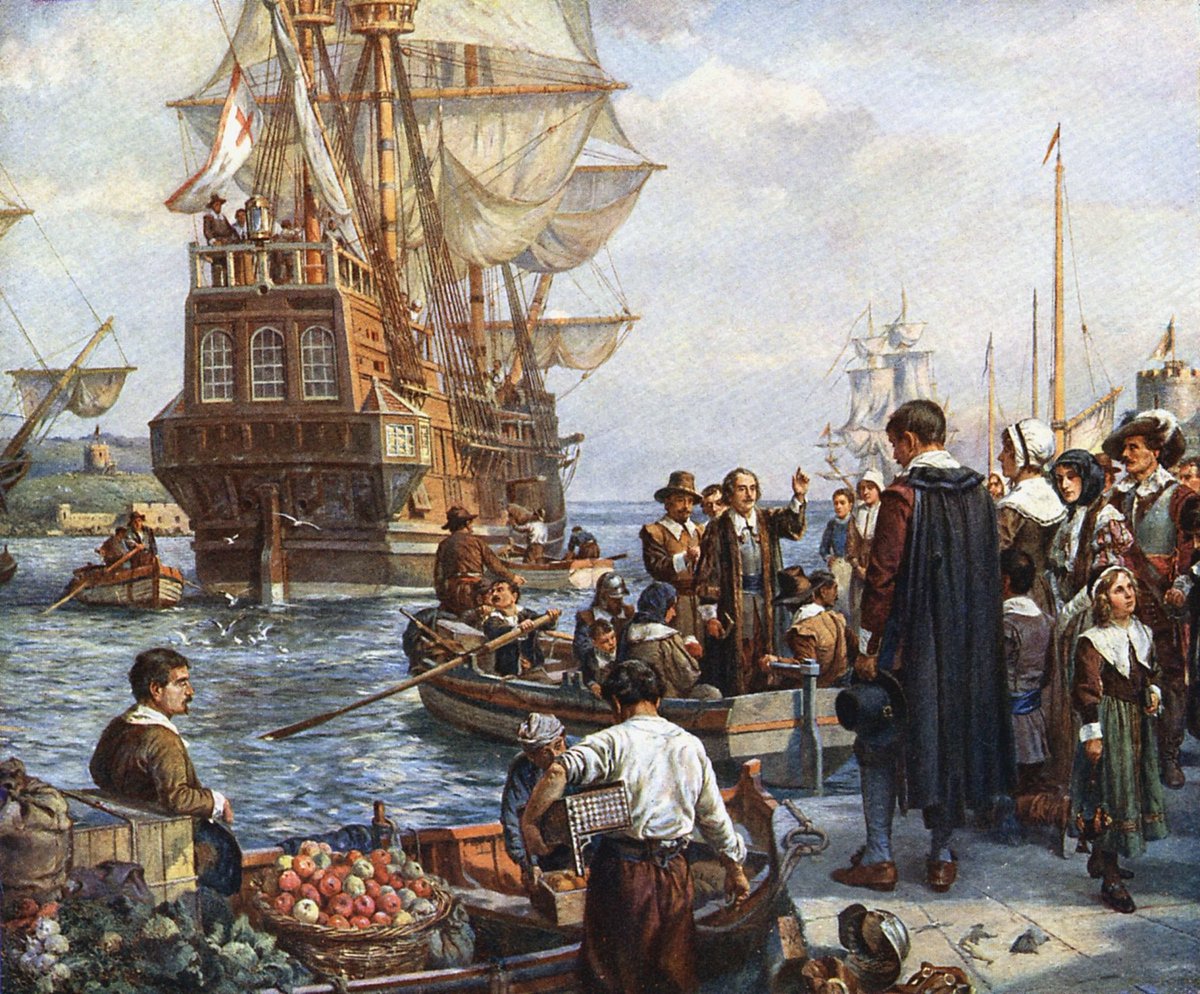
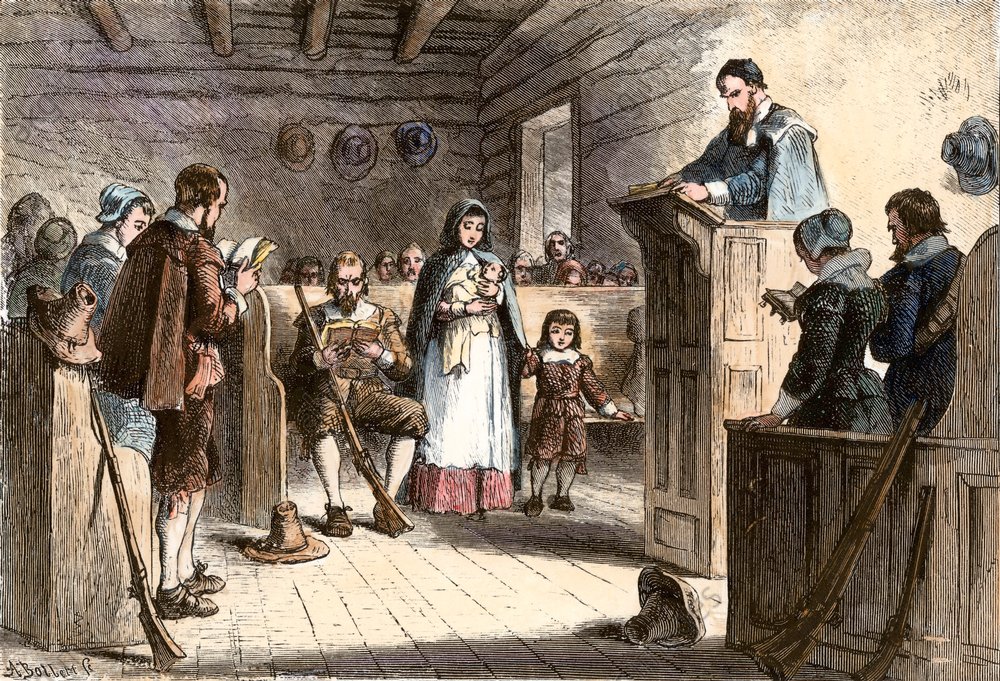
And that understanding was certainly there in a strong way back in the early 1600s.  That was what brought the Calvinist Separatists and Puritans to New England, to build in the New World a society that operated out of that same understanding.  New England society was a covenant society, a people covenanted (contracted) to be a people of God – to serve him, and thus be served by him.  And it worked.  It worked fabulously.  It made America (at least the northern and middle portions of the American colonies) a very unique society.

Finally, after a dozen years of pastoring, I was led back to classroom teaching, to a Christian high school this time – where, over the years, I got to teach all of my four children (and their friends) American history and social dynamics, on the basis of this very understanding:  America's grand covenant with God.

During these years these ideas got clarified, reformulated for a younger audience, and expanded considerably (the enormous pictorial portion is still to be found online at spiritualpilgrim.net).  Then after eighteen years of such teaching, I finally "retired" to put this work into print – the three-volume series completed in the second half of 2019 and first months of 2020.  And now the condensed or "abridged" version is finally available ... as you are reading it right now!


[1]Reason, posing itself as absolute Truth, tends generally to be presented merely from the point of view of personal or social self-interest!  This hardly qualifies as "Truth" in itself.  Even at six years of age my granddaughter could offer the most sophisticated reasoning in rebuttal to her mom’s command "It’s time for bed."


THE PURPOSE AND CHARACTER OF THIS STUDY

Recovering the Christian Covenant with God. So what we have here is the narrative of a people, the American people, going at life by way of a special covenant relationship with God.  They do not always live up to that commitment – distracted by waves of "enlightenment" in which some Americans have supposed that they could control life their own way without God's instructions.  But they are a people revitalized by divine interventions (the "Great Awakenings") when God remembers his covenant with America and restores its spiritual character, usually in anticipation of an enormous life-and-death challenge that the nation will soon be facing and will need enormous spiritual strength to take on successfully.  And so, like Israel of old, it is the narrative of a "covenant people" living and serving God himself, as a "City on a Hill," a "Light to the Nations", showing the world how ordinary people can do extraordinary things when they work closely with the God who presides over the universe.

The power of the Christian narrative.  One of the things I learned in seminary was the power of a society's narrative itself, the way it shapes social identity and purpose.  Indeed, Christianity is itself built on the power of such a narrative, found in our Bible. The Biblical narrative has long shaped Western society.  And it certainly was critical to the birth of the American nation in the early 1600s, and key to its development over the next several centuries.

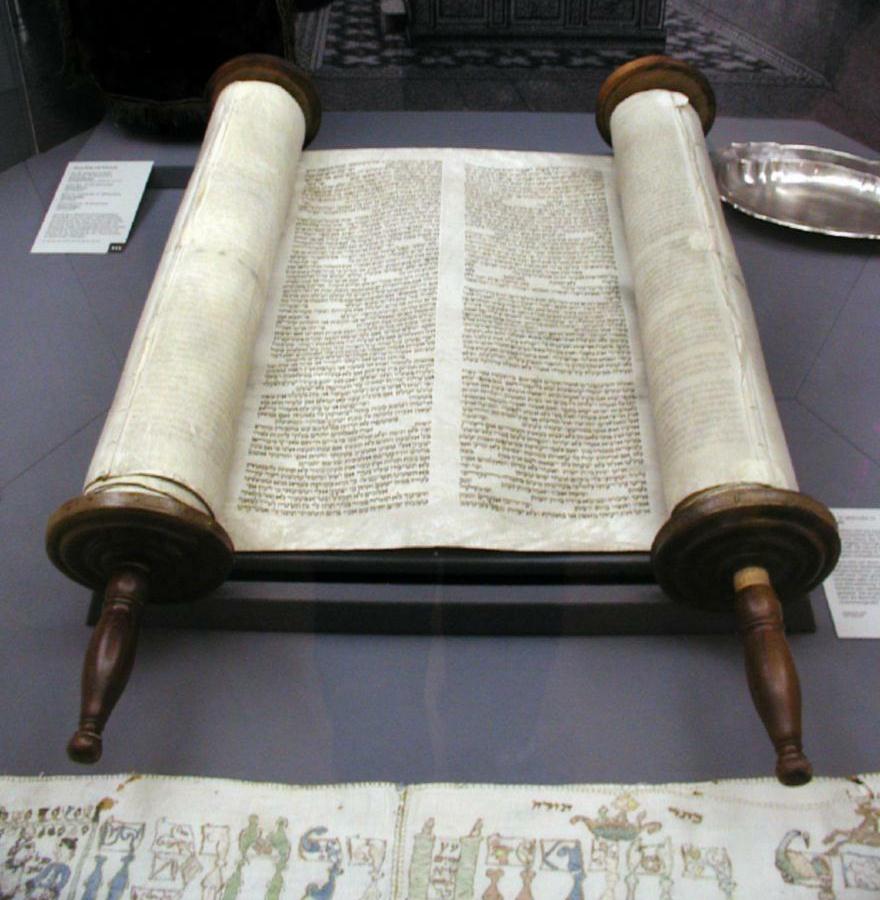
I was deeply impressed by how Judaism built itself entirely on its own narrative ... and how that Jewish experience also shaped the way Christianity would understand its character and role in life.  While other civilizations conducted worship by having priests sacrifice animals (sometimes even people) at alters located at huge temples (the Jews at one point did that as well, just with animals, of course!), the Jews learned to approach God also – and more importantly – simply through prayer, reflection, and study, of God's ways, and of the ways of those Jews and Israelites of earlier generations revealed through their well-recorded social experience (Scripture) which demonstrated by the example of those who went before them how best to work with God in daily life itself – not to mention in times of wars and enormous social crises.  So the Jews developed Godly worship simply through devoting themselves to the task of learning from Scripture, gathering weekly to study and learn from such social narrative.

Indeed!  Looking to such social narrative for guidance was a very unique way to go before God – one that worked very well for the Jews, certainly at least as well as having priests slaughter animals at the Temple.

And it was this habit that was picked up by Christianity in its formative years (also as an oppressed people), as Christians gathered locally (homes or underground "churches") to worship and attend to the instructions or sermons of their elders or pastors.  And it proved so powerful that eventually Christianity would take Roman society by storm!  But we will have more to say about this in the pages that follow.

But anyway, that was real Christianity.  And I understood very clearly its power and its vital importance in the founding and development of American society, unfortunately an understanding that is being lost as America turns away from such "superstitious" doings to follow the more "reasonable" path of Secular-Humanism, a religion established by the Liberal political Left, and the federal courts – quite in violation of a very Christian Constitution that is supposed to be protecting the people's powers to shape and direct their own society ... like the ancient Christians – and the Jews before them.

The moral role of leaders.  I am also (as my four-generation parable illustrates clearly) a great believer in the enormous power and social role played by the very special people of society: their leaders.  Usually leadership comes from a society's governing officials.  But it frequently comes also from others who step into the picture to give society critical guidance.  The Reverend Dr. Martin Luther King, Jr., for instance, would qualify as the second type:  not a government official, but one whose leadership had a huge impact in moving America off in a much grander direction.

Leaders set the moral-spiritual example before the people, helping them to understand the best way to go at life's challenges.  Modern social science sees them as planners and managers.  I see them as inspirers, people who do not need to dictate to others, but simply show others the way through personal example. 

Thus I tend to give America's historical leaders very special coverage in this narrative, especially in the matter of what it was precisely that made them the leaders they happened to be.  This is not only to give insightful information to those who want to know more about those who left such a major mark on American society, it is, as with all personal testimony, to inspire the reader to try to follow a similar path in life themselves.  That is, after all, how true leaders (not dictators) lead:  by inspiring others with their own personal example!

Taking up the narrative.  And so we begin our journey, taking up the American narrative or story – learning not just the facts of history but, even more importantly, the ways of society itself:  its social dynamics.

Indeed, let us now begin that journey into America's great social narrative, its grand history ... so as to know how to deal more effectively with the challenges before us today.


THE STUDENT SYLLABUS

Recovering the Christian Covenant with God. A printable PDF copy of the syllabus for America's Story - A Spiritual Journey

Questions to consider in doing the readings


1st Quarter Origins and Early Development of the American Covenant

 
Unit 1 - pp. 1-11 (Preface)

What is it that seems to cause the rise and fall of a society over the generations?  How is it that the author of this particular history or narrative understands personally that very dynamic?  Why does he view a covenant with God – especially by its leaders … but also by a society in general – to be so vitally important to a society's ultimate success?  Also … why is historical narrative itself so important in understanding and managing the dynamics or "science" of society?

 Unit 2 - pp. 12-32 - (America's Moral-Spiritual Inheritance - 1)

How does Western society in general differ from the other major moral codes of the world ... such as the Hindu and Buddhist variety?  What role did ancient Jewish, Greek and Roman society play in the development of the Western social order?  How did Jesus bring a very different understanding to life ... and its general purpose?

 Unit 3 - pp.   32-46 (America's Moral-Spiritual Inheritance - 2)

What happened to Jesus's Christian legacy when it stopped being persecuted and finally became accepted - even "Romanized" - by Roman authorities?  How was it that Christianity was able to survive the onslaught of the Germanic tribes … even when once-powerful Rome did not?  How did the rediscovery of wealth and power (centuries later … thanks mostly to the crusades) finally stir deep challenges from religious reformers desirous of returning Christianity to its original 1st century character?  Why was such reform considered to be such a danger to the "Christian" social order of the 1500s and 1600s?  What was it that the "Puritans" were attempting to achieve in terms of social reform in England?  But how did a rising belief in the power simply of Human Reason itself also shake the foundations of that same social order?

Unit 4 - pp. 47-68 (Getting Started in America)

In what ways were the Spanish, French and Dutch involved in "Europeanizing" the Americas?  What was the intended purpose of the Virginia settlement ... and how was its startup in the early 1600s?  How did Virginia tend to imitate Europe's older feudal order?   What was the nature of the relationship with the Indians at that time?  Just exactly how "Christian" was Virginia also at that time?

Why did English "Separatists" come to New England as "Pilgrims" also in the early 1600s?  Why did thousands of English Puritans soon join them in this venture?  In what ways was New England so very different from Virginia?  How did New England have its own distinct challenges facing its survival and development? 

What was the purpose and general character of the Maryland colony?  What was happening in England in the mid-1600s that would impact the development of the American colonies? What was the purpose and general character of the Carolina colony?  The Dutch New Netherland colony?  James's New York and New Jersey?  Penn's Pennsylvania?  What was behind the establishment of the Georgia colony?

Unit 5 - pp. 69-86 (Independence / the New Republic - 1)

Why did Berkeley have such a problem with Bacon and his supporters? How did this help push Virginia towards the acquiring of slaves rather than just indentured workers to support the Virginia aristocracy?

How and why would the religious fervor of the early-to-mid 1600s both in England and in the American colonies find itself being replaced in the later 1600s by a very Secular or Humanist belief that human reason alone (human "Enlightenment") would do a better job at directing social progress?  Where did that leave the Puritan spirit in America as it moved from the 1600s into the 1700s?  How was it then that a "Great Awakening" of the Christian spirit suddenly exploded in America in the 1730s-1750s?  Why was this historically such a significant event?

How did England's Hanoverian kings at first give America a lot of freedom to develop ... and then have all that changed under George III?  Why were the Americans so reactive?  What pushed the Boston region to the lead in the reaction?  What was the role of the Second Continental Congress in the conflict?  What were the key developments both in Congress and on the battlefield in the later 1770s? Why was Washington so vital to the American effort?  Why did the British finally move their action to the American South?  How did things turn out there for the British ... especially at Yorktown?

 Unit 6 - pp. 86-100 (Independence / the New Republic - 2)

What were the major challenges facing America as it emerged into a post-war world?  Why was it necessary for Franklin to remind fellow politicians gathered in Philadelphia in 1787 to write a new constitution to build their work on what they all knew was God's work ... and not their own political self-interests so rationally presented (they were mostly lawyers by trade) – which was getting them nowhere.  What exactly was the form of government they finally came up with ... and what were the guarantees that it would work - that is, not allow power to result eventually in some kind of political tyranny?  How did a supposedly similar effort by the French to construct their own new Republic fail so miserably … while the American effort succeeded so brilliantly?

 Unit 7 - pp. 101-117 (The American Republic Gets Up and Running - 1)

How and why did Washington set a key precedent in terms of the length of presidential service?  What did Hamilton do to put the dollar and the federal government on strong economic foundations?  Why did Jefferson differ politically so deeply with Washington and Hamilton … and what did he do to counter their political positions?  Why was he so completely wrong about the dynamics of the French Revolution?  How did John Adams fare as US president?  What were Jefferson's various policies and programs as US president?  What did John Marshall do as Supreme Court Chief Justice to award power to his federal court … power not specifically assigned to the court by the US Constitution?  Why did America declare war against Britain in 1812 … and how did things go for America in that war?

Unit 8 - pp. 117-135 (The American Republic Gets Up and Running - 2)

How was it that America ended up owning Florida?  How did Henry Clay hope to defuse the rising North-South dispute over slavery with his "Missouri Compromise"?  What was the real meaning of the "Monroe Doctrine"?  In what ways was Andrew Jackson so very different from his predecessor as US president, John Quincy Adams?  What was so unique about America … according to the thinking of the Frenchman Alexis de Tocqueville?  What and why was the "Indian Removal" of the 1830s?  How was it that Texas came to be such a big part of the American expansive instinct?  What did O'Sullivan mean by the term "Manifest Destiny"? What finally brought Mexico and America to war with each other?  How is it that Oregon, California, and other Western territories also got pulled into this American expansion? What was the economic panic and depression of the late 1830s all about?

How did rising Unitarians (and Humanists) – individuals such as Jefferson, Emerson, Thoreau, etc. – find themselves up against a very strong "Awakening" Christian spirit in America?­  Who were the key individuals responsible for this "Second Great Awakening"? What were some of the more unusual religious varieties birthed by this same Awakening?  How did this Awakening also inspire huge Christian missionary and educational programs?


2nd Quarter The Gradual Rise to Greatness

Unit 1 - pp. 136-158 (Civil War and Recovery)

How was it that growing anti-slavery attitudes and activities in the North were deepening a North-South political-cultural split?  Why did the Kansas-Nebraska Act of 1854 fail horribly to resolve the growing North-South bitterness over the slavery issue?  Why did Taney's Supreme Court Dred Scott Decision of 1857 only make the situation worse?  In what ways was Lincoln definitely not the "country bumpkin" that other, more "sophisticated," American leaders at first consider him to be?  Why did he ask his political critics to become part of his presidential cabinet?  What was it indeed that made Lincoln one of America's greatest presidents (some would even say the greatest of all!)?  Why did his election to the presidency trigger the American Civil War? 

Why was finding the right military leader such a deep challenge to Lincoln in the first years of the war?  How was it that the Battle of Gettysburg almost ended the Civil War … but ultimately didn't?  What was it that distinguished Grant from the other Union generals?  How was it that the battles in southern Tennessee and northwestern Georgia seemed to mark a turning point in the war?  How was 1864 a time of deep Southern military setbacks … and early 1865 the end of the Confederacy?  How was the assassination of Lincoln a huge tragedy not only for the North but also for the South? 

Why was Johnson unable to hold off the intense spirit of anti-South revenge coming from the Republican Radicals?  How was it that Grant proved to not be as high quality a president that he had been as a general?  How did the end of the Civil War now open up a rush westward … into the remaining Indian territories?

Unit 2 - pp. 159-182 (America Comes of Age - 1)

What made the "Captains of American Industry" (or "American Robber Barons" as others termed them) so incredibly wealthy?  What were the key elements of the American Industrial Revolution of the late 1800s … and how did such material development overshadow the realm of American national politics … especially in the matter of social reform designed to counter the rapid spread of wealth and power separating Americans?  How was Western society in general also turning increasingly to the social-reformist idea of the political empowerment (through political struggle) of the common citizen … something that would also inspire a rising spirit of nationalism?  Where did Marx and Lenin stand on this matter?

 Unit 3 - pp. 182-202 (America Comes of Age - 2)   

In what key ways did Jane Addams, William Jennings Bryan, Teddy Roosevelt and Howard Taft serve America as agents of deep social reform?  But what also was the impact of a spreading spirit of Secular-Humanism – focused especially on that idea of "progress through liberating struggle" and thus identified at the time as "Progressivism" or "Liberalism" – on the Christian moral-spiritual legacy of both America and the larger Western world?  How did this then lead to a revising of the Constitution in such a way that made it more "democratic" – undercutting the checks and balances system originally built into the Constitution (originally designed to keep power from accumulating in one or other of America's several political institutions)?  How did all of this "progressive reform" impact American Christianity?

Unit 4 - pp. 203-219 (America Enters the World Stage - 1)

How did this rising spirit of nationalism inspire deeply the global "imperialism" that so consumed Western society in the latter part of the 1800s?  What role did America play in this Age of Imperialism?  What was America president Wilson's stand on this matter of imperialism?  How did this nationalist-imperialist urge finally push the European powers in 1914 into a pointless war against each other right there in the European heartland?  Why did it simply drag on – to no great purpose – except mutual slaughter?  How did this finally bring on the Russian Revolution?  How did this in turn inspire an intellectually self-blinded Wilson to get involved in this tragic war?  What was he hoping to see result as America's involvement in the war? What were the ultimate results for both America and Europe when simply sheer exhaustion finally brought things to an end?  Who, in the end, were the "winners" and "losers" in this pointless struggle?

Unit 5 - pp. 219-237 (America Enters the World Stage - 2)

In what kind of a post-war mood did the "Great War" leave America and Europe?  Why do we say that things "roared" in the 1920s?  How did America seem to divide into "two Americas":  a depressed rural America … and a partying urban America?  How did all of this impact the spirit and soul of the two Americas?  What role did presidential leadership play in all of this?  What hard economic realities finally brought the urban "partying" in America to an end?

What exactly did Franklin Roosevelt have in mind with his "New Deal"?  What were the immediate benefits of all his government programs?  How did the Idealism of the Humanists at first cause them to believe that they had discovered a new religion – a "Religious Humanism" – that would save America spiritually (and materially)?  But why did Roosevelt's New Deal ultimately fail to bring America out of its economic depression?  How did this depression impact American Christianity … and in what ways did Christian America seek to restore its broken world?

Unit 6 - pp. 238-255 (World War Two and The Start of the Cold War - 1)

What was the supposed appeal of the European dictators – Stalin, Hitler, and Mussolini?  Why was "appeasement" by Chamberlain supposedly the correct program in dealing with these dictators?  Why would Gandhi prove be a serious problem for Britain during its coming dark days?    Indeed, why was Western society in general under challenge by rising Asian powers?  What started the war in China in 1937?

Why did Hitler and Stalin decide to ally themselves … and immediately begin the war in Europe in 1939?  Why did only a "Sitzkrieg" result as a result of the Russian-German aggression?  Why did America want to stay out of these matters?  What finally brought America into the war?  How did the American conflict with the Japanese go at first in the Pacific?  Why was the action in Italy so difficult … and what happened at Anzio – and then Rome?  Why was the Russian stand at Stalingrad so important?  Why did the Western allies choose to move from their Normandy landing towards Paris rather than straight east towards Germany?  What happened to the effort to swing into Germany from the Dutch North?  Meanwhile, what was happening in the Pacific?

Unit 7 - pp. 255-269 (World War Two and the Start of the Cold War - 2)

In what ways was Truman a most awesome replacement for Roosevelt upon the latter's death in the last days of the European war?  What action by Truman soon ended the war with Japan?  

What was the "Iron Curtain" that Churchill described as having fallen across central Europe?  What did Truman do to help block the efforts of Stalin to take control of Greece and Turkey … and in his Communist Parties attempts to take control of Western Europe as well?  How did events in Czechoslovakia in 1948 finally wake up the general American populace to the serious danger of Stalin's Communist program?  How did Truman take the lead in the West in opposing Stalin … in Yugoslavia, in Berlin, and in the creation of NATO?  Why did China fall so quickly to Mao's Communists?  How did political confusion at war's end in Korea lead to a bitter war between the North and South of that country … and a strong division between Truman and MacArthur as to how American actions should proceed there? 


3rd Quarter Cold-War America

Unit 1 - pp. 270-287 (Middle-Class America Triumphant - 1)

How did America's Veterans (or "Vets") of the recent war now find themselves facing new social dynamics – such as a nervous labor movement, their own "Baby Boom," their post-war Christianity … but most of all, their fear of Communists (or former Communists) at home right there in America?  How was it that McCarthy was able to take such advantage of the Vets' fear of Communism in their country … and leave such bitterness in the hearts of the American "Progressives" or "Left" against the Vets?  What kind of a leader was Eisenhower?  Why would the Vets' offspring, the Baby Boomers, grow up to be so very different in their understanding of life and its dynamics than their "Middle American" Vet parents?  Why did the Vets themselves suffer from too much Idealism and too little Realism … especially in the realm of foreign policy?  Where did American Blacks fit in this social profile in the 1950s?

Unit 2 - pp. 287-301 (Middle-Class America Triumphant - 2)

How did Stalin's death in 1953 raise hopes of a lightening of the Russian grip and a calming of the Cold War?  How did that actually work out … in Berlin, in Iran, in Hungary?  Why were the efforts of Britain and France to hold onto their vital Suez Canal such poor timing in all this dynamic … and what were the political results for both Britain and France?  How was America's "anti-imperialist" foreign policy principle not evident in America's dealings with its Latin neighbors to the South?  Why did a U-2 incident destroy hopes for an end to the Cold War?

In what ways did Kennedy represent a new, younger spirit?  Why did his foreign policy not get off to an impressive start?  Why, however, did his Peace Corps program appeal so greatly to the young Silent generation? How did the Cuban missile crisis change that dynamic?  How was Dr. King able to get America to move against the racism that tarnished deeply the American social profile?  Why was former French Indo-China meanwhile becoming a greater problem?

Unit 3 - pp. 302-317 (America Shifts to the Humanist Left - 1)

How did the political changeover after Kennedy's assassination change the character of American politics deeply?  What, in Johnson's background, shaped his understanding of what he was supposed to do as US president?  In what ways did Johnson's Great Society programs take America down a political route almost opposite of what Americans previously understood to be the proper role of government?  How did his action in Vietnam add further to the idea of governmental professionalism directed from DC.

What was the rising role of the Supreme Court in all of this deep social change hitting America at this point?   Why was Congress unable to counter the Court's major political-legal initiatives undercutting Christianity's traditional social-moral role in American society? 

Unit 4 - pp. 317-336 (America Shifts to the Humanist Left - 2)

Why did DC's "affirmative action" program deepen rather than soften racial animosities in America?  Why was Johnson's Vietnam War such a catastrophe?  How did all this tempt De Gaulle to try to replace American leadership in Europe with French leadership?  Where did America stand in the 1967 fight between Israel and its Arab neighbors … and in the 1968 Czech crisis … and in matters concerning Mao's China? 

What kind of deep social changes began to develop within the Boomer generation?  Why was 1968 such a horrible year at home in America itself?

How did Nixon's election bring hope that America might pull itself out of its messes both domestically and internationally?  Why was 1969 another eventful year for America?

Unit 5 - pp. 337-349 (The 1970s – America Divided - 1)

Why was Nixon's (and Kissinger's) Realpolitik so poorly understood or accepted by this Progressivist America … especially in Nixon's winding down the American disaster in Vietnam?  Why did Nixon's détente with both the Soviets and Chinese go unappreciated by his Democratic Party or Progressivist adversaries?  In what ways did the Watergate issue give Nixon's adversaries the weapons to bring down this otherwise very popular president?  How did his Congressional adversaries even cut back Nixon's ability to restrict "pork barrel" spending by Congress and the federal bureaucracy?  How did the Arab-Israeli war of October 1973 test Nixon-Kissinger's Realpolitik? 

Unit 6 - pp. 349-366 (The 1970s – America Divided - 2)

Why and in what ways did Ford have such a huge moral challenge facing him as Nixon's replacement?

How did Congress's undercutting of the Nixon presidency ultimately lead to the murderous collapse of the political systems of both South Vietnam and Cambodia?  Why did Congress fail to understand its own role in this?

Why did the "outsider" Carter (Georgia governor) rather than the "insider" Ted Kennedy (US Senator) become the Democratic Party presidential candidate in 1976?  What kind of a leader was Carter?  What did Carter mean by claiming to bring "Morality" to the conduct of American foreign policy?  How did that relate to his surrender of the Panama Canal?  How did that confuse Iranian politics deeply and dangerously – despite a quick return of Carter to something more resembling Realpolitik – and how did Carter's new Realism apply in other foreign policy areas?  How did the Iran crisis go from bad to worse – much, much worse?  Why was the oil crisis that hit the world in 1979 worsened greatly by Volcker's intervention to "fight" inflation?

How was the assault by American Progressivists on Middle America and its longstanding social standards intensified in the 1970s?  How was it that the Supreme Court took a leading role in this social development?  How did Christianity attempt to make a comeback in the face of this same development? 

Unit 7 - pp. 367-385 (The World's Sole Superpower - 1)

In what different ways did Regan demonstrate that he too was a practitioner of Realpolitik – both at home and abroad (eg. dealing with the air traffic controllers' strike, with Lebanon, with Granada)?  How was it that America was able to climb out of the economic depression that hit at the beginning of the 1980s?  Why was tying Social Security to the federal debt not a good idea?  How was Reagan able to incentivize Gorbachev into wanting to 'liberalize" Russia?  What was also happening in China at that same time?  What was the Iran-Contra Affair all about? 

What kind of a president was Bush, Sr.?  What was happening in both Russia and China during his presidency?  What was the Iraqi invasion of Kuwait all about … and how did Bush, Sr. handle the matter?  Why did Bush fail to get himself reelected?


4th Quarter The Superpower under Challenge

Unit 1 - pp. 385-397 (The World's Sole Superpower - 2)

What kind of a leader was Clinton?  What was his understanding of his presidential responsibilities in his early days in office?  How is it that Gingrich forced Clinton to back away from his Liberal programming instincts … and have Clinton become himself rather "centrist" in economic-social matters? 

How did Clinton also demonstrate Realpolitik instincts when it came to foreign policy matters (Somalia, Israel-Palestine, Haiti, Rwanda … and ultimately Bosnia)?  How was that same Realpolitik instinct put to service several years later in Kosovo, in relations with Russia, and in NATO's expansion?  But in what ways was the Arab Middle East firing up as a major problem area?  How did Muslim aggressiveness impact America itself in 1993?

How was America itself showing ever deeper instincts for violence in its handling of social-political matters (Rodney King, Ruby Ridge, Waco, Oklahoma City, O.J. Simpson, Columbine High School)? How was it now that Congress's impeaching of presidents seems to have become a regular part of the American political process?

How was America itself continuing to undergo deep social change during the 1980s and 1990s?  Why could Reagan not get an amendment passed to override the Supreme Court's forbidding of prayer in public schooling?  How in 1987 did the Supreme Court go even further in undercutting America's longstanding Christian cultural-moral foundations?  What were the varying Christian responses to these developments?

Unit 2 - pp. 409-427 (America Stumbles)

What kind of a leader was Bush Jr.?  Why was the makeup of his presidential cabinet so important?  How did 9/11 change Bush's priorities?  What were Bush's intentions in Afghanistan … and what were Rumsfeld's ideas on the matter?  Why not also take on Pakistan … a much bigger al Qaeda base?  Why did Bush (and Cheney-Rumsfeld) turn America's attention fully to Saddam's Iraq?  Why did the world fail to offer its support to the Iraq operation the way it did to the Afghanistan operation?  What was the original plan for Iraq … and how did that work out?  What was the 2007 troop "Surge" all about?

What deep social-moral changes were taking place in the American economic dynamic during those same Bush Jr. years?  Why did that all end up as a catastrophic 2008 economic "meltdown"?  Why did Bush now believe that it was the government's job to bail corporate America out of this catastrophe? 

How at the same time were the moral foundations of Christian "Middle America" further undercut politically (especially by the federal courts)?

Unit 3 - pp. 428-454 (Obama Strives to "Change" America - 1)

Why was a well-recognized American war hero (McCain) unable to defeat a relatively politically-inexperienced Obama in the 2008 elections?  What did Obama have in mind with his call for deep "Change" in America?  What about his origins made him the person he was?  How were his two Supreme Court appointments so impactful on American society?  How did Obama himself act against the "homophobia" of traditional America – such as in his opposition to Congress's once widely-supported 1996 Defense of Marriage Act or DOMA?  How did Christian social values now find themselves even under legal assault?  And why did racial hostilities heat up during the Obama years?

Why was the national economy and society now coming under stronger governmental management?  Why did the federal debt climb (double even) in each of the Bush Jr. and Obama 8-year (two-terms each) presidential years?

Why was Obama nominated (and ultimately awarded) the Nobel Peace Prize … before he had done anything of note?  In what ways did Obama move to end American involvement in Iraq and Afghanistan … and with what results?  What about the bin Laden takedown?  How did the spreading spirit of revolt in the Middle East (the 2011 "Arab Spring") come to involve America – and with what results … particularly in Libya and Syria?  How was Russia now taking on a more familiar heavy hand in its politics both at home and abroad … and China also?  How did Obama and the West react to this?  What was the effort to improve relations with Iran all about?

Unit 4 - pp. 455-481 (Into the Age of Trump)

Why was the 2016 election such a controversial event?   How was research material developed by the Hillary campaign (the Steele dossier) claiming a pro-Trump "Russian connection" in that election used as a basis to try to impeach Trump?  What were key elements of the Trump background and personality?  What was happening during the very long investigation into the "Russian connection" ... and with what ultimate results?  How were Trump's Supreme Court appointments designed to change the political disposition of the Court?  On what basis did the Democrats attempt a second time to impeach Trump?  How did the Corona Virus outbreak – and subsequent lockdown – impact America and the world politically and socially?

What was Trump's – and Congress's – response to the hordes of people heading to America across its border with Mexico?  What was the new trade pact with Canada and Mexico?  What was happening in Venezuela?  How were China and Russia becoming more aggressive in their relations with America and the West?  How about America's relations with the Arab or Muslim world?  How was the Trump personality itself part of Trump's own foreign policy program … and with what results – especially in Europe?

Why were the 2020 elections even more chaotic than the deeply contested 2016 elections?

Unit 5 - pp. 482-491 (Biden Takes Command)

What kind of personal background did Biden bring to the presidency?  What was the nature of the numerous Executive Orders that Biden immediately put into effect on becoming US president?  In what ways did he seek to continue Obama's "Change" right on into his own presidency?   What was his position vis-à-vis the Mexican-American border-crossing into America of massive numbers of immigrants?  Why was he so interested in "freeing up" the American voting process?  What happened to Biden's efforts (like Roosevelt's in the 1930s) to increase the number of Supreme Court seats?  What was his view on the matter of federal government spending … and taxation?  How well did he conduct the American withdrawal from Afghanistan?

Unit 6 - pp. 492-522 (The Lessons of History)

In what key ways does America seem deeply divided between two very different moral-spiritual approaches to life:  the Spiritual or Christian approach and the Materialist or Mechanical approach?  How has that actually always been the case … even since America's early years in the 1600s?  Why is the matter of God so controversial in America today?  What are the essential differences between Human Reason and Divine Reason?  Why are strong moral codes so vital to the strength and success of any society? 

Why is the moral character of a society's leaders also of critical importance to any society?  Why is it so hard for some people to see God's hand in human history … especially in this matter of God's long-standing covenant with America?   What is Christian or Middle America to do today in the face of these challenges?


Go on to the next section:  America's Moral-Spiritual Inheritance


  Miles H. Hodges