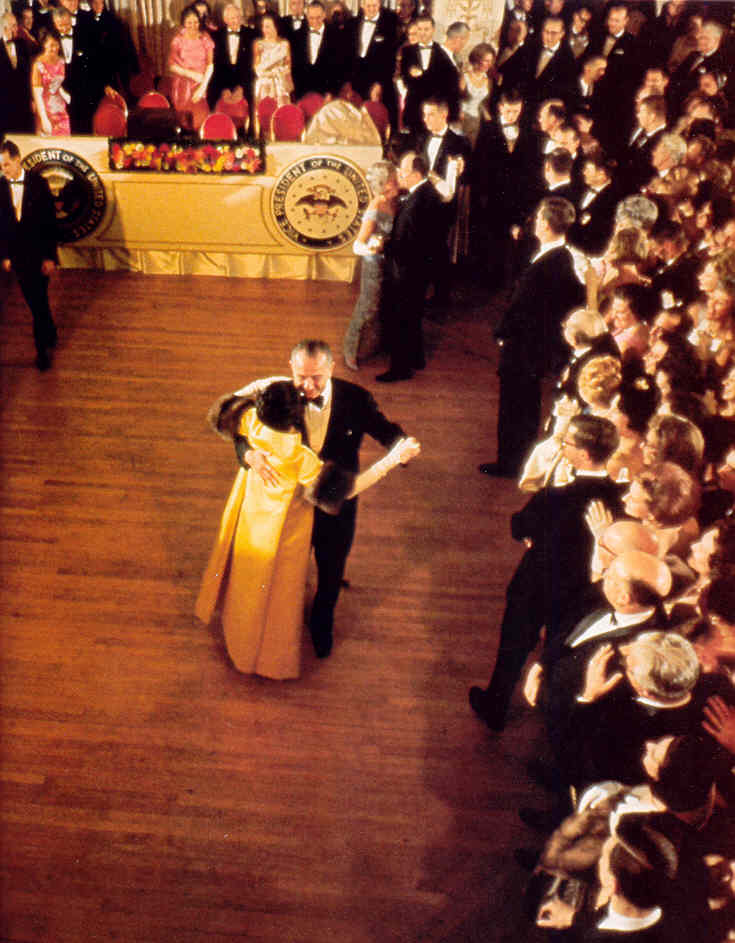
In an important way, Johnson was still a Roosevelt New
Dealer – having early on taken a lead in the world of American politics as a
local administrator in Texas of one of Roosevelt's 1930s New Deal programs. Johnson remained forever convinced
that letting the Washington Establishment take command of the country's affairs
New-Deal style was always the best way of going at the nation's
challenges. Nothing would ever change
his opinion on that matter.
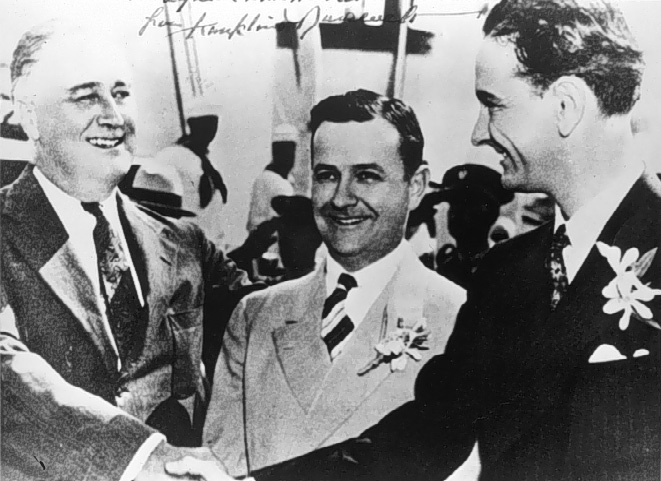
1937 – President Roosevelt, shaking hands with LBJ ...
with Texas Governor James Allred between the two men
Johnson approach to life was
undoubtedly shaped by his own personal sensitivities – his concern about the
racism he saw around him in Texas, something that deeply distressed him. He had grown up on a farm in the tiny and
remote community of Stonewall, Texas, in a condition of poverty and humble
social circumstances. He attended public
school in nearby Johnson City (named after his own
ancestors) and went on to Southwest Texas State Teachers College, intending to
become a teacher. He took a year off
(1928-1929) to teach Hispanic-American children, touching deeply an old nerve
when he found himself in the midst of these children's deep poverty and social
discrimination.
But
he switched quickly from teaching to politics after only one year of teaching
public speaking (!) in Houston (1930-1931), when he became involved in Richard
Kleberg's Congressional campaign. With
Kleberg's victory in 1931, Johnson followed him to D.C., where
he found it almost natural organizing fellow Congressional aides into something
of a political fellowship. But he also
cultivated personal relationships with key politicians such as Vice President
Nance Garner and the powerful Speaker of the House of Representatives, Sam
Rayburn, a fellow Texan who took a deep interest in Johnson's political career.
Also
interested in Johnson was "Ladybird"
Claudia Taylor, also of Texas, but with an Alabama aristocratic background as
well. The two of them were to meet in
D.C. in 1934, and get married only ten weeks later. Both of them were very decisive individuals!
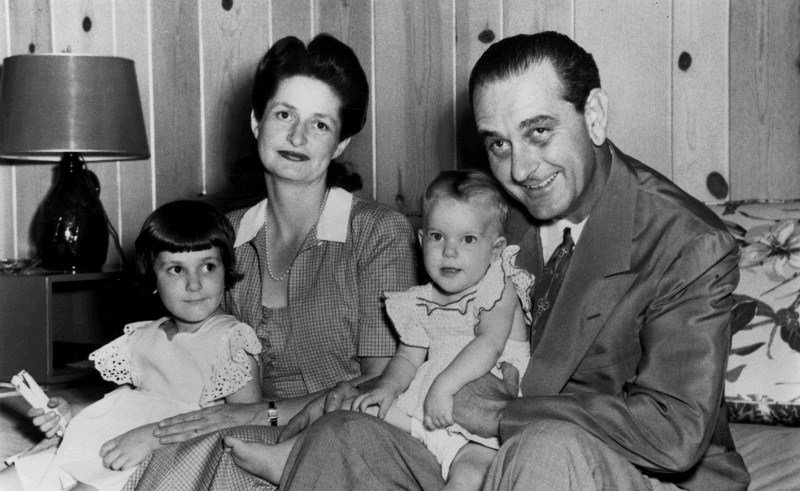
Johnson with Lady Bird and their two daughters – 1948
But they were to return to Texas the next year for Johnson to become a key part of
Roosevelt's New Deal programming, with Johnson becoming head of the Texas
National Youth Administration, most importantly setting up job training
programs for Texas youth. And this would
dig itself deeply into the Johnson mentality, as the
understanding Johnson would hold as to what the
proper role of government happened to be.
It was there to take care of people in need. Period.
In
1937, financed heavily by his wife, he ran and was elected in a special
Congressional election, and would remain a Congressman for the next dozen
years. However, with the mounting
appearance of a war before them, he joined the U.S. Naval Reserve in 1940. When war finally did break out at the end of
1941, he sought active duty. But
Roosevelt instead wanted him to stay on in Washington to look into the matter
of how government money was being utilized by American industry to support the
American war effort (the same thing Truman was doing in the Senate). And thus Johnson helped create and then head
up a key subcommittee of the House Naval Affairs Committee investigating such
matters.
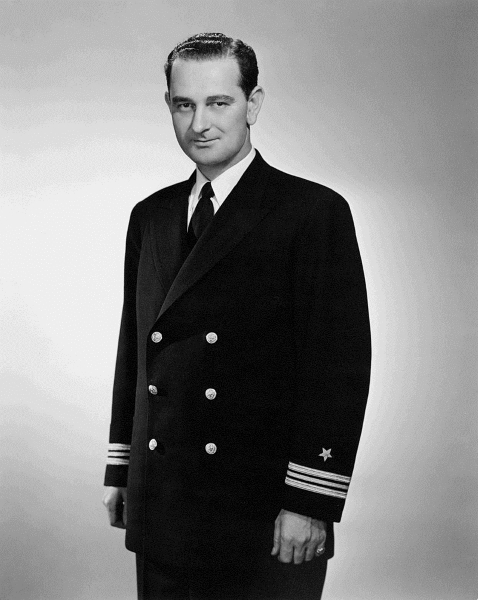 1942 – LBJ in his naval uniform
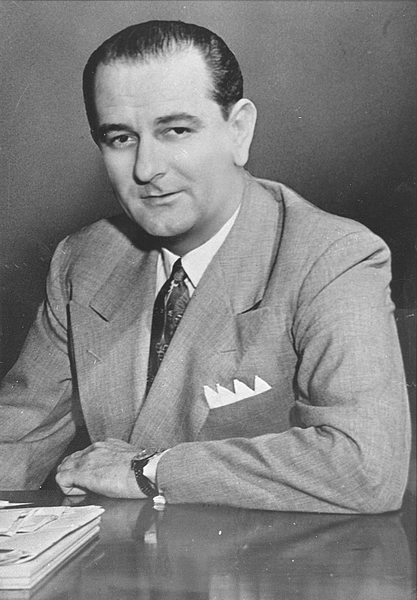 Johnson as U.S. Senator from Texas
After the war, Johnson was ready to move on to
bigger challenges, and in 1948 ran for the position as U.S. Senator, winning
the Democratic Party nomination very narrowly (and very questionably). And thus with Texas still very "Dixiecrat"
in political character, running as the Democratic Party's candidate, Johnson
easily won also the Senatorial race itself.
Now in the Senate, he continued his role looking into government
contracts with private industry. This in
turn caused him to rise in importance within the Democratic Party itself. And he soon (1951) was chosen to become the
Democratic Party Majority Whip (charged with the task of making sure that all
Democratic Party members are present for Congressional votes). He lost the position as "majority"
whip in 1953 when the Republicans took over Congress and the White House. But instead he was elected by his party as
its minority party leader, the youngest person to have achieved such political
distinction. And then when in 1954 the
Democrats took back control of the Senate, he found himself as Senate majority
leader to be one of the most powerful political leaders in D.C.
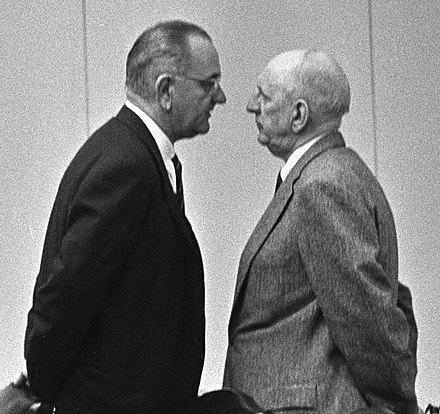
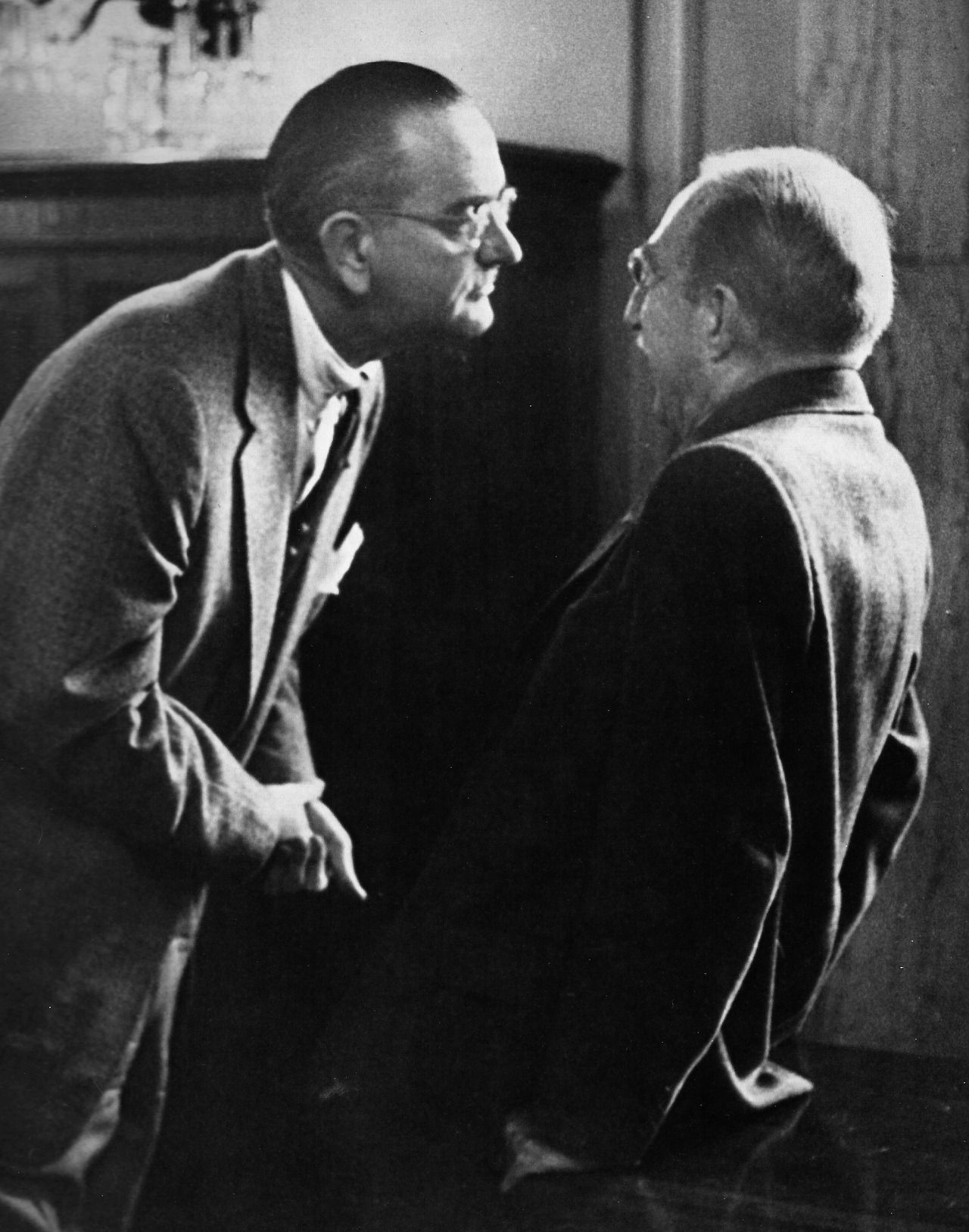 Senator Green getting the "Johnson Treatment" – 1957
And
what kind of moral-spiritual qualities came with this man of power? Actually, on his mother's side he was the
descendant of a number of Baptist pastors.
But his father was not deeply interested in such a religious life. But Johnson himself grew up in the
Disciples of Christ or "Christian" church, a denomination that tried
to rise above Presbyterian, Methodist, Baptist, etc. differences, to become
broader in its theological character (which becomes denominational itself in
time!). Consequently, although Johnson was non-sectarian in
Christian identity, he did indeed enjoy himself in the company of a broad span
of Christian pastors, although he seemed to prefer the liturgical character of
the Episcopalian and Catholic Churches somewhat. Consequently as president, he would move
around from church to church, keeping the press guessing as to where he would
show up the next Sunday.
Nonetheless, the one person who meant most to him personally as a
Christian pastor or counselor was Billy Graham – whose contact with Kennedy
had been quite minimal. Graham and Johnson became very close over the
years of the Johnson presidency. Graham was called on to speak at
every one of the presidential prayer breakfasts in those years, and Graham met frequently with the
president both in the White House and on Johnson's Texas farm, to pray and
offer comfort to a personal friend who was well aware of the troubles his
presidency had come to encounter. Johnson even asked him in 1964 as to
who he thought would make the best running mate, to which Graham wisely declined to give an
answer! Graham stayed with Johnson the president's last night at
the White House, and eventually would be called on to conduct Johnson's funeral service
(1973). But very little of this close
relationship was known outside the inner Johnson social-political circle.
Johnson never saw the need to personally inspire,
through his own spiritual qualities, a "Christian America." He did not usually talk about his religion
publicly, or bring religion into his public arena. Although he himself personally was a fairly
strong Christian, and found himself in personal prayer often over his work, his
public working-world was strictly Secular, and would remain that way, even
through all the difficulties he would face in trying to lead the nation.
| JOHNSON'S GREAT SOCIETY PROGRAM |
Johnson was fairly quick in getting into action pushing his own
Progressive program for America – one unlike Kennedy's (and King's) program
that called on the Americans themselves to take up the country's various
challenges. Instead Johnson was going to gather in
Washington technical experts of all varieties – and give them the
responsibility of designing a vast array of programs (New Deal style) designed to put the
finishing touches on America as a "Great Society." All the Americans themselves had to do was
sit back and marvel at what the experts could achieve by way of presenting an
expertly-managed America acquire such social perfection that it would knock out
the Soviets in the Cold War contest for the hearts of
the rising Third World. In short, he had
completely reversed Kennedy's challenge, so that it read something like, "ask
not what you can do for your country; ask what your country can do for you!" The government was going to take care of
you. Expect it.
Thus
it was that on May 22, 1964, Johnson took the opportunity, during
a graduation address he had been invited by the University of Michigan to
deliver, that he announced the particulars of his new Great Society Program. He began by explaining how today
we have the opportunity to move not
only toward the rich society and the powerful society, but upward to the Great Society.
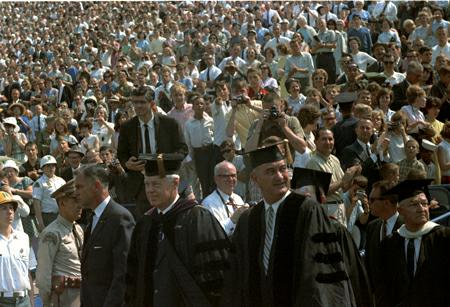
LBJ at the University of
Michigan, May 22, 1964 –
announcing the outline of
his "Great Society" Program
LBJ Library – University
of Texas
He pointed out that it was in three areas in particular that his
new program was designed to make improvements in American society: improved urban infrastructure, protection of
the natural environment, and improved education of America's youth. Clearly this pointed to massive Washington
involvement in the internal affairs of America formerly left in the hands of
state and local governments closer to the dynamics of America's towns and
cities across the nation. However, he
reassured Americans:
While our Government has many programs directed at those issues, I
do not pretend that we have the full answer to those problems.
But
I do promise this: We are going to assemble the best thought and the broadest
knowledge from all over the world to find those answers for America. I intend to establish working groups to
prepare a series of White House conferences and meetings on the cities, on
natural beauty, on the quality of education, and on other emerging
challenges. And from these meetings and
from this inspiration and from these studies we will begin to set our course
toward the Great Society.
The
solution to these problems does not rest on a massive program in Washington,
nor can it rely solely on the strained resources of local authority. They
require us to create new concepts of cooperation, a creative federalism,
between the National Capital and the leaders of local communities.
"Creative federalism." What Johnson said in that last statement –
"The solution to these problems does not rest on a massive program in
Washington" was in fact complete fiction – because that was exactly what
he had in mind as he developed his new Great Society Program. And his understanding of things in creating "new
concepts of cooperation, a creative federalism, between the National Capital
and the leaders of local communities" was that the local communities would
be expected to follow the lead of Washington as it laid out this concept of "creative
federalism." And creative
federalism it would be indeed!
He
was indicating more accurately what he intended to do in his Great Society Program when he said "We
are going to assemble the best thought and the broadest knowledge from all over
the world to find those answers for America."
Democracy from above." Thus it was that Johnson was preparing America to come
to the new understanding of "democracy from above." And as such, he was preparing the Democratic
Party to reshape itself around that same idea as to what it would henceforth
offer America: a better (or Progressive) government from above. This would leave the (conservative)
Republican Party to continue to defend the idea that government in America
rightly belonged to its people, not the "more-enlightened" Washington
experts.
The 1964 Civil Rights Act. There was not much argument in America (angry
Southerners and Northern racists excepted) over the issue of whether or not
Black civil rights needed "help from above." That was one area of Johnson's Progressivism that had wide support
in America. The front-page newspaper photo of the attacks in Alabama on
peaceful Black protesters (May 1963) by Birmingham police and their attack dogs
– or Birmingham firemen and their fire hoses cruelly aimed at protesters seated
along the street – or Alabama Governor Wallace personally blocking the entrance
of Black students to the University of Alabama (June 1963) – outraged most
Americans – now quite convinced that waiting for the State of Alabama to do the
right thing (actually the Constitutional thing) was not going to happen.
Thus
in 1964 Johnson was able to persuade Congress
to pass a Civil Rights Act (actually originally authored by Kennedy), outlawing
the discrimination by way or race, religion, sex or national origin in voting
registration, school segregation, employment or hiring, and in public
accommodations (restaurants, hotels, etc.)
Much celebration accompanied the signing (July 1964) of this
wide-ranging civil rights law. But in
fact the new law lacked strong enforcement possibilities – and also it was
largely disregarded in the South, where attitudes were widespread that Congress
had no right to pass legislation concerning purely domestic matters. Nonetheless, the law did carry enforceable
weight in the North, where racist lines still played a role.[2]
The "War on Poverty." Ultimately, however, the centerpiece of Johnson's Great Society Program was his "War
on Poverty" set up in 1964 and directed by the new Office of Economic
Opportunity – overseeing such programs as VISTA – sort of a domestic Peace
Corps of volunteers directed to help not Third World countries but instead
American communities caught in poverty (inner-city neighborhoods, Indian
reservations, rural communities) with job training. Then there was the Job Corps, a federal
employment program modeled along the lines of Roosevelt's CCC, offering the
unemployed jobs in Federal Parks and other Federal lands. Another program was Head Start, setting up
early childhood education, health service and parent training for children in
poverty areas of the country, to help prepare the children about to enter
elementary schooling. And there were the
Community Action Agencies, supporting local programs designed to help people
caught in poverty – programs ranging from the local Head Start operations, to
food pantries, to utility bill assistance, to other programs local welfare
agencies might want to develop.
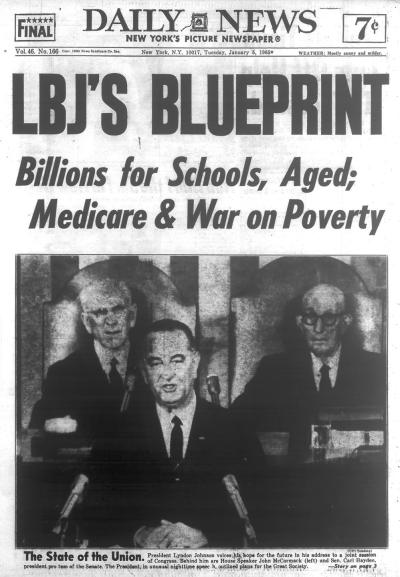 January 1965 – Johnson in his State of the Union address
before Congress details even further the content of what
he wants to see take shape as his "Great Society" programAlthough
these programs operated at the local level
(obviously, because that is where the challenges were to be found) they were
overseen by a Washington bureaucracy that exploded in size over the next few
years, as multitudes of individuals flocked to the nation's capital to find
employment in this massive governmental enterprise.
[2]The 1964 Civil Rights Act would continue to serve as the moral
foundation for the future expansion of federal involvement in matters of civil
rights of an even widening nature: gender, preferred language and sexual
orientation, and even the dismissing of the long-held Christian norms in public
affairs.
Vietnam: The domino theory.
Meanwhile the long-brewing crisis in Vietnam had taken on growing
significance. The necessity of acting
boldly in Vietnam as well as at home was thus
put forward to the American people by Johnson. In explaining this mounting international
challenge facing America as the defender of the Free World, he employed a
logical line of argument built on the "domino theory." This theory was that if America did not take
a firm stand against aggression in one place in the region and let that nation
fall to Communism, then soon the country next door would fall, then the one
next to that, and then next to that – like a line of dominoes. The presumption was that Communism was a
single-minded force ultimately directed from a single command center: the Kremlin in the Soviet Russian capital at
Moscow.
Tragically,
the role of nationalism and nationalist varieties within the Communist camp –
often in sharp conflict with each other (which Truman wisely exploited) – did not
factor into Johnson's presumption of Communism
being a single-minded force. Thus arose
the conclusion that America needed to take a rigid stand in Vietnam – lest all the countries in
Southeast Asia fall to Communism like a line of dominoes.
The Gulf of Tonkin Resolution (August 7,
1964). To get America on board with him on his plans
for Vietnam, he put before Congress in
August two incidents that were reported as having occurred just days earlier –
when two American navy destroyers stationed just off the coast of Vietnam were attacked by Vietnamese
torpedo boats. Unknown to America – and
Congress – the second attack indeed did not actually occur – and the first
attack was likely provoked by attacks of South Vietnamese commandos on the
North Vietnamese coast. In any case it
served Johnson well enough – so that he was
able to get Congress (almost totally unanimously) to award Johnson special war powers to do what
he saw fit about the conflict going on in Vietnam. Johnson would use these powers widely
– supposedly to stop the domino effect of Asian societies falling to Communism.
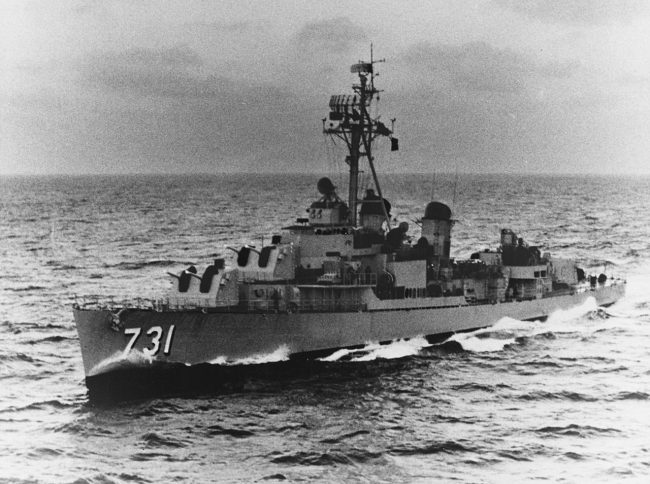
The
destroyer USS Maddox - which found itself engaged in
action against
several North Vietnamese torpedo boats in the
Gulf of Tonkin ... just
offshore from North Vietnam.
The professionalization of the Southeast Asian conflict. Johnson did not see himself as
actually calling the nation to war, as had been the case in World War Two and
in Korea. He did not want the Vietnam issue to distract the nation
from its more important task of putting his Great Society Program in place. Rather, he supposed he could simply assign
American military units (already in being) to head to Vietnam, go ashore at various points
along its long coast, fan out from there as they took ground from the enemy,
and quickly bring the country under American control. It looked quite clear on a map how this was
to work. So, no, America was not going
to war. It was simply going to involve
itself briefly in a "police action," one conducted by America's
rather professional army.
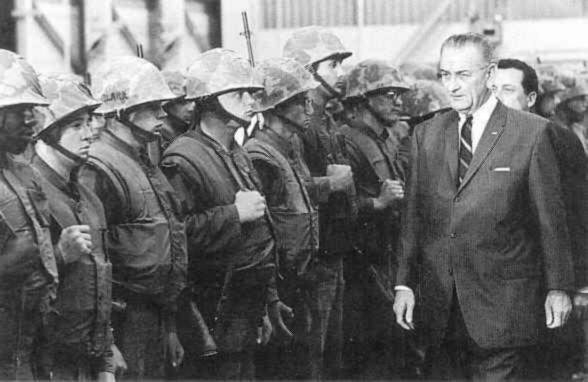
Lyndon Johnson reviewing
American troops
In
short, American action in Vietnam would be another variety of "democracy from above" – the
American soldiers qualifying as the "experts" who would install
democracy in Vietnam for the Vietnamese
themselves.
| THE NATIONAL ELECTIONS OF 1964 |
Behind much of the speed by which Johnson moved to get his Great Society Program planted – and
increased American involvement in Vietnam underway – was Johnson's awareness that it had only been
months since he assumed office as President, and now similarly only months
before the time he would have to face voters in the November 1964 national
elections. He naturally was eager to see
himself actually elected by the American people themselves as their President.
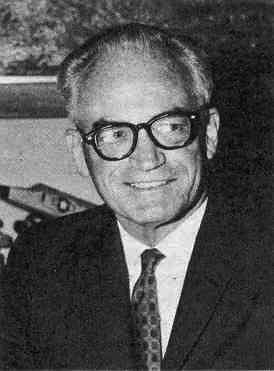 Facing
him as presidential candidate for the Republicans was Arizona Senator Barry Goldwater – who was so bold as to
present himself proudly as a Conservative – even authoring a book in 1960
entitled The Conscience of a Conservative. During the 1964 campaign, Goldwater was quick to point out that Johnson's Great Society program amounted to a
huge Washington overreach – and a serious danger to American democracy.
Facing
him as presidential candidate for the Republicans was Arizona Senator Barry Goldwater – who was so bold as to
present himself proudly as a Conservative – even authoring a book in 1960
entitled The Conscience of a Conservative. During the 1964 campaign, Goldwater was quick to point out that Johnson's Great Society program amounted to a
huge Washington overreach – and a serious danger to American democracy.
But Johnson conducted an effective
campaign depicting Goldwater as a dangerous threat to
world peace – because Goldwater, in being pushed by the
press corps to give an answer to the question, "would you ever resort to
the use of atomic weapons if you saw their need in fighting Communism, even in Vietnam," in essence said 'Yes." How could Goldwater have said "no?" That was a politically loaded question, of
course. No one wanted to see those
weapons ever unleashed. But as Truman himself understood, possessing
the weapons – but going on record as unwilling to actually use them – destroyed
all the deterrent value that came with possessing them. A leader had to make it clear that he had the
guts to use them if necessary.
But
the Democratic Party played Goldwater's response hugely, in order
to heighten the natural fears of the American voter about any form of a nuclear
war. The Democrats even broadcast a TV
commercial ("Daisy") implying the nuclear devastation that would hit
the world if Goldwater were allowed to become
President. That stuck in people's mind –
more than any other feature of the national elections. Goldwater stood for war. Johnson stood for peace. It was that simple – or so the Democrats
convinced the American voters.
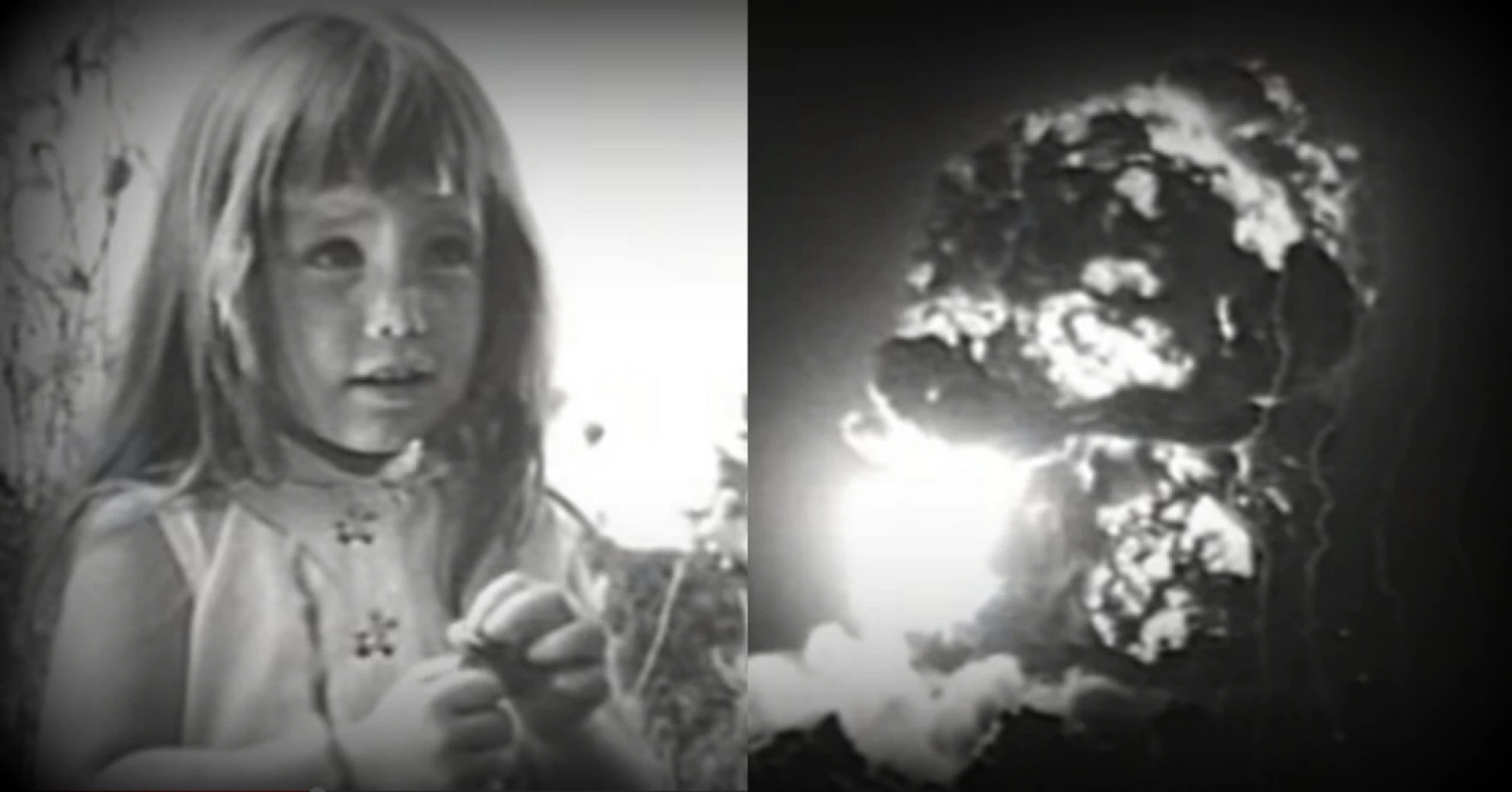
The 1964 Democratic Party "Daisy" Ad
depicting Goldwater as war crazy
Goldwater fought back – pointing out
that Johnson's growing focus on Vietnam was devoid of any
realistically achievable goal – and would merely end up destroying multitudes
of young American soldiers for no particular purpose. But Americans – at the moment – were well
convinced that a strong (but conventional) military stand in Vietnam was needed in order to stop
the advance of Communism. Even on this
point Goldwater could make no headway
against Johnson.
As a consequence, the November elections turned out to
be a huge disaster for the Republicans – and an equally huge mandate for Johnson and his programs both at home and abroad. Johnson ended up with 61% of the popular vote, to only
38.5% for Goldwater – and with 486 electoral votes to Goldwater's mere 52 electoral votes. Goldwater won the electoral vote of only his own state
Arizona (barely)... and the Solid South – which was beginning to switch its
loyalty (since the Civil War) from the Democratic Party to now the Republican
Party.
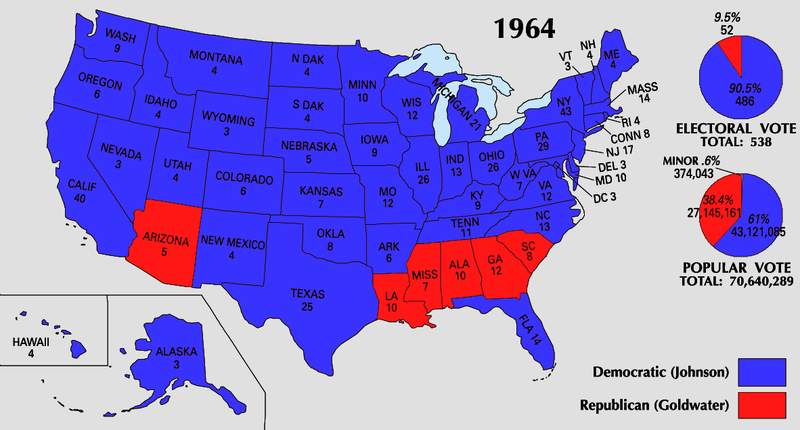
Nov. 1964 – Johnson is elected overwhelmingly to the
Presidency
and holds that position now by his own right
| THE 1965 VOTING RIGHTS ACT |
Then when in March of 1965 Alabama state troopers attacked with
tear gas, billy clubs, and whips a nationally televised peaceful protest march
from the towns of Selma to Montgomery – led by the Rev. Dr. King himself – the vast majority of
Americans were convinced that it was time for the Washington government to step
in and enforce Blacks' 15th Amendment voting rights[3],
now – not tomorrow or some day in the near future – and by whatever means
necessary to enforce the law.
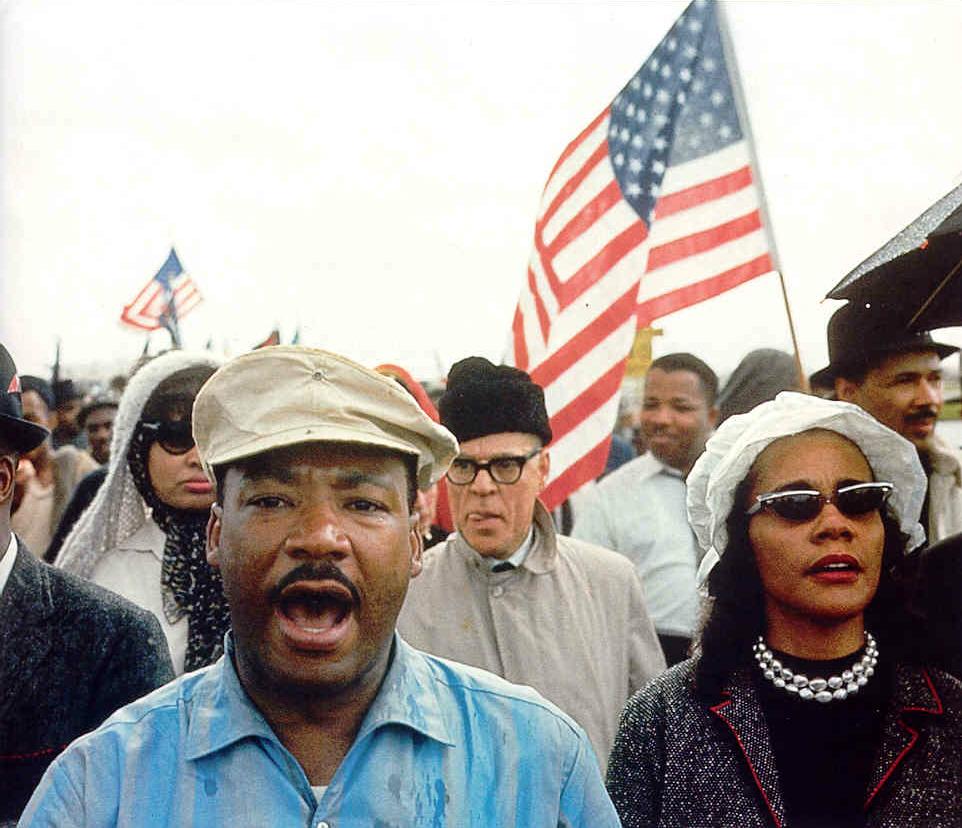
Martin Luther and Coretta
King leading a march in Selma,
Alabama, demanding Black voters' rights – March 1965
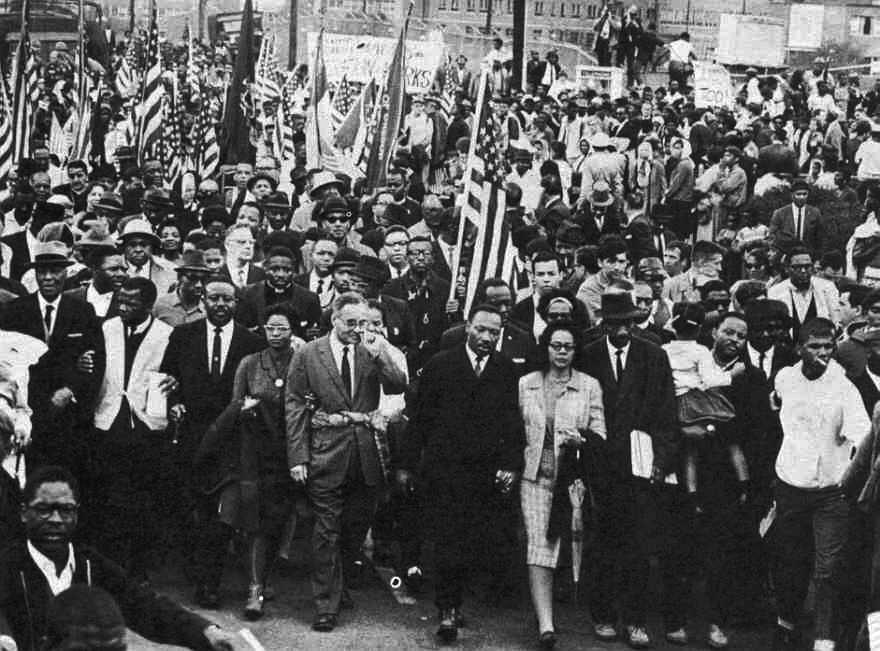
Martin Luther King and 25,000
marchers
from Selma to Montgomery
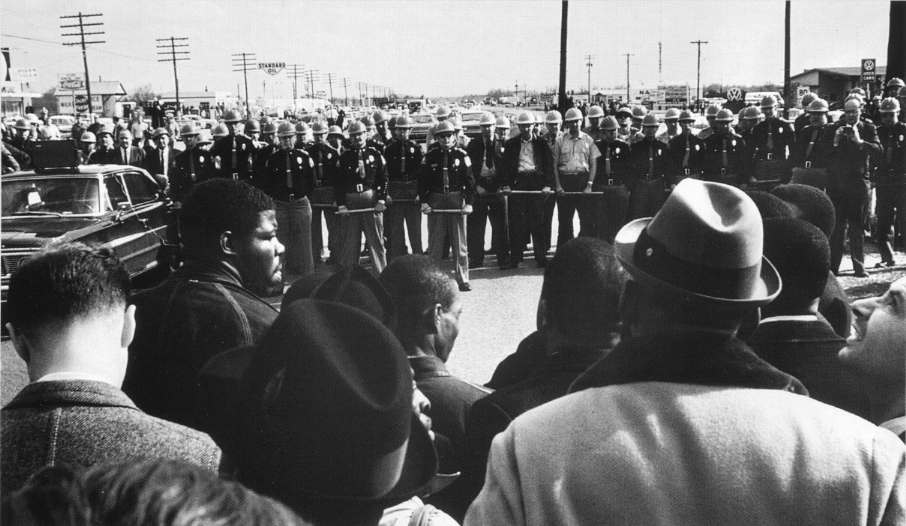
Police outside of Selma,
Alabama,
attempting to stop this civil rights march
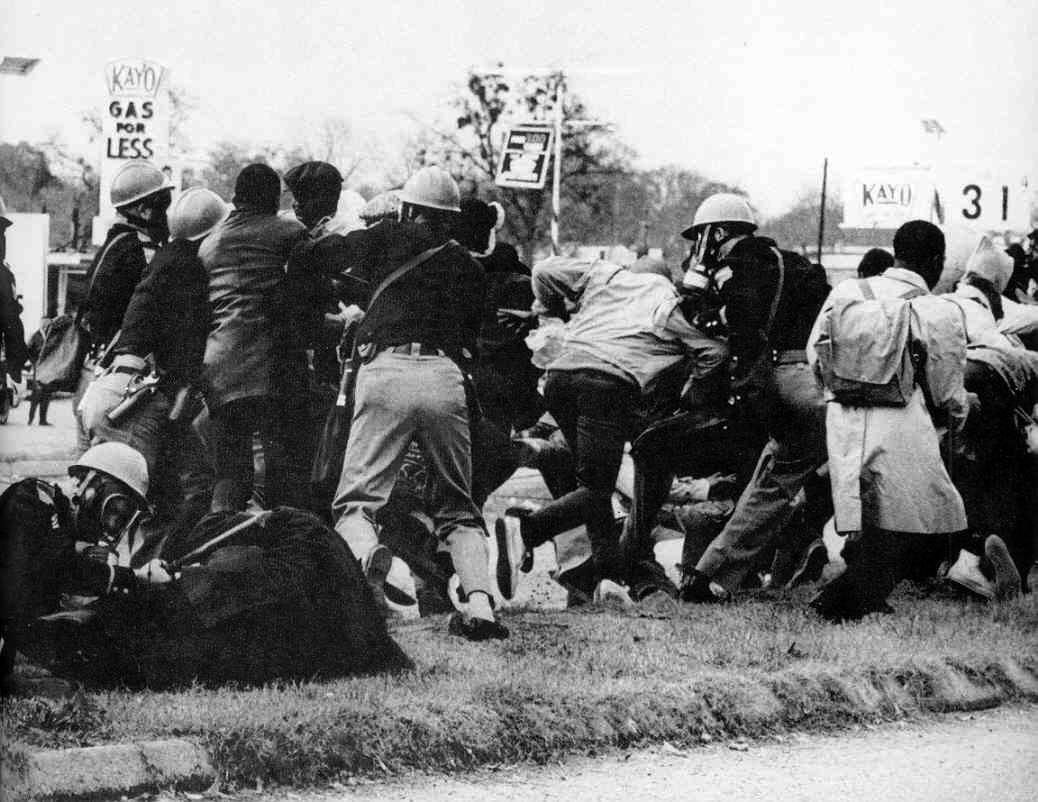
Alabama state troopers attacking
civil rights demonstrators
Thus
two months later (May of 1965) Johnson was able to get the Senate to
approve (77-19) a voters' rights bill – and then in July the House of
Representatives to approve the same bill (333-85) – including most certainly
the six Black members of the House. He
was then able to sign it into law on August 6th – with the Rev. Dr. King at his
side at the well-publicized signing.
Basically, the law made illegal all the "literacy tests"
(having to recite the entire Constitution, for instance) imposed on potential
Black voters as a means of keeping them off the voting rolls. Simply as American citizens they were fully
entitled to vote in all elections. There
would be no more qualifying tests allowed.
Under
federal supervision, Blacks now began to register in huge numbers. And the South now understood that segregation
was about to lose its political grip south of the Mason-Dixon line! Fair enough!
[3]"The right of citizens of the United States to vote shall not be
denied or abridged by the United States or by any State on account of race,
color, or previous condition of servitude."

Go on to the next section
 Miles
H. Hodges
Miles
H. Hodges

 The transition from Kennedy to Johnson
 Lyndon Baines Johnson (LBJ) – the man and his making
  Johnson's Great Society Program
  "Democracy from above"
  Vietnam
  The national elections of 1964
  The 1965 Voting Rights Act