In fact quite the opposite actually happened with the post-war
American economy. Virtually no cars had
been produced during the war years and consumers were eager to trade up to a
shiny new car, helping the automobile manufacturers quickly shift back to
massive automobile production from the manufacture of tanks, trucks, and
airplanes that they had converted their operations to during the war. Then there was a huge demand for the new and
quite affordable small homes that allowed young American families to leave the
multi-generational old homes of traditional America – and move out on their own
in the widening world of America.
Military service had introduced young men to the dreamy world of
California, the robust world of Texas, etc. – and after the war young Americans
eagerly moved West in huge numbers, into fast-growing suburban neighborhoods –
arising, however, around not only the newly expanding cities in the West but
also in cities everywhere across the country.
Consequently, the construction industry boomed – offering plenty of jobs
for young men who had returned home from military service.
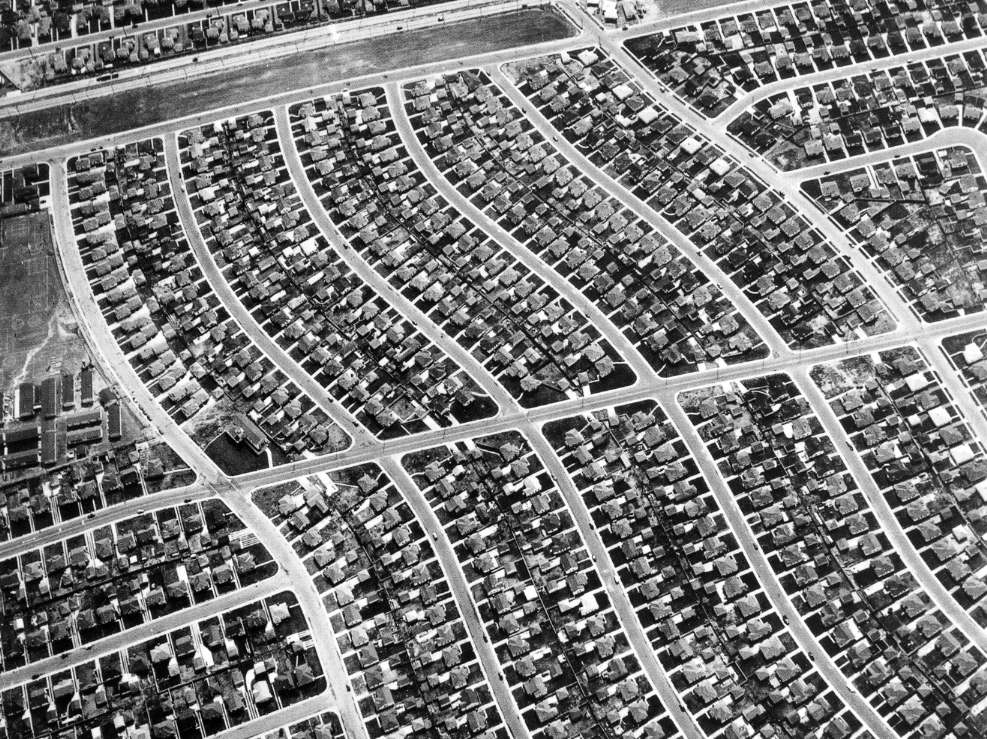
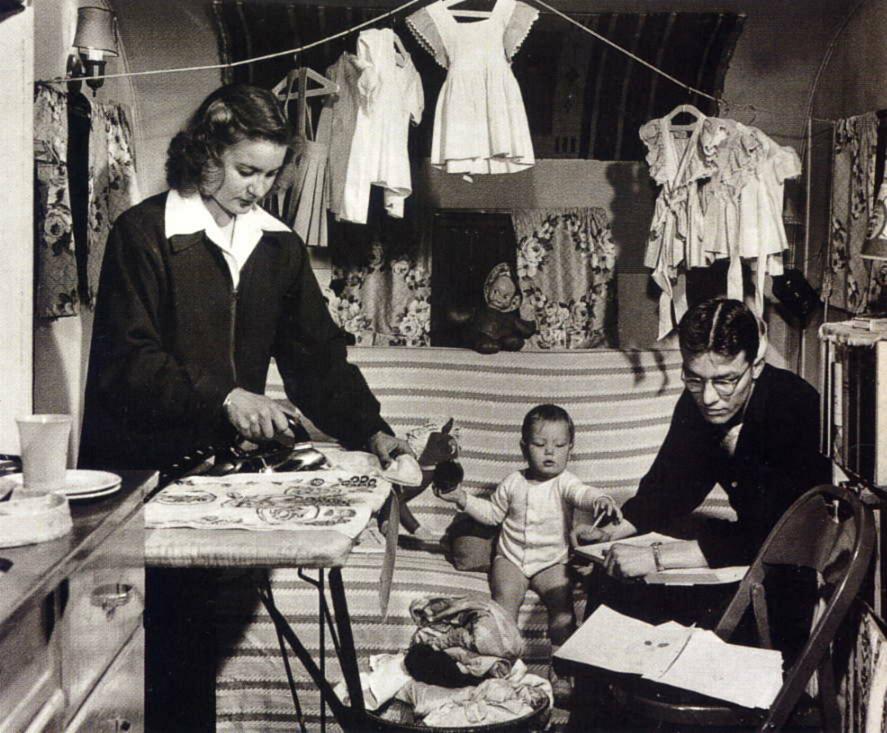
A post-war housing subdivision
outside Los Angeles
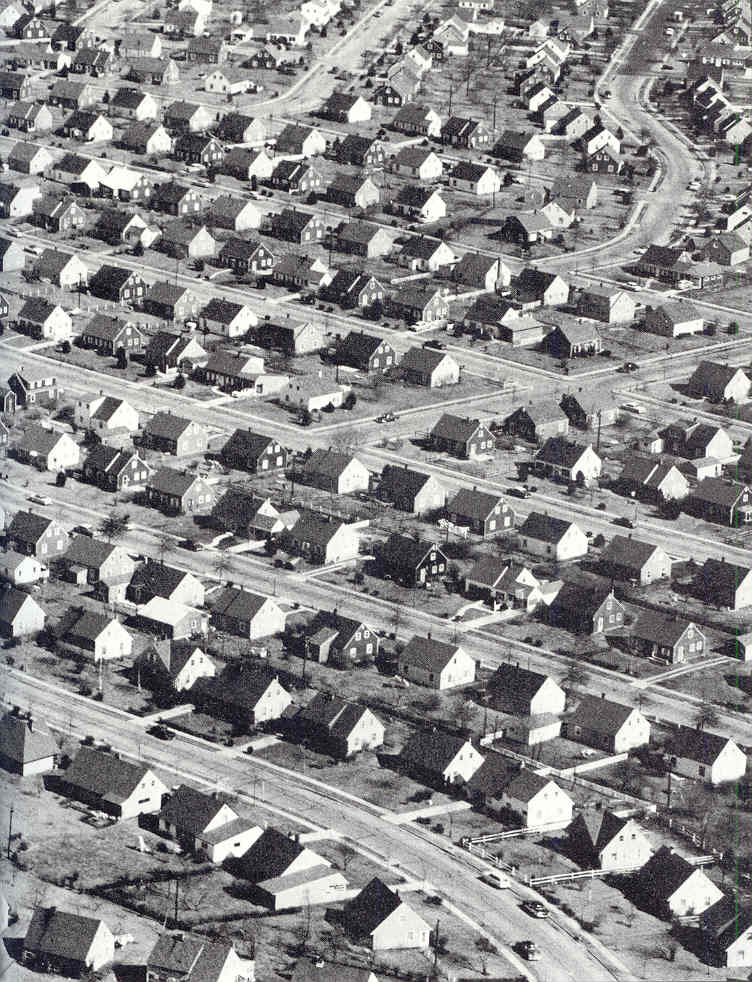
Levittown – Long Island -
home for more than 17,000 families –
late 1940s

Rapid suburban housing growth
in the post-war years in America
Housing starts jumped from 114,000 in
1944 to 1.7 million in 1950
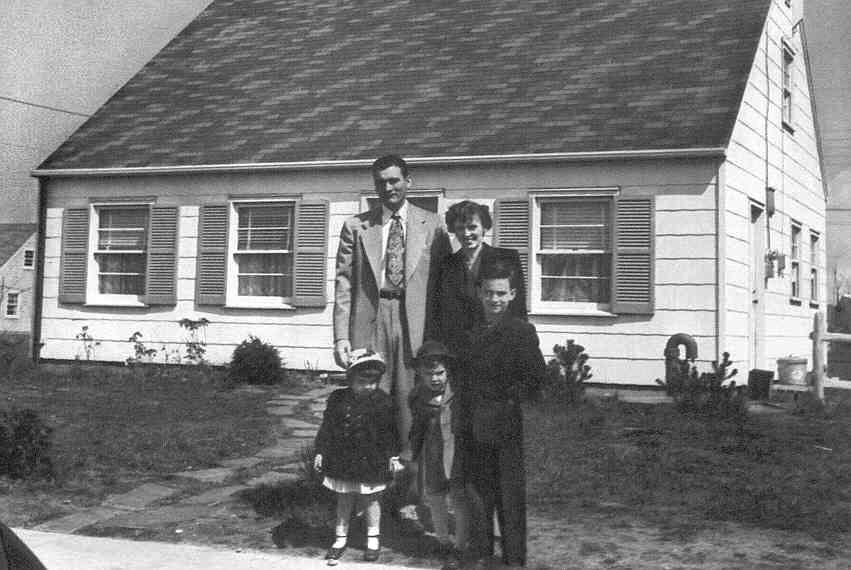
Suburban family in Levittown,
New York
The Marshall Plan aiding the European
recovery also added immensely to the American economy. Much of Europe's industrial infrastructure
had been destroyed by the war – although America's factories had been
untouched. Consequently, the Marshall Plan funds mostly made their
way back to America in the form of orders for American goods: machinery, trucks and tractors, electronics,
etc. In fact, by the year 1950 it would
be correct to say that America itself provided fully half of all industrial
products being produced worldwide.
Then this culture expanded considerably in the 1950s
A major contributor to the
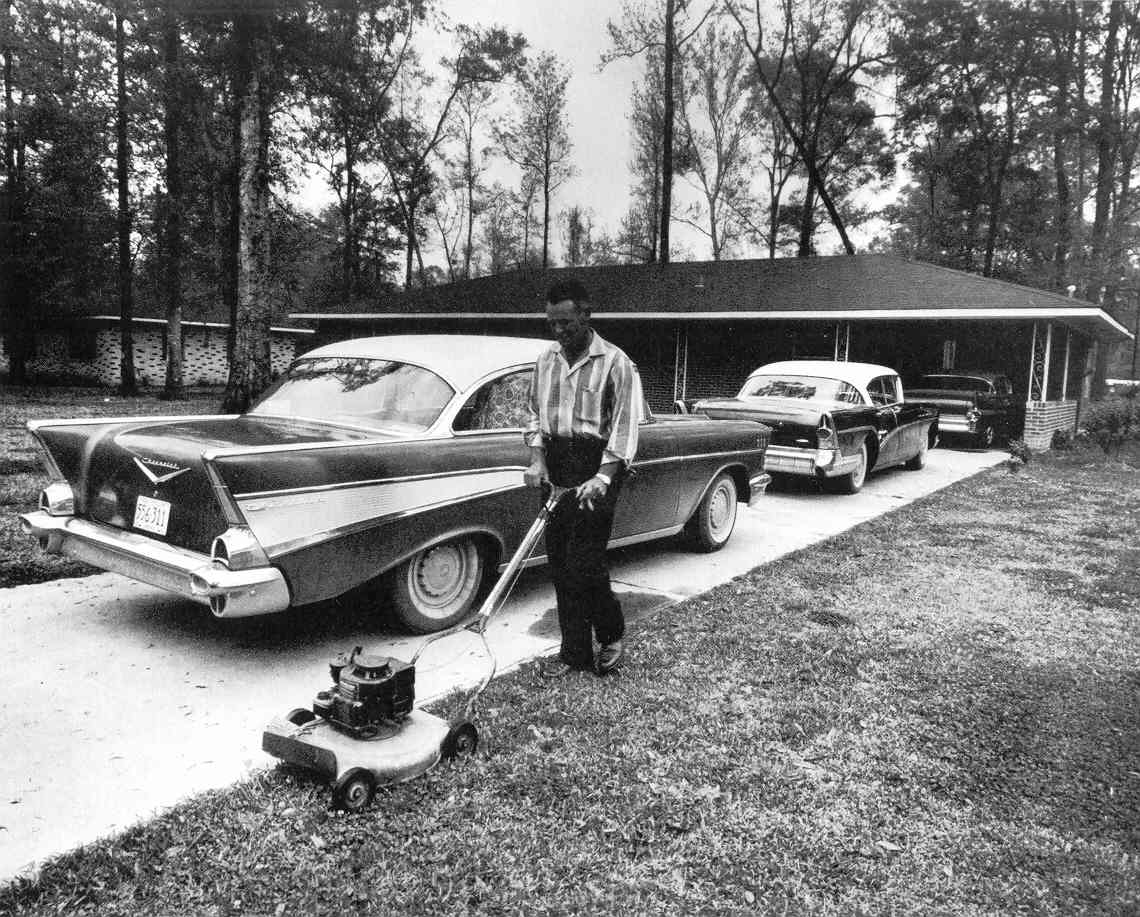
new American scene was, of course, the automobile
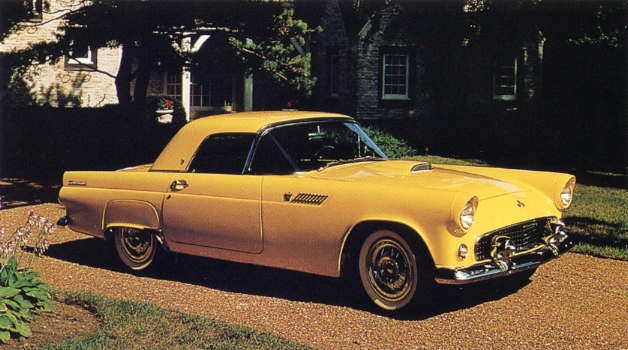
The 1955 Ford Falcon – a
major hit with America's younger drivers
Lawn care in the
suburbs
Along with the automobile
was the drive-in fast-food restaurant
A McDonald's fast-food restaurant – San Bernardino, California – mid-1950s
The startup of a family was a matter that young Americans had been
forced to put off during the war years.
But now, peacetime presented the opportunity for young men and women to
make up for that lacking. They rather
quickly married in massive numbers – and soon began to produce the next
generation. Babies were thus born also
in massive numbers in the period of 1946 and after – the beginning of the "Baby
Boom." And those babies, soon
children (the 1950s) and eventually young adults (by the mid-1960s) would
develop into a very distinct generation of Americans, known appropriately as
the "Baby Boomers" – and eventually
just "Boomers." They would
come to rock the nation.
Entitlement" replaces the sense
of service or duty among the Boomers. Tragically, what these young parents seemingly
were unaware of was that the enormous dignity they found in their lives as
Americans was a huge personal emotional payoff that mysteriously came from the
life of service or duty, which they had been forced to take in both the
Depression and recent war just to survive.
Now with peace in the world and America prospering greatly, they saw the
"wonderful" possibilities that their Boomer children would never have
to undergo such a social burden.
Sadly
this adult or Vet generation failed to understand
how important their approach to life – through the taking up of burdensome but
necessary service or duty to the surrounding social world – was behind their
also deep sense of both personal and corporate success. Thus they would raise and supposedly "bless"
their Boomer children – as part of their on-going sense of personal duty – by
trying to keep from them the "burden" of such sacrifice, such dutiful
service. They would give their children
generously and freely all the personal and social payoffs that they themselves
in their growing up never had the pleasure to experience.
And
in doing so, they believed they were performing a great service to their
children. Actually quite the opposite
would be the social results.
Consequently, the Boomers would not form this deep
sense of personal connection through the path of duty or deep personal service
to the surrounding social world. Indeed,
they would be amazingly lacking in such social powers. This was because the Boomers would grow up
seeing society not as something you are deeply wed to through the personal
investment of service or duty. Instead,
when they looked out on society it was to see what social entitlements were due them through their social
connections, and changing those connections (marriages, jobs, local
communities) when they did not see a proper social payoff coming their
way. Thus it was that they were largely
attached to society only to the extent that society continued to offer a person
his or her "entitlements."
In short, socially speaking, they were badly "spoiled."
| CHRISTIAN-CAPITALIST-CONSTITUTIONAL AMERICA |
Christian America. A notable thing about
post-war middle-class culture was that it was personal and highly relational –
rather than dreamily rational or utopian – the kind of world that those who
like to direct the lives of others from a position of lofty and rather abstract
enlightenment typically live by. The war
that Middle America had just been through
was neither rational nor abstract. It
had not been fought on the basis of high and noble ideals – the way Wilson took America into the First
World War in the name of "making the world safe for democracy" – but
more as a sense of simple defense of the America that had been treacherously
attacked by Japan and called to war by Hitler's own design. There had been much personal sacrifice
involved for Americans. Indeed, this war
had been from the beginning very personal.
But
going at life on a relational rather than rational basis had been given
considerable impetus by the Christianity that informed most Americans at this
point – the sense that their personal relationship with God was critical in
their ability to go the course – all the way to victory. Americans looked to God rather than to human
programs to keep them moving forward.
True, there was a Washington government to lead the way. But even there, that lead was more personal,
prayerful, spiritually-directed than programmatic. Roosevelt had kept in close touch with the
hearts of Americans with his fireside chats and personal prayers – ones that
related the president, the citizen, and God in a very special way – vitally
needed to keep things moving ahead, even in the face of huge uncertainties that
always accompany war.
Thus
Americans came out of the war highly committed to their Christian faith –
especially in the way it defined for them the idea of America itself, what it
stood for, how it operated – what was to be expected from American life – and
what defined the good and the bad in all of this.
Capitalist America. Right along with
Christianity came Capitalism as core to Middle America's understanding of
life. Certainly the huge industrial war
machine led by American capitalists had proven itself. And the continuing economic prosperity that
followed the war in terms of the building boom in American housing, the booming
automobile industry, and the easy availability of a whole number of domestic or
personal consumer items brought capitalism back into favor in the American
heart. It was also easy to look across
to Europe and see that continent's tendency towards Socialism seemingly serving
much less capably than the American capitalist system.
Constitutional America. And America's governmental
system clearly had proven its strengths during and after the war – when
Washington's immense military and bureaucratic system, needed so vitally during
the war, was now reduced drastically in order to let America return the focus
of its political dynamic back to local American life. Here too, with the process of government
carried out essentially as a local responsibility – rather than as some
imperial institution located in a distant national capital – there was
something very constitutional in all this.
Americans were proud of their Constitution, considering it to be the
perfect model – even for the world – of excellent government.
Over the next twenty years that followed the end
of the war in 1945, Christianity, Capitalism, and Constitutionalism (the Three
C's) would all come together to form something of a grand cultural blend.
Awakenings. Interestingly, one of the
groups taking the initiative in this matter were America's capitalists, now
restored to dignity because of the war.
They had joined Abraham Vereide even before the war in
strongly supporting his prayer-breakfast movement. But now they were joined by Washington senators
and congressmen, as a strong sense of Christian responsibility, not just to the
country but to the world, called forward an active spirit of American social
mission.
And
then along with this, there was the young Christian evangelist, Billy Graham, who seemed to be taking the
nation by storm as he packed huge coliseums with vast multitudes attending his
various crusades ... with his month-long 1952 Washington D.C. crusade drawing
as many as half a million participants, many of them also representatives and senators
from Congress.
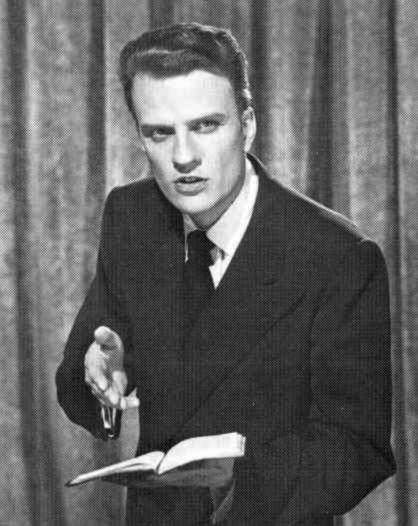
Christian Evangelist Billy
Graham
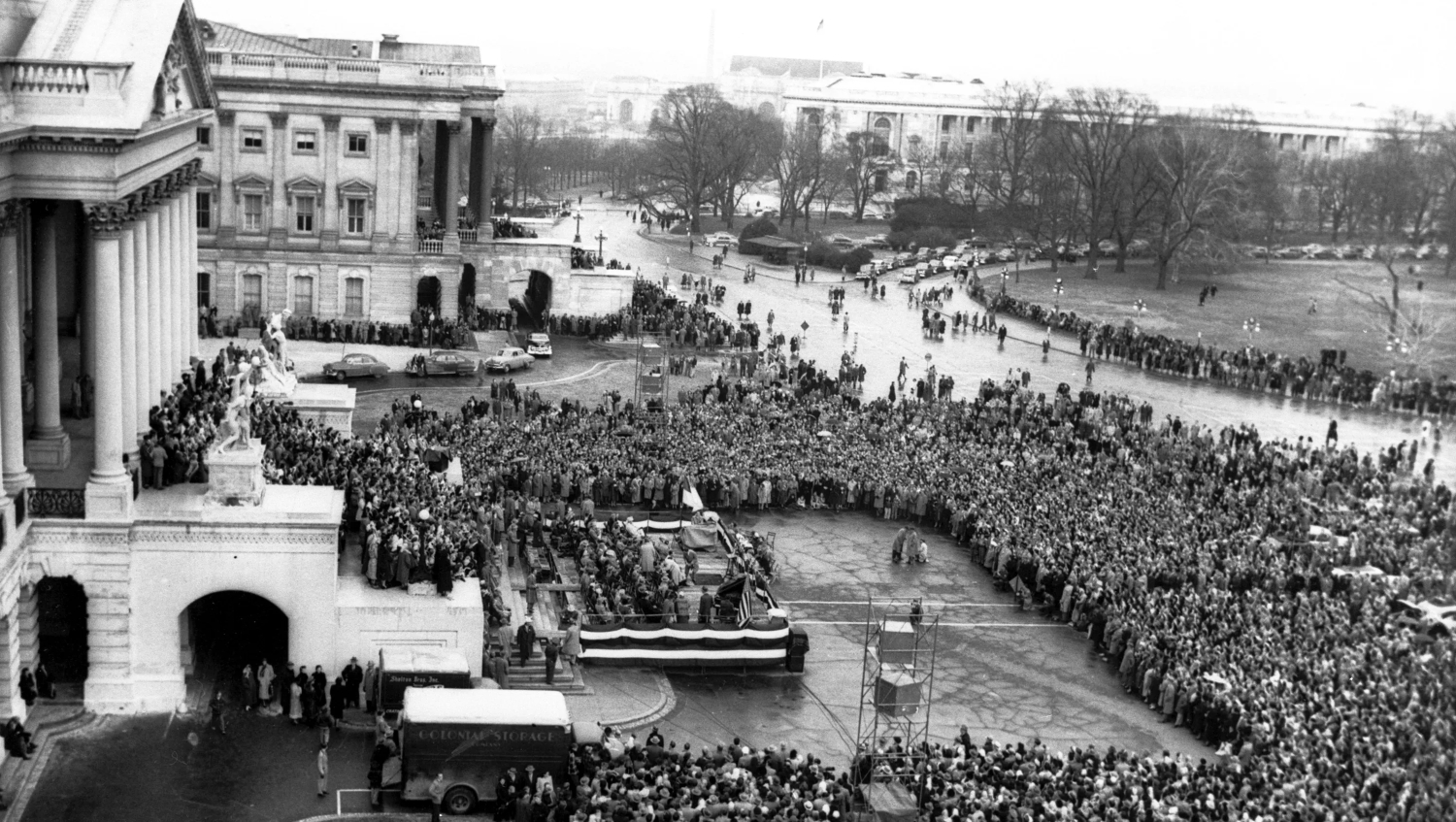
Even in the rain ... Graham could bring people out to his Crusade
Washington, D.C. – February 3, 1952
So
effective was this crusade (well financed by American business leaders) that it
led to the call by President Truman (although he generally tended
to prefer to keep the matter of religion personal and private) for an annual
National Day of Prayer – the first one, captioned "Freedom Under God,"
to be held that year (1952) on the 4th of July.[2]
[2]Actually Truman had several times previously called the nation to prayer … when he found himself facing a number of
crises for which he had no easy answers.
His unsophisticated but very Biblical and very personal Christian faith
drew criticism from more sophisticated and "theologically-informed"
voices of the day. But the important
fact was that Truman truly looked to God and the Christian world for support in
carrying out the responsibilities placed on him by his nation.
Then too, just as the radio revolutionized life in the 1920s, the
widespread appearance of the new television (TV) would have the same massive
impact on American life from the early 1950s onward. The development of the TV certainly also put
a huge boost in the American economy, Americans flocking in vast numbers to the
stores to buy this new and most wonderful addition to American homelife. It was like having the movie industry brought
into your home. In fact, Hollywood was
in a bit of a panic fearing that this TV craze would bring down the movie
industry (it did not).
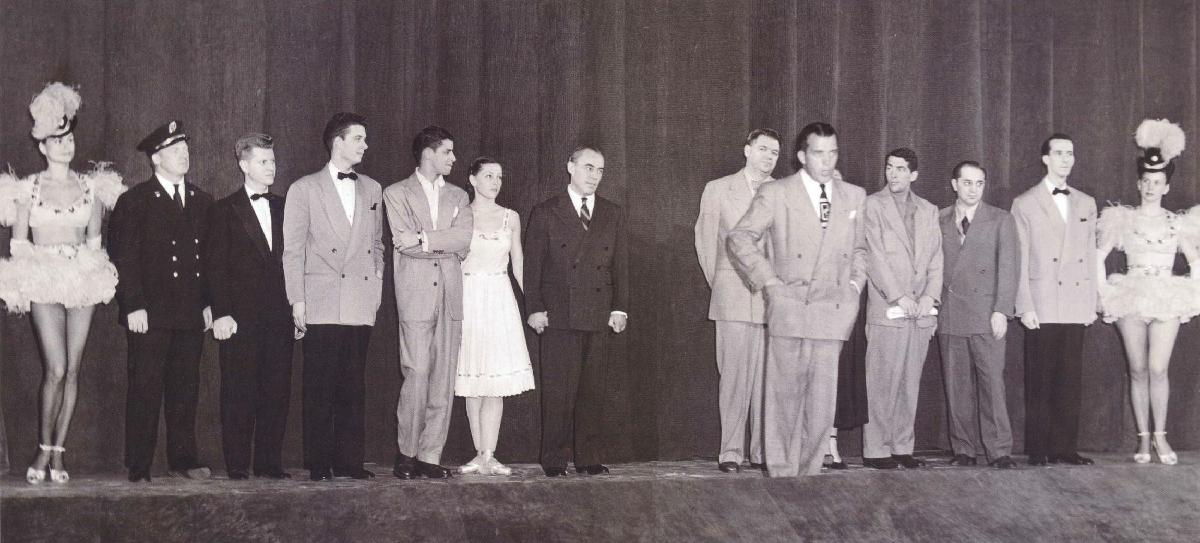
The opening night of the
CBS TV Ed Sullivan Show – 1948
Guests included Richard Rodgers and Oscar
Hammerstein, 22-year-old
Jerry Lewis (3rd, 4th + 5th from
left) and Dean Martin (4th from right)
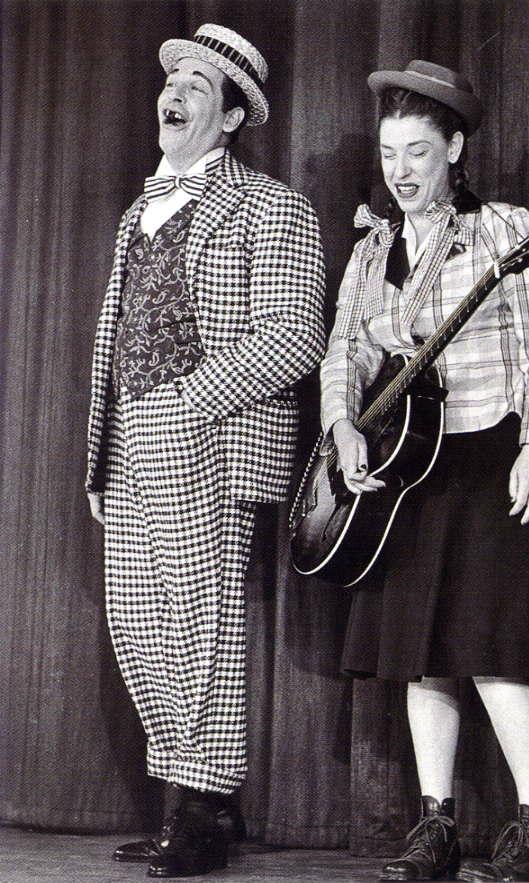
Milton Berle and Judy Canova – 1948
His Tuesday night NBC show mesmerized
the nation
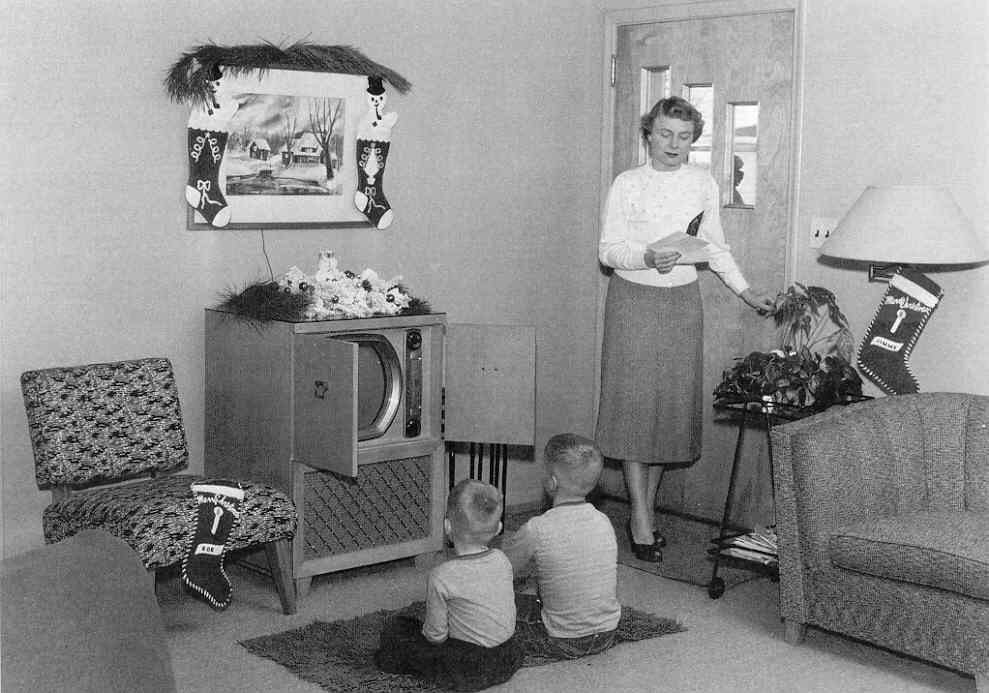
The living room in a 1950s
American home

Typical living room scene
- 1950s
But the TV put in front of Americans a clearer picture
of a well-modeled world of everything from family life (The Adventures of
Ozzie and Harriet), cowboy heroes (Hopalong Cassidy), comedy (I
Love Lucy), and classic drama (The Hallmark Hall of Fame). Soon it would move on to major sports events
(National Football League games) and the latest dance steps for teens (American
Bandstand). In short it presented a
very clear definition of the core ideals of Middle-Class American life,
something that Americans felt set them apart from – and way ahead of – the rest
of the world in terms of modern development.
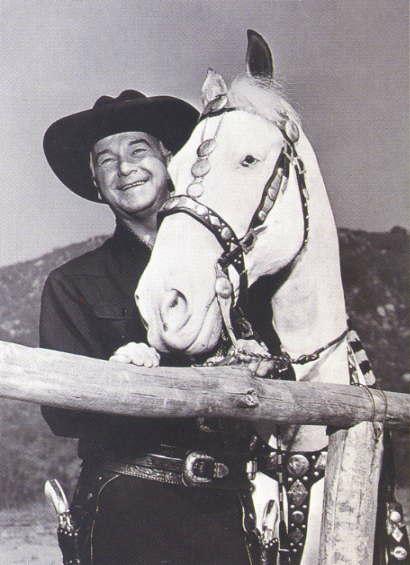
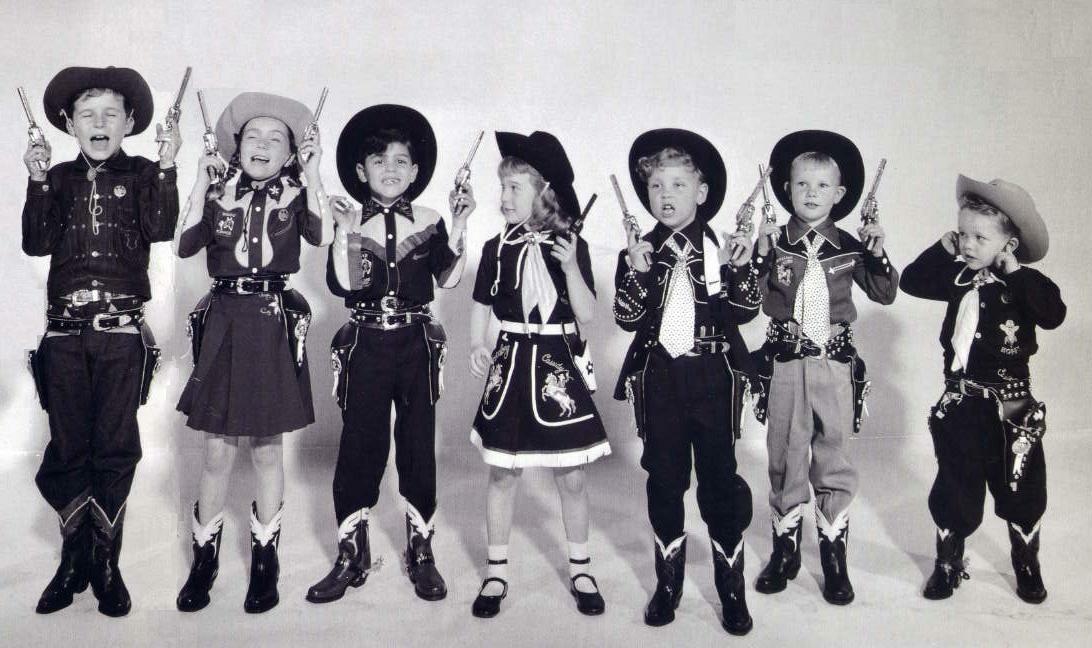
Hopalong Cassidy
a favorite
kids' TV program (early 1950s)
William Boyd bought up the TV rights to
66 of his B-grade
movies –
and turned them into major TV hits with
the kids
Hopalong Cassidy gear
Boyd also licensed and marketed cowboy
gear --
which sold very well with the kids 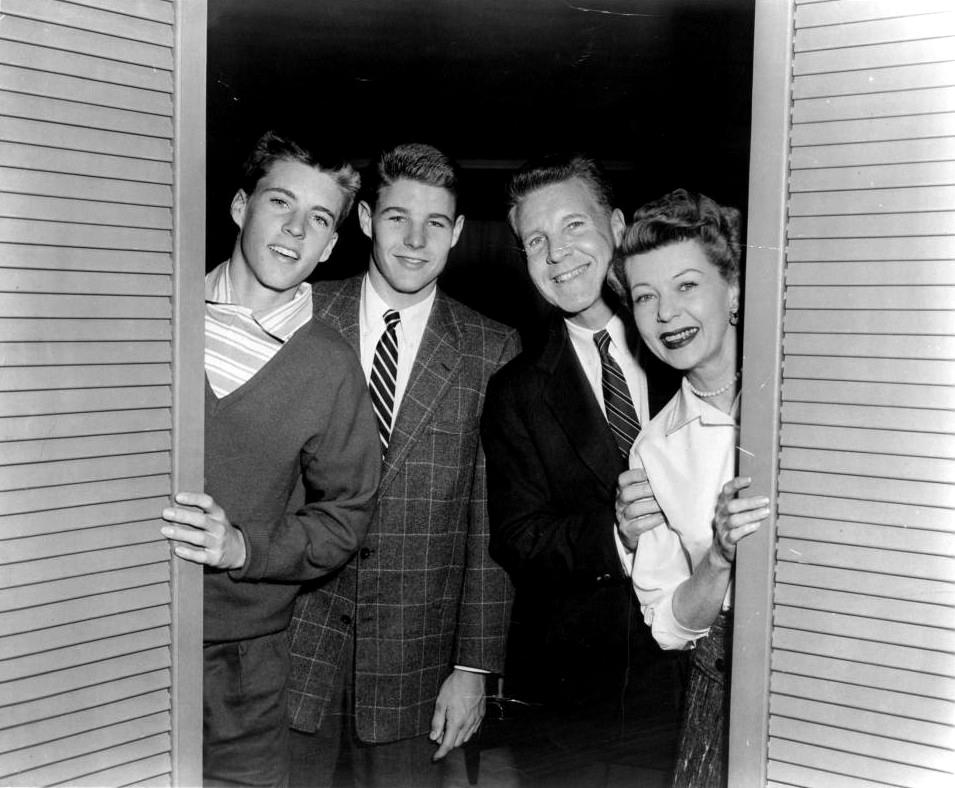 Ozzie, Harriet and family gave TV viewers a picture of the perfect "Middle American" family
And there was also the totally ridiculous ... to make America laugh
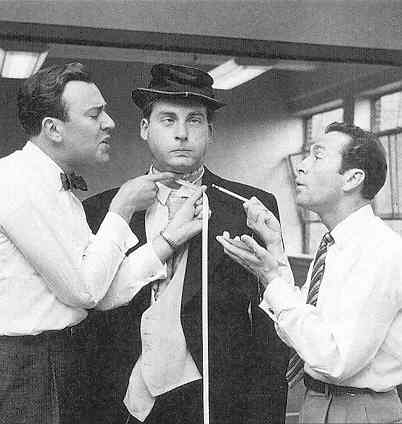
Sid Caesar: The Show of
Shows
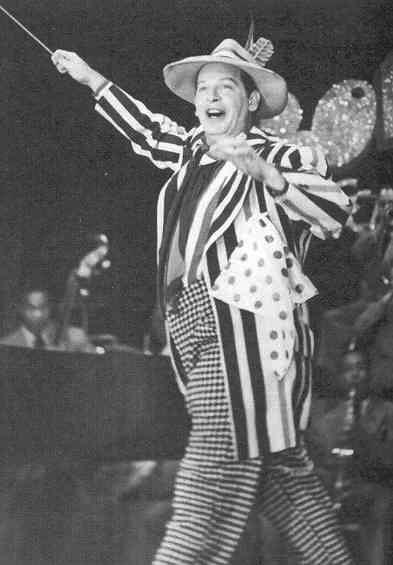
Milton Berle – 1950s
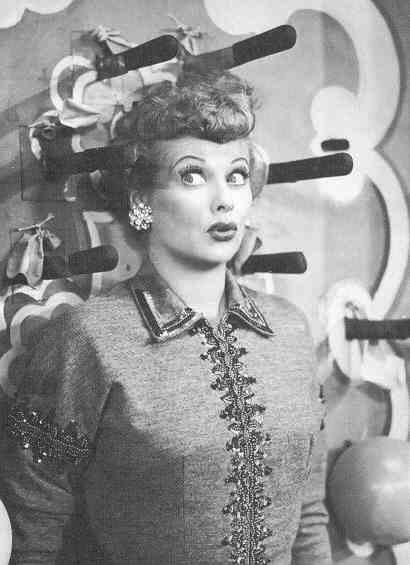
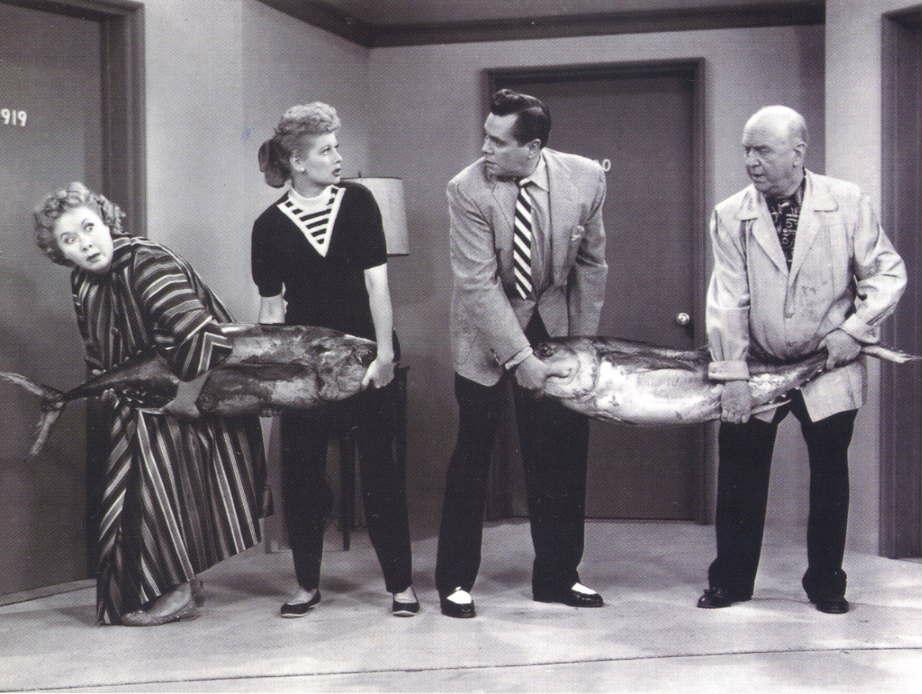
Lucille Ball
An "I Love Lucy"
episode
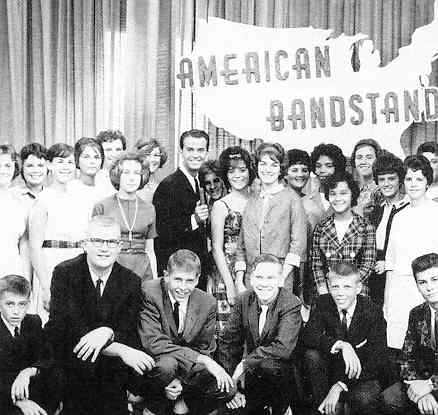
Dick Clark and the American
Bandstand – late 1950s.
(featuring talented local "South Phillie" youth)
and for the man of the family
. . .
The first televised NFL game
(Colts vs. Giants championship
game) – December 28, 1958
An excellent feature
of the new TV culture was the TV evening
news –
which brought the larger
world right into the American
livingroom
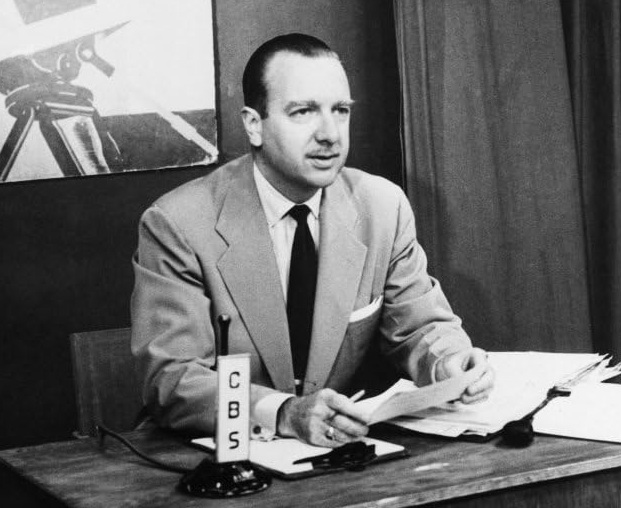
Walter Cronkhite - CBS News and news specials (1950-2009;
anchorman 1962-1981). Considered "the most trusted man
in America"
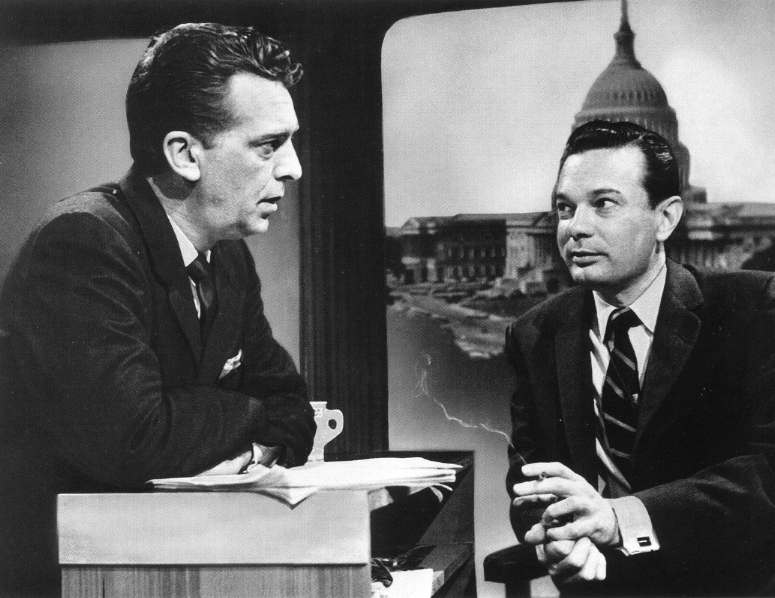
NBC's double-anchor news-team,
Chet Huntley
and David Brinkley – 1956-1970

Go on to the next section:
 Miles
H. Hodges
Miles
H. Hodges

 A swing to the Republican "Right" after the war
 The G.I. Bill
  The booming American economy
  The "Baby Boomers"
  Christian-Capitalist-Constitutional America
  Christian Revival
  The world of television