Harriet Beecher Stowe's Uncle
Tom's Cabin. However, the
publication of Harriet Beecher Stowe's Uncle Tom's Cabin (1851-1852)
would keep the issue in front of the nation, where it would burn American
passions deeply. It depicted the
suffering and bravery of American slaves so touchingly that the idea of ever
sending Blacks that escaped Southern slavery back to the South became
virtually unthinkable to a Northerner, thus outraging the South because of the
North's unwillingness to obey the law (the Fugitive Slave Act of 1850).
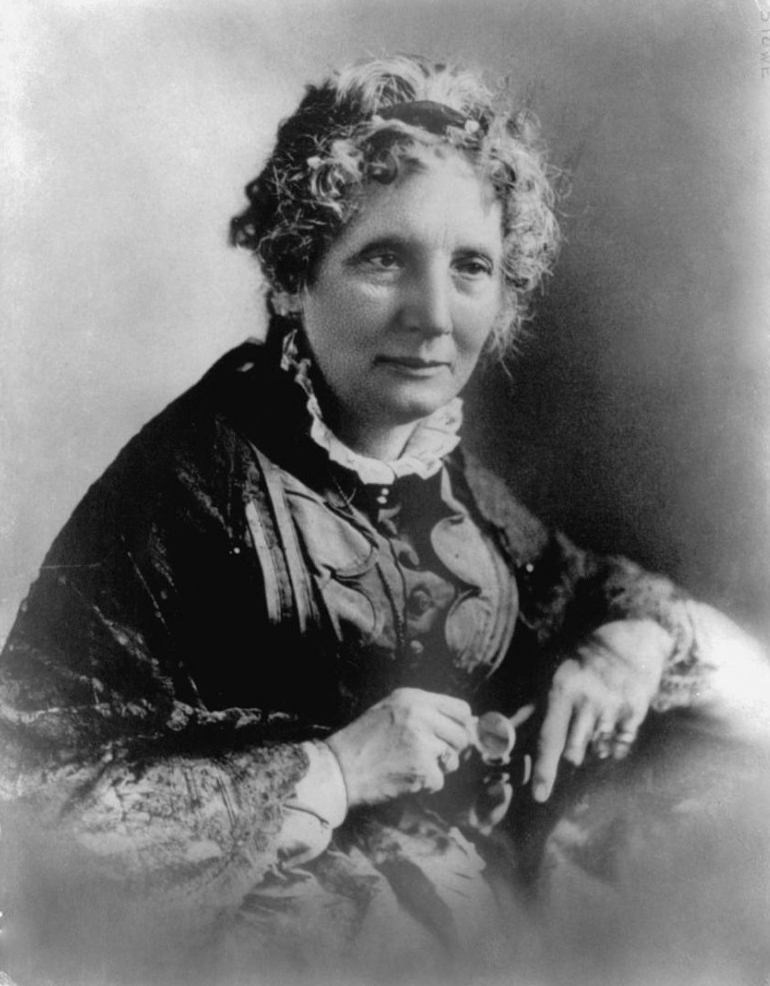
Harriet Beecher Stowe – Author of Uncle Tom's Cabin (1852)
It sold 300,000 copies in the first year of its publication alone
... and ended any idea of a serious enforcement
of the return of escaped slaves to the South
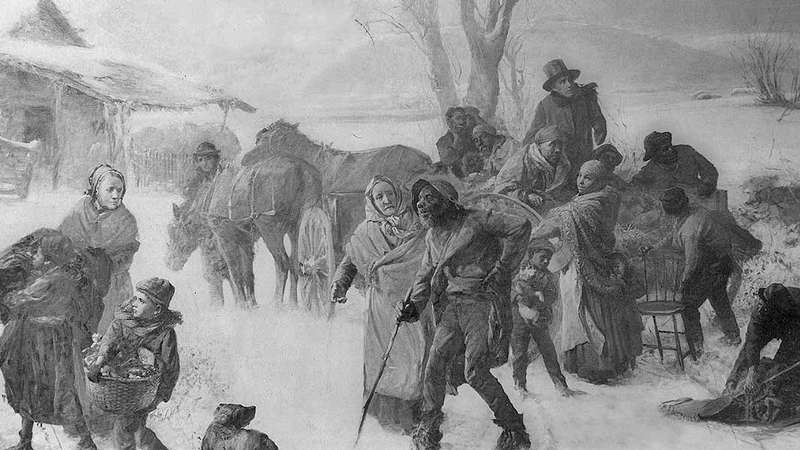
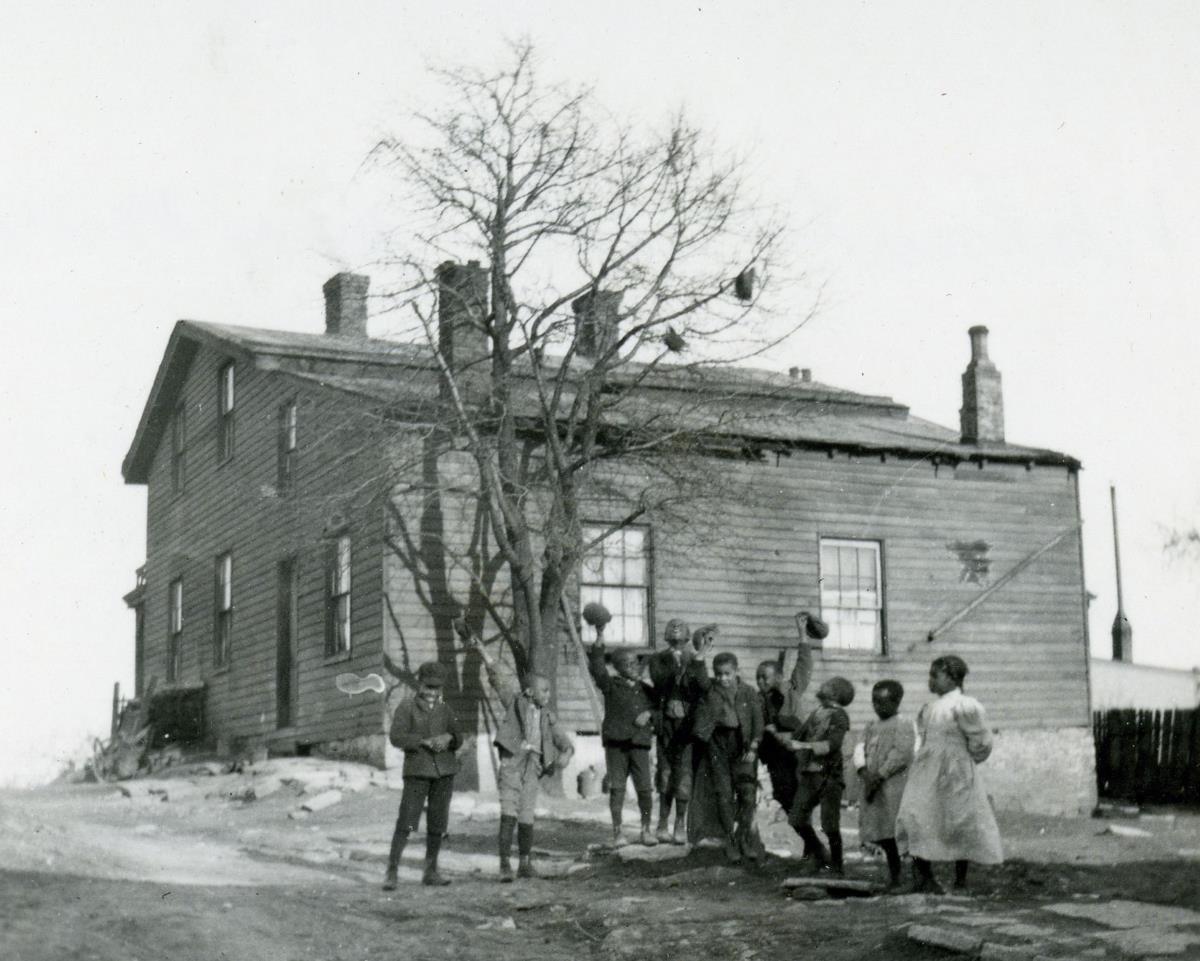
The "Underground Railroad." Then to infuriate the South even more, rumors
began to grow about a secret program that was designed to help Blacks escape to
the North, or even to Canada. Actually,
it was neither underground nor a railroad but instead a series of safe houses
along a trail of escape which provided support and guidance for those fortunate
enough to break from their bondage. How
extensive it was remained a great mystery, the numbers possibly expanded
greatly – by the South to stress how terrible this violation of their "property
rights" happened to be, and by the North, eager to show how widespread was
the support in the North in the freeing of Southern slaves.
Thus
it was that the spirit of Abolitionism finally took hold widely
of hearts across the North, at the same time that it spurred a growing resolve
throughout the South to simply depart from the Union.
Nebraska – and "Bleeding Kansas."
Things finally came to full violence with the question of what to do
about the fast-developing Western territory of Nebraska – and how it might join
the Union, whether slave or free. This matter was so divisive that it split the
huge Democratic Party into two contending wings (the Whigs had all but disappeared at this
point).
Ultimately
the decision was made (1854) to divide the huge territory into two sections,
Nebraska to the North and Kansas to the South.
They would also repeal the Missouri Compromise which would have
automatically made both states free – and instead, according to the new "compromise,"
let the two new territories themselves decide how they might enter the Union,
slave or free. Again, at the time, this
sounded like a very good idea, letting the locals rather than Washington make
this vital decision. Actually this
decision made the situation worse – far, far worse.
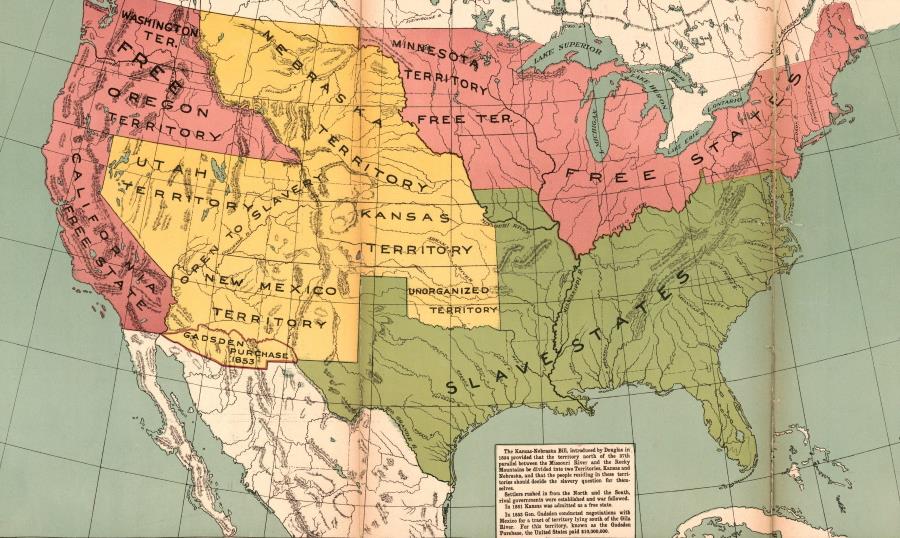
For
the northern portion or the new Nebraska, this decision presented no particular
problem – as it clearly was inhabited by "Free-Soilers" opposed to slavery. But the southern portion or Kansas was
another matter – with the inhabitants in the northern part of that territory
also Free-Soilers, but the inhabitants to the south supportive of the slave
option. Thus the new "compromise"
immediately split Kansas itself into two warring factions – with two
legislatures (one at Lecompton and one at Topeka) and all sorts of militias
supporting one side or the other of the slavery issue (as were almost most
all of the Kansas newspapers). And
Americans began to rush to Kansas to increase the size (and thus vote) of one
side or the other: pro-slavery "Border Ruffians"
and anti-slavery "Jayhawkers."
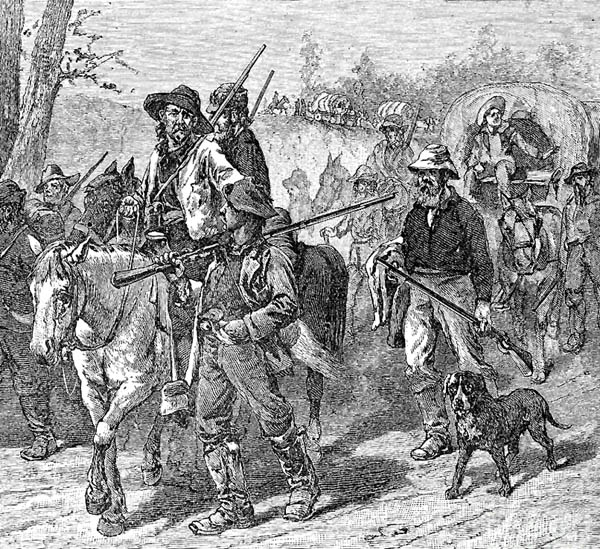
"Border Ruffians" entering Kansas to inflate the pro-slavery vote
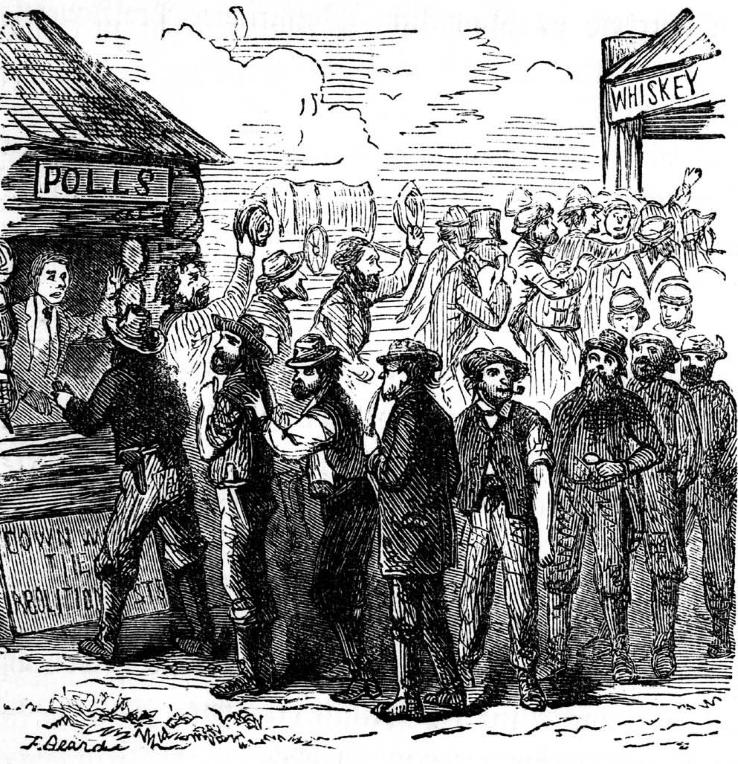
Pro-slavery Missourians voting in the Kansas elections
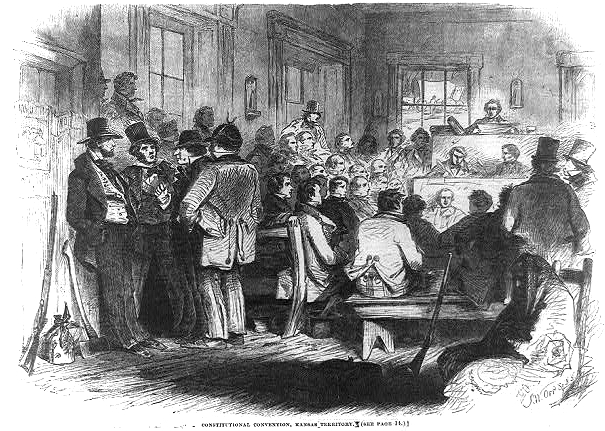
Free-Staters holding their own Constitutional Convention
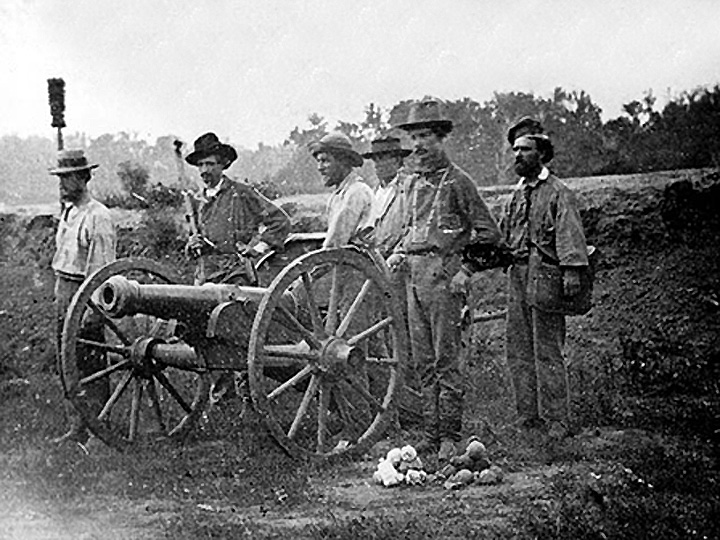
Members of the Kansas Free
State Battery
Kansas State Historical
Society
An
example of how savage this Kansas rivalry became was in the action in 1856
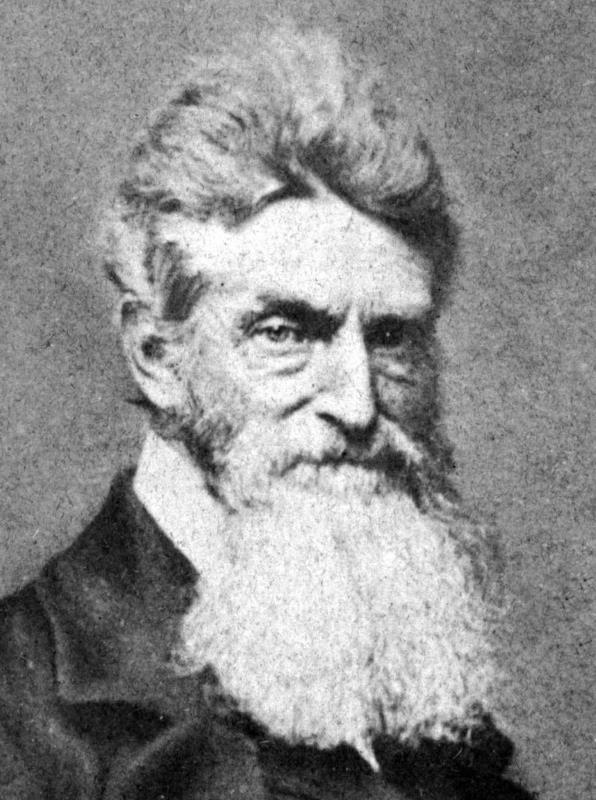
involving John Brown and his family. He
and his sons killed five pro-slavery farmers – in revenge for the
sacking of Lawrence by pro-slavery forces. In return, several hundred pro-slavery forces attacked Brown's
hometown of Osawatomie, killing two of Brown's sons (and others) and sacking
and burning the town.
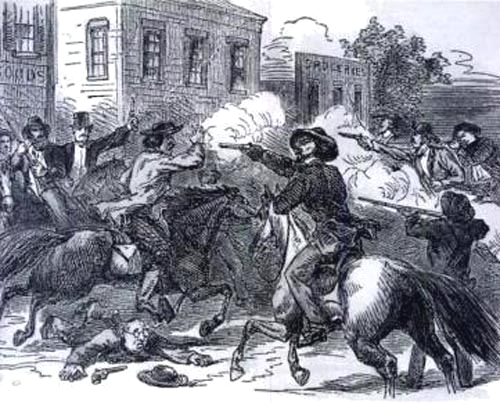
The Sacking of Lawrence
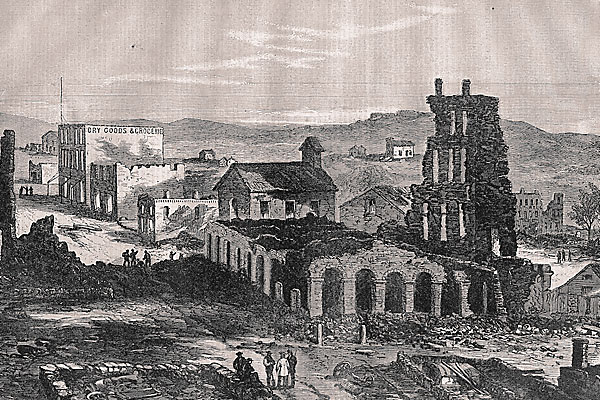 The ruins of the "Free Soil" Hotel in Lawrence
Thus
turning the matter over "democratically" for the citizens of Kansas
themselves to decide merely escalated the problem into full-scale
guerrilla-style warfare. Killing,
looting, burning and ravaging the homes and farms of "Bleeding Kansas" now became
common across the territory.
In
short, by 1856, the American Civil War had already begun in Kansas.
The election of 1856. With the Whig Party gone,
a number of parties – plus factions taking a stand on the slavery issue – took the political
stage. The newly formed Republican Party
(no connection with Jefferson's earlier Republicans, but
forerunners of today's Republicans) basically took up the Whig cause – but
could not get together on which candidate should represent the party in the
presidential election that year.
Ultimately one group nominated General Frémont and another group nominated
Millard Fillmore, former President (1850
1853) when General Taylor, who had been elected
President in 1848, died a year into his presidency.
So also the Democrats found themselves deeply
divided and ended up dropping Pierce and choosing Pennsylvanian James
Buchanan, when Illinois Senator Stephen Douglas finally threw his
vote to Buchanan on the 17th ballot. Buchanan had been away
serving as
American Ambassador to England and therefore had no record one way or
the other
about the deep split tearing at the country.
Voted to office as President in the 1856 election, President Buchanan would try to stay above the
battle – which meant only that the North-South split would deepen as national
leadership tried to look away from the growing problem. 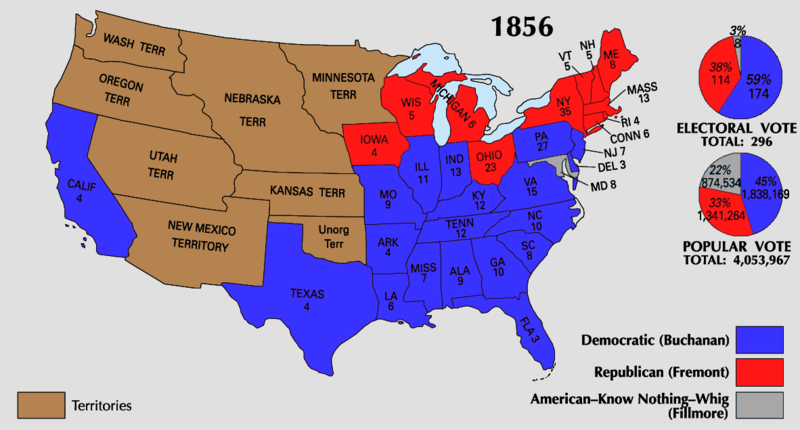
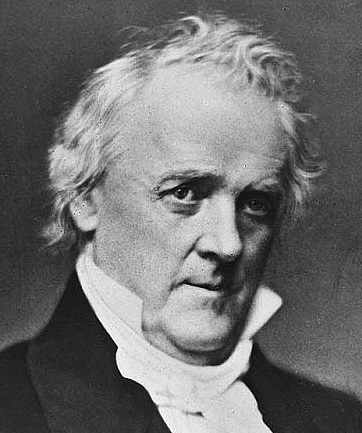
James Buchanan US President
- 1857-1861 (Mathew Brady daguerreotype)
Library of Congress
The Dred Scott Decision of 1857.
Instead, the Supreme Court found itself taking the crisis head on with
its decision concerning the return to a Southern master of a former slave, Dred
Scott. Scott had accompanied his master
to the North, been sold and resold several times – and after a lengthy
residence in the North was being forced to return to the South. Scott ultimately (in his first civil suit in
1846) claimed that he (and his wife and daughter) had earned the right to
freedom as longtime Northern residents.
But after a lengthy process of multiple court hearings on the matter,
the Supreme Court, led by pro-slavery Chief Justice Roger B. Taney, in 1857 ruled in favor of his
latest master John Sanford, claiming that the Constitution was only intended
for Whites and, since slaves were actually property, Congress had no authority
to take property away from anyone – nor also had any authority to grant
citizenship to Blacks ... who were by God's own decree intended to be a race
perpetually in service to the Whites.
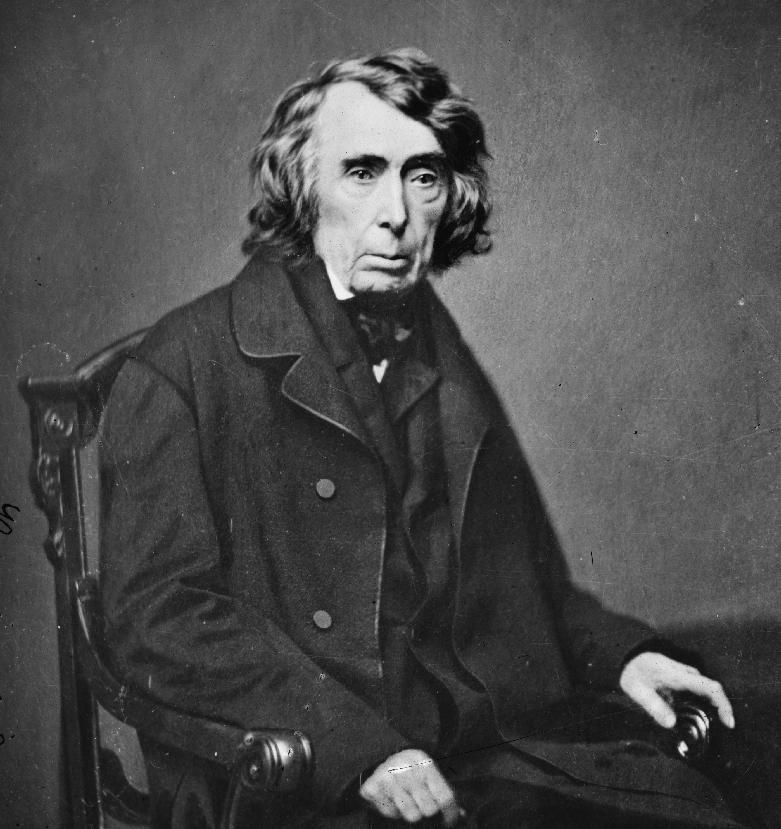
Roger B. Taney – Chief Justice of the
U.S. Supreme Court
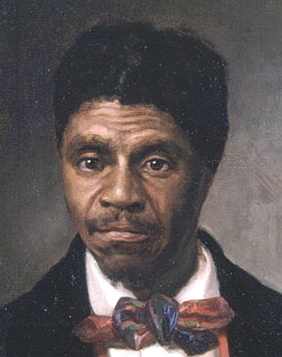
Dred Scott, plaintiff in
the Dred Scott v. Sandford case
painting by Louis Schultze
(1882 – based on an 1857 photo)
Southerners
were elated by the decision, claiming that under Taney's ruling, slavery could not be forbidden
anywhere within the Union, North as well as South. The North on the other hand was furious at
the ruling. In all, Taney's decision did not resolve the
question – but instead only deepened the bitter feelings separating the
American North and South.
It
was also a preview of how the Supreme Court would, from time to time (but with
increasing frequency), take upon itself the task of deciding exactly how the
laws of the nation should be read and understood ... in accordance with the
various justices' ideological makeup, of course.
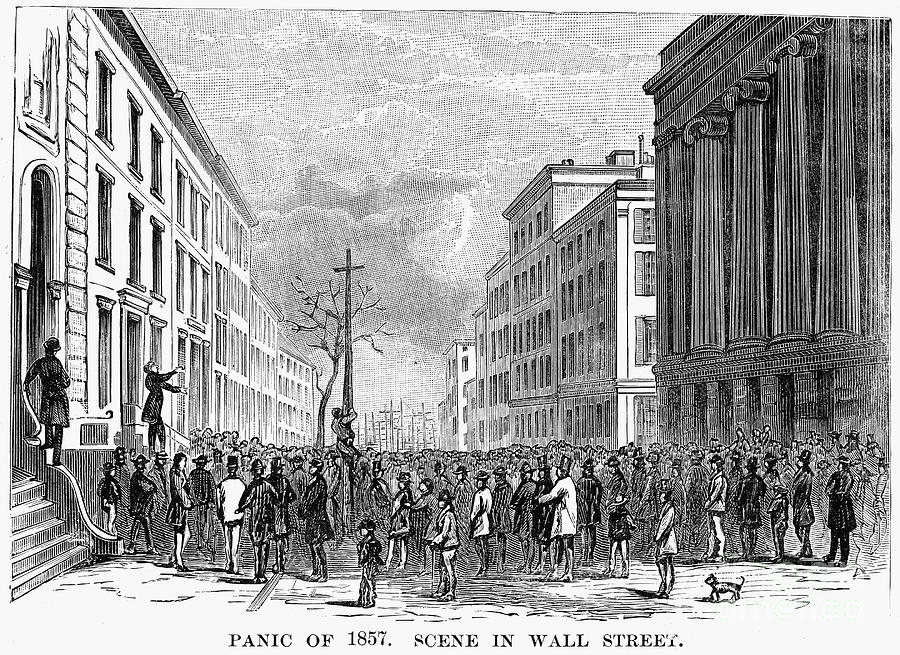
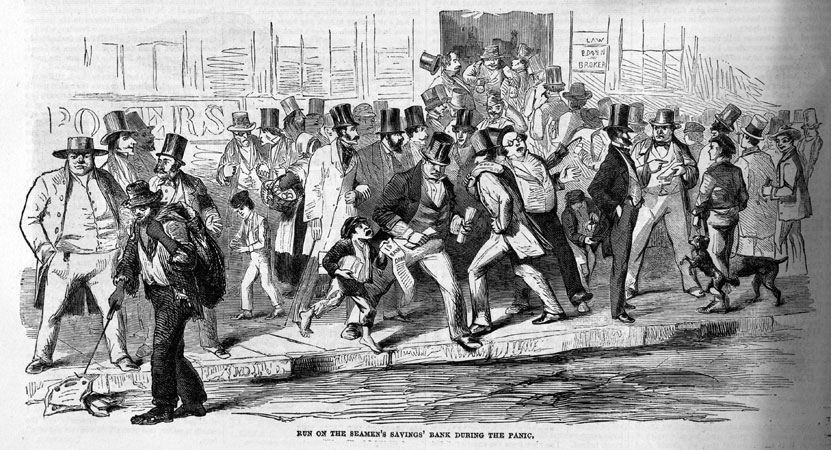
The Panic of 1857. The Dred Scott Decision
also made it clear that the Western states were now to be brought into the
Union as a decision of the people of those states themselves. This in turn meant that fierce battles (like
the one going on in Kansas) would most likely result – something most people
chose to avoid. Consequently, once again
land values in the West collapsed as people backed away from Western land
purchases – leaving private investors and banks holding worthless land titles –
which in turn caused bank panic and collapse of the world of investment. But this crisis hit almost solely in the
North – the South not being really part of the world of financial
speculation. The very fact that the
South escaped this crisis seemed to Southerners to confirm what they already
supposed, namely that the Southern life and culture (slaves and all) was vastly
superior to the Northern way of life – and that they were ready to defend that
life and culture to the death. And
indeed, Southerners would be called on soon to do just that.
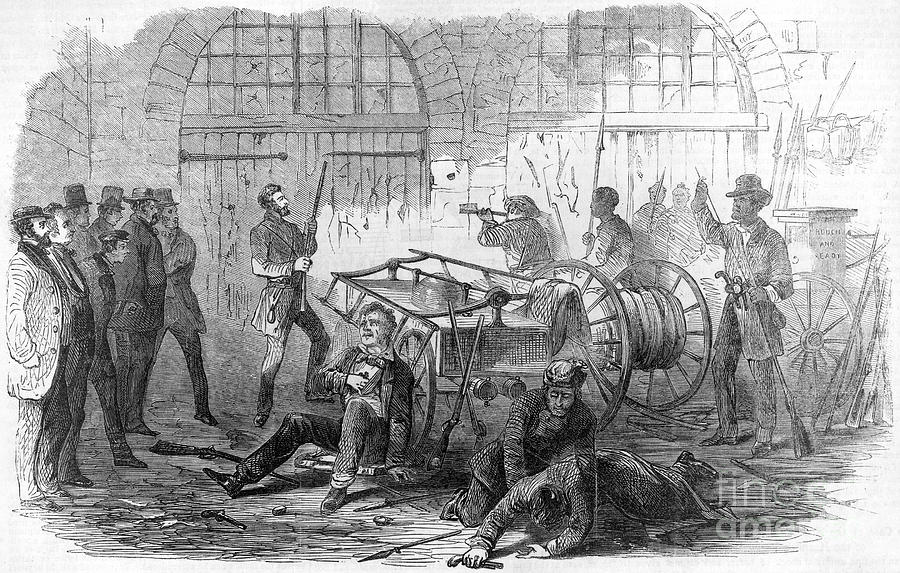
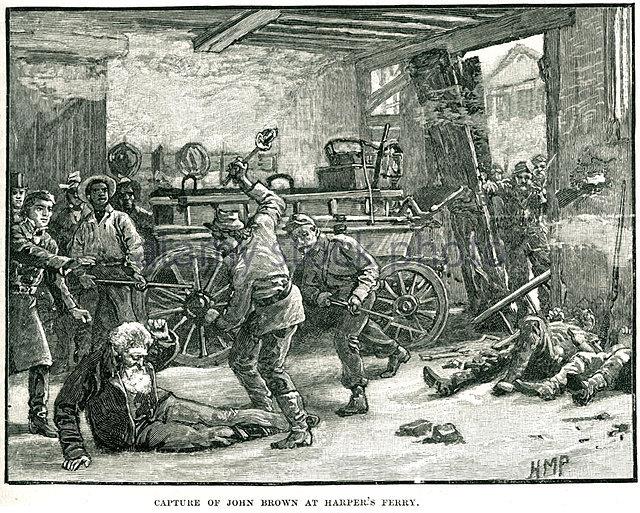
Revolt at Harpers Ferry (October 1859).
Semi-crazy John Brown (and his remaining sons) decided to spark an event
intended to lead to a massive slave uprising in the South – when he and a group
of 20 followers raided the U.S. military depot at Harpers Ferry to grab its
ammunition and supplies. But ultimately
no slave rebellion took place. Instead
U.S. Colonel Robert E. Lee surrounded the Brown
party – killing ten of the group in the process. Brown and four others were tried and executed
for this ill-fated raid. Overall, the
call to the slaves to revolt made Brown the very personification of evil that
Southerners saw in the North. But in the
North, he became something of a hero, serving the greatest of all human causes:
freeing the slaves.
Brown hoped that his seizing of the military arsenal at
Harpers Ferry would inspire a slave revolt across the South
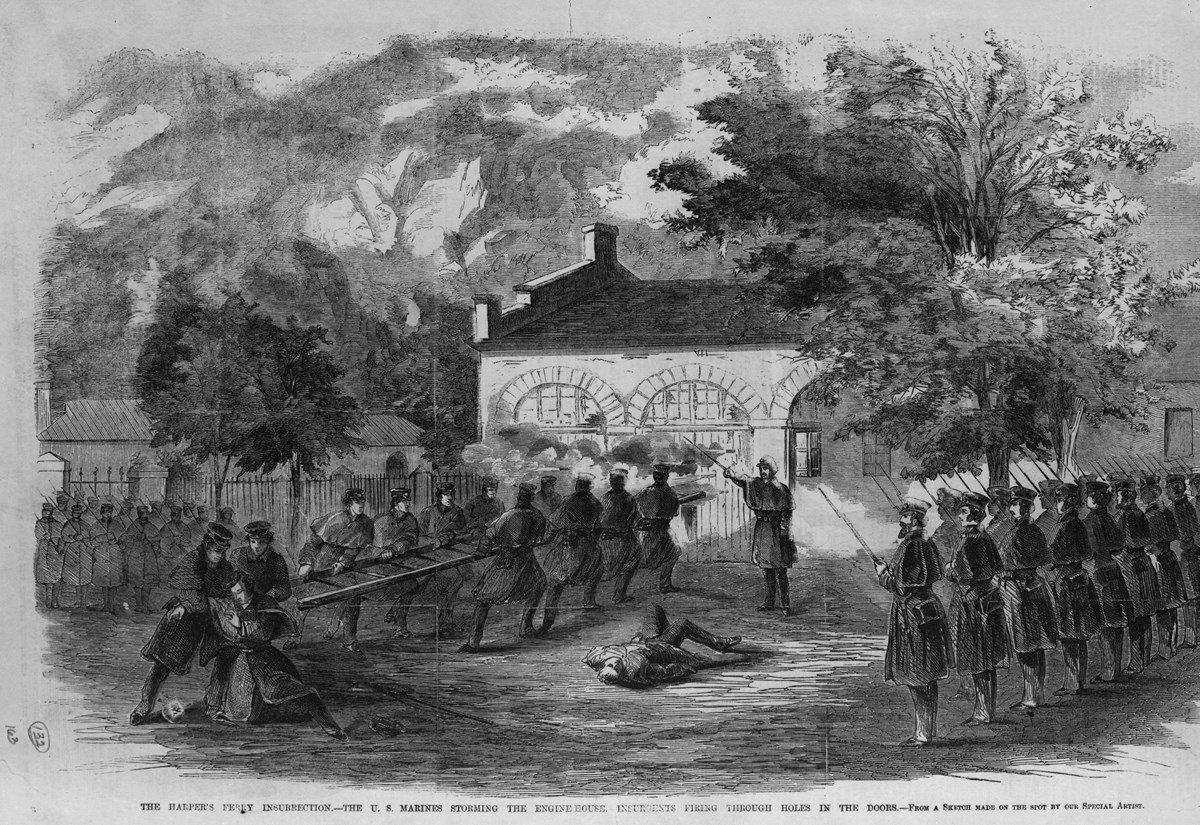
U.S.marines (led by Robert E. Lee) assault Brown's
small group at Harpers Ferry – October 1859
Lincoln's election (1860). The determining event in the move of the South
to full withdrawal from the Union was the election of Abraham Lincoln to the U.S. Presidency in
November of 1860. Two years earlier, in
public debates for the position of Illinois Senator conducted between the
Democratic Party Congressional leader Stephen Douglas and the new Republican Party's
candidate, Abraham Lincoln, the subject had focused
heavily on the issue of slavery – with Lincoln taking the much stronger
position against slavery. Very impressive was the presentation of this "country
boy" Lincoln. However, a Democratic Party
majority in the Illinois Assembly ultimately chose Douglas to represent the
state in the U.S. Senate.
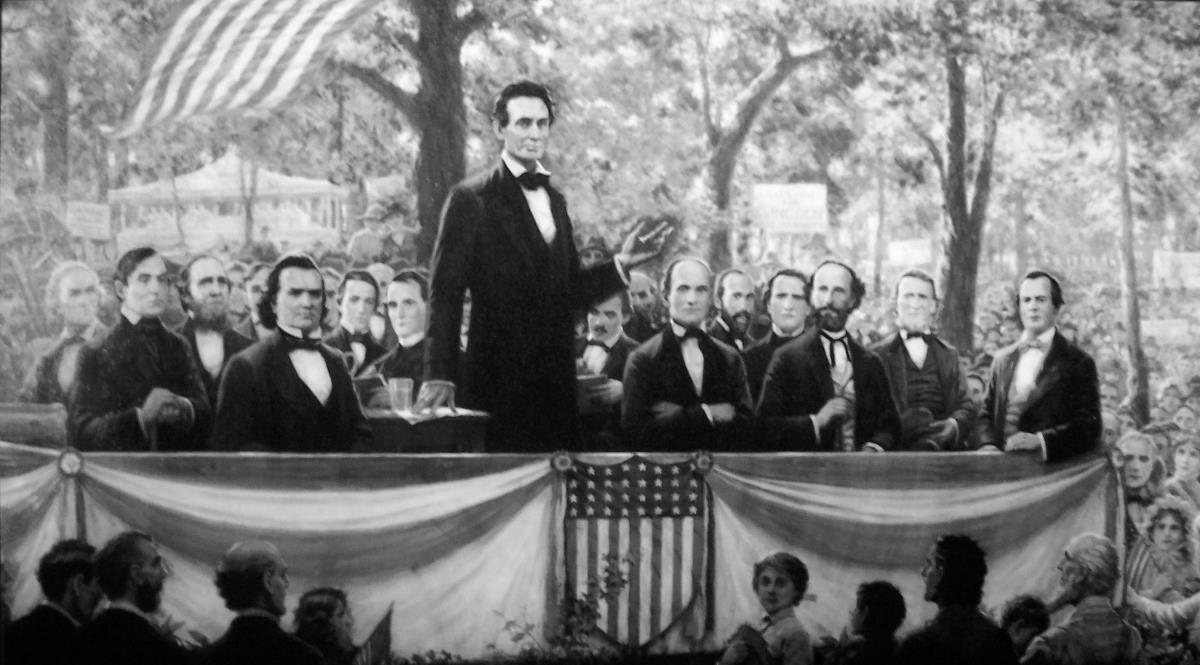
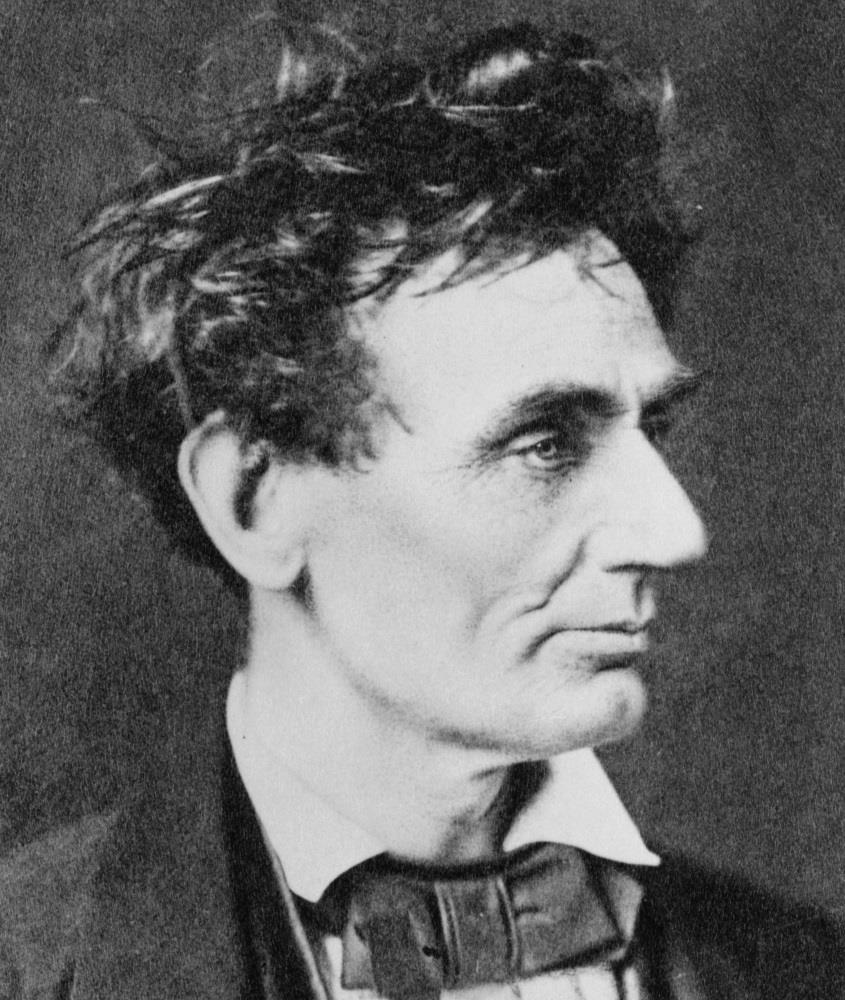
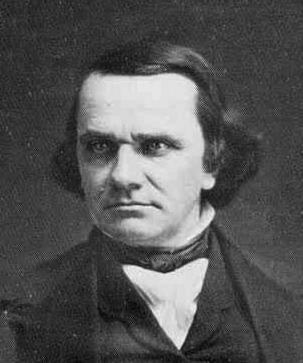 Lincoln and Douglas
 But so
impressive was Lincoln in his speech delivered at
the Cooper Union (New York City, February 1860) in his stand on not just slavery but a wide range of issues
impacting the country, that the Illinois Republicans got fully behind him as
candidate for the U.S. presidency. And
it took only three ballots at the Republican National Convention that May to
put Lincoln ahead of William Seward and Salmon Chase in the selection of that party's
presidential candidate. And in November Lincoln was elected as the nation's
sixteenth President: 1.87 million votes
for Lincoln, 1.38 million for Douglas,
850 thousand for Breckinridge and 589 thousand for a fourth candidate, John
Bell – but an absolute majority of the electoral vote, 180 votes for Lincoln to his opponents' combined
total of 123 votes.
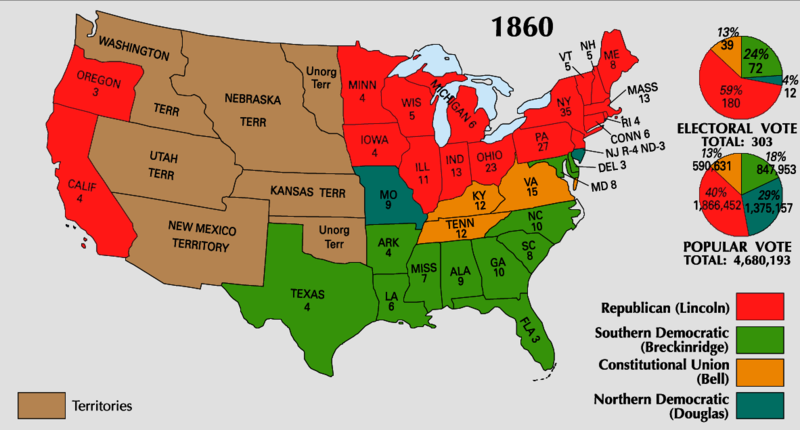
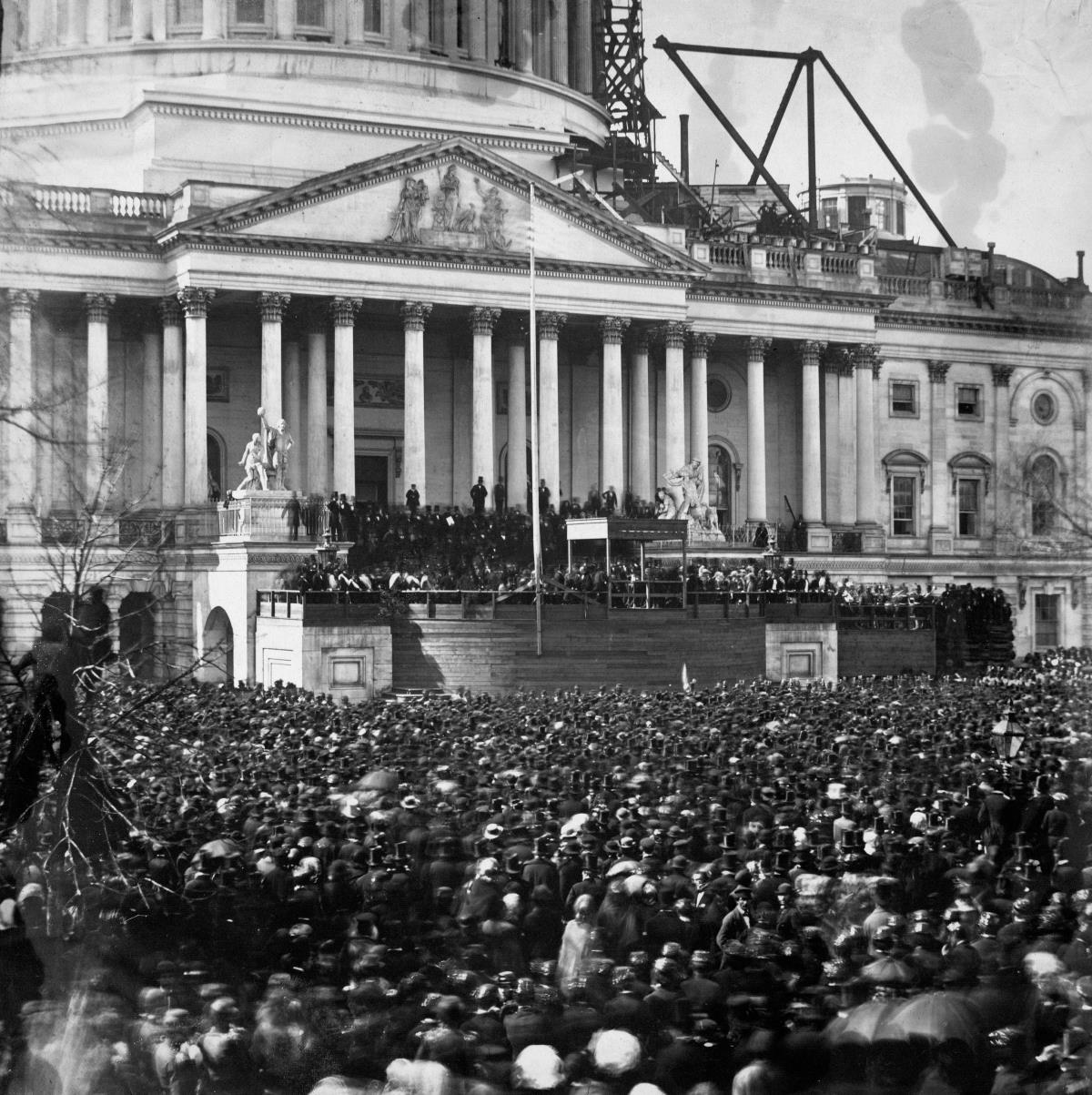
Abraham Lincoln Inauguration
- March 4, 1861
Abraham Lincoln.
This new president was a man shaped by tragedy. He lost his mother at an early age, lived
under the direction of a disapproving father, grew up in an environment of
tough poverty, and would himself lose two of his children to death, one even
while serving in the White House as U.S. president. But he armed himself against depression by a
highly developed sense of humor. He also
possessed a most singular perspective on life, one that seemed to show up in
the stories and tales that constantly shaped his conversations with those
around him.
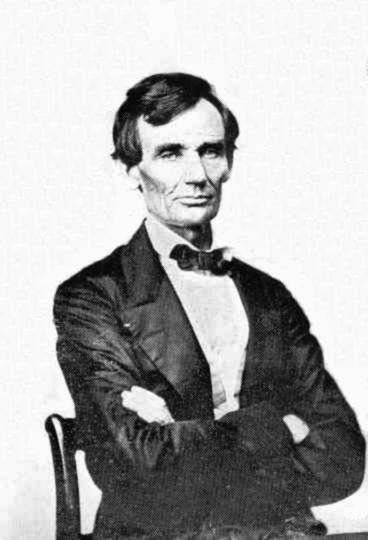
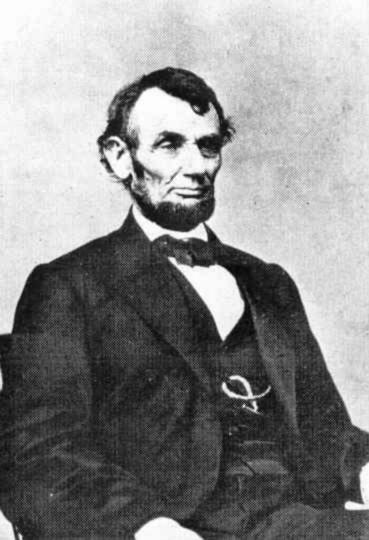 Abraham Lincoln – before
and after beardLibrary of Congress (left)
/ National Archives (right)
Abraham Lincoln – before
and after beardLibrary of Congress (left)
/ National Archives (right)
As
already noted, he served briefly as a captain in the Illinois militia during
the Black Hawk War (1832) ... gaining
some sense of what wars are really all about.
However, his venture into the business world (also 1832) did not bring
him success. He at that point ran for a
position in the Illinois General Assembly, but just did not have the background
to impress voters outside of his own precinct.
But he was a voracious learner, and decided to teach himself the law,
and became an excellent lawyer.
With a second attempt, he was finally elected to
serve on the Illinois state legislature (1834-1846). He then went on to serve as a member of the
Whig Party in the House of Representatives in Congress (1847-1849), though he
had promised to serve in Washington only one term. He thus returned to his law practice in the
Illinois state capital at Springfield, presuming that his political career was
over.
But
his Southern-bred aristocrat (Kentucky) and highly strong-willed wife, Mary
Todd, had plans for him other than his political retirement! But he was also touched deeply by the slavery issue – and what it was doing
to the country – as the nation fought over the Kansas-Nebraska Act. And thus in 1854 and then again in 1858 he
found himself running for the position of U.S. Senator as an Illinois candidate
of the newly formed Republican Party.
Indeed, in the Republican Party's 1856 national convention, he came in a
close second for the nomination as the party's vice-presidential
candidate. And thus it was that his
national career got up and running.
Now,
as newly elected U.S. President, Lincoln had facing him the deepest
crisis the country had experienced since its revolt against King George a
century earlier. Many Americans wondered
how exactly Lincoln would face this explosive
issue of slavery and the probable breakup of
the Union, issues that so many before him had done everything possible to
avoid.
But Lincoln was a man of incredible
talent, a talent needed greatly by the nation at this point. Lincoln was steady, strong and very
wise in personal character. From the
very start, the wisdom of Lincoln was evidenced in the way he
shaped his new presidential administration, by bringing onto his cabinet his
strongest political rivals[1] – such as William Seward, Salmon Chase and Edward Bates. He knew the importance of uniting all the
major pro-Union leaders, in order to take on successfully the huge challenges
ahead.
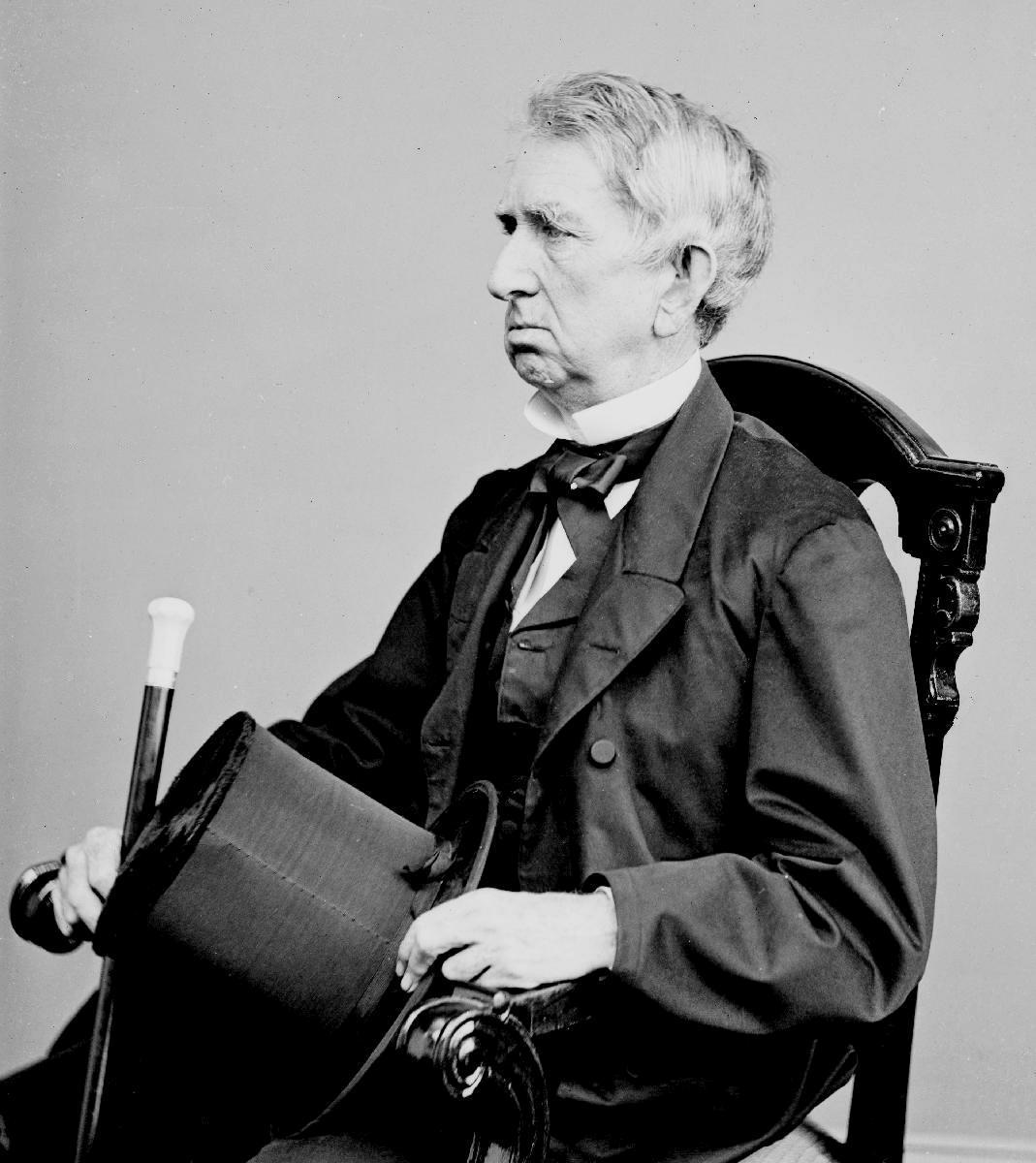
William H. Seward – photo by Mathew Brady
Secretary of State of the
United States (1861-1869)
Governor of New York
(1839-1842)
United States Senator from
New York (1849-1861)
Library of Congress
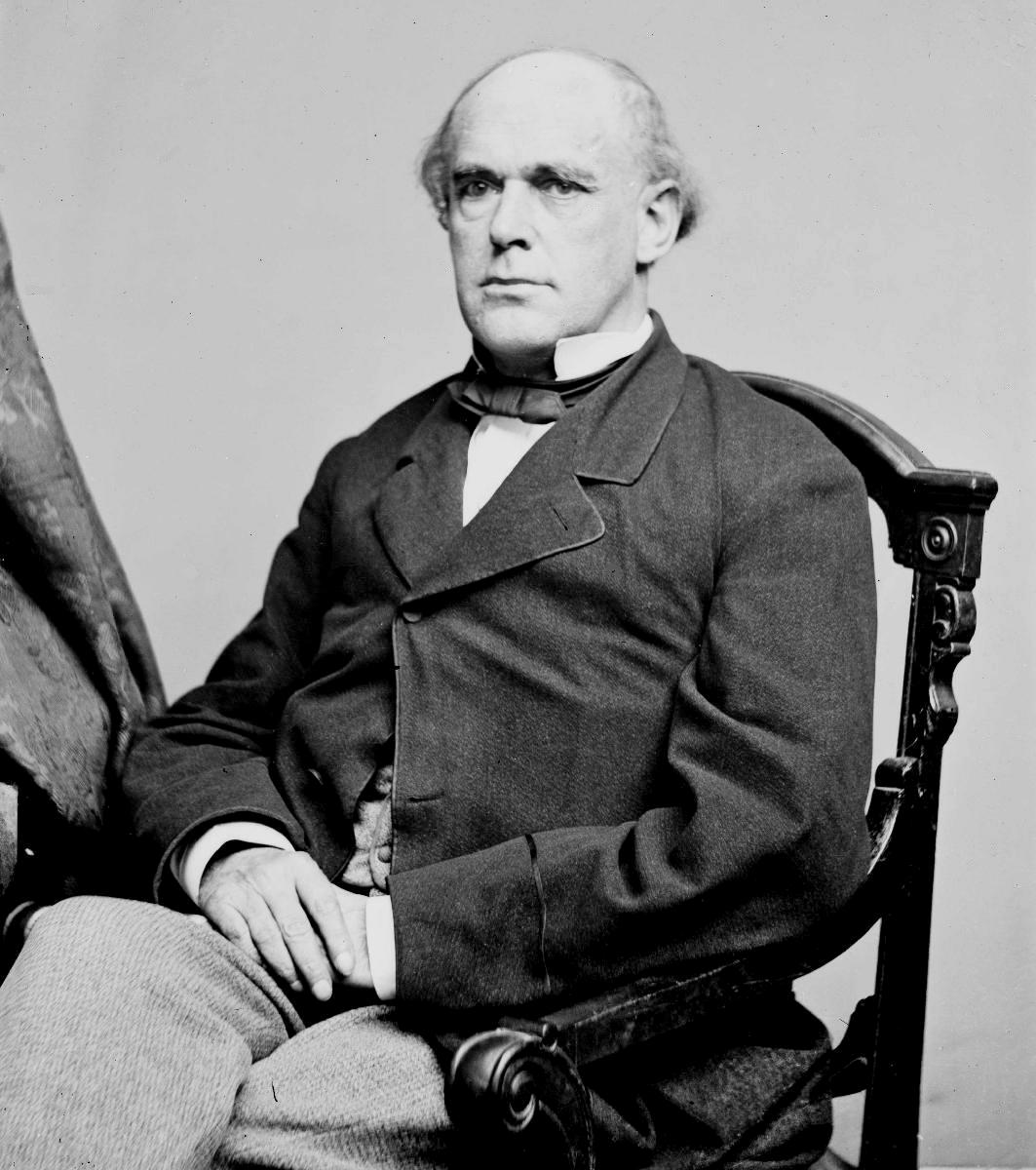
Salmon Portland
Chase
United States Secretary
of the Treasury (1861-1864)
United States Senator from
Ohio (1849-1855)
Governor of Ohio
(1856-1860)
6th Chief Justice of the
United States (1864-1873)
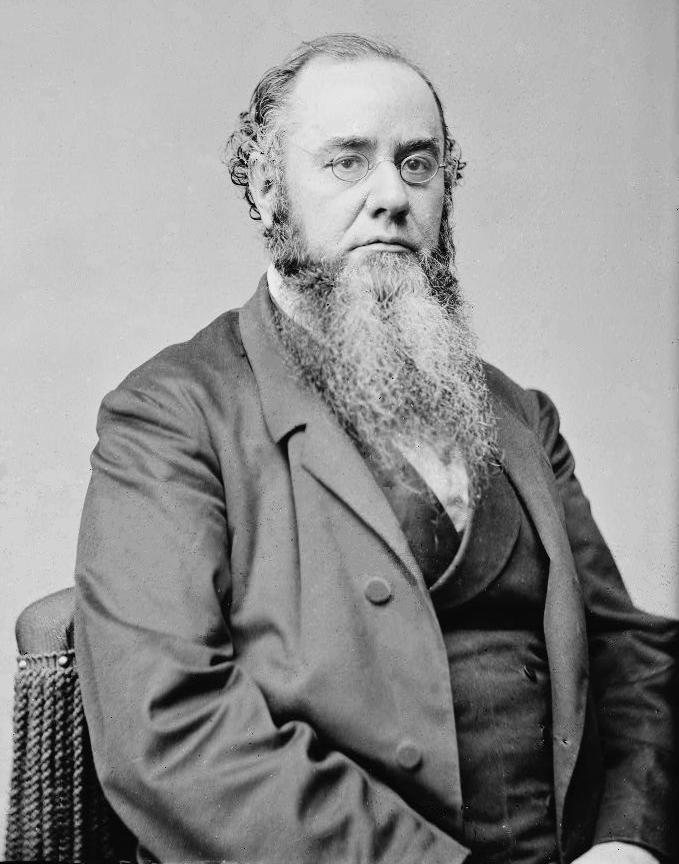
Edwin McMasters
Stanton
United States Secretary
of War (1862-1868)
United States Attorney General
(1860-1861)
Library of Congress
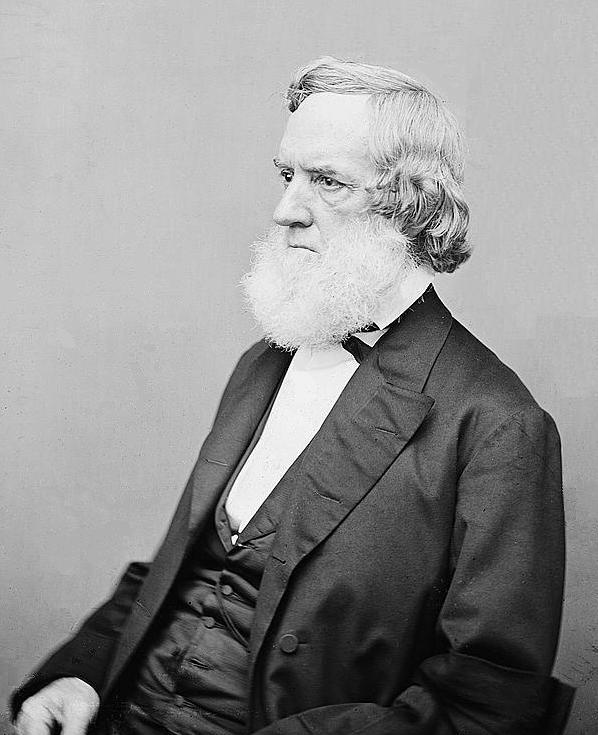
Gideon Welles
United States Secretary
of the Navy (1861-1869)
Library of Congress
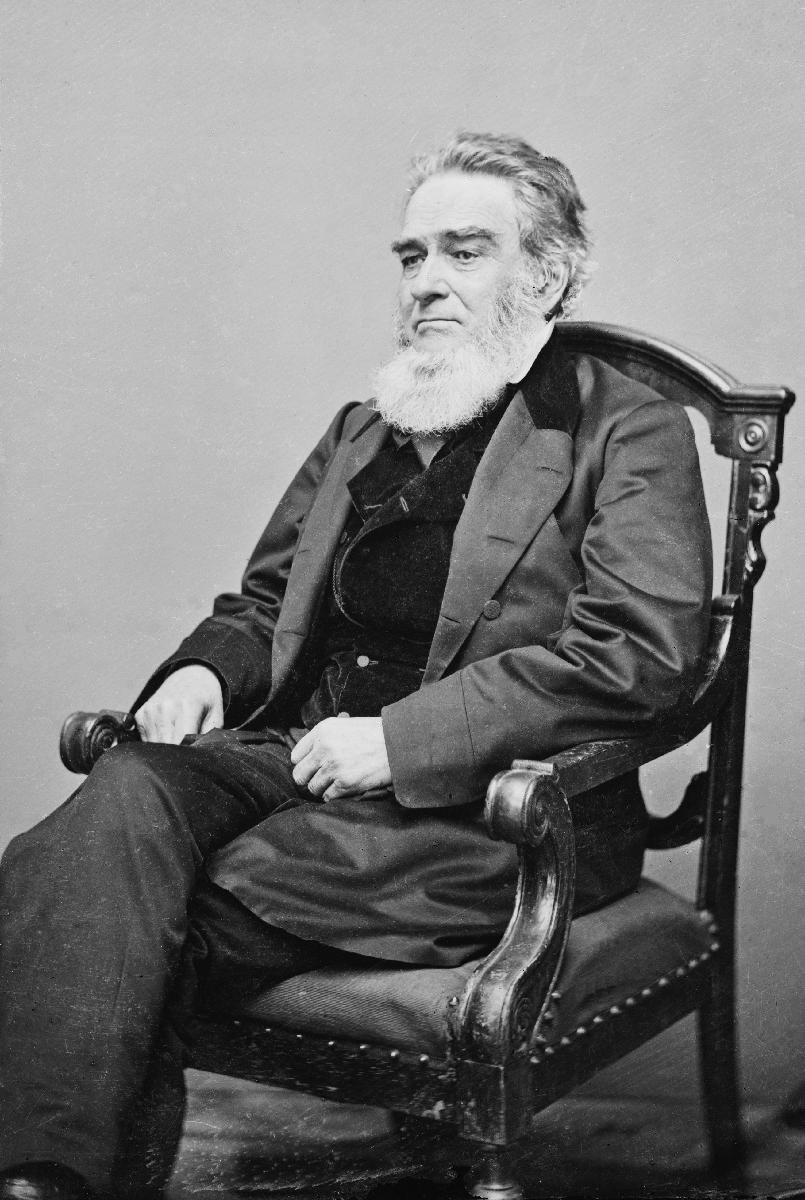
Edward Bates
US Attorney General
(1861-1864)
Library of CongressAt first these political dignitaries tended to be
contemptuous of him and his "country boy" ways![2] But gradually they all (except Chase, whom Lincoln finally moved onward in appointing him Chief
Justice of the Supreme Court) came to see Lincoln's true political genius, and moved to full
support of him as their president.
[1] Doris Kearns Goodwin termed it A Team of Rivals in making it
the title of her Simon & Schuster 2005 Pulitzer Prize-winning book.
[2] Seward,
supposing Lincoln to
be something of a naïve country boy, at first proposed to Lincoln to
have him turn all real powers of the presidency over to Seward
himself. And then Seward
proposed a bizarre foreign policy in dealing with the South, all of which Lincoln
politely ignored as he moved steadily ahead with his own policies for dealing
with the rising crisis.
Go on to the next section:
 Miles
H. Hodges
Miles
H. Hodges

 The deep North-South cultural split
 Events deepening further the North-South split
  Abraham Lincoln