America was not founded outside of some kind of larger social
context. In fact, quite the opposite was
the case. Although America seemed to
have been built "from scratch" beginning in the early 1600s, it did
so with a full understanding of the cultural legacy it had inherited from the
motherland back in England, and England's own larger European context. In fact, it was deeply motivated by the
desire to build in America a much purer form of exactly that very social
inheritance, especially in the setting up of New England.
That
social inheritance was not universal, but was – in the setting of the larger
world and its many different civilizations – quite unique. And that very uniqueness is what we will be
looking at in this chapter.
The heart of the "Western" social ethic. Westerners, unless they have lived and worked
substantially in other non-Western cultures, tend to suppose that what they
understand to be true about life is something of a "universal" for
all humankind. This is hardly the
case. In fact, this naïve supposition
has been the source of major problems for Westerners – and for America in
particular, ever since it took leadership of Western civilization after World
War Two.
Because
of its development via the Jewish, Greek and Roman experience –
synthesized beautifully in the Christian religion – Westerners see life as
shaped by deep personal involvement of adventuresome individuals. Western individualism is in fact a key component
of Western civilization, found in everything from capitalism, to Darwinism, to Humanism, to modern science, to
democracy (and much more). But it is
summed up most perfectly in Christianity, which, through the teachings and
example of Jesus, makes the bold assumption that
we all are potentially sons and daughters of God Himself, divinely empowered
individuals able to take on life personally because of this empowerment. There are huge moral and spiritual
responsibilities placed on the shoulders of those who rise to this
understanding, which could be (even should be) any of us. But we have the wise guidance of holy
scripture to help us make the right choices in taking up these personal
responsibilities freely.
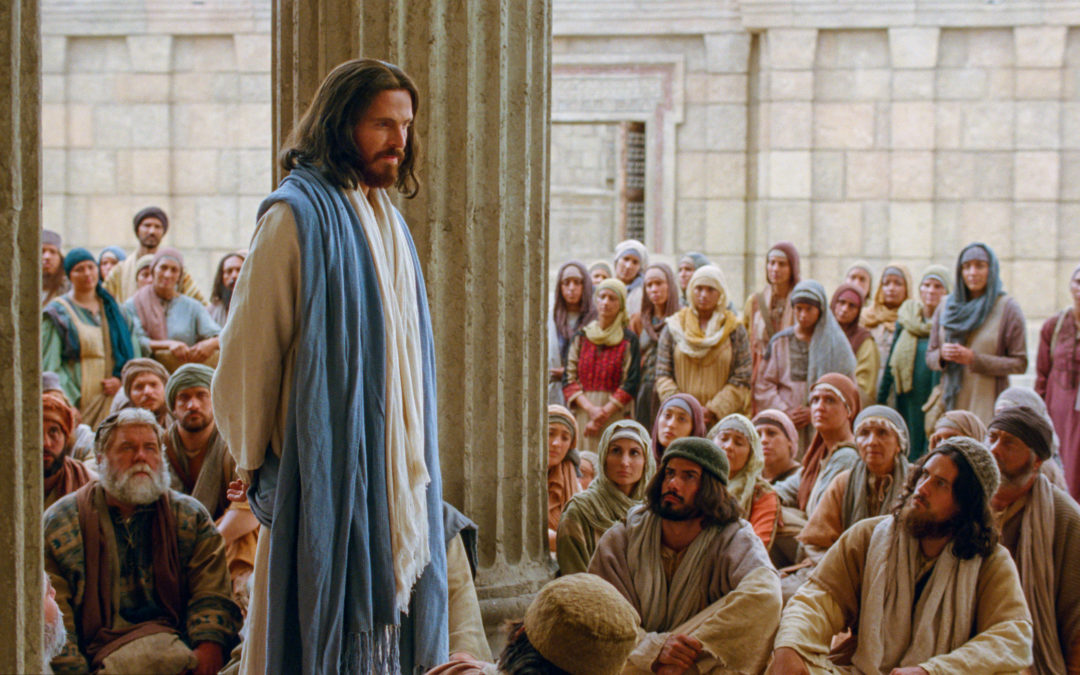
Jesus teaching the true "way" in the Temple courts
John 7:14-53
Of
course this understanding allows the option of not following such divine
guidance, because Westerners are not God's puppet but instead fully free
agents. Indeed it is God Himself who
ordained our human nature, wanting us to choose freely to join him in
celebrating His awesome Creation. If we
did not have the option not to do so, it would cheat the decision to
actually do so of its real significance.
Westerners, especially recent scientists such as Schrödinger, Bohr, Polkinghorne, etc. in fact have made
it quite clear that human life exists in the midst of this universal vastness
specifically for this purpose: to join
the Creator of it all in celebrating with Him (Einstein's "Herr Gott" or "Lord
God") the beauty of it all. As far
as we know, we are the only part of Creation that is fully aware of its own
existence! This indeed is the very
purpose of quite conscious or "awake" human life itself.
And
thus it is that we freely design societies that allow the people themselves to
use this special human talent to observe, to learn, to design even their own
lives, as they themselves personally choose to do so. Personal "freedom" that allows this
dynamic to flourish thus comes to be a Western value of supreme
importance.
Of course, freedom raises its own problems, because
there is at the same time a primal instinct in humans to want to control the
world we live in,to remove its obstacles, its complexities, in order to make it
more understandable, more predictable, more manageable. And that includes the world of others, because
other people can become quite problematic for us. Dominance, even dictatorship, is a possible
result of such human impulse. But
supposedly, this is why we have Scripture to warn us, to guide us, to keep us
within workable social boundaries.
Otherwise either pure chaos or pure dictatorship would come of the full
use of absolute human freedom. And there
are plenty of examples of this in human history, especially in Western
history. And some of these are quite
recent, in fact even very operative among us today.
Other cultures have gone at life in ways quite different from this
Western pattern. For instance, Hinduism, which has long dominated
the Indian subcontinent, sees life resulting from what we Westerners might term
"fate." All of life is shaped
by a cumulative record of actions, good and bad, that result from our behavior.
In fact it is this record that shapes our destiny, not just in this life but in
lives to come – just as the present has been shaped by the record of human
action in previous lives. And how do we
come to understand the source of our personal fate? It is clearly shaped by the social position
we found ourselves born to. We take on a
new life as members of a particular sub-caste or jati (India has
thousands of just such different social groups or jatis), a community shaped by
very clear rules that will determine our social record (and how well or poorly
we perform accordingly), and whether we advance or retreat over the flow of
many rebirths to a higher or lower social status.
This
is a quite compelling social system.
There is no room for personal negotiation, no opportunity for an
individual to come up against some very serious cosmic judgments that lie
beyond his or her control. You must obey,
or you suffer.
Interestingly
you can build a very strong social order on just such an approach to life. The rules of Hinduism are so fixed that Indian
society needs no dictator to make the whole thing work. Social responsibility is completely that of
the individual Hindu – to obey and prosper – or otherwise suffer, if not in
this life at least in the lives to come.
When
Americans look at India, they see "democracy" in action, or at least
that is what they think they are seeing.
India indeed has governing institutions quite familiar to Westerners –
part of the British inheritance, which Gandhi, the "father" of
modern India, himself disliked intensely!
He himself as a young man tried very hard to become "English,"
to escape the fate of being Hindu. But
he found that his brown skin was very much a problem in this endeavor to enter
fully (in high social standing) in English society. He eventually turned bitterly against things
English, but could not bring himself to support the Indian caste system on
which Indian society rested.
In
the end, India came under the industrial modernizer Nehru (and his family) and
India managed to move into a world that accepted some of the Western legacy, while
keeping the Hindu legacy still intact.
Tragically however, it took the slaughter of hundreds of thousands of
Indians (including Gandhi himself) to make the
transition (1947-1948). But India seems to enjoy a quite workable system today.
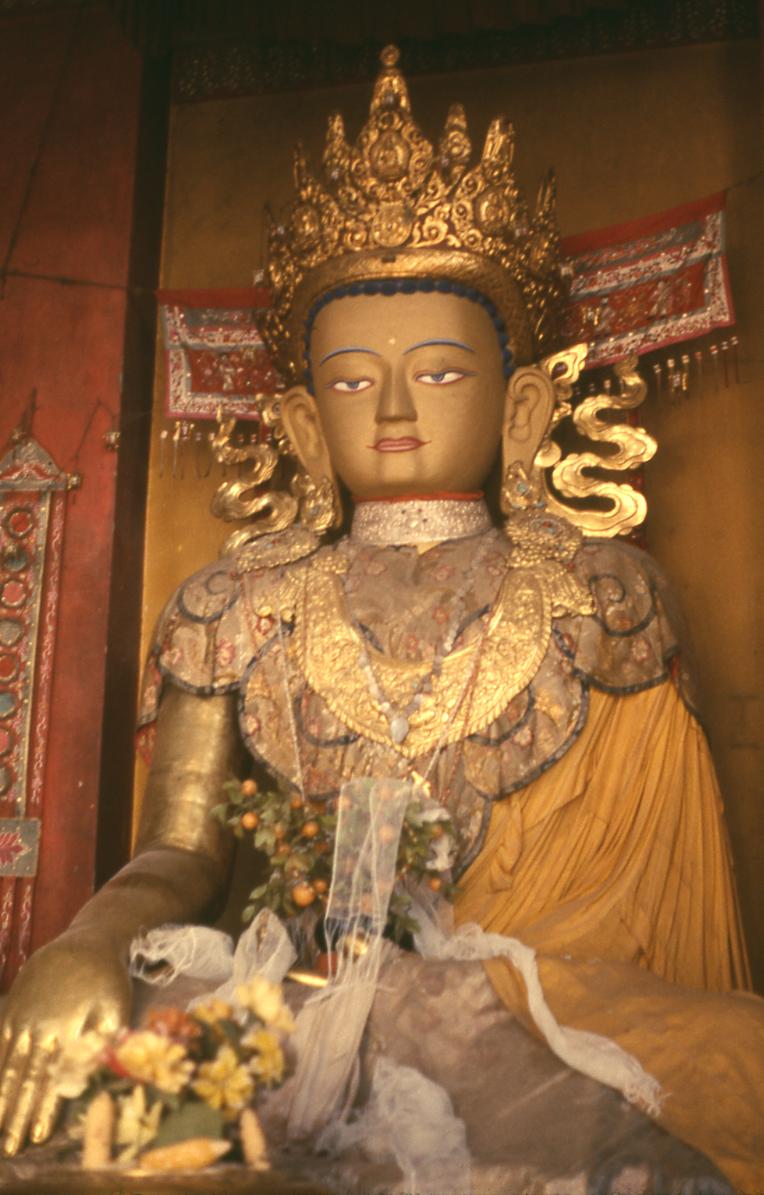
Buddhism was born in India centuries before even Christ entered
the picture, as something of a reaction to the inflexible social restrictions
of Hinduism. Buddha, as an Indian prince-turned-guru
(teacher or prophet), tried to create a social system that would be fairer to
those who suffered the most socially, economically and politically from the
rigidness of the Hindu system. He failed
in this socio-political enterprise.
However he did end up discovering a way of escaping the rigid Indian
caste system, by simply quieting, even deadening, one's concerns over life's
many obstacles. He discovered that a
deep spiritual passivity would not only remove the frustrations of this life,
but in letting go of the hold of the Hindu social ethic, offer even freedom
from the problem of having to be reborn, of having to have another go at life
in order to improve a person's place in the scheme of life! No more rebirths meant freedom or Nirvana. But Buddha's Nirvana was a freedom that
resulted not from activity (Western style) but from passivity.
For
a while (several centuries) Buddhism spread widely across
India. But theological splits within the
religious community, plus the determination of the Hindu priests or Brahmans to
retake control of Indian life slowly drove Buddhism from its homeland in
India. But by then it had spread
eastward into Southeast Asia (Burma, Thailand, Cambodia, Vietnam, etc.), into Nepal and Tibet,
and ultimately into China, Korea and Japan.
Buddhism provided spiritual comfort
to the masses of farmers or peasants across the land as they dealt with the
many challenges of nature, of insects, disease, floods, droughts, and raiders
and plunderers, all of which so often made life very difficult. This tendency toward passivity also made it
easier for certain warlords to take command over their region, some even
becoming emperors, rulers able to offer protection against the larger threats
to local life. And out of this
arrangement, life in Asia could take on civilized ways, as long as emperors
were able to carry off their responsibilities and as long as the challenges did
not become overwhelming (which they could indeed become from time to time).
Democracy
was not what the people wanted ... or even understood. They simply expected that those that took
responsibility for life's larger issues (ones that Buddhism could not take on
personally) would do their job. And if
so, then Heaven itself would bless the people and the land. They did not ask to be part of the decisional
structure. That was the role of the
rulers. But they did have their
expectations that their world would be served wisely and well by those in
charge.
Basically this is what guides China today. This is also what Johnson was up against in Vietnam in the 1960s when he tried to encourage the
South Vietnamese to take up the responsibilities of democracy, democracy
conducted in the same manner that Americans supposedly governed their
lives. But Johnson was working entirely outside of the Asian
(largely Buddhist) social context, and had no idea at the time
of how problematic that would be for him and his grand plans. For instance, when in the early 1960s Buddhist monks took to the streets to protest against
outside intrusions into their culture – one monk even burning himself to death
– they were not clamoring for democracy, nor for Communism. They just wanted everyone to go away and let
them get back to the kind of life they well understood.
Islam is a first-cousin of Christianity, but forged out of a very
different social metal than the deeply Westernized Christianity.Muhammad was completely fascinated by
Christianity, and thought of himself as actually someone operating along the
lines of the Judeo-Christian prophets.
But he was Semitic in mentality, meaning, he saw life as a tightly
structured social realm. Social
authority was necessarily very strict (the desert environment in which he lived
offered little room for social error), and very hierarchical. In fact, Islam conveys the meaning not of
freedom, but of submission, submission to those standing in authority above
you. A son obeyed his father, a father
obeyed his clan chief, who in turn obeyed his prince, who in turn obeyed
God. And there was also a strong element
of religious authority in the mix. In
fact, Muhammad's successors (caliphs)
carried in their all-important political-social governance both secular and
theological authority.
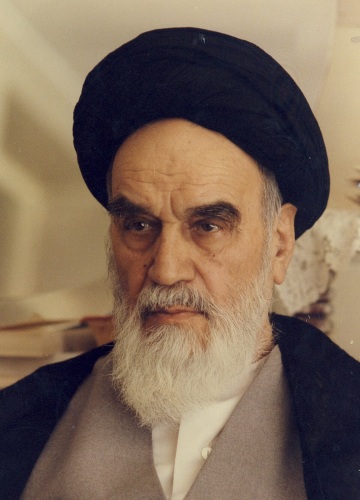
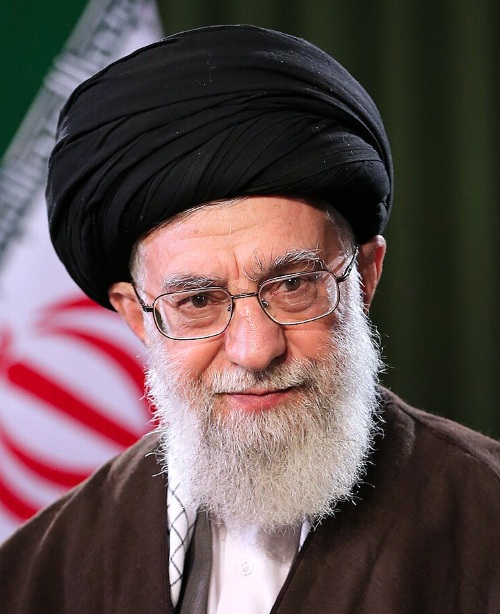
Ruhollah Khomeini (1979-1989) / Ali Khamenei (1989-2026)
Thus
to a true Muslim, all this talk of Westerners about personal freedom seems to
derive from Satan himself, for such freedom would, in the thinking of a typical
Muslim, be entirely disruptive of the Muslim social order. Indeed, the efforts of Westerners to get the
Islamic world to take on Western democratic ways is about as appealing to "true"
Muslims as, for instance, Communism is to most Americans. It's just not going to happen. The Muslim world has its own ways of
governance – patterns established long ago – and still dictated by the commands
of the Qur'an (Islam’s holy book), a grand work derived from the supposedly
divinely-inspired pronouncements of Muhammad – and thus not
negotiable! Period.

 Miles
H. Hodges
Miles
H. Hodges

 The heart of the "Western" social ethic
 The Hindu social ethic
  Buddhist Asia
  Islam
Islam