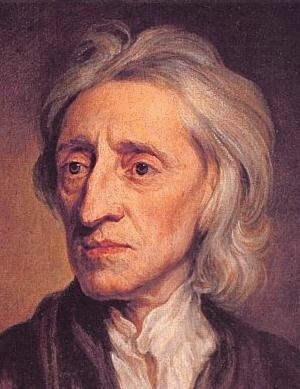
But England's Puritan Commonwealth, under the
strict rule of Oliver Cromwell and his powerful Puritan army, did not find its way
into the hearts of the majority of the English.
Thus also failing to find a potentially popular leader after Cromwell died in 1658 (his son was
proving to be a big disappointment), the decision was finally made by
Parliament in 1660 to call the Stuarts from exile – and turn the crown over to
Charles I's son, Charles II. Thus the
Stuart monarchy was restored in England (the "Restoration").
But England's Puritan Commonwealth, under the
strict rule of Oliver Cromwell and his powerful Puritan army, did not find its way
into the hearts of the majority of the English.
Thus also failing to find a potentially popular leader after Cromwell died in 1658 (his son was
proving to be a big disappointment), the decision was finally made by
Parliament in 1660 to call the Stuarts from exile – and turn the crown over to
Charles I's son, Charles II. Thus the
Stuart monarchy was restored in England (the "Restoration").
But
the years of parliamentary rule during the Commonwealth had changed
considerably the rules of English politics – so much so that the King and his
Tory supporters had to proceed carefully in the presence of the strongly Whig
Members of Parliament. The party of Whigs, although no longer Puritans by
spiritual inclination, were nonetheless certainly Puritan offspring in terms of their
quite post-feudal attitudes about government.2
 Charles II however was careful to watch his step in
dealing with the Whigs – and managed to conduct a fairly successful
reign as English (and Scottish) King.
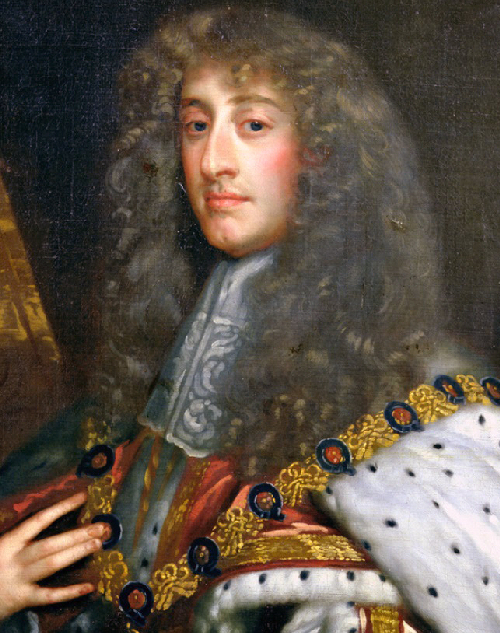
But his brother James II, who took over at Charles' death in 1685 – was
not so wise. He got caught up in the
trendy fashion set by French King Louis XIV, who not only reigned over the most
glamorous court in all of Europe, but also set the example of what truly
autocratic rule should look like. Trying
to imitate that dictatorial style of government in England would ultimately
force James II's expulsion from his throne in 1689. Subsequently the Protestant Dutch governor,
William of Orange, and his wife (and James' Protestant daughter!), Mary Stuart,
were called on by Parliament to take the English throne as joint sovereigns.
Charles II however was careful to watch his step in
dealing with the Whigs – and managed to conduct a fairly successful
reign as English (and Scottish) King.
But his brother James II, who took over at Charles' death in 1685 – was
not so wise. He got caught up in the
trendy fashion set by French King Louis XIV, who not only reigned over the most
glamorous court in all of Europe, but also set the example of what truly
autocratic rule should look like. Trying
to imitate that dictatorial style of government in England would ultimately
force James II's expulsion from his throne in 1689. Subsequently the Protestant Dutch governor,
William of Orange, and his wife (and James' Protestant daughter!), Mary Stuart,
were called on by Parliament to take the English throne as joint sovereigns.

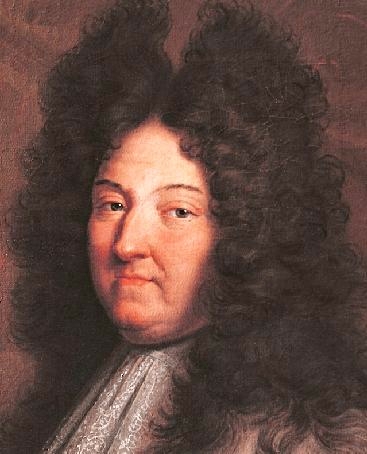 James
II
Louis XIV
James
II
Louis XIV
 William
III (of Orange)
Mary II
William
III (of Orange)
Mary II
2These labels "Whigs" and "Tories" were terms of contempt that one party assigned to the
other: Tories, the name for Irish Catholic bandits, assigned to those who
stood with their Stuart king and his pro-Catholic sympathies, and Whigs, the name first for Scottish horse thieves and then later for
Scottish Presbyterian rebels, eventually assigned to those pressing for a law
which would exclude a Catholic from the English or British throne!
Eventually those
terms would also be used to describe the groups in America in the 1770s who
either supported, as "Patriots," full independence from England (Whigs) or those "Loyalist" colonials who thought it criminal
to rebel against their English king (Tories).
| THE "GLORIOUS REVOLUTION" AND THE "HUMAN ENLIGHTENMENT" |

 English religious neutrality under Elizabeth
 James I
  Charles I and the English Civil War
  England's Puritan Commonwealth ... and the Stuart Restoration
 The "Glorious Revolution" and the "Human Enlightenment"