But Rome declines in the West anyway. Not only did Constantine reshape Roman culture by
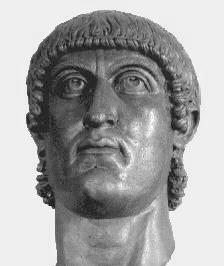
adopting Christianity as Rome's new moral spiritual foundation, he also moved
the political center of the Empire east, from its original base in Italy to a
new position at the point where the Black Sea empties into the Aegean Sea
(Eastern Mediterranean) – anciently the city of Constantinople (named after
him), today's Istanbul, Turkey. He did
so to move his operations closer to where the political (or more particularly,
military) action was – against the Persians to the East and against the
Germanic tribesmen to the North (the Balkan Peninsula) pressing the Empire from
both directions. But this move of the
Imperial capital east from Latin-speaking Rome to Greek-speaking Constantinople
left the old Italian city of Rome forlorn – pathetically so.
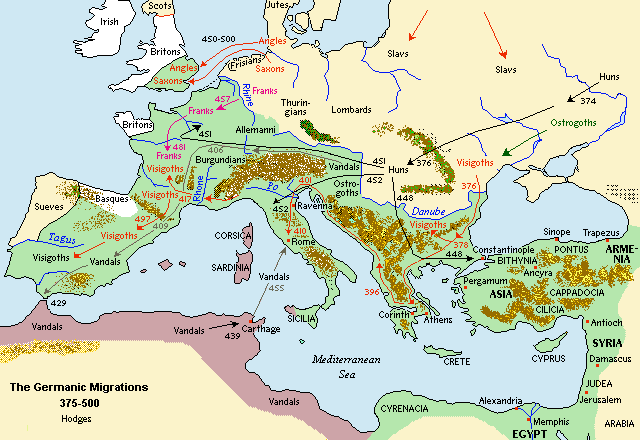
Thus
it was that German tribes migrating into central Europe from the Northeast
(under pressure from the Asian Huns coming in from further East) found the
eastern half of the Roman Empire a solid barrier to expansion. But as they slid westward, they found a very
different dynamic: only a very weak Rome trying to hold its own ... an easy
pickoff.
Indeed,
in 410 Visigoth chief Alaric and his Germanic tribal troops breached the walls
and plundered the helpless city of Rome.
This was then the signal for the Germanic tribes of north central Europe
(Goths, Franks, Alemanni, Burgundians, Angles, Saxons, Frisians, Thuringians,
Vandals, etc), to invade the western half of the Roman Empire in earnest.
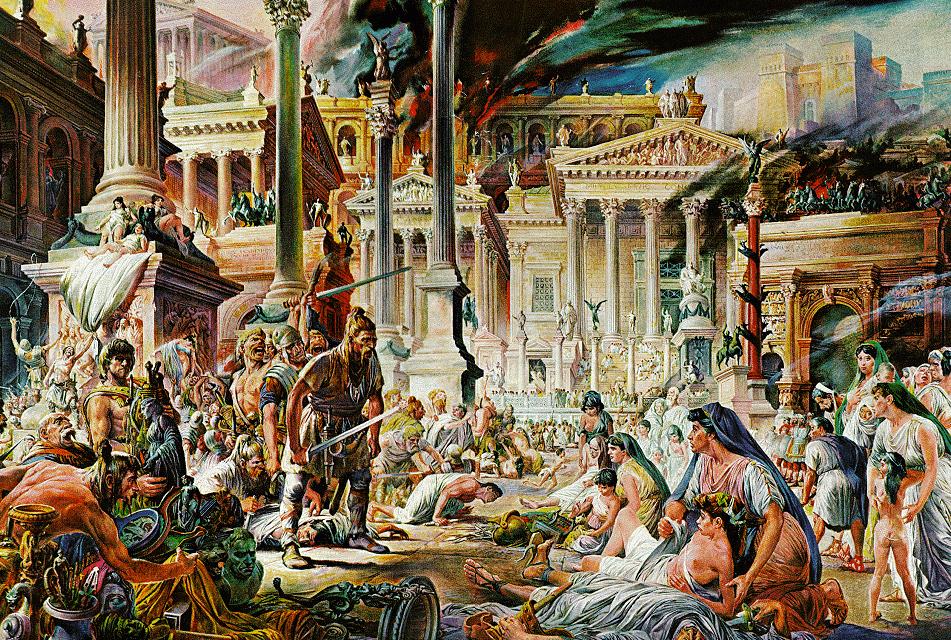
Alaric sacking Rome - by Andre Durenceau
It
is important to remember that these Germans came not to destroy Rome but to
capture the elegance of the once-famous Rome.
But there was very little elegance left to capture at this point. Roman civilization had simply broken down in
the West.<
Now
travel on the Roman roads became dangerous, leading to a decline of commerce
and trade. Consequently, urban life
decayed and eventually disappeared in most areas of Western Europe. Survival now depended on the ability of the
new tribal societies simply to support themselves locally from the bounty of
the small farms that became the sole foundation of the Western European
economy. Materially an economic, then
social, Dark Age fell upon the West.
Christian survival in the West. Nonetheless a
series of talented Christian Bishops of Rome, who remained behind in the
ancient capital city, continued to command considerable respect within the
Western Christian community – and slowly came to be recognized as the head of
the Christian Church in the Latin West – eventually gaining the title "Pope,"
meaning something like Father – but Father (Papa) above all other priestly
Fathers! Especially notable among these
popes were Leo I (pope, 440-461) and Gregory I (pope, 590-604), who managed to
preserve and strengthen what little remained of Roman or Latin moral-cultural
order in the West.


Indeed,
the church of Rome not only survived the Germanic impact but converted some of
the most important tribes to Trinitarian Christianity and restored the city of
Rome to a position of some degree of religious cultural importance – at least
within the West itself. [4]
 And
there was the British monk, Patrick, who brought Trinitarian
Christianity to neighboring Druid Ireland in the early to mid-400s. In Patrick's
30-year mission to the Irish, he established over 300 churches and he baptized
over 120 thousand Irishmen. In turn the
converted Irish would soon themselves become Christian missionaries to the
Germanic and other Celtic tribes to the East of them, most notably: Columba
(mid-to-late 500s) to Scotland; Columban (late-500s) to the Burgundians, the
Alemanni and Celtic Gauls on the European continent; and Aidan (mid-600s) to
the Angles, Mercians and East Saxons of Britain.
And
there was the British monk, Patrick, who brought Trinitarian
Christianity to neighboring Druid Ireland in the early to mid-400s. In Patrick's
30-year mission to the Irish, he established over 300 churches and he baptized
over 120 thousand Irishmen. In turn the
converted Irish would soon themselves become Christian missionaries to the
Germanic and other Celtic tribes to the East of them, most notably: Columba
(mid-to-late 500s) to Scotland; Columban (late-500s) to the Burgundians, the
Alemanni and Celtic Gauls on the European continent; and Aidan (mid-600s) to
the Angles, Mercians and East Saxons of Britain.
 And
there were other such missionaries, monks and priests who acquitted themselves
quite honorably along vital moral-cultural lines, especially once the monastic
movement had been disciplined by Benedict (early 500s), whose monastic rule was
widely honored throughout the West.
These monks were sent out among the Germanic tribes to convert them not
only to the Christian religion but also to the Roman Catholic
political-religious order that accompanied that religion. In many cases the effort by monks pointed
only to the first part of the program: the saving of souls. But the popes had more of the second part of
the deal in mind.
And
there were other such missionaries, monks and priests who acquitted themselves
quite honorably along vital moral-cultural lines, especially once the monastic
movement had been disciplined by Benedict (early 500s), whose monastic rule was
widely honored throughout the West.
These monks were sent out among the Germanic tribes to convert them not
only to the Christian religion but also to the Roman Catholic
political-religious order that accompanied that religion. In many cases the effort by monks pointed
only to the first part of the program: the saving of souls. But the popes had more of the second part of
the deal in mind.
Ultimately
tribes had to decide where they belonged in the Christian program ... on their
own as autonomous Christian tribes, or as components of the larger Western
Christian or Roman Catholic community.
Thus, for instance, in 664, a religious council or "synod"
gathered at Whitby (north central England), where the majority of the delegates
voted to end the self-supporting religious life in England introduced by the
Irish monks who had originally brought Christianity to the kingdom. The Synod decided instead to bring the
Northumbrian tribe or kingdom within the religious realm (and its particular
Latin rites) overseen by the Pope at Rome.
In
effect this decision conveyed the idea that the Pope was the ultimate
authority, both religious and political, within Western Christendom. Of course tribal kings tended to ignore in
practice the moral-legal distinctions of this relationship. But the popes, especially the more active
political popes, were very aware of this special entitlement they possessed.
 Charlemagne and the European
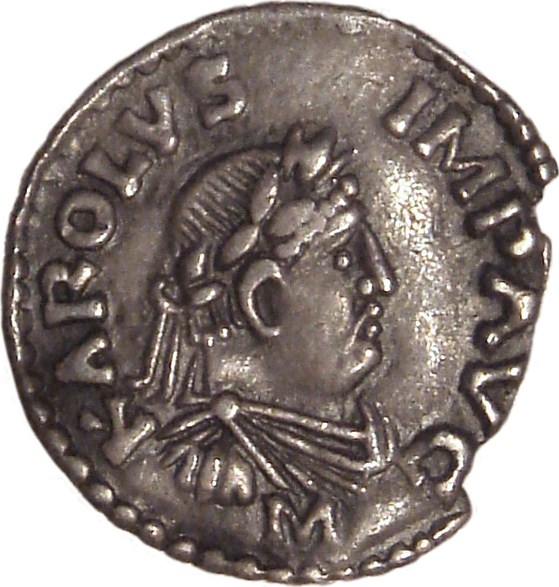
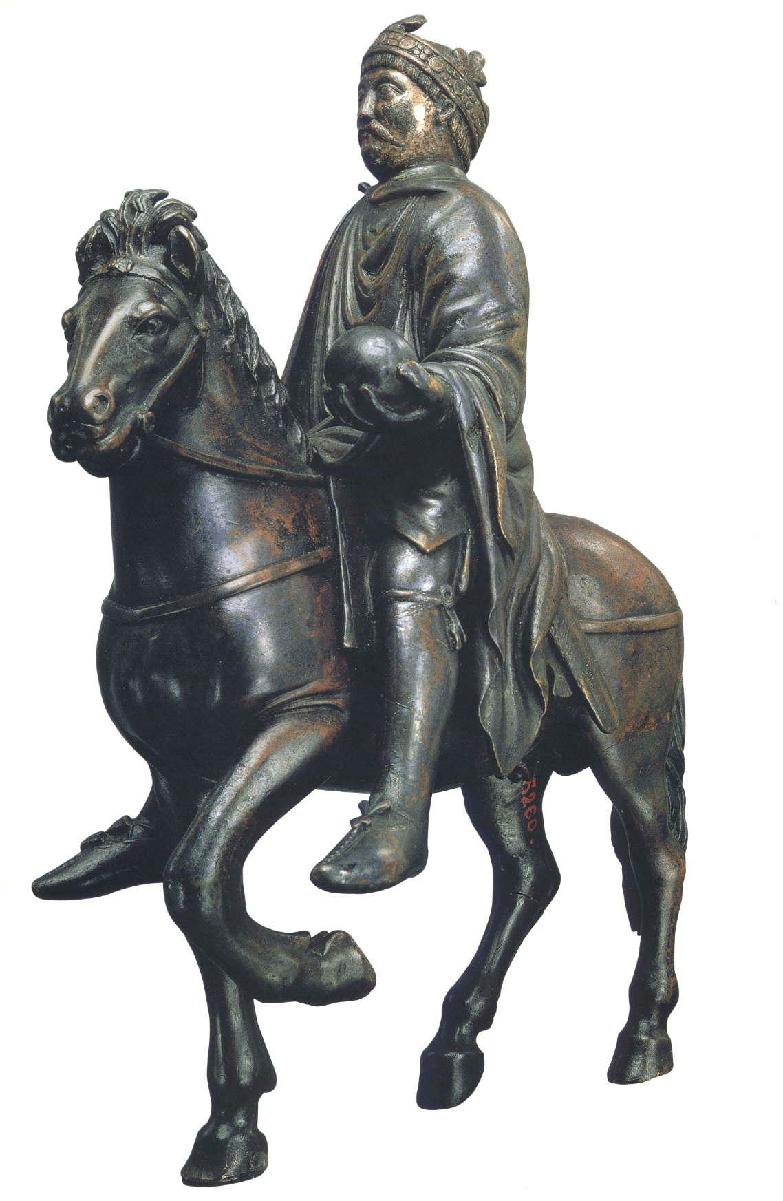
feudal order. Then in the late 700s
a Frankish tribal king, Charles or "Charlemagne" (Charles the Great)[5] succeeded
in conquering nearly all of the other Germanic tribes of continental Western
Europe.[6]
Charlemagne and the European
feudal order. Then in the late 700s
a Frankish tribal king, Charles or "Charlemagne" (Charles the Great)[5] succeeded
in conquering nearly all of the other Germanic tribes of continental Western
Europe.[6]
Such
political power did Charlemagne accumulate for himself
that he was able to end the independent existence of these various Germanic
tribes, not only forcing a new unity on much of Western Europe but also making
himself now the single landowner of Western Europe! The former tribal lands were now his –
personally his. And when the Roman Pope
certified Charlemagne as Emperor, any moral
basis for contesting this development was eliminated.

Map showing the growth of the Frankish
Kingdom
(From: William R.
Shepherd, "The growth of Frankish power, 481–814," Historical Atlas,
1926 edition, p. 53)
But this was an enormous reach of territory for a single
individual to be governing – as Charlemagne had no vast bureaucracy,
civil or military, by which to manage his lands. So, appointments were made by Charlemagne (and his descendants), to
certain well-respected supporters or vassals – authorizing them to govern
certain areas of his Empire – all in Charlemagne's name of course. These vassals were then permitted to become
lords themselves of these assigned territories, appointing their own
supporters, their own vassals, to help manage smaller regions within their own
appointed land. Completing this ruling
class were then numerous warriors or knights who came into full service to the
local lords, offering these lords military support and receiving in return the
right to share the dining tables and residence in the castles of their
lords.
Over
a period of time, these feudal responsibilities tended to be passed on from
fathers to sons. Thus it was that Europe's
ruling class came to be made up only of individuals born to this small group of
privileged families. Likewise, those who
tended to hold the higher offices in the Church – which authenticated or
legitimized this social arrangement – also were themselves usually drawn from
these same families. As far as the rest
of the 95% of the population, they remained permanently locked out of entry
into this privileged ruling class.
Instead, as peasants, they tended the fields and performed the manual
labor needed by the local lords and ladies.
And this was then the feudalism that would govern European life
for centuries.

Viking blood added to the mixture.
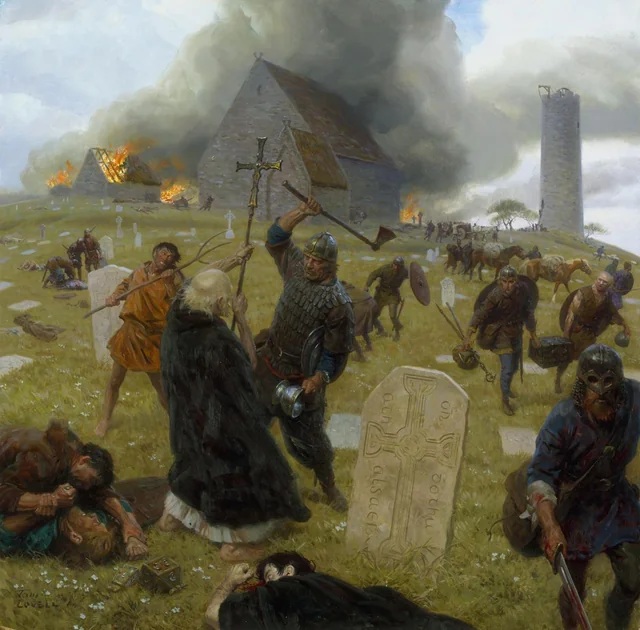
But about the time Charlemagne was bringing Western
Europe under this feudal system, attacks were happening along the edges of his
vast Empire – and across the way even in the British Isles. Northmen (Normans)
or Vikings coming from the Scandinavian North were beginning to conduct
horrible raids on Christian Western Europe – stopping cold the cultural advance
that had almost got up and running with Charlemagne's social-political
revolution. These Viking raids effectively plunged
Christian Europe back into the Dark Ages.
However, around the start of the second Christian
millennium (ca. 1000 AD) the barbaric attacks of the Vikings or Normans slowed
up considerably, giving Europe something of a degree of peace, the first in a
long time. Part of this was due to the
settling of the Normans within the communities they had once raided ruthlessly
– the Vikings or Normans adopting both the local languages and the Christian
religion of the people they had overrun – now becoming as dukes or even kings,
protectors of those same communities – such as French Normandy, the English
Danelaw, eventually England itself (1066), and even places as distant from the
North as the Mediterranean island of Sicily.
The Crusades – and encounter with Islam's great wealth.
But even with their settling in, the Normans lost none of that energy –
though this energy was now tamed and converted to the powerful service of
Christian or Western society.
And in 1095 this energy would be called on by the
Christian Pope to rescue the Holy Lands from the Muslim Turkish "infidel"
who had made Christian pilgrimage to the Holy sites of the East very difficult,
if not even impossible. The Normans –
but also the Germanic kings and noblemen (as well as multitudes of commoners) –
boldly answered the call to go crusading ("to take up the cross") in
the Holy Lands of the Mediterranean East.

Pope Urban II at the Council of Clermont (1095) calling for a crusade
against the Muslims ruling the Eastern Holy Lands
The
Crusades which followed over the next two centuries (1100s and 1200s) in turn
inspired two major developments in Christian culture or civilization at the
time. First, it involved the outpouring
of a renewed religious spirit eager to spread the Christian faith to the Muslim
lands of the East. This spirit could be
found high and low in Christian society – although the European feudal nobility
of kings and princes quickly took the lead in the enterprise.

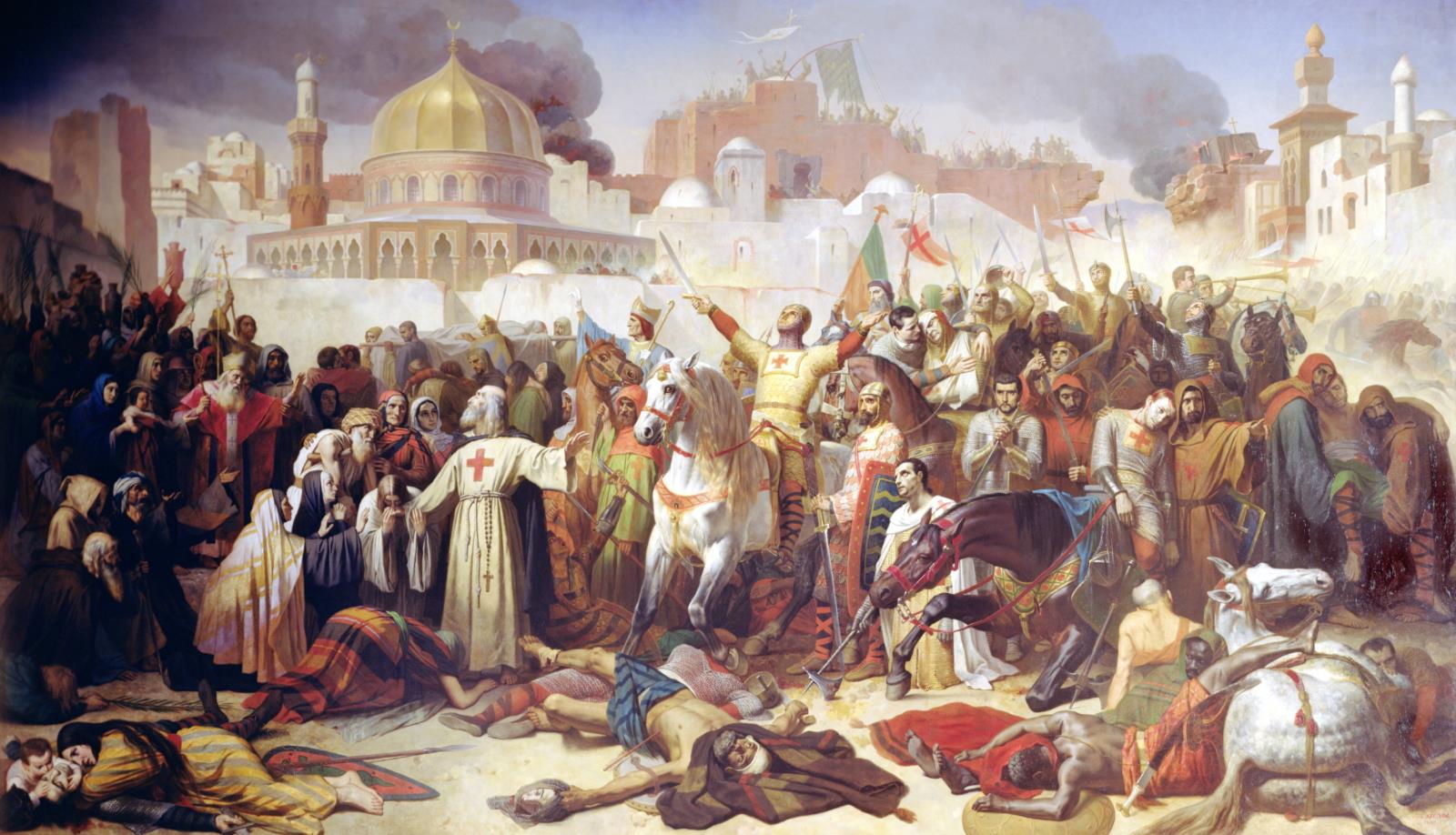
The taking of Jerusalem by the crusaders - 1099
But
secondly, the Crusades brought the rather materially primitive Europeans into
direct contact with the East's fabulous wealth, such wealth as Western Europe
had not seen since the fall of Rome many centuries earlier. Not surprisingly, the Crusaders themselves
wanted to participate in that world of wealth.
Some of the Crusader noblemen even settled themselves amidst the wealth
of Islam, establishing Norman kingdoms
in the recently conquered lands of the Middle East – sort of "going native"
– not exactly abandoning their Christian faith, but wanting very much to
combine their Christian world with this higher level of Muslim material
wealth. But this new hunger for material
wealth would include also those crusaders who returned to their kingdoms and
principalities in Europe after having fulfilled their pledges to crusade for
Christ in the East.

The Franciscans and Dominicans. In the early 1200s a spiritual "awakening" was
to come to a young, very wealthy and very brash Francis of Assisi, through both
a series of personal hardships and a mystical call to give his life over to
serving the poor, as Christ himself exemplified. In fairly short order a much-transformed
Francis attracted a large number of other young Italians to such service,
forming something of a monastic community, which the Pope then forced him to
bring under Roman or papal supervision (lest he be declared a heretic). Out of this the huge Franciscan movement developed, one
that would eventually take multitudes of Franciscan monks to all corners of
the world, and one that finds Franciscans even today serving the poor both in
urban ghettos and rural villages everywhere.
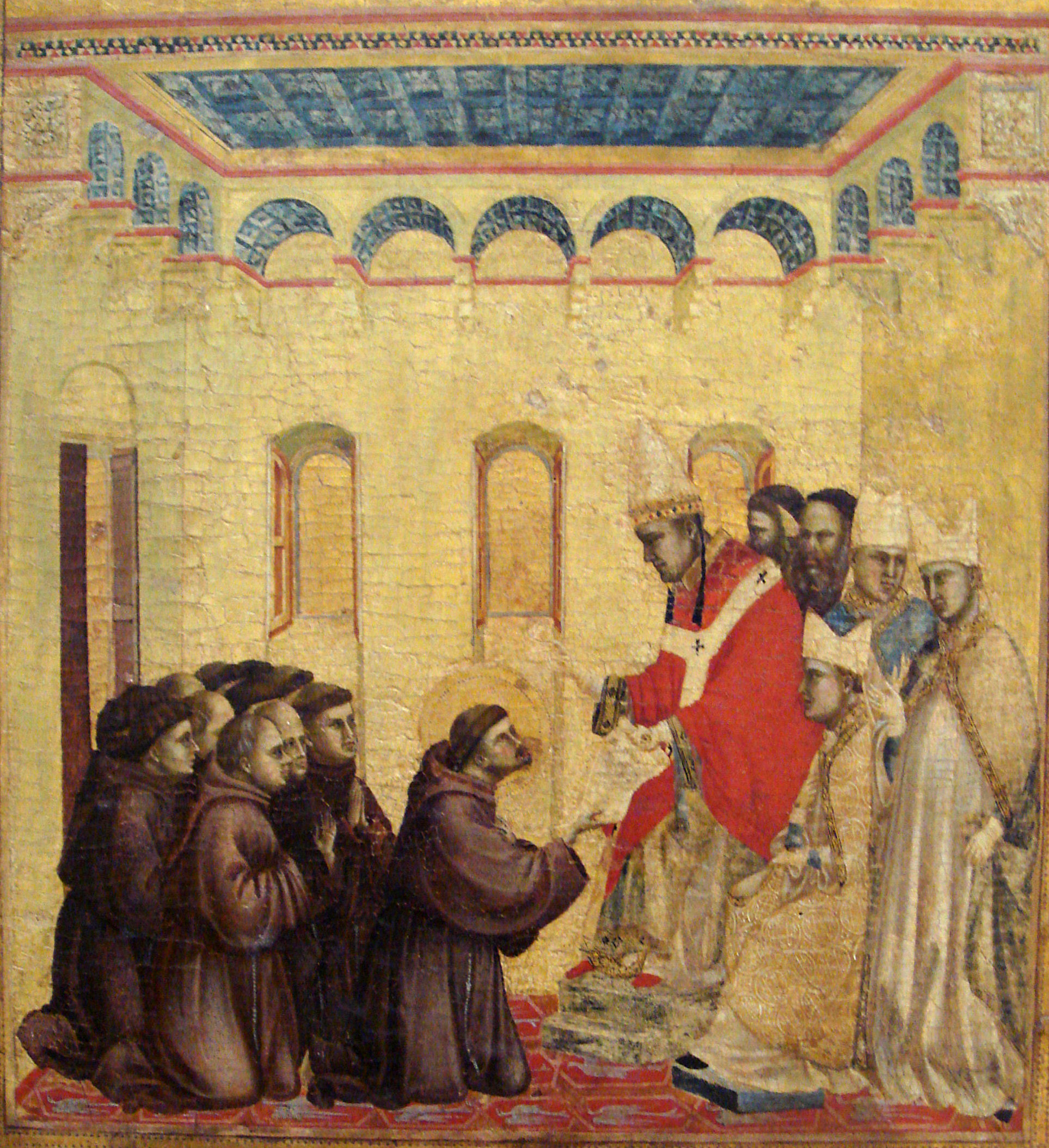
Pope Innocent authorizing the Franciscans - by Giotto
At about the same time (also the early 1200s) another
individual, the Spanish priest, Dominic de Guzman, began to train Christian
teachers in order to rebuild proper faith in the Church and its Christian
ministry. Here too his new monastic
movement (with considerable papal support) spread rapidly around Europe, as
vast numbers of Dominican monks or "Friars" were sent out to
teach and enforce Christian orthodoxy.
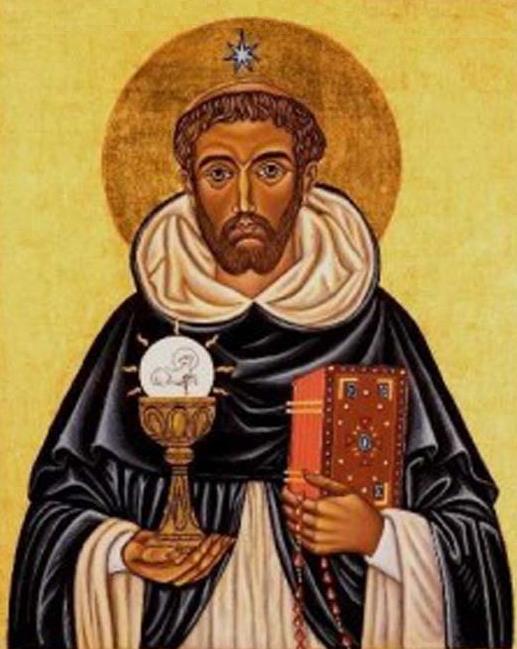
Dominic de Guzman ... founder of the Dominicans
[4]Some of these tribes, particularly the Goths, were already Christian, though Unitarian or "Arian" thanks to the missionary effort of
Ulfilas and the leadership of the Gothic chieftain Fritigern in the 300s; Rome
was "Trinitarian" and thus looked on these tribesmen as not yet fully
Christian, and thus in the need of conversion.
[5]He was the grandson of Charles Martel (the "Hammer") who had
made his own great place in history by being able to stop the spread of Islam into Europe by defeating Muslim forces at the Battle of Tours
(732) in central France. He went on to
establish the Carolingian dynasty ruling France, which Charlemagne was soon to head up.
[6]The Saxons and Celts of the British Isles excepted, as they continued
to lay outside Charlemagne's conquered territory.
Likewise, most of Spain also fell outside Charlemagne’s realm because it remained under Arab-Berber Muslim
control, and would do so in part for the next 700 years.
| THE STIRRINGS OF A NEW EUROPE |
The rise of urban Europe. Meanwhile, taking
advantage of Europe's awakened consumer or materialist spirit brought on by the
crusades were a number of port-cities located strategically along the sea
routes that made for easy access to the wealth of the East. Prominent in this regard within the key
Mediterranean region were a number of city-states of Italy, not at all feudal
domains but instead types of urban republics – the most important being Venice
(which actually went on to develop a vast commercial empire linking Europe and
the East) – but including importantly also Genoa (another shipping center) and
Florence (a banking center situated in the center of the flow of moneyed wealth
East and West). But coastal cities of
the Atlantic – such as Portugal's Lisbon, Flanders' Antwerp, Bruges, and Ghent
and England's London (not on the coast but accessible to the high seas by way
of the Thames River) – and the cities of the Hansa League of northern Germany,
such as Lübeck, Hamburg and Danzig and the Rhine region such as Cologne also
got involved – and also grew quite wealthy from this new East-West trade.
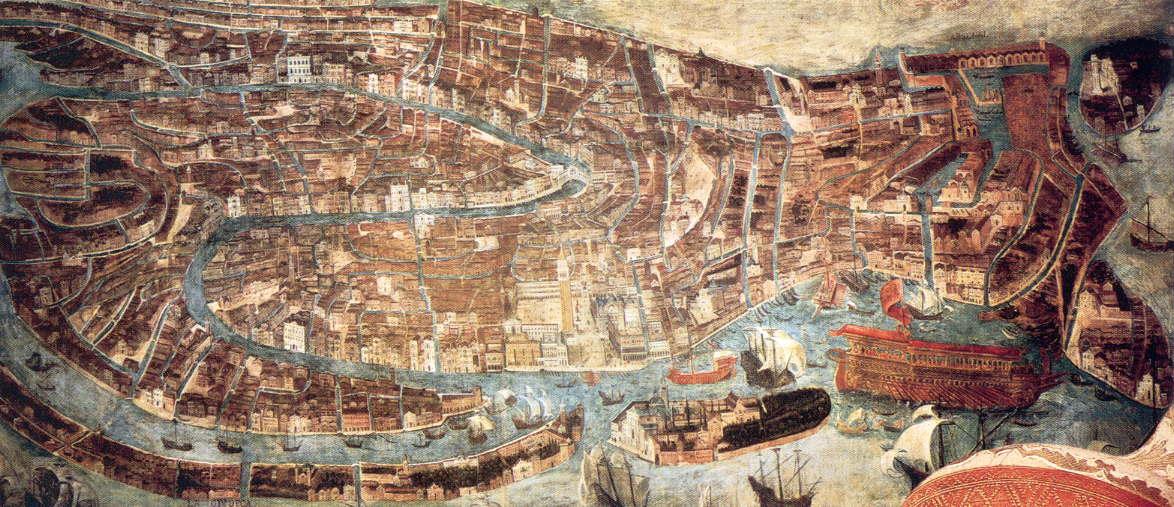
A view of Venice
Scala -
Florence
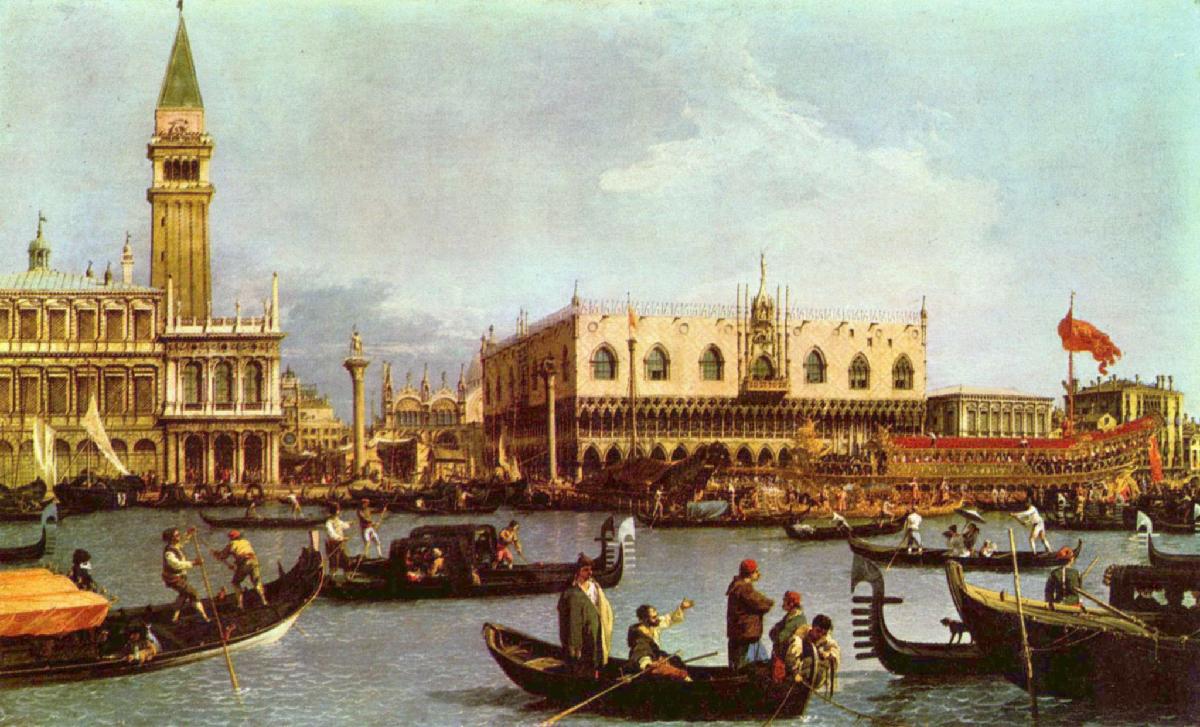
Canaletto - The Doge's Palace –
Venice (ca. 1730)
The Royal Collection -
Windsor Castle
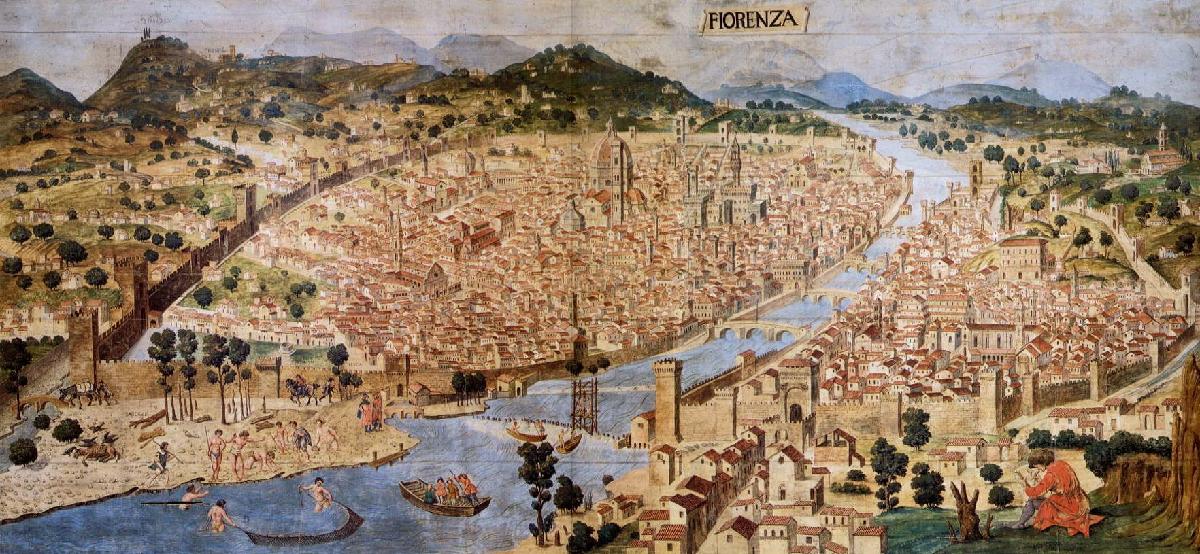
The "Carta della Catena": a
15th century view of Florence (c. 1490)
Florence, Museo de Firenze
Com'era
Renaissance Europe. By the 1300s and 1400s, Europe was being
stirred by this flow of wealth and power to a vast cultural awakening, later
termed the "Renaissance" (French for "rebirth"). God and Christ soon became upstaged in
popular interest by simply the life of man himself, and his new-found ability
to bring his world seemingly under human mastery. Thus "Humanism" increasingly became
the cultural motif of Renaissance Europe.
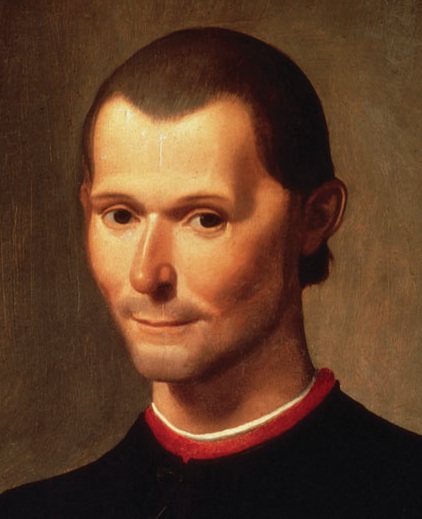 A
classic example of such Humanism was found in the works of
the political analyst, Niccolò Machiavelli. In his early 1500s study, The Prince, Machiavelli insightfully described
the way for a dictator to bring unity to a conflicted society, through
everything from brute force to simple political deception. Humanists would later denounce Machiavelli for his less than elegant
depiction of the human spirit. But they
would also find it impossible to prove him wrong. In any case, none of this had anything to do
with traditional Christianity and its role in European society.
A
classic example of such Humanism was found in the works of
the political analyst, Niccolò Machiavelli. In his early 1500s study, The Prince, Machiavelli insightfully described
the way for a dictator to bring unity to a conflicted society, through
everything from brute force to simple political deception. Humanists would later denounce Machiavelli for his less than elegant
depiction of the human spirit. But they
would also find it impossible to prove him wrong. In any case, none of this had anything to do
with traditional Christianity and its role in European society.
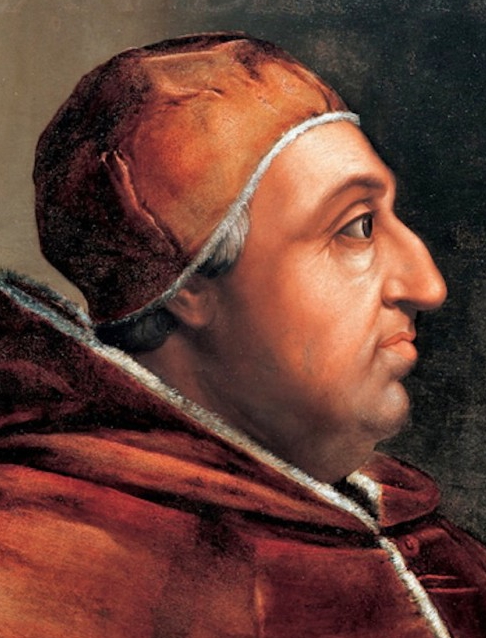 Indeed, traditional Christianity at the time was suffering deeply
under the greed and political corruption of the Church, even papal authority
itself, such as the very corrupt Pope Alexander VI and his Borgia family
which directed the church during the period 1492-1503, in political opposition
to the powerful della Rovere family (Pope Julius II, 1503-1513) and the Medici
family (Pope Leo X, 1513-1521). The
Church had become a matter of constant, sometimes even brutal, politics – and
very little spirituality.
Indeed, traditional Christianity at the time was suffering deeply
under the greed and political corruption of the Church, even papal authority
itself, such as the very corrupt Pope Alexander VI and his Borgia family
which directed the church during the period 1492-1503, in political opposition
to the powerful della Rovere family (Pope Julius II, 1503-1513) and the Medici
family (Pope Leo X, 1513-1521). The
Church had become a matter of constant, sometimes even brutal, politics – and
very little spirituality.
 Miles
H. Hodges
Miles
H. Hodges

 The critical importance of America's own Christian roots
 The pathway to the Fathership of God
  The early church
  The "Romanization" of Christianity: "Christendom"
  Medieval Christendom
  The stirrings of a New Europe