Muammar Gaddafi. With the exception of Egypt – now under
Mubarak but continuing to follow Sadat's same pro-West, even
pro-American, foreign policy – the Arab world was as eager as ever to develop
Arab nationalism. Israel provided the
ever-ready cause behind restless Arab nationalism – with various Arab modernizers
such as Muammar Gaddafi of Libya trying to present
themselves as the Arab world's best champion.
The flamboyant Gaddafi attempted all sorts of
programs (his little Green Book of Gaddafi quotations – similar to Mao's little Red Book), from Arab
Socialism and then back to Arab Capitalism (Libya was very wealthy in terms of
oil reserves) – sometimes quite Secular, sometimes orthodoxly Muslim (in Gaddafi's own unique way). When the Arab world turned out not to be
terribly responsive to his attempts at Arab leadership, he then became very "African"
– attempting to make himself the leading voice in African affairs taking place
to the south of Libya.
Muammar Gaddafi. With the exception of Egypt – now under
Mubarak but continuing to follow Sadat's same pro-West, even
pro-American, foreign policy – the Arab world was as eager as ever to develop
Arab nationalism. Israel provided the
ever-ready cause behind restless Arab nationalism – with various Arab modernizers
such as Muammar Gaddafi of Libya trying to present
themselves as the Arab world's best champion.
The flamboyant Gaddafi attempted all sorts of
programs (his little Green Book of Gaddafi quotations – similar to Mao's little Red Book), from Arab
Socialism and then back to Arab Capitalism (Libya was very wealthy in terms of
oil reserves) – sometimes quite Secular, sometimes orthodoxly Muslim (in Gaddafi's own unique way). When the Arab world turned out not to be
terribly responsive to his attempts at Arab leadership, he then became very "African"
– attempting to make himself the leading voice in African affairs taking place
to the south of Libya.
But
he pushed things too far with Reagan when it was discovered that he
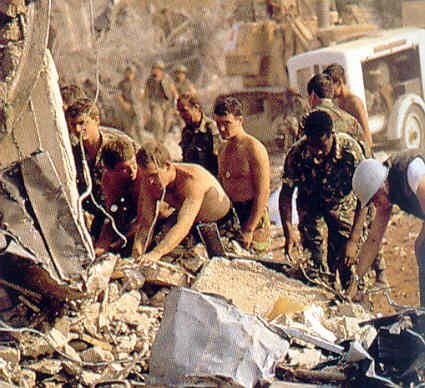
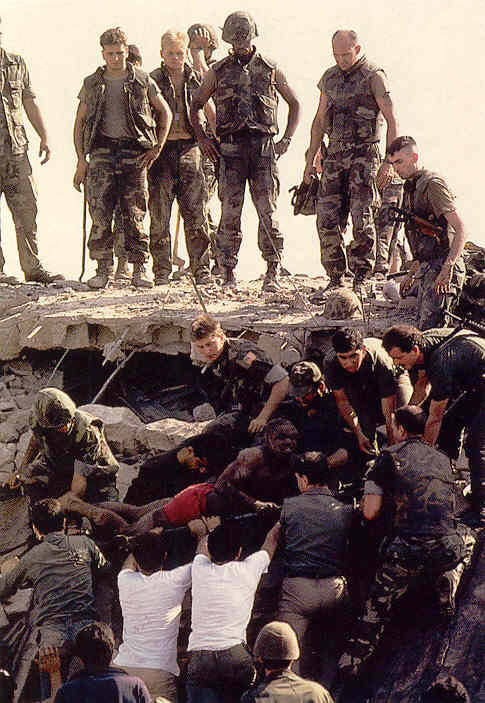
was connected to the 1986 Berlin bombing of a discotheque in which a number of
American soldiers were killed – and Reagan retaliated by sending patrol
boats into waters claimed by Libya (considered by the West as high seas and
thus nobody's territory) – which naturally were fired on by Libya – and which Reagan answered by attacking Gaddafi's Presidential Palace. When the United Nations condemned the
attacks, Reagan simply ignored the
organization – as did a number of other countries which too were tired of Gaddafi's ventures (principally
supporting various terrorist organizations such as the Irish Republican Army
and various Moro or Islamic jihadist groups operating in the Philippines). Even the Soviets found themselves backing
away from Gaddafi, not wanted to get dragged
into an unwanted event.
Anyway,
for a while, Gaddafi would be forced to behave –
for fear of Reagan's reprisals.
Other militant organizations. But huge problems
in the Middle East were coming from a number of other sources, principally the PLO or its subgroup Fatah, plus Hezbollah and Hamas – primarily dedicated to the
crippling or even destruction of Israel.
But each represented a very different part of the world of Islam. The Palestinian Liberation Organization (PLO) or Fatah had long been the voice
of the Palestinians chased out of their homelands by the Jewish migration into Palestine – and was the
organization officially sponsored by the Arab League. Defending both Christian and Muslim Arab
interests in Palestine, it tended to be mostly Secular in its promotion of
Palestinian rights. Hezbollah however was a strongly
Muslim voice of the Shi'ites – founded and supported by
Iran and numerous Shi'ites among the Lebanese and
Syrians – which found itself constantly in competition with the Arab Sunnis. Then Hamas came into being in the later
1980s – upset that the PLO/Fatah was beginning to show a
willingness to negotiate a compromise of some kind with the Israelis. Hamas was also more militantly Muslim
(Sunni) – rather than merely Secular
in character.
The Rapid Decline of the Soviet Empire: Afghanistan. Meanwhile, the Soviets found themselves caught
in a quagmire of rising Afghan Muslim and
tribal hostility – aroused by the Russian attempt to impose a Communist puppet
government in the Afghan capital city, Kabul.
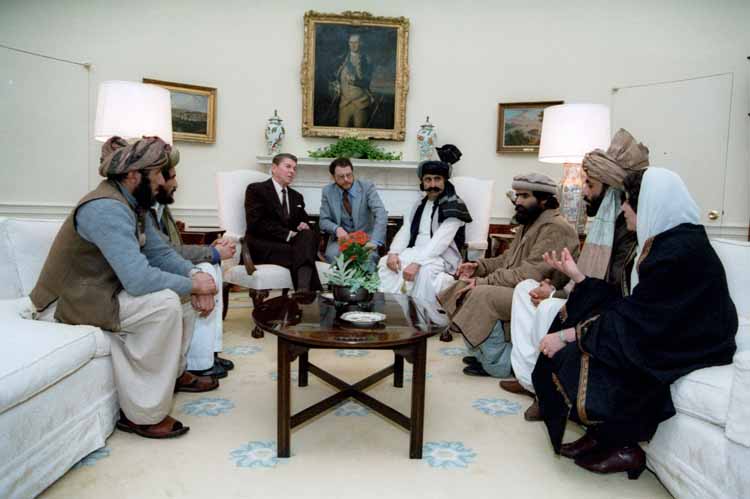
Afghan rebels (mujahedin) even looked to the Reagan government for help in ousting
the Russian troops occupying their country – finding Reagan very eager to help out. Americans sent the mujahedin all varieties of
weapons, including missiles that could easily take out Russian tanks and
jets. Consequently, the Soviets found
themselves struggling to hang on to any kind of defensive position in the
country. Soon anti-war sentiments began
to grow among the Russians – including even members of the Russian military.
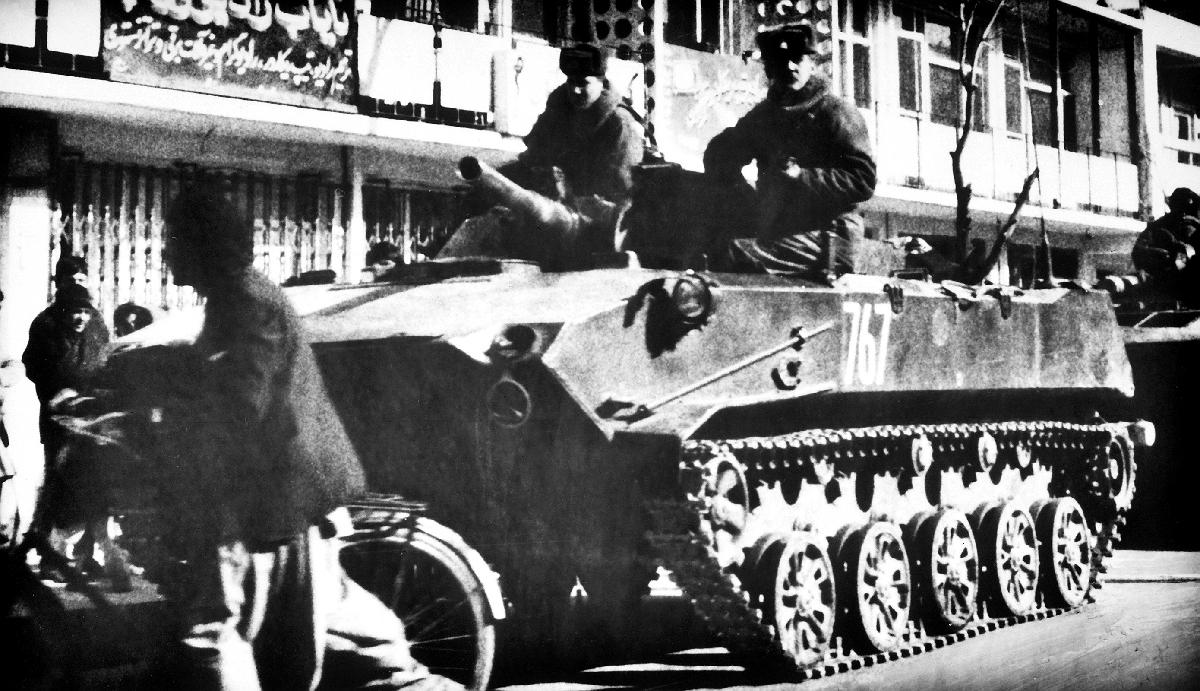
Soviet paratroopers aboard
a BMD-1 in Kabul
Reagan listening to the
mujahidin's
description of
Soviet atrocities in Afghanistan – February 1983
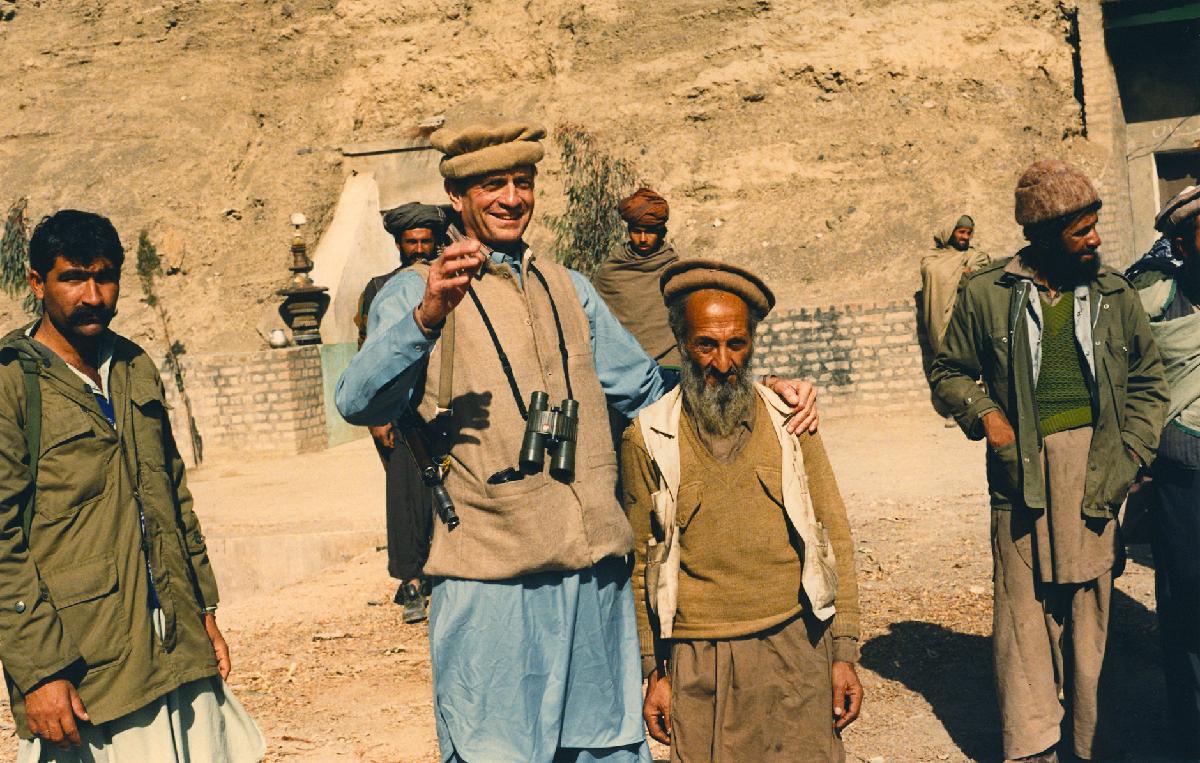
Texas Congressman Charlie
Wilson in Afghanistan
Wilson was a prime mover
in Operation Cyclone, in which
the US sent $ millions to support the
mujahidin in their fight
against the
Soviets (unfortunately much of the money
ended up in corrupt Pakistani
military hands). Resistance
by conservative
Muslim mujahidin however is grinding
down the Soviet effort to maintain Communist control
in Afghanistan.
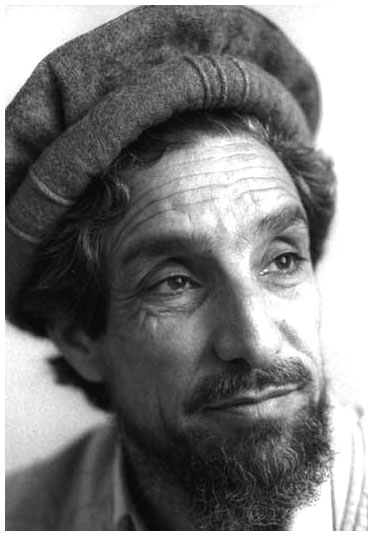
Ahmad Shah Massoud – the
"Lion of Panjshir"
This
engineer-turned-mujahidin
proved to the the most
effective of the Afghan resistance commanders. When
the Taliban later
took over the country, he became their
prime opponent. The Taliban
assassinated him just days
before the September 11, 2001 attack
on the New York
Twin
Towers)
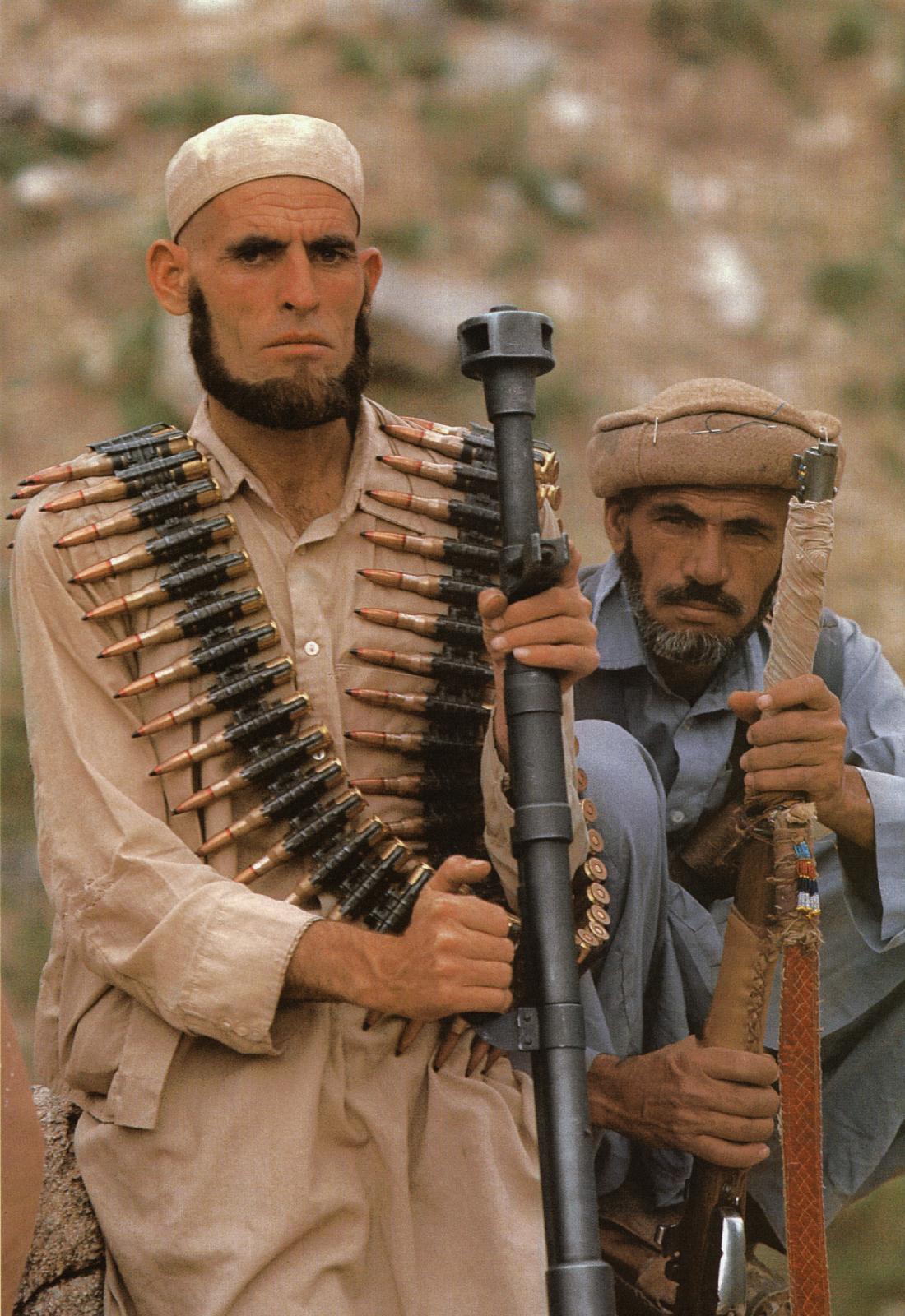
Well armed mujahedin
confronting
Soviet troops in AfghanistanThe rapid turnover in Soviet leadership (1982-1985). This all was taking place at a time when the
Russians were having a very hard time getting leadership in place – ever since Brezhnev's death in late 1982. At first a Communist hardliner (supposedly a
good match to the equally hardline Reagan) was put in place at the head
of the Party in Moscow. But he died only
a year later. He in turn was replaced by
another individual – who was in no better health – and who also died only a
year after that.
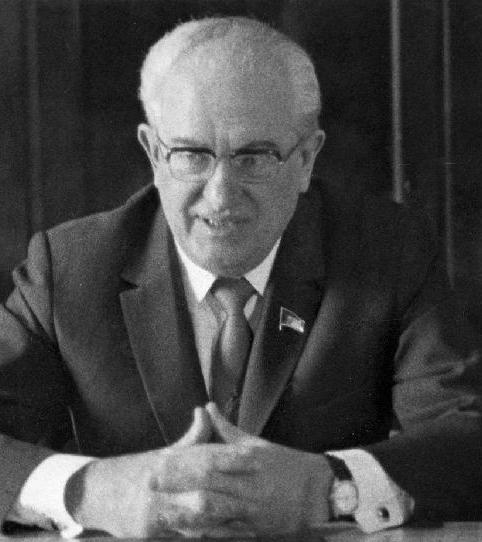
Yuri
Andropov
1982-1984
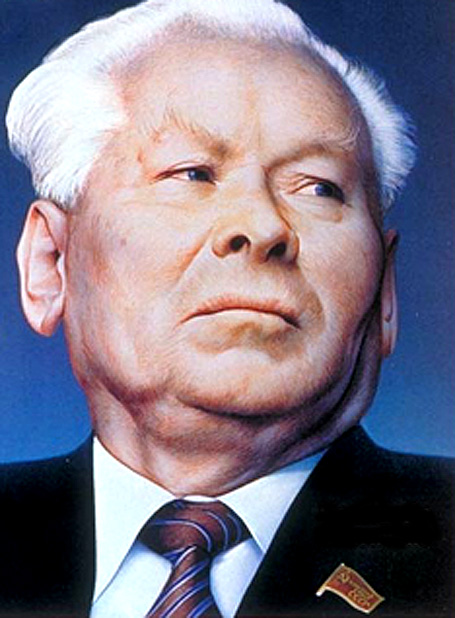
Konstantin Cernenko
1984-1985
Pressure from Reagan.
Meanwhile Reagan was pushing and pressuring the
Soviets in every way possible. He sensed
the Soviet decline and intended to exploit it.
He threw down the challenge to Russia in a speech before the British
Parliament in 1982 when he called the Soviet Union an "Evil Empire"
and predicted its collapse in the near future.
Soon thereafter Reagan restored the B1-bomber program
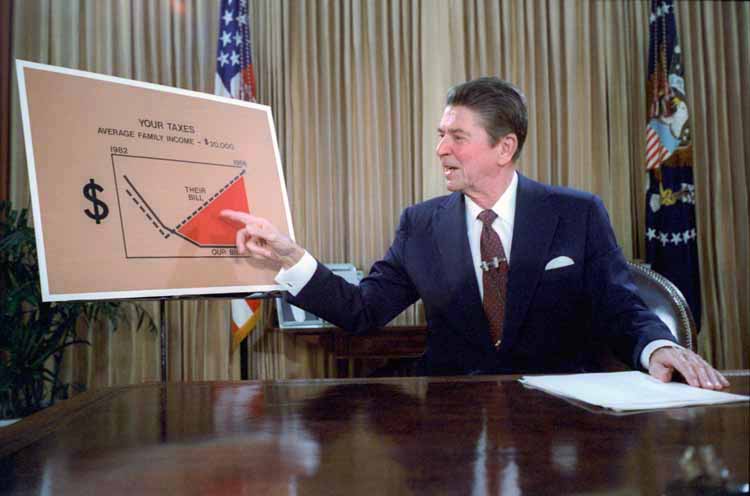
that Carter had canceled and armed NATO with Pershing II missiles. In 1983 he announced plans (the Strategic
Defense Initiative or SDI) to develop and deploy missiles capable of defending
America from a missile attack from any enemy – which Kennedy termed as "reckless
Star Wars schemes." It was an
expensive program – but one which the Soviets – whose economy was stumbling –
would be unable to match. Ultimately,
the American people seemed to approve of Reagan's "Star Wars schemes." Once again, Reagan's toughness drew the approval
of the majority of Americans.
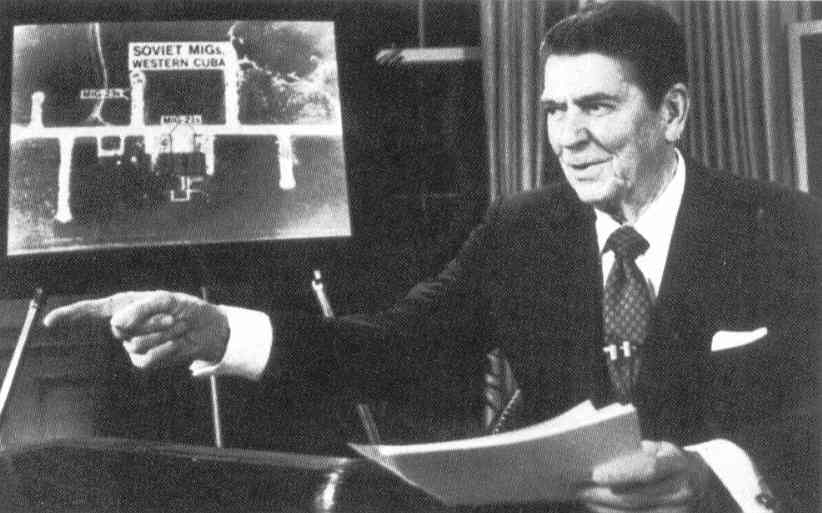
In a televised speech, Reagan
reveals his Strategic Defense
Initiative or "Star Wars" plan – March 23,
1983
But
in the end, the program would not be needed.
The Soviet Empire would soon collapse.
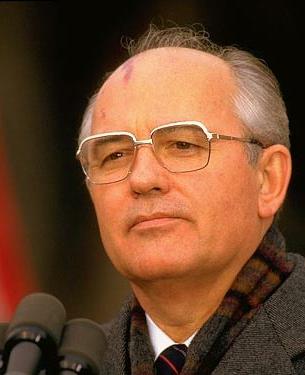 Mikhail Gorbachev.
In 1985 the Russians brought to power a younger, more visionary Mikhail Gorbachev – who was looking forward
to enacting a number of reforms to liberalize the government and Russian
society. He was also hoping to improve
relations with America.
Mikhail Gorbachev.
In 1985 the Russians brought to power a younger, more visionary Mikhail Gorbachev – who was looking forward
to enacting a number of reforms to liberalize the government and Russian
society. He was also hoping to improve
relations with America.
Gorbachev introduced a number of
liberalizing reforms – known as glasnost (more personal
freedom for the people), perestroika (liberalizing the
economic system), and demokratizatsiya (a democratizing of the political
system). These reforms were well
received both at home and abroad – and led to a number of very friendly
meetings between Reagan and Gorbachev – to see how they could
finally end the Cold War.
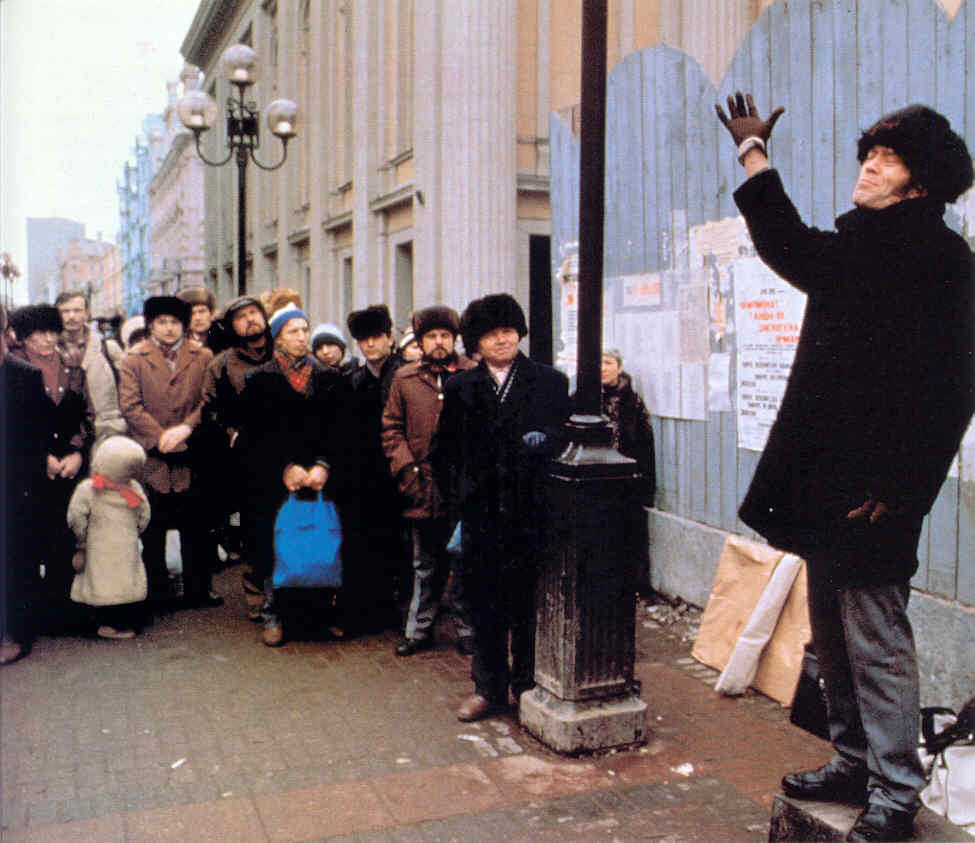
A Russian practicing
glasnost
on a Russian street
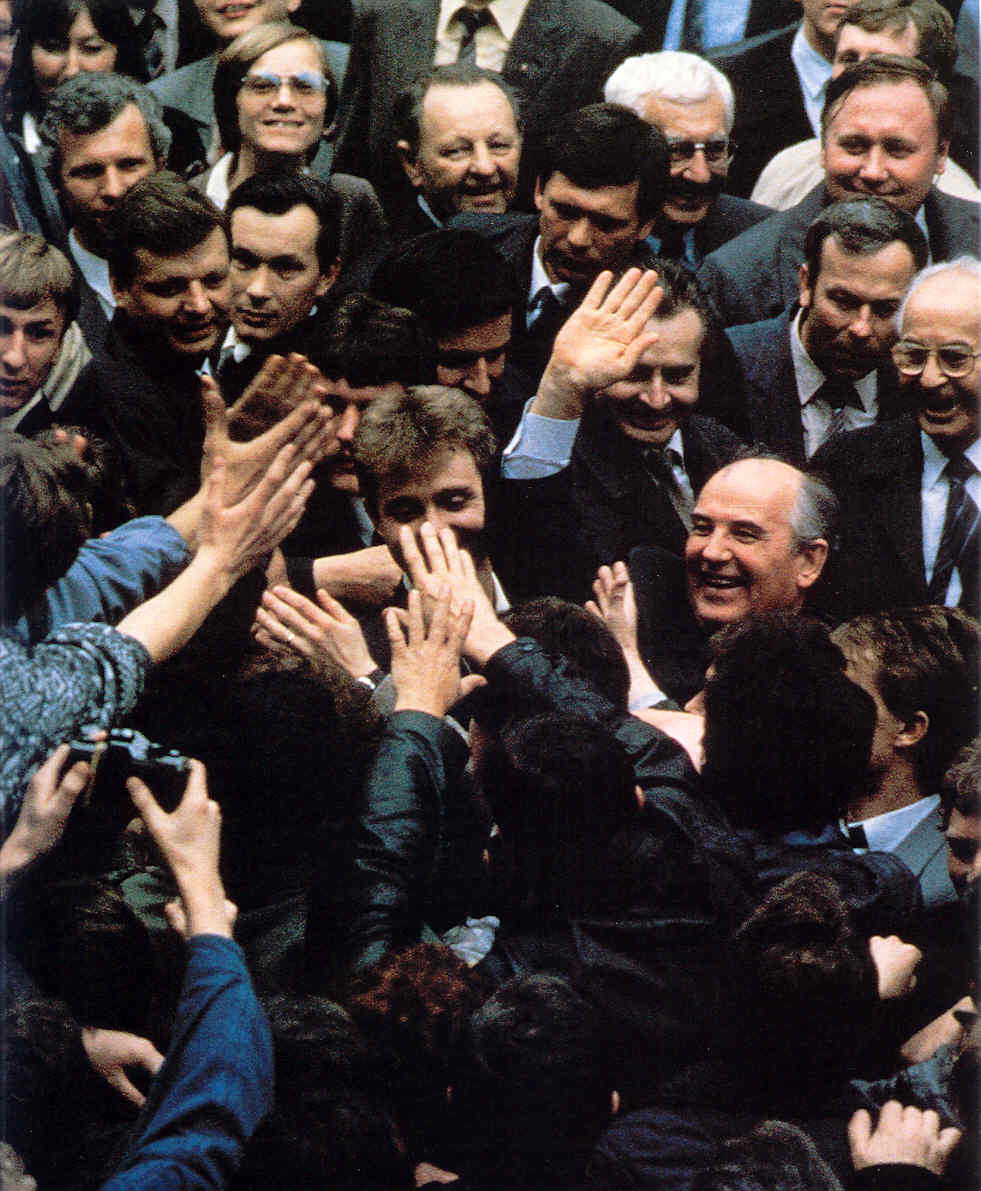
Gorbachev welcomed in Prague
for his reforms
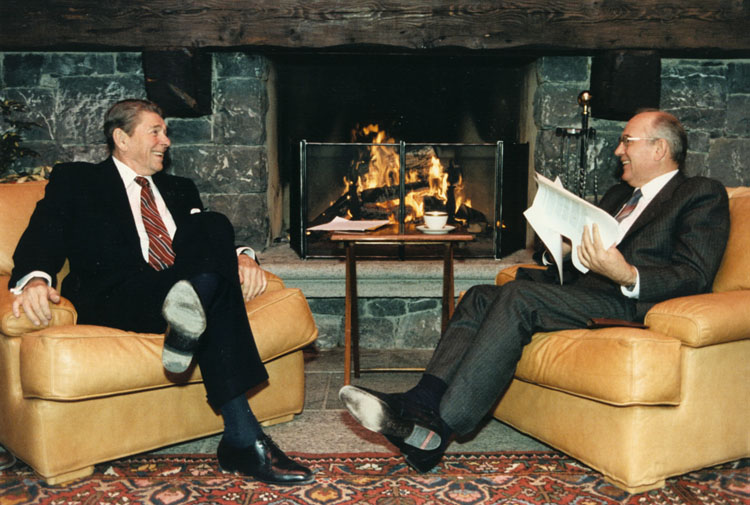
Reagan and Gorbachev at the
first Summit in Geneva, Switzerland
19 November 1985
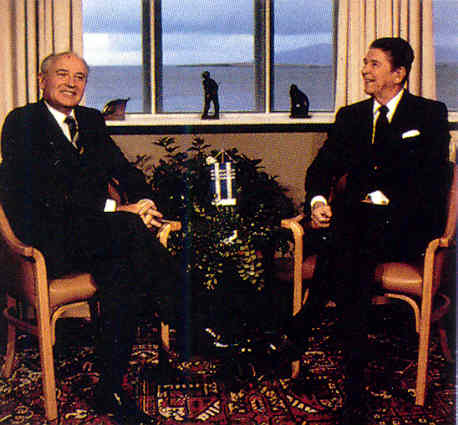
Gorbachev and Reagan meet
in Reykjavik, Iceland – autumn 1986
Reagan's challenge. At one point, in June of 1987, when Reagan was visiting Berlin, he issued
this challenge as he was speaking at the Brandenburg Gate:
... if you truly want peace and liberalization – Mr. Gorbachev, open this gate! Mr. Gorbachev, tear down this wall!
This did not happen right away – but something like it was
underway. And Reagan knew so – although he would be
one year out of office when this challenge finally was answered with the coming
down of the Iron Curtain separating East and West
Europe.
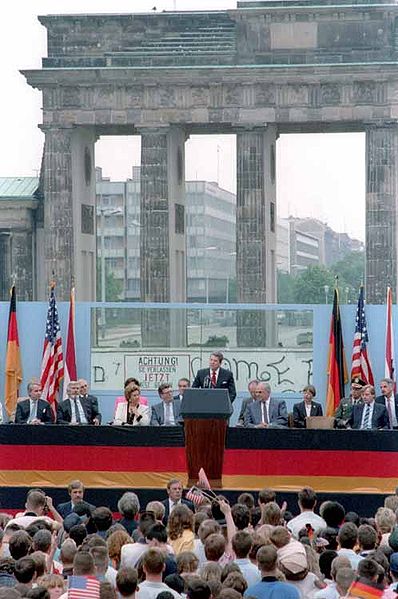
"Mr. Gorbachev, tear down
this wall!" – June 1987
______________________________________________
Gorbachev,
realizing that the Afghan War was merely
weakening further the Soviet
strategic position globally,
decides to call it quits in Afghanistan –
July 1987
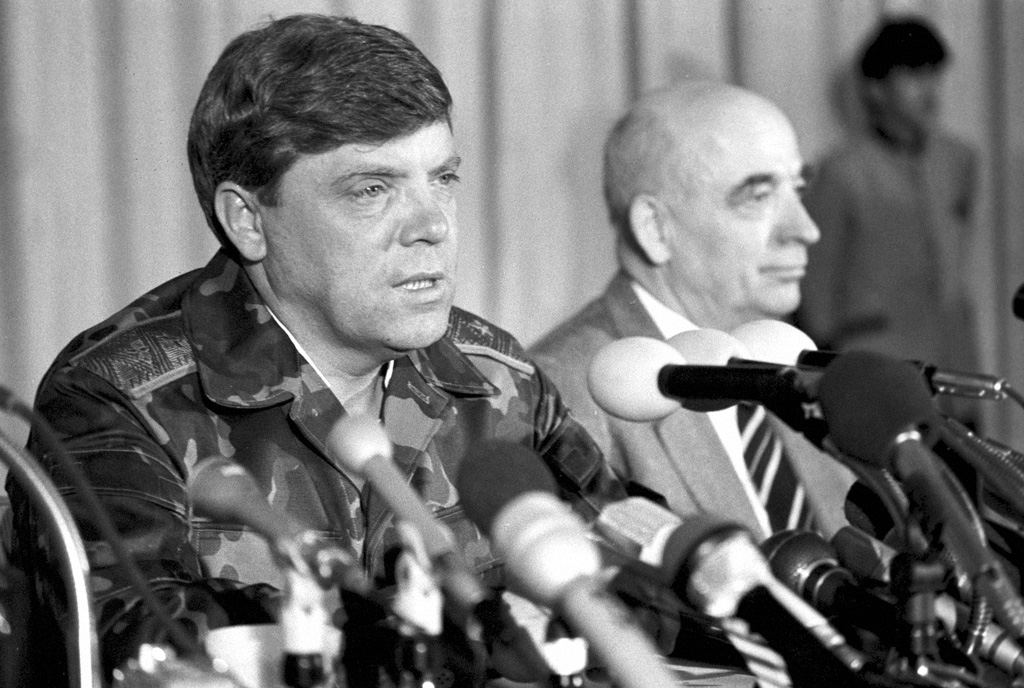
Soviet Commander Boris Gromov
announcing the Soviet
troop pullout from Afghanistan – July
1987
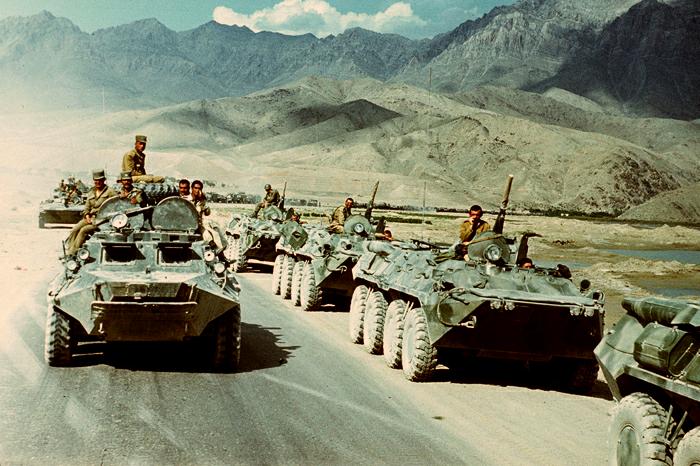
Afghan troops (on the left)
watching Soviet troops
leaving Afghanistan – 1988
___________________________________________________
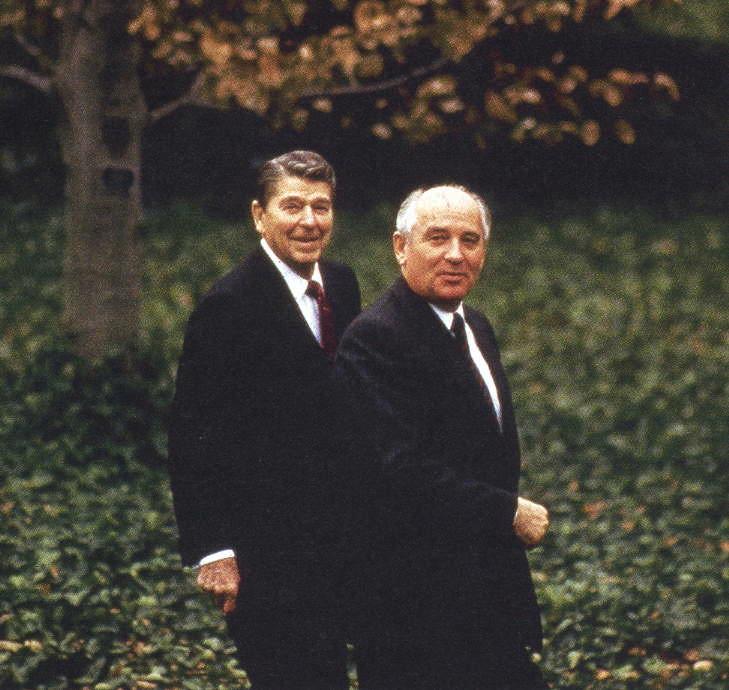
Gorbachev with Reagan on
a summit visit to Washington – 1987
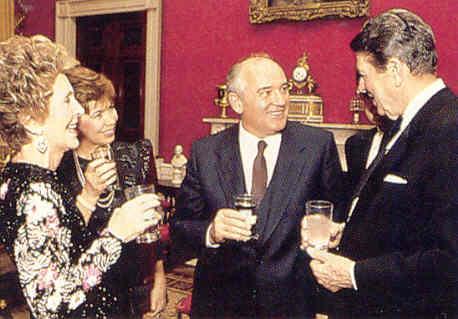
The Gorbachevs visit the
Reagans in Washington – December 1987
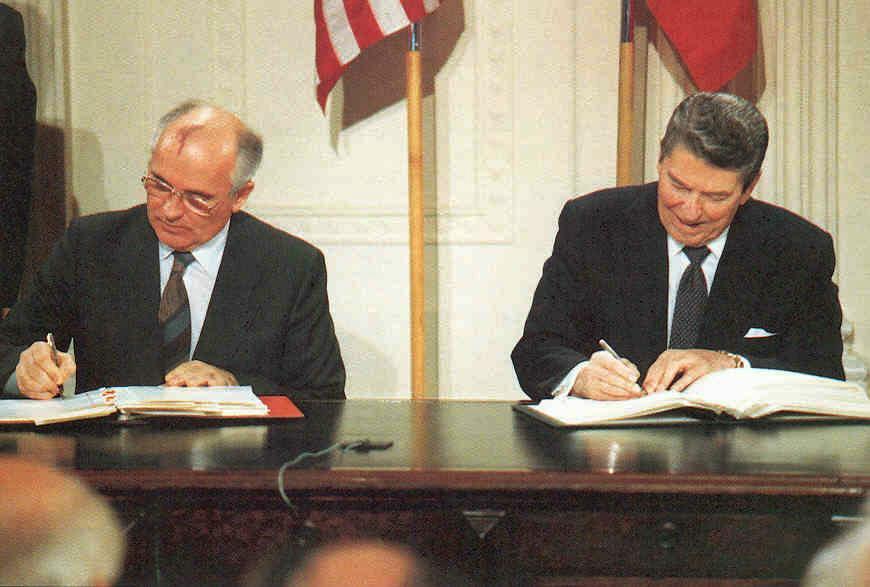
Gorbachev and Reagan sign
the Intermediate Nuclear Forces
(INF) Treaty in Washington – 1987
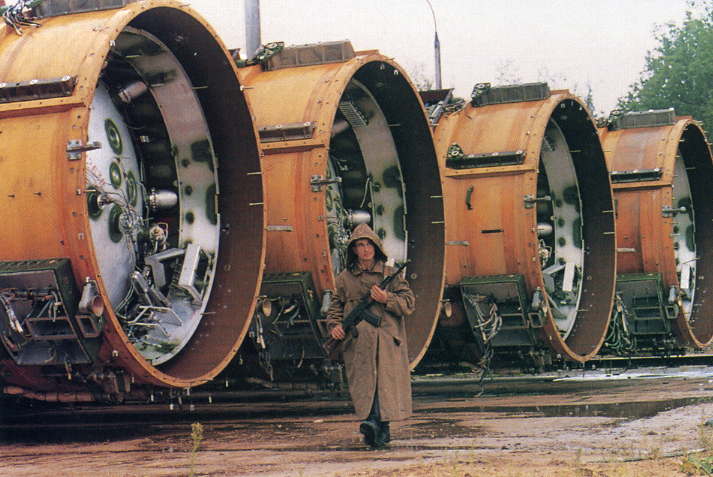
A Soviet sentry guarding
ICBMs scrapped under a 1987
disarmament treaty with the US
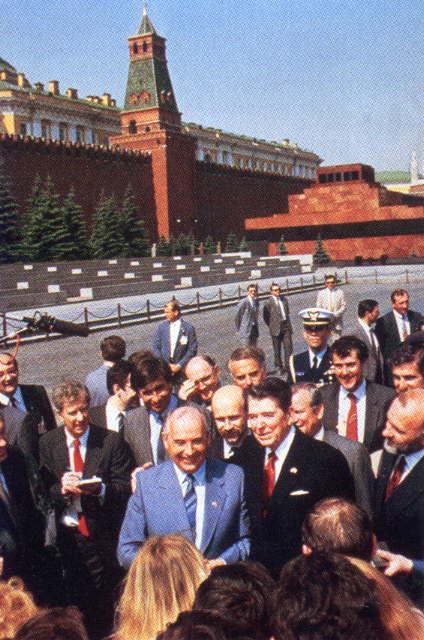
Gorbachev and Reagan in Moscow
- 1988
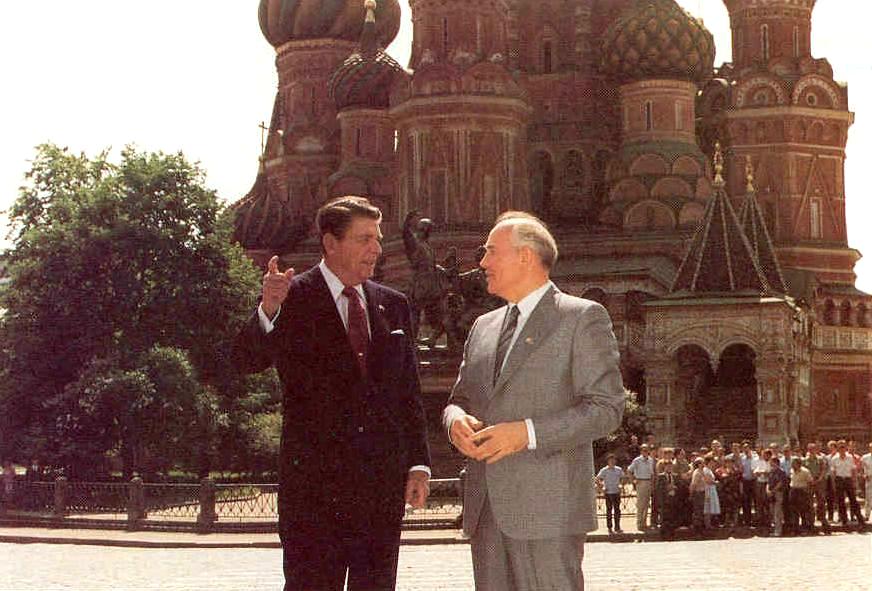
President Ronald Reagan visiting
with Soviet Premier Mickail
Gorbachev in Moscow,
chatting in front of St.
Basil's Cathedral
on Red Square
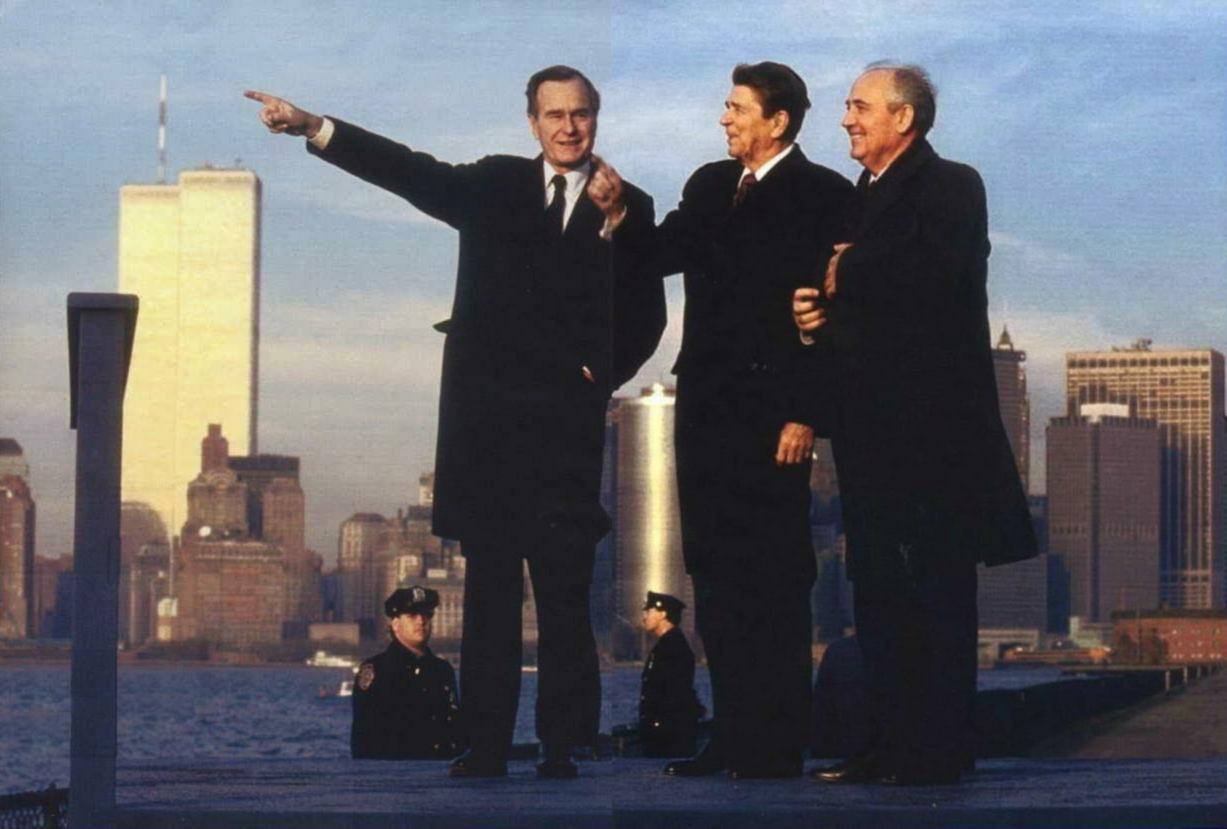
Soviet Premier Gorbachev
visiting Reagan and Bush in New
York shortly after the latter's
electoral victory in 1988
China continues self-reform under Deng Xiaoping. While the Soviets were undertaking deep
reforms to get their economy up and moving, the Chinese Communists were doing
the same thing, except with very different results. At the same time that the reforms crumbled
the Soviet social-economic-political order, in China similar reforms were
clearly working to strengthen Chinese society – politically in a moderate
fashion and economically in a massive fashion.
Part
of this was due to the Chinese entrepreneurial instinct being still alive and
well in China – especially along its major Eastern cities such as Shanghai,
which earlier in the century had been a hub of Chinese industry. But part of it was also due to the very
favorable trade protection deals with the West that Deng had secured from the Westerners,
the latter anxious to see China move closer to their world of capitalism.
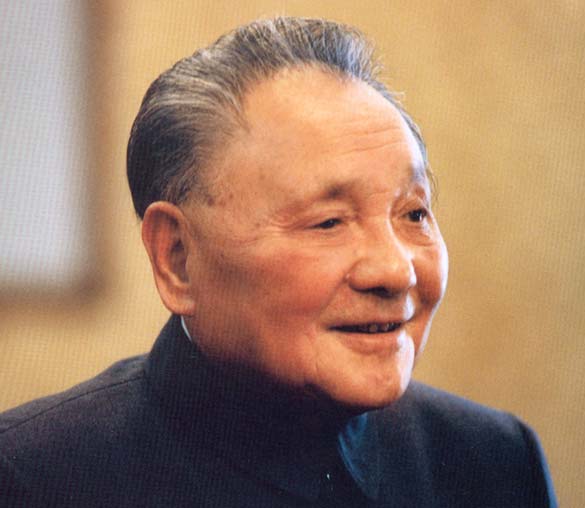 Deng Xiaoping
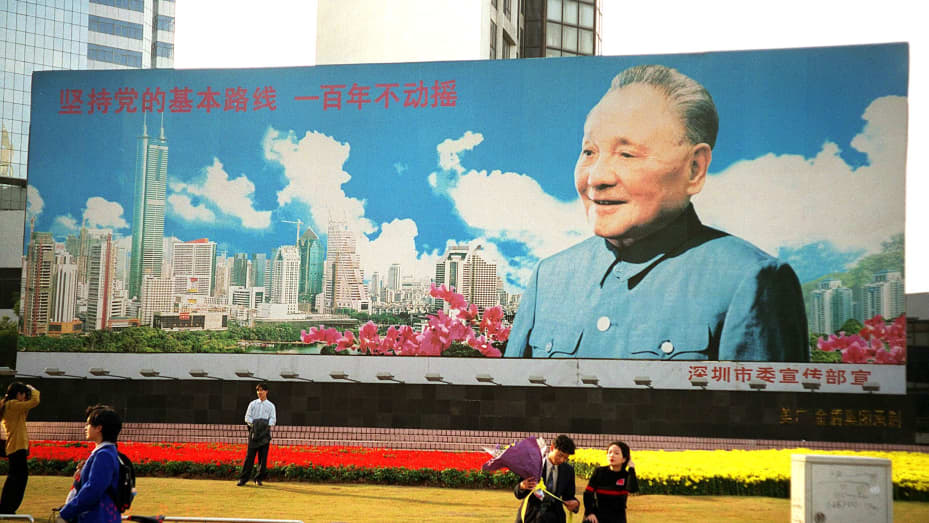 A huge billboard in Shenzhen celebrating Deng's economic reforms
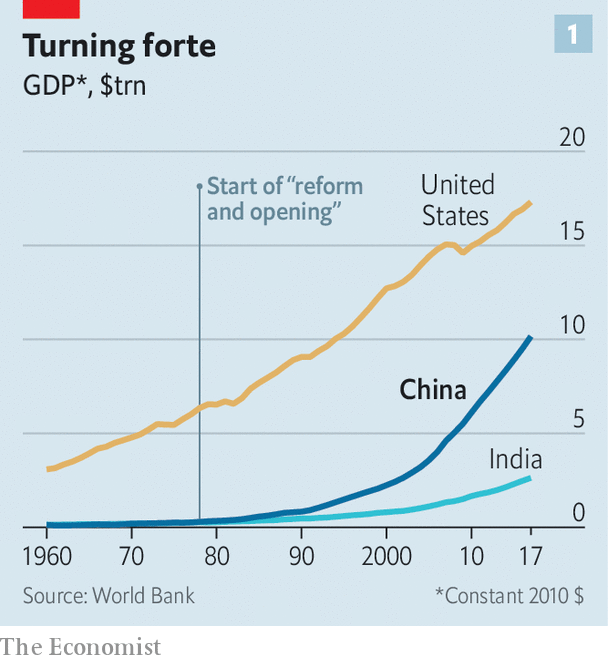 Comparative economic growth of US, China and India 1960-2017
Deng also kept important restraints
on the dynamic in order to keep it from getting out of control (as things had
developed in Russia), largely through the heavy government subsidizing of this
new "independent" industrial dynamic.
This heavy government support not only gave huge trading advantages to
the Chinese industrialists, it kept them in a very cooperative relationship
with the Deng government. Thus the Chinese economy began to boom,
annual growth rates averaging 8-10% during most of the 1980s and 1990s.
In the meantime a major problem for Reagan exploded at home when in
November of 1986 a Lebanese newspaper reported a story about a secret deal to
get Iran to intervene to release kidnapped Americans held in the Middle East by Hezbollah – through the sale of
various US weapons (via Israel as intermediary) to Iran. At about the same time (October), a CIA plane was shot down by the
Nicaraguan Sandinista (strongly Leftist)
government, a plane carrying weapons to anti-government troops known as the
Contras. One American, Eugene Hasenfus,
survived the downing, was arrested by the Nicaraguans and immediately tried –
at which point he confessed to the secret shipment of arms to the Contras. Both actions were in violation of very
specific legislation (the Bolen Amendment to the Pentagon budget forbidding
further help to the Contras) plus the long-standing taboo of paying off
kidnappers (even if only indirectly, by way of Iran's intervention), because it
merely encouraged more kidnapping.

Nicaraguan President and
Sandinista leader, Daniel Ortega,
campaigning in support of his government
- 1984
The
two events occurred at around the time of the 1986 Congressional elections in
which the Democrats increased their majority in the House and now took control
of the Senate as well – with large majorities in both houses (House: 258 to 177
and Senate 55 to 45).
But
even before the new Congress could take its seat, the Iran-Contra Affair (as it came to be
known) exploded as a major news item – forcing Reagan in mid-November to go before
national television to explain his side of the affair. Two weeks later U.S. Attorney General Edwin Meese admitted that the money
from Iran was used to finance the Contra shipments. On that same day Reagan fired Marine Lt. Col. Oliver North – who confessed to being
in charge of the whole matter. And on
that same day Reagan set up a three-man
Presidential Commission, headed up by former Texas Senator John Tower, to look into the matter. In late February of the following year (1987)
the Tower Commission delivered its report, outlining the actions of various
participants in the whole affair – although it largely excused Reagan as not having much knowledge
of the operation.
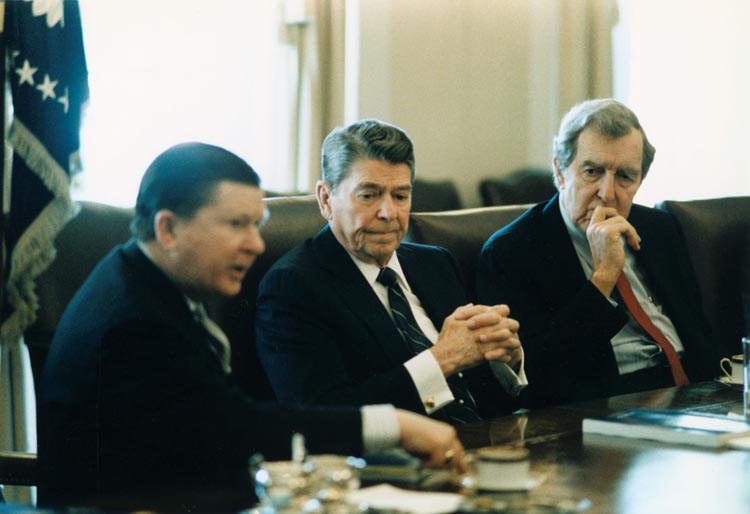
President Regan received
the Tower Commission Report
in the Cabinet Room
with Senators John Tower
(l.) and
Edmund Muskie (r.) attending – February 26, 1987.
In
March Reagan again went before TV audiences
– to apologize for his mishandling of the whole affair – explaining that he was
in part trying to help get the release of hostages and in part working with
Iranian moderates in trying to improve Iranian-American relations.
But
in the meantime (January), the new Democratic Congress set up its own
investigative committees – dismissing the Tower Report – obviously looking for
more material to bring against the Reagan "imperial presidency." It was Watergate all over again. The hearings ran from early May to early
August – again watched closely on TV by the Americans – especially when Lt.
Col. North was interviewed. Finally a
Joint Committee Report was published in November – with Republican members of
the Committee issuing a dissenting Minority Report. Basically Reagan was criticized for not doing
his job in staying on top of such matters.
However, the Report came up with nothing specific that Congress could
charge Reagan with. But even then, that would not be the end of
the matter – as further investigations were conducted by a
Democrat-controlled Congress all the way into 1991.
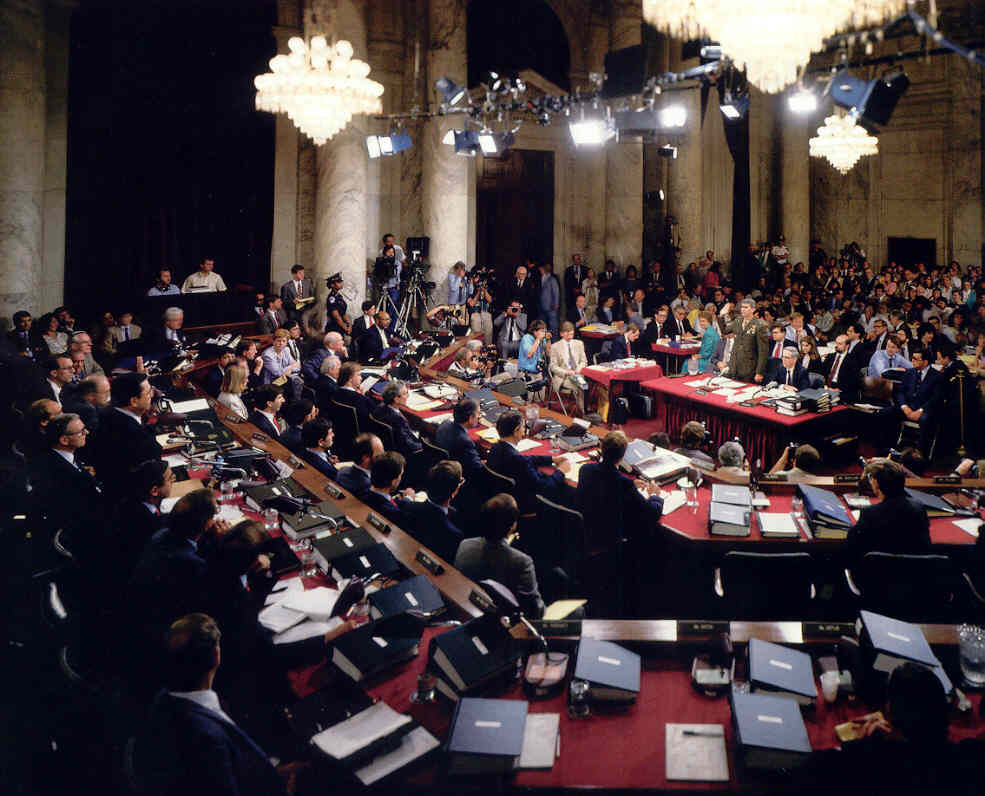
Lt. Col. Ollie North Testifying
before Congress
in the Iran-contra affair – July 1987
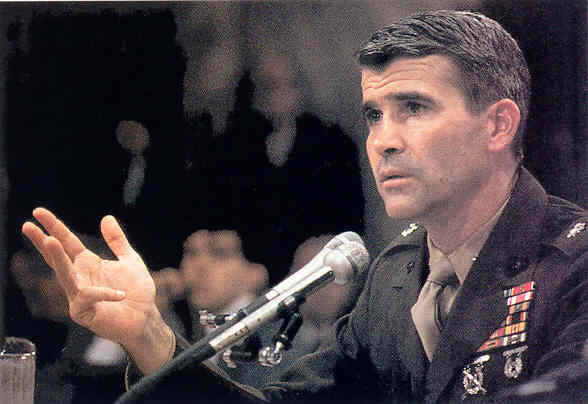
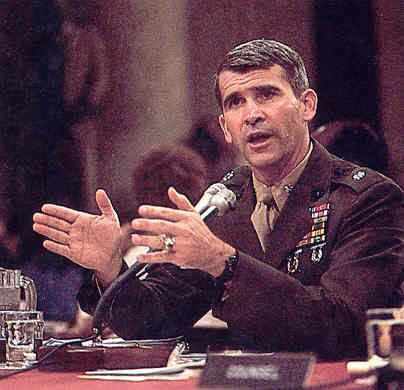
Oliver North testifying about
the Iran-Contra affair.
At the time, Reagan's popularity dropped dramatically from a
two-thirds approval rating to less than half.
Yet his approval ratings would soon climb again to pre-Iran-Contra
levels as he finished out his presidential term – due to his obvious success
with Gorbachev in lowering the tensions of the Cold War.

Go on to the next section:
 Miles
H. Hodges
Miles
H. Hodges

 Reagan enters the White House
 Reagan gets tough
  The American economy struggles forward
  Major develoments in foreign policy
  The Iran-Contra Affair