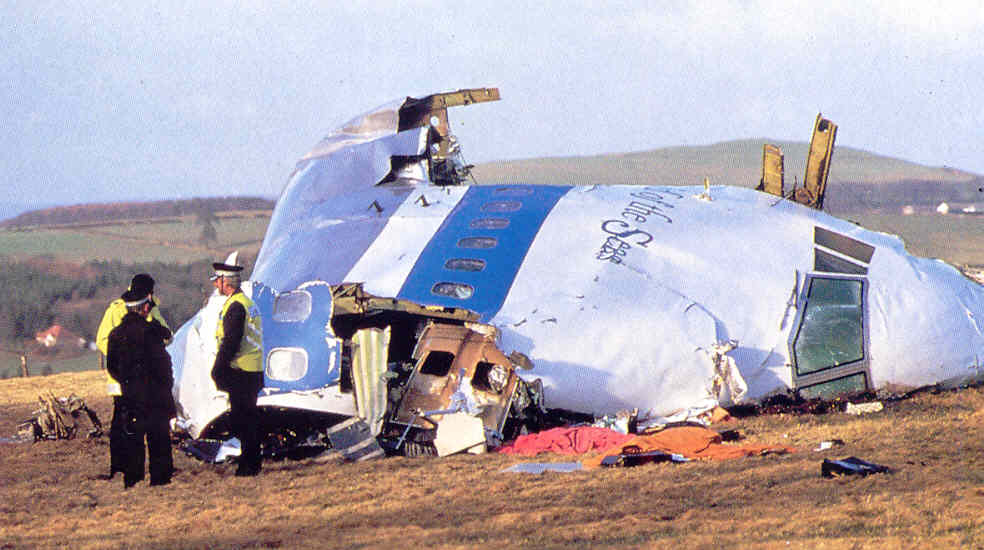
The Lockerbie bombing (December 1988).
Perhaps as the result of an effort by Libyan dictator Gaddafi to see what the newly elected
American President was made of (would he be tough like Reagan?) ... at the end of 1988 a Pan
Am passenger jet (Flight 103) exploded in the sky over Lockerbie, Scotland –
with everyone on board and 11 people on the ground killed. Under the subsequent investigation of the
explosion, the trail led back to Libya.
But nothing was done immediately to punish Gaddafi.
The remains of Pan Am flight
103 bombed by (Libyan) terrorists
over Lockerbie, Scotland – December 21,
1988
However
long-standing (and already struggling because of earlier security concerns) Pan
Am was sued for failing to take security precautions (but Pan Am reminded its
opponents that it received hundreds of notices daily about security concerns
and had no way to check out each and every one of them), bringing one of
America's oldest and largest global airline companies to bankruptcy and
extinction.
The breakup of the Soviet Empire in East Europe (1989). Although President Bush had little to do with what was
about to break out in the Soviet Empire, events there would form a huge part of
America's political focus during the Bush years (January 1989 to January 1993).
Gorbachev's reforms – not
surprisingly to those who understand these things – set off another "revolution
of rising expectations," which once underway would get way out of Gorbachev's ability to control. The well-announced new freedoms of glasnost and perestroika were also received
in the European satellite countries as some kind of permission to move to the
same freedoms in their own countries – first in Poland, then East Germany and
Czechoslovakia, etc. – and finally the very repressive Romania. 1989 would be the banner year for this
event.
Poland had actually been heading
down this road since 1980 under what started out as a labor organization: Solidarność (Solidarity). It had been suppressed by the Polish military
(fearful that it would invite another Soviet invasion) but had survived
nonetheless. And now in the new Gorbachev era, it was an active
participant in Poland's 1989 summer elections – in which Solidarity trounced
the Polish Communist Party. Gorbachev made no move to dismiss the
election results.
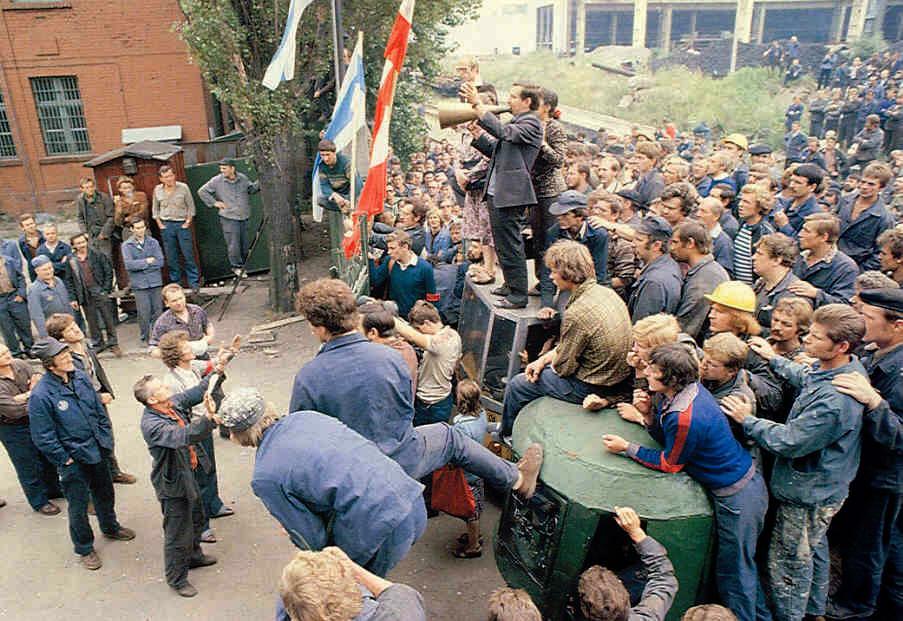
Lech Walesa leading the strike
of workers at the Lenin
Shipyards in
Gdansk, Poland – August 30, 1980
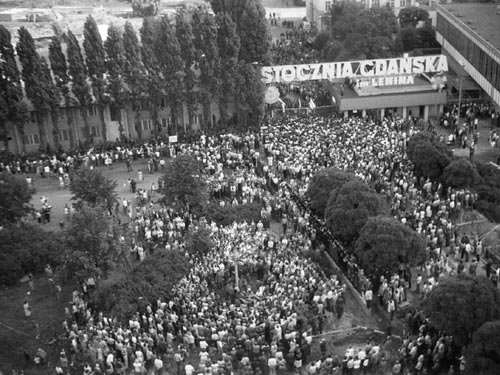
Striking Solidarity workers at the Lenin
Shipyard – 1980
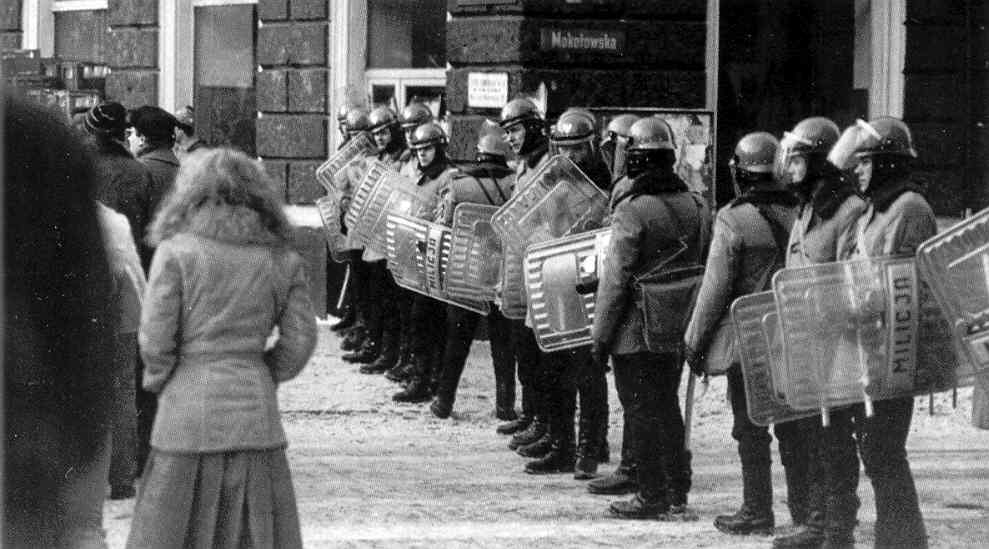
Polish military under Gen.
Jaruzelski, fearful of a Soviet
military reprisal (such as occurred in Czechoslovakia in 1968),
retake Poland from Solidarity – December 1981
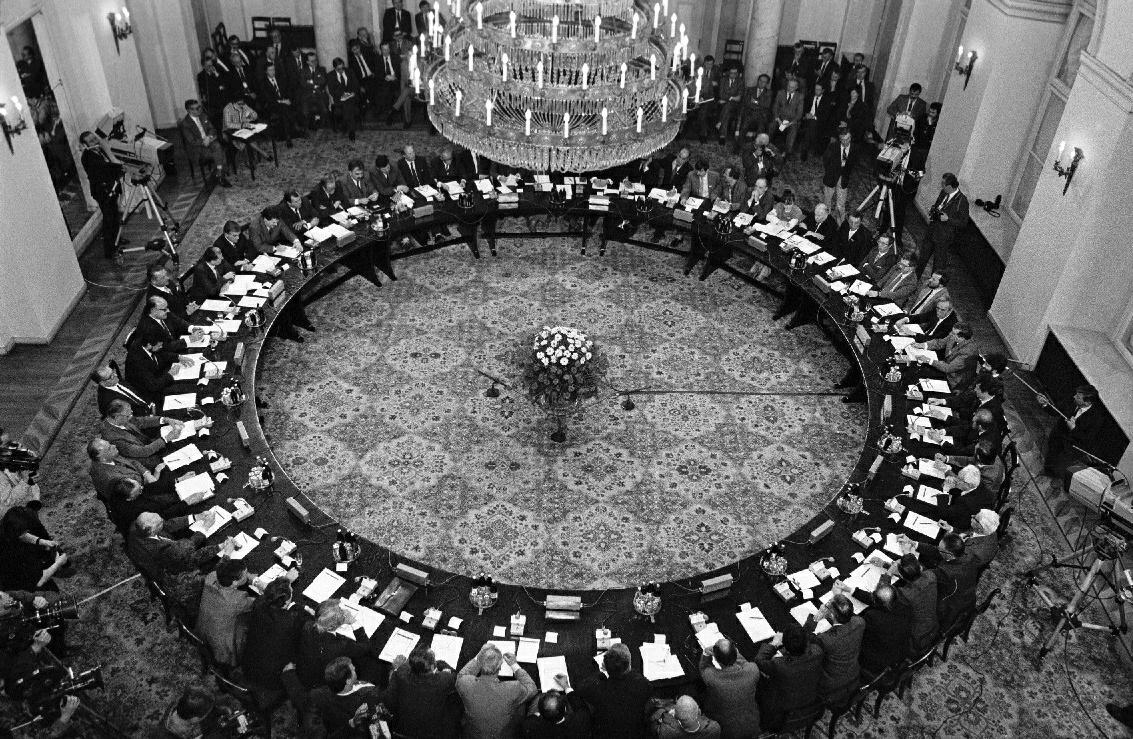
Polish Round Table Talks
took place in Warsaw, Poland from
February 6 to April 4, 1989
beginning the challenge
of the East
European "Soviet satellite" countries to Communist domination
Now
began a mad dash of other East European countries to attempt the same kind of
national elections – with virtually the same results: the Communists were swept from power and
replaced by new national parties. The
most dramatic was the event taking place in East Germany – when East Germans
began to flood into newly free Czechoslovakia and Hungary ...embarrassing the
East German Communist leader Honecker sufficiently so that he stepped down from
power. At this point, the East German
government simply disintegrated. In
November East Germans found themselves free to leave the country – and by
Christmas German youths had taken to smashing down (or trying anyway, because
it was quite sturdy!) the Berlin Wall.
Germany
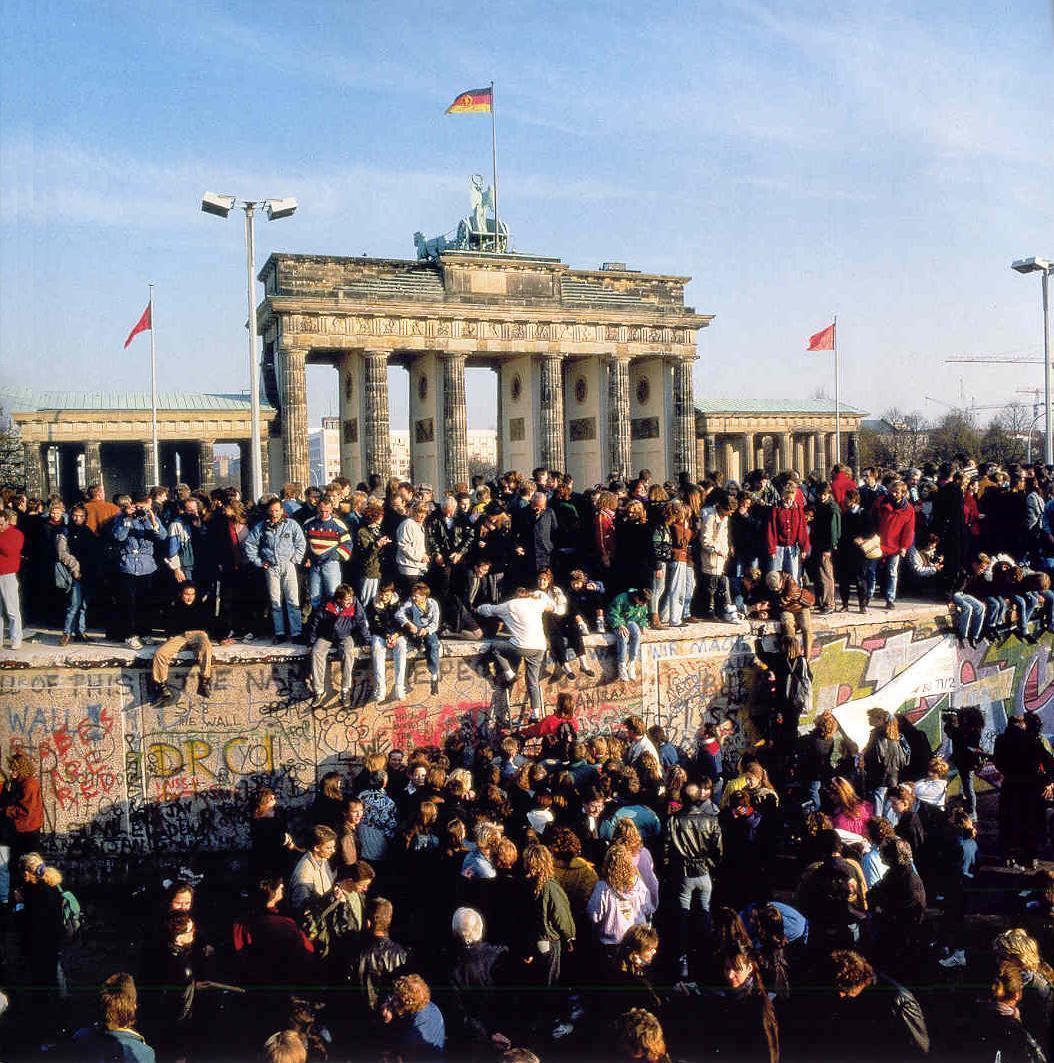
Celebrating the collapse
of East German Communism atop
the Berlin Wall – November 10, 1989
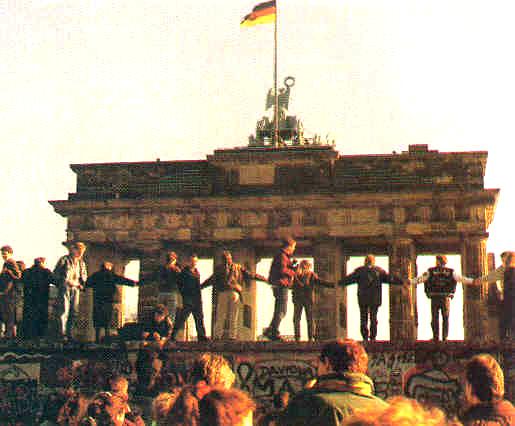
Germans dancing atop the
Berlin Wall
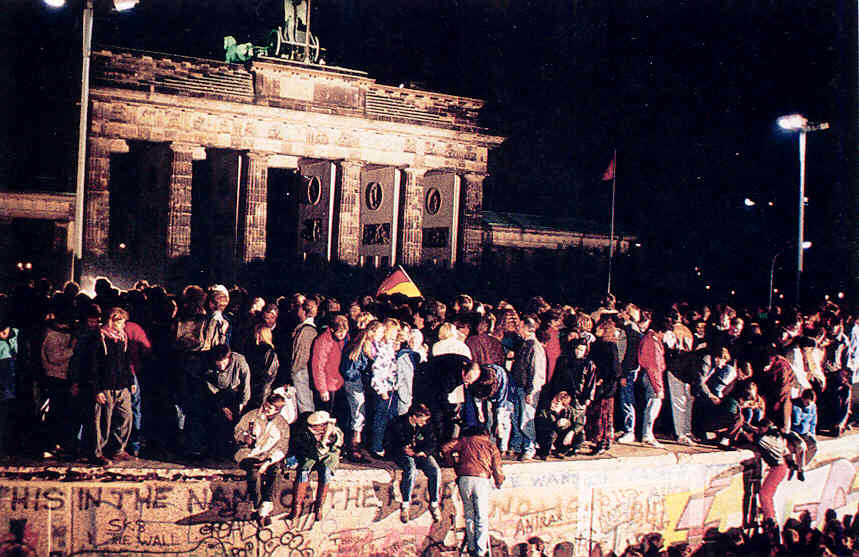
East and West Berliners celebrating
the end of 28 years
of separation by the Berlin Wall – November 10, 1989.
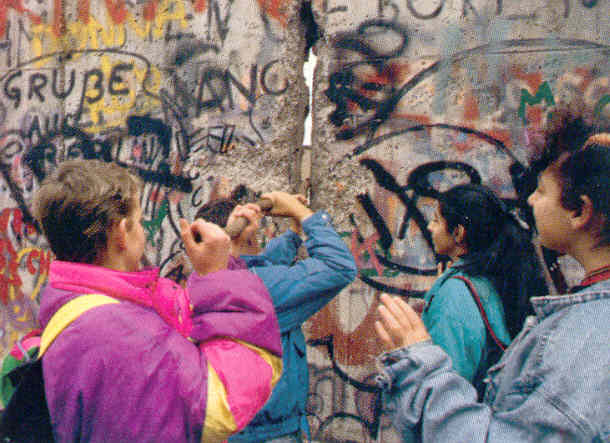
Hammering down the Berlin
Wall
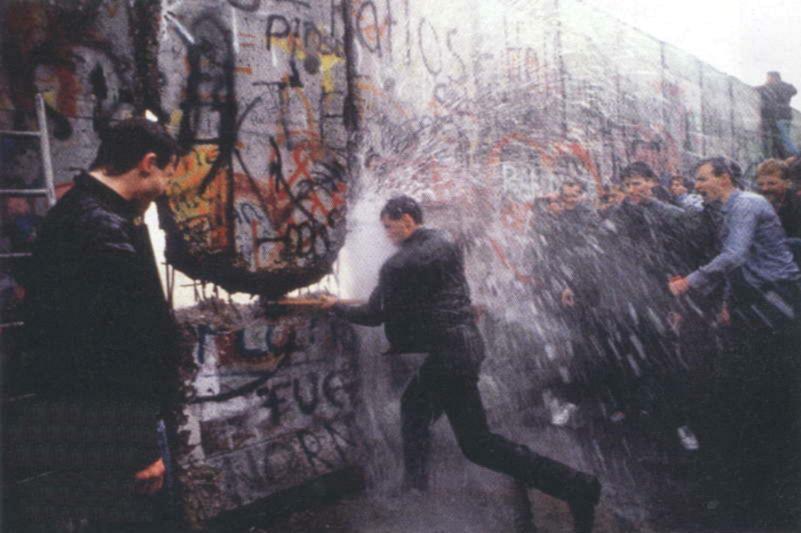
Bashing the Berlin Wall -
1989
Czechoslovakia
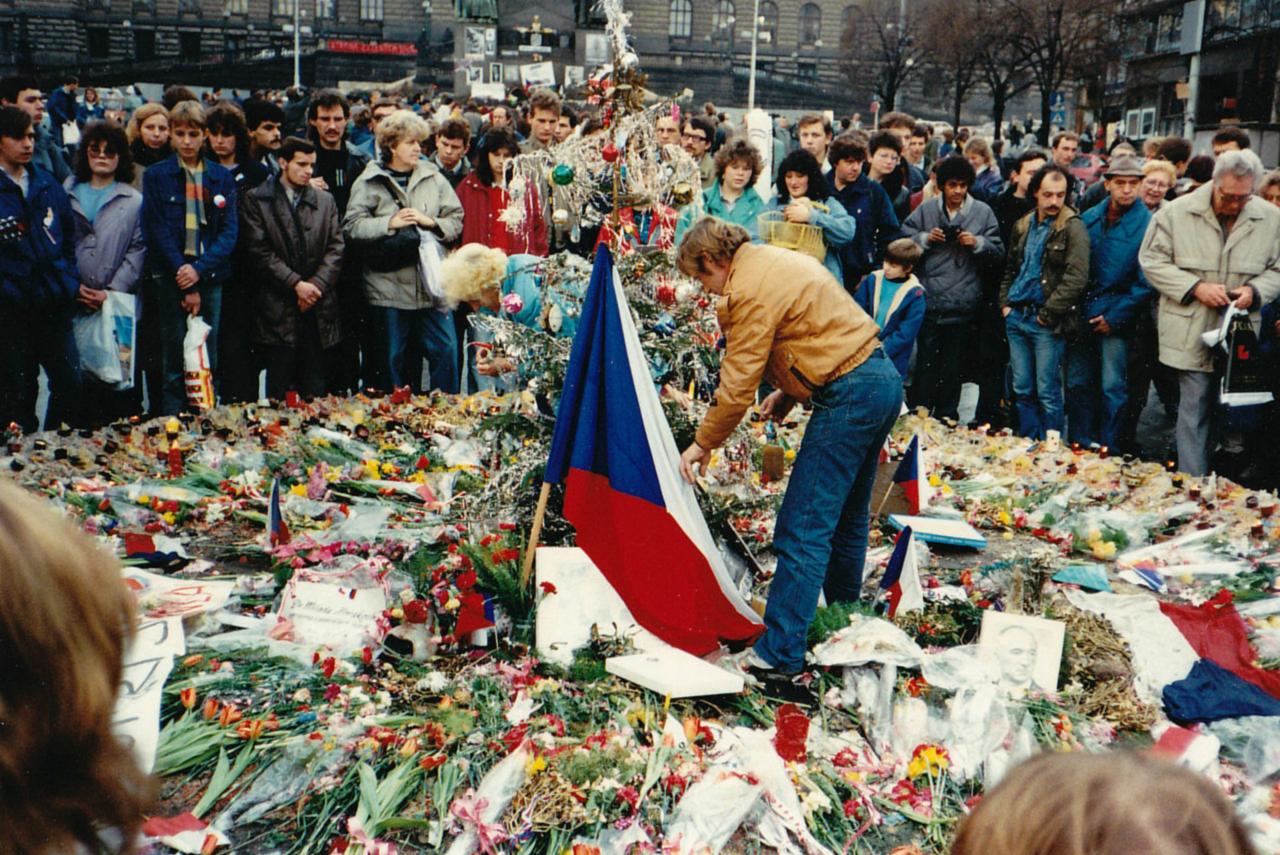
Vaclav Havel & peaceful
Prague protest – November 1989
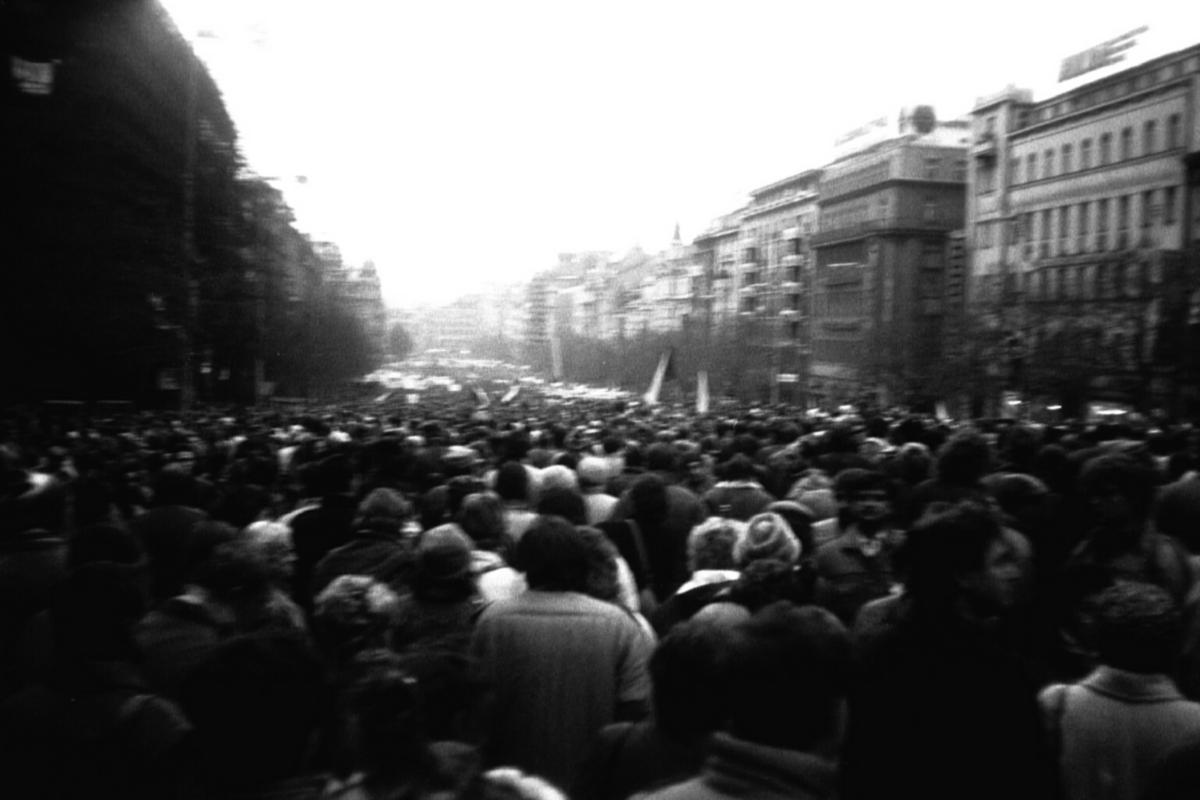
Wenceslas Square during the
Velvet Revolution – November 1989
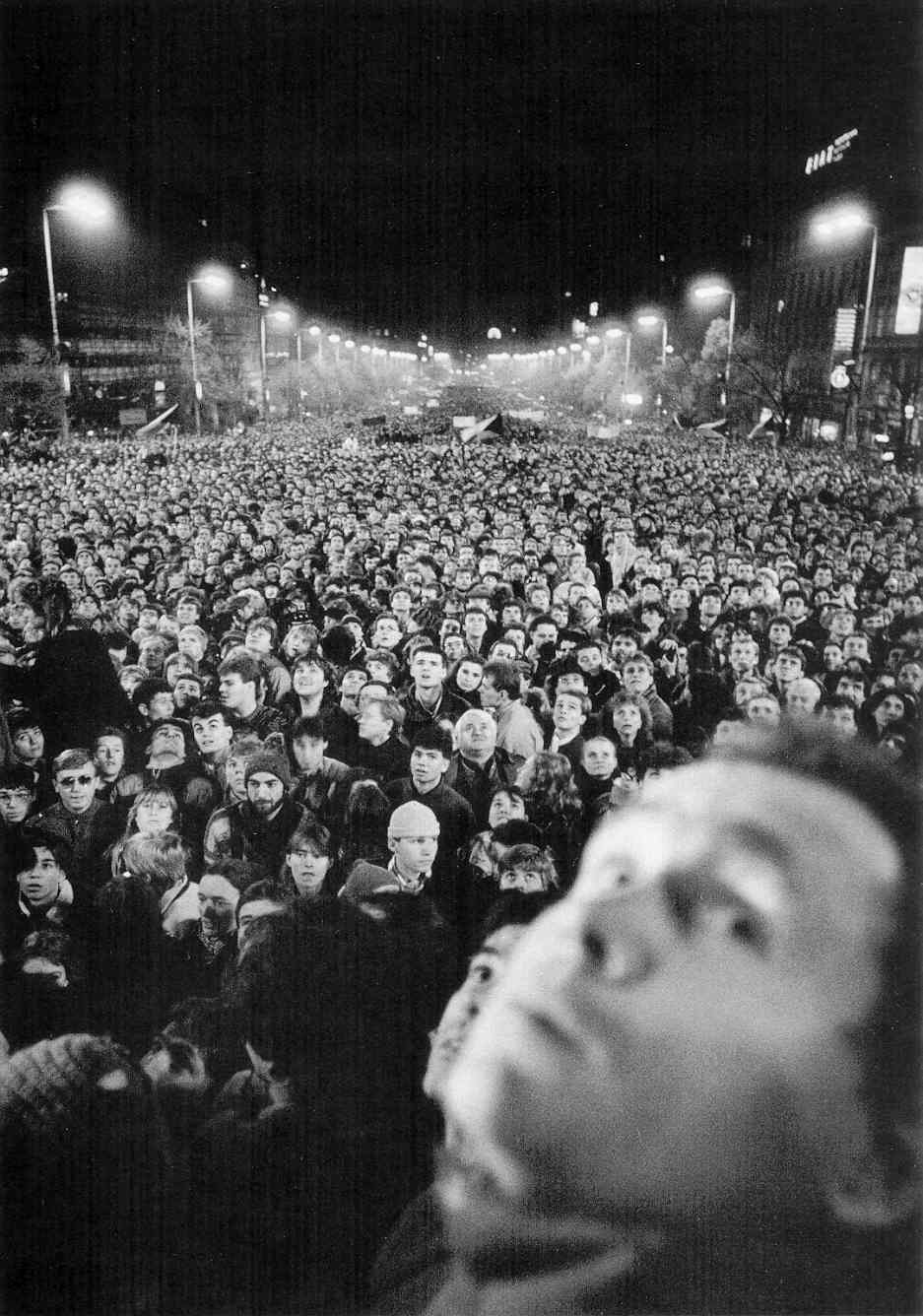
A pro-reform rally in Wenceslas
Square in Prague
November 1989.
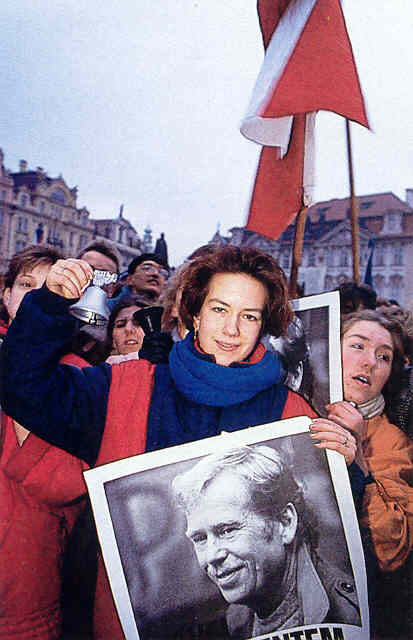
Czechs in Prague celebrating
their new freedoms
... won under the leadership of Vaclav
Havel -
January 1990
Only
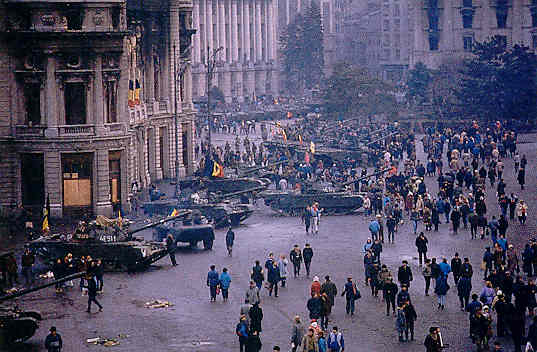
in Romania was the new order met by violence, when Romanian dictator Ceaucescu
had his troops attack protesters – until the soldiers actually joined the
protesters. In late December he and his
wife were arrested and rather immediately executed by a firing squad. The last of the Soviet satellite nations had
made their escape from the Soviet Empire.
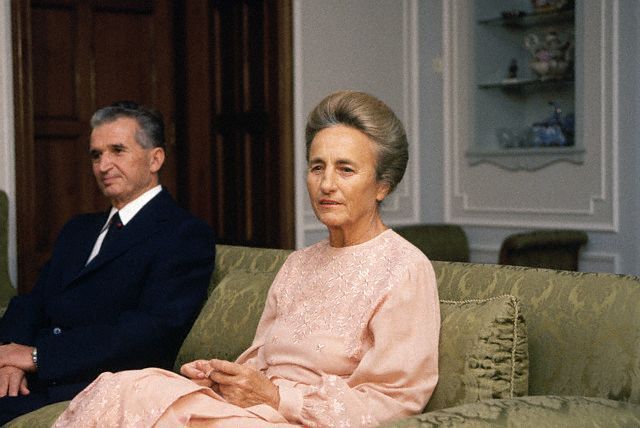 Romanian dictator Nicolae Ceausescu
and his wife Elena(he had appointed
his wife as Deputy Prime Minister)
Romanian dictator Nicolae Ceausescu
and his wife Elena(he had appointed
his wife as Deputy Prime Minister)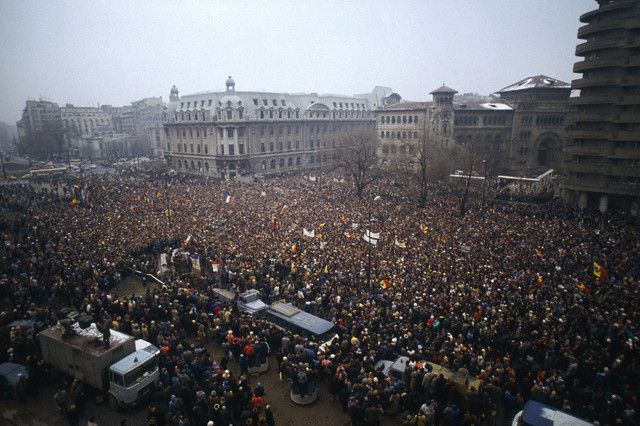 Romanian protesters in Bucharest -
December 1989
Romanian protesters in Bucharest -
December 1989
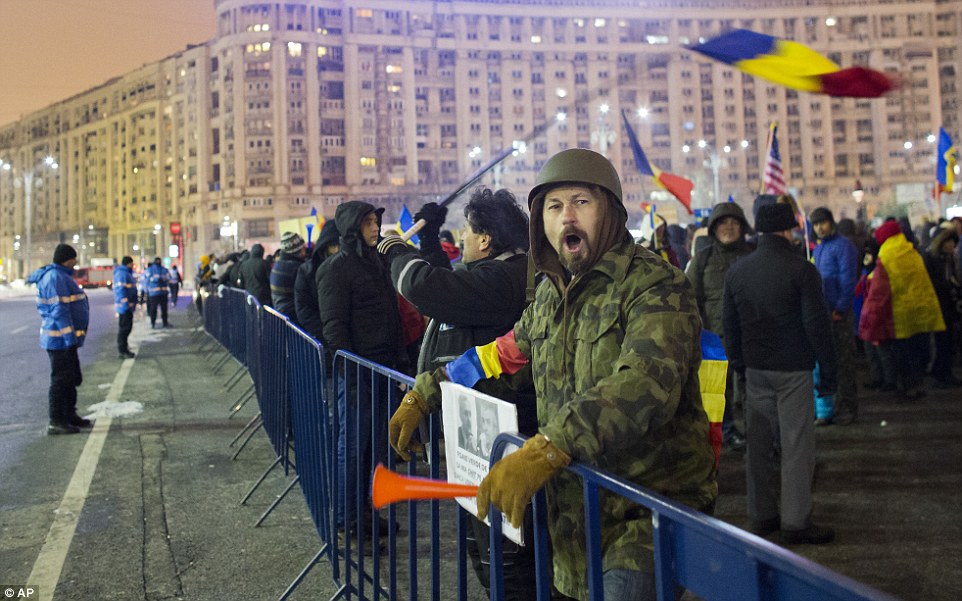 On December 22, the Romanian army
would join
On December 22, the Romanian army
would join
the side of the protesters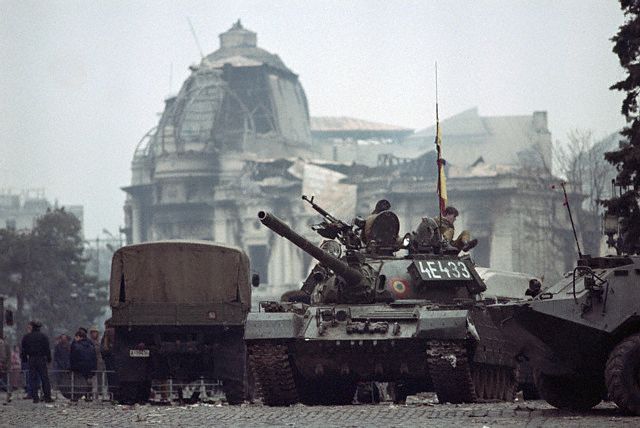
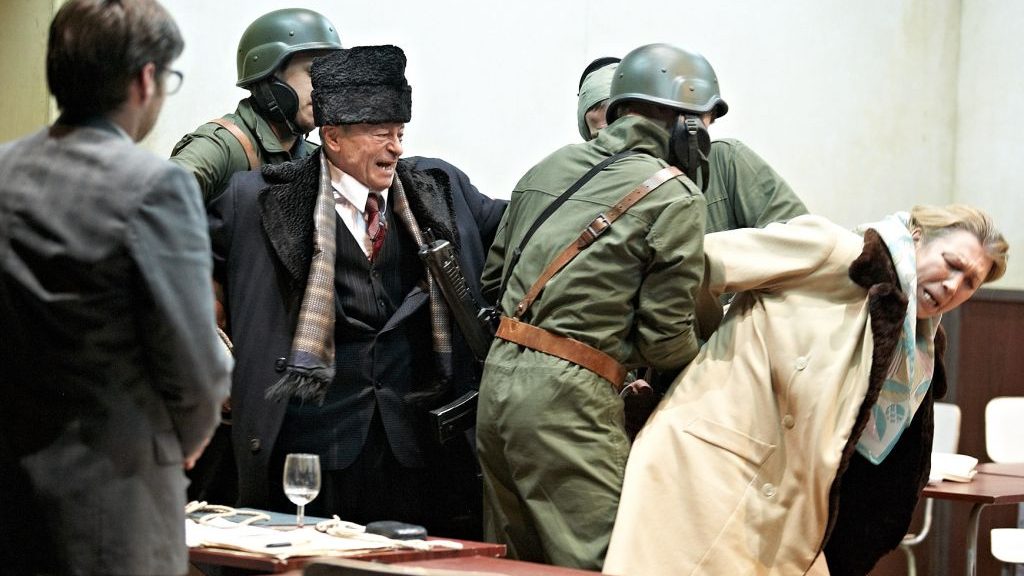 Nicolae Ceausescu and his wife Elena
arrested on December 22,1989
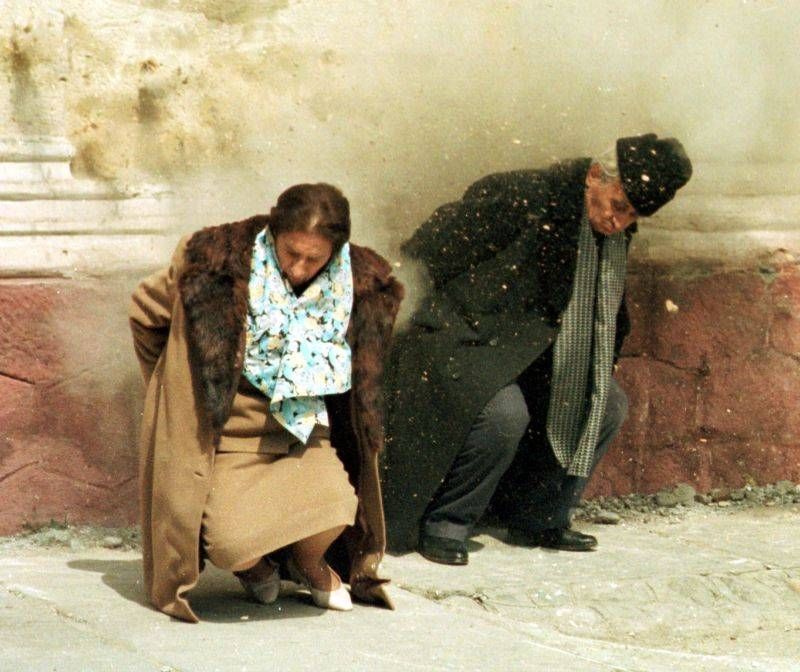
Romanian dictator Nicolae Ceausescu
and his wife Elena shot
after a brief 60-minute trial on Christmas Day
The Disintegration of the Soviet Union itself (1989-1991).
But the momentum did not stop with East Europe. At the same time, minority Soviet Republics
(from Estonia, Latvia, etc., on the Baltic Sea, South to Moldova and Ukraine,
and East across Asia to the Turkish "stans" of Kazakhstan,
Uzbekistan, etc.) were demanding independence from the Soviet Union
itself. Even the Russian Federation
(headed up by the Moscow Mayor Boris Yeltsin) was calling for independence
from the Soviet Union. Gorbachev was quickly losing control
of political events over the country that he theoretically still presided over.
So angry were the old Communist hardliners in Gorbachev's own cabinet over his
reforms that in August of 1991 they attempted a coup against Gorbachev, which did not go very well
– when Yeltsin led angry Russian protesters
to virtually imprison the plotters inside the Parliament Building. Thus the coup failed. But in the end, it also undercut Gorbachev's authority so badly that
Russia's political leadership seemed simply to have passed on to Yeltsin. And by the end of 1991, the Soviet Union was
no more when all of the former Soviet Republics (including even Russia) had
declared their national independence.
A failed attempt by Communist
hardliners to seize power
and end the Gorbachev reforms
(August 19-21 1991)
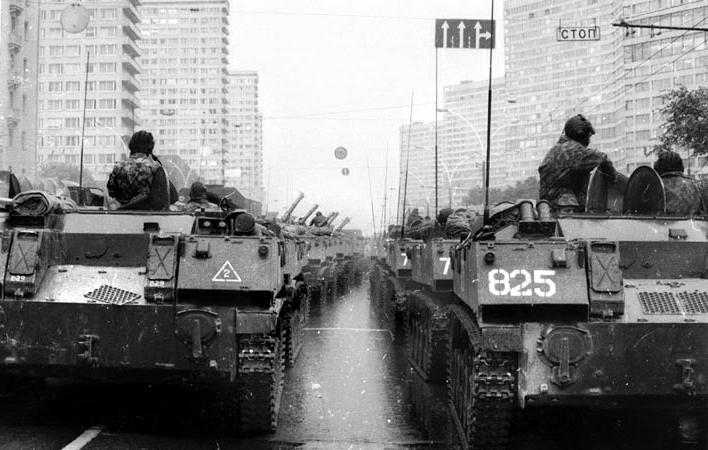
Tanks on Kalininsky
Prospekt
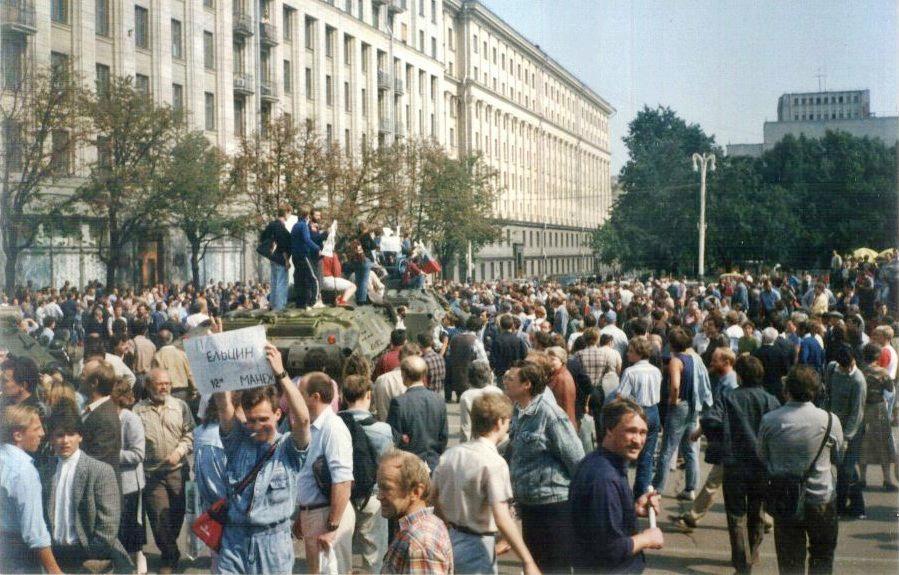
Demonstration in the
streets of Moscow during the August 1991
coup d'etat attempt.
A BTR-70 personnel carrier
is surrounded
by the demonstrators.
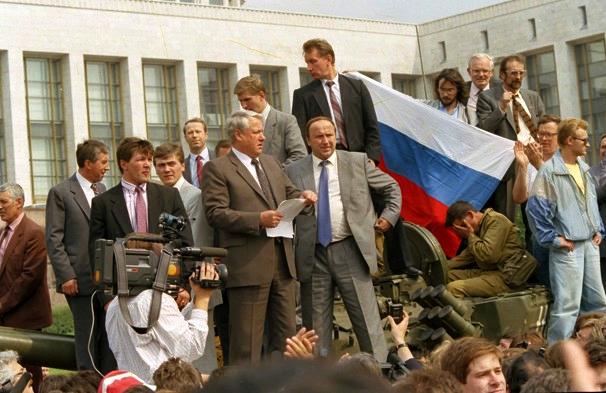
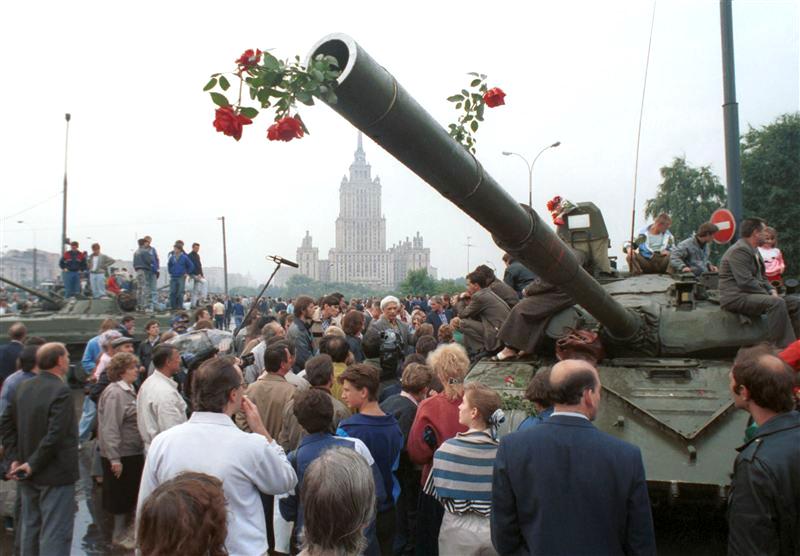
Boris Yeltsin on a tank addressing
fellow Moscovites
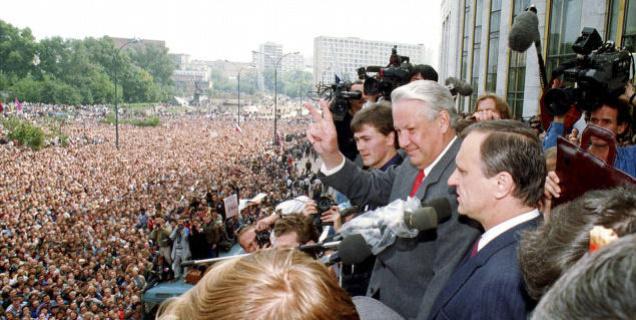
Boris Yeltsin addresses the
Moscow crowd
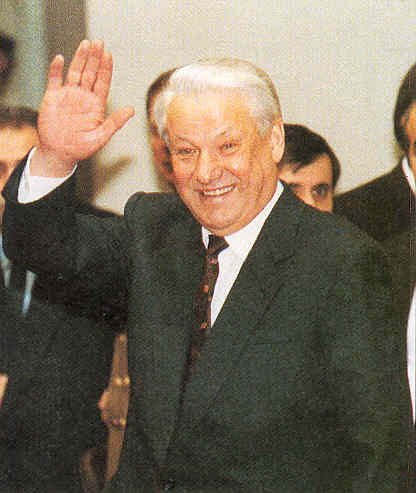
Boris Yeltsin – new Russian President
Tragedy at Tiananmen Square.
Chinese youth were watching closely developments in the Soviet Union ...
and decided that they wanted to go down the same road to full political
freedom. In April of 1989 thousands,
then tens of thousands, of youth gathered in Beijing's Tiananmen Square to
demonstrate support for full release from the Chinese government's political
restraints on Chinese society.
At
first the Chinese government did nothing, while a bitter debate developed
between the hardliners and the appeasers.
Finally Deng, seeing social disintegration as
the possible result of appeasement, moved toward the side of the hardliners, and
the decision was made at the beginning of June to forcibly clear the square of
its (possibly a million by this time) youth gathered there.
Thus
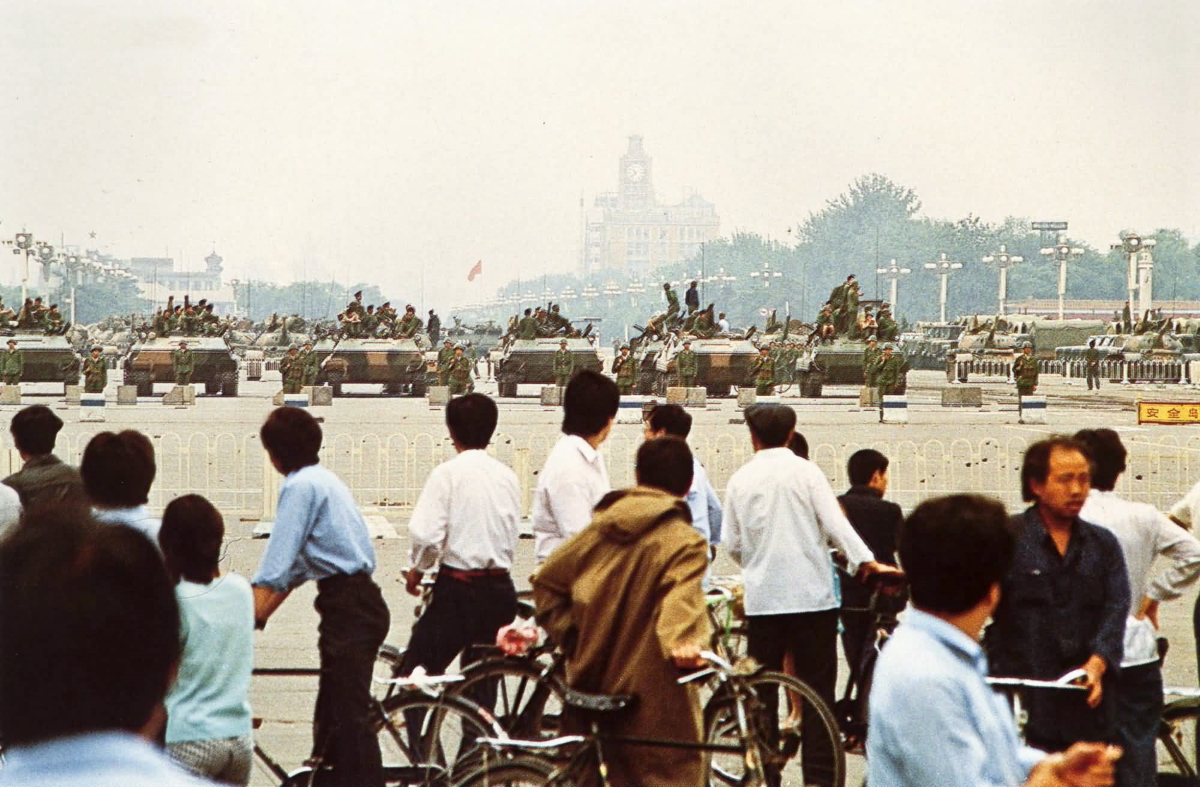
on the night of June 3-4 the Chinese military was ordered to clear the square,
by whatever means necessary. Guns and
even tanks were brought into use, resulting in the clearing of the square – but
also the death of countless youth in the process. And thus the political movement such as it
was (not always clear what exactly it hoped to achieve) came to an end in China.
Bush,
in company with the rest of Western leaders, was outraged at the Chinese
government's actions. But Bush soon backed off, trying to keep
a positive attitude toward Deng's China and its efforts to
Westernize, without disintegrating socially like Russia in the process.
Serious problems begin
to develop in the late spring of 1989 –
as Chinese students demand some of the same reforms that
they see Communism
undergoing in Eastern Europe
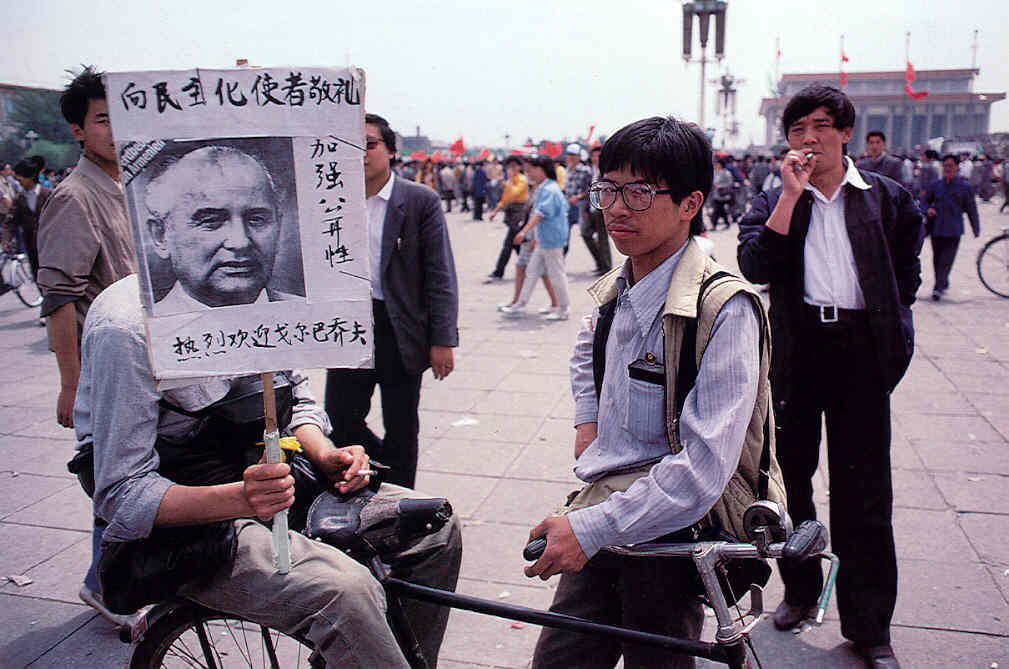
Students in Tiananmen square
calling for reforms in China
similar to those undertaken in Russia by Gorbachev
Spring of 1989
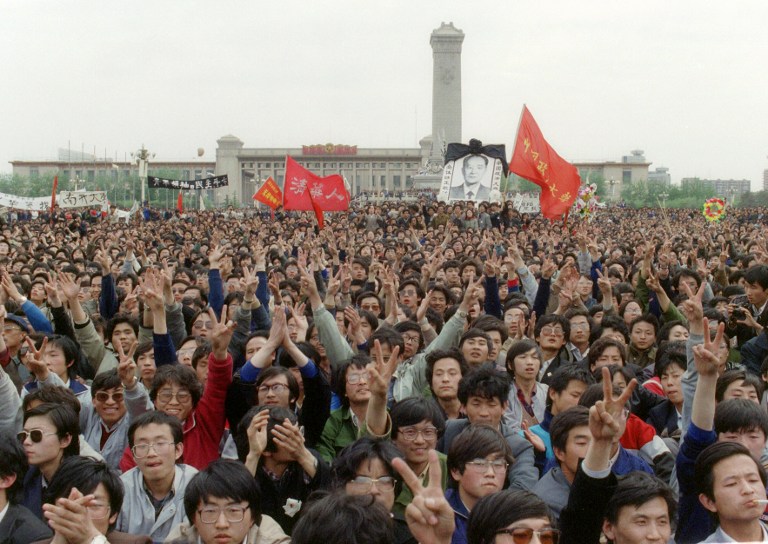
April 22, 1989 -
thousands (200,000?) of students at Tiananmen
Square gather to honor Liberal reformer
Hu Yaobang
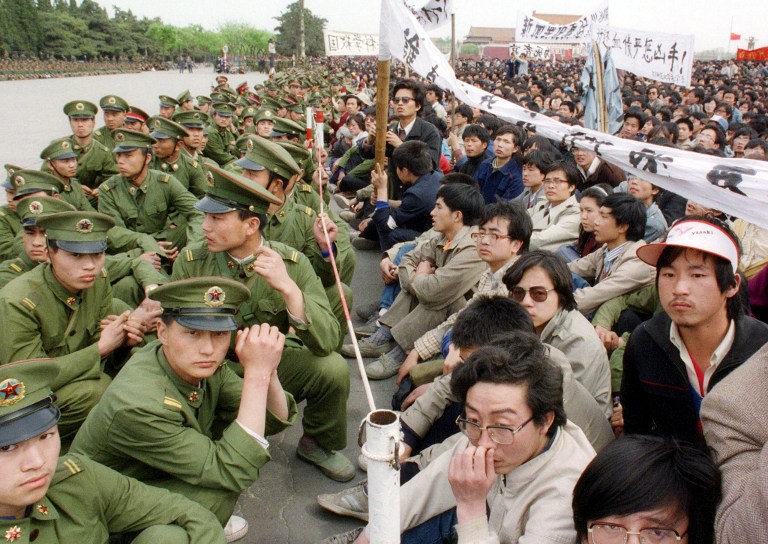
Police and protesters meet
at a line drawn up
in front of the Great Hall of the People
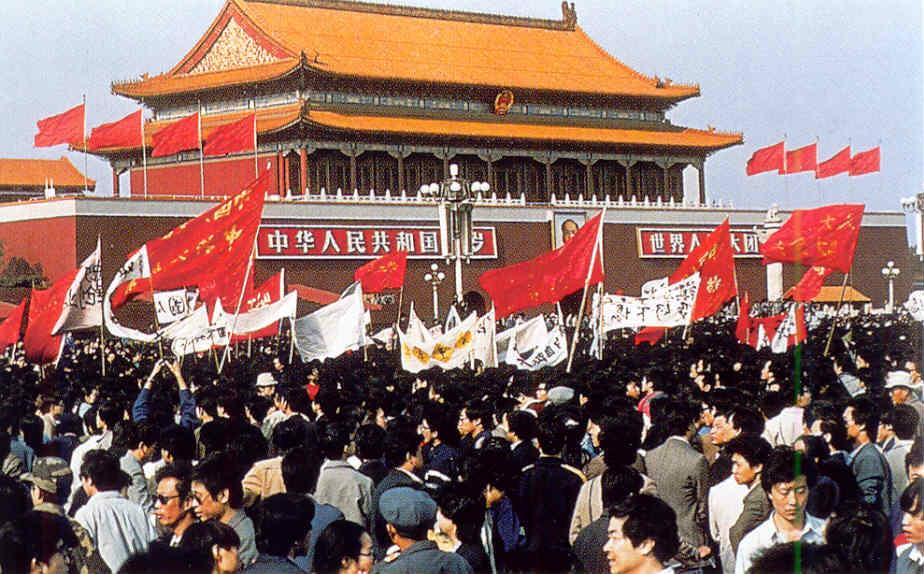
Student demonstrators gather in ever
greater numbers
in
Tiananmen Square, Beijing – April 27, 1989
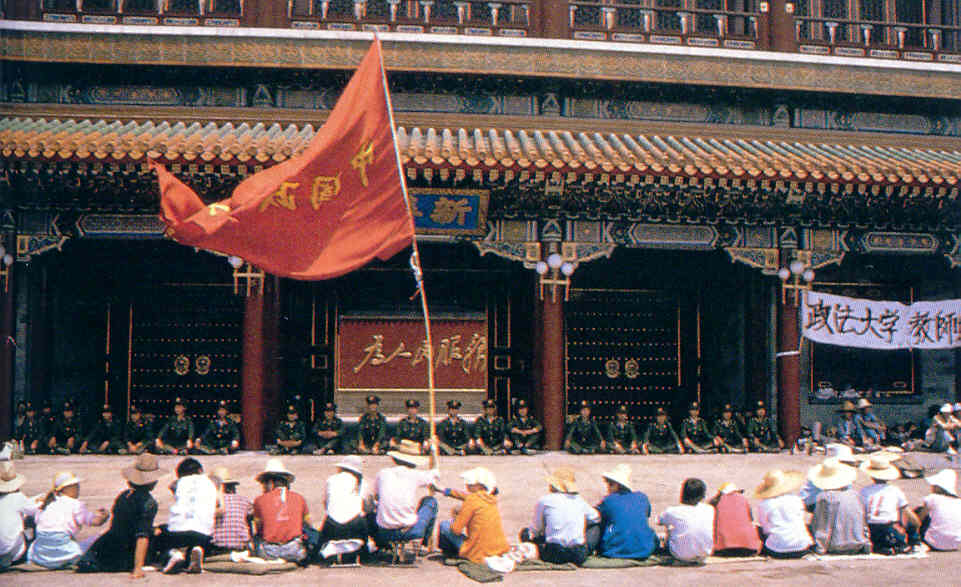
Students in Tiananmen Square
in silent protest before the Red Army
late spring 1989.
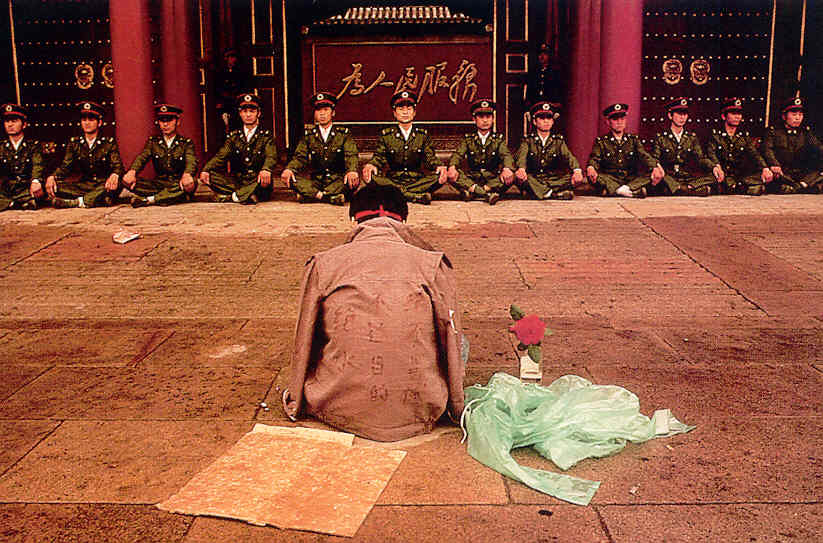
A student protester seated
before the Chinese military – May 1989.
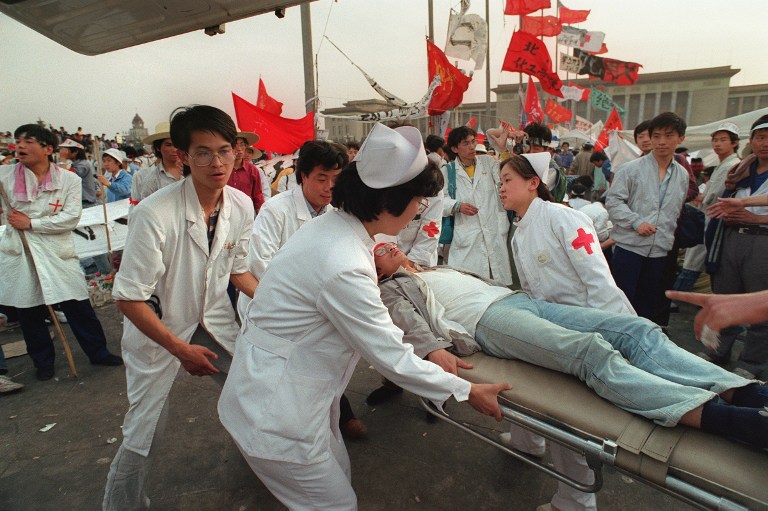
In mid-May a number of the students undertook a hunger-strike
to
protest in favor of democracy
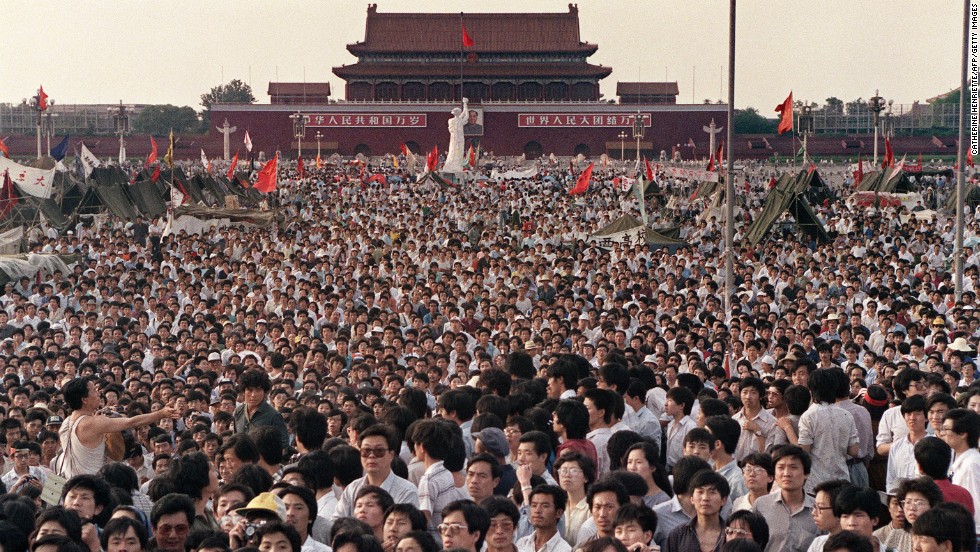
By the beginning of June hundreds of
thousands (even a million?)
had convened on Tiananmen Square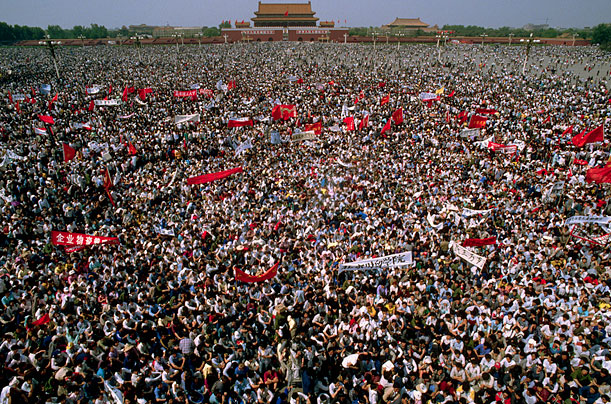 On June 4th, masses of troops are
brought in
On June 4th, masses of troops are
brought in
to clear the Square of the protesters
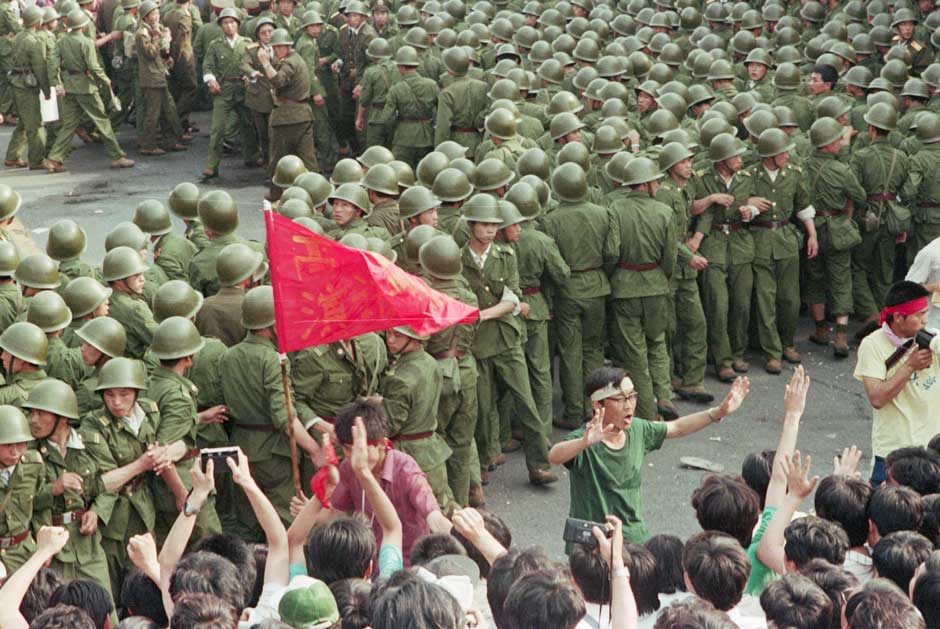
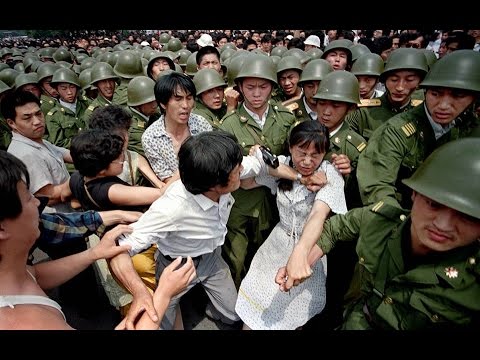
The clearing of the Tiananmen
Square by soldiers turns violent
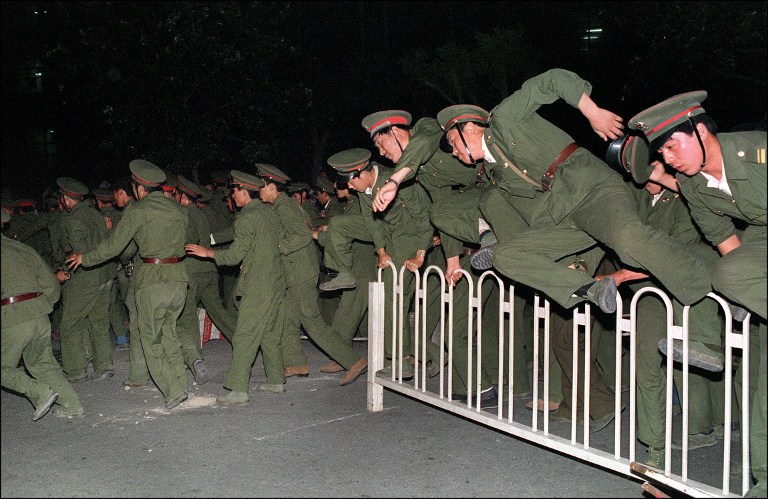
On the night of June 3-4 the soldiers begin their move
to clear the
Square of protesters
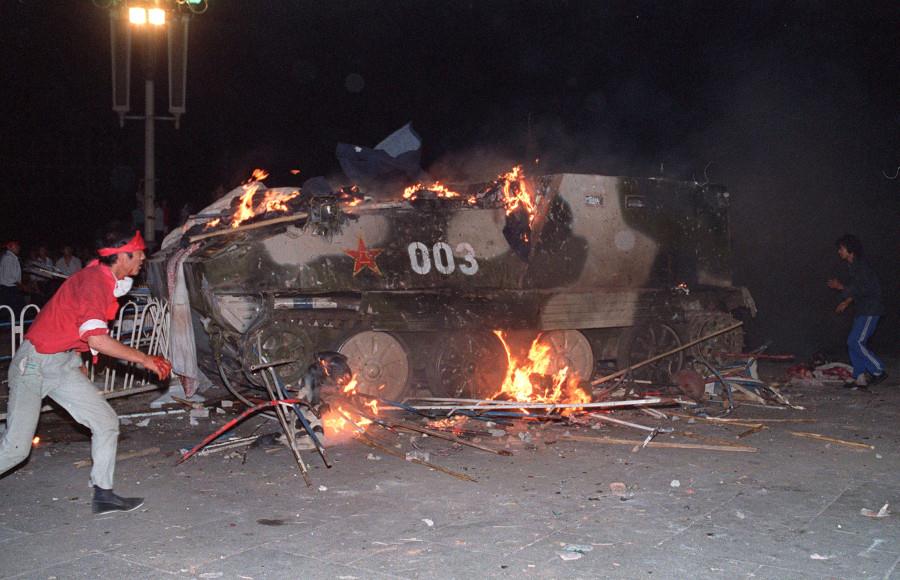
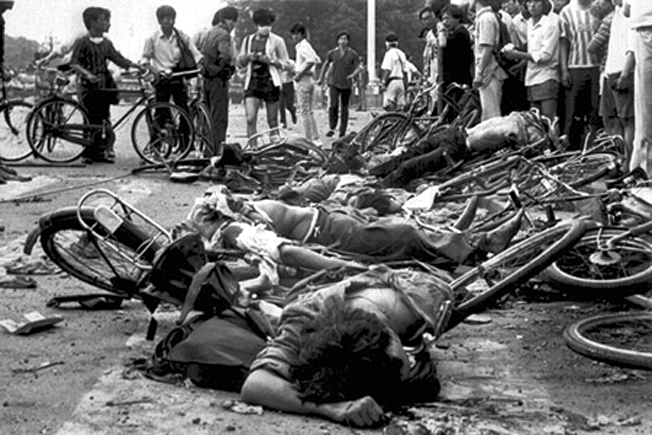
The aftermath of the Tiananmen Square
protest
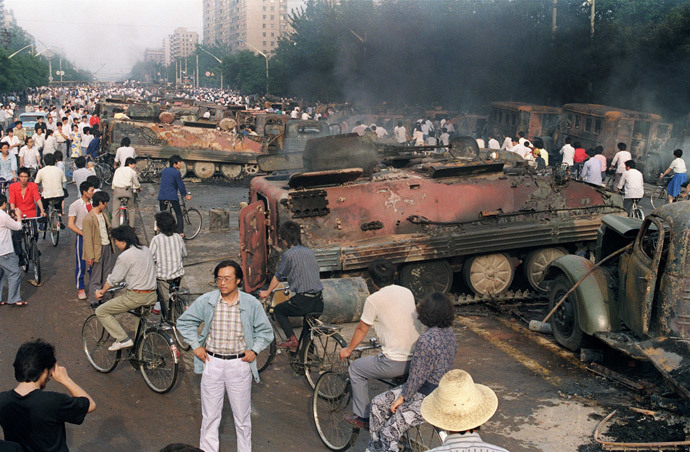 Burned out
personnel-carriers
Burned out
personnel-carriers
On June 5, a multitude of tanks show up
to prevent the protesters
from returning to
the Square
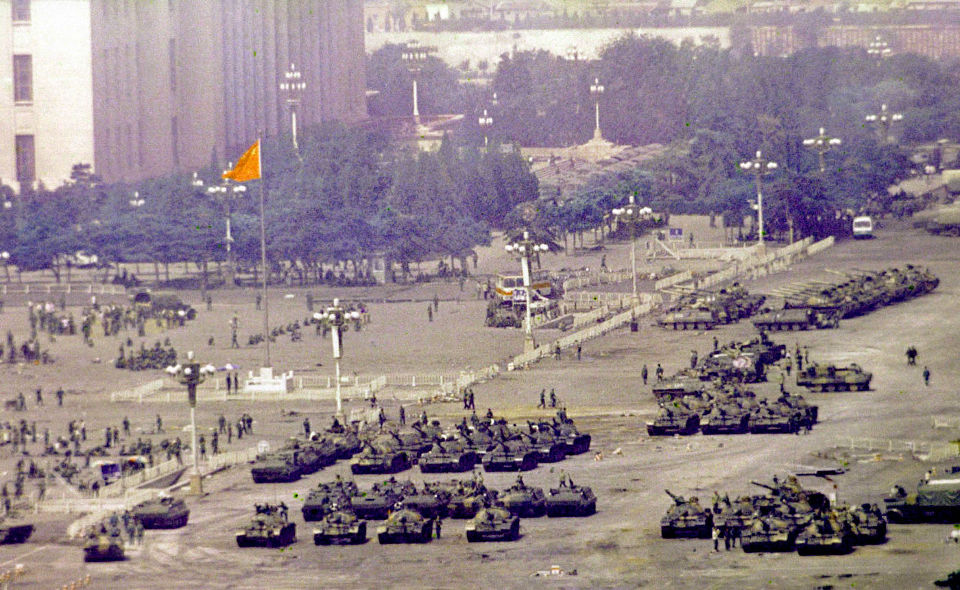
Tanks advancing on the remaining
protesters
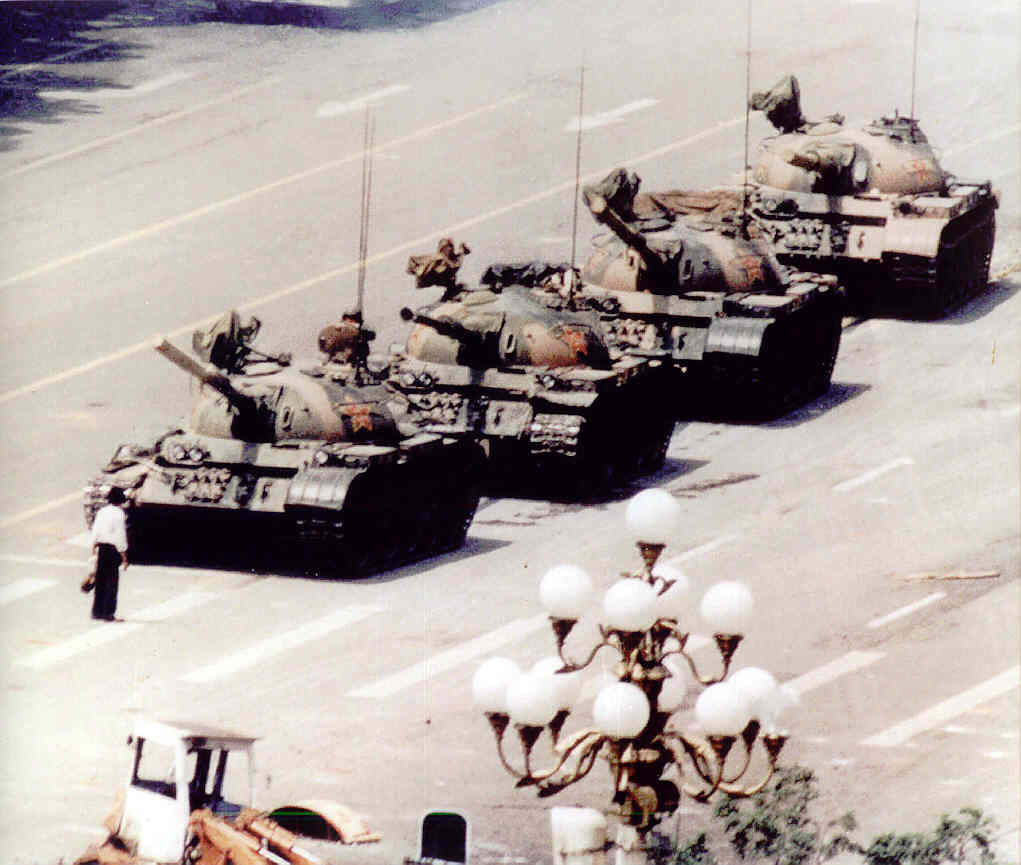
A student defying Chinese
T-59 tanks in Tiananmen Square
June 5, 1989
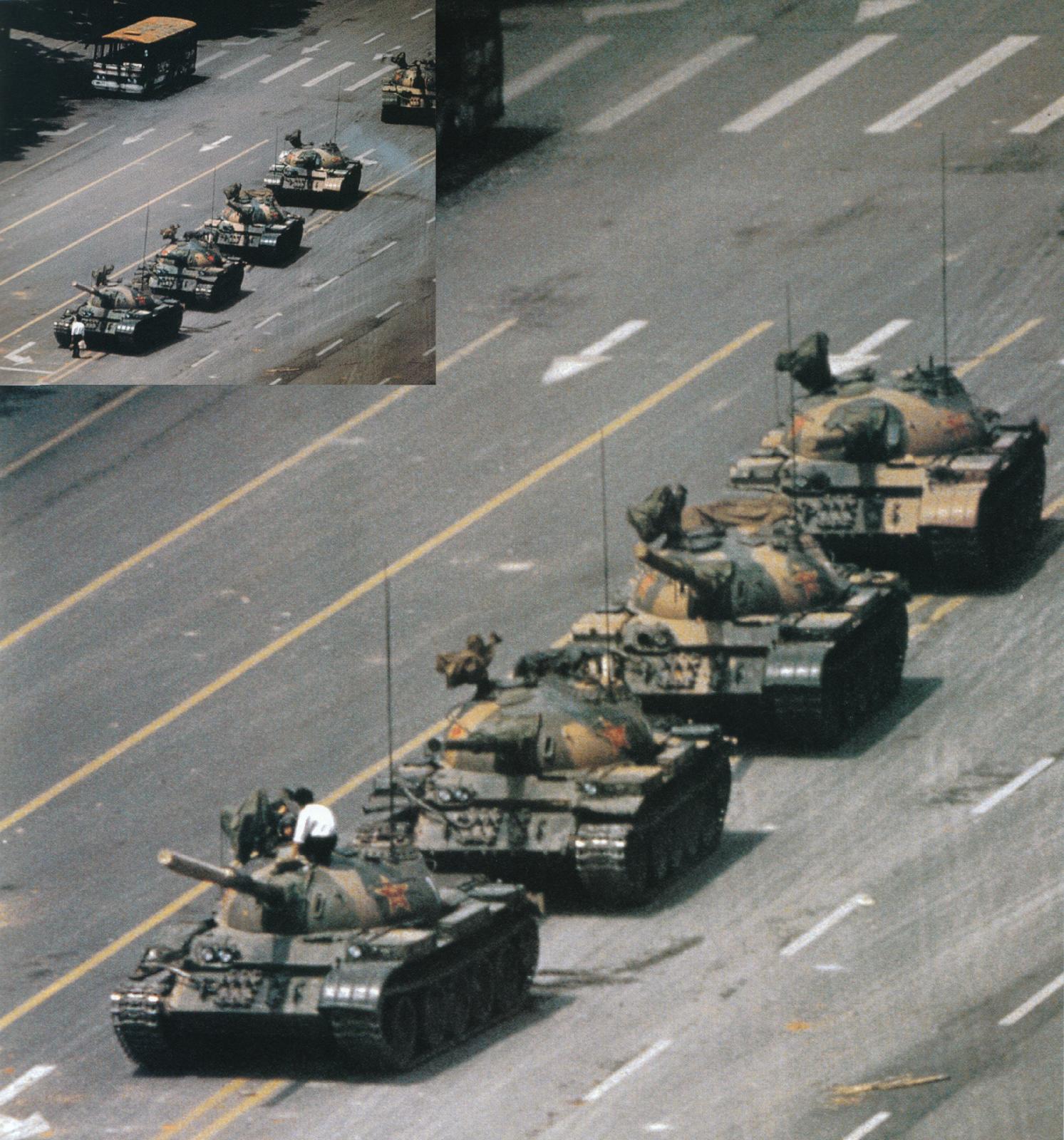
A lone protester and Chinese
T-59 tanks at Tiananmen Square
The Gulf War or "Desert Storm"
(1990-1991). In the meantime, a very big problem had
developed in the Middle East when Iraqi dictator Saddam Hussein had his Iraqi army
invade and occupy the tiny (but oil rich) neighbor, Kuwait. The whole thing ended up as a huge political
miscalculation by Saddam – one that threatened to start
up another Arab oil crisis. But Bush was
determined to prevent that from happening.
Saddam had been long involved in an
Iran-Iraq War (1980-1988) which started up when Saddam attempted to grab ethnically
Arab lands located just across the Iraqi border in ethnically Persian Iran
(Persian Iran is not Arab in language or culture – though certainly Muslim,
although of the dissenting Shi'ite variety, as are most of the
Arabs in that part of the Muslim world).
But this merely bogged the two countries down in a campaign of vast
mutual destruction ...until in 1988 when the United Nations was able to work
out a truce between the two countries.
At the end of this war Iraq found itself hugely in debt due to the fact
that its oil industry had been mostly shut down during that long war.
Then tensions had grown between Iraq and Kuwait, when Iraq accused
Kuwait of not only overproducing oil sales (thus keeping prices very low) but
also slant-drilling below ground – right into Iraqi oil fields near their
border. There was also Iraqi resentment
over the very existence of Kuwait in the first place – carved out of former
Mesopotamia (Iraq) after World War One – simply to give the British oil
company, British Petroleum, an oil source it could continue to control. Also Saddam had the usual Arab desire to
play the part of grand leader of the larger Arab world.
On
top of this, Saddam thought he had the go-ahead
from America via the American Ambassador who seemed to offer only an
indifferent response when Saddam told her of his plans to grab
Kuwait. Besides, Iraq was something of
an American ally – being the third-largest recipient of American foreign aid
(especially during the Iran-Iraq War).
Thus
when Saddam invaded Kuwait in August of
1990, he was stunned to find himself in trouble with Bush, who demanded that he get his
troops out of Kuwait. But at that point Saddam felt he could not do that –
for such a retreat would deeply undermine his ever-shaky position as Iraqi
dictator.
This
was importantly due to the fact that he was a Sunni Arab, supported by the smaller Sunni Arab portion of the Iraqi
population, holding tight control over the majority Shi'ite Arab portion of the
population, the latter group resenting deeply Saddam and his Sunni Ba'athist Party's dominance in Iraqi
political affairs. Thus it was that his
position in Iraq was very fragile.
Negotiations between Saddam and Bush dragged on ... going
nowhere in the process. But in the
meantime, Bush was putting together a grand coalition of European and Arab
countries (other Arab countries were also afraid of Saddam's ambitions), including Saudi
Arabia, which let America use its land as a base to build up a large coalition
force there. By mid-January the
coalition army was ready to move.
The
Iraqi Army and Air Force proved to be no match to the coalition forces which
quickly downed and blasted everything Saddam could muster. In the matter of simply a few days, the
Iraqi Army was chased from Kuwait.
Of
course at the first gun shots, the "anti-imperialist" voices of the
American Left waxed indignant – but soon were silenced by the stunning success
of Bush and his coalition forces.
Then
Bush halted his attack on the retreating Iraqis. He had no interest in going any further after
Saddam. He had kicked him out of Kuwait. That was as far as he was going to go. Furthermore, he had no desire whatsoever to
find himself having to take responsibility for a shattered country of
conflicting ethnic groups (60% Shi'ite Arabs, 20% Sunni Arabs, and 20% Sunni Kurds) groups that hated each
other and were held together as a society only by the tight grip of the Ba'athist
organization that Saddam headed up in Baghdad. No, America was not going to get itself
caught up in nation-building. Vietnam had taught President Bush the
dangers of such arrogance. America would
not be fixing Iraq. To try to do so
would be for America to fall into a "quagmire," as Bush's Secretary
of Defense Dick Cheney would later (1994) explain the
decision.

Iraqi dictator Saddam Hussein
... at one point an ally in his war with Khomeini's Iran.
Now an adversary
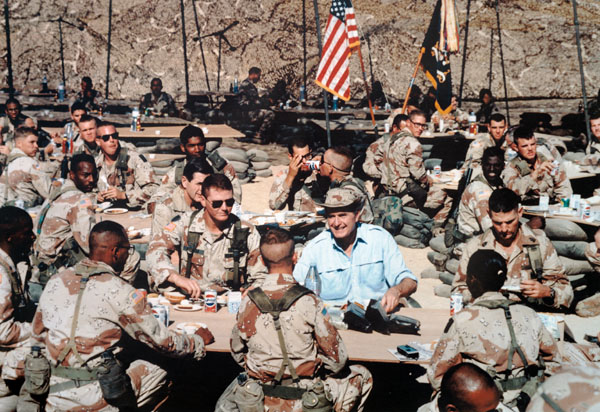
President George Bush enjoys
Thanksgiving Dinner
with U. S. troops stationed in the Persian Gulf
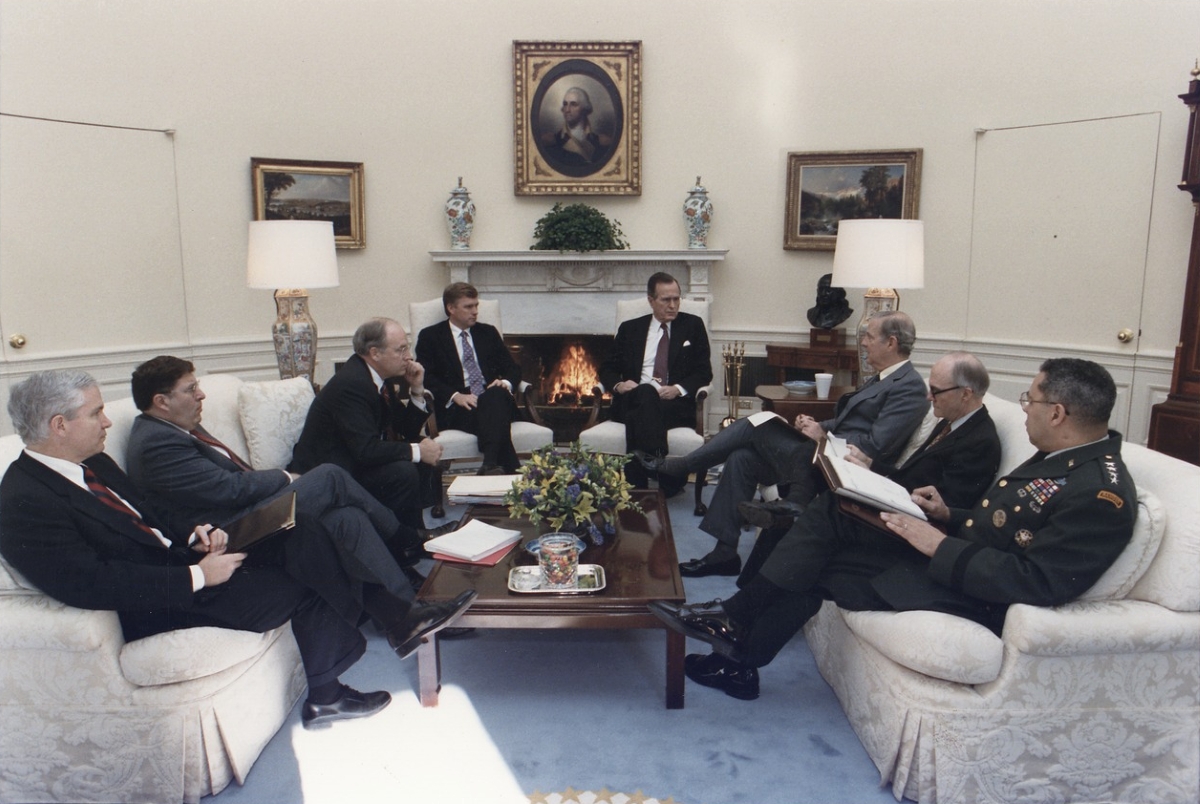
Bush meeting with his staff concerning the developing
situation in the Persian Gulf – January 1991
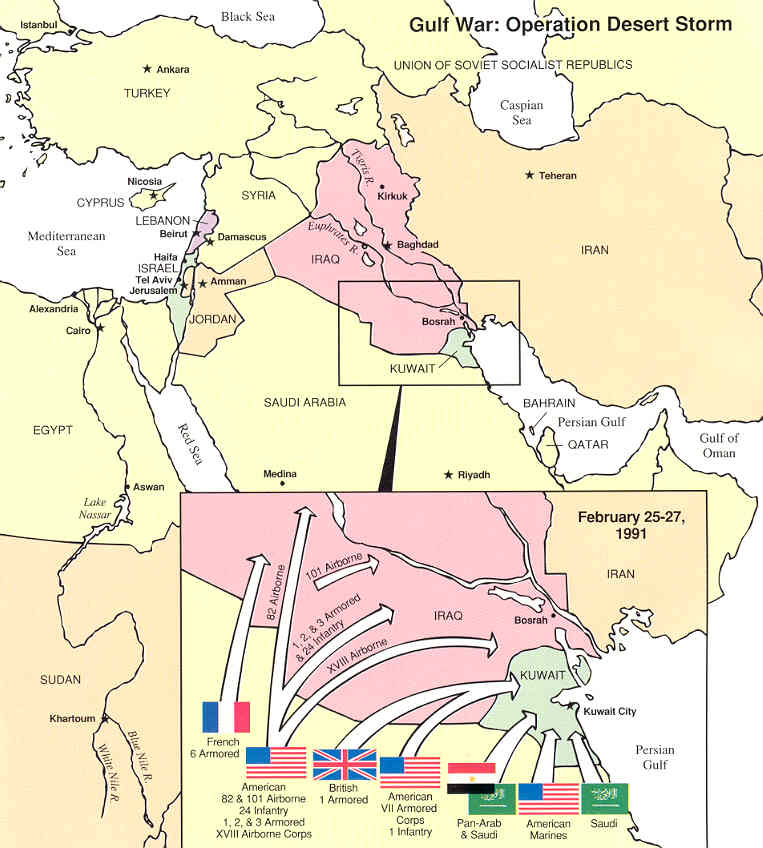
Keesee and Sidwell, p.
633
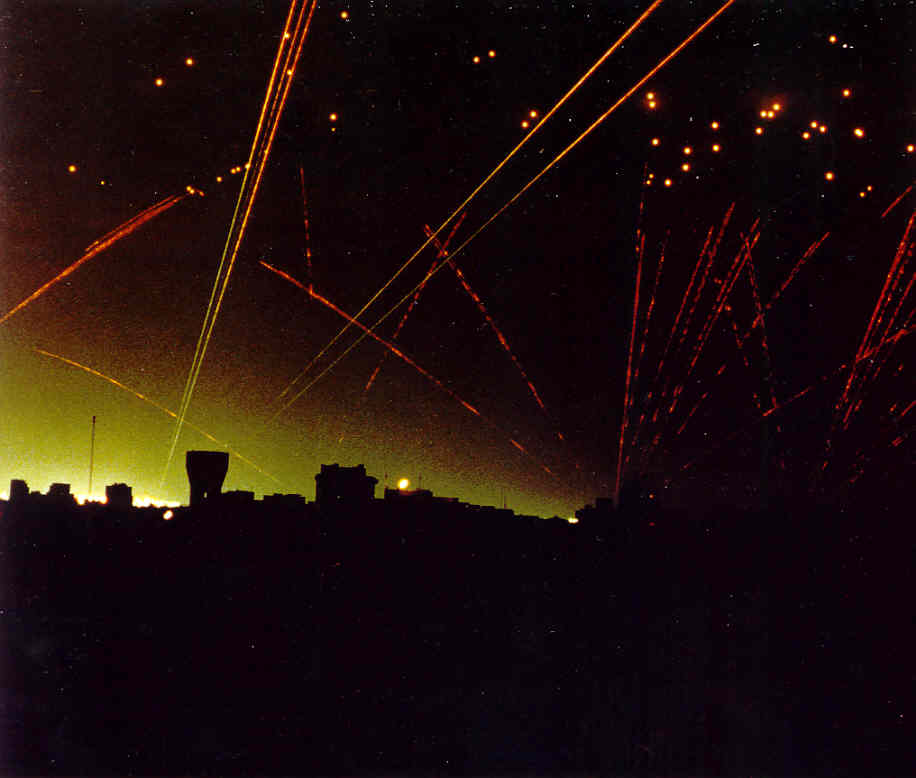
Gulf War – Air raid over
Baghdad January, 1991.
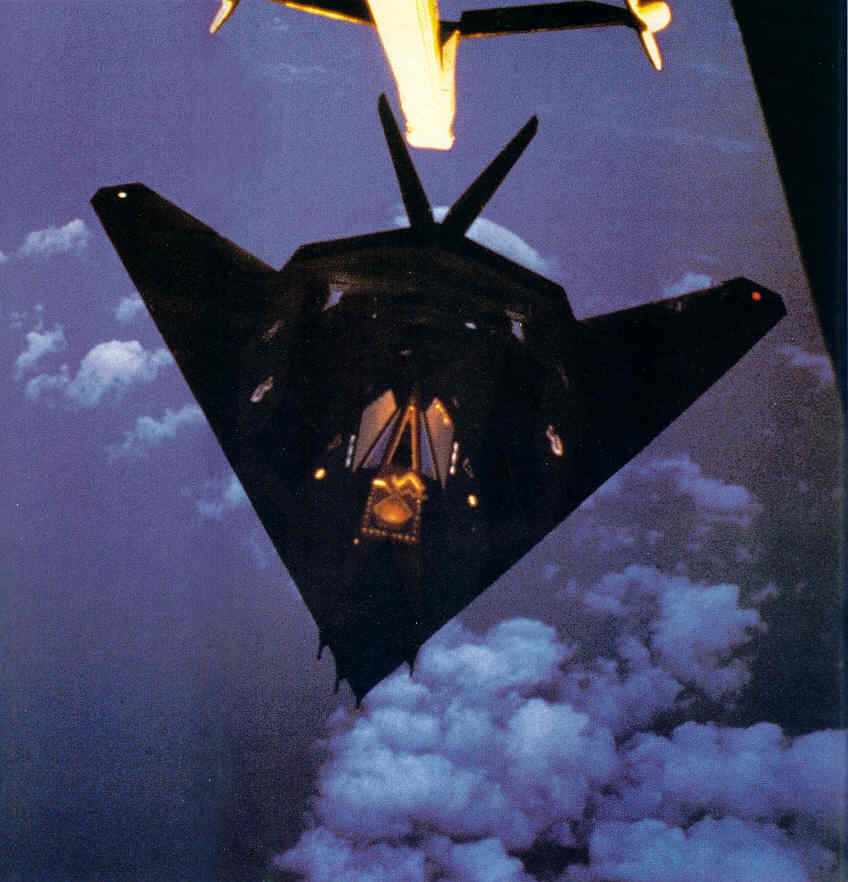
Refueling an F-117 bomber
over Iraq.
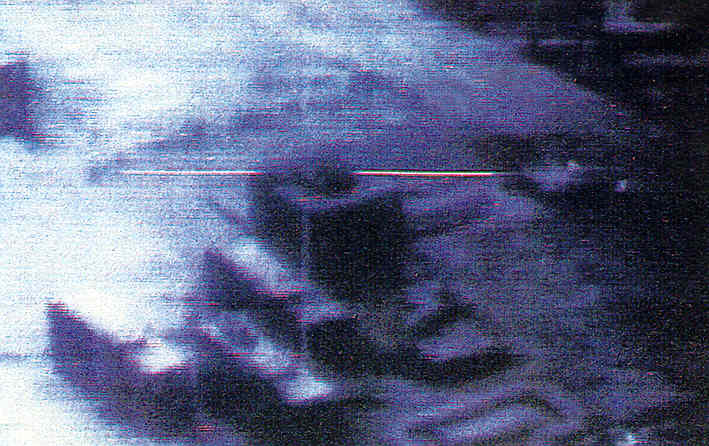
Infrared image of a Iraqi
telecommunications building
about to be blown up by a Stealth-fired intelligent
rocket
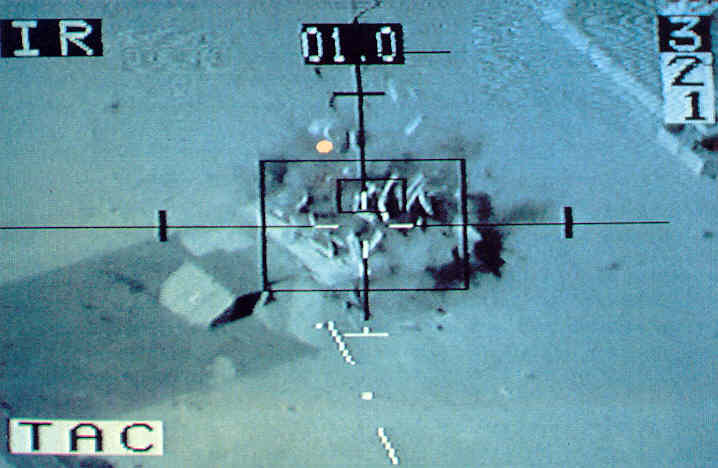
Sighted missile targeting
Iraq
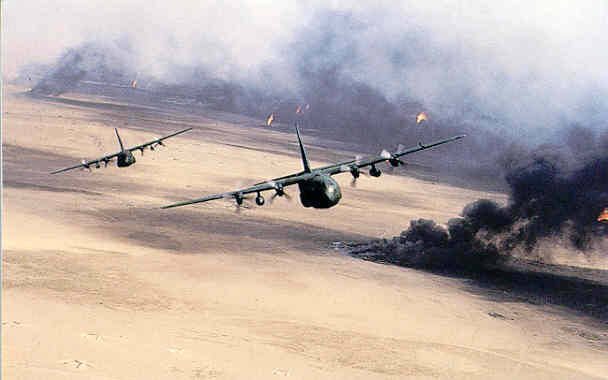
A US bomber attack on the
Iraqi positions.
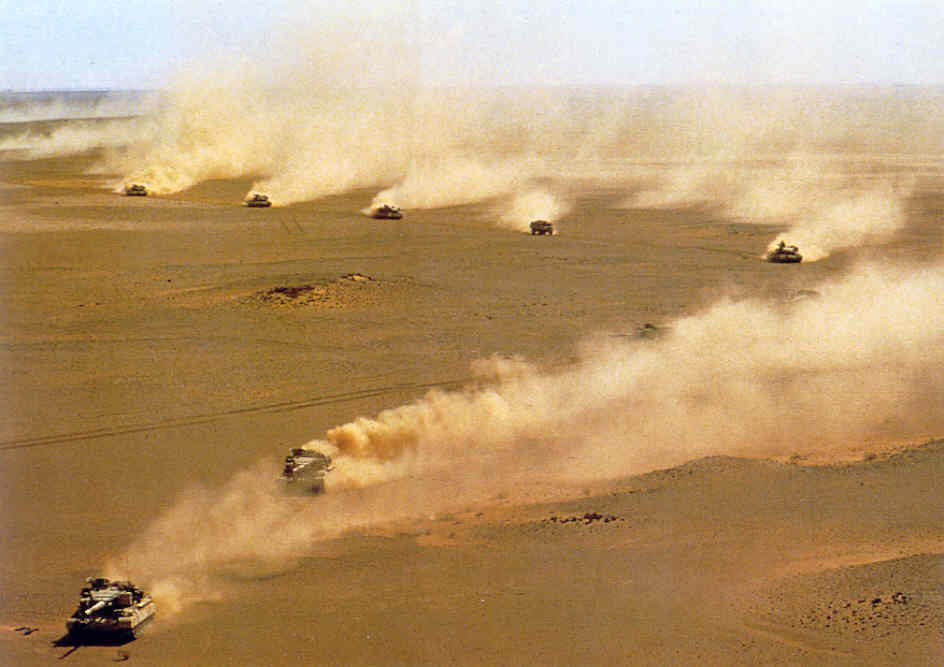
US tank assault on Iraqi
lines – February 1991.
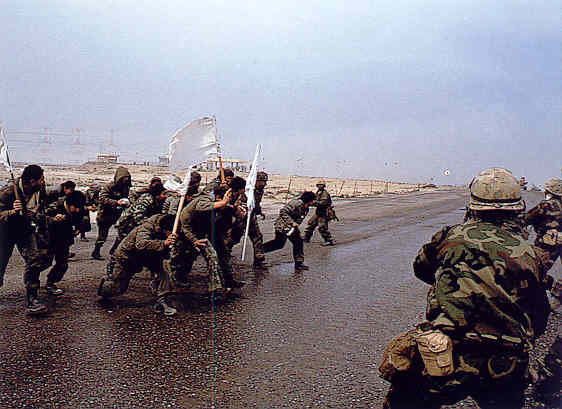
Iraqi troops
surrendering.
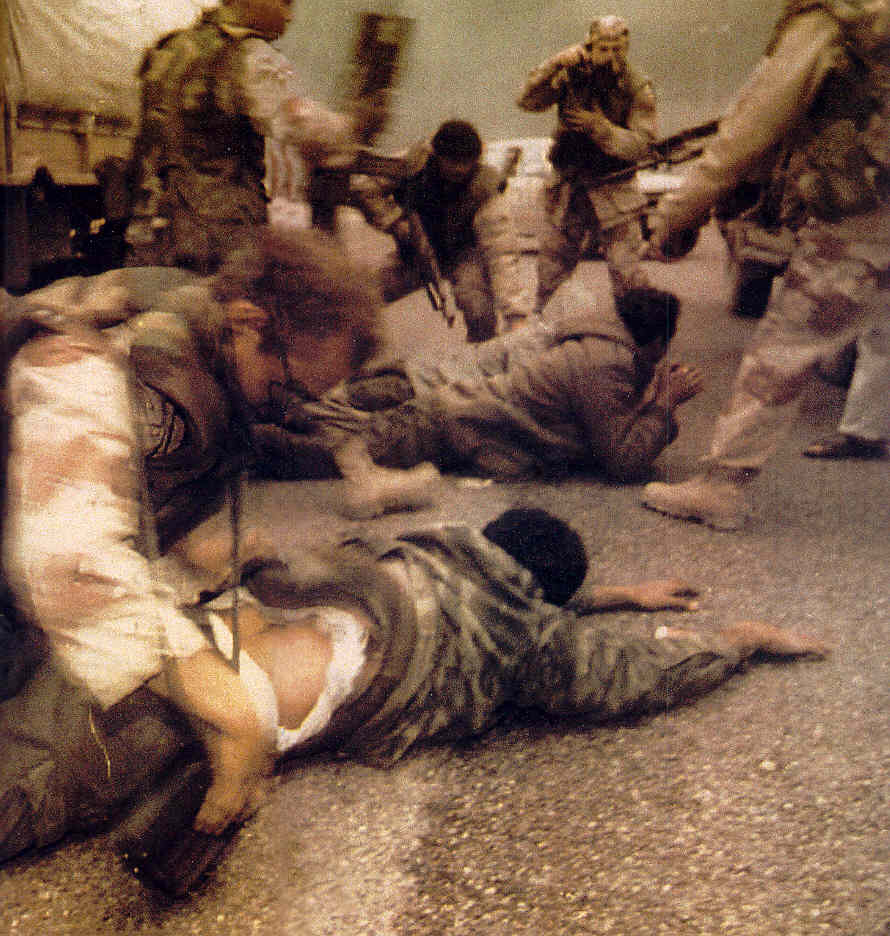
US Marines taking Iraqi
prisoners.
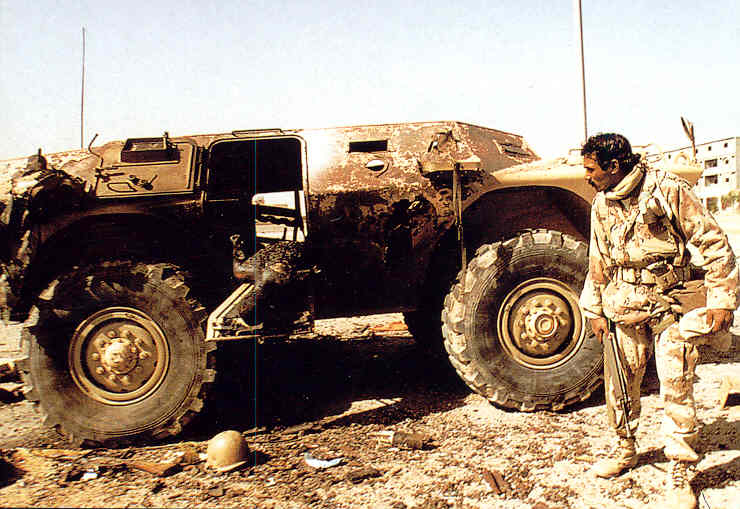
A Saudi soldier inspects
a burned-out Iraqi armored vehicle and dead Iraqi solder
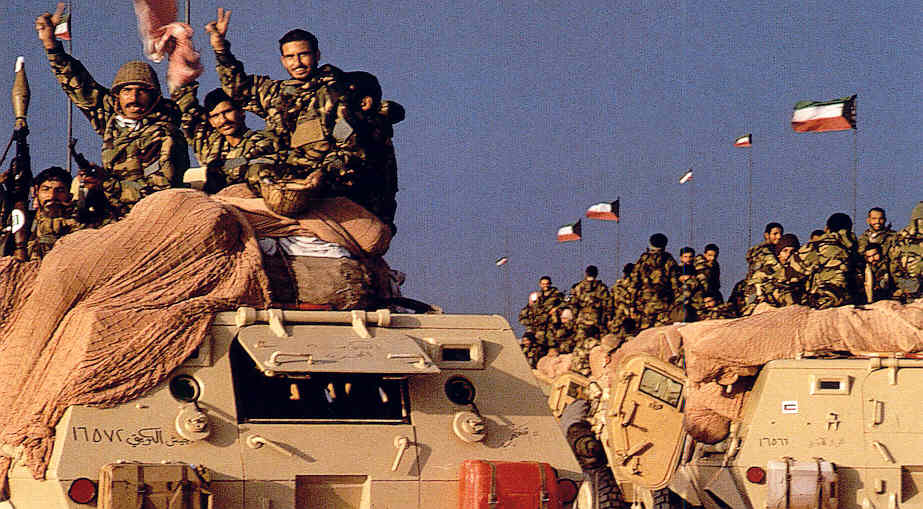
America's allied Arab troops
celebrating victory
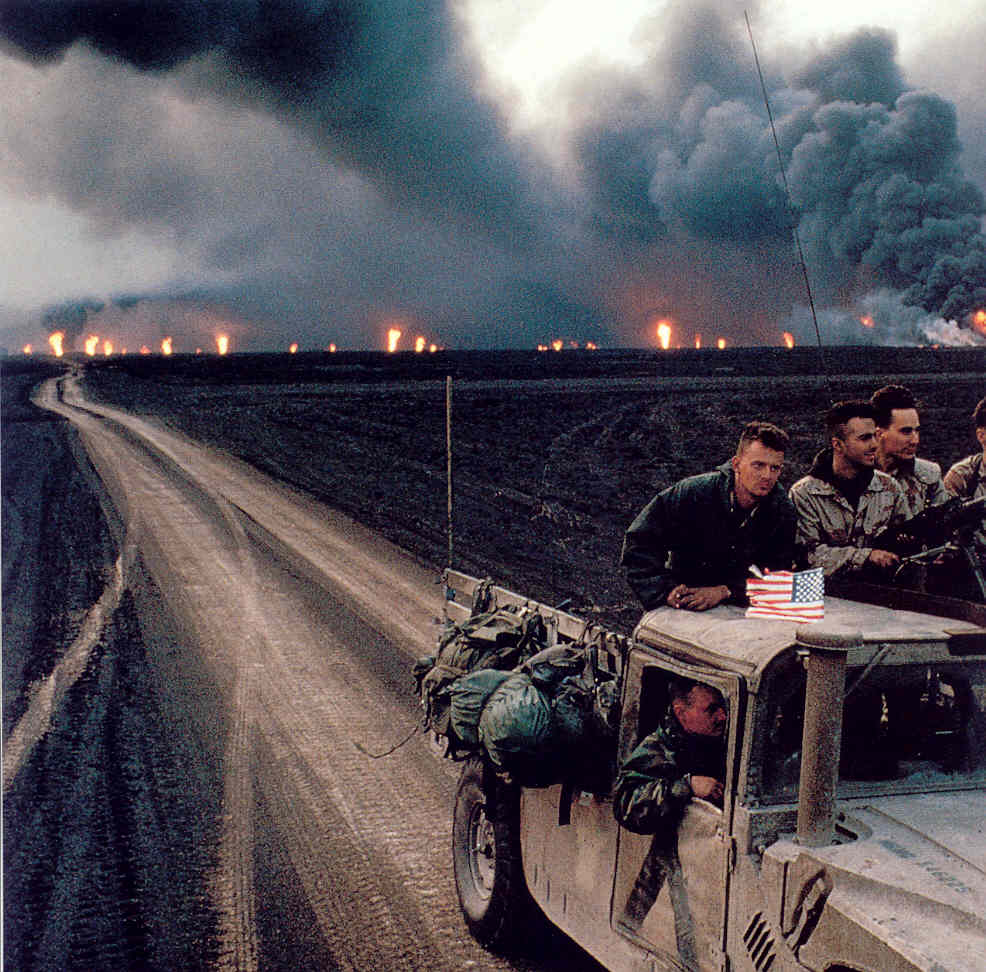
US soldiers and Kuwaiti oil
fields set ablaze
by retreating Iraqis – February 1991
Burning oil well silhouetted by a destroyed Iraqi
tank.
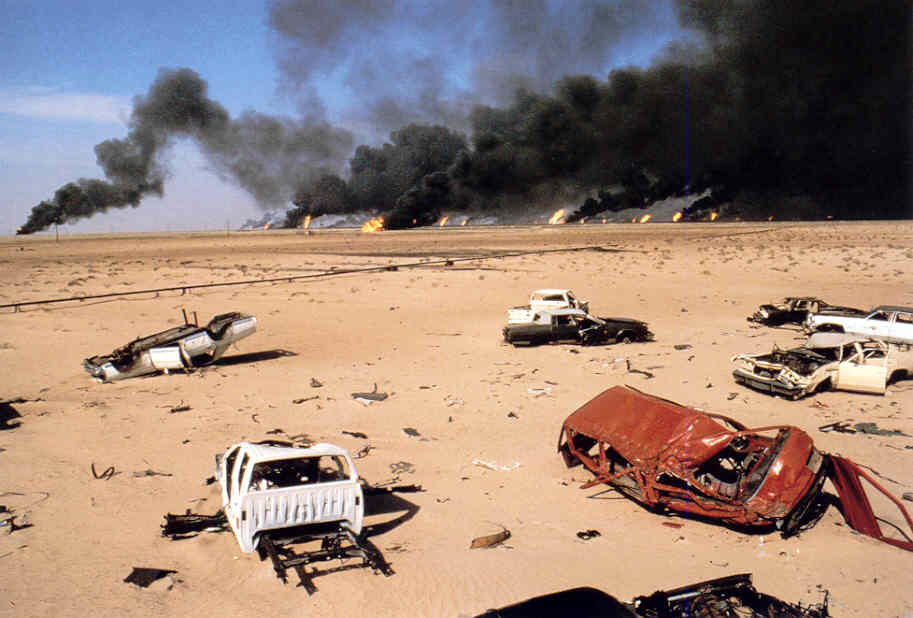
Wreckage and burning oil
fields in Kuwait in the wake
of a rapidly retreating Iraqi army
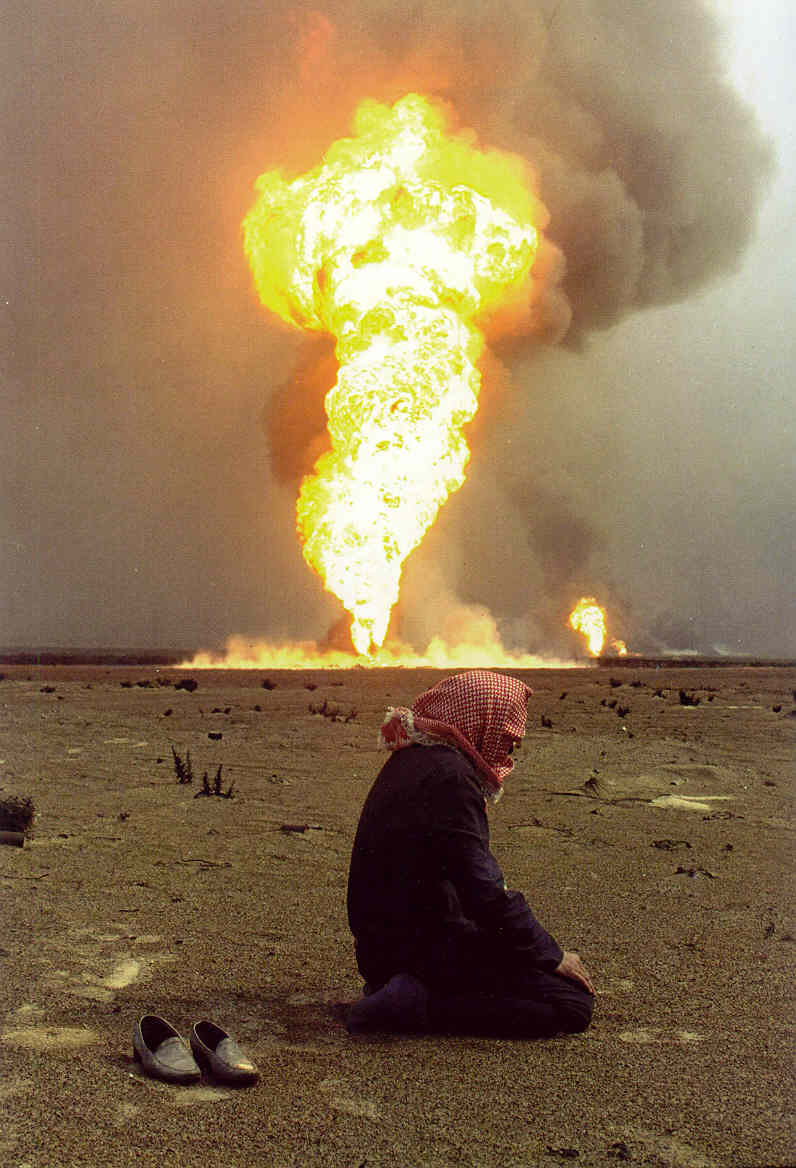
The Gulf War in Kuwait -
March 2, 1991
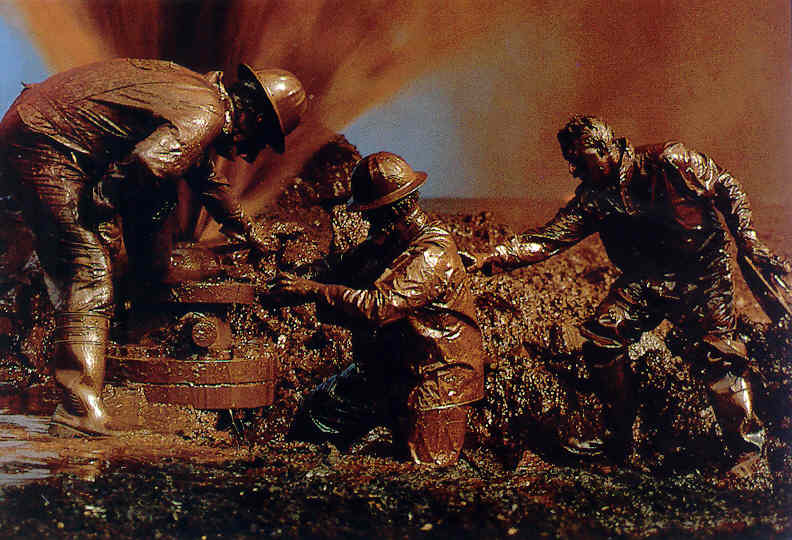
Red Adair's team putting
out the Kuwaiti oil well fires
started by the retreating Iraqis
Saddam Hussein is put under
international restriction because
of the cruel way (employing chemical and
biological weapons)
he put down the rebellions of the
Arab Shi'ite and (non-Arab)
Kurdish communities in Iraq ... which have long resented
tremendously the domination of Iraq by the Sunni Arab
community and its political arm, Saddam
Hussein's
Ba'athist Party.
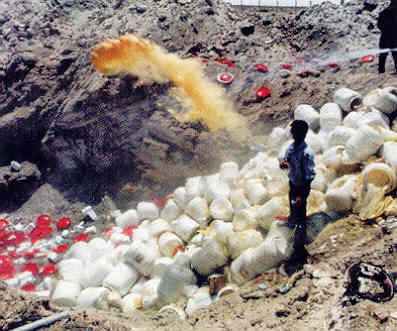
United Nations inspectors
destroying
suspected Iraqi bioweapons – 1996
| TROUBLES IN THE AMERICAN ECONOMY |
In his early years in office, during the horrible economic
recession he stepped into, Reagan had lowered taxes in an effort
to put money in people's pockets so as to help get the economy back up and
moving again. This of course cut Federal
tax revenues at a time when Reagan was also trying to rebuild
American military strength. Then when
the economy began to move, Regan could have – should have – moved toward a
balanced budget of government expenditures being matched by government tax
receipts – by raising taxes or cutting back on government programming, or
both. But Reagan did neither. And as a consequence, the Federal debt grew
monumentally, more than tripling over Reagan's eight years in office.
Bush, in his 1988 presidential
campaign – at a time when America was again experiencing a small recession –
promised American voters that during his presidency there would be no new
taxes: "read my lips – no new taxes."
But unemployment brought on by the recession meant that the government
was going to be spending more money for federal unemployment benefits – at a
time that tax revenues would also be down even further. Thus the deficit continued to climb.
Finally in 1992 – in cooperation with the Democratic
Party controlled Congress – a range of tax increases were put in place to slow
up the growth in the deficit. But it was
a presidential election year – and those increases (plus his promise of "no
new taxes") would be played against him by his political opponents (two
actually) in the presidential race that year.
| THE 1992 CAMPAIGN AND ELECTION |
Ross Perot.
Indeed, the failure of Bush to bring the growing federal deficit under
control gave billionaire businessman, Ross Perot, just the right cause he needed
to put himself in the running for President as an independent, third-party
candidate. He voiced concerns Americans
had about this matter or that – sometimes taking a Democrat position, sometimes
a Republican position. His rankings in
the polls also rose and fell – causing Perot at one point to back out of the
race – then reenter again. He even flew
off to Vietnam to demonstrate his ability to
conduct a new style of diplomacy – only to have the Vietnamese refuse him entry
into their country. And – his unusual
campaign was heavily financed by his own immense personal fortune.
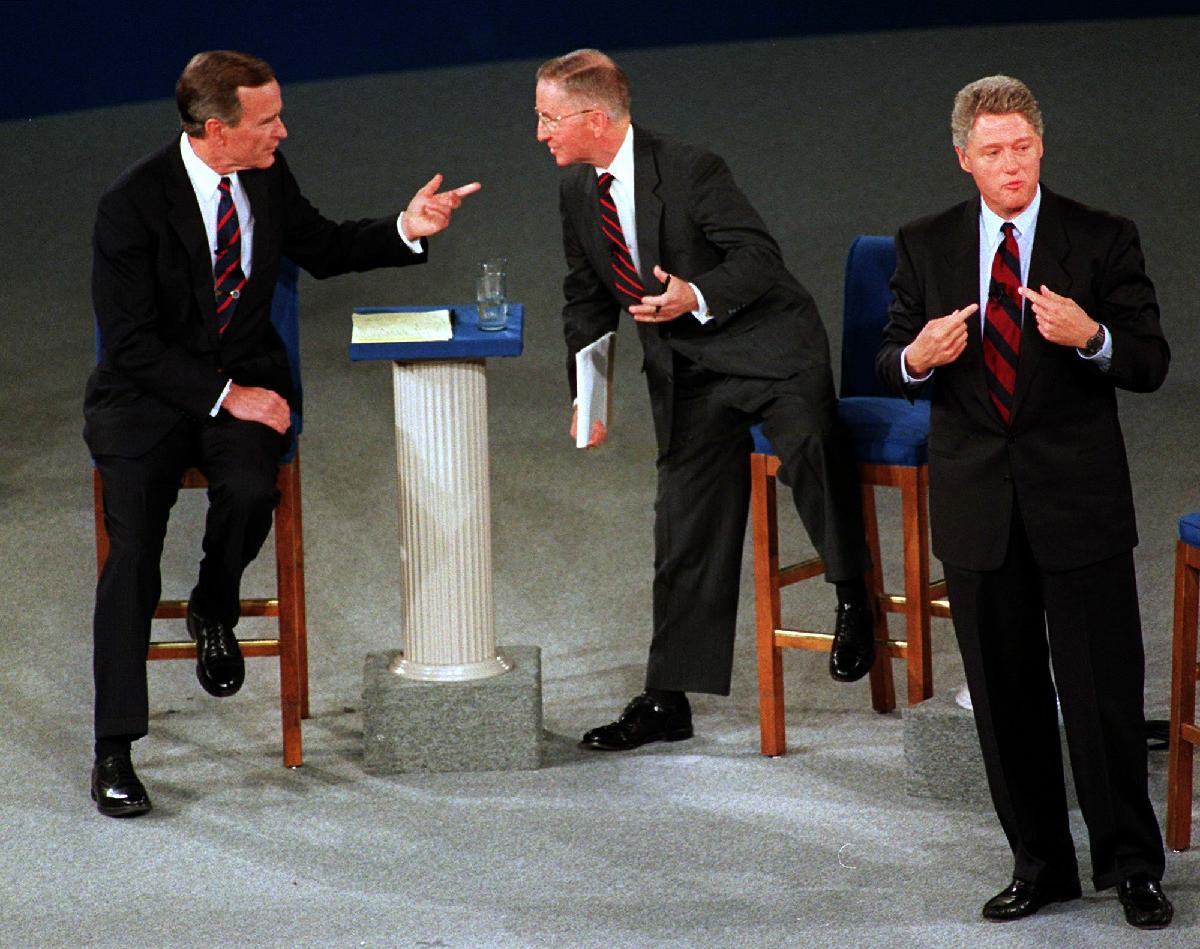
Bush, Ross Perot and
Bill Clinton during the 1992 Presidential debates
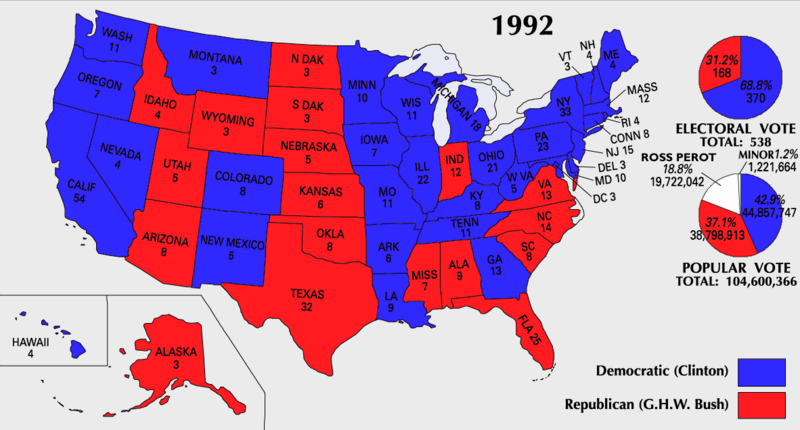
The 1992 campaign and election. The presidential
campaign of 1992 was an amazing balance of all three candidates. In June, polls put Perot at 39% approval, Bush 31% and Clinton (not yet officially the
Democratic Party candidate) at 25%. The
debates helped Clinton move ahead, the sense of
economic slump undercut Bush, and Perot – despite his zaniness – was
able to hang on to a respectable size of support.
What
was sad for Bush was that the economy was actually picking up again – in fact
would go on to be the largest and longest growth period in American
history. But this was not yet perceived
by the American voters. Thus when
elections were finally held in November, Clinton came in with 43% of the
popular vote, Bush 37.4% and Perot nearly 19%. It is easy to wonder what the results would
have been if Perot had not been in the race –
hacking away at the Washington Establishment (Bush and company) for its poor
economic performance.
But
in any case, the electoral college gave Clinton a full majority win with 370
votes to Bush's 168 votes (and Perot, nothing). Clinton would thus be entering the
White House the following January (1993).

Go on to the next section:
 Miles
H. Hodges
Miles
H. Hodges

 George H.W. Bush (Bush Sr.!)
 Foreign affairs during the Bush presidency
  Troubles in the American economy
  The 1992 campaign and election