In
the field of foreign affairs Clinton was to demonstrate an
instinct for Realpolitik – perhaps picked
up from his university days at Georgetown, perhaps by learning from the
examples set before him by both Reagan and Bush ... and certainly learned from
his own experience as Arkansas governor when he had to change course in order
to make a political comeback after having lost an election to a more populist
opponent.
His
moves abroad were carefully calculated on the basis of cost versus reward in
promoting the American national interest (the central thesis of Political
Realism), but also the global interest – thanks to America now being the world's
sole superpower.
Black Hawk down" in Somalia
(1993). Somalia would be an early test case. The United Nations looked to America for help
in its efforts to get food aid to thousands of civilian victims of a civil war
going on in Somalia among various tribal and gang groups, a war that was
tearing that country apart. In October
of 1993 Clinton ordered an air assault on the
group holding the Somali capital of Mogadishu – which did not turn out well
when the local citizens shot back – and two Black Hawk helicopters were
downed. Clearly such American
intervention had little local support from the Somalis (probably too afraid to
come up against the gangs).
At
this point Clinton's goal became one of simply
extracting American troops from Somalia.
There would be no further effort to straighten out Somalia. Actually – as with Reagan's failure in Lebanon in his
early years as President – Clinton's pullout from Somalia was
greeted with respect on the part of those watching the drama unfold there. Clinton had done the right thing – in
not letting his ego get the better of him – and admitting failure in the
effort. As a Realist he had simply cut
costs and moved on.
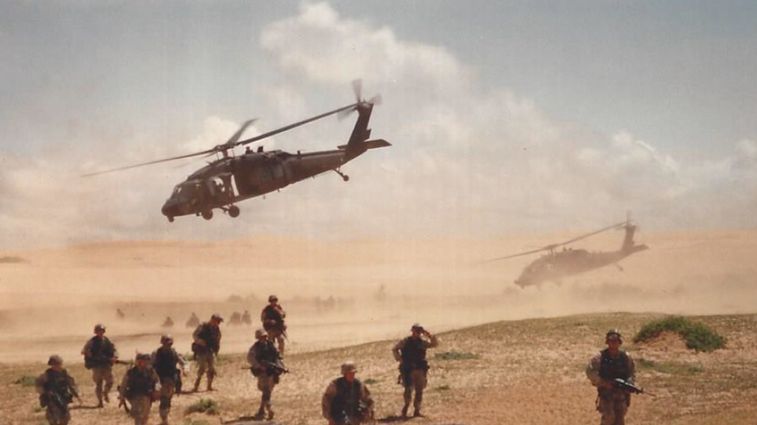
Going after the warlords in
Somalia
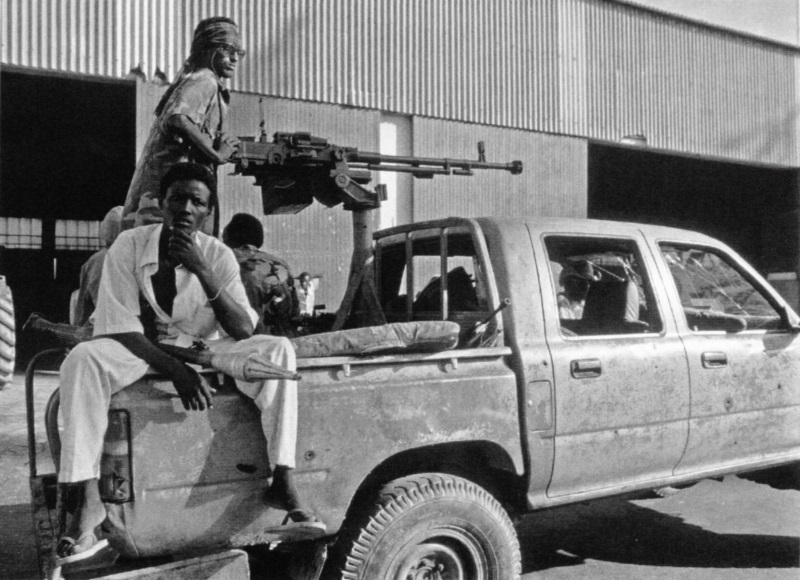 Troops of one of the
warlords
Troops of one of the
warlords
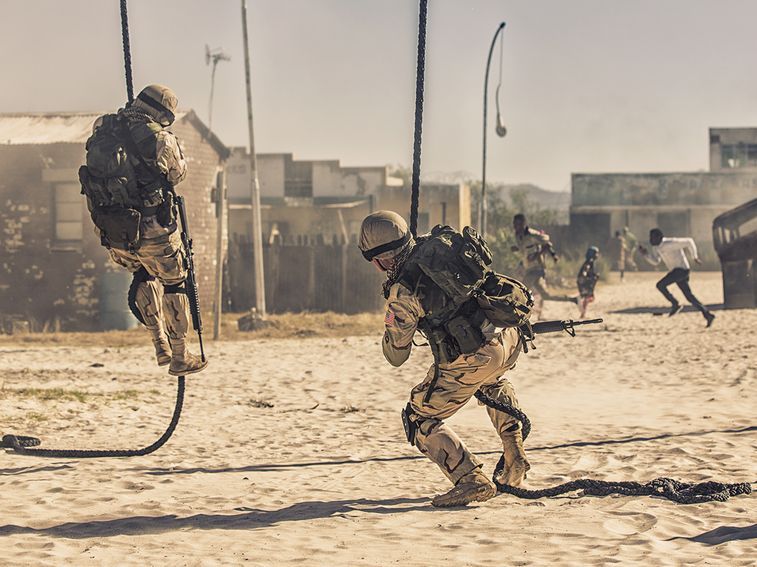
Dropping troops in Mogadishu by
helicopter
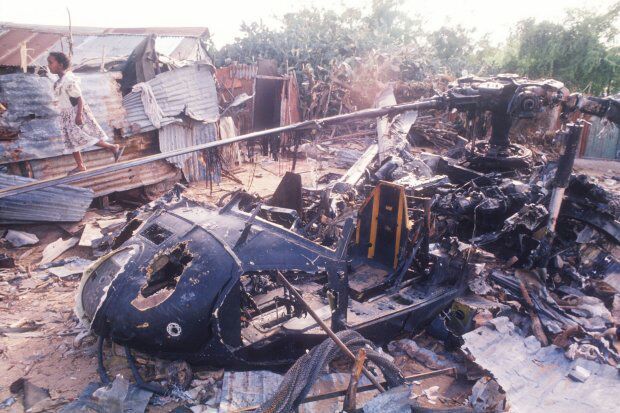 But two
Black Hawk helicopters are down ... and at this point
But two
Black Hawk helicopters are down ... and at this point
the goal switches
from trying to seize Mogadishu to simply
getting our downed solidiers
out of
Mogadushu. A hard lesson
is learned: beware of trying to
save societies whose
leaders
do not want to be "saved."
Haiti intervention (1994). In Haiti, Clinton was faced with another
rapidly deteriorating situation as a result of the overthrow by a military
junta in 1991 of the elected government of Jean Bertrand Aristide.
Deteriorating conditions in that country had set Haitians in huge numbers (tens
of thousands) fleeing the country, heading for America by sea – but with many
of the overloaded and unseaworthy boats sinking along the way.
In
this matter, Clinton was more circumspect because
of the Mogadishu mess. In 1994, with
full backing from the United Nations –
even as he began military preparations for intervention in Haiti – he sent
representatives (former President Carter, General Colin Powell of Iraq War fame and Senator
Nunn) to Haiti to let the military junta know that the US was getting ready to
send troops to their country, and that they had better restore the civilian
government of Aristide before these troops landed.
The
Haitian military officers ultimately backed down just as some 20,000 troops
(mostly the American 82nd Airborne, but including some from other nations) were about to land in Haiti (September 19, 1994) –
and in October Aristide returned to power in Haiti – under the protection of US
troops sent to Haiti to oversee the transfer of power. The American troops were then soon pulled out.
Clinton came away from this venture
looking very presidential.
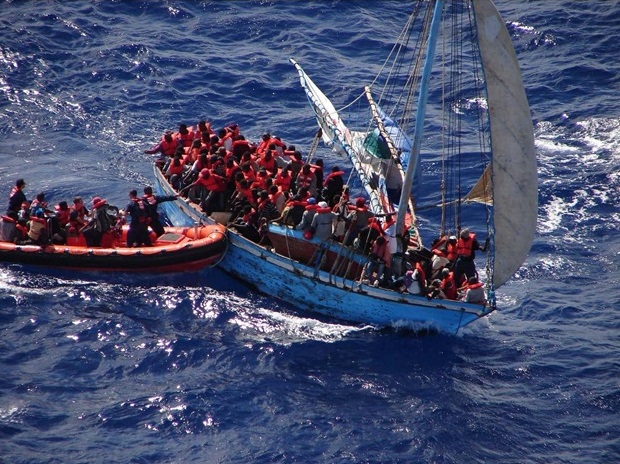 Haitian "boat people" being intercepted
by US agents
Haitian "boat people" being intercepted
by US agents
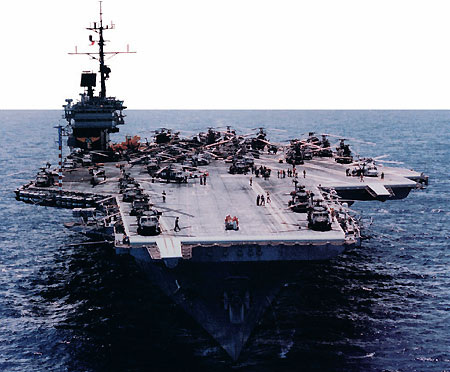 Carrier USS America headed for Haiti
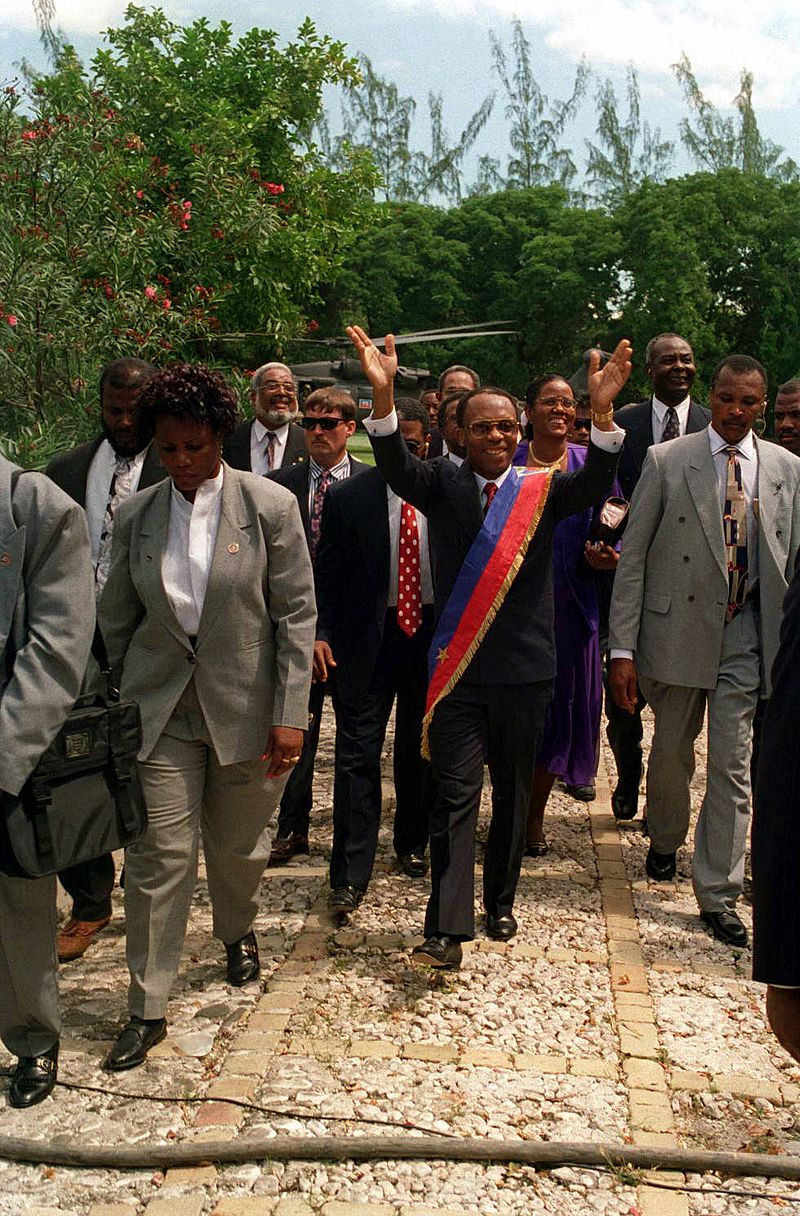
Aristide on his return to Haiti
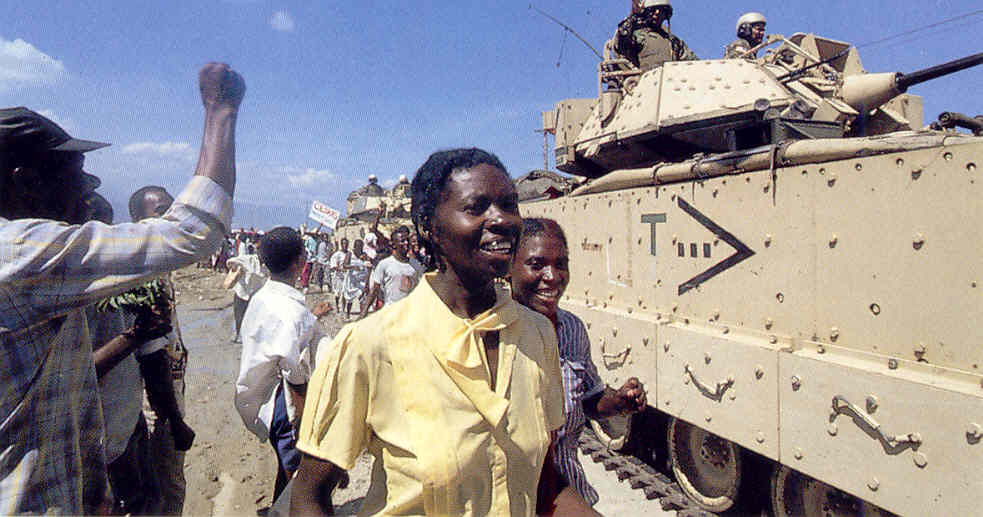
Troops restore Aristide in
Haiti – 1994
"No" – to Rwanda (1994).
On the other hand, Clinton had to say "no" to
a request from the UN to intervene in the slaughter taking place in Rwanda, as
Hutu tribesmen and Tutsi tribesmen fell into mutual slaughter – causing virtual
genocide – when possibly as many as a million Rwandans (no one knows for sure the actual count) were
butchered in the fighting. This was way
too big for America to take on. Clinton's "no" was greeted
with scorn by fellow Liberals. But Clinton was very wise not to drag
America into something that would only tragically drain a huge amount of
American blood with little likelihood that it would make much difference in how
things worked out among the Hutus and Tutsis.
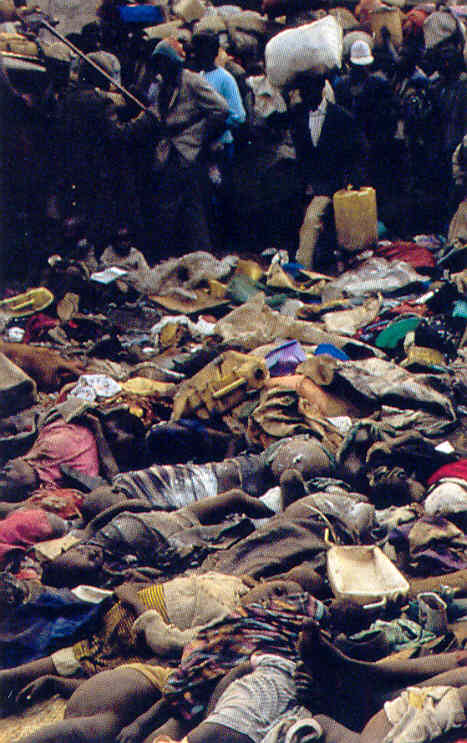
The living and the dead at
a Rwandan refugee camp in Zaire – 1994
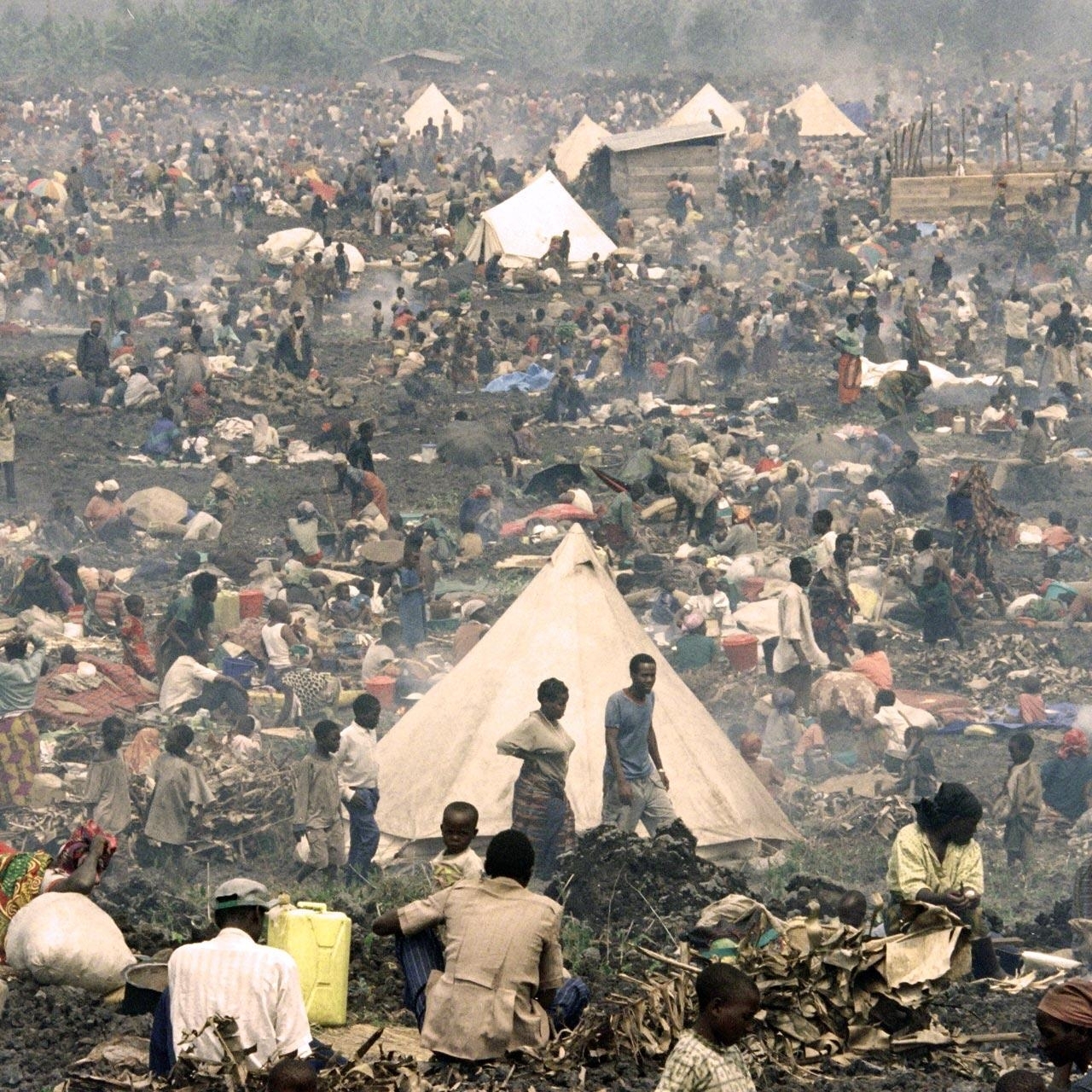 Life inside a Rwandan refugee camp – 1994
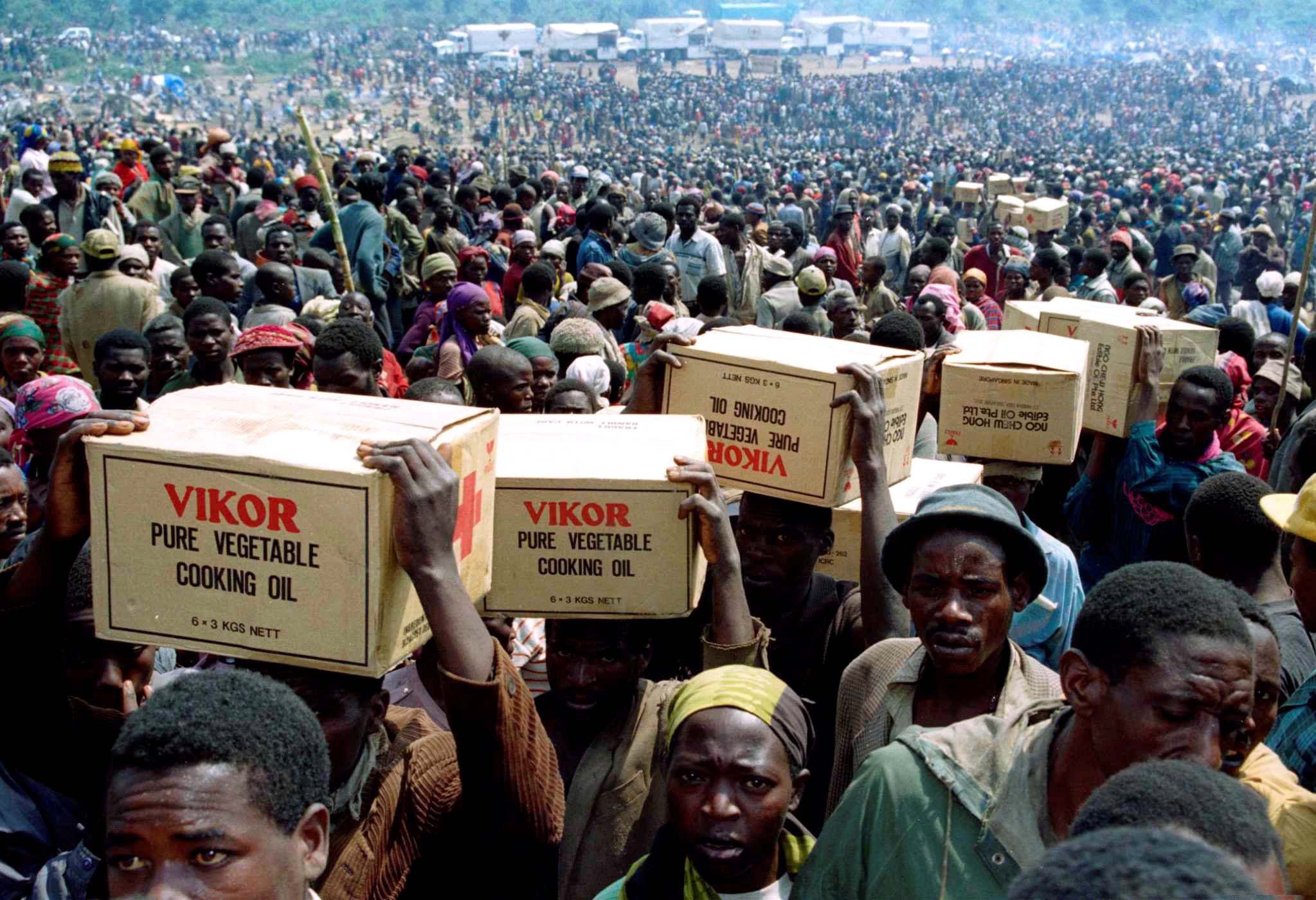
Trying to feed a desperate Rwandan population
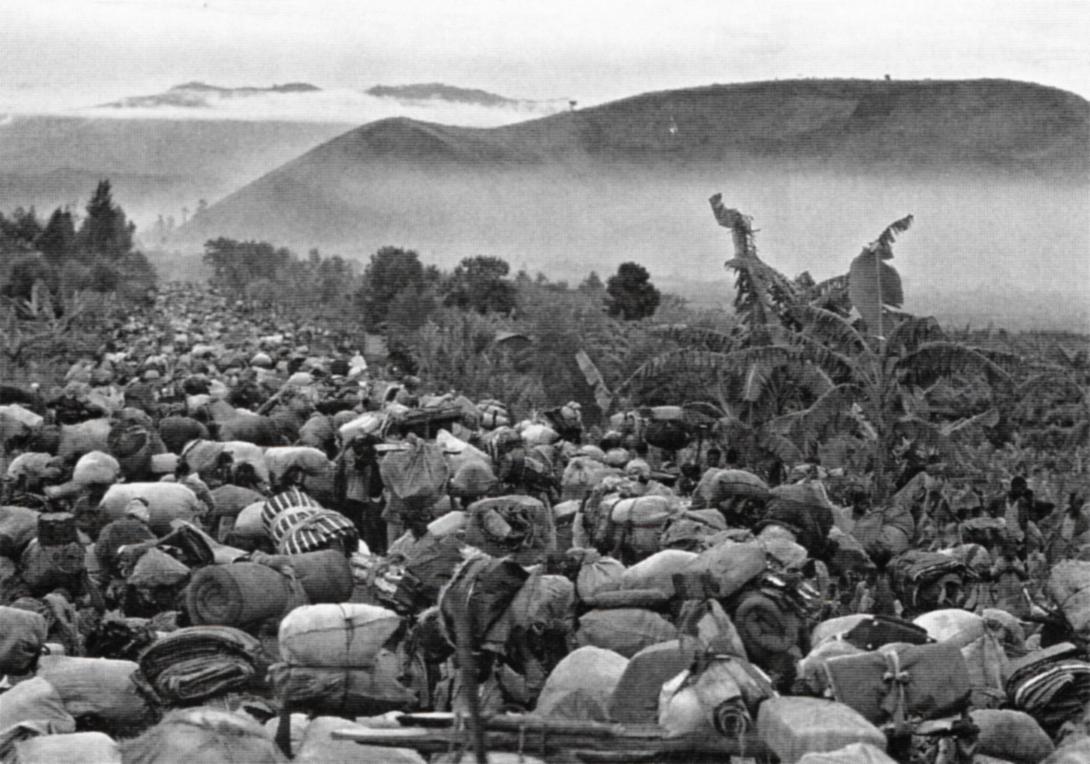
Hutu refugees returning to
Rwanda
But "yes" to Bosnia (1995). Ever since Tito died in 1980, it had been a
struggle to keep the various ethnic groups making up Yugoslavia together. Basically, divisions were getting deeper –
and increasingly hostile. Then with the
example set in the departure of the East European countries from the Soviet
Empire, the various national groupings in Yugoslavia began to declare
independence, starting in early 1990 with Croats and Slovenians (basically
Roman Catholic rather than Eastern Orthodox like the dominant Serbs). Then Bosnia-Herzegovina declared independence
in 1991 – except independence would carry away a huge section of the Serbian
population (about a third of the population in Bosnia). At this, the Serbs invaded Bosnia (also about
44% Muslim – with another 17% Croatian), and ethnic and religious tensions
exploded. Civil war soon became mere
genocide – as, for instance, in the town of Srebrenica when in 1995 some 8,000
Muslim men and boys were executed by Serbs.
And the beautiful city of Sarajevo (the site of the Winter Olympic Games
of 1984) became a no-man's land and a physical disaster.
Europeans
looked on in horror, and began to discuss the possibility of NATO intervening to stop the
genocide. At first, Clinton's reaction was shaped by his
experience in Somalia. But the situation
grew so grim that he agreed to lead NATO airstrikes against Serb
positions – at the same time that Croatian and other Muslim nationals engaged
ground troops against the Serbs.
Finally,
toward the end of 1995, an armistice – followed by peace
negotiations at Dayton, Ohio, plus an agreed-on stationing of 60,000
international troops (20,000 of which were American) – brought the region to a
nervous peace. At this point a quarter
of a million people had been killed and over a million had been made homeless
and living in refugee camps. Getting the
states of former Yugoslavia back into some kind of order could now begin –
although it was not going to happen quickly – and would require the continuation
of the stationing of international troops in the region – on a reduced basis,
but there in any case as a warning not to start things up again.
In
the end this measured response worked the best way possible. There would be no victory parades and no
heroic talk. But the job had been done –
and again, Clinton looked very presidential!
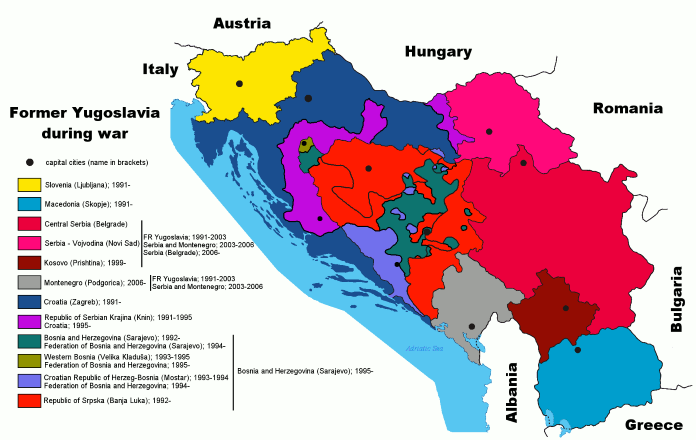
Wikipedia, "Yugoslav
Wars"
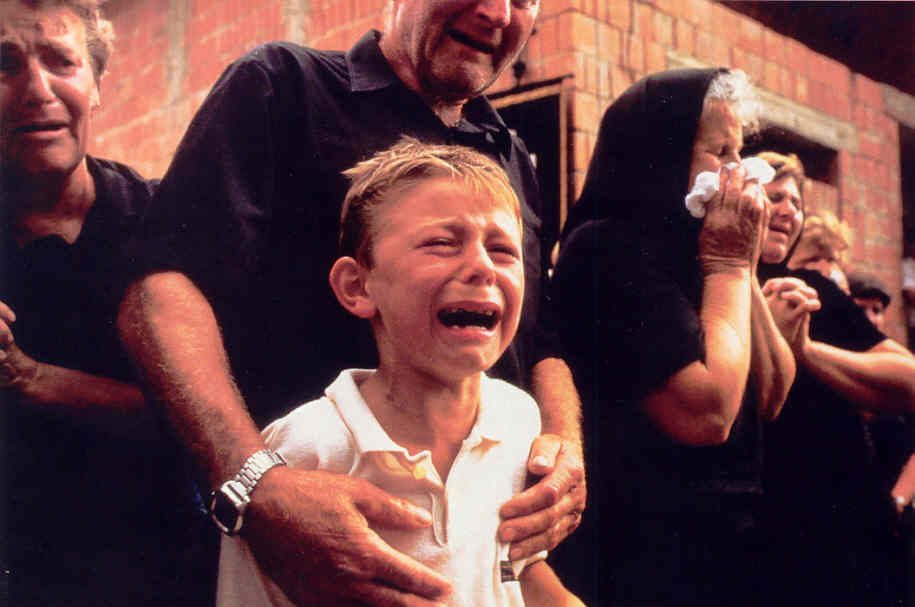
A Croatian boy mourning the
loss of his father, a policeman
killed by Serbs - September 1991
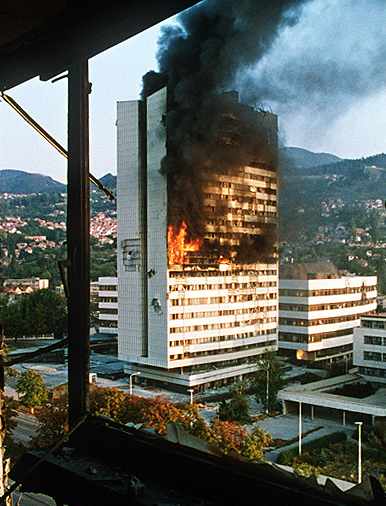
The building of the Parliament
of Bosnia and Herzegovina burns
after being hit by Serbian
tank fire during the siege in 1992
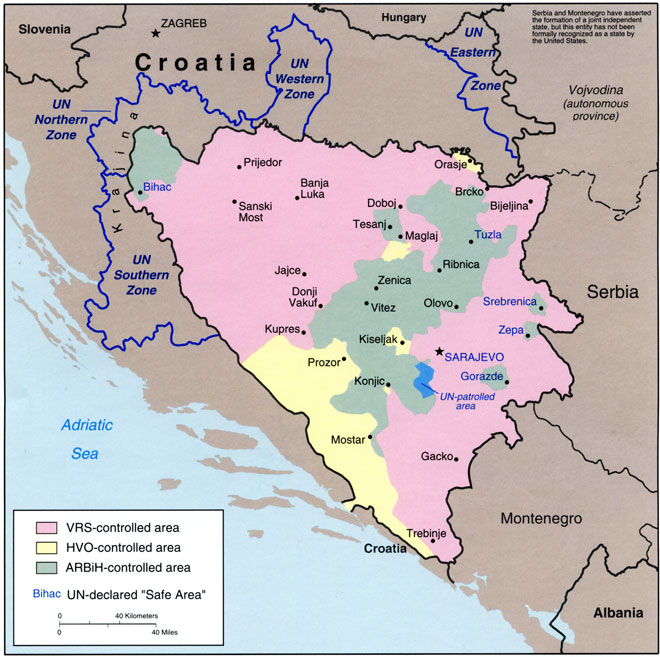
Areas of control in Bosnia
and Herzegovina, September 1994
VRS = Bosnian Serb Army
HVO = Croatian Defense Council
ARBiH = Army of Republic
of Bosnia and Herzegovina
Wikipedia
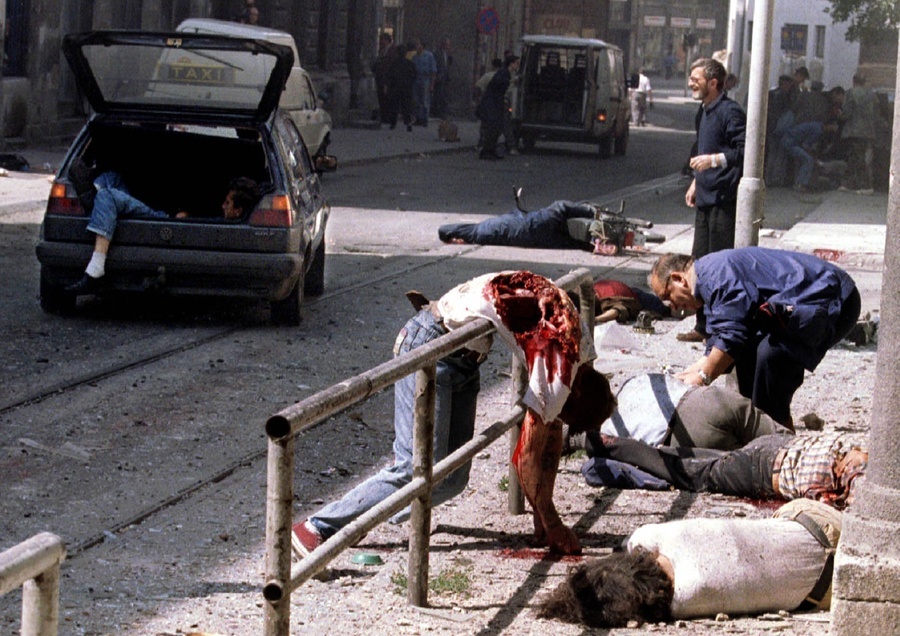
Sarajevo itself became a slaughterhouse as hostile forces fired
across
streets, catching civilians in the cross-fire.
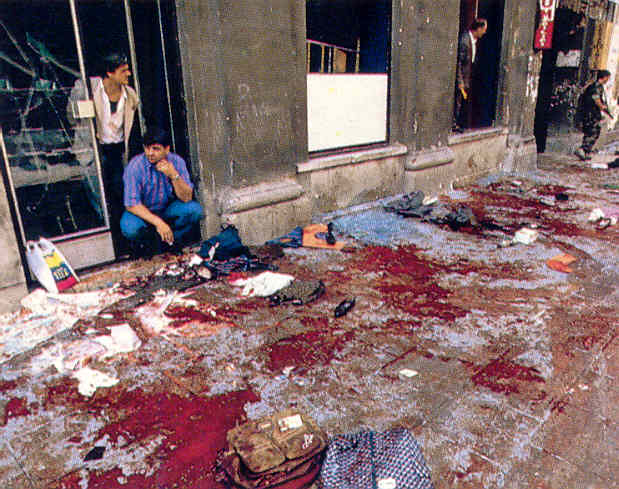
The aftermath of an attack in the Bosnian capital city, Sarajevo
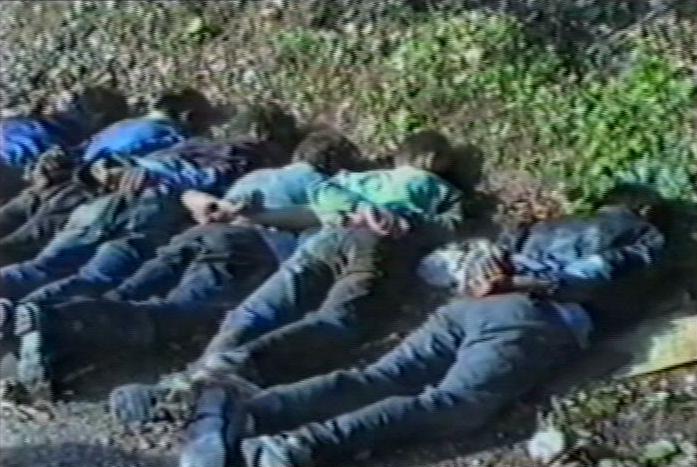
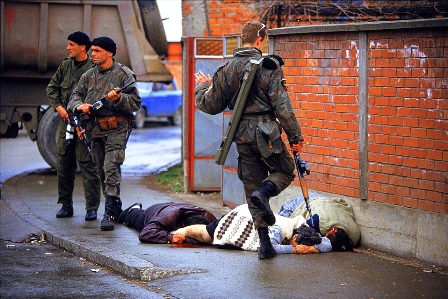
Serb troops checking Bosnian
Muslim dead in Biijeljina – 1992
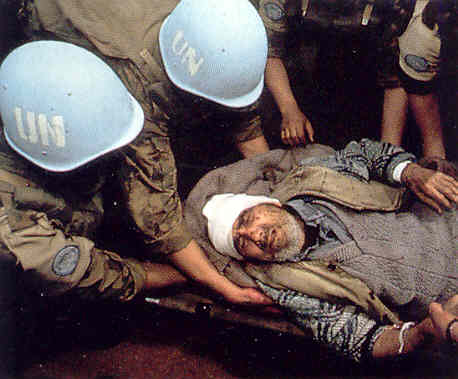
UN troops aiding wounded
civilian in Gorazde – 1994
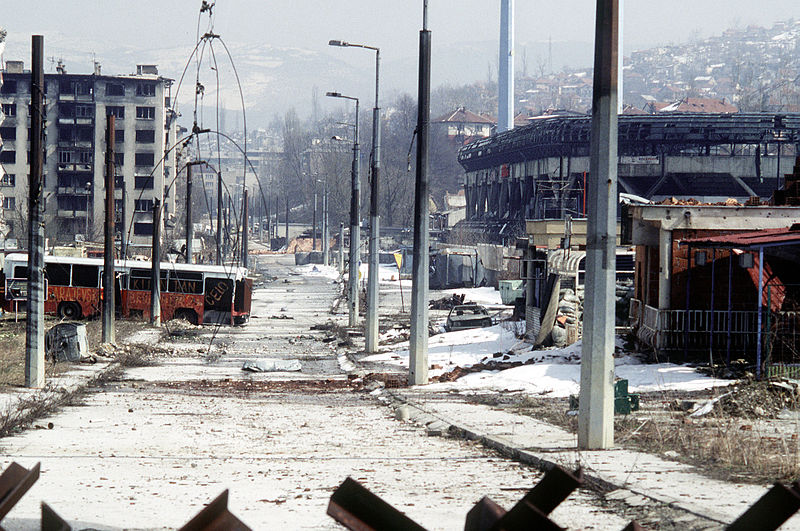
Overall view of downtown
Grbavica, a neighborhood in Sarajevo
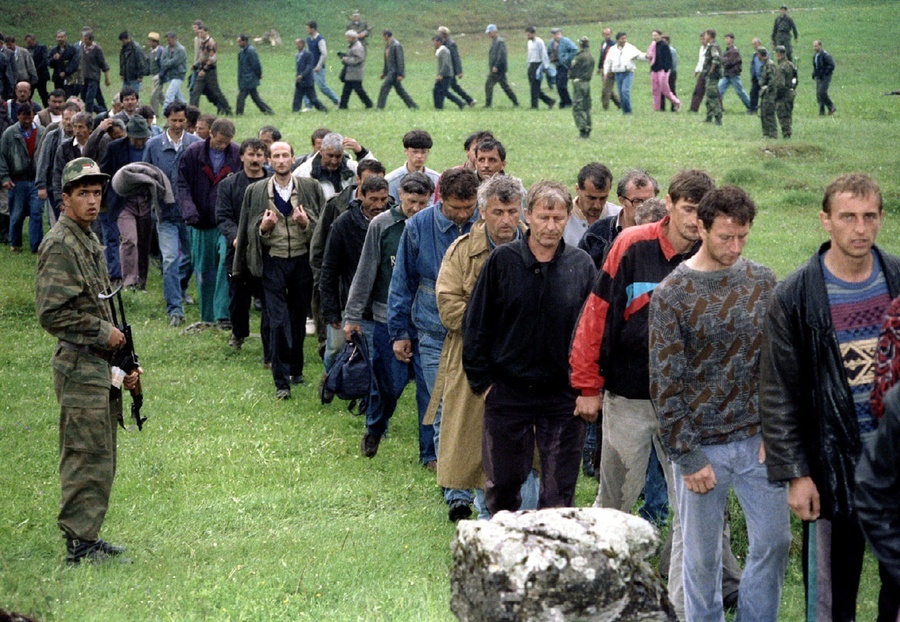
Bosnian Croat soldiers taken as
prisoners by Bosnian Serbs ...although about 7,000
Croat civilians chose to flee to Serb-held territory in order to escape heavy Muslim
assault.
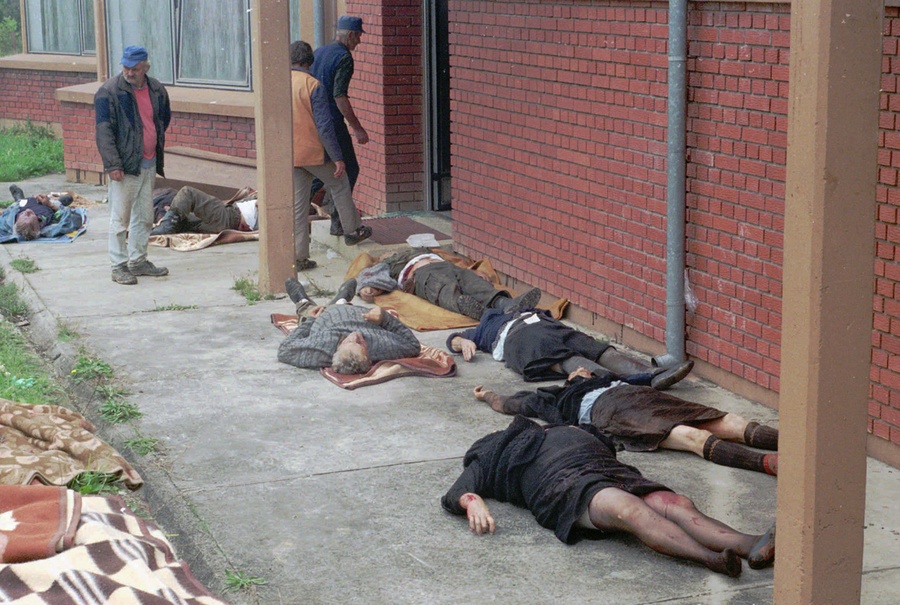
Ethnic cleansing however went both
ways ...
Serbian civilians killed by Croatian soldiers in a small town
west of
Sarajevo.
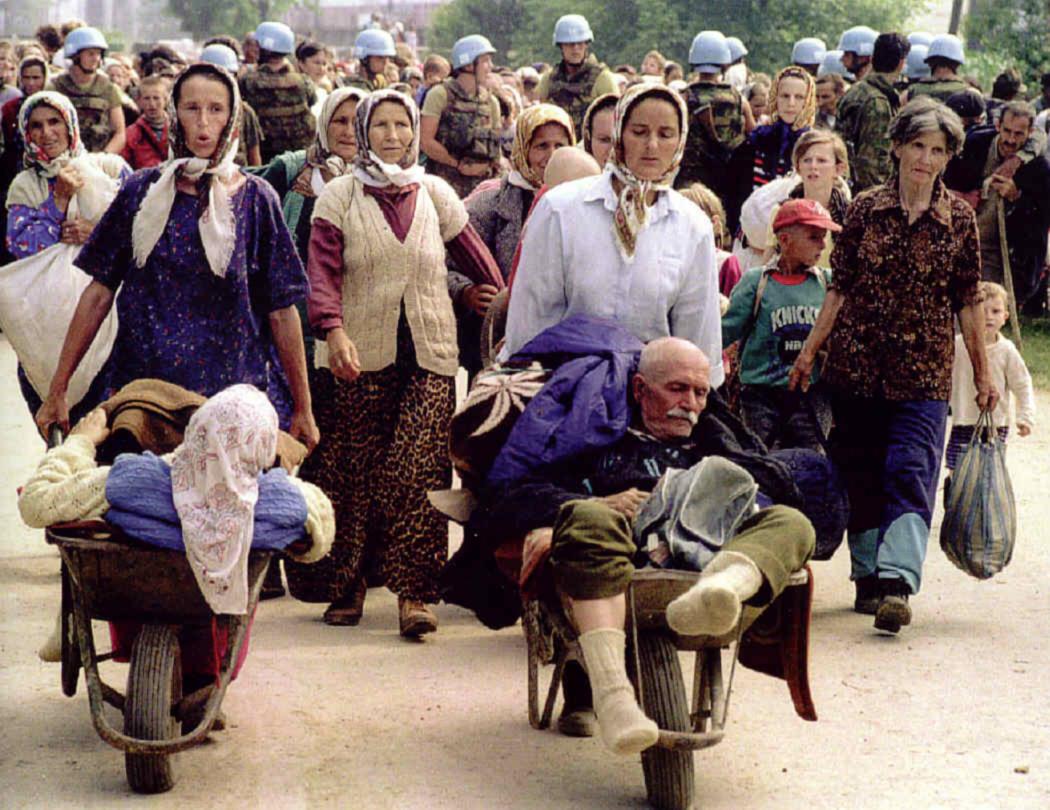
Bosnian Muslim refugees –
July 13, 1995
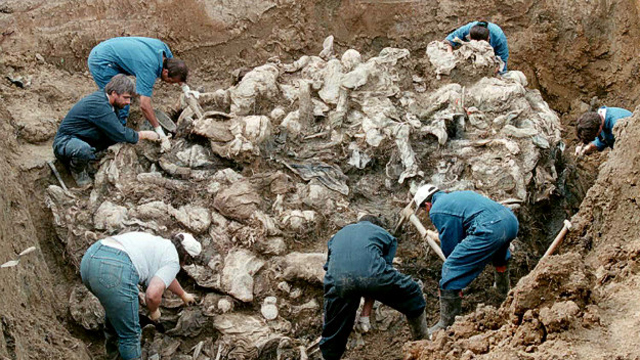
Uncovering the mass graves
in Srebrenica of thousands (6,000 -
8,000?) of Bosnian Muslims
killed in 1995 by Ratko MladiÄ's Serbs
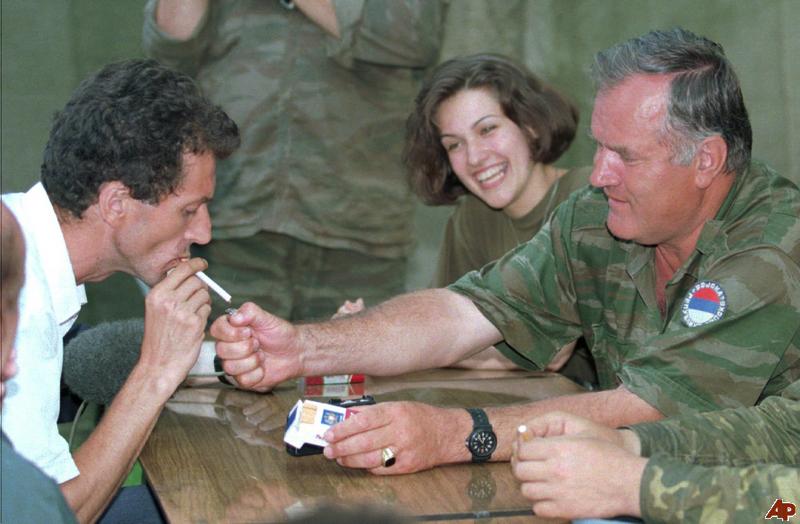
Bosnian Serb General Ratko
MladiÄ commanding the 'ethnic
cleansing' designed for the Serbian takeover of
Bosnia. He
would later be arrested, tried and convicted (2011)
by the UN
Yugoslavia
Tribunal for war crimes he
committed at Sarajevo
and Srebrenica

Serb Generals Ratko MladiÄ and Radovan
KaradžiÄ ...
President of the Republic of Srpska (Serbian
Bosnia)
In 1995 President Clinton (urged on by America's European
allies)
decides that it is time for America to act ...
to end this European
tragedy
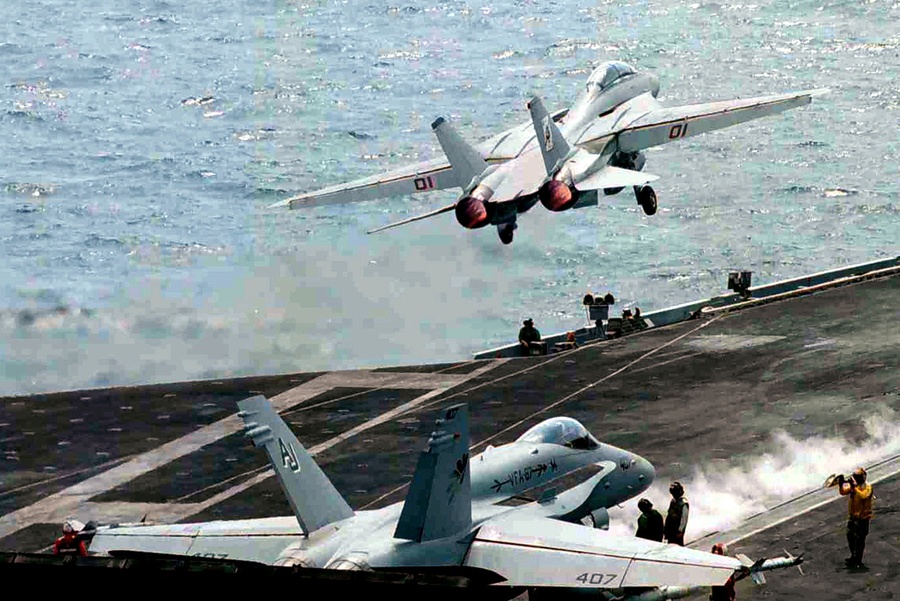
A US F14 tomcat fighter takes off on a patrol over Bosnia
from the
aircraft carrier USS Theodore Roosevelt
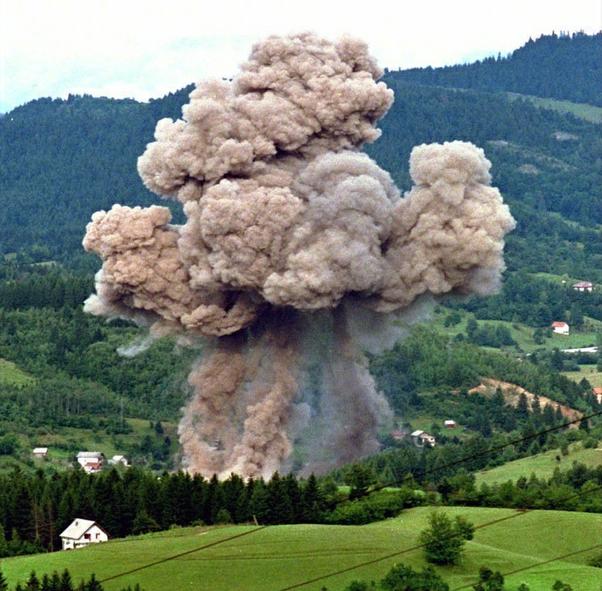
August 1995 - NATO airstrike of a Serb
ammunition depot in Bosnia
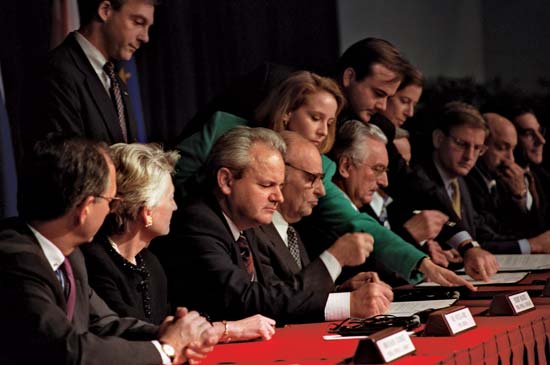
The signing in Ohio of the Dayton Accords by
the presidents
of Bosnia, Croatia and Serbia 4 November 21, 1995 ... organized
by US chief negotiator Richard Holbrooke and Secretary of
State Warren
Christopher
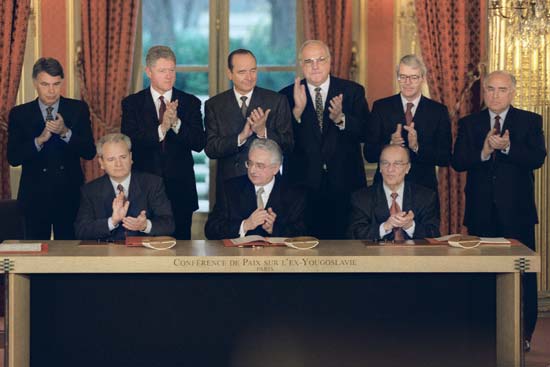
The final peace agreement is signed in
Paris December 14, 1995
Seated are Slobodan MiloÅ¡eviÄ (Serbia), Franjo Tudjman
(Croatia), and Alija Issetbegovic (Bosnia Herzegovina).
Standing
behind them are Felipe Gonzalez (Spanish Prime
Minister), Bill Clinton,
Jacques Chirac (French President),
Helmut Kohl (German Chancellor),
John Major (British Prime
Minister) and Viktor Chernomyrdin. (Russian
Prime Minister)
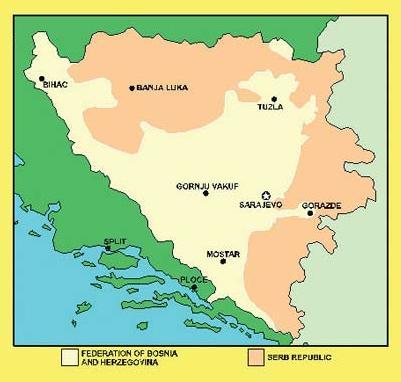
The division of Bosnia into two parts:
the Bosnian-Croat Federation (Bosnia and Herzegovina)
and the Bosnian Serb
Republic
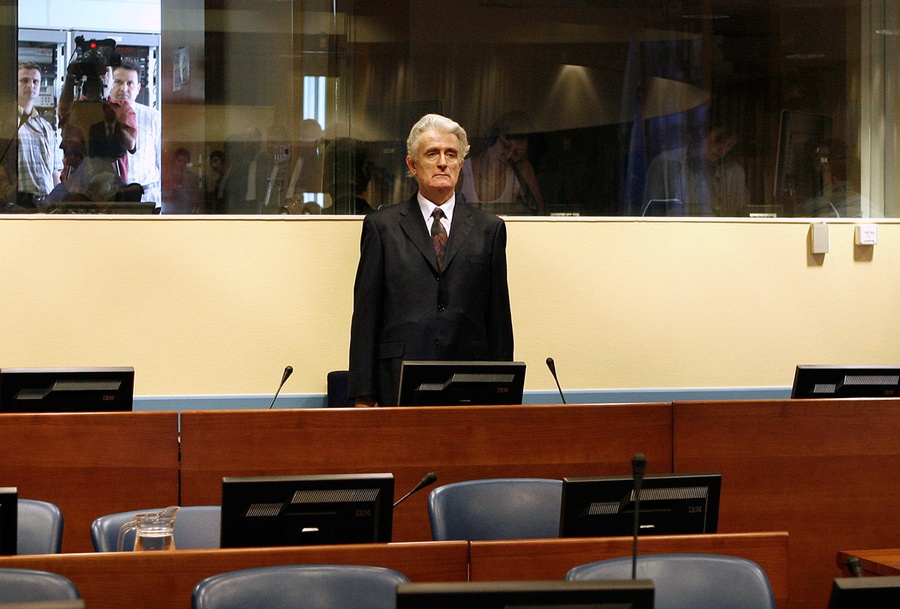
Bosnian Serb political leader Radovan KaradžiÄ
on trial
at The Hague, Netherlands (2008)
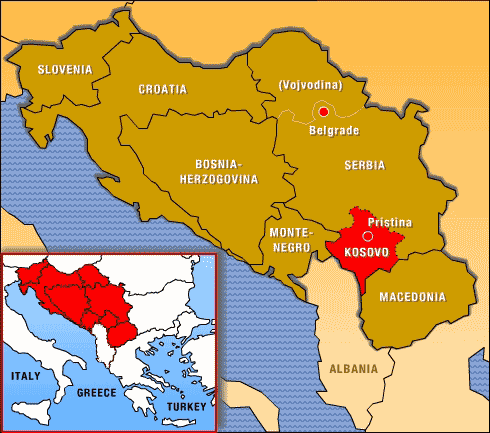
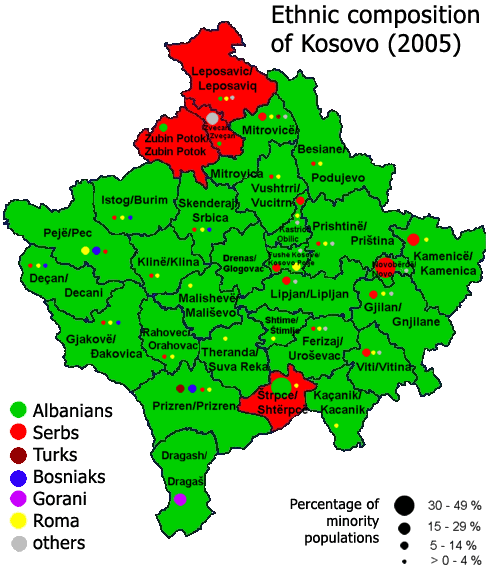
The Kosovo Crisis (1999). Then ethnic tensions flared up again in the
former Yugoslavia – this time in the southern region of Kosovo – pitting a Serbian minority
(but backed by Serbian power to the north) against the Albanian-speaking and
largely Muslim Kosovar majority.
Genocide again became the rule of the day – with a million Kosovars forced
to flee their homes or be slaughtered by the invading Serbs (but small Serbian
communities here and there suffered as well from groups of Kosovar militia).
 Having
so recently experienced the Bosnian crisis, NATO was quick to respond this time –
with Americans once again involved in heavy air attacks on Serbian positions –
including even the Serbian capital at Belgrade.
Having
so recently experienced the Bosnian crisis, NATO was quick to respond this time –
with Americans once again involved in heavy air attacks on Serbian positions –
including even the Serbian capital at Belgrade.
Rather quickly Serbian President Slobodan Milosevich was forced to yield – and
accept another peacekeeping force of 50,000 troops (7,000 of them
American). Milosevich was subsequently
arrested and brought before the International Court of Justice at The Hague for
war crimes – but died in a Dutch prison during his long trial.
And the Kosovars erected a large statue of Clinton in their capital of Priština
– certainly the hero to many in Kosovo!

Serbian police standing over the bodies of
Kosovar fighters – 1999
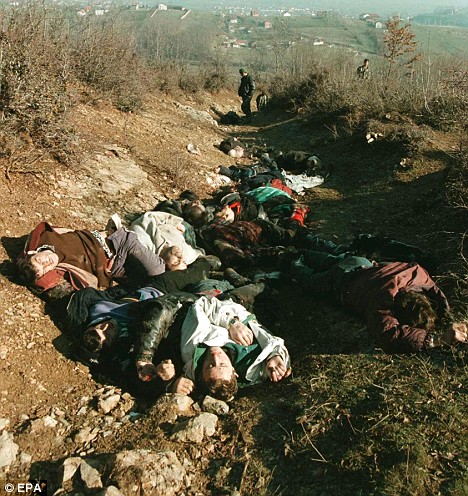
Genocide in Kosovo – Albanian dead
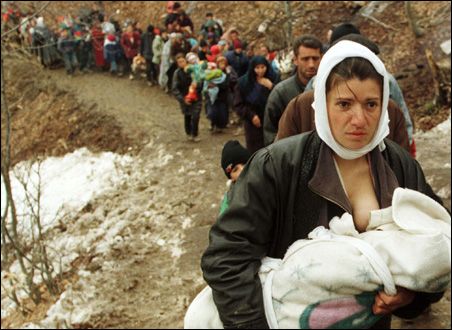
Kosovar refugees fleeing the war
zone
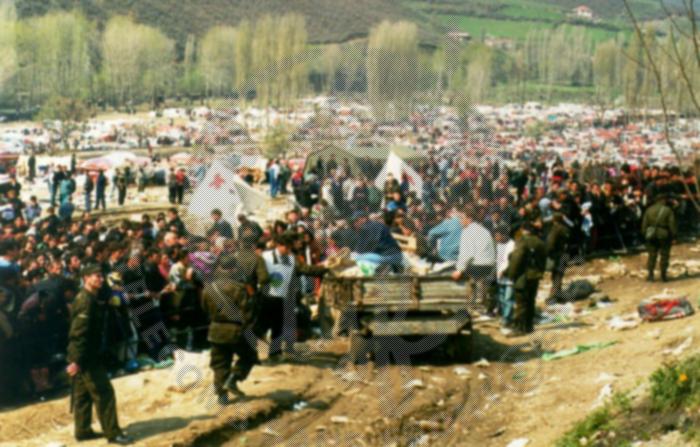
Some of the (800 thousand to 1
million?)
Kosovar refugees
... including my now son-in-law (and pastor) Rimi,
who was a teenager at the time
Clinton and the West respond
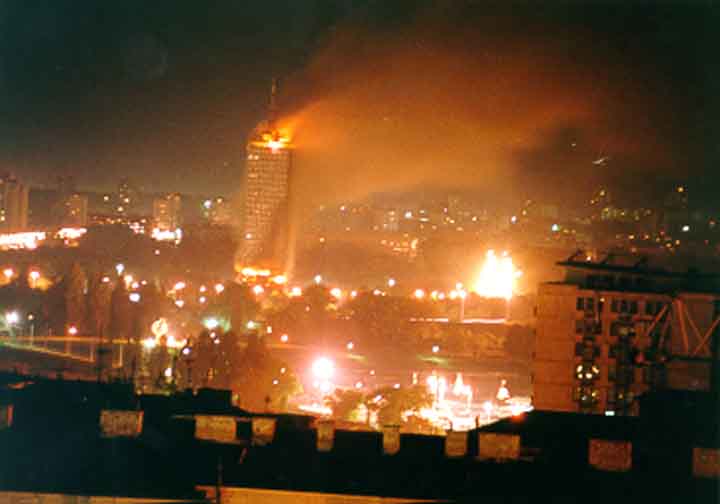
The 1999 American-led NATO bombing of Serbia's
capital
Belgrade
... forcing the Serbs to back away from their slaughter
of the Albanian Kosovars
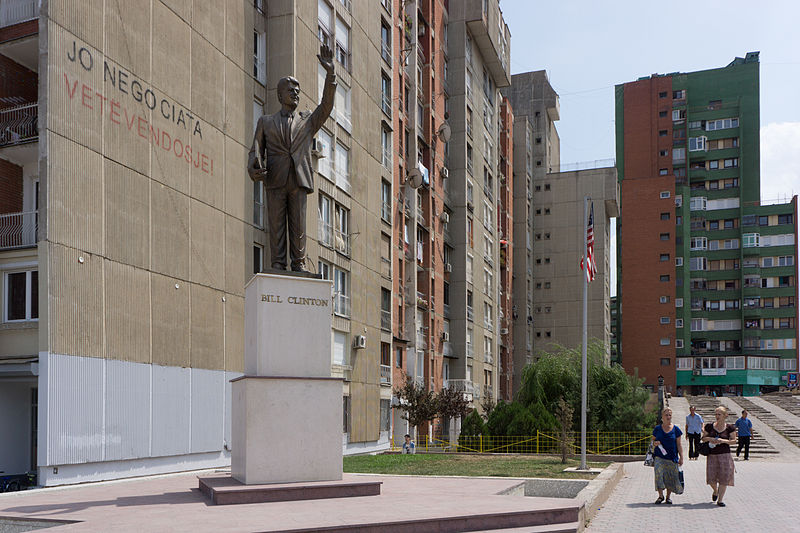
A statue of Bill Clinton in downtown
Pristina, Kosovo's capital city!
He is considered to be something of a "savior" by the KosovarsThe new friendship with the Russians. The Russians, now under Boris Yeltsin, were experiencing something
that roughly qualified as democracy – and enjoyed watching the developing
friendship between Clinton and Yeltsin.
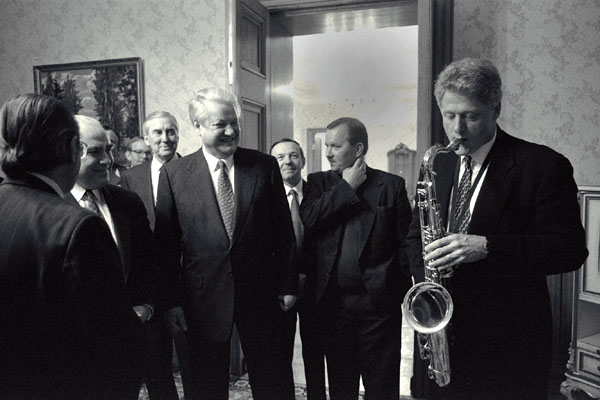
President Bill Clinton
plays the saxophone presented to him by
Russian President Boris Yeltsin at a private dinner hosted
by
President Yeltsin at Novoya Ogarova Dacha, Russia –
13 January
1994
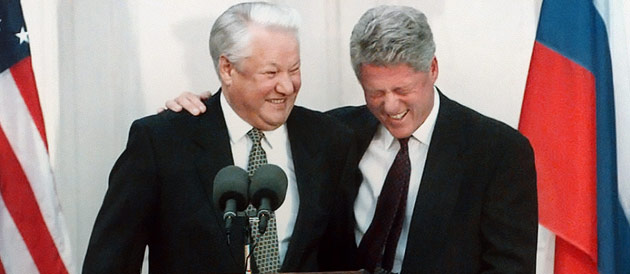
Yeltsin and Clinton having
a good laugh together
during Yeltsin's visit to the US in
1995
But underneath it all was a Russia that was
having a very hard time coping with a world in which the Russians themselves –
and not just their government – found themselves responsible for the social
rewards that came their way. A few of
them (mostly younger) grew quite rich – some through what would qualify in the
West as purely criminal behavior. Others
just could not figure out how this democracy thing was supposed to work – and
found their lives gradually growing poorer and poorer. Life expectancy dropped by a full ten years –
and Russia began to look and act like a Third World country. Increasingly, disenchantment with "Russian
democracy" mounted in Russia.
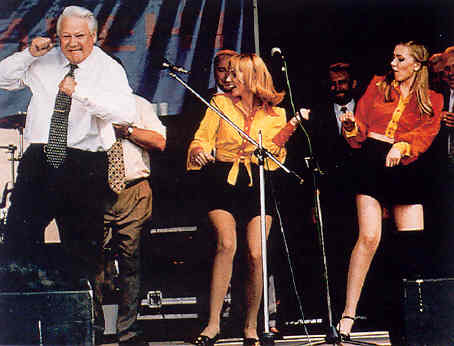
Yeltsin showing his
stuff
But the reality was that only a very small group of Russians were
benefiting from the "New Russia" ... while the situation deteriorated
deeply economically and socially for the rest of Russian socety
Russian Yuppies -
1994
The development of the European Union and NATO.
For the West, these were very good times. European nations were coming closer together
through the European Union – and the new Maastricht Treaty (1992) which pointed
to a full unity of European states – through Europe's single currency, the
Euro, and through the free movement of workers and industrial products from
country to country within the Union (with Britain still a bit standoffish in
keeping their Pound rather than the Euro as their currency).
The signing of the Maastrict Treaty - February 7, 1992
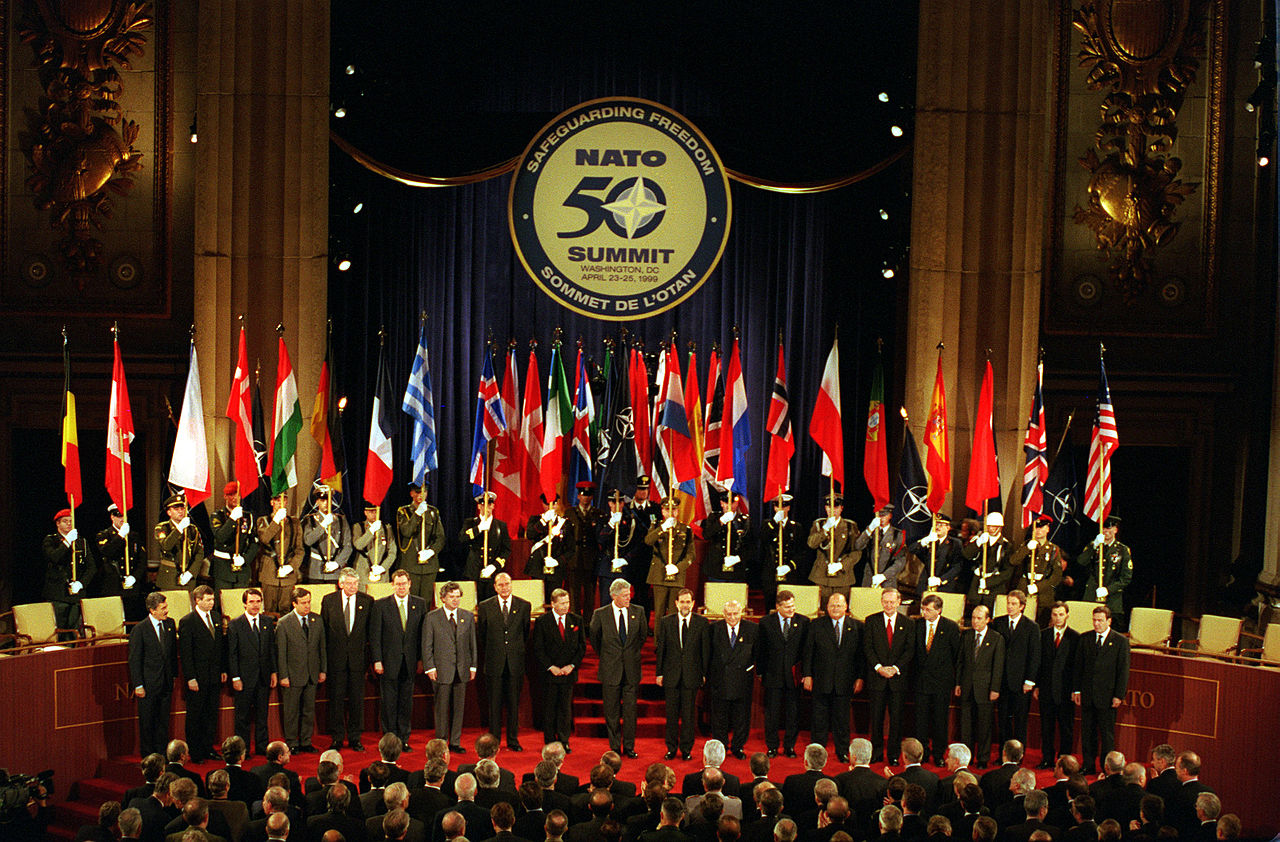
In
addition, the military side of this unity, NATO, was looking very good after
action in old Yugoslavia – and was also taking on new members from the former
Soviet bloc (to the annoyance of Russian hardliners): the new Czech Republic,
Hungary and Poland – bringing the total membership in NATO to 19 countries.
A NATO Summit meeting held in Washington,DC - April 24-25, 1999
Celebrating the 50th anniversary of the organization ... with new
NATO members Poland, Hungary and Czechoslovakia attending.
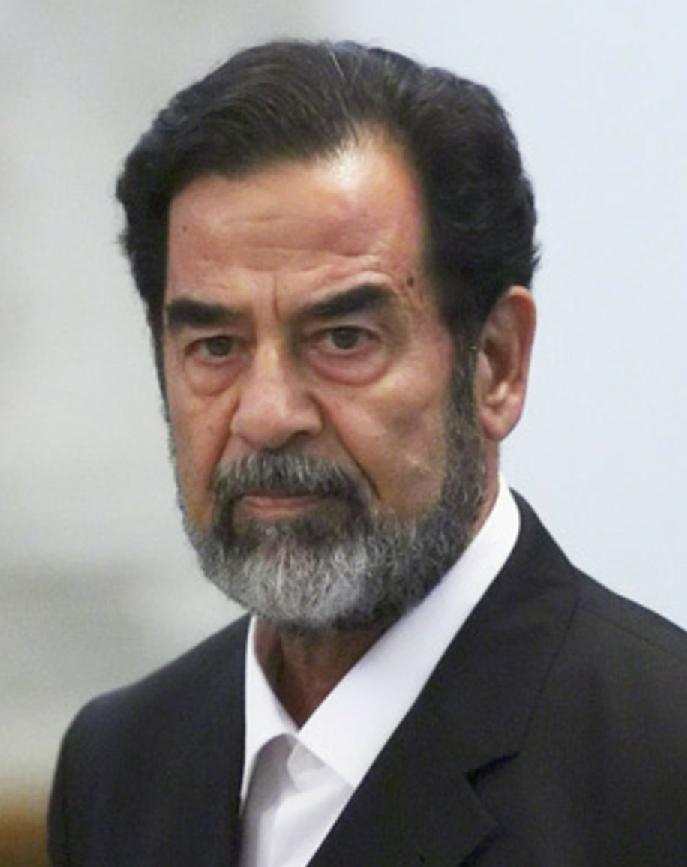 Saddam Hussein's Iraq. Ever since the ouster of Saddam from Kuwait, America had kept
a close watch on the Iraqi dictator's doings.
He had been forced to accept U.N. terms allowing inspectors into his
country to confirm that he was keeping his side of the agreement to suspend
chemical, biological and nuclear weapons development ("weapons of mass
destruction" or WMDs). But Clinton was not convinced that the
inspections were digging deeply enough.
Thus in October of 1988 he signed the Iraq Liberation Act, financing
Iraqi opposition to the Saddam regime. Then in December of that year he forced the
inspectors out of Iraq in order to conduct four days of missile attacks on Iraq
– although they appeared designed more to undercut the Iraqi government than
simply take out questionable weapons production sites (mostly military
installations and their personnel were targeted).
Saddam Hussein's Iraq. Ever since the ouster of Saddam from Kuwait, America had kept
a close watch on the Iraqi dictator's doings.
He had been forced to accept U.N. terms allowing inspectors into his
country to confirm that he was keeping his side of the agreement to suspend
chemical, biological and nuclear weapons development ("weapons of mass
destruction" or WMDs). But Clinton was not convinced that the
inspections were digging deeply enough.
Thus in October of 1988 he signed the Iraq Liberation Act, financing
Iraqi opposition to the Saddam regime. Then in December of that year he forced the
inspectors out of Iraq in order to conduct four days of missile attacks on Iraq
– although they appeared designed more to undercut the Iraqi government than
simply take out questionable weapons production sites (mostly military
installations and their personnel were targeted).
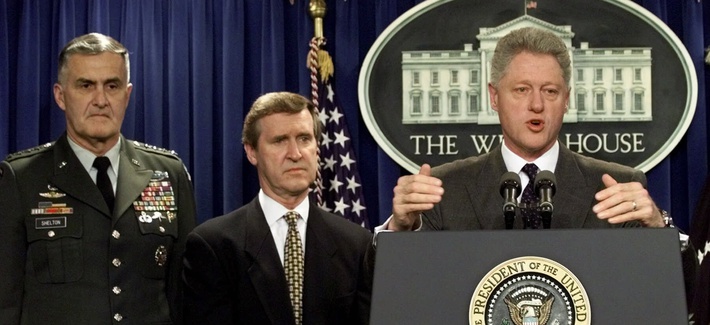
Clinton explaining "Operation Desert Fox" bombing of Iraq
December 1998
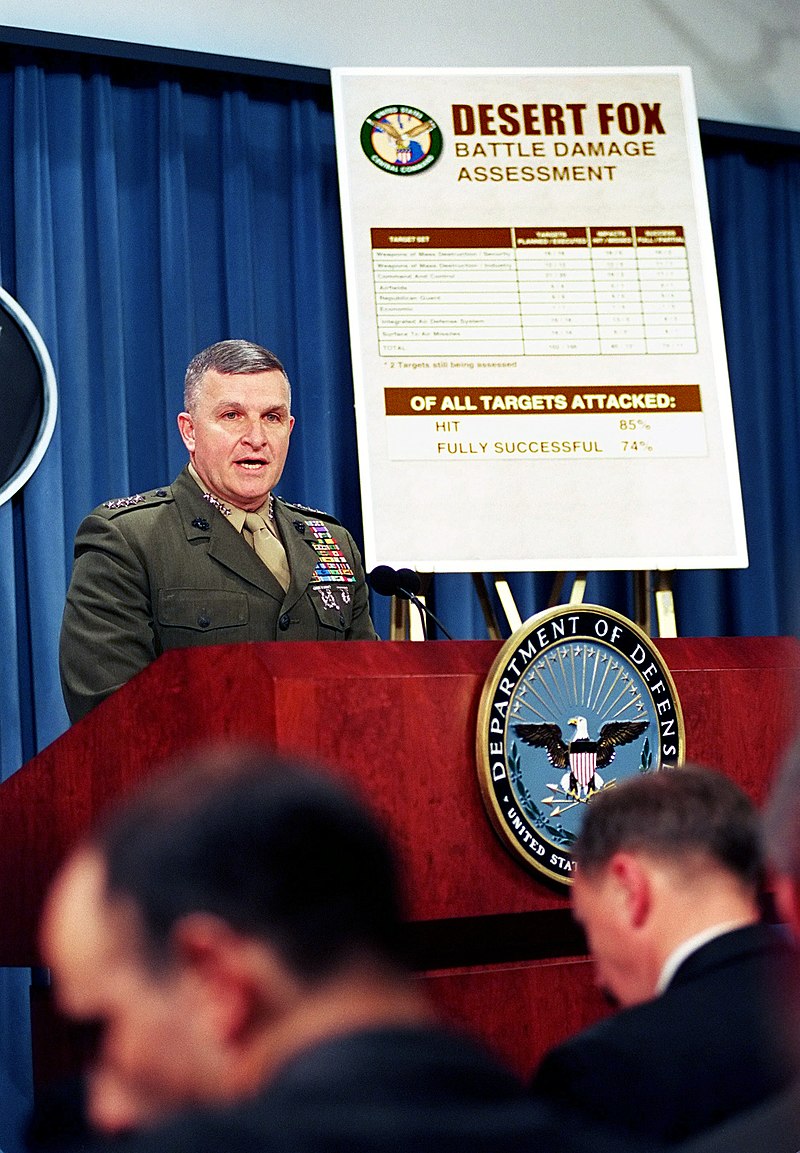
General Zinni offering details on Operation Desert Fox
There
was considerable international opposition to Clinton's program this time, not only
from outraged Arabs but also from Russia, China and even France – which reacted
with a call to end the oil embargo aimed at Iraqi exports. Others loudly accused Clinton of undertaking in this attack
merely a diversion away from the spotlight aimed at him because of the scandal
of his having sex with a White House intern.
But it certainly was also part of Clinton's tough response to the
bombing of the American Embassies in East Africa just a few months
earlier. He was getting very tired of
dealing with rising Arab Islamic radicalism – from any source, whatever that
might be.
Dealing with Islamic Jihad. This matter arose from a growing problem
brewing in the Middle East – one that did not necessarily take conventional
national lines and thus fairly expected behavior. Muslim fanatics, young and extremely
dedicated in their hatred of things Western, were growing in number – in
various ways that had little to do with nations or even countries and their
governments. These fanatics, mujahideen
or jihadists – both words formed from the Arabic jihad, meaning "struggle"
(against evil) – could be found widely around the Middle East (even as far away
as the Philippines) – forming here, moving there, so that it was all that
Western intelligence agencies (such as the America's CIA, Britain's MI6 or MI5, or Israel's
Mossad, etc.) could do to keep up with their activities.
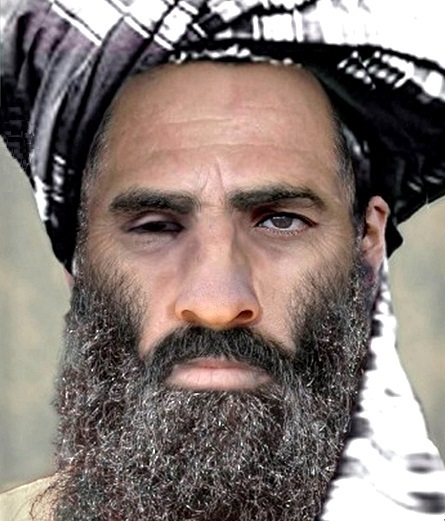 The Taliban.
One such group was the Taliban (from talib, Arabic
for "student") – that had formed originally at various conservative
Muslim schools – most notably the one in Pakistan headed by the mullah
Muhammad Omar. They were found strongly
positioned among the Pashtun tribesmen of Northern Pakistan and Southern
Afghanistan. This was the group actually
helped by America in their effort to oust the Russian Soviet troops from
Afghanistan in the 1980s. But now (1994)
from a political base in the southern Afghan (Pashtun) city of Kandahar, the Taliban were focused on overthrowing
a tribal coalition governing in Kabul – one which the Americans were trying to
work with.
The Taliban.
One such group was the Taliban (from talib, Arabic
for "student") – that had formed originally at various conservative
Muslim schools – most notably the one in Pakistan headed by the mullah
Muhammad Omar. They were found strongly
positioned among the Pashtun tribesmen of Northern Pakistan and Southern
Afghanistan. This was the group actually
helped by America in their effort to oust the Russian Soviet troops from
Afghanistan in the 1980s. But now (1994)
from a political base in the southern Afghan (Pashtun) city of Kandahar, the Taliban were focused on overthrowing
a tribal coalition governing in Kabul – one which the Americans were trying to
work with.
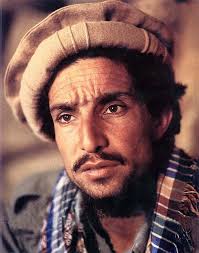 In 1996 the Taliban advanced on Kabul and drove
the coalition from the capital city – the coalition retreating to the north of
the country to become the Northern Alliance under the
leadership of the Tajik, Ahmed Shah Massoud. But the regime of the Taliban was so oppressive (they
executed thousands of civilian Shi'ites and minority Hazaris – and
drove thousands more to the north of the country as refugees) that Americans
felt compelled to support Massoud and the Northern Alliance. This in turn brought friction between America
on the one hand and its old allies Pakistan and Saudi Arabia on the other – Sunni Muslim states actively
supporting the Taliban. Clinton thus had to move cautiously
concerning the mounting crisis in Afghanistan.
In 1996 the Taliban advanced on Kabul and drove
the coalition from the capital city – the coalition retreating to the north of
the country to become the Northern Alliance under the
leadership of the Tajik, Ahmed Shah Massoud. But the regime of the Taliban was so oppressive (they
executed thousands of civilian Shi'ites and minority Hazaris – and
drove thousands more to the north of the country as refugees) that Americans
felt compelled to support Massoud and the Northern Alliance. This in turn brought friction between America
on the one hand and its old allies Pakistan and Saudi Arabia on the other – Sunni Muslim states actively
supporting the Taliban. Clinton thus had to move cautiously
concerning the mounting crisis in Afghanistan.
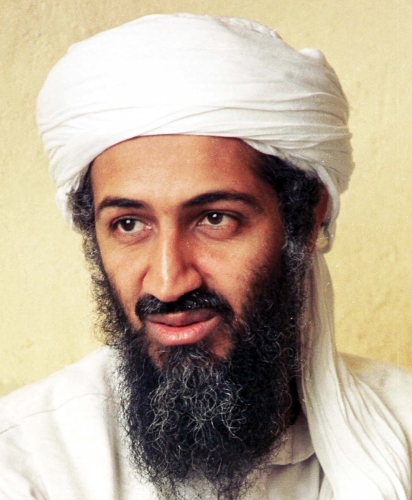 Al-Qaeda (or more properly al-Qa'ida). Even more ominously for America, another
group of Muslim jihadists – al-Qaeda – was being organized by a
Saudi Arab, Osama Bin Laden. His anger at the Saudi Royal family for
allowing the stationing of kaffir (infidel or unbelieving) American
troops on holy Arabian soil (Saudi Arabia itself) during the Gulf War of
1991-1992 had led to his expulsion and flight to the Sudan. In the Sudan, his family name (he was the son
of a very wealthy Saudi businessman) convinced the Sudanese government to give
him permission to set up a training camp there to prepare young Muslims for
jihad – until his organization started conducting attacks on Sudan's neighbors
– and he was again expelled. This time
he moved to Pashtun lands (both in Afghanistan and Pakistan) where his
radicalism was well received. From this
position, Bin Laden began to organize cells of
operatives instructed in the art of suicide bombing against various kaffir
targets – all done to the glory of Allah.
At the same time al-Qaeda missionaries were sent
around the world to various mosques to bring them to al-Qaeda's jihadist vision.
Al-Qaeda (or more properly al-Qa'ida). Even more ominously for America, another
group of Muslim jihadists – al-Qaeda – was being organized by a
Saudi Arab, Osama Bin Laden. His anger at the Saudi Royal family for
allowing the stationing of kaffir (infidel or unbelieving) American
troops on holy Arabian soil (Saudi Arabia itself) during the Gulf War of
1991-1992 had led to his expulsion and flight to the Sudan. In the Sudan, his family name (he was the son
of a very wealthy Saudi businessman) convinced the Sudanese government to give
him permission to set up a training camp there to prepare young Muslims for
jihad – until his organization started conducting attacks on Sudan's neighbors
– and he was again expelled. This time
he moved to Pashtun lands (both in Afghanistan and Pakistan) where his
radicalism was well received. From this
position, Bin Laden began to organize cells of
operatives instructed in the art of suicide bombing against various kaffir
targets – all done to the glory of Allah.
At the same time al-Qaeda missionaries were sent
around the world to various mosques to bring them to al-Qaeda's jihadist vision.
Part
of this was also done in competition with Shi'ite Iran – to promote a Sunni lead in the destruction of
infidel Western culture – in Europe, in Asia (principally the Philippines), in
Africa, and in America.
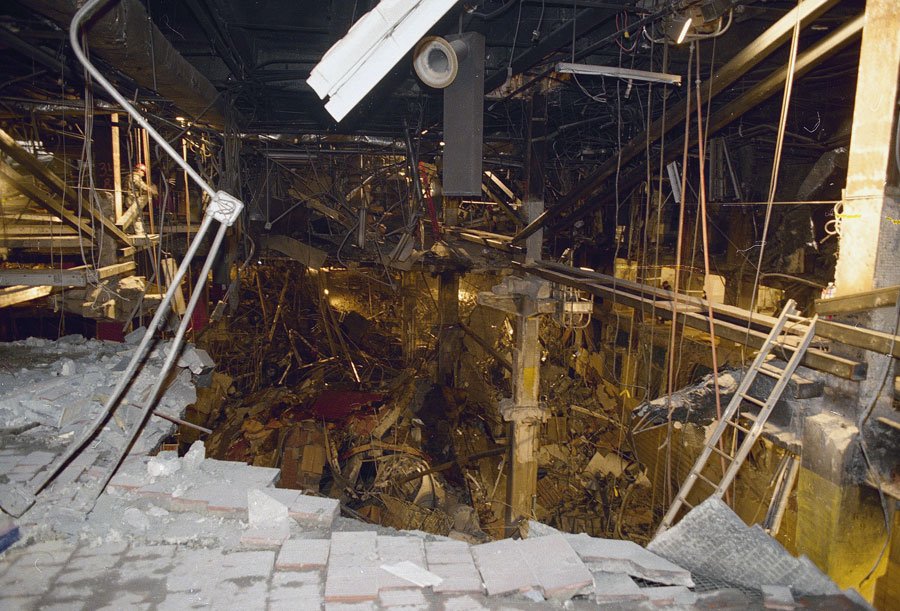
The 1993 New York World Trade Center bombing.
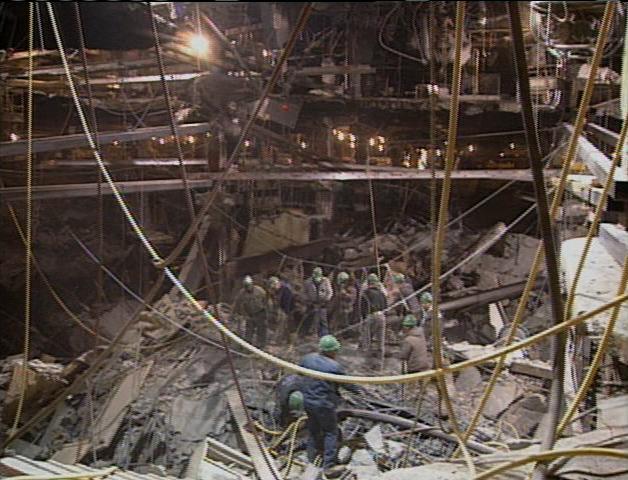
In late February of 1993 a van parked in the garage of the New York
Trade Center exploded – with the purpose of collapsing the North Tower against
the South Tower and killing the tens of thousands of people working at these
immense towers. Instead, it merely
destroyed six stories of the building – although it did kill six people and
wound thousands of others. Had the van
been parked closer to one of the main supports of the North Tower, the bomb
might well have succeeded in its evil design.
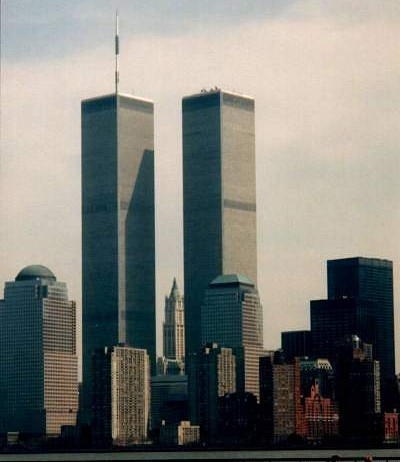
The World Trade Center in New York
City
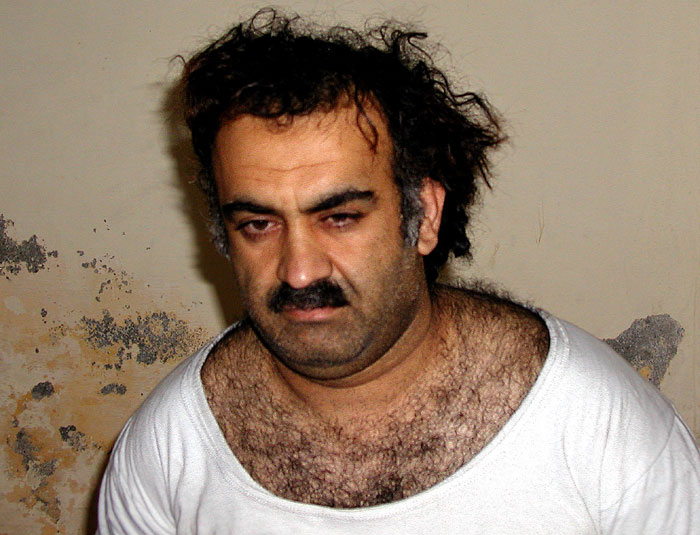
The
attack was supported financially by a Pakistani al-Qaeda member, Khalid Sheikh
Mohammed, uncle of the actual organizer of the event, Ramzi Yousef – who would
also be the mastermind of the second (and successful) attack on the World Trade
Center in September of 2001 (9/11).
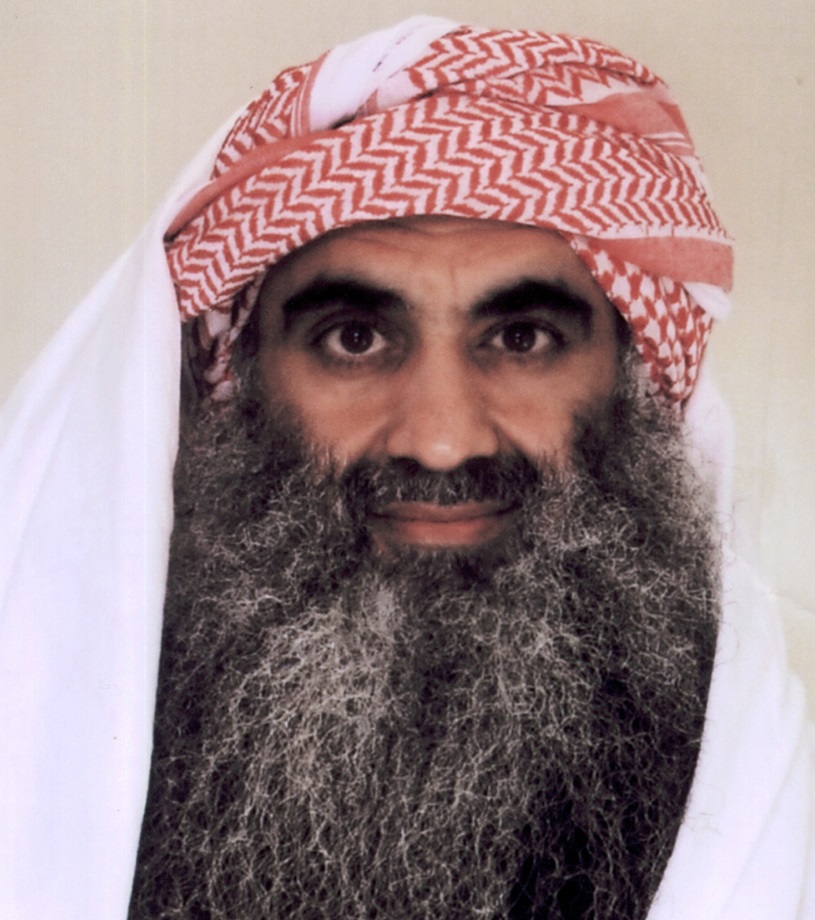
Khalid Shaikh Mohammed
He also masterminded the
second attack on the Twin
Towers on 9-11 2001 ... as well as other attacks
on
Western society
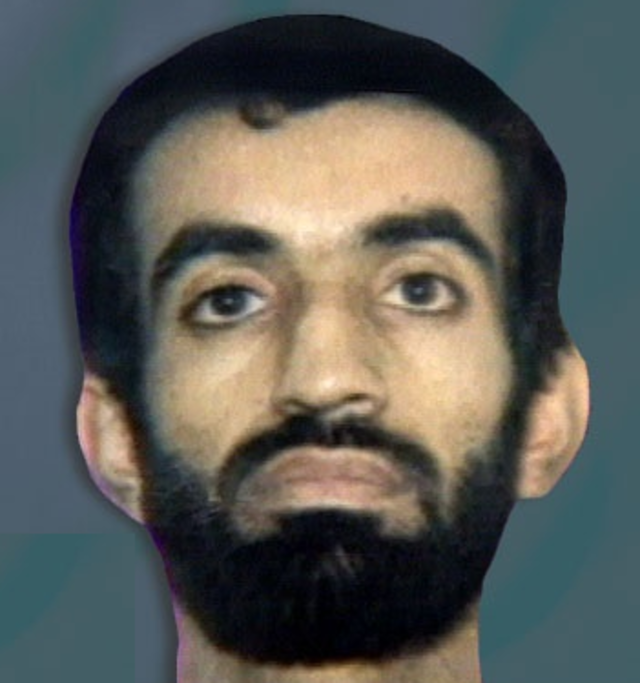
Ramzi Yousef – nephew of
Khalid Shaikh Mohammed –
and operational leader of the 1993 WTC
attack
The
1993 operation involved a number of mosques in the New York metropolitan area, and
the arrest of a number of the conspirators gradually followed. From the outset, American investigators were
strongly suspicious of the al-Qaeda organization as the source
of the enterprise – though no precise connection was established in the
investigation. But at this point, al-Qaeda was put at the top of
America's list of terrorist organizations.
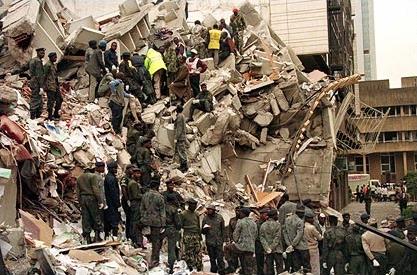
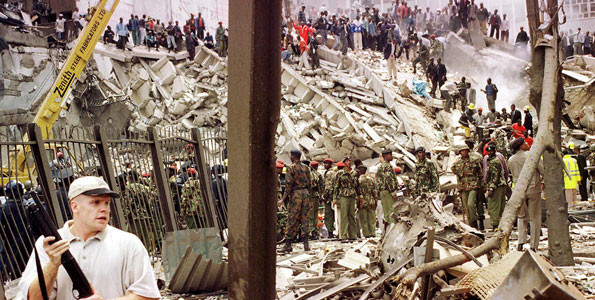
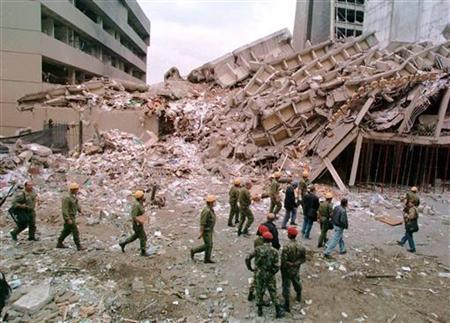
The attack on American embassies in Tanzania and
Kenya (1998). In August of 1998 two American embassies in
East Africa were bombed, with hundreds of people killed. This time al-Qaeda's connection (through its
Egyptian affiliate, Egyptian Islamic Jihad) was clearly identified as
responsible for the bombings. Clinton struck back immediately, with
missile strikes on Afghan and Sudanese targets (although the Sudanese site may
have been unconnected to the event).
Many Arabs cheered the al-Qaeda attack on the embassies –
and took to the streets in protest against the American retaliation.
America's relations with significant parts of the Arab
Islamic world were clearly reaching a very low point.
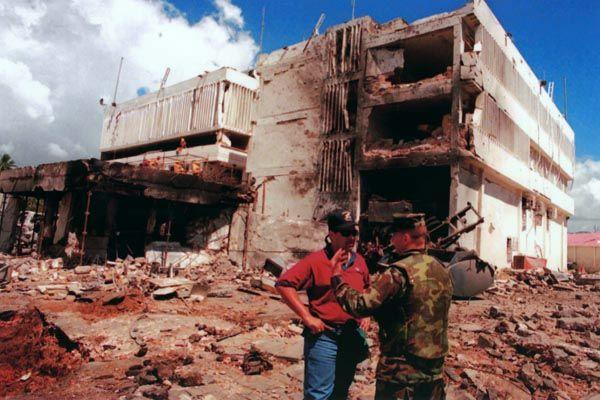
The U.S. Embassy in
Dar es Salaam, Tanzania,
in the aftermath of the
August 7, 1998, al-Qaida suicide bombing
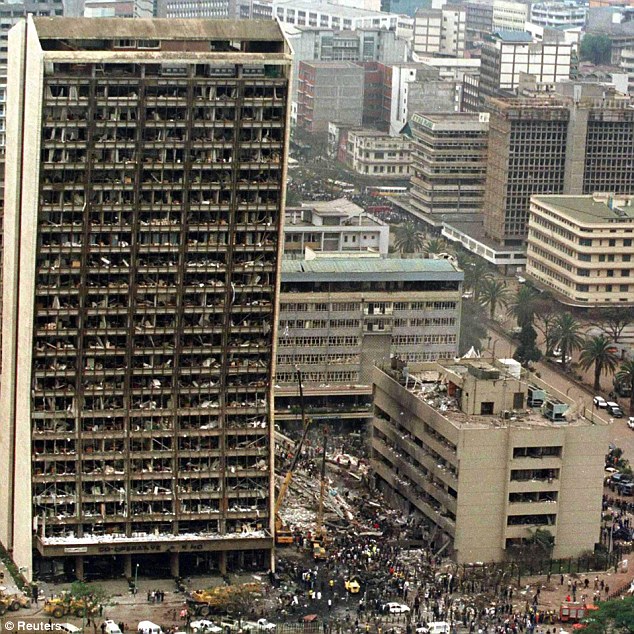
The U.S. Embassy bombing
in Nairobi, Kenya – August 7, 1998
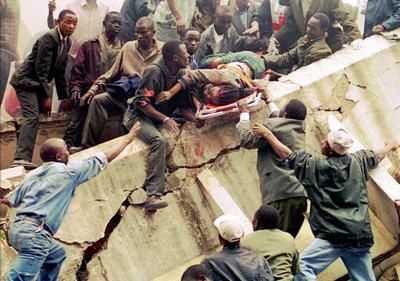
_______________________________________________
American retaliatory attacks
on al Qaida training camps in
Afghanistan and supposed supply depot in
the Sudan
August 20, 1998
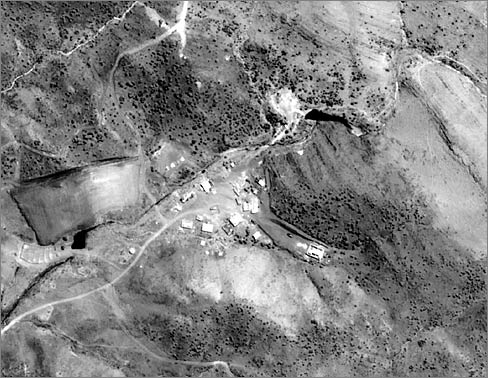
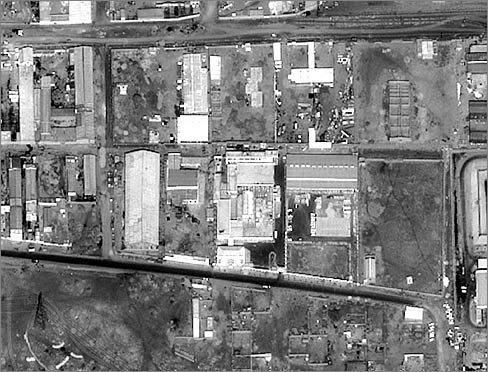
"1998 satellite image released
by the U.S. Government of an
Al-Qaeda training camp
at Zhawar Kili, Afghanistan
that was
later bombed during Operation Infinite Reach"
"1998 US Government
photograph
shows a suspected
bioweapons production facility
in Shifa, Sudan that the
U.S.
destroyed in the wake of terrorist bombings
of the American
embassies
in Kenya and Tanzania that year."
| PARTICULAR EVENTS THAT SHAKE THE COUNTRY DEEPLY IN THE 90s |
Although the country had settled down greatly since the tumultuous
1960s and 1970s, there were a number of incidents (besides the Twin Towers bombing of 1993) that
shook the country, incidents that stood out not because they represented the
sweep of new political impulses, but incidents that for unique reasons of their
own shattered the American image of prevailing peace and social justice.
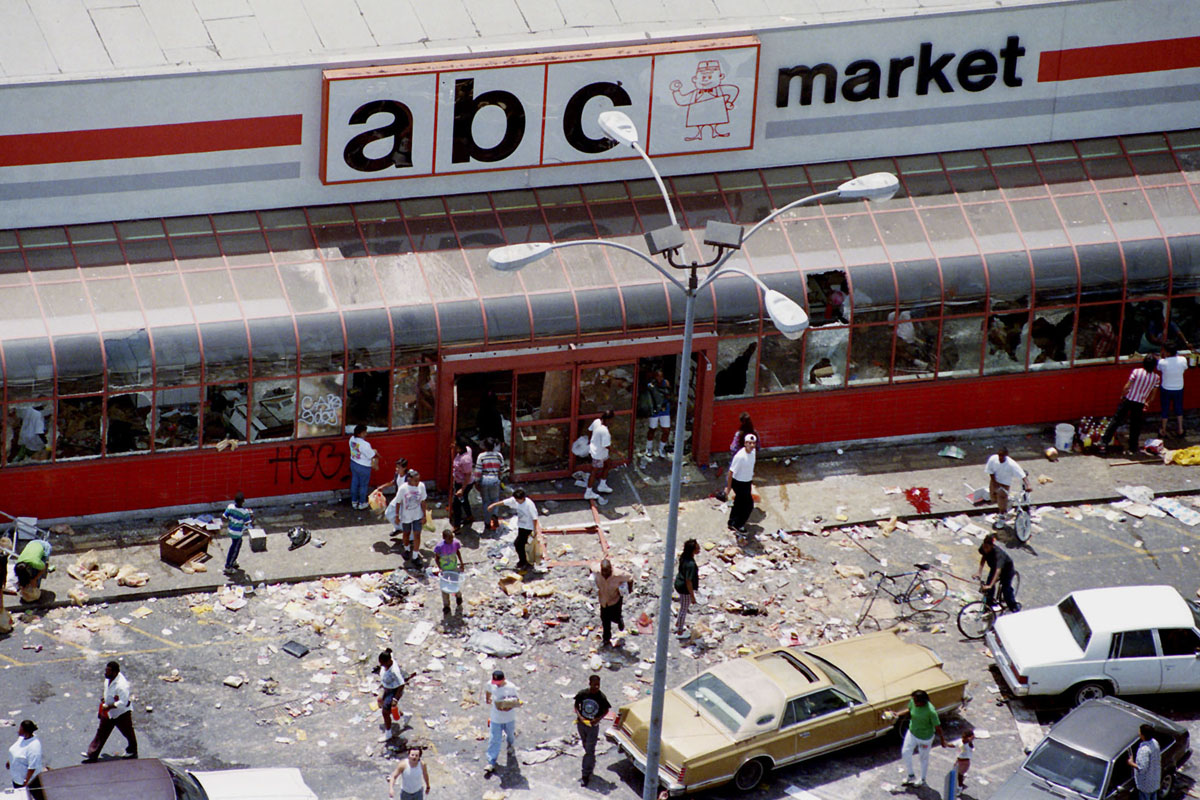
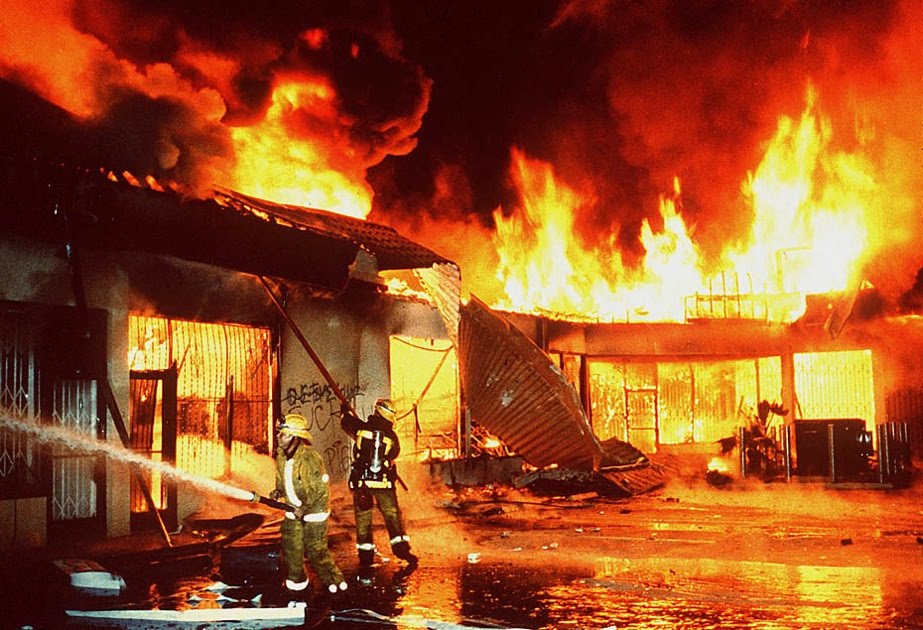
The Rodney King incident (1991-1992).
A major tragedy hit the nation in 1992 when a court decision in Los
Angeles did not go the way Blacks felt that it should, and for the next six
days they rioted, plundered and torched the world around them, causing over $1
billion in property damage to some 1,600 businesses (some 40% of them owned by
local Korean shopkeepers), a social catastrophe that injured 2,000 and killed
63 people as well.
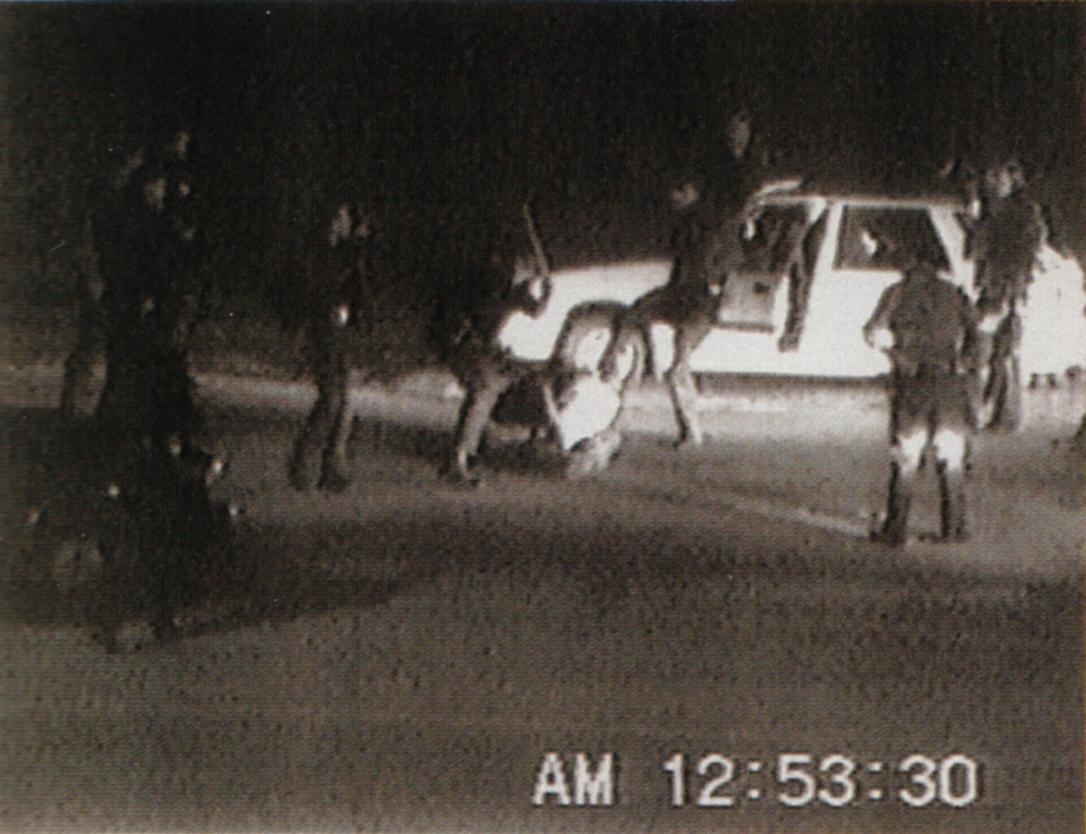
The incident occurred over the arrest of Rodney
King the previous year, whose takedown by police was videoed by someone drawn
to the commotion by police sirens and helicopters. The video was submitted to a scandal-hungry
press, which repeatedly showed only the last moments when King was beaten to
the ground, failing to mention in their report the long chase of his (and two
companions) car through the city's streets and failing to show (in the same
video) King's repeated efforts to break from the police when finally
caught. But the jury that tried the case
did have all the contextual information, and acquitted the police.
That
was not a decision that the Blacks wanted.
So they rioted ... urged on by LA Mayor Tom Bradley, expressing his own
anger at the jury decision (understandable on the part of a Black mayor, but
one disastrous for LA in the way it encouraged the wrong kind of behavior, not
to mention disastrous for Bradley's own political career).
Ironically,
King eventually sued the city of Los Angeles, and was awarded $3.8 million in
compensation (plus $1.7 million for his lawyers). Thus supposedly American justice was
served. King would continue to drink and
take drugs, was arrested eleven more times, and finally drowned in his own
swimming pool years later.
The Rodney King incident – March
3, 1991
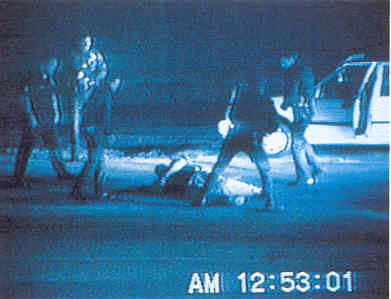
The Rodney King beating caught
on video-tape – 1991
Los Angeles police officers
beating Rodney King after he led
them on a late night chase – March 3,
1991
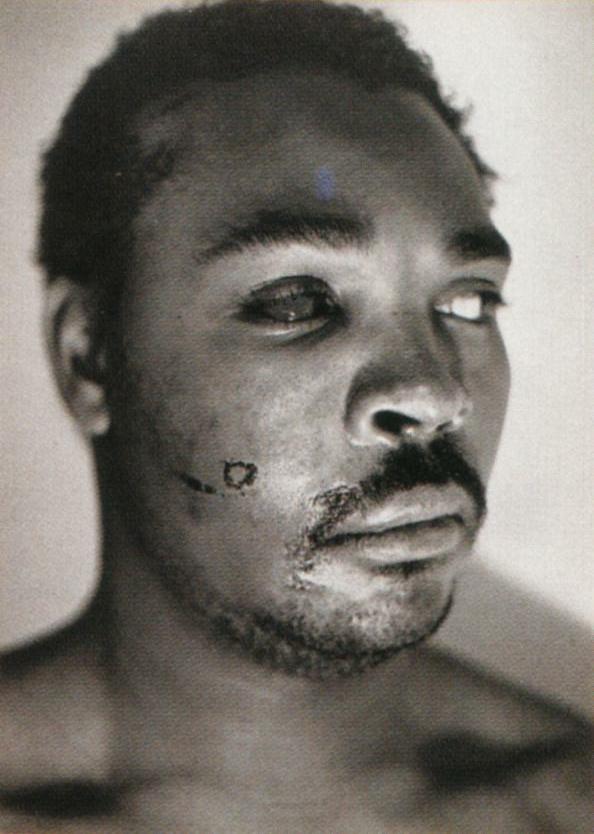
Rodney King after his
beating
When an L.A.
jury acquitted the police (April 29, 1992)
Blacks began to riot
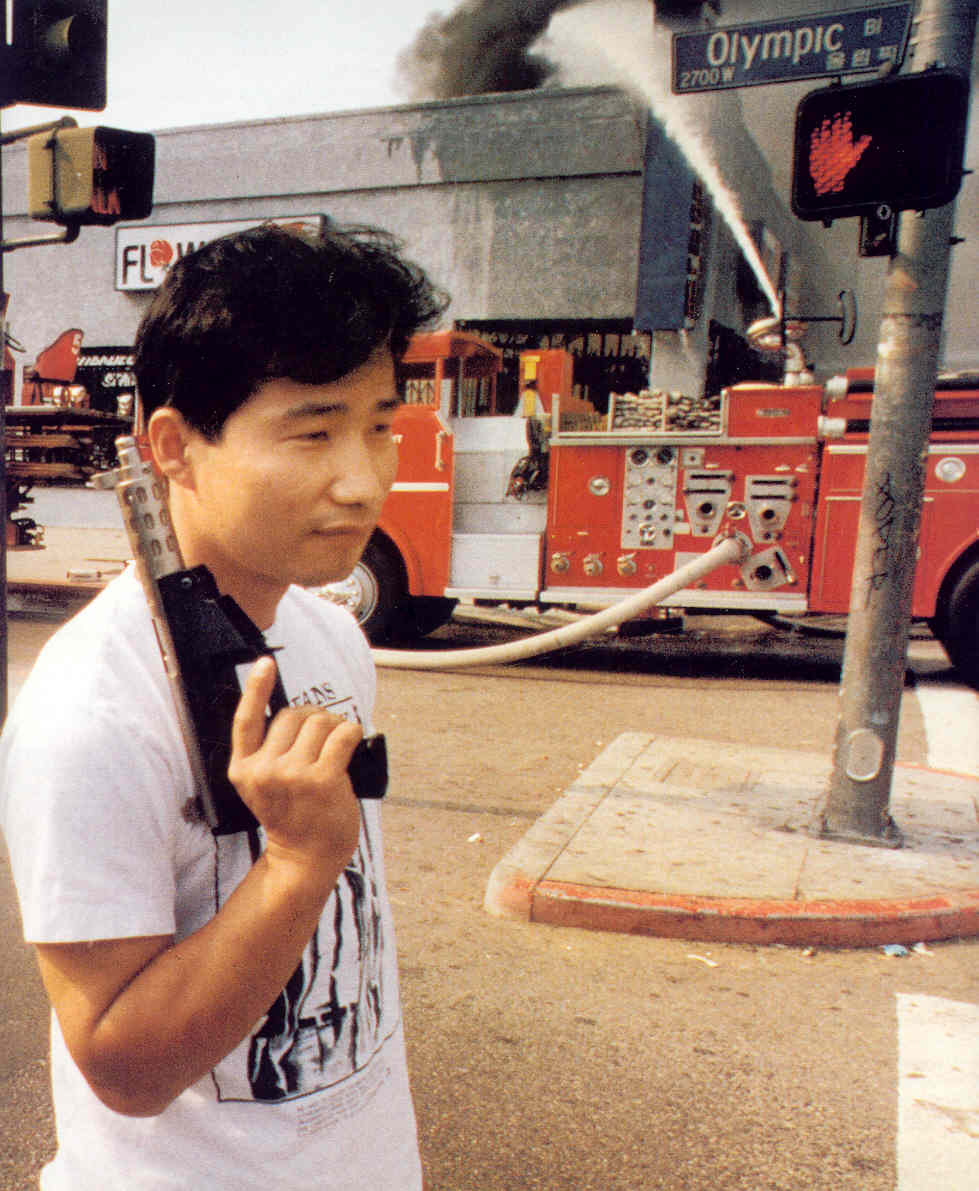
A Korean-American defending
his store in Los Angeles
against Black looters and arsonists
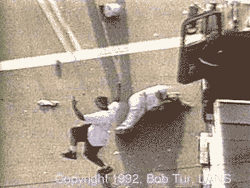
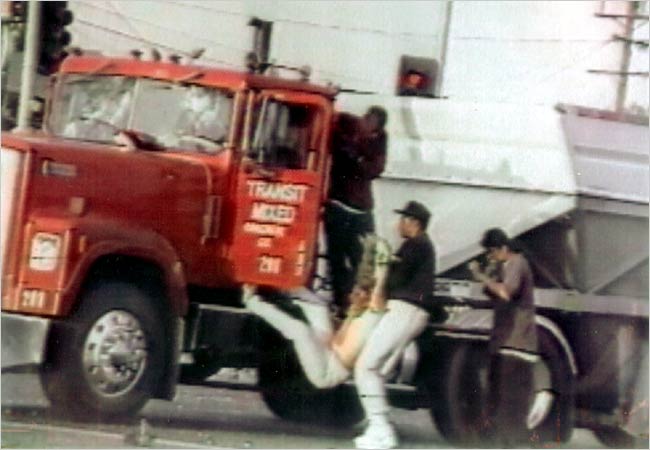 They even felt entitled to pull a White truck driver from his
truck
and bash his head with a brick and kick him mercilessly
They even felt entitled to pull a White truck driver from his
truck
and bash his head with a brick and kick him mercilessly
when
down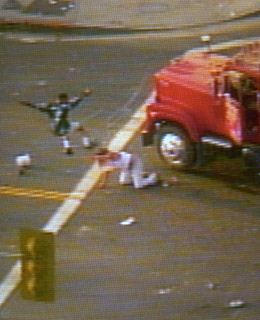
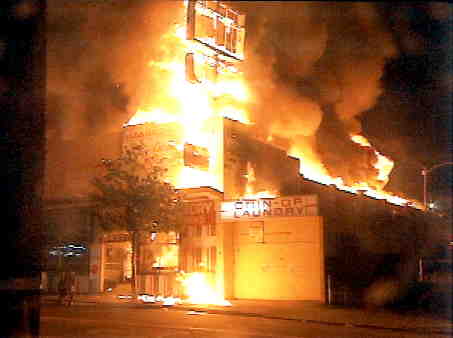
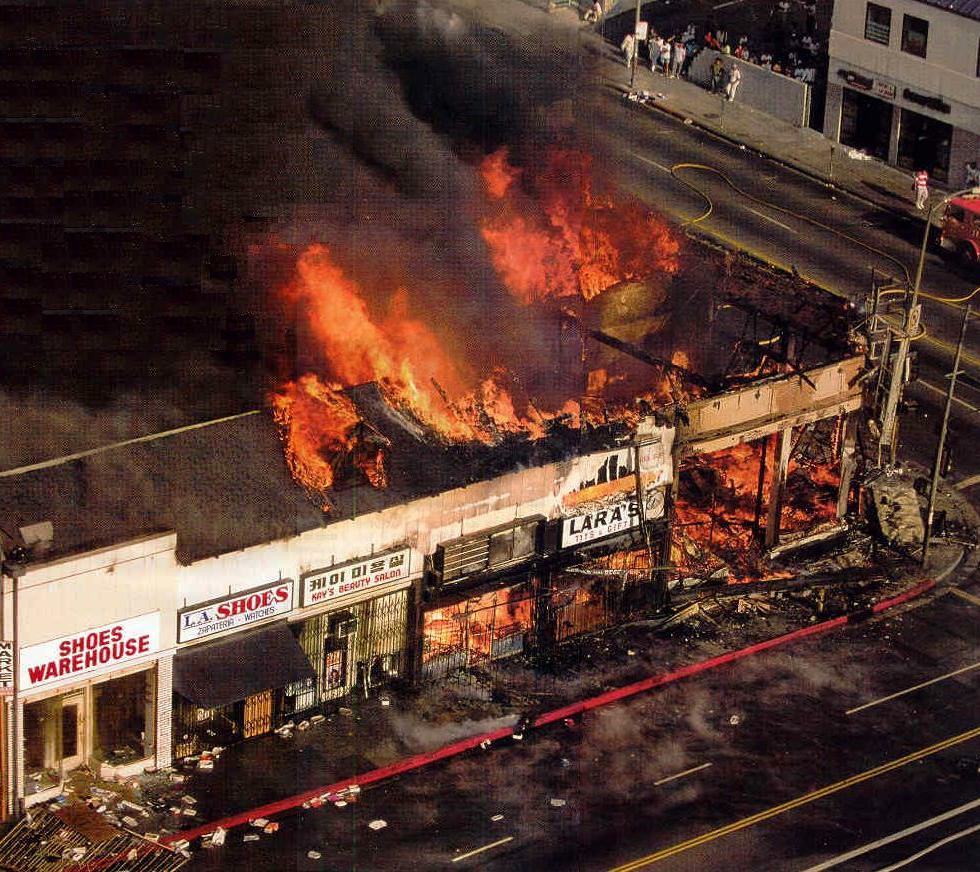
L.A. burning during the riots
of April 1992
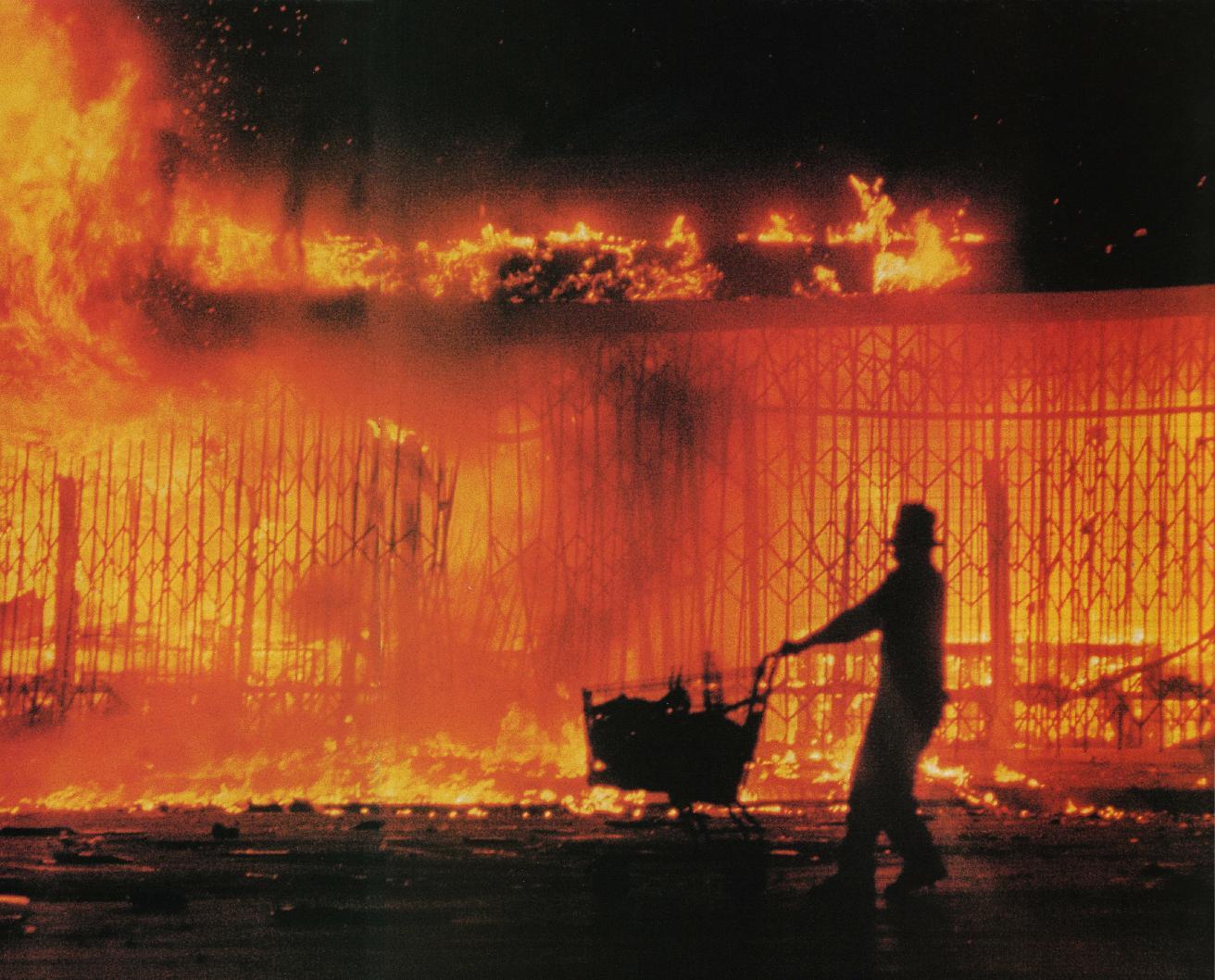
Los Angeles' South-Central
district on fire
The Ruby Ridge incident (August 1992).
A local feud among neighbors in Idaho turned into a major Alcohol,
Tobacco and Firearms (ATF) disaster when an angry neighbor – who lost a
property claim in court – took revenge on the Weaver family by reporting them
to the FBI and Secret Service as having made threats on the life of the
President, the Pope and the Idaho governor (pure fabrication by the neighbor), and
eager government officials took the bait.
The matter was put in the hands of the ATF and they set a trap to bring
Randy Weaver into custody, and the event went wrong. Their warrant, deviously place in his hands
when Randy Weaver attempted to help ATF agents pretending to be stranded
motorists, listed the wrong date for the court appearance. And when he did not show up, ATF agents were
sent to arrest him, resulting in months of a standoff when Weaver refused to
give himself up. Then when a TV
cameraman filming from a helicopter the action accused (quite falsely) the
Weavers of having fired on his helicopter, the Feds felt that they finally had
the just cause to act directly against Weaver.
Thus six Federal Marshals were sent to raid his home. When Harris, a family friend, and the Weaver's
14-year-old son went out to investigate the family dog's barking, shooting
broke out between Harris and the Federal agents and the son was killed – as
well as a US Marshall. Then a sniper
killed the wife when she went to the door to let Harris back into the house, and
for the next twelve days a standoff occurred at the site as agents negotiated
Weaver's surrender.
Ultimately
the ATF had no case to stand on other than Weaver not originally showing up at
court on schedule. Harris was found not
guilty of all charges on the basis that he had simply responded to being fired
on by an agent who had failed to identify himself before firing. In fact it became clear that the Federal
agents had disregarded the Rule of Engagement (ROE) completely.
Ultimately
the "Ruby Ridge" episode became famous as a case of government
misconduct – books, songs, and even a CBS miniseries was published over the
tragedy, and a lawsuit (quite light in terms of the horrible damage to the
Weaver family) was brought successfully against the government.
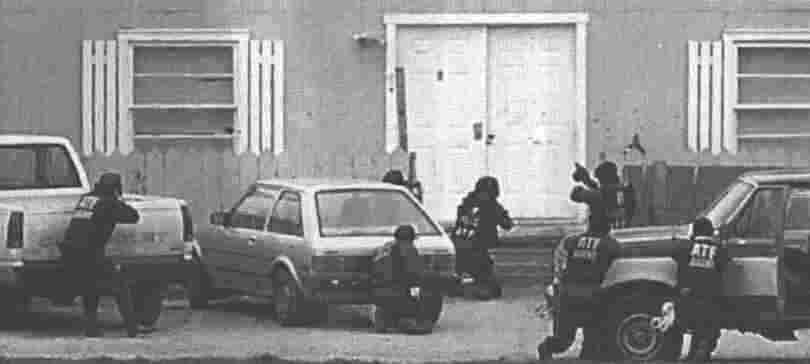
The Waco Siege (February-April 1993). A similar incident of government malfeasance
occurred the following year in Waco, Texas, when locals reported to local
officials all kinds of misconduct going on at a very secretive commune of
Branch Davidians (a break-away millennialist group from the Seventh-Day
Adventists). The locals had no evidence
of any of the "facts" they were reporting – only rumors which grew
more graphic with the retelling. Thus it
was that the ATF was once again brought into a local drama in order to bring "justice"
to the matter.
Here
too a standoff occurred, which the ATF tried to resolve by simply invading the
compound, only for a firefight to break out between the two groups. Four federal officers and five Davidians died
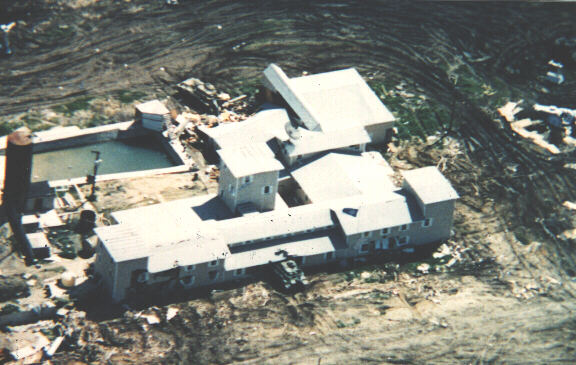
and more than 20 other federal officials were wounded in the action. Now the matter became truly a war. Water was cut off to the compound and over
900 officers assembled to begin a full-scale attack (including armored tanks),
which on April 19th finally took place.
In the melee, the compound burst into flames, 76 Davidians (including
numerous women and 25 children) died in the blazing inferno (only nine
Davidians came out alive from the event).
The
trial of the survivors dragged on for years, even reached the Supreme Court,
which finally reduced greatly the sentences imposed on the survivors, and the
ATF again came away looking very bad as the facts of the whole incident became
ever clearer.
The standoff began after a shootout
on Feb. 28, 1993
On April 19, FBI agents decided that
it was time to end
the 51-day impasse.
FBI-driven tanks assault the David Koresh
compound
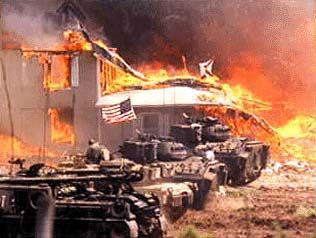
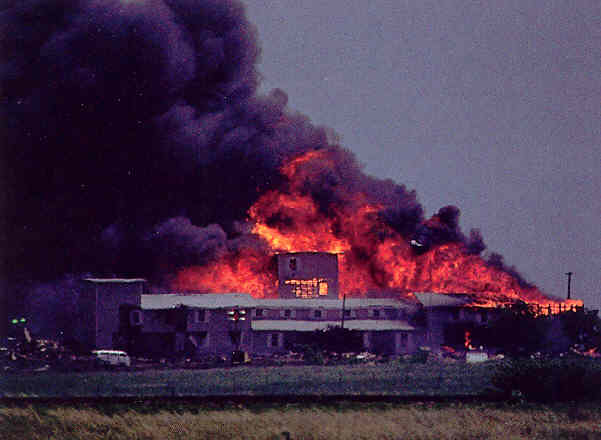
The Koresh compound in Waco
in flames – April 19, 1993
About 80 Davidians died
The Oklahoma City bombing (April 19,
1995). Two years later on exactly the same date as
the Waco disaster, a huge explosion took out the front portion of a federal
building in Oklahoma City, killing 168 people (19 of them children at a
day-care center located in the building) and injuring some 680 others, and
causing property damage reaching blocks away.
Timothy
McVeigh and his accomplice Terry Nichols were stopped for a license plate
violation, which in the process revealed to police a record of weapons
possession – which in turn led the police to realize that these two were the
ones who had carried out the explosion.
McVeigh explained his action as revenge for both
the Ruby Ridge and Waco disasters caused by federal authorities (the latter
determining the date for McVeigh's action).
But McVeigh's vigilante act gave him no just cause in the eyes of the
jury and he was found guilty (1997) and executed (2001), with Nichols receiving
life imprisonment. This in turn prompted
Congress to pass the Antiterrorism and Effective Death Penalty Act of 1996,
providing for stronger protection at federal facilities.
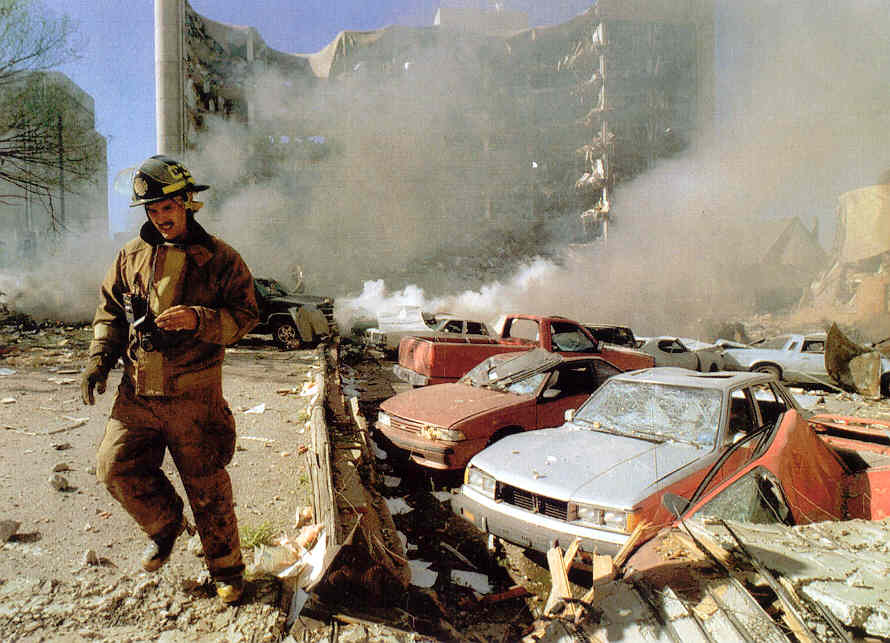
The Oklahoma City Bombing – April 19, 1995
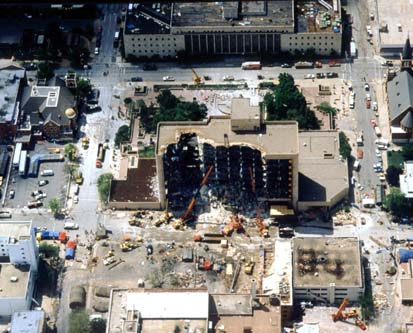
An aerial view of the destroyed Federal
Building
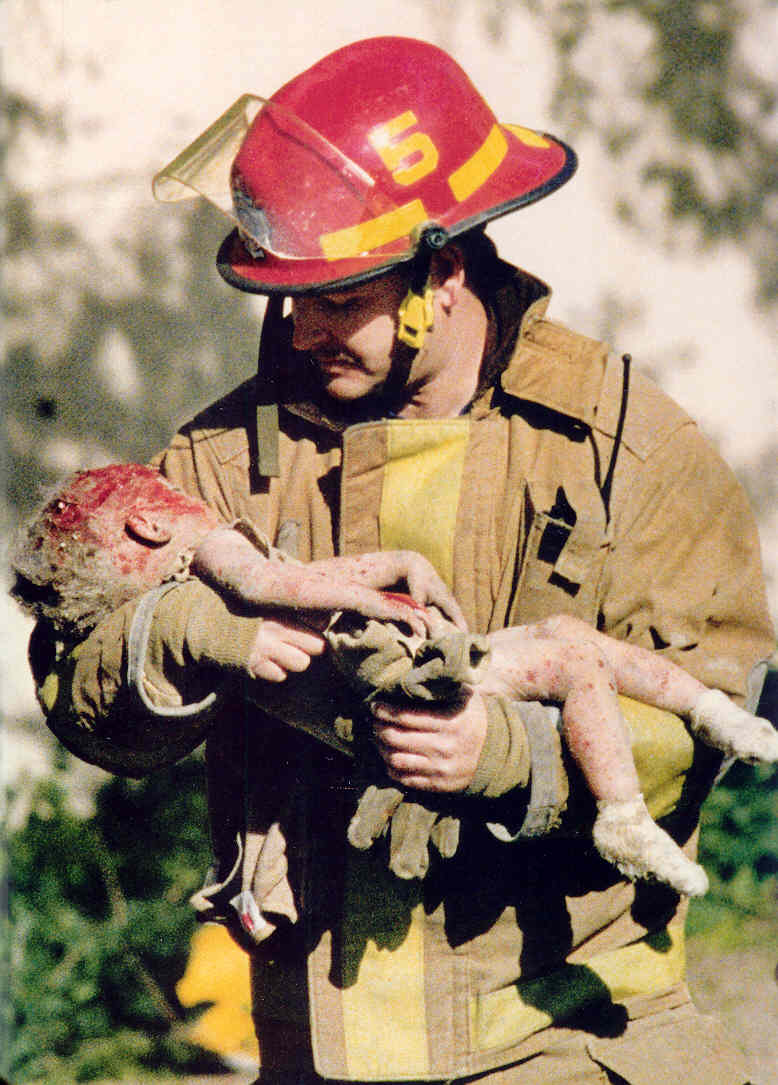
Dead baby from the Oklahoma
City explosion – 1995
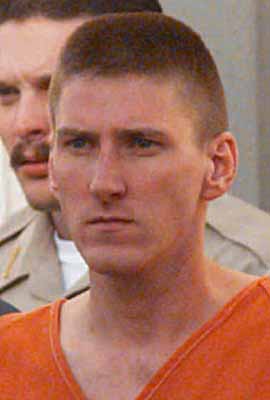
Timothy McVeigh – convicted
and executed for the crime
(June 2001). McVeigh claimed he was taking
revenge
against the Federal government for the destruction of the
Waco
Branch Davidians exactly two years earlier.
The O.J. Simpson murder case (1994-1995).
Another event which had the potential to shake the country to the core
was the trial of O.J. Simpson, accused by Los Angeles authorities of having
killed his ex-wife, Nicole and her boyfriend Ron Goldman on the night of June
12, 1994. Evidence, (a bloody glove
found at the scene of the crime in front of Nicole's home and a matching bloody
glove found at the home of Simpson) immediately pointed to this famous football
(and media) celebrity. Thus when the
news hit the media, a huge national drama unfolded. At first it looked as if Simpson might take
his own life rather than surrender himself.
But ultimately, he gave himself up, and the country prepared for a major
courtroom media event.
To
make the case as "fair" as possible, a predominantly Black jury was
chosen, and the defense thus was able to employ the "bad police"
defense (the prosecuting attorney was a "genocidal racist"; racist
police could have planted the second glove at Simpson's home to make him look
guilty). But the racist argument was
countered by pointing to the fact that police had been called to the Simpson's
home eight times by battered wife Nicole and only the last time was Simpson
actually arrested. However the October
3rd (1995) verdict was foreordained.
There was no way that a predominantly Black jury was going to find
Simpson guilty of the murders.[5] Thus the hundreds of police (remembering the
Rodney King situation), who were ready to deal with a situation that was
expected to follow if he were found guilty, were able to stand down.
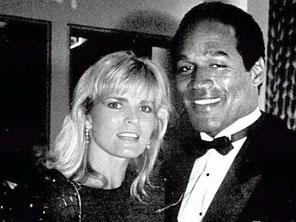
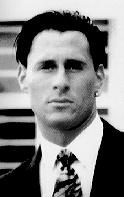
Nicole Brown Simpson and O.J. Simpson
(in happier days)
and Ron Goldman
O.J. Simpson was arrested on June
17th
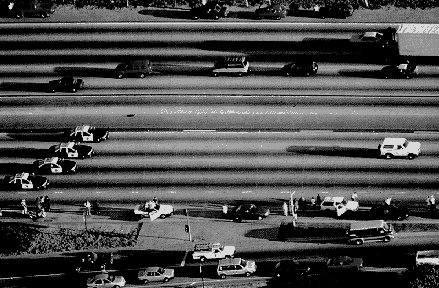
O.J. (in the White Bronco) being followed
slowly by police
as he contemplates turning himself
over to authorities
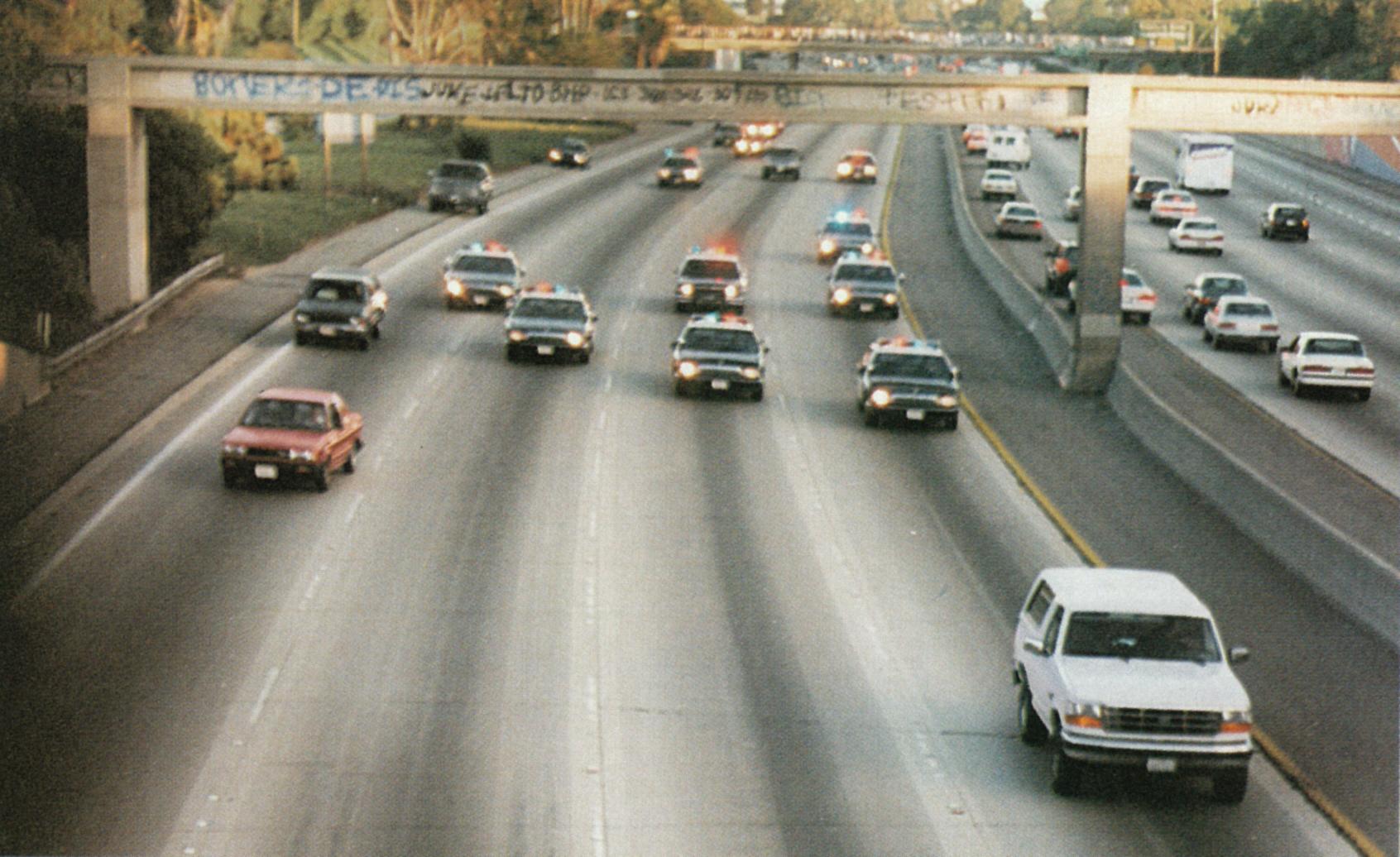
O.J. Simpson pursued by L.A.
cops
after learning of being
charged with the murder of his
ex-wife and her boyfriend – June 17, 1994
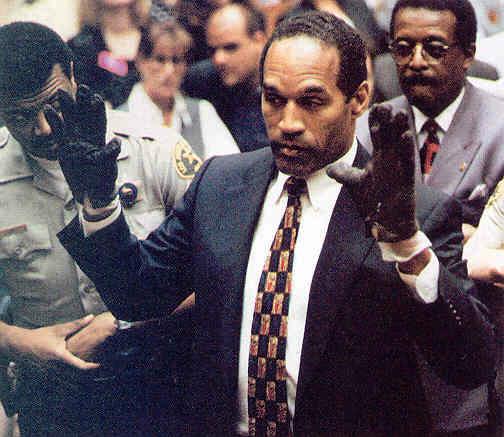
O.J. Simpson demonstrates
that the blood-stained gloves
could not have been his
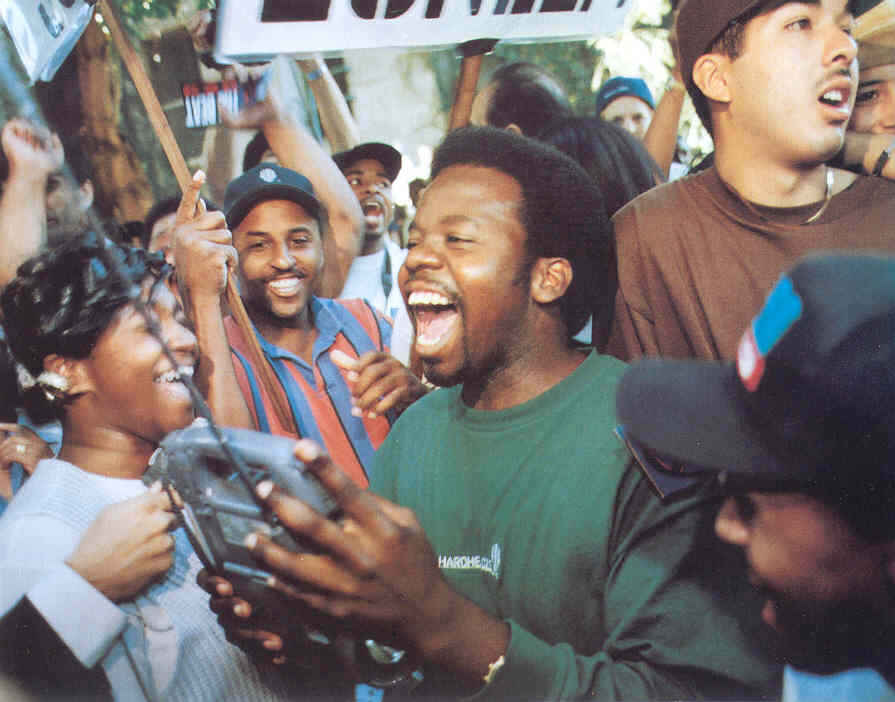
Blacks are jubilant over
the O.J. Simpson verdict – 1995
The Million-Man March (1995).
Just two weeks after the Simpson verdict a huge "Million-Man March"
on Washington, D.C., was assembled by Black Muslim leader Louis Farrakhan. But it was designed to encourage a very
different sense of honor among Black males than simply "burn, baby burn." Behind this event was deep concern that it
was Black women who were left with the responsibility of holding the Black
family together – in the face of widespread male no-show at the family scene. The March was a call to men to repent of the
way they related to the women of their community, to put themselves before God,
and take up the family and social responsibilities that should be theirs as
men.
The
gathering was peaceful and dignified throughout, seemed to please the White
world (which actually commented very little about the event), but did draw some
complaints from Black feminists – who did not find anything redemptive about
any event that was focused just on men and them alone.
In
any case, would this appeal work? Would
it restore the Black family (over 70% of Black children lived in homes with
only the mother present) – once the bulwark of Black strength through some very
terrible times in American history. But
to address that issue, America would also have to address the welfare system
that rewarded Black families only when an employable male was not present. This
was a major financial disincentive facing the Black family. Thus ironically, the effort of the welfare
system to help the Black community had only seemed to make things worse.
The "workfare"
policy of Gingrich/Clinton was designed to address this
situation, but seemed only to give Black women greater talent as members of the
workforce (a good thing) without addressing the matter of the missing male (a
bad thing). In the meantime, young Black
males were still being left to enter manhood without any guidance from a loving
father at hand to help them make that entry.
Gang membership was too often providing such instruction to rising Black
males. But that was hardly a good thing.
What
could be done to correct this matter? No
one seemed to have any good answers. The
Million Man March was an excellent step forward – but ultimately seemed to have
changed very little over the longer run.
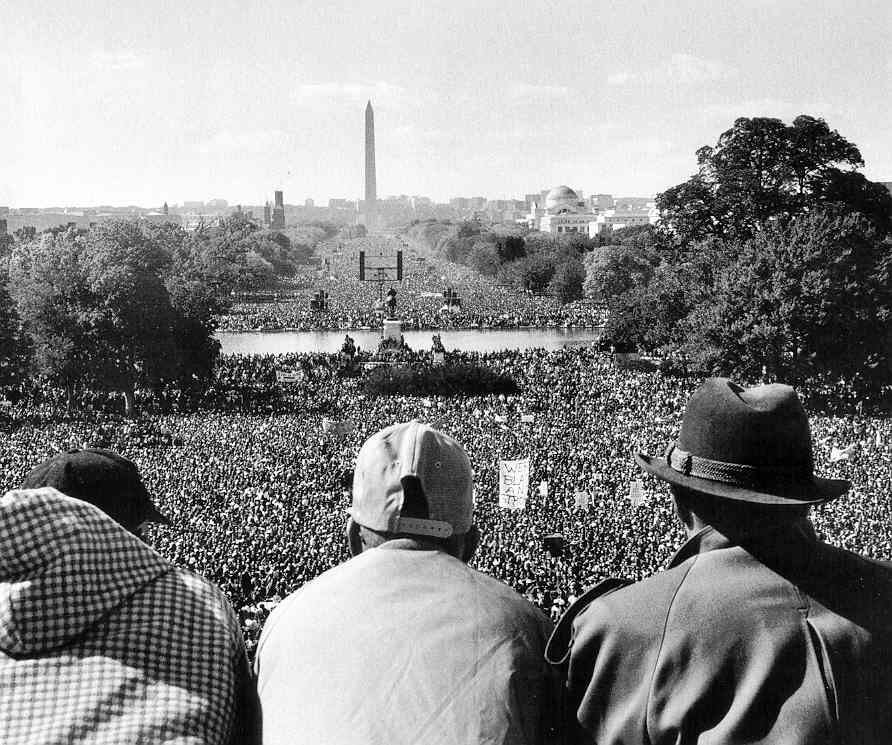
Million Man March -
1995
Impeach, impeach, impeach. Clinton's last two years in office
were darkened by revelations of an affair he had been having with a young White
House intern, Monica Lewinsky. Sex or money in exchange for status and power
has not been a particularly new thing in Washington, or for that matter in the
world or across the centuries. This does
not make it right. There are rules
against it. But being powerful tends to
cause people to think themselves exempt from such rules. You are just not supposed to get caught.[6]
Naturally, Clinton denied having the
affair. Then the truth of this affair
came out, along with a number of other women who testified that they themselves
had had the same experience with Clinton along his way to power. Ah-hah!, so he lied about the affair! Certainly lying to Congress about this affair
constituted supposedly one of those "high crimes and misdemeanors"
that then allowed the Republicans to begin impeachment hearings against the
president.
But
the American public was in no mood for such a move against the president, and
the November 1998 elections cut back the Republican majority in the House from
21 seats to 12 seats. This in turn
caused a Republican revolt against House Speaker Gingrich, who then announced his
resignation as Speaker.[7] Nonetheless, the impeachment hearings
continued forward and on December 19th the vote went against Clinton on two counts and in his
favor on two other counts (most of the voting along party lines).
Thus
the Republicans joined the Democrats in confirming the new political practice
of impeaching the President when any opportunity to do so would present itself,
a horrible political activity to mix into the "normal" process of
Washington politics.
But
when the case went to trial in the Senate, the best the Republicans could do
was a 50-50 vote on one count and an even worse 45-55 vote on the other,
neither coming close to the 2/3s vote needed to convict.
There
were some interesting outfalls from all this.
First of all, a new email campaign which called itself "moveon.com"
mobilized the young "wired" generation during the 1998 electoral
campaign to "move on" past this meaningless scandal, the organization
then itself "moving on" to become a major Democratic Party campaign
support group in future elections.
And
most bizarre of all, Clinton ended his last months in
office (prior to the end of his term in January of 2001) with one of the
highest approval ratings of a president at the end of his term! Indeed, the nation had "moved on."
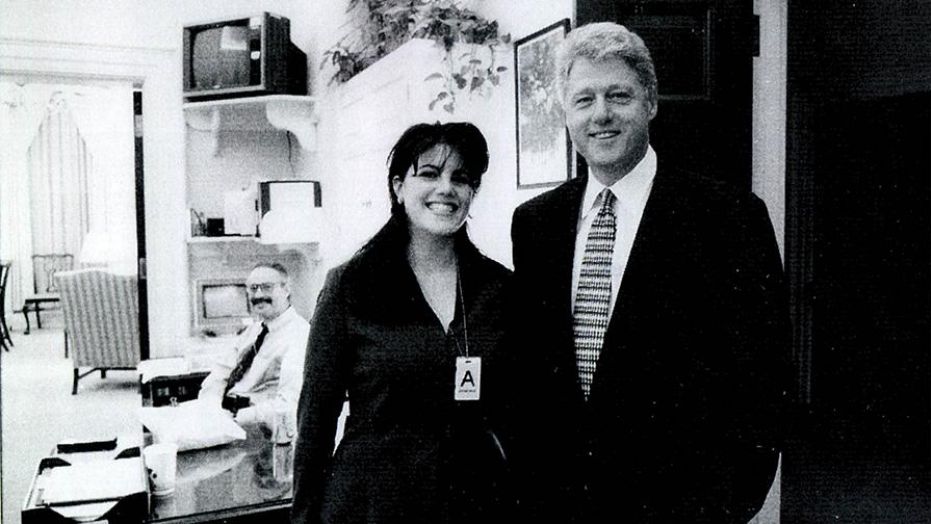
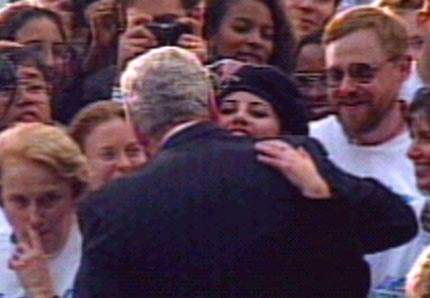
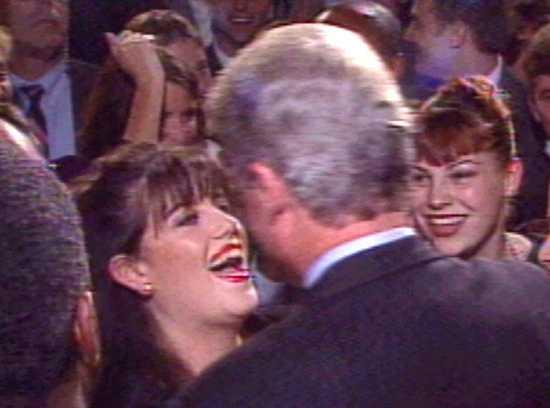
White House Intern Monica
Lewinski and President Clinton
November 6,
1996 – the day
after Clinton's re-election
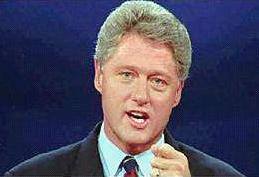
"I did not have sexual relations
with that woman"
"But I want to
say one thing to
the American people.
I want you to listen to me.
I'm going to say this again:
I did
not have sexual relations with that woman, Miss
Lewinsky.
I never told anybody to lie, not
a single time
– never. These allegations are false."
January 26, 1998 – to the press
in the Roosevelt
Room in the White House
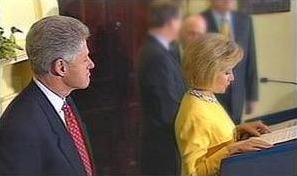
Hillary demonstrating to
the press that she's standing by her man
– January
26,1998
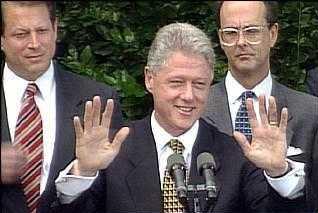
Clinton claims that he is
eager to testify on the Lewinsky matter
NBC News
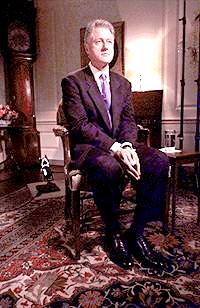
Clinton about to confess
to nation his "inappropriate
relationship" – August 17, 1998
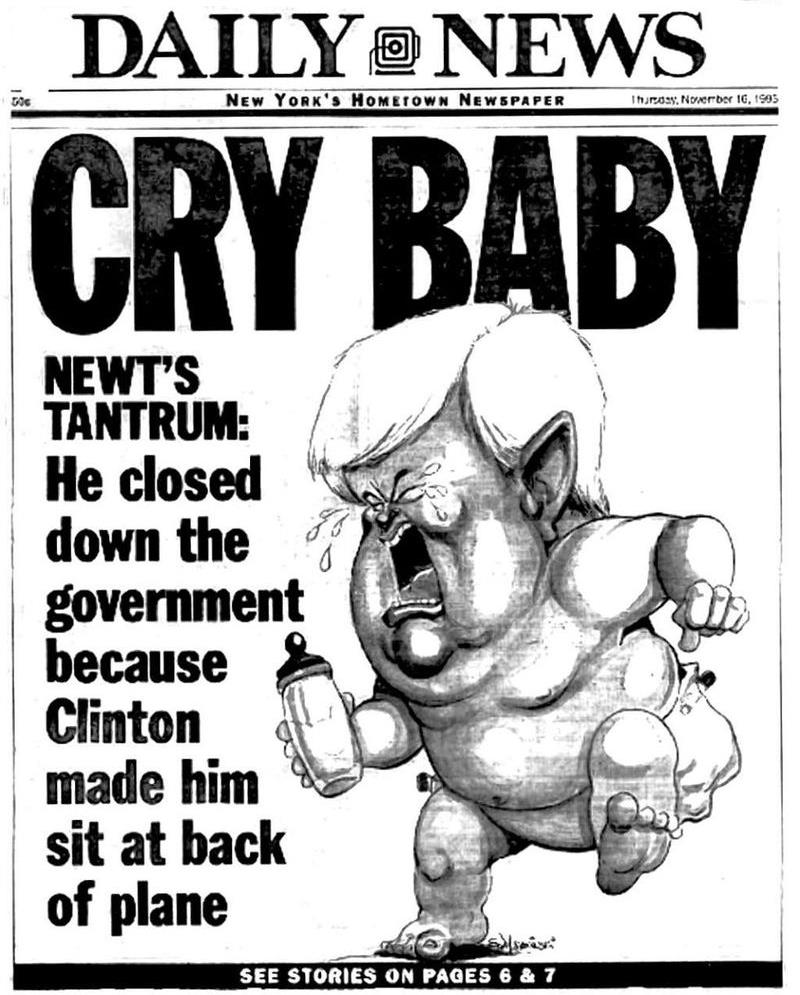
Meanwhile ... ethics charges against Gingrich
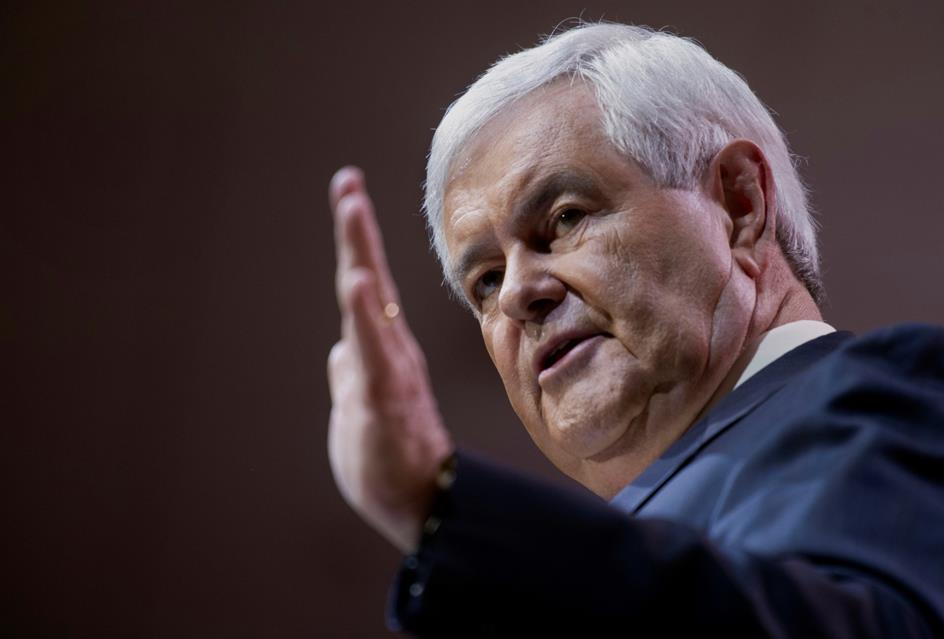
Newt Gingrich as House Speaker
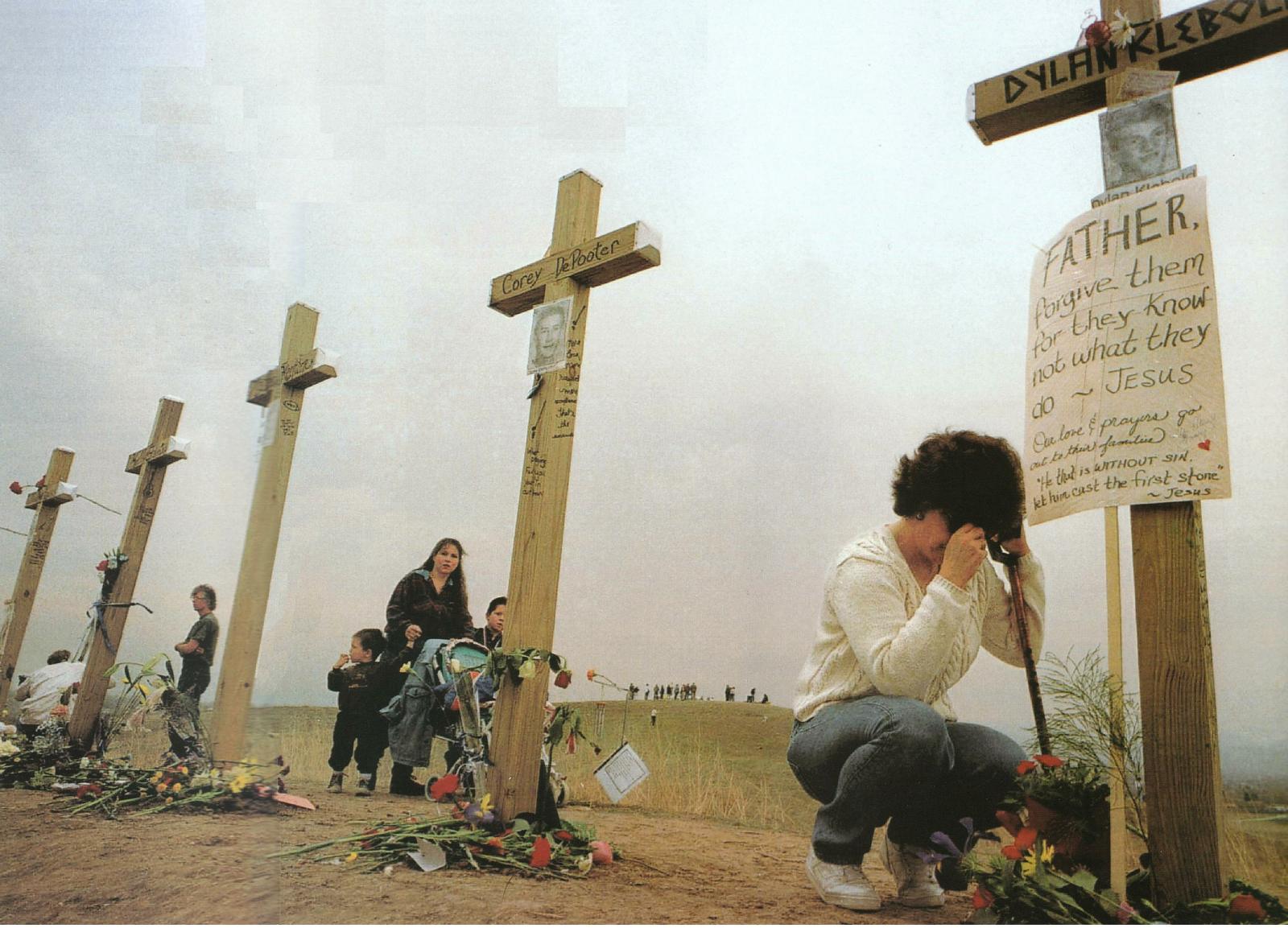
The Columbine High School Massacre (April
1999). A tragic event became part of the closing of
the 20th century when two high school students undertook a long-planned
massacre of fellow students at their Columbine High School in Littleton,
Colorado. A bomb by which they had
planned to blow up the school failed to detonate. But they were fully armed and succeeded in
killing twelve students and a teacher, before they turned the guns on
themselves and ended their lives when the police arrived on the scene. Ultimately,
there was no reason given as to their actions, other than the desire to commit
a grander murder than had been the case in the Oklahoma City bombing.
In April of 1999 two students at the
Columbine High School in Littleton, Colorado, came to school fully armed and ready
to undertake mayhem … for reasons not entirely clear even to this
day
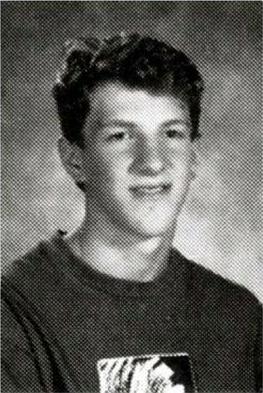

Dylan
Klebold / Eric Harris
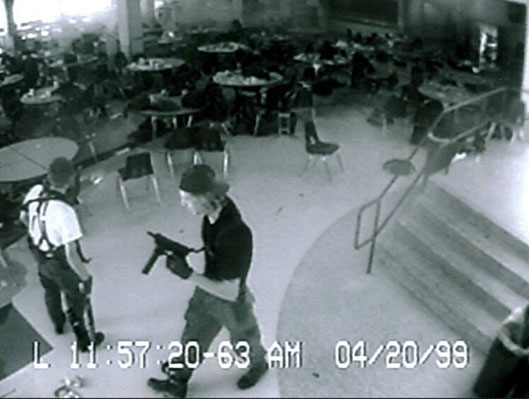
Security tapes showing Harris
and Klebold looking in the cafeteria
for classmates and teachers to
kill
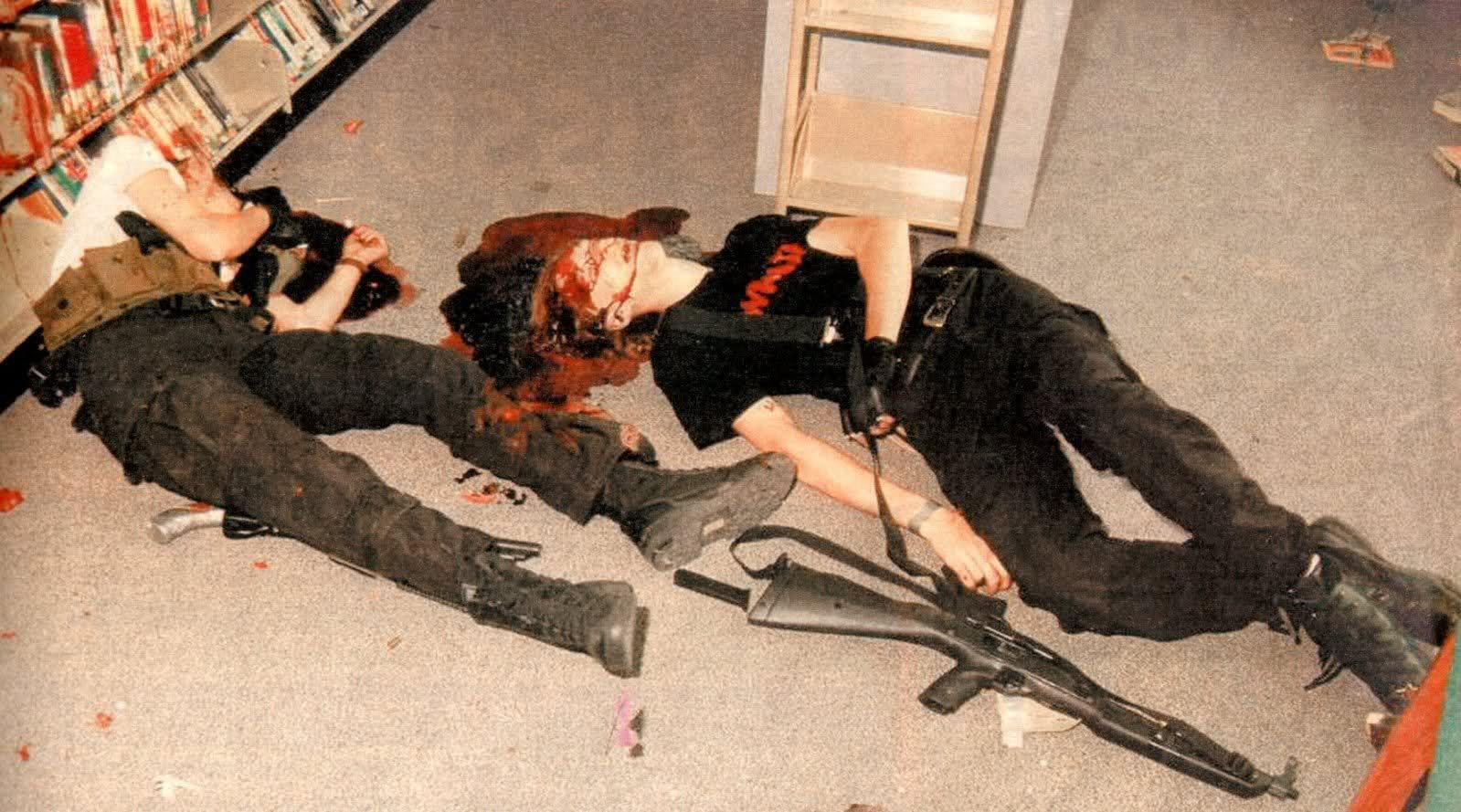 After having killed 12 fellow
classmates and a teacher ...
After having killed 12 fellow
classmates and a teacher ...
and
severely wounding 18 others, the two young gunmen
turned their guns on
themselves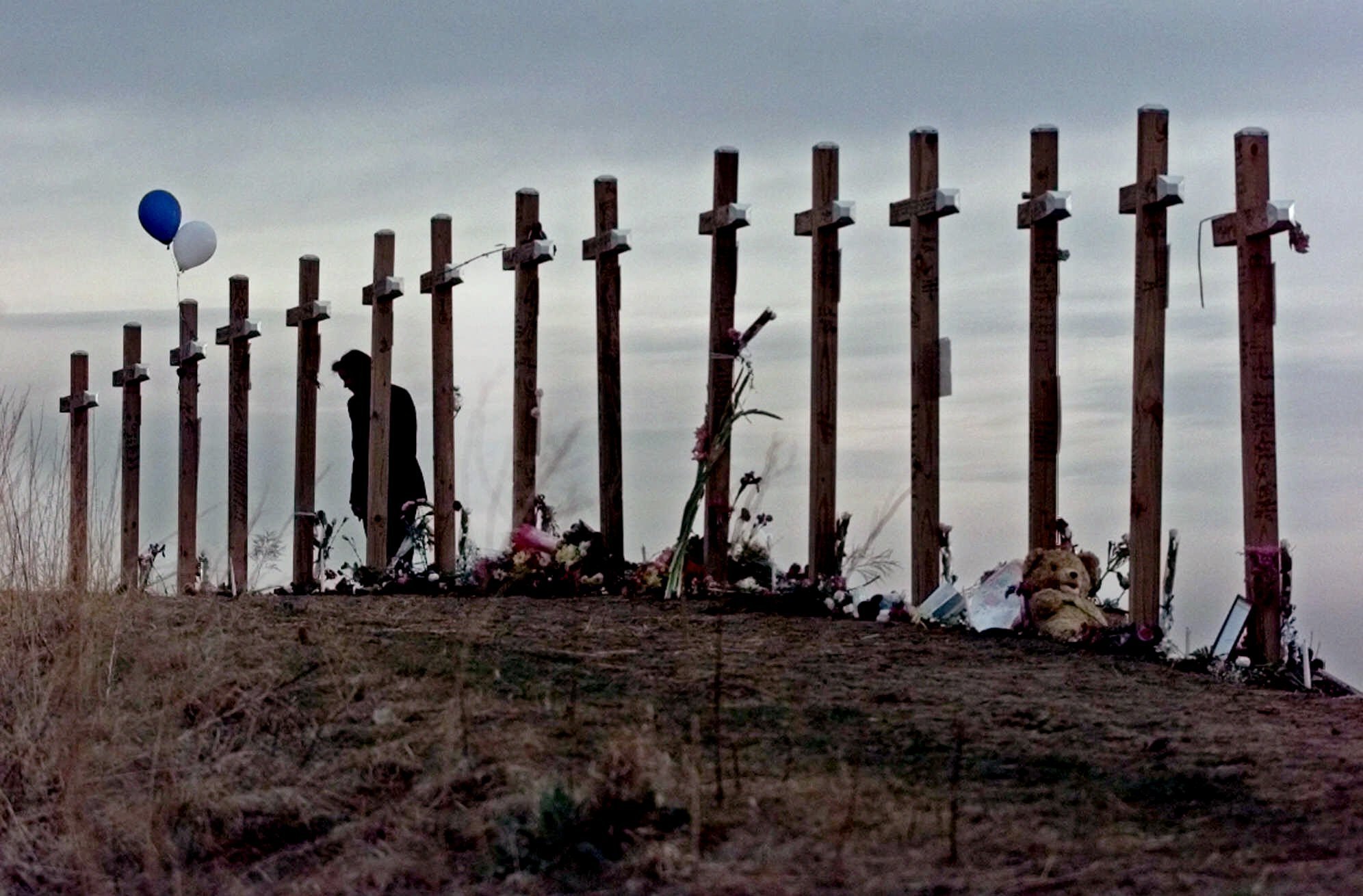
15 crosses on a hill above
Columbine High School in
remembrance of the 15 (including the two young gunmen)
who died in the shooting
This raised the question, would there be more copycat
killings (as this one seemed to be), by people who simply wanted to be
significant, to be noticed? People do
the most horrible things for the worst reasons imaginable, especially when it
becomes a trend (like mass rioting, pillaging and ultimately killing). Would America see more of this kind of
behavior in the future?
Black jury members included even a former member of the Black
Panthers – who in the announcement of the verdict, raised the Black Power fist
salute to Simpson!
A classic example was King David of ancient Israel, who had sex with a
man's wife while the husband was off fighting wars for the King. And bitterly
ironic, Gingrich, who was leading the impeachment effort against Clinton,
was having his own affair with a woman not his wife (but soon to become his
third wife) while Clinton was being tried for his sexual "high crimes and misdemeanors"!
Gingrich,
despite being returned to his House seat by a huge majority in the November
1998 elections, in January of 1999 – when new terms were due to start –
announced that he was stepping down from even his position as simply a House
member. Actually, this seems to have
been the startup of a spiritual journey for Gingrich, from
a Secular Realist (we were both of that same moral-spiritual order back when we
were friends, both doing our doctoral research in Brussels in the late 1960s)
finally developing into to the strong Catholic Christian he is today.

Go on to the next section:
 Miles
H. Hodges
Miles
H. Hodges

 Bill Clinton (President – 1993-2001)
 Domestic politics during the Clinton years
  Clinton and the world
  Particular events that shake the country deeply in the 90s