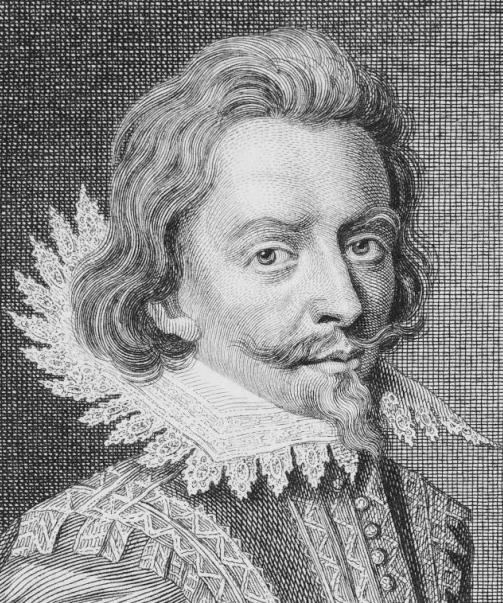
 Soon after the Stuart Restoration in 1660, Virginia fell under the
spell of a young English aristocrat, Nathaniel Bacon, a recent arrival to Virginia –
who was ambitious and had plans of his own to take charge of the Virginia
colony. He cultivated the land hunger of
landless Poor-White Anglos and the bitterness of Anglo frontiersmen who felt
that Governor Berkeley was uninterested in the
problems they faced from the fierce Indian wars on the frontier (Berkeley was
known to try to keep the peace between the English and the Indians – rather
than solve the matter by driving the Indians from their lands).
Soon after the Stuart Restoration in 1660, Virginia fell under the
spell of a young English aristocrat, Nathaniel Bacon, a recent arrival to Virginia –
who was ambitious and had plans of his own to take charge of the Virginia
colony. He cultivated the land hunger of
landless Poor-White Anglos and the bitterness of Anglo frontiersmen who felt
that Governor Berkeley was uninterested in the
problems they faced from the fierce Indian wars on the frontier (Berkeley was
known to try to keep the peace between the English and the Indians – rather
than solve the matter by driving the Indians from their lands).
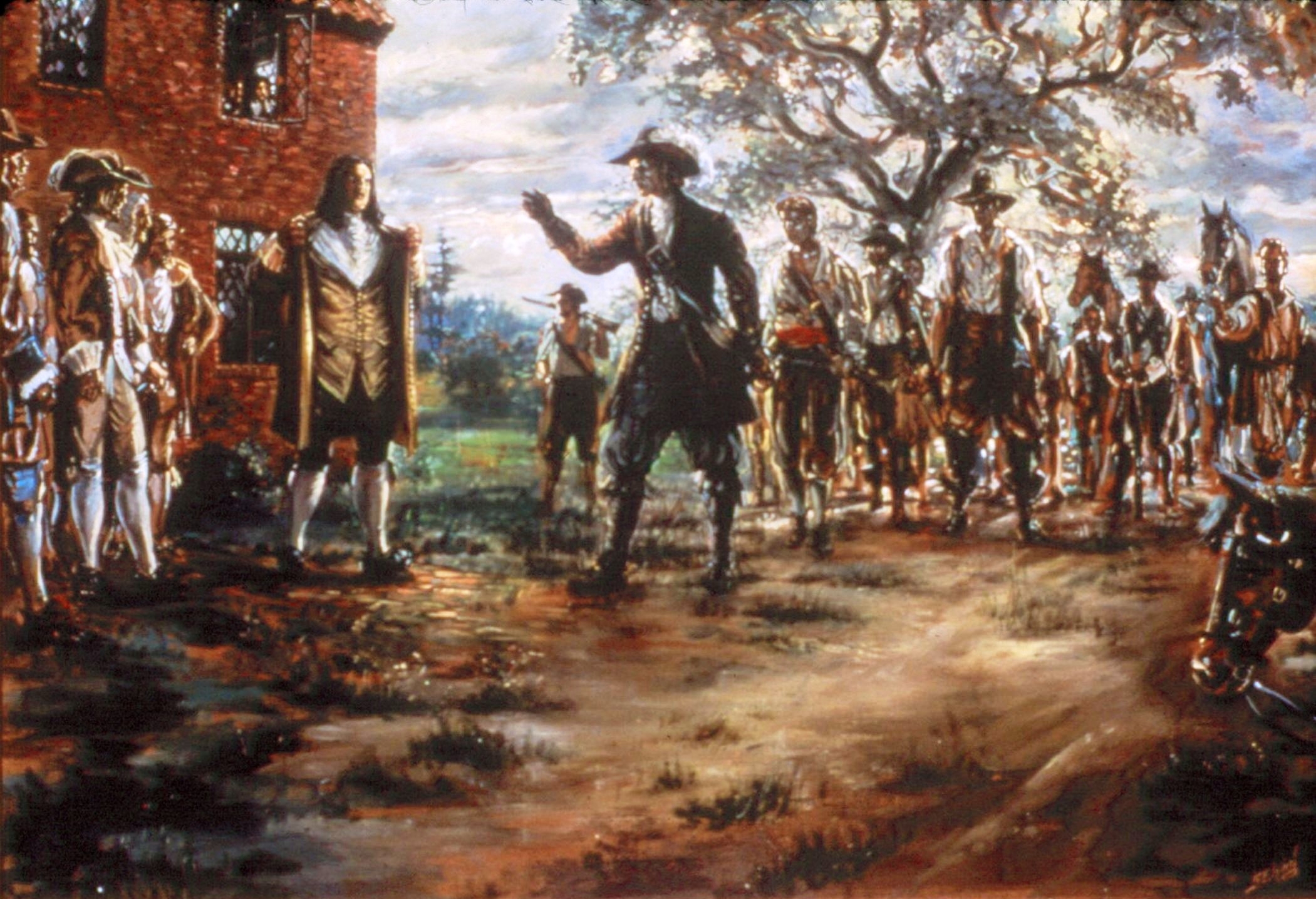
Bacon confronting Berkeley over the lack of protection of
the Virginia workers and frontier farmers
Then
in 1676, in disobeying Berkeley directly by attacking friendly Indians whose
land the Anglos wanted, Bacon was arrested and imprisoned, only to have Bacon's
supporters break him free – and start a rebellion. Bacon's militia burned Jamestown to the ground. And then suddenly Bacon developed a fever and
died, and the rebellion fell apart.
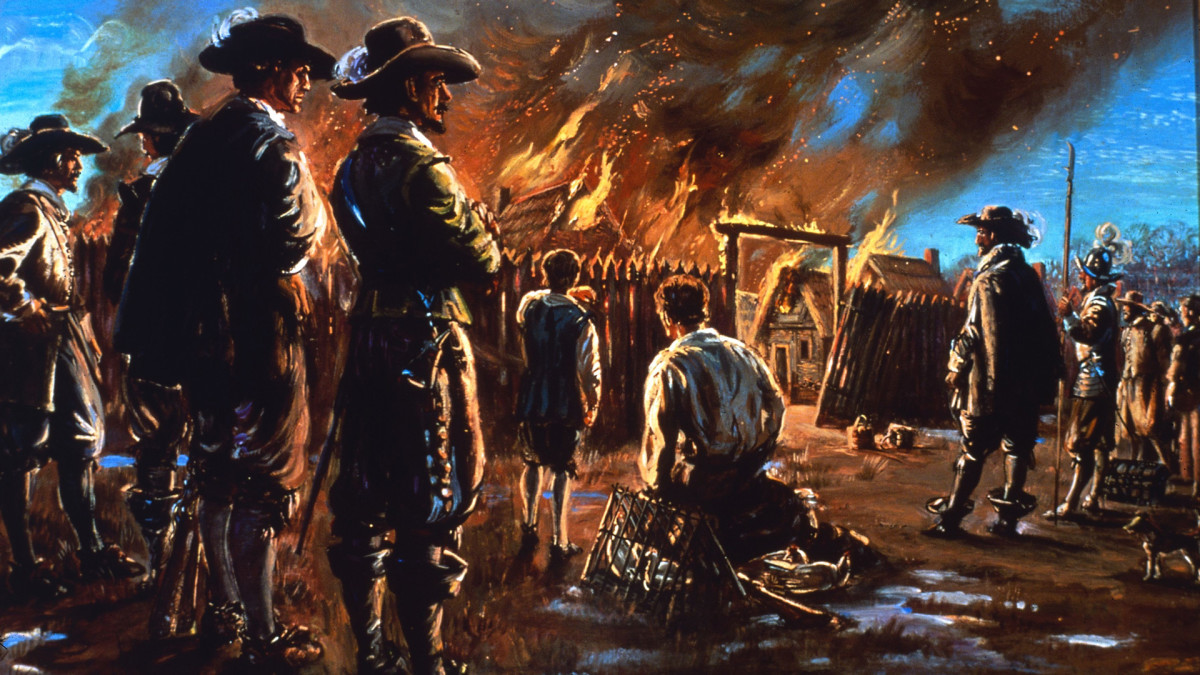
Bacon's rebels burn Jamestown to the ground
| THE MOVE FROM INDENTURE TO SLAVERY |
The fallout from this incident was that the Virginia aristocrats
were so unnerved by the anger of the rebels that they now lost interest in
indenture – and moved to use fully slave labor instead – mostly African.
Up
until that time Africans had been brought to Virginia largely as indentured workers (like the English,
Scots, Germans and others). However, the
much more passive Africans tended to stay on – and then their children after
them – even generation after generation – because free life on the frontier
seemed more dangerous than simply staying on with the masters of the
plantations. Thus step by step, Africans
and their offspring found themselves locked into a state of total dependency on
their masters – which ultimately became outright slavery.
At the same time, the business of the purchase, shipping and sale
of African slaves (brought down to the African ports for sale by tribal
enemies) was becoming quite extensive, making slavery in America an option in lieu
of indenture.<
It
should be noted that the sale of people as slaves was not a shocking practice
at the time, reaching back to the dawn of history – and long practiced not only
among Europeans (and Arabs) but also even among the Indian tribes – and as well
as the tribes of Africa. Actually, in
Virginia slavery as an institution had been
recognized as a permissible institution only in 1654. In any case, after Bacon's Rebellion in 1676, the move
to slavery was more deliberate (fully
defined in the Virginia Slave Code of 1705) on the part of the Virginia
aristocracy, as slaves seemingly presented less danger of future rebellion –
although not completely, for the fear of that too was always somewhere in the
minds of the slave-owners.
| THE COOLING AND WANDERING OF THE PURITAN SPIRIT |
Meanwhile, up in New England, Puritan society was following a
pattern well described in the Bible as having occurred regularly with the
ancient Israelites: a fervently religious
generation that looked to God for support in a great struggle for survival, being
followed eventually by future generations that fell away from this affection,
feeling that they themselves were in full control of their world and no longer
in need of the protection or even the counsel of God. This was proving to be exactly the case for Puritan New England as well.
Whereas
Williams's Providence Colony and Hooker's Connecticut Colony had built
their social orders on the idea that the realm of religion and the realm of
politics were to be treated as separate items (mostly so as not to pollute the
religious ideals with political corruption) the Massachusetts Colony had
insisted that full religious standing as true believers was absolutely
necessary to ensure that those who had political or civil responsibilities
carried those out in a truly Christian fashion.
Thus civil rights and responsibilities were based on a person's ability
to demonstrate to the community their full standing as Christians.
However
younger generations of Puritans, who found life much less challenging, and thus
the need for Puritan discipline not terribly
necessary, just simply did not measure up to Puritan standards, both religious and
civil, appearing even to be uninterested in achieving such a goal. The colony by the 1660s was thus in a
quandary about how to answer this situation of mounting spiritual
indifference. Thus the old Puritan leaders came out with the
idea of a compromise of sorts, in which "partial" church membership
could be offered to the rising generation, sort of an internship in which some
civil responsibilities could be assigned to the individual pending the ability
of that person to demonstrate sufficiently full Christian standing, sort of a "Halfway Covenant" with the
community and with God.
But over time either the ability to give proof of such merit was
just not forthcoming, or simply there was little interest in taking up the
challenge coming from the members of the younger generation. In short, the Puritan spirit was cooling and
dying. Massachusetts was, like Israel of
old, going through a time of spiritual wandering. The younger generation just did not "walk
with God" the way the older Puritans had.
| CHRISTIAN "ENLIGHTENMENT" |
On top of that, towards the end of the 1600s and into the early
1700s, many of the leading intellectual voices in the "Christian"
world itself (both back in England and there in the American colonies) were
looking more to Human Enlightenment or Human Reason than to God to solve
life's problems. Also, Unitarianism, even Deism, was infecting the upper
reaches of the English religious hierarchy.
Thus for instance, the very head of the English
Church, the Archbishop of Canterbury, John Tillotson, portrayed Jesus not as the atoning sacrifice for sinners but
instead as the great moral example that reasonable people would want to follow
in order to achieve righteousness. And
others, such as the popular author, Matthew Tindal, in his book Christianity
as Old as Creation, advised Christians not to put much stock in the Bible's
stories of miracles and other non-scientific stories, and instead focus on
developing the moral instincts that are to be found in all men, and ultimately
in all religions.
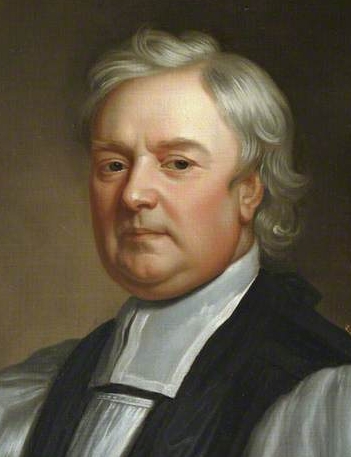
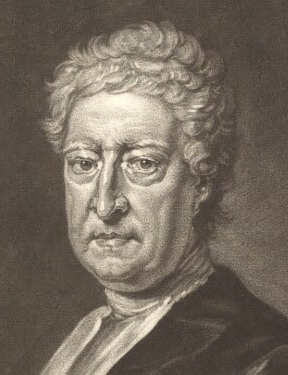
John Tillotson
Matthew Tindal
This decline of the Puritan spirit did not mean that the
colony had been delivered from all serious problems. It is just that as the Puritan spirit had grown legalistic
and stale, many of the less intellectually inclined New Englanders tended to
look to more primitive religious instincts for spiritual relief, such as a
belief in witches and warlocks.
At
this point the rocky soil of New England had been overworked by New England's
rapidly expanding population – and the deep and dark fear of another Indian
attack had not yet left the hearts and minds of the New Englanders. Thus it was very easy for nervous New
Englanders to look to the works of the devil and demons as the logical
explanation for the recent round of crises hitting the colony.
Very
famous today is the Salem witch-scare of 1692-1693 – told
as a rebuke to Puritanism, in an effort to show how degrading such religious
superstition as Puritanism can be. The
only problem with this theory is that this tragic event resulted not from
Puritanism – but from the very loss or lack of the original Puritan spirit.
It is indeed a very tragic mark on the social
record of New England how the prank of a few schoolgirls turned the town
hysterical in fear of witches everywhere – resulting in the execution or just
death in prison of some twenty-four people breezily accused of this
practice.
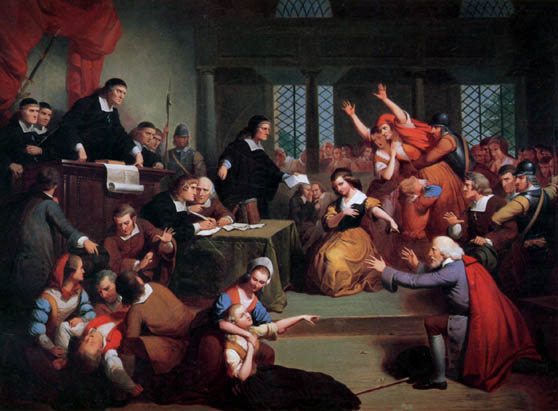
Trial of George Jacobs of
Salem for witchcraft – August 5, 1692
by Thomkins H. Matteson – 1855
Peabody Essex
Museum
The
event was finally brought to a halt when the Puritan authorities in Boston stepped
in to stop the whole affair – an important detail usually left out of the
modern anti-Puritan (or anti-Christian)
narrative. Also the larger context of
the times is not mentioned – because much of the West, including enlightened
France and newly emergent Sweden (which were hardly Puritan) were also caught up in the
same witchcraft hysteria at the same time,
and to an even greater extent.
This
American horror resulted because the guidance of the Christian faith was being
put aside for newer, more rational or "reasonable" thinking. But Reason can go in any number of different
directions. Witchcraft had its own way
of becoming a reasonable assumption about life, as it also seems so today in
modern popular culture where interest in witches is considered cool or cute.

Go on to the next section:
The American "Great Awakening" of the Mid-1700s
 Miles
H. Hodges
Miles
H. Hodges

 Bacon's Rebellion in Virginia (1676)
 The move from indenture to slavery
  The cooling and wandering of the Puritan spirit
  Christian "Enlightenment"
  The Salem witch-scare