And once in office Jefferson began to undo the
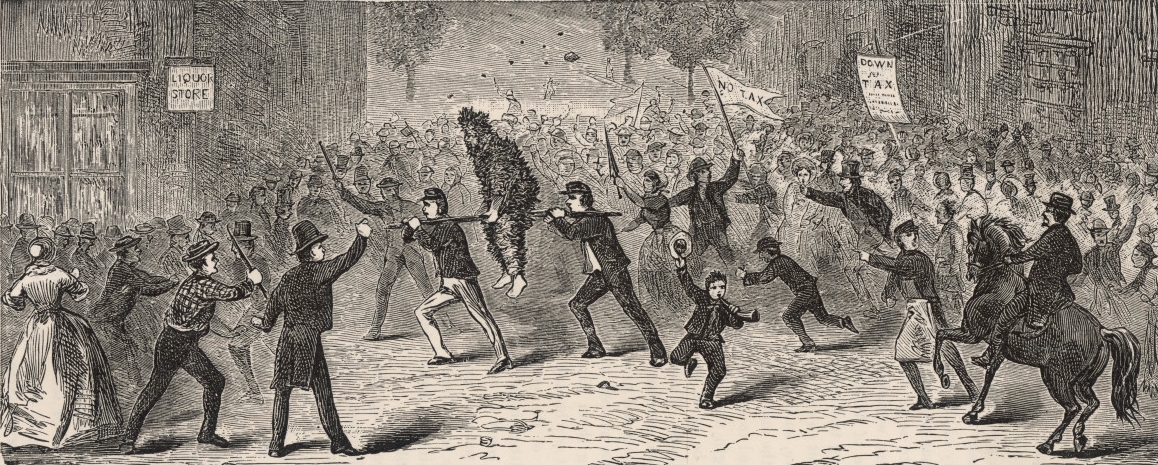
Federalist legacy – by removing the land taxes imposed on the farmers – making
him very popular in the South and the West – and shifting the source of revenue
to customs duties imposed on (largely Northern) imports and exports. He also raised revenue by selling (quite
cheaply) Western land to new settlers – another very popular move among
Westerners or those headed West – which came at a great cost to the Indians
living there of course! Thus Jefferson built the Republican Party
into a great political powerhouse.
To Jefferson's great credit,[4] it was
during the early years of his presidency that America purchased from the French
the huge Louisiana territory to the West of the Mississippi (the Indians living
there not being consulted on this matter, of course) – blocking the possibility
of any European power getting there before the Americans – who were spreading
westward rapidly. This purchase
effectively doubled the land claim of the American nation!
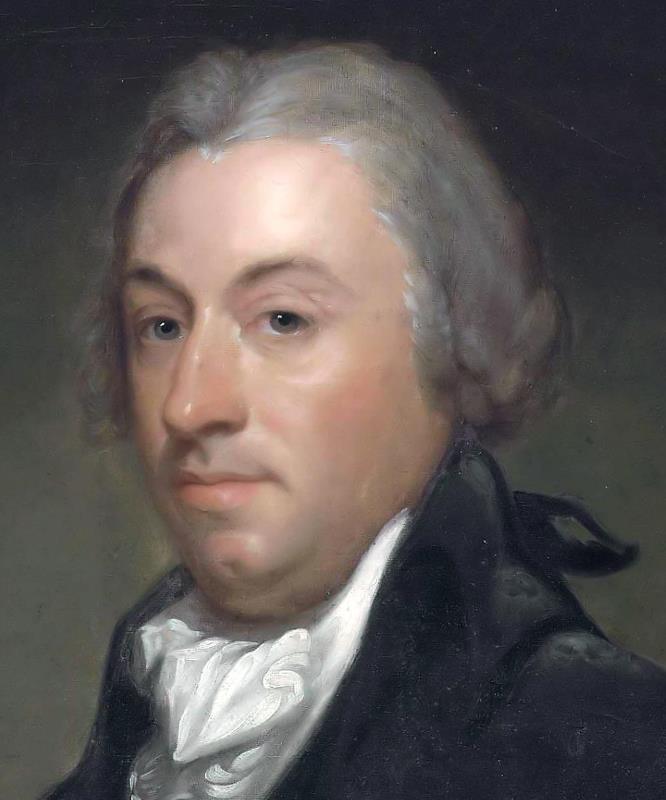
Robert Livingston
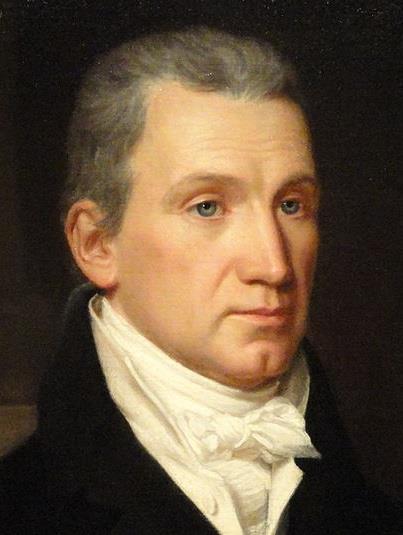
James Monroe
These were the two Americans who actually negotiated
the purchase of the entire Louisiana Territory
And in great part this bargain purchase had been made possible
because American public finances had such a very strong credit rating – due to Hamilton's monetary policies, ones
that Jefferson had so recently hated
intensely!
Lewis and Clark explore this new region.
What it was that America had exactly come to in this Louisiana Purchase
was largely unknown to its new owners.
Thus Jefferson commissioned Captain Meriwether Lewis (accompanied by William Clark) and a team of fifty
men to explore this new territory (1804-1806).[5] They followed the Missouri River West, hoping
to find a water route to the Pacific.
But as winter set in they found themselves bogged down in the Dakotas, and
thankfully were able to bring on a French fur trapper and his Indian wife Sacajawea to guide them
westward. The next summer they reached
the Rocky Mountains, crossed them, and in November finally arrived at the
Pacific Ocean. They wintered there, then
in early 1806 began their trek back East, arriving in St. Louis as heroes.
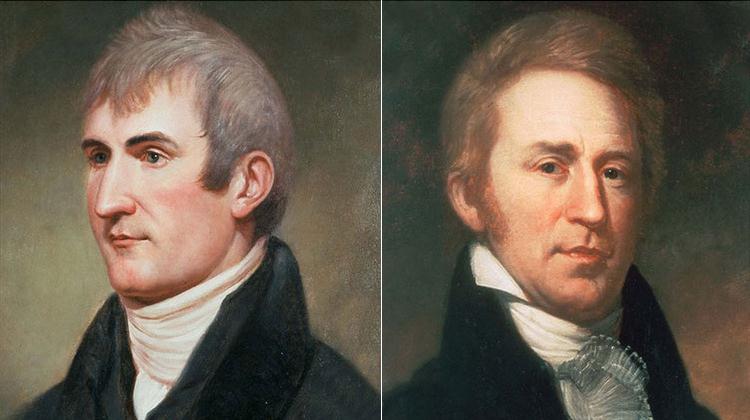
Meriwether Lewis and William Clark
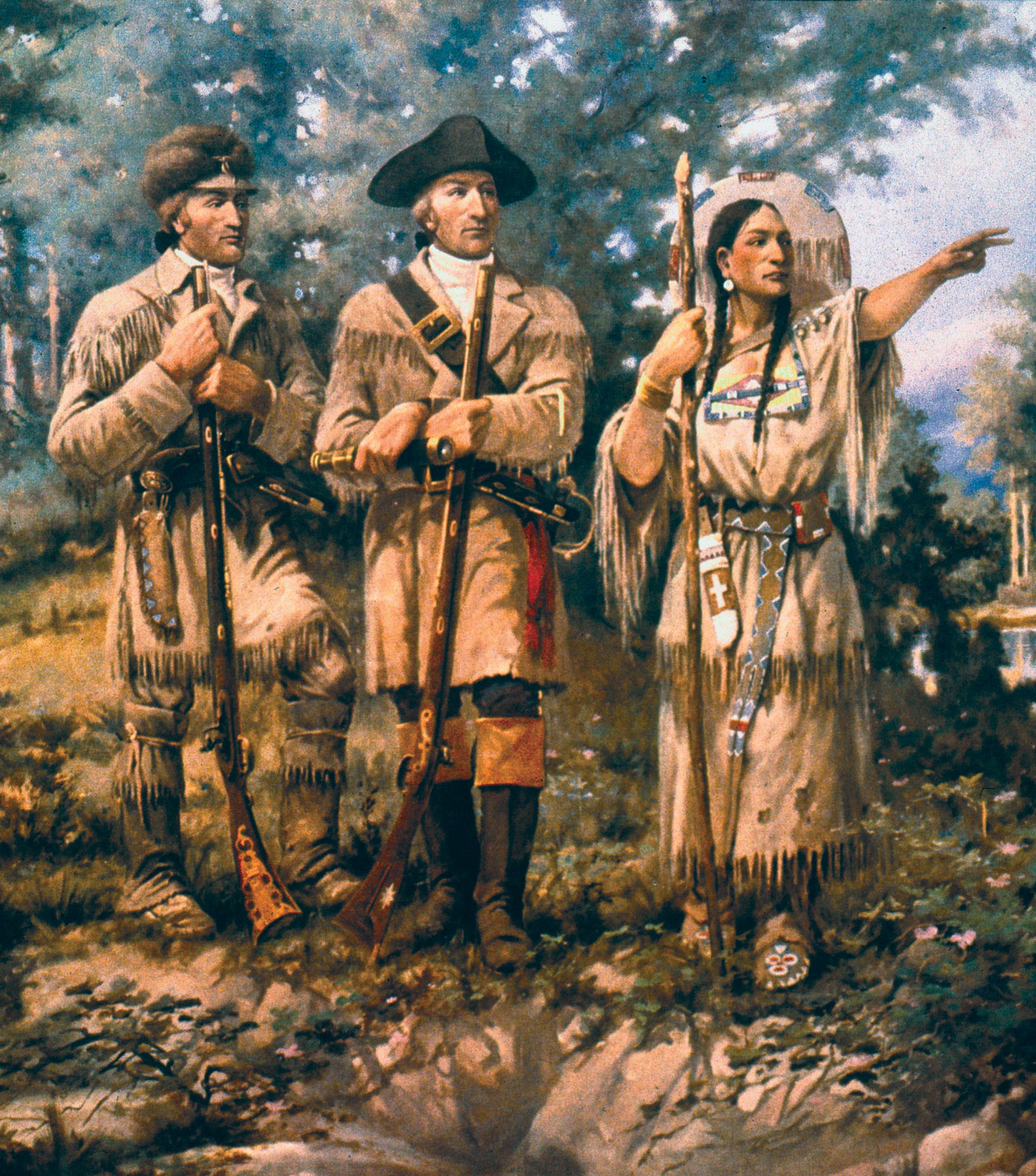
Lewis, Clark and Sacagawea
Montana House of Representatives
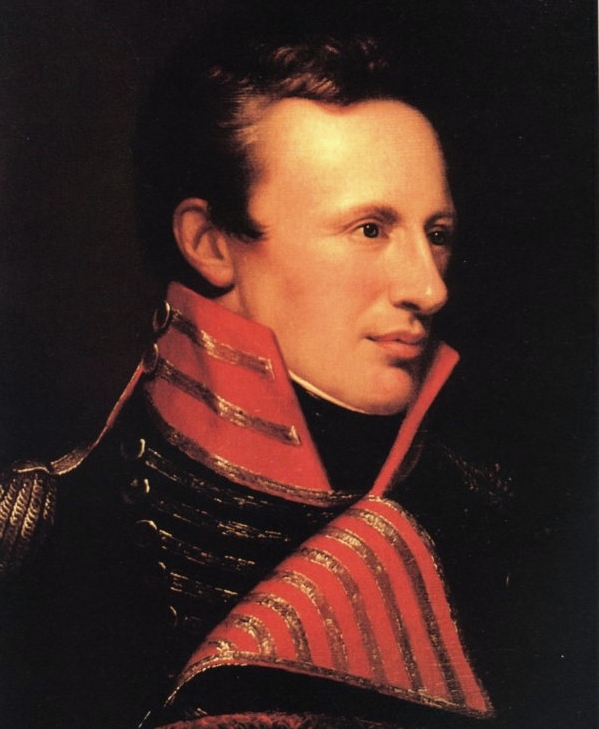
Zebulon Pike
led two additional explorations into the American West
(1805-1806 and 1806-1807)
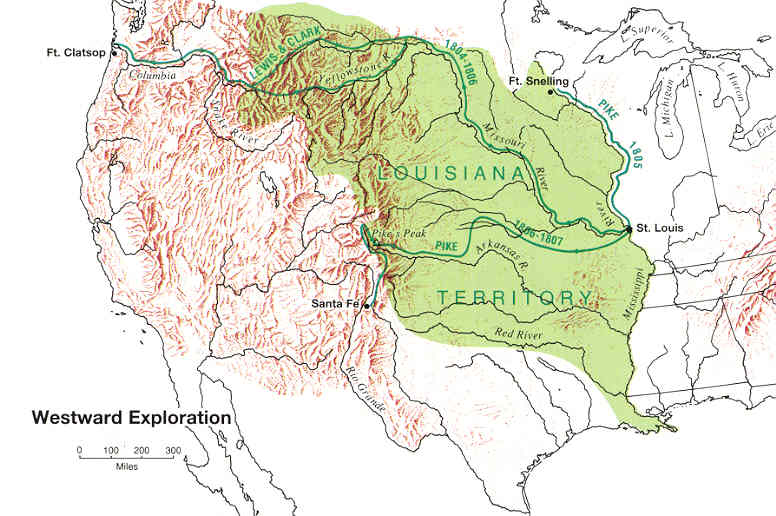
The explorations of the New
Louisiana Territory
by Lewis and Clark and by Pike –
1804-1807
To the shores of Tripoli.
Further to his credit, Jefferson had the navy tackle the
problem of Muslim pirates operating out of the Mediterranean towns of North
Africa. Jefferson refused to pay tribute any
longer (formerly paid out to release hostages or just prevent attacks on
American shipping in the Mediterranean), instead sending American ships in
concert with the Italian King of Naples against the pirates. This worked somewhat – but would need the end
of the Napoleonic Wars in 1815 before the task could be completed.
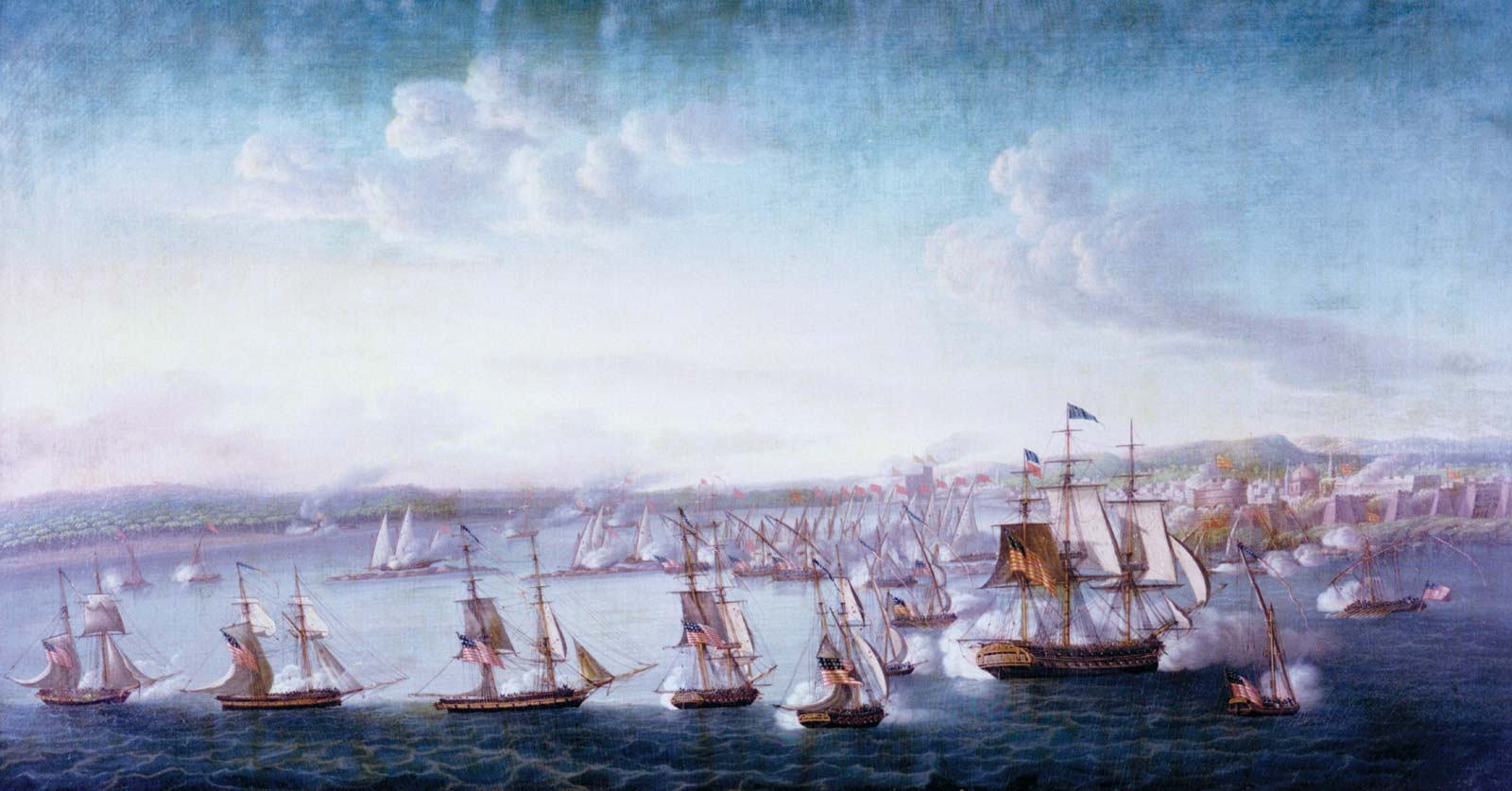
The bombardment of the harbor at Tripoli (August 3, 1805)
U.S. Naval Academy Museum, Annapolis
Jefferson takes command of
American foreign trade. But on the
negative side of his political balance sheet, Jefferson imposed an embargo on the
sale of American goods to Britain, in response to the ongoing British
impressment of American sailors – the logic of this move being that this would
deprive the British of vital American goods and bring Britain to its senses. But Jefferson's commercial boycott served
only to make America appear to the British to be clearly a French ally – at a
time when French dictator Napoleon, who had managed to seize
control of nearly all continental Europe, had also placed an embargo on all
European trade with Britain – in an effort to collapse the British
economy. So England's response to Jefferson's policy was to become
more, not less aggressive, against America – at a time that Jefferson had weakened considerably
America's own military capabilities.
Jefferson decided to extend the same
restriction against trade with France as well, shutting down pretty much all of
America's export business – and nearly collapsing the American economy.
Jefferson cuts back on the navy. To make bad matters even worse, Jefferson then chose to meet the
European challenge by not building more warships (frigates), the likes of which
had proven themselves so capably in the war with the Barbary states. He figured that not having a fighting navy
would help keep Americans from making the mistake of wanting to go to war with
either France or Britain.[6] Instead he chose to build a number of much
smaller gunboats. These would not be
terribly effective in defending American shipping overseas, but certainly could
be used to help prevent the American smuggling that his embargo encouraged.
Thus
it was that Jefferson continued to see himself
not as a warrior but as "a man of peace" – unable to understand how
international power actually works, and consequently leaving America
increasingly vulnerable to European power politics abroad – and vengeful
Indians at home.
It
is also important to note that for one who had been so loud about protecting "states'
rights" against the assumption of autocratic power by an uncontrolled
government in Washington, Jefferson had no problems personally
acting in such an autocratic fashion when he himself was president (imposing
his restrictions on American trade and downsizing America's military
defenses).
But
of course Jefferson was among the most "enlightened"
of Americans, and that justified his autocracy (as "enlightenment"
always does!).
But
thankfully, just as he was about to leave office in 1809, Jefferson somehow awoke finally to
the realization of the magnitude of the disaster his economic policies had
produced – and he finally repealed his ill-conceived embargo. And the American economy soon revived.
[4]Actually, such credit belongs to his envoys sent to France, Livingston
and Monroe, who were originally authorized to purchase (for an amount not to
exceed $10 million) only the town of New Orleans located near the mouth of the
Mississippi River – but who on their own authority answered with an immediate
"yes" when Napoleon offered them the entire Louisiana Territory for $15
million. In part this came about so
easily for the Americans because Napoleon was short on funding at the time and found American money
rather than American land more supportive of his ambitions.
[5]Jefferson would also send out other teams to explore the new
territory, including that of Gen. Zebulon Pike who
in 1806 ventured as far west as the territory that would become Colorado (who
also was captured by the Spanish in the process, but released in 1807!).
[6]Liberal Humanists such as Jefferson
have always supposed that it is weapons that cause wars – and thus disarming
the people will automatically cut back on the dangers of the people falling
into a war with someone else. But in
fact self-disarmament – that is, disarmament if not mutual on the part of all
contending societies – will merely undercut the ability of a society to protect
itself against another society that has come to hold such power that it no
longer fears the consequences of its efforts to bully others into submission. Weapons are not the problem. The political-moral intentions of societies
are what are critical in matters such as this.
| JOHN MARSHALL – AND THE EMPOWERMENT OF THE SUPREME COURT |
As we have just noted, one of the last things Adams did before he turned the
presidency over to Jefferson was to make the last-minute
appointment of John Marshall to the position as Chief
Justice of the Supreme Court.
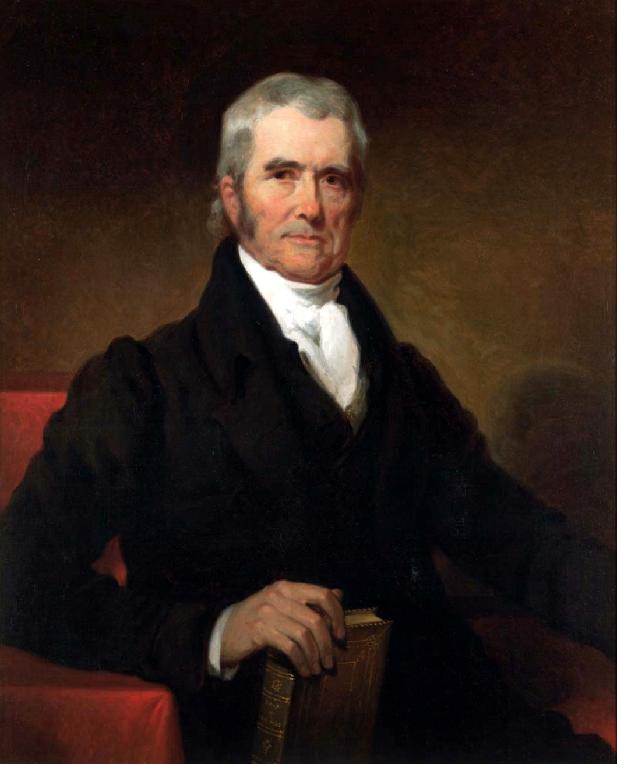
John Marshall – by Henry Inman,
1832
Library of Virginia,
Richmond
Marshall
would go on to hold that position from 1801 to 1835. This would have a huge impact on the shaping
of American government, for Marshall would gradually, case by case, assign to
the Supreme Court increasing powers to decide which laws of Congress – and the
states – were "constitutional" and which were not, and if not (by the
Court's own decision on the matter), then that they would not be supported by
the judiciary as the law of the land.
Or even the Court might decide that the law ought to be interpreted in
this or that particular manner – in essence revising (even extensively) the
very purpose of such law. As stated
before, this would make the Supreme Court, not Congress, the highest
legislative body of the land!
Why did the Supreme Court assume such power for itself? Basically because Marshall saw that it was there for
the taking – and because no one at the time understood the dynamic and thus did
nothing to block this huge assumption of power by the Supreme Court. Eventually because nothing was done, it
became simply assumed that the Supreme Court had such constitutional
powers. But unlike the rest of the
federal system, which was put in place with a number of built-in checks on its
various powers, the Supreme Court was originally defined with no known checks
on its power.
The
presumption was that a long-held Anglo legal ethic would somehow direct the
action of the Court. But such an ethic
would prove over time susceptible to being interpreted widely and deeply in a
number of quite different ways, depending on the personal political or
ideological makeup (always well rationalized, as lawyers are indeed trained to
do) of the nine members of the court – or even just five of the justices
constituting a slight voting majority for any particular case. That's a lot of unrestricted power to put in
the hands of a very small group of enlightened individuals!
Go on to the next section:
 Miles
H. Hodges
Miles
H. Hodges

 George Washington and Alexander Hamilton
 Thomas Jefferson
  Jay's Treaty
  Washington's second – and final – term
  John Adams
 Life settles in nicely at home in the new republic (pictures only)
  Jefferson as President
  John Marshall – and the empowerment of the Supreme Court