Jackson's decision in 1833 to
withdraw all government deposits from the Bank of the United States – and move
them to his "pet banks" located here and there around the country –
undercut New England's world of industrial/financial capitalism deeply. But this action found wide approval among
Jackson's rural supporters, who generally hated the banking world (most farmers
found themselves in debt to banks in order to finance their farming
operations). They were hoping that
Jackson's stripping the BUS of its powers would make money cheaper (inflating
the value of the dollar, making the repayment of their debts less costly to
them). The Whigs, however – representing the
banking community of the Northeast – demanded tight discipline of the money
supply and the value of the dollar.
The national economic crisis of 1837-1840.
An economic bubble of prosperity – built on the huge printing of paper
money and the pricing of Western land at nearly give-away rates – suddenly
burst in 1836 when currency problems back in London forced banks there to have
to raise interest rates dramatically – in turn forcing American banks closely
connected with the London banks to have to do the same. At the same time Jackson, oddly enough,
reversed course on Western land sales – and demanded that payment be made in
gold or silver coin rather than paper money – ruining land speculators, who had
bought huge amounts of land rights with paper money, now finding potential
purchasers of those lands backing away.
Also, people began to make a run on banks, demanding that their deposits
be refunded in hard currency (gold or silver) – something banks did not
themselves possess in their vaults.
Suddenly the American economy seemed to crash.
Jackson's Vice President Van Buren, now newly-elected U.S.
President, did not cause the crash – but was the one everyone looked to in
order to solve the crisis.
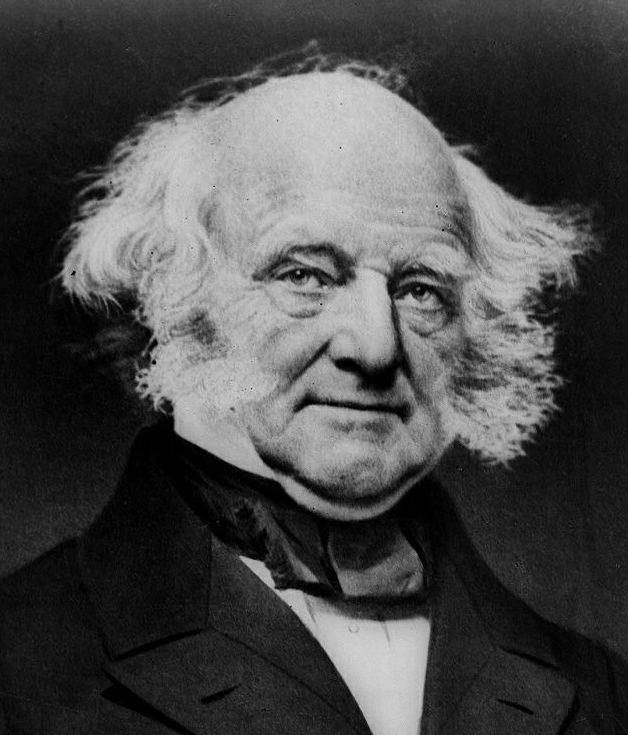
Martin Van Burin
But the
crisis was one of fear, not policy.
Paper money simply was not trusted and gold and silver were not easily
expanded items. All anyone could do was
ride out the panic – and hope that somehow the crisis would resolve itself. But that crisis was still on several years
later when in 1840 Van Buren stood for reelection. Slowly a bit of confidence had been returning
to the American economy – and businesses and banks were getting back on their
feet (somewhat). But the process was too
slow for Van Buren not to take the hit for it
all.
Consequently
the Whig candidate and former war hero (Indian fighter) William Henry Harrison was elected president –
although he served in the presidential office only briefly, having caught a bad
cold speaking long at his inauguration ceremony and dying a month later. Thus his Vice President John Tyler stepped
into the presidency. Now the pro-BUS Whigs commanded the situation – and
slowly put the American finances and thus the economy back on a stronger
footing.
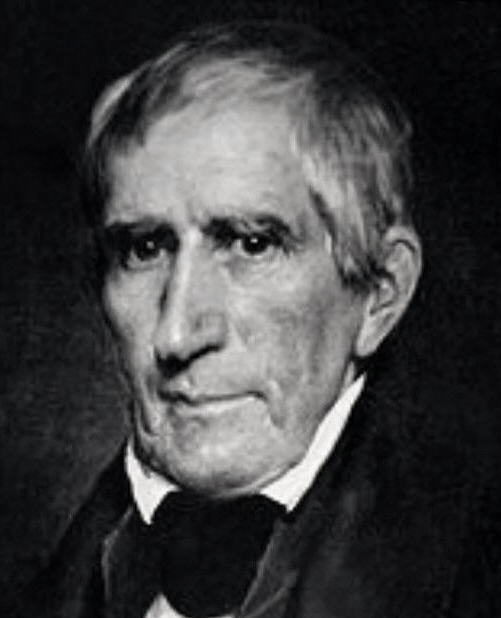
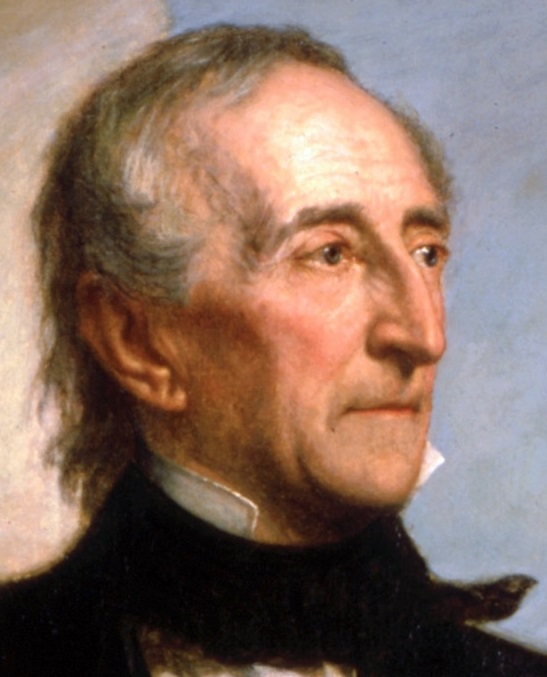
William
Henry Harrison
John Tyler
Lessons
about careless handling of the nation's wealth by a government seeking to gain
popularity by making wealth appear to come very easy (thus inflating a huge
speculative bubble) should have been learned from this experience. But this would not be the last national
financial crisis to hit the nation because of unwise government financial
policies (the crisis of 2008 being a recent example.)
| AMERICA'S INDUSTRIAL REVOLUTION |
Moving goods from field to
factory and Americans always on the go (usually westward) was greatly
facilitated by the development of rail and canal transport – those two
technologies requiring the development of massive infrastructure (the laying of
tracks and the digging of canals) – not to mention the steam power that drove
the boats and trains (and factory machinery).
But despite the economic setback of the late 1830s, by the early 1840s
there were some 1,200 cotton mills in operation (mostly in the Northeast), the
Erie Canal was in place with the Baltimore railroad linked to it (actually the
Baltimore and Ohio Railroad had its first section in place as early as 1830),
the McCormick reaper was harvesting huge wheat harvests, steam boats were
making regular runs on the Great Lakes, etc.
And by the early 1850s, railroads had reached from the East coast all
the way to the Ohio River in the North and the Tennessee River in the South –
and soon thereafter all the way to Memphis on the Mississippi River. America at this point was an industrial giant,
not yet quite acknowledged by the European powers.
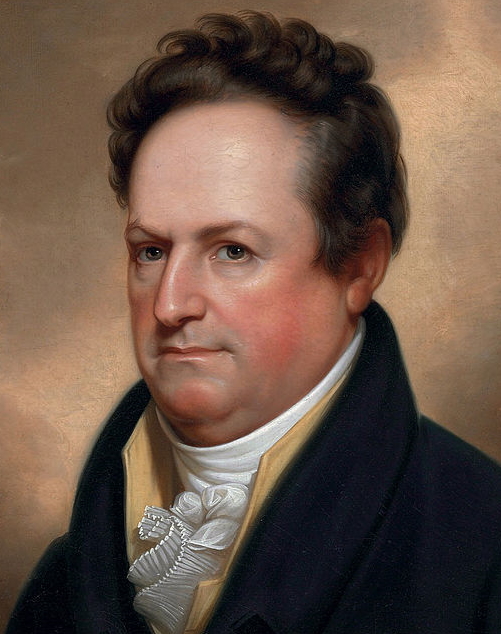 New York Governor
DeWitt ClintonAuthorized the building of the 363-mile Erie Canal (1817)
New York Governor
DeWitt ClintonAuthorized the building of the 363-mile Erie Canal (1817)
which opened for business in 1825 ... and a big
supporter of industrial development in general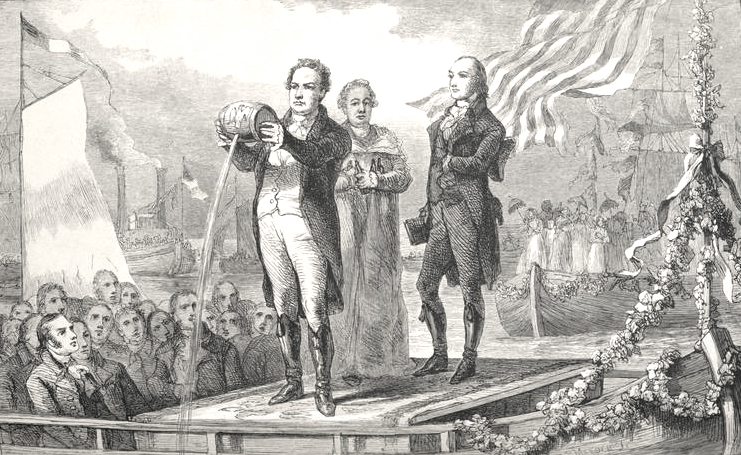 As overseer of the project, Dewitt Clinton,
mingles the waters of
As overseer of the project, Dewitt Clinton,
mingles the waters of
Lake Erie and the Atlantic upon the completion of the Erie Canal
(October 1825)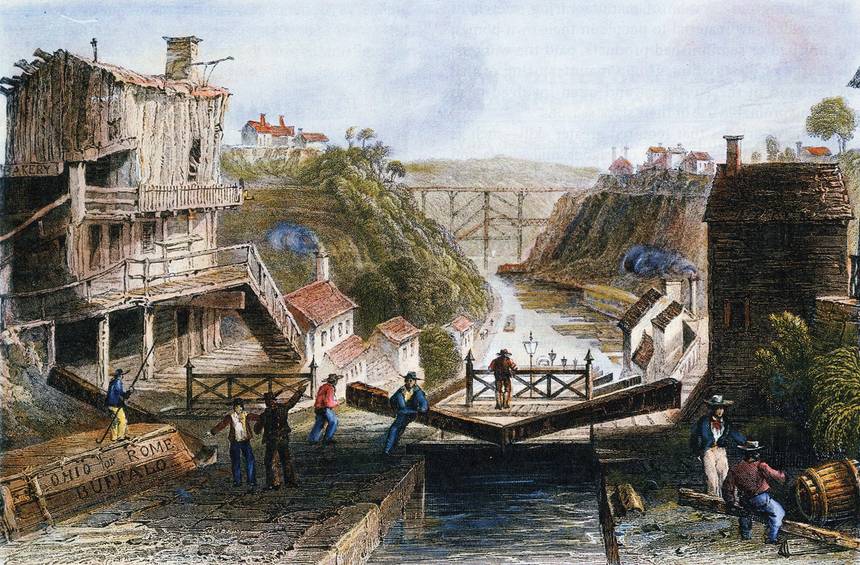 One of the locks on the Erie Canal
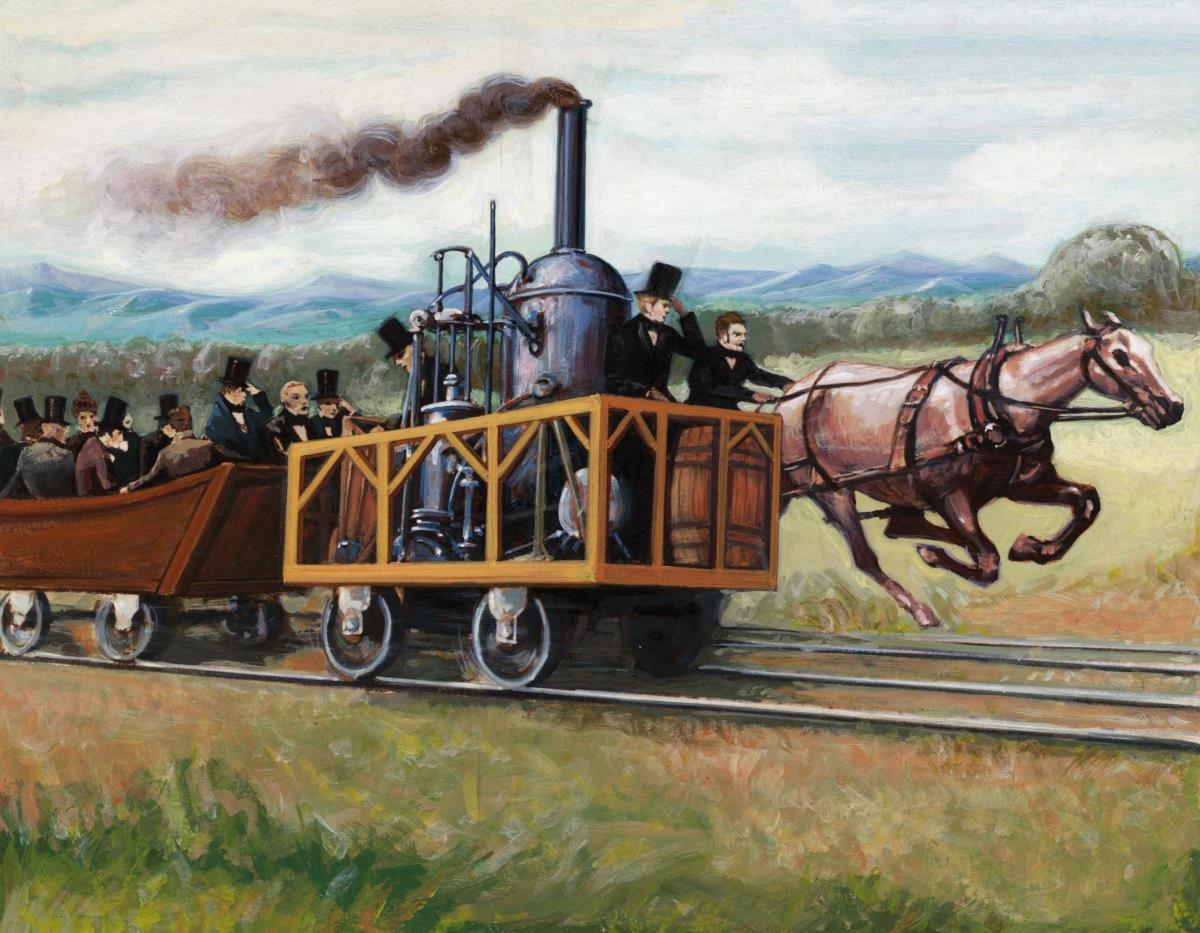 Steam-driven Tom Thumb racing a horse (August 1830)
the locomotive pulled well ahead of the horse ...
until a belt broke in the locomotive, ending the race.
Steam-driven Tom Thumb racing a horse (August 1830)
the locomotive pulled well ahead of the horse ...
until a belt broke in the locomotive, ending the race.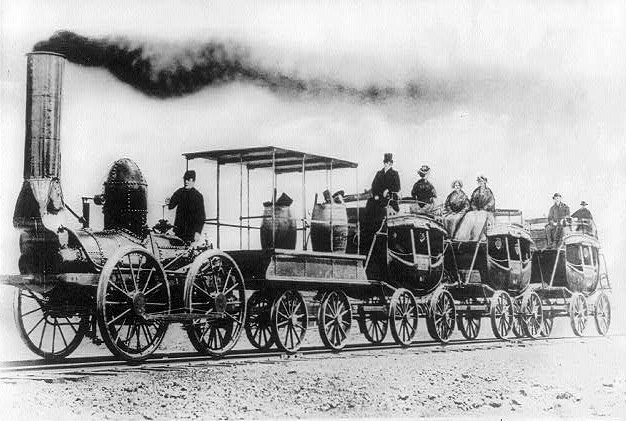 A very early American steam-driven locomotive, the De Witt
Clinton – 1831 (named after the New York
governor)Library of
Congress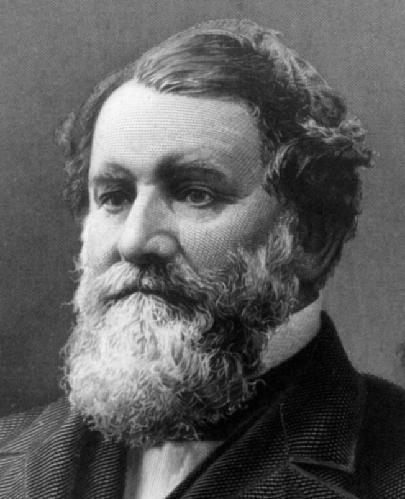 Cyrus McCormickHis reaper helped revolutionize the American farming industry
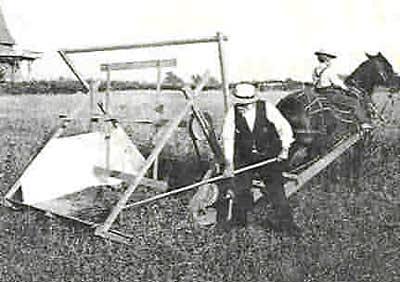 A demonstration
being given on the operation
A demonstration
being given on the operation
of the McCormick reaper (1831)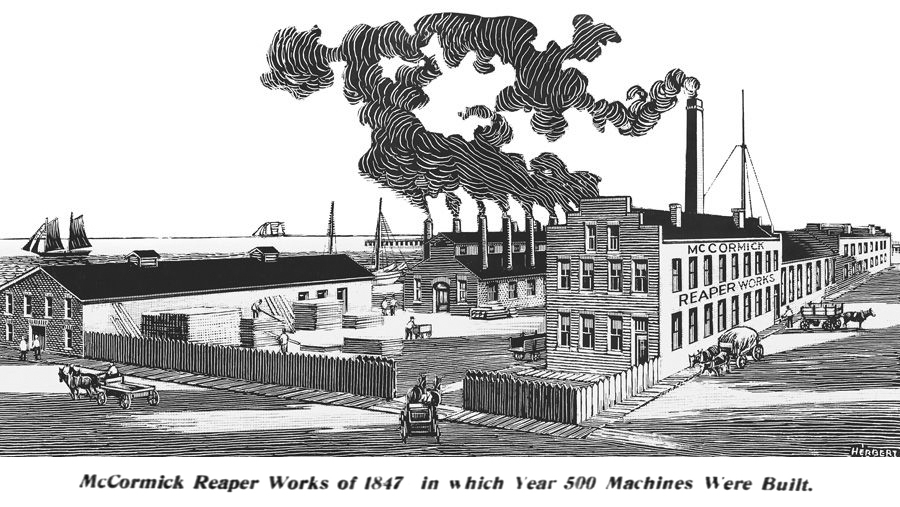

Go on to the next section:
America's Ongoing Spiritual Development
 Miles
H. Hodges
Miles
H. Hodges

 The national economic crisis of 1837-1840
 America's Industrial Revolution