Overall, America had certainly settled down a lot since the
tumultuous days of the 1960s and 1970s.
America enjoyed strong, stable, and quite wise presidential leadership
during the 1980s and 1990s. But this did
not mean that America was a completely harmonious society. Indeed, a number of fundamental social (even
spiritual) problems continued to tear at American society – especially as the
world of the Vets gradually found itself giving
way to the rising world of the Boomers – with a very different set of political
expectations accompanying this major cultural shift.
The continuing advance of professionalism. The American family took a huge hit – as
personal professionalism as the supreme goal in life replaced the goal of a
family and comfortable place in society, characteristic of the way the Vets went at life. The workplace, not the home, was becoming the
staging ground for life's most important endeavors.
And there – at the
workplace – was the biggest of all problems – for feminists anyway because the
workplace had long been dominated by men – and women were demanding equal
opportunities to rise professionally, much like the men. And when the system seemed not to move fast
enough to accommodate these rising expectations – for instance women claiming
to have hit a "glass ceiling" – when they seemed unable to rise to
the top in their climb professionally – feminism turned increasingly
militant. Men were viewed not as
partners in life but as the problem ... at times even the enemy.
"Progressives" picked up on the challenge and began to call for an end to the subtle ways men
were given priority status in American culture.
"Inclusive language" was to be employed in all walks of
life. One could no longer talk about "man"
as the representative of all humanity (such as in "paleolithic man"). Instead of mailman, the term mail-carrier was
to be employed. Congressmen became
congressional representatives. "Our
men" at war were now "our men and women" at war. Gender studies – or more directly, women's
studies – were added as major fields of study at numerous colleges and
universities across America (no men's studies however). And virtually all men's colleges were forced
to go co-ed (men and women students) – though numerous women's colleges chose
to remain in that single-sex category.
In
the Christian world the change was just as apparent. Women were not only entering the Christian
ministry in large numbers but even finally being appointed as Methodist (1980)
and Episcopal (1989) bishops. And,
following the trend of the culture, the use of "inclusive language"
even in Scripture reading, much less sermons and theological studies, became
mandatory in many of the mainline denominations.
One
of the more radical of developments along the feminist line was the November
1993 Re-Imagining Conference in which over
2000 women – mostly from the traditional mainline denominations – (plus some 80
men) assembled in Minneapolis to consider ways to rid Christianity of
male-centered language which supposedly oppresses women – not to mention to end
centuries of patriarchy which crushed the souls of women. To strip God of masculine traits such as "our
heavenly Father," the conference continuously referred to God as "Sophia,"
understood as the life-giving female God of Wisdom. And a communion service was held in which
milk was substituted for wine as the new sacramental element. Lesbianism was honored (standing ovation) as
the successful release from the oppressive male-dominated family system.
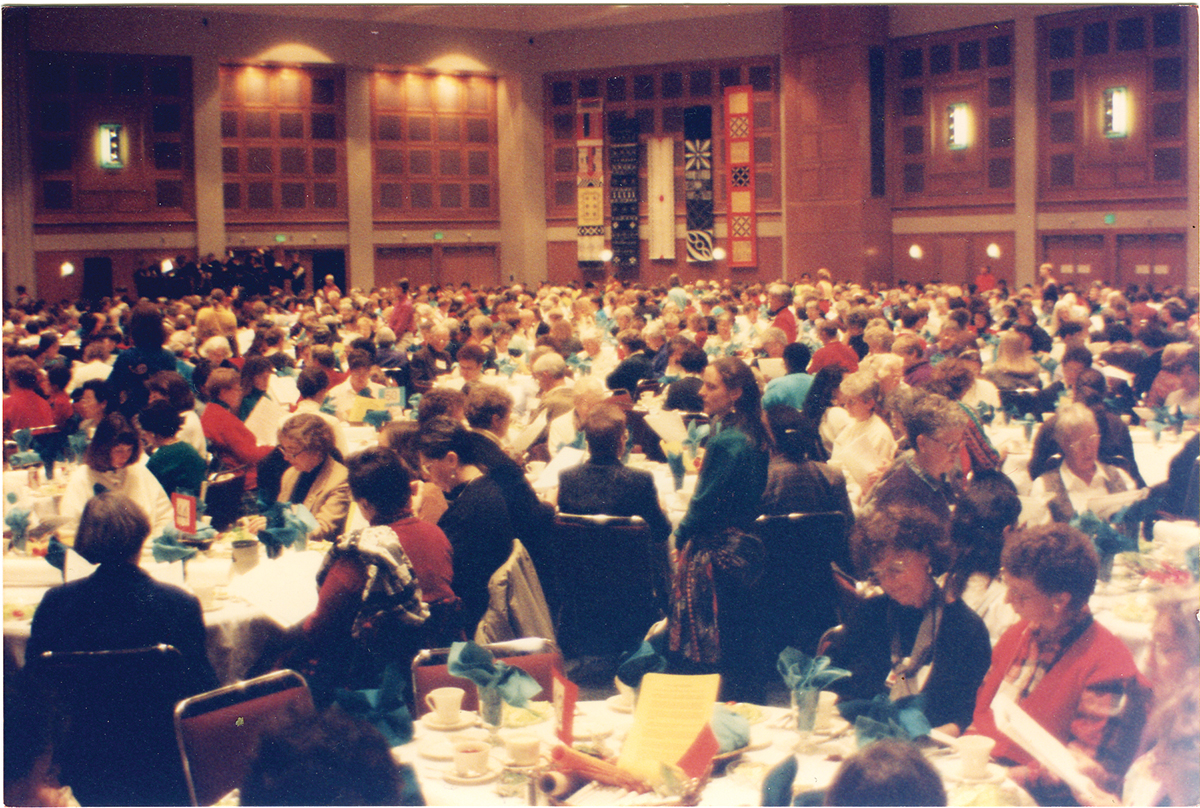
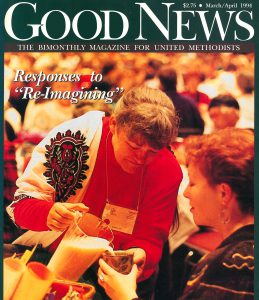
A participant being served "sacramental milk"
Ultimately the conference sparked enormous outrage
of such mainline denominations as the Presbyterians and Methodists, whose
national officers had originally contributed funding and planning for the
conference, so that the movement backed down and no further attempts were made
to go further down this road.
The Feminist/Liberal attempt to block the Supreme Court nomination
of a conservative Black, Clarence Thomas (1991).
Things got explosive when in 1991 Bush had the audacity to nominate as a
Supreme Court Justice a Black conservative, Clarence Thomas. The large Democratic Party majority was not
in the mood to see political conservatism grow within the Black world and tried
to shoot down the nomination, the same way they had four years earlier when
they threw full opposition to the appointment of another conservative (but
White), Robert Bork.
And
just the previous year another Supreme Court appointment by Bush, that of David
Souter, barely got past the full-force opposition of the National Organization
of Women, the NAACP and Senators Kennedy and Kerry, because Souter was a known "conservative," and
such ideological bias had no place on the Supreme Court (meaning by someone who
did not have the Democratic Party's ideological bias!).
Now
the Democrats fully intended to block another conservative Supreme Court
appointment by "Borking" Thomas (as the resistance action was coming
to be termed). Their effort to destroy
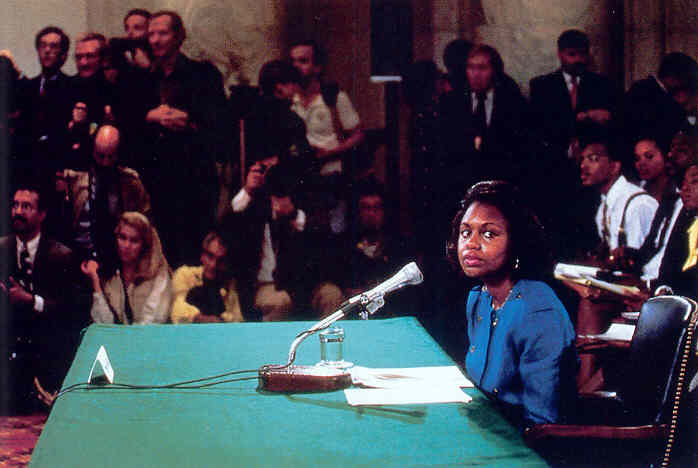
the character of Thomas was built on the testimony of a Black female, Anita
Hill, brought forward to testify about "inappropriate" behavior of Thomas towards Hill when she worked
for him as a staff member. But the
effort was muddied greatly by the number of women staffers who came forward to
testify strongly in favor of Thomas's excellent behavior as their boss, and the
fact that Hill had followed Thomas from job to job, and that it was she who
seemed to be initiating whatever relationship (which turned out to be not much)
that actually existed between the two of them.
Thus the effort to "chauvinize" Thomas fell somewhat flat, and
eleven Democrats found the way to vote in favor of his appointment, which
passed 52 in favor and 48 against (again, with those 11 exceptions and 2
Republicans who opposed Thomas, the vote being along party lines).
Supreme
Court appointments were now big political business, since the Court had taken
up the responsibility of being the country's chief legislative branch of the
federal government.
Clarence Thomas Supreme Court confirmation hearings in the Senate
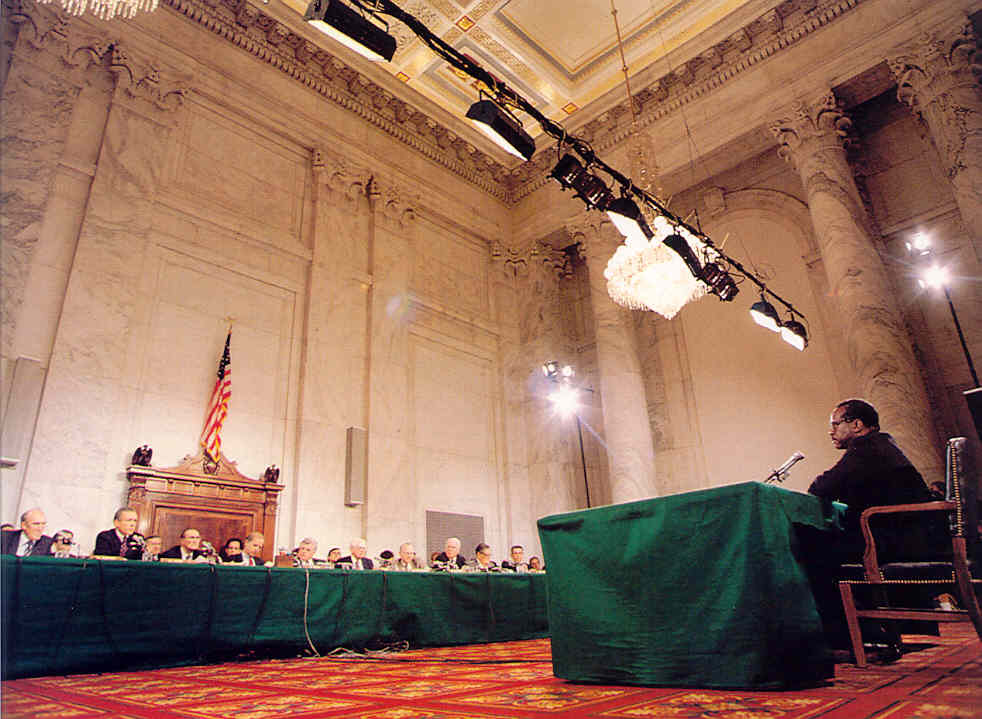

Anita Hill testifying that the behavior toward her of the Bush-
appointee Clarence Thomas had been "inappropriate"
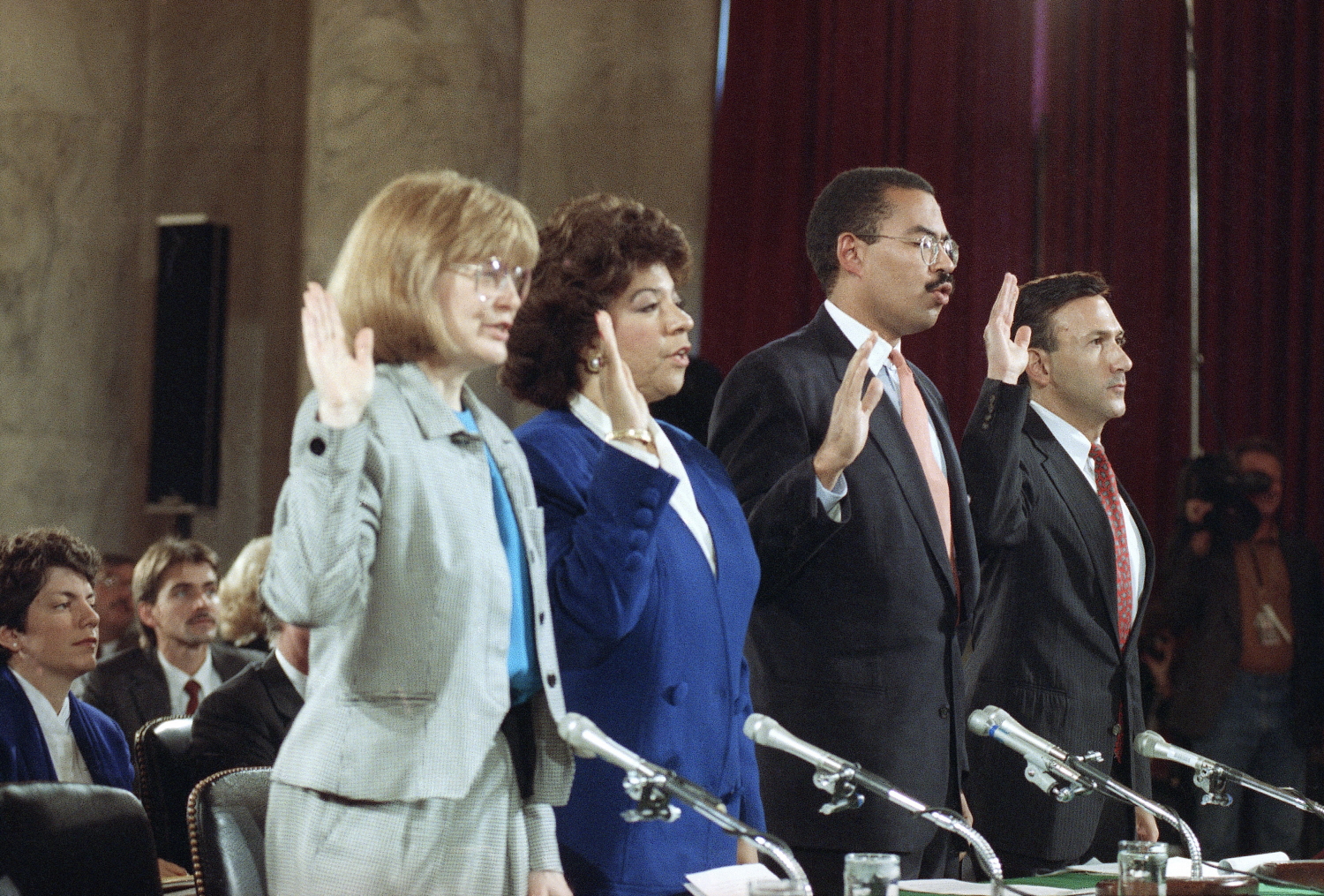
However ... numerous people testified that Hill's accusations
were deeply wrong
| THE "COMING OUT" OF GAYS AND LESBIANS |
Feminists were not the only ones attacking the traditional role of
the male in American society. The
Boomers' social justice instincts turned to a new victim group – the
homosexuals or gays who were being hit hard with the deadly plague of the AIDS
virus. The source of the problem was
clear enough – as was its most obvious solution. But abstinence even in the face of this
deadly disease was not going to happen, and now Boomer Liberals or Progressives began
to demand that medical research be diverted from traditional pursuits (cancer,
for instance) and focus on finding a cure for AIDS, no matter what the
cost. Anyone who differed with this
sense of urgency received the immediate label as "homophobe" (hating
homosexuals) – so discussion or debate was placed out of reach. For that matter all research into the causes
of homosexuality was now declared off limits – because it was decided by the
social justice crusaders that homosexuals had no more choice about their status
than did Blacks – or even women, for that matter. A person was simply born that way. End of discussion.
Indeed, those who came out of the closet to confess
their homosexuality were celebrated as the real heroes of the day. Any who did not feel like celebrating this
development with them were portrayed in the most negative of ways.
Boomer Logic: "how
can anyone be so "homophobic"
as to be other than totally sympathetic to such poor
wretches
who have simply been following
their "natural"
homosexual instincts?"

A man dying of AIDS -
1983
Boomers
failed to understand why it is that sexual relations
are the most
highly regulated of all social activities in nearly
all
societies ... now and throughout history. Sexually
transmitted
diseases have long been known to be highly
deadly (of course there
are other reasons as well that cause
societies to put tight
restraint on human sexual activity).
But
of course Boomers identify all such social restrictions
as simply
fascist tyranny, needing to be overthrown in pursuit
of the cause of
"personal freedom."
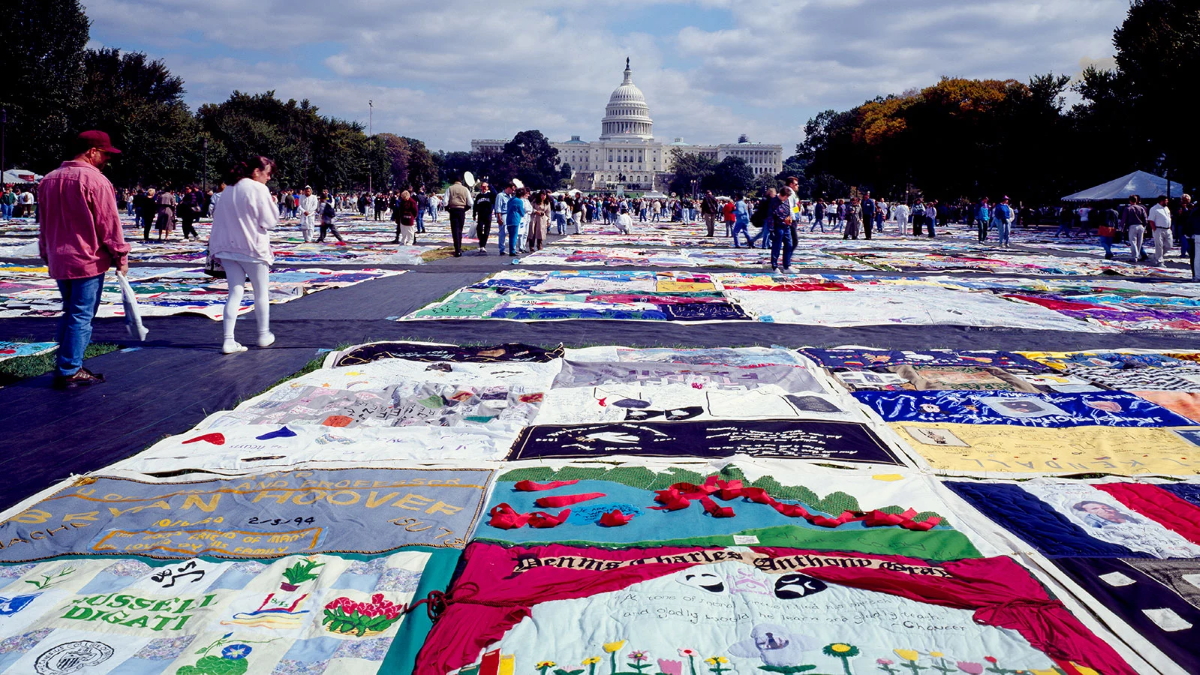
Memorial Quilts laid out on the DC Mall –
in memory of "AIDS Victims" – 1987
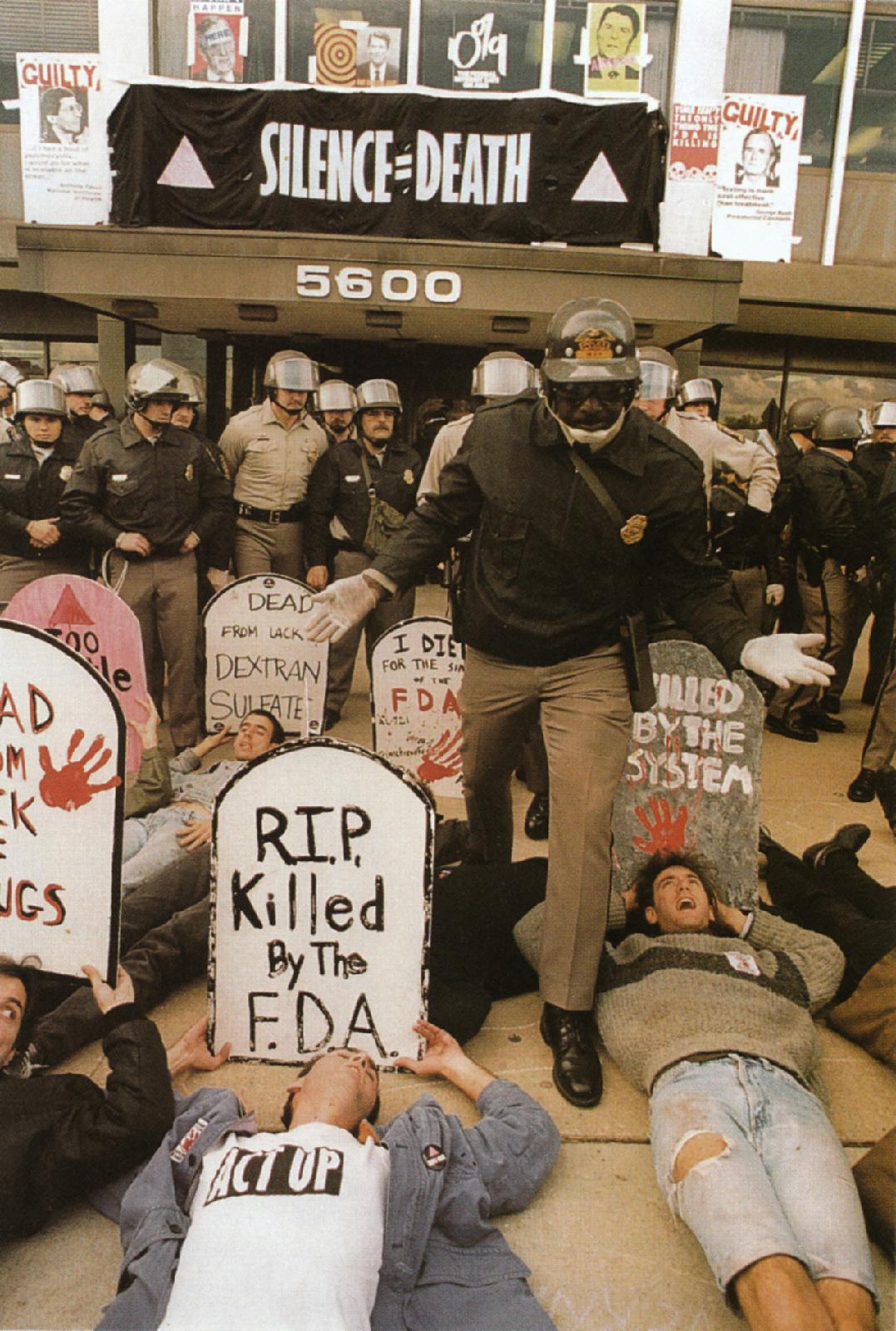
"Act Up" protesters in front
of FDA headquarters in Maryland
protesting lack of AIDS medical R&D – 1988. They eventually
get the Federal government to move funding away from
the study of the causes of cancer ... to the "more important"
study of the causes of and treatments for AIDS.
Traditional
Christianity of course considered homosexuality to be no less a sin than
prostitution, alcohol, drug and gambling addictions, tendencies to physical
violence, etc. – human problems that needed addressing – and deliverance from.
But homosexuality was by the 1980s being
taken off the list of such sins ... even by some Christians.
Soon
therapy was being insisted on not on the part of homosexuals seeking to emerge
from that status (actually such therapy was now even outlawed in some parts of
the country) but instead, on the part of those not ready to accept it as proper
behavior. Pro-homosexual "sensitivity
sessions" were being required by corporations of their officers, or
employees in the field of government and education, and ultimately even of
pastors and lay leaders in some Christian denominations.
This
gave recognition to the fact that people's attitudes, beliefs and deepest
tastes and preferences can be reformulated through careful re-education ("brainwashing"
some would call it, as has so often taken place in dictatorial countries) – and
that not only was such action allowed in America, it was even required – as
long as it went in the "right direction" – that is, in the direction
of "political correctness," as some would term the newly enforced
cultural dynamic.
The first-century
Christian leader, Paul, in his Letter to the Romans (chapter one, verses 20-32)
goes into lengthy discussion about how such male and female sexual perversity
is a result of men and women abandoning their knowledge of God … with the tragic
result that God then simply allows them to fall victim to their own very
self-destructive sexual lusts. Not
surprisingly, therefore, many Christians believed that AIDS was simply the
fruit of just such a horrible sexual dynamic.
| THE CONTINUING DECLINE OF AMERICA'S TRADITIONAL CHRISTIAN DENOMINATIONS |
Christianity was losing its membership rapidly during the 1980s
and 1990s. For a variety of reasons,
Boomers were not interested in church life, either for themselves or in the
raising of their children. Morality was
viewed as a matter of simple human logic (just as the Vets had unfortunately supposed to be
the case with their Boomer children) – which required no
special modeling or discipline. Anyway,
the public schools could tend to that matter – because that was simply part of
what public education was supposedly all about.
Also this issue of homosexuality tore deeply into the
unity of the various Protestant denominations, the ones that once had been the
foundation of American culture and society.
Fierce battles were fought at national conferences on the issue of the
ordination of homosexuals, starting with the need at first to affirm that no
such thing was going to be allowed – only to have that position challenged at
each new national gathering – with the pro-homosexual group making slow
progress against the traditionalists (older Vets disappearing in numbers with age). Ultimately the decision would go fully in the
LGBT direction – splitting the denominations – and causing bitter battles over
church properties of those congregations that pulled out of the old
denominations because of this issue.
Certainly the loss of unity contributed greatly to the increasing
emptiness of the old American churches.
| REAGAN'S PRAYER AMENDMENT |
And then there was the failed effort of Reagan in 1984 to get Congress to try
once again to put into effect a constitutional amendment protecting the right
of prayer in the public schools or any other public institution. Reagan cited the Constitutional
Framers' own pro-Christian views on the matter.
But it was all to no avail. Reagan could not get the necessary
two-thirds vote (only 56 in favor with 44 votes opposed, largely along
predictable party lines) needed to authorize a referendum on a constitutional
amendment proposal. Reagan would try again the next year,
but again with no success.
| EDWARDS V. AGUILLARD (1987) |
Just to add to the sense of decline of the Christian covenant that
had so long carried the country, the Federal Judiciary got into the act again
by way of a case that made its way to the Supreme Court. This blow to the Christian faith came in 1987
in the Court's decision in favor of plaintiffs who argued that the teaching of
creationism (the universe being created by God) alongside Darwinism (creation as a
self-engineered mechanical process moving forward through time on the basis of
its own momentum) was disallowed by the 1973 Lemon Test, which stated clearly
that only things that served a purely secular purpose – namely the Darwinist
worldview – could be taught in the public schools.
During the court
hearings, the only scientists that were allowed to testify were ones that
affirmed that creationism was not a co-equal science with the secular world
view, "science" now meaning only things that operate mechanically,
and thus predictably – and consequently subject to full human control, socially
as well as materially. Other opinions
were not allowed – as this would merely move things down the forbidden
religious path.
Thus with this decision, American children could no
longer be taught in the public schools that there was intelligent design in the
creation of the universe – only a mysterious self-generated creation. Scientists who would have pointed out that
statistically the secular viewpoint made no sense at all were not allowed to
make their case – not in 1973, not in 1987 – nor repeatedly after that. To the Federal Courts – God did not exist in
any meaningful way. Once again, the First Amendment was interpreted to mean not the freedom
of religion, but instead the freedom from religion!
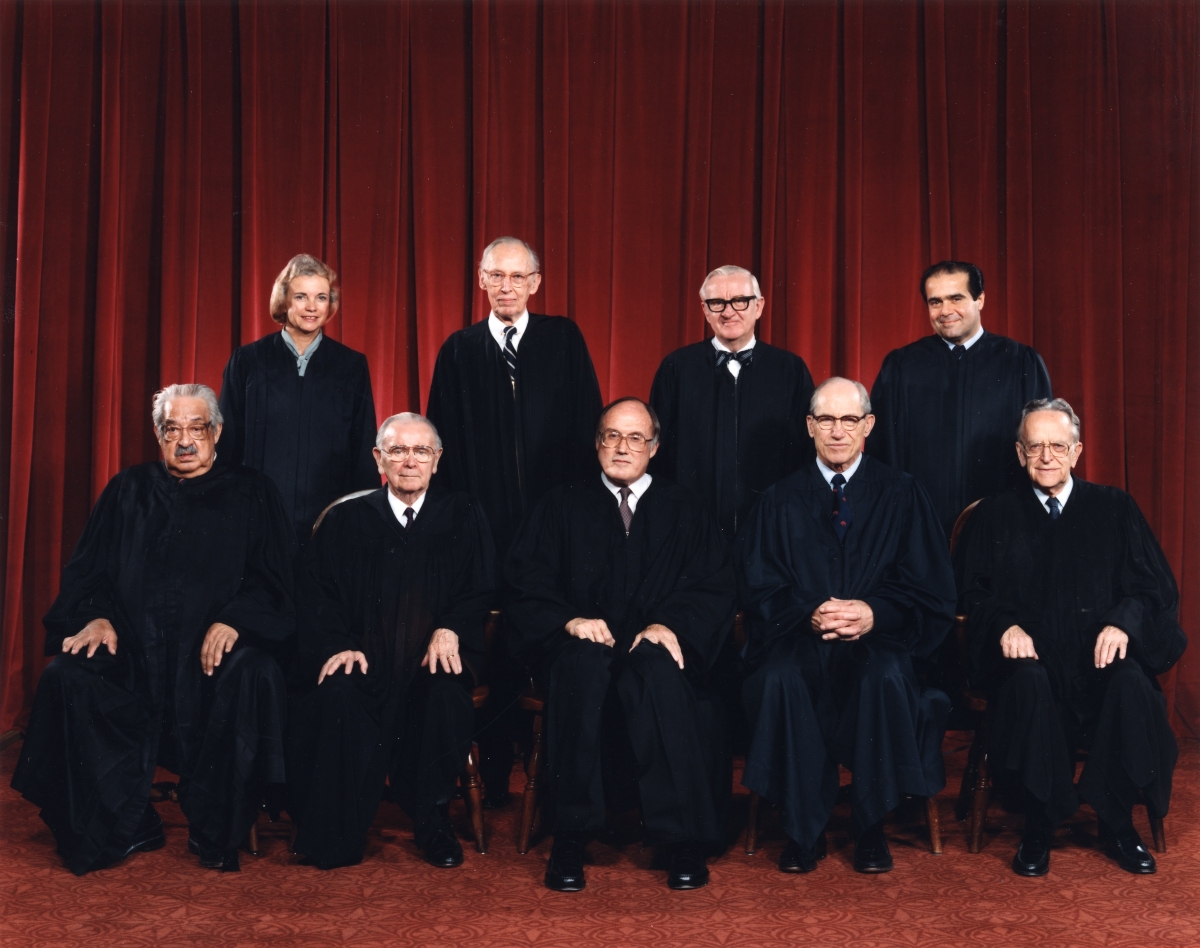
1987 – the Rehnquist court
Only Justice Scalia (back right) and Chief Justice Rehnquist (center)
dissented from the Edwards v. Aguillard decision
| EVANGELICAL OR CHARISMATIC CHRISTIANITY CONTINUES FORWARD |
Only in the area of Evangelical Christianity was real
growth still being registered – again, not at the same rate as the decline of
the traditional mainline churches, but certainly at a rate strong enough to
keep Christian America from sliding into the status of the largely defunct
European Church. Many of these churches
were part of the breakaway groups that formed new denominations. But most were simply independent churches
formed up out of no particular denominational family – or were part of church
growth movements that developed so strongly that satellite churches were
started up by the mother churches – even in other parts of the country.
Liberals
termed these churches as Fundamentalist.
But they really were not part of that group at all – any more than they
were a part of mainline Christianity.
Evangelicals considered both fundamentalist churches and mainline
churches as heavily into "works righteousness." They saw fundamentalists as religious
legalists – possessing something of the same legalistic spirit as the ancient
Pharisees – the very ones who had Jesus put to death because he was not
keeping the Jewish Law the way that the Pharisees read the
Law. Likewise they saw the focus of the
mainline churches on peace and social justice as just more Liberal abstract
idealizing of a perfect world, one that would never come to pass through
Christian Progressivists' carefully-designed
social programs.
Evangelicals
continued to focus on sinners (to the Evangelical, that was all of
us) and the need for repentance, the acceptance of forgiveness by God through
nothing more than faith in God's sacrificial gift of Christ's cross (such faith
if even only the size of a mustard seed!), and the acceptance of help by the
Holy Spirit to live the new life in Christ in power – power to push back the
ever-pressing forces of evil.
Evangelical Christianity was/is
personal – very personal – personally relational rather than rationally
programmatic. It did not happen by
taking the right position with respect to the fundamentalists' laws of the
Church – nor the Liberals' programs of peace and social justice. It came through getting involved, personally,
in a very confused and needy world, needy of personal companionship and a
mutual sharing of life's journey. As
some would put it, Evangelical Christianity was like one
street bum showing another street bum where they could together get some food.
And certainly the world would not soon run out of the
need for that kind of Christianity!

Go on to the next section:
 Miles
H. Hodges
Miles
H. Hodges

 Increasingly militant feminism
 The "coming out" of gays and lesbians
  The continuing decline of America's traditional Christian denominations
  Reagan's prayer amendment
  Edwards v. Aguillard (1987)
  Evangelical or charismatic Christianity continues forward