Leading this inquiry into the Communist involvement in America was
the House Un-American Activities Committee (HUAC), conducting Congressional
investigations not only into the labor movement and the world of socialist
intellectuals but also into the movie industry – which had produced a number of
films now considered to have strongly Leftist messages. This would come to include even the U.S.
government itself, when accusations came out in 1948 that high-level officials
in the Roosevelt Administration had been spying for the Soviets.
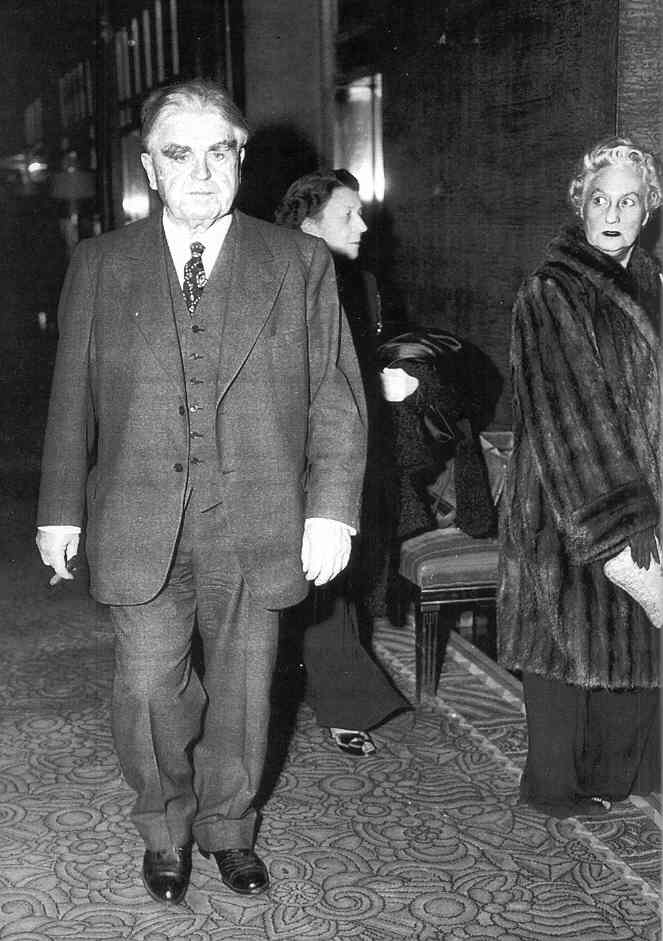
Tough labor leader, John
L. Lewis,
receiving the stare of a rich lady
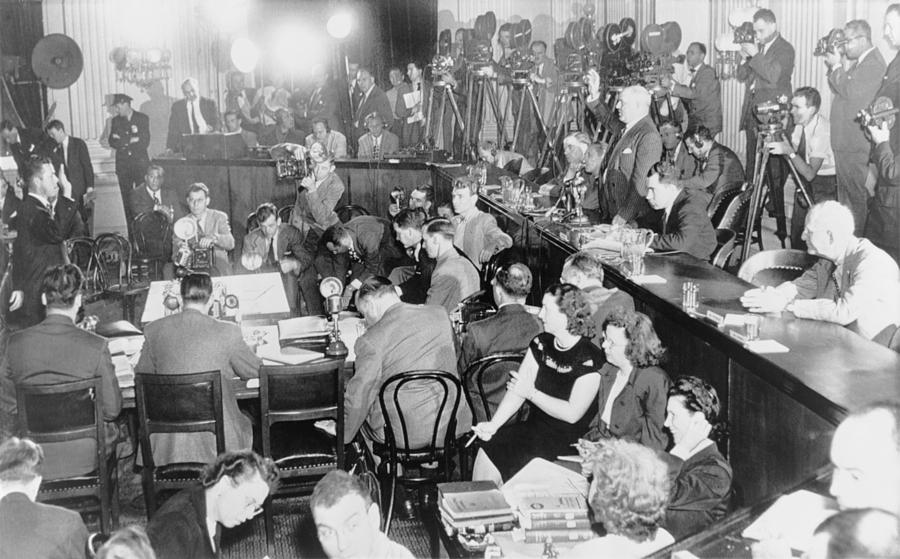
HUAC hearings of those accused of
having ... or having had ...
Communist associations
This
matter turned itself into extensive social paranoia on the part of Middle America, met on the other hand
by the scorn and disgust against Middle America on the part of
Intellectual America. When actors began
to be blacklisted and refused roles in Hollywood's world (ultimately some 300
individuals were blacklisted, including even famous actors), Hollywood
protested that this kind of authoritarianism was what America itself was
supposed to be combating – not embracing.
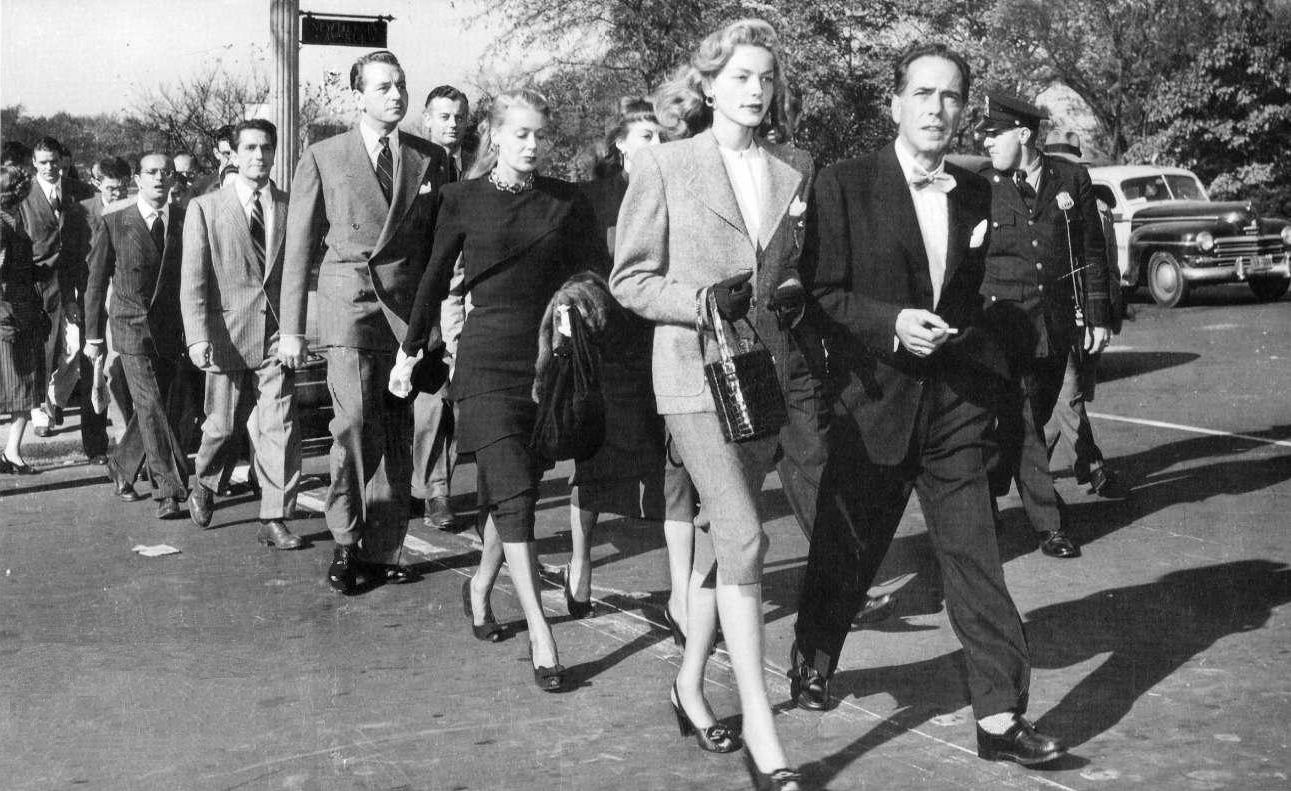
Hollywood stars (Lauren Bacall
and Humphrey Bogart in the
lead)
descend on the Capitol to
lodge their note of protest
against HUAC's proceedings – 1947
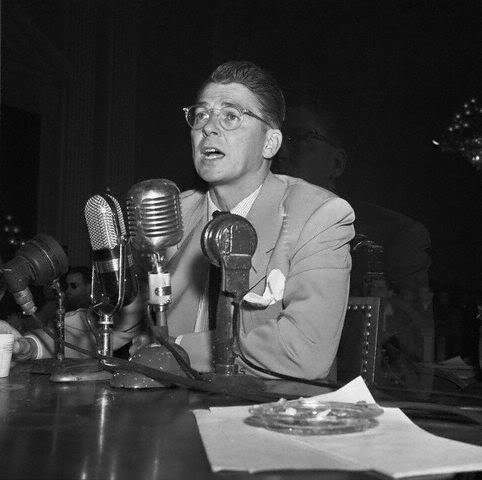
Screen Actors Guild president
Ronald Reagan
testifying before HUAC – 1947
Then
when senior U.S. Treasury official Harry Dexter White (who was a key
figure at the 1944 Bretton Woods Conference setting up the new United Nations)
and Alger Hiss (a top State Department advisor
at the Yalta meeting designing the post-war world) were accused of being spies
for Soviet Russia, America lined itself up into two opposing camps. Intellectuals were convinced that this was
only a form of witch-hunting on the part of unenlightened individuals from the
American Middle Class – simply resentful of these individuals because of their
highly talented backgrounds (the highly educated White, for instance, was a
product of Columbia, Stanford and Harvard University educations – and Hiss was a Johns Hopkins University
and Harvard Law School Graduate).
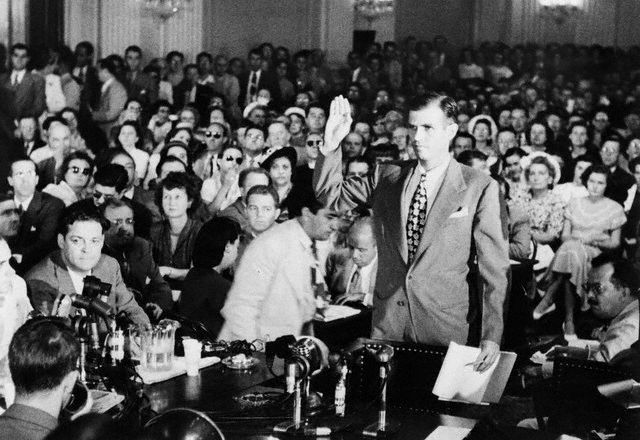
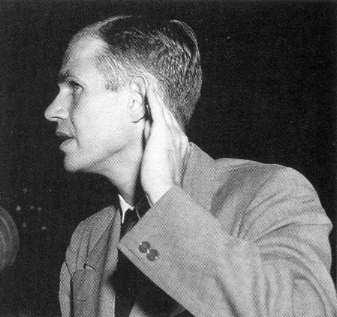
U.S. State Department official Alger
Hiss taking the oath before the HUAC
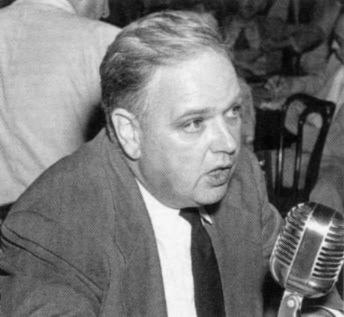
Whittaker Chambers accuses
Alger Hiss of passing information
to the Soviets
Particular resentment by intellectuals was aimed toward the
freshman Congressman and HUAC member Richard Nixon, who refused to relent in his
investigation of Hiss... which eventually led to the
conviction and imprisonment of this polished diplomat – to the dismay of Hiss's
fellow intellectuals.[1]
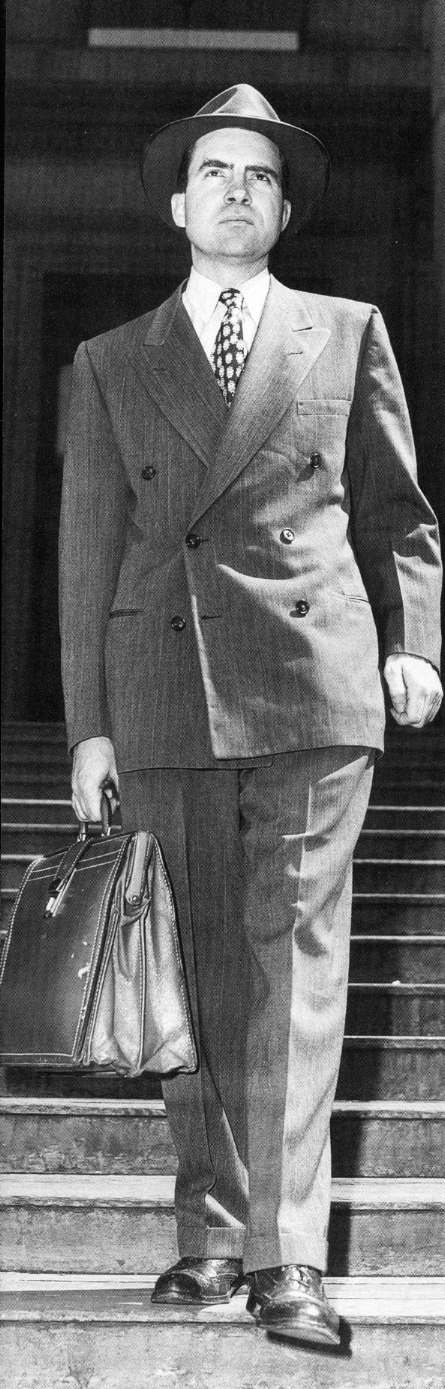
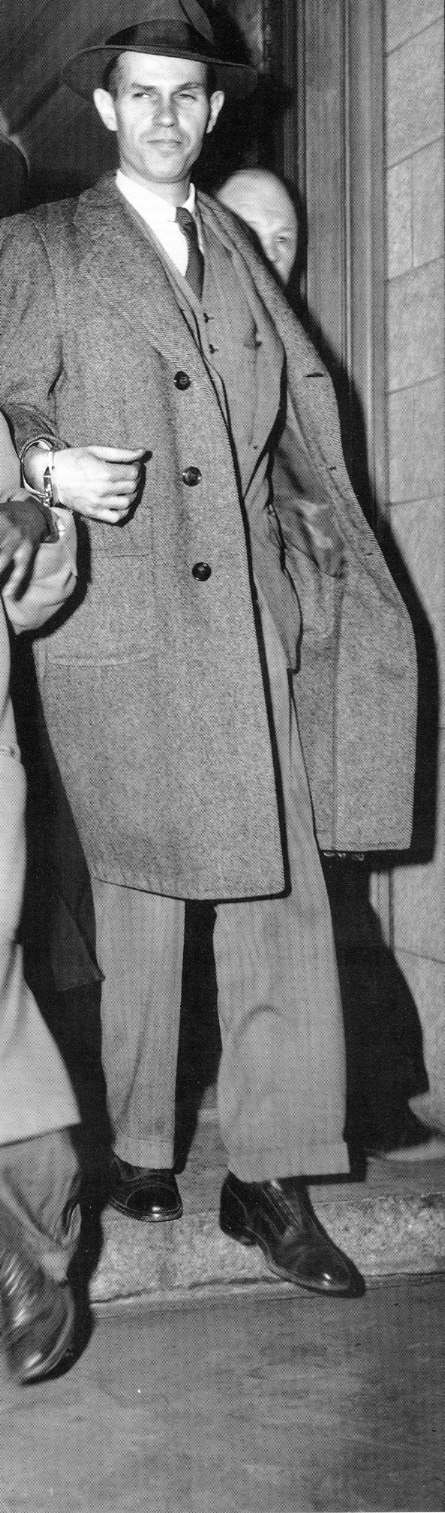
Richard Nixon (left) , who
headed up the HUAC investigation
of Alger Hiss (right)
as a Soviet agent planted
high within the
American foreign policy-making machine
Also,
when suspicions turned towards some of America's scientific community – whom
Americans had assumed possessed the highest integrity of all people – the
nation was shocked. Intelligence work
had cracked the Soviet code and discovered that nuclear scientist Klaus Fuchs
was a Soviet spy. He in turn named David
Greenglass and Julius and Ethel Rosenberg as spying for the Soviets while
helping to develop America's nuclear weapons.
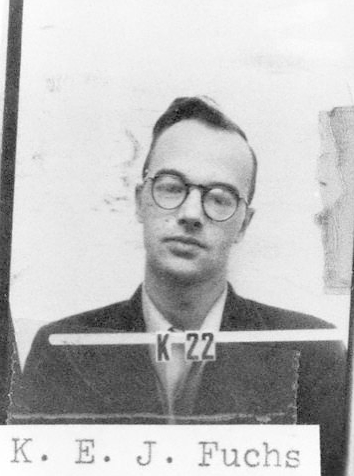
Klaus Fuchs' I.D. badge at
the Los Alamos National Laboratory
Los Alamos National
Laboratory
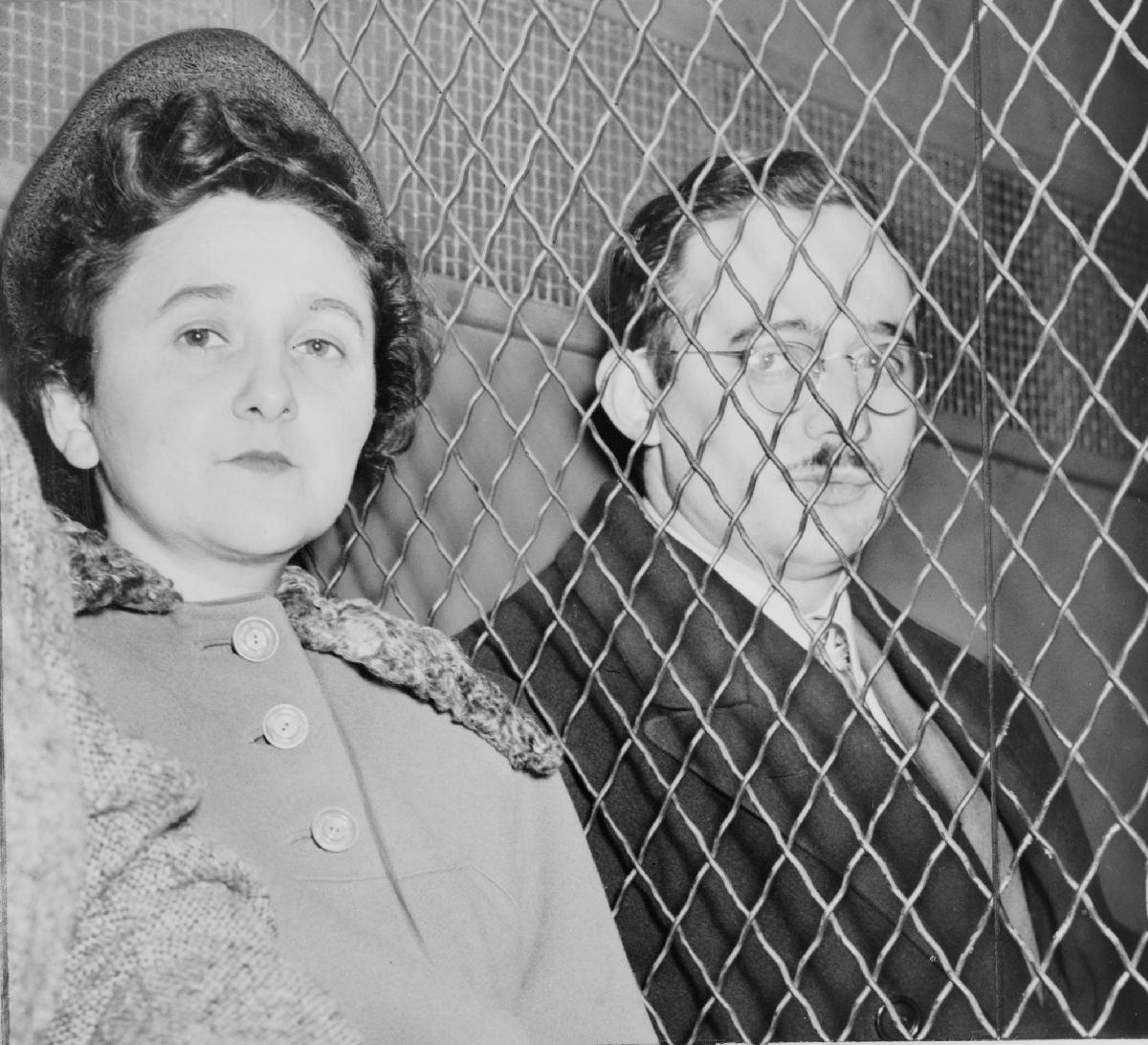
Julius and Ethel Rosenberg
after their conviction
There
were others as well, accused and ultimately convicted of spying in the early
1950s, though only Julius and Ethel Rosenberg were executed – despite the huge
international call for clemency (they claimed innocence to the end).[2]
McCarthy cultivates a Red Scare.
At this point a loud, accusatory voice in the U.S. Senate became even
louder, as Senator Joseph McCarthy in early 1950 began whipping
up American fury at this "treachery in high places." McCarthy accused (without any
specific details) the American diplomatic corps broadly, then the American
civilian government in general, and then finally, by 1954, even the US
military, of being loaded with Communists who were secretly subverting America. With this, the Red Scare was whipped up so as to
turn in every direction.
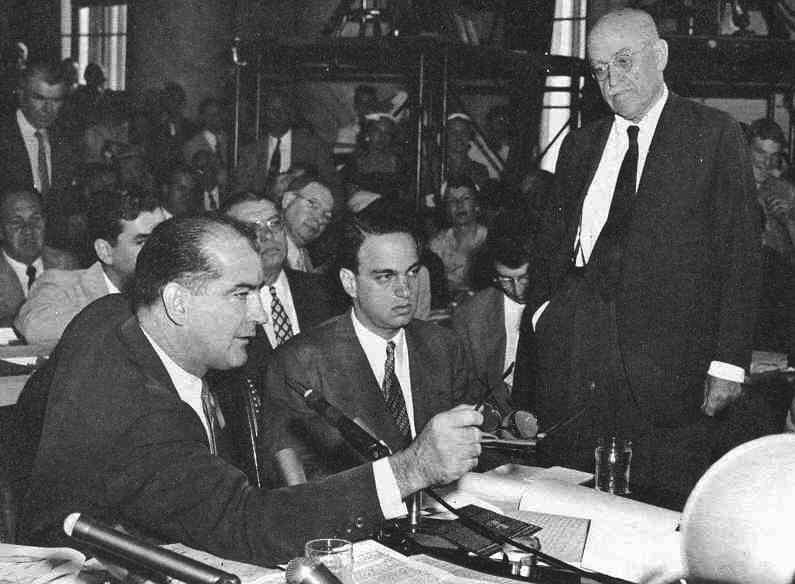
Senator Joseph McCarthy in
action – 1954
(with a disapproving Senator
Ralph Flanders looking on)
American intellectuals fight back. The Red Scare hit especially hard America's intellectuals
– who were known to have "fancy ideas" about the need for social
reform – ideas which seemed overly critical, even unpatriotic, even treasonous,
to fiercely patriotic middle-class Vets. The Vets therefore were (with McCarthy's help) easily led to believe that this class
of intellectuals formed a conspiratorial group seeking to overthrow the nation
and everything it stood for. Needless to
say, the intellectuals did all that they could do to fight back – though it had
to be done cautiously, very cautiously.
[1]Actually, in the opening of the Russian archives after the collapse of
the Soviet Union in the early 1990s, it was confirmed that in fact both White
and Hiss had been spying for Stalin.
[2]Again, with the fall of the Soviet Union, it was finally revealed that
indeed the Rosenbergs (or at least Julius Rosenberg) too had been spying for
the Soviets.
| ARTHUR MILLER'S PLAY, THE CRUCIBLE |

 Authoritarianism as the new threat
 American intellectuals under suspicion
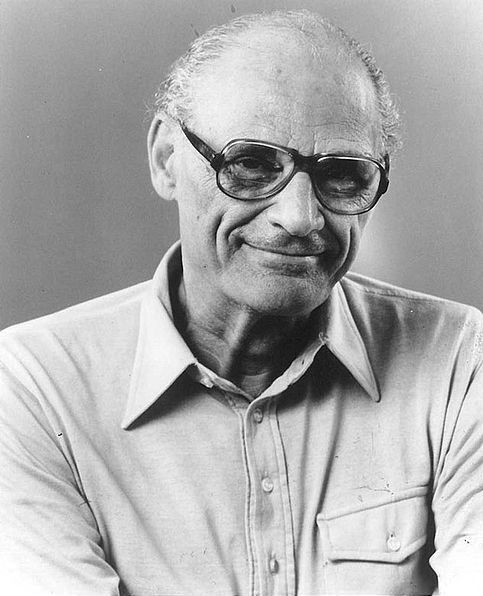
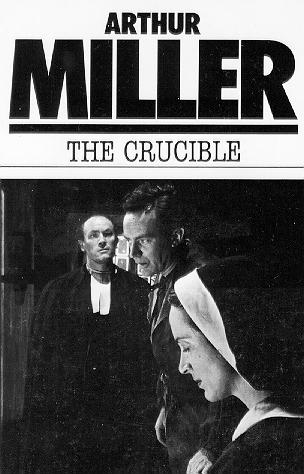
  Arthur Miller's play, The Crucible