The 1956 Hungarian Crisis. Apparently, university
students in Hungary were also hoping that Khrushchev's New Look indeed meant
that Hungary could move out from under Soviet domination, and they began to
make demands (street demonstrations) to that effect. Also U.S. Secretary of State John Foster
Dulles had been passing the word via the U.S. government's propaganda radio
station, Radio Free Europe, assuring Eastern Europeans that America stood with
them in their quest for national freedom.
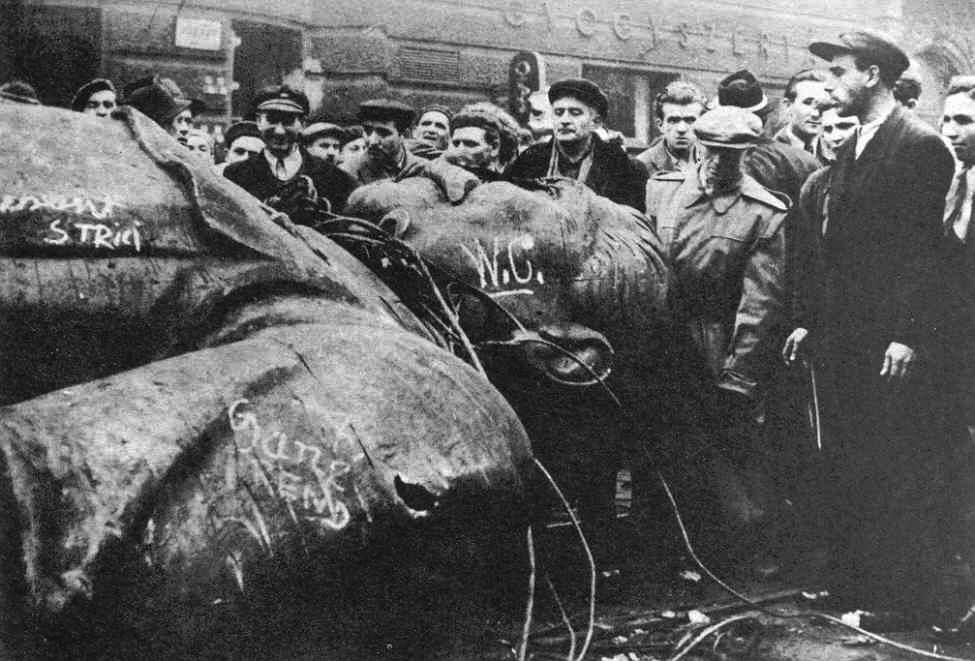
Budapest students and workers
next to a toppled statue of
Stalin - at the beginning of the
Hungarian uprising -
October 23, 1956
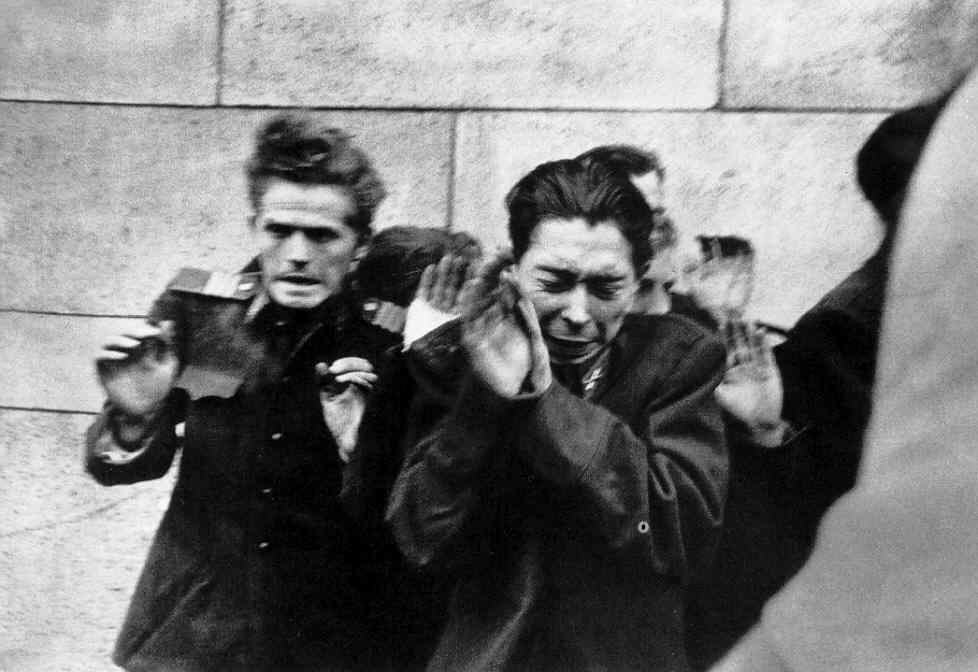
Hungarian security police
being cut down by rebel fire
as they pour out of a Communist
headquarters - November 1956
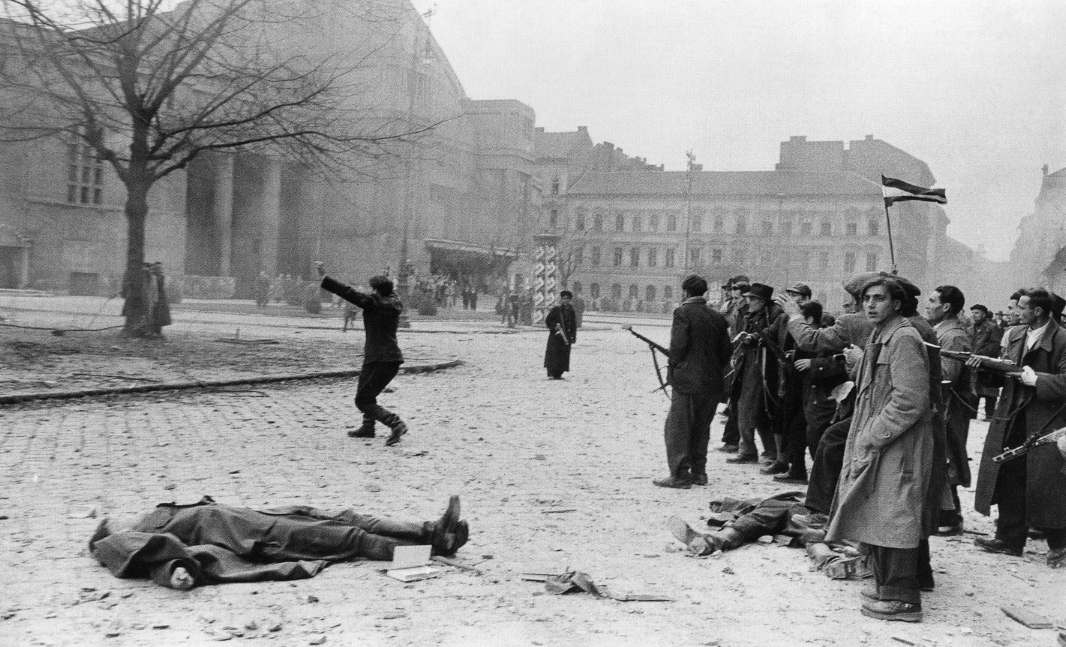
Dead Hungarian secret police
lie at the feet of young
protesters in Budapest - November 1956
Of
course that was not at all what Khrushchev had in mind with his New
Look. But when things began to quickly
get out of hand in the Hungarian capital of Budapest, he hesitated. What should he do? To bully Hungary back into submission would
completely undercut his Third World strategy of wooing these "emerging
nations" with Communism's New Look.
Meanwhile
China's rising Communist leader Mao began to taunt Khrushchev about his lack of
decisiveness. In part this heckling of
his fellow Communist by Mao was because Mao saw those times as very opportune
for China - not Russia - to take the lead in directing the Third World towards
his own Maoist version of Communism (or "Social Democracy", as
Communism was frequently labeled by the Communists themselves).
The 1956 Suez Crisis. At precisely the same time (October 1956) that
the Hungarian crisis was going very badly for Khrushchev, another crisis was
brewing over in Egypt. Egyptian
President Gamal Abdel Nasser was making himself a candidate
for leadership within the rising Third World - or at least within the
politically divided Arab world - becoming president not of Egypt but of the "United
Arab Republic" (which however included at the time only the union of Egypt
and Syria). His goal was to make his
Arab Republic a rising industrial power (in competition with other rising Arab
leaders and their countries), except that the oil-rich region of the Arab world
(Iraq, Kuwait, Saudi Arabia) had the monetary resources to do so - resources
that Egypt lacked totally. Nasser lamented that Egypt (and
Syria) were among the few Arab countries devoid of the valuable asset of
oil.
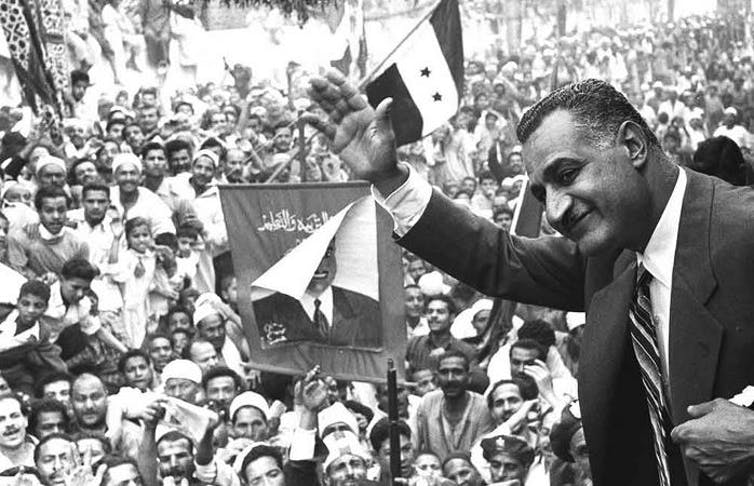
Egyptian President Gamal Abdel Nasser greeting fellow Egyptians
Also
once-friendly Egyptian relations with the West were souring - not only with the
Middle-East "protectors" Britain and France but also with
America. America, trying to stay out of
the growing Israeli-Palestinian conflict, had cut off arms sales to all the national
players of the Middle East, turning Nasser to Russia in 1955 to buy arms
for his growing military force - a major "no-no" to Americans.
Still,
America had been willing to finance a major project of Nasser's - the building of the huge
Aswan Dam across the Nile River in order to generate electrical power for an
energy-less Egypt. But when in 1956 Nasser recognized Mao's instead of Chiang's government as the official
Chinese government, Eisenhower was so annoyed that he cut
off the funding for the Aswan Dam project.
Thus again, Nasser turned to Russia for help
(June 1956) - receiving some, but not enough funding to carry out the project
in full.
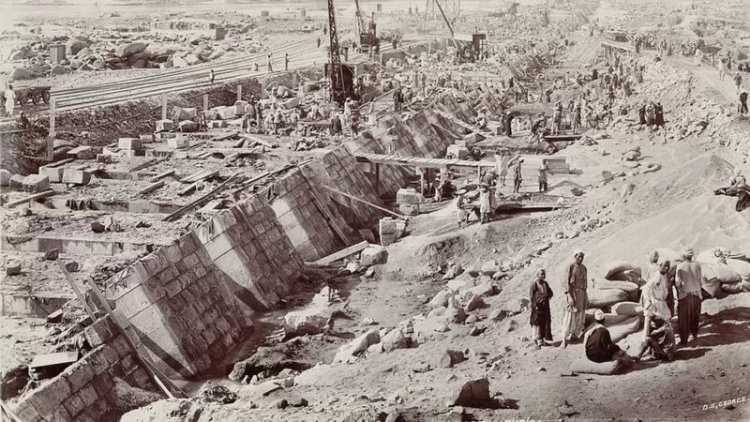
Early construction of the Aswan High Dam
This
is what decided Nasser in July to simply grab the
English-run Suez Canal as a revenue producer for Egypt. A major international crisis now erupted.
America lines up with the Russians against the English and French.
America did what it could to get the British
(and French) to come to some kind of deal on the matter (perhaps an
international authority governing the canal) - but the effort dragged on for a
couple of months with no results.
Actually, unknown to Eisenhower, the British and French
(and Israelis) were secretly working on plans to simply retake the canal by
force - and in late October all three countries invaded Egypt and quickly took
the canal.
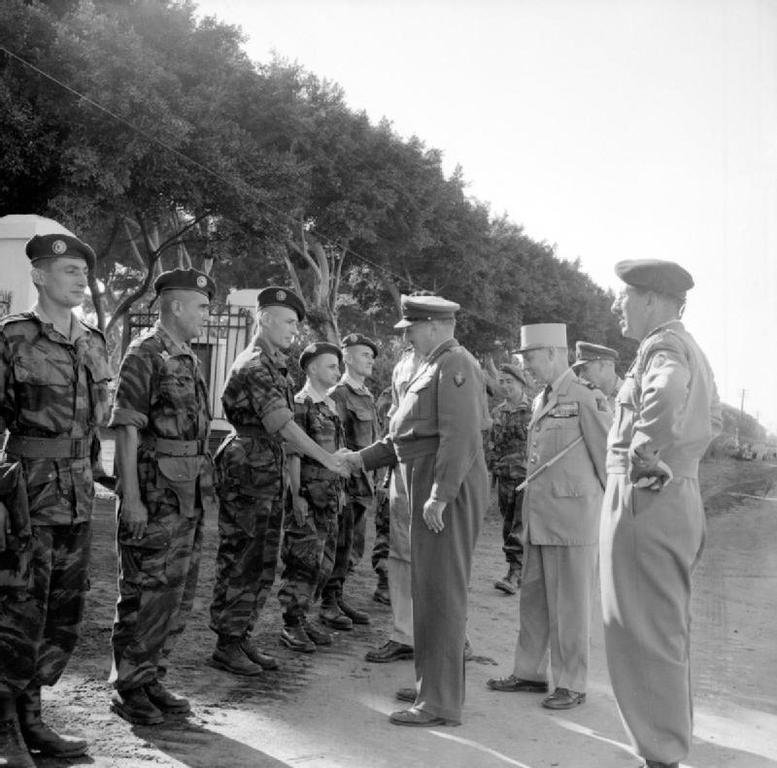
British General Sir Charles Keightley greeting French paratroopers - November 1956
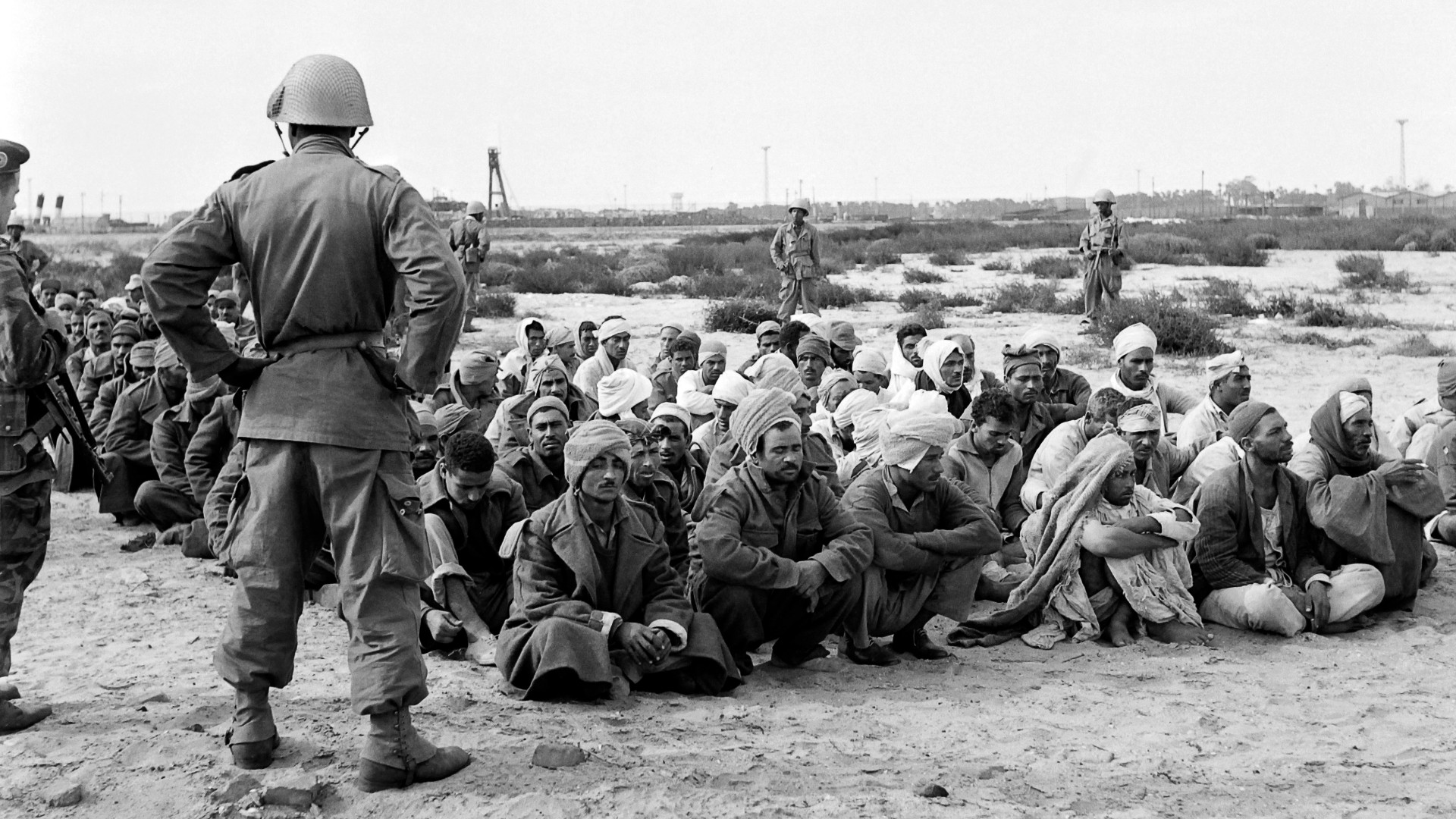
French soldiers with Egyptian prisoners - November 1956
But
an international outcry resulted over this bullying of Egypt - embarrassing and
ultimately angering Eisenhower - who was trying to score
propaganda points with the Third World against the Soviets for their bullying
behavior with respect to developments in Hungary going on at exactly the same
time. America's allies were behaving no
better than the Soviets as far as the Third World - and Eisenhower - were concerned.
Khrushchev crushes the Hungarian Revolt.
Worse, because of the political confusion over the Suez Canal grab, Khrushchev finally felt that he had
the opportunity to make a bold move to end the Hungarian uprising, in early
November sending in 2,500 tanks and 120,000 soldiers to crush the
rebellion. The results for Hungary were
disastrous, with the Hungarian Army doing its best to fend off this massive
invading force. Around 2,500 Hungarians
were killed (700 Soviet troops as well), 22,000 Hungarians imprisoned, 350
executed, and about 200,000 chose to flee the country.
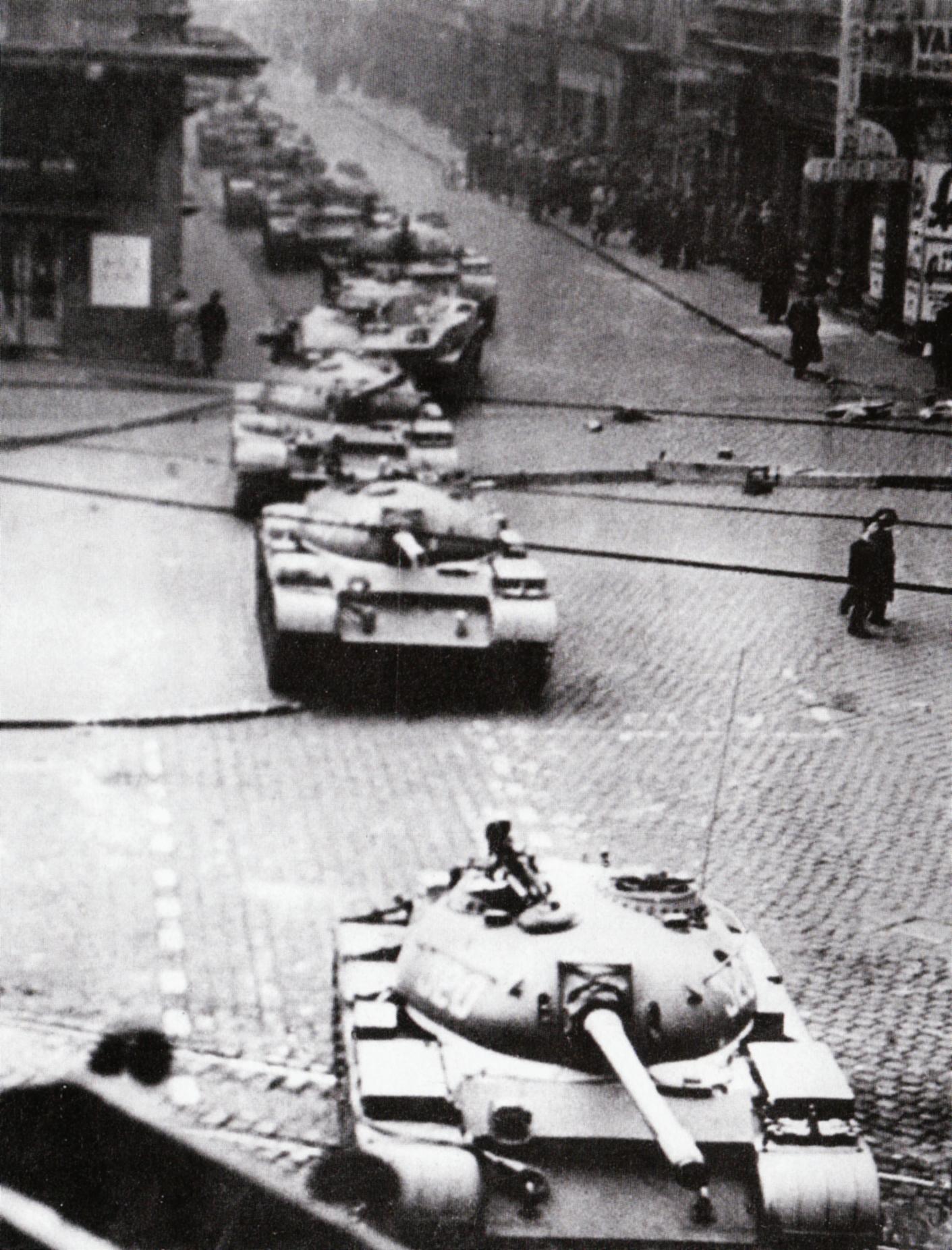
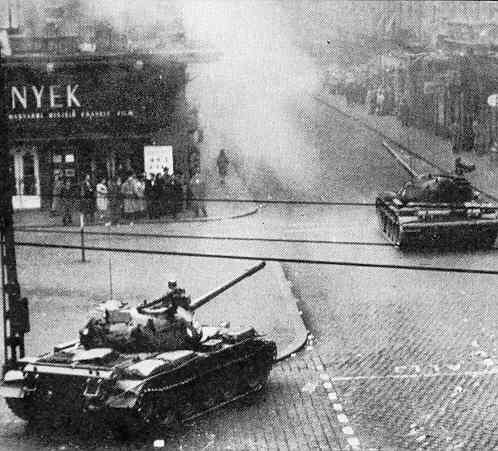
Soviet tanks crushing the
Hungarian uprising in Budapest,
November, 1956
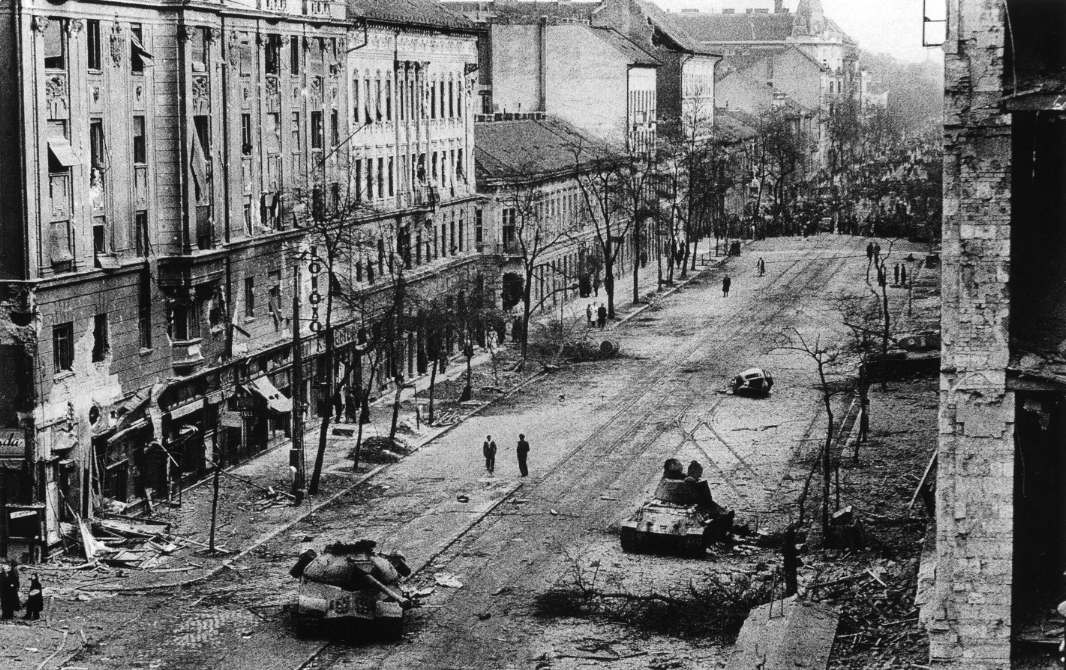
Burned-out Soviet tanks in
Budapest, Hungary - November 1956
There
was nothing America could do to help the Hungarians. But America did help Nasser, coming out strongly against
its English and French allies (and Israel) for this act of "imperialism"
- actually siding with the Soviets in condemning English and French behavior,
and forcing them finally to back out of Egypt and let Nasser keep the Suez Canal.
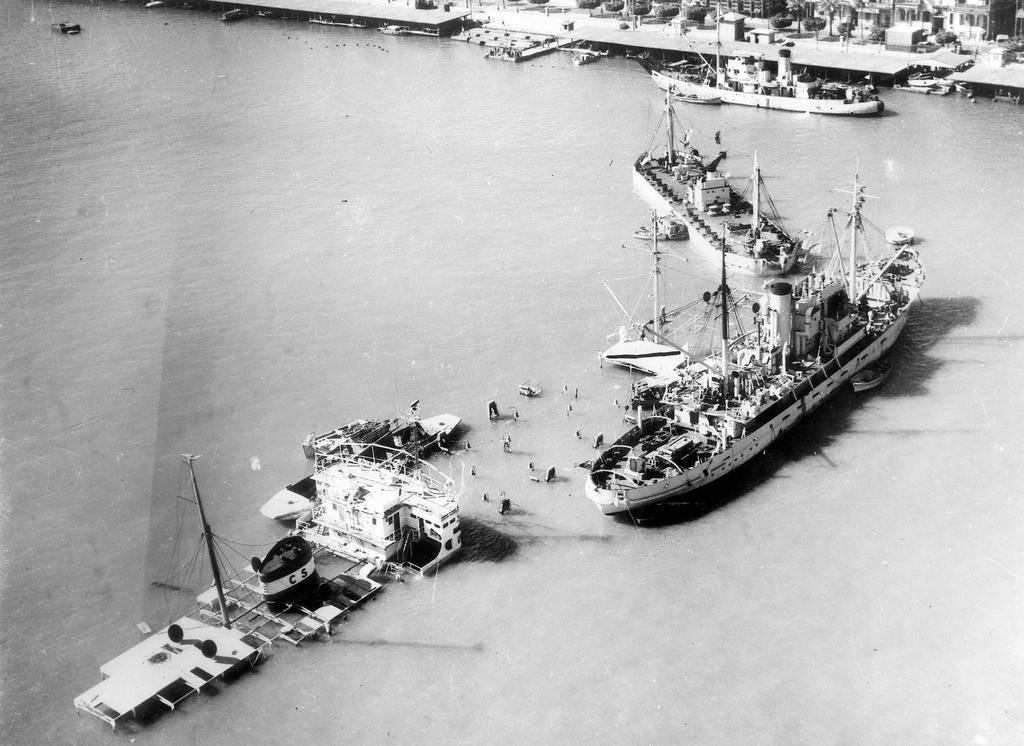
Trying to clear a ship sunk during the Suez Crisis - 1956
The political fallout for America (and Europe). Supposedly this was done to put America on the
right side of the Third World debate - although time quickly revealed that this
position had earned America no political credit from the Third World itself. But it did put America definitely on very
shaky ground with its English and French allies - as well as Germany - which
began to question publicly the idea of America as a reliable ally, especially
as a NATO ally.<
America had clearly not come to the aid of its NATO allies, France and Britain, in the defense of
vital national interests of theirs. But
Americans were unable to understand or even acknowledge the confusion and pain
they put the English and French through.
The English would basically accept silently their huge loss in national
standing. The French, soon under General
De Gaulle, would not.
In fact De Gaulle would make it a point to work with France's
old enemy, Germany, in an effort to squeeze America out of Europe's diplomatic
affairs. Americans seemed at a loss to
understand De Gaulle - whom they grew to dislike intensely.
In October of 1957 the Soviet Russians launched into orbit the
first satellite (Sputnik I) - indicating that the Russians possessed the means
to deliver virtually unstoppable nuclear weapons - a fact that Americans noted
with horror. A month later, the Russians
launched into orbit a 7.8-ton Sputnik II - with a dog aboard. This served to intensify the American horror
- and shame at having fallen behind in the technological race with the
Russians. Finally, at the end of January
1958, America responded with the launching of its own satellite, Explorer
I. It helped some to rebuild American
confidence - but it certainly did not relieve the fear that with such rocketry
available in the Cold War, nuclear war looked more
like a possibility than ever.
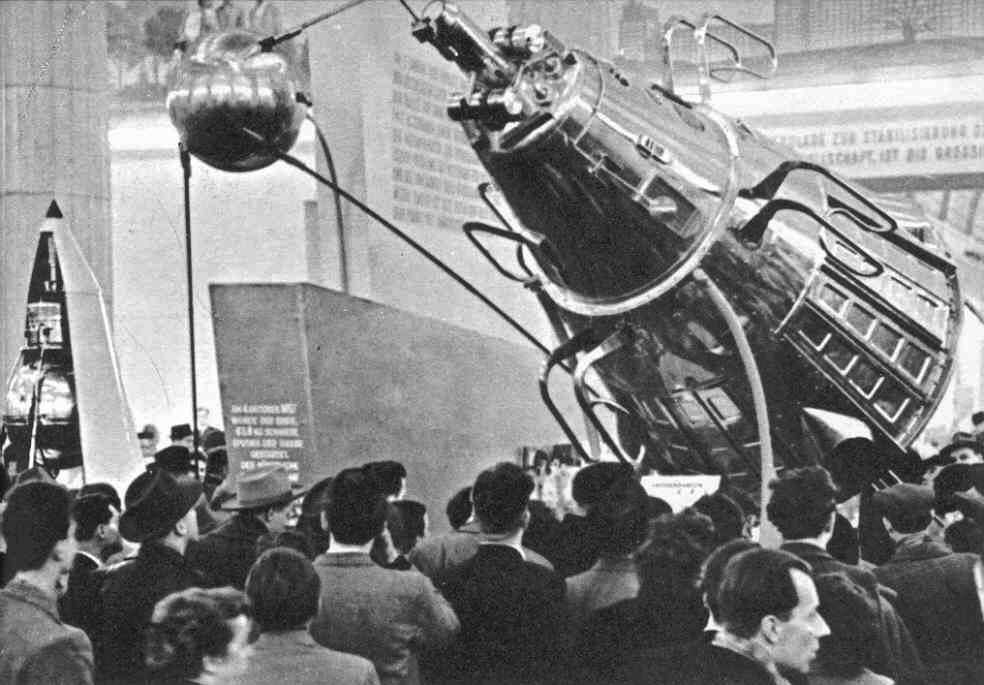
Models on display in East
Germany of the Sputnik (launched
1957) and the more elaborate Sputnik III
(launched 1958)
Sovfoto
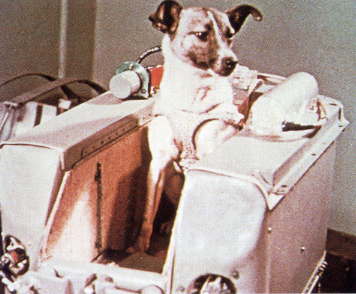
Laika - space dog, launched
into space November 3, 1957
on a one-way trip
Sovfoto
| MORE CRISES IN THE THIRD WORLD |
Rising concern about a post-Imperial Third World. In the latter part of the 1950s, the Cold War contest moved a bit toward
the continent of Africa - as the European grip on Europe's African empires
began to weaken - and local leaders began to demand national independence from
the various French, British, Portuguese and Belgian colonies.
The Algerian Crisis. This move
proved tremendously violent in Algeria - which the French considered not a
colony but an integral part of France - so violent in fact that in 1958 it
brought to power in France, through basically a military coup against the
failing Fourth Republic, former French General De Gaulle.
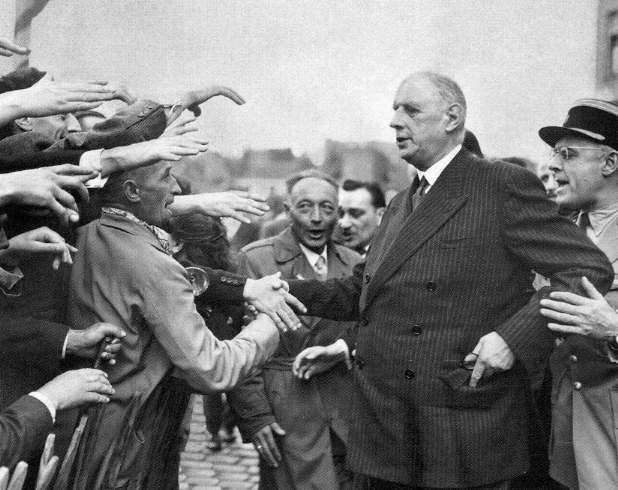
Charles De Gaulle takes over
French government in 1958 with
the total stalemate
in French politics over the Algerian question
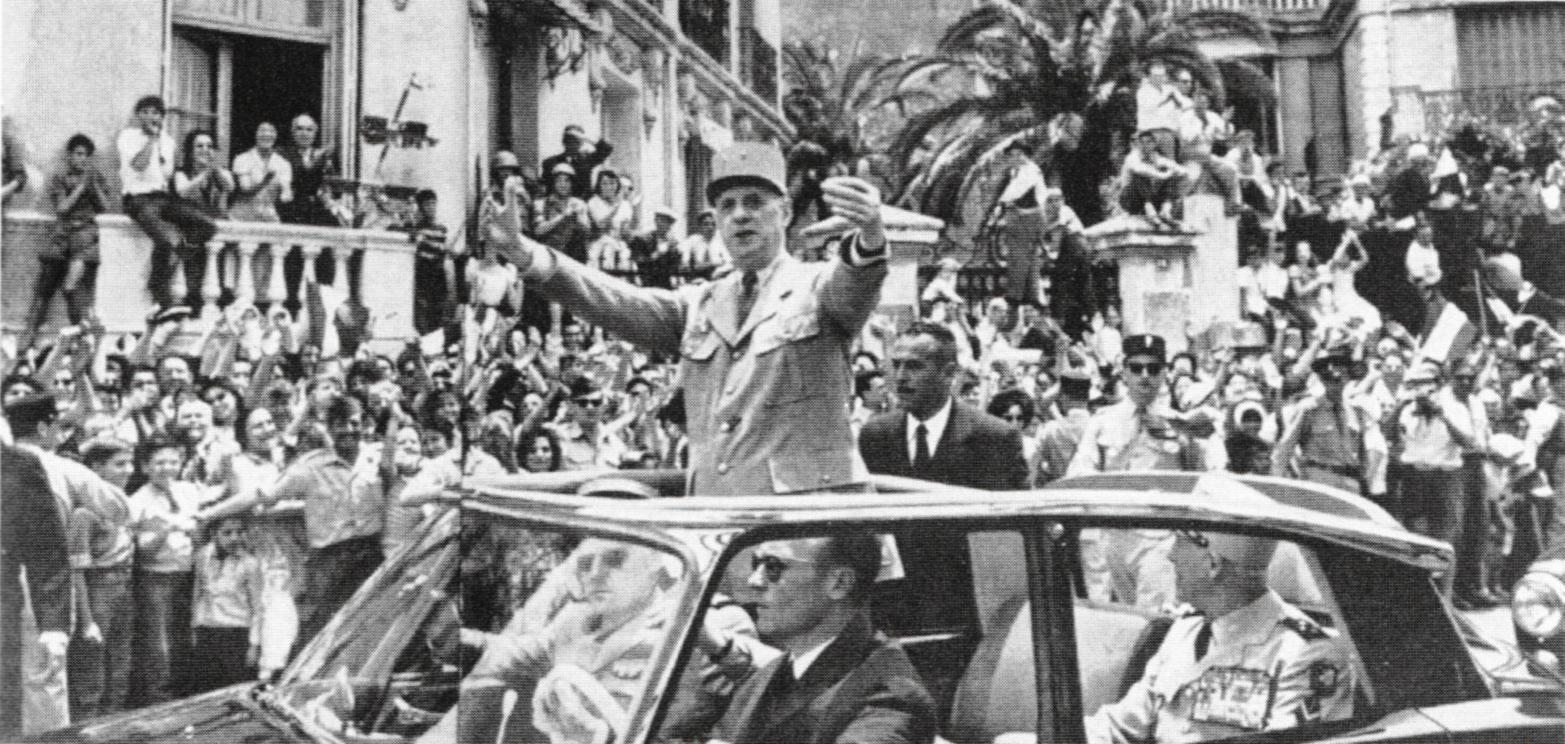
1958: General Charles
de Gaulle, being greeted in Algiers
as the savior of the French in Algeria.
The French were hoping that De Gaulle would bring the Algerian crisis to an
end ... most of the French expecting him to come down hard on the Algerian
rebels. Much to everyone's surprise -
and to the outrage of three million Frenchmen living in Algeria - he took
action in early 1962 by simply agreeing to complete independence for Algeria. To De Gaulle, France had bigger things to do than
waste itself on a war with the Arabs of Algeria, a war whose social costs would
clearly outweigh greatly any particular social benefits.
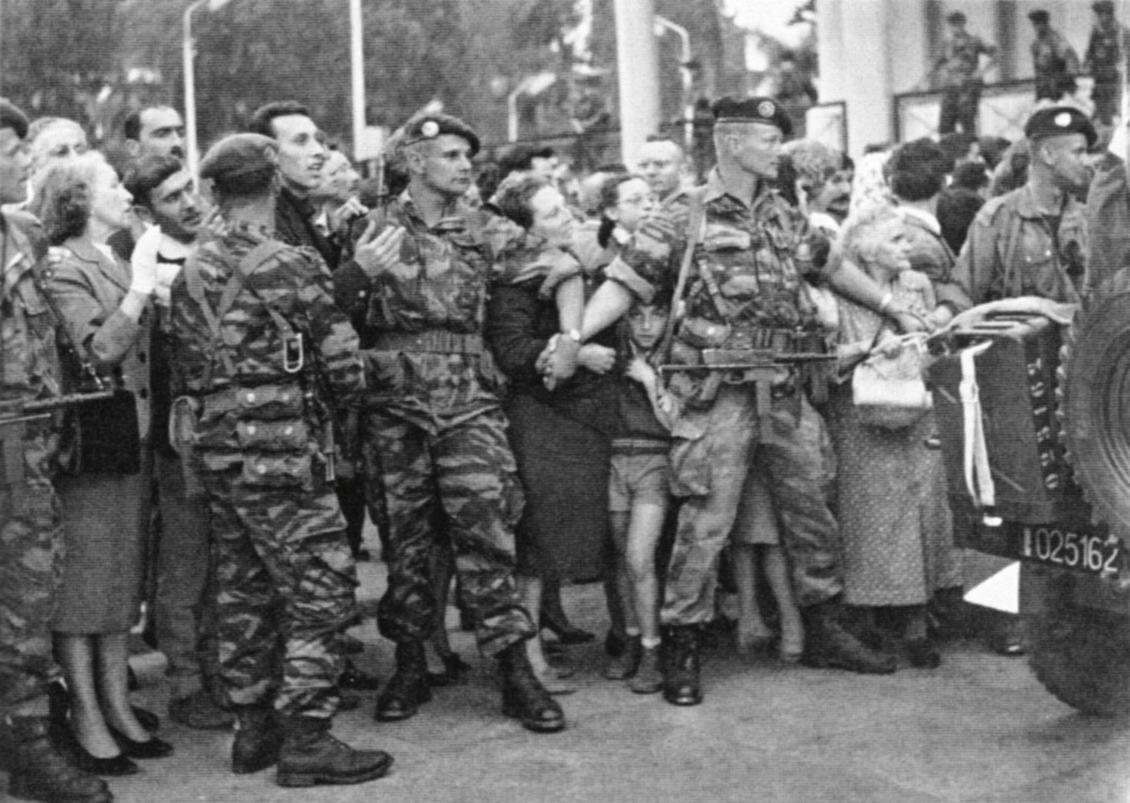
1961: Angry French
mass outside government headquarters
in Algiers.
They are listening to rebellious
French generals
condemning de Gaulle's plan to begin peace talks with
the
Algerian (Arab) nationalists.
The military was forced
to back down after four days of resistance.
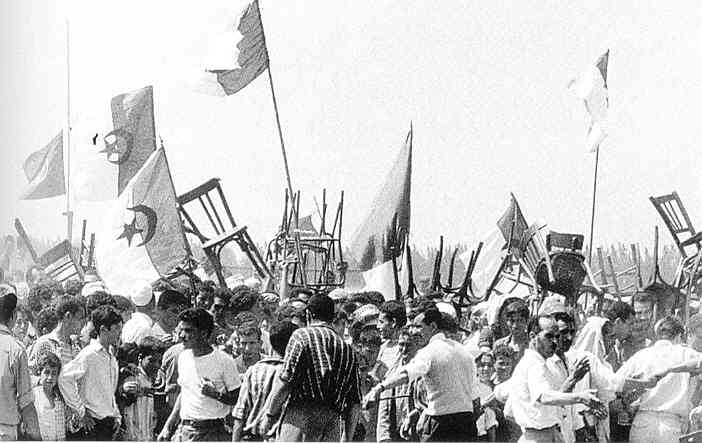
Algerian Arabs celebrate
independence from France
after 132 years - March 1962
Mostly
everywhere else in Africa the transition to independence began to occur fairly
smoothly as Western-educated African elite began to take the reins of power of
their new "nations."
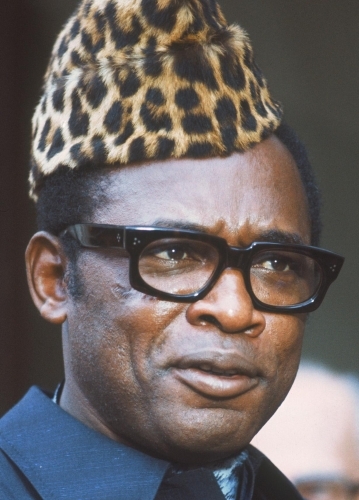 The Congo Crisis.
But the situation in the Belgian Congo did not go so smoothly - as the
Belgians had been hesitant to prepare a group of Westernized locals to take
over the Congo. Thus the Congo fell into
confusion as regions and tribes put forward their own leaders, hoping to either
take over the Congo, or break sections from it (such as the mineral-rich
Katanga Province) in order to produce their own independent country. Ultimately this stirred both Soviet Russian
and American interest in seeing things move in the direction of their own particular
choosing. But the chaos made even that
fairly impossible. Eventually the Congo, with much help from America,
came under the dictatorship of General Mobutu - and things settled down.
The Congo Crisis.
But the situation in the Belgian Congo did not go so smoothly - as the
Belgians had been hesitant to prepare a group of Westernized locals to take
over the Congo. Thus the Congo fell into
confusion as regions and tribes put forward their own leaders, hoping to either
take over the Congo, or break sections from it (such as the mineral-rich
Katanga Province) in order to produce their own independent country. Ultimately this stirred both Soviet Russian
and American interest in seeing things move in the direction of their own particular
choosing. But the chaos made even that
fairly impossible. Eventually the Congo, with much help from America,
came under the dictatorship of General Mobutu - and things settled down.
This
would soon be a pattern repeated in other African countries - as "democracy"
failed and dictators came to power to bring these African states under some
semblance of unity, ancient tribal hatreds within these new states making the
task extremely difficult. In general,
America decided that further involvement in Africa was not worth the trouble -
and let Africa go its own way (with the exception of South Africa, which
continued to interest pro-democracy Americans greatly, in the same way that
Dutch Indonesia had once interested them).
Cuba: the problem hits closer to home.
Although America never admitted it, America's relations with its
neighbors to the South in Latin America had much the same quality as Europe's
imperial positions in Asia and Africa.
America went from a paternalistic instinct to protect its neighbors from
the meddling of European powers (the Monroe Doctrine) to a paternalistic
interest in seeing its neighbors join America in exemplifying New World
Democracy - such as America believed that it itself exemplified.
However
such democratic idealism was deeply compromised by the tendency of American
businessmen (who generally took the lead in America's relations with its
neighbors to the South) to prefer to work with strongmen (dictators, basically)
who offered greater possibilities of social stability and economic protection
with respect to America's extensive industrial and financial investment in
their countries. This certainly was the
case in Cuba - where America supported the very corrupt Batista dictatorship -
but somewhat ambiguously, due to his embarrassing behavior.
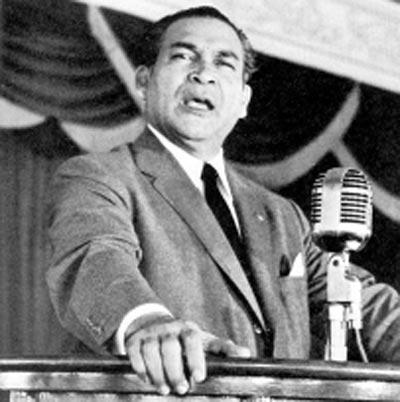
Fulgencio Batista
Anti-Batista
rebellion broke out in the mid-1950s, and Americans (some of them, anyway) took
an interest in the colorful rebel lawyer Fidel Castro, who was leading one of the
several anti-Batista groups in Cuba.
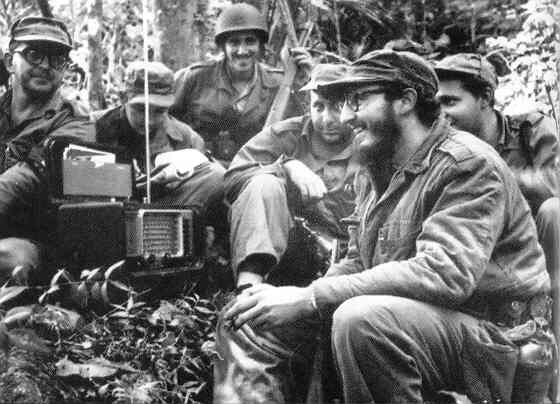
Castro in the Sierra Maestra
with his rebel band - 1957
Finally in 1958, the US government placed an arms embargo on Cuba –
weakening Batista's power considerably.
Then at the beginning of 1959 Batista fled Cuba – and rebel groups,
including Castro's, took over the country. Castro himself soon took control of
Cuba – and proceeded to put into action a huge range of socialist policies,
confiscating the lands and businesses of the Cuban wealthy in order to pass
these assets on to the poorer classes of Cuba. This in turn caused thousands of
middle and upper-middle class Cubans to flee to the mountains – then from Cuba
itself, many ending up in Florida.
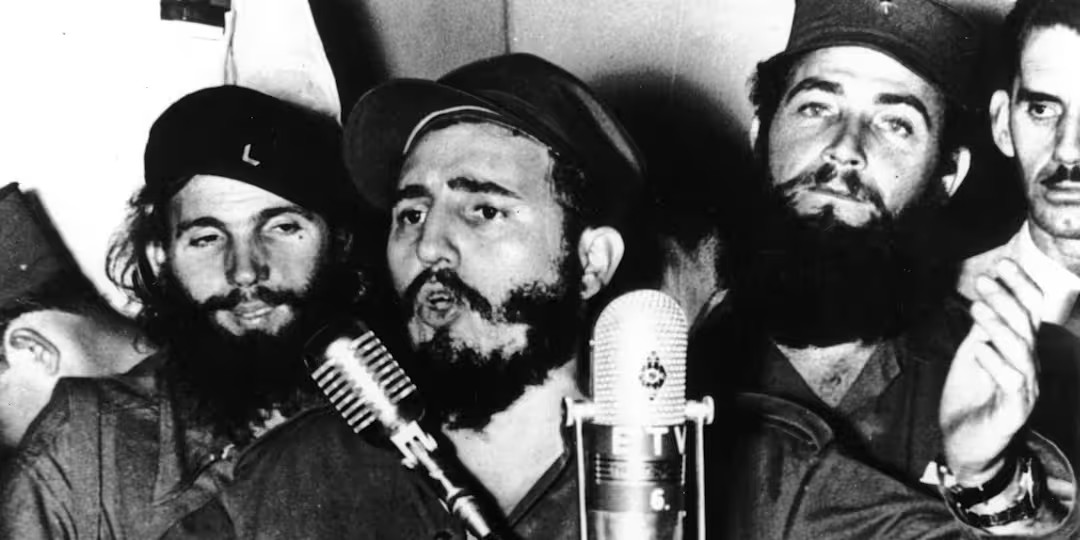
Castro grabs power upon Batista's flight out of Cuba
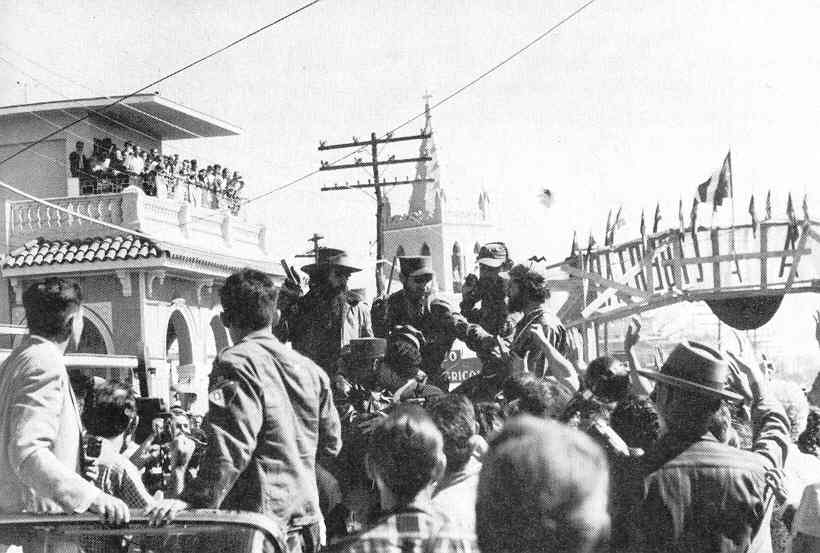
Castro hailed in Cienfuegos,
Cuba – January 8, 1959
after his overthrow
of the Batista dictatorship
Fidel Castro at the
podium – January 8, 1959
Then
when Eisenhower refused to lift the
weapons ban to Cuba, Castro (like Nasser before him) went to the
Soviets instead for arms, thus putting Cuba at the center of the Cold War. Consequently, Eisenhower ordered an end to the
purchase of Cuban sugar and sale of American oil to Cuba. Here too, the Soviets were quite happy to
make up the difference – drawing Cuba deeply into the Soviet economic order. Then when American oil refiners in Cuba
refused to service Soviet oil, Castro simply grabbed the oil
companies – and other key American industries located in Cuba.[2]
At
this point Eisenhower authorized the creation of
a liberation army made up of anti-Castro Cuban expatriates. And the CIA, at camps in Honduras and
Guatemala, began preparing these troops for an invasion of Cuba.
But Eisenhower finished his term in
office (January 1961) just a few months prior to the proposed launch date of
this invasion.
[2]Americans have a very hard time understanding that when we try to shut
down a society’s political system by cutting off our relations with that
country economically as well as politically, we simply give our enemies an opportunity
to rush in there and offer themselves as this country’s new ally. We have done this repeatedly – recently in
Syria, Iran and Venezuela – giving the Chinese and Russians (as well as the
Iranians themselves) an opportunity to extend their power bases into these same
countries.
Eisenhower was hoping to finish out his presidency with politics
in an upbeat mood – with improved Soviet-American relations pointing to a more
peaceful future. The Americans had been
permitted to put on an American National Exhibition in Moscow in July of 1959 –
and Vice President Nixon met Khrushchev there to discuss (the
famous Kitchen Debate) the differences between American and Soviet society –
all conducted in fair humor. A couple of
months later (September) Khrushchev returned the favor with a
two-week visit to the United States – to underline the policy of "peaceful
coexistence" that was supposed to mark the new international mood. And a much larger international conference
was even scheduled for mid-May in Paris of the next year (1960) to bring
America, Russia, England and France together – as a big step in the advancement
of world peace.
But
two weeks before the event, Khrushchev announced that an American
U-2 reconnaissance plane had just been shot down in a flight over the Soviet
Union. This very high-level flight was
not a new thing, as U-2 spy planes had been regularly overflying the Soviet
Union in an attempt to locate and analyze Soviet nuclear siting and
development. Thus why Soviet leader Khrushchev chose to shoot down one of
these planes just two weeks prior to the scheduled Paris summit remains a much
speculated on mystery. Was Khrushchev feeling himself under too
much pressure from Eisenhower to make deep concessions, or
from party regulars not to make any concessions in the arms race that the
Soviets apparently were winning?
In
any case, at the news of the downing, Eisenhower, who understood the damage
this would do to his summit hopes – but who also believed that the pilot and
his plane shot down at that height would not have survived the attack – claimed
that the plane was a weather plane that had inadvertently strayed off course, not
a spy plane.
However much to America's shock, the plane did not
disintegrate – and the pilot, who parachuted from the plane, was captured alive,
and paraded before the world as an example of American perfidy. Not
only did the event provide Khrushchev the opportunity to withdraw from
the Paris
4-powers summit meeting with Eisenhower, French President De Gaulle and
British Prime Minister Macmillan, but Eisenhower's attempt at a coverup
gave the Soviets the
opportunity to strike a huge propaganda blow against the United States
– and
the "liar" Eisenhower personally.

Go on to the next section:
 Miles
H. Hodges
Miles
H. Hodges

 Khrushchev ... and Soviet Russia's "New Look"
 The Hungarian and Suez Crises (October-November - 1956)
  Sputnik
  More crises in the Third World
  The U-2 incident