<


2. GETTING STARTED IN AMERICA

THE FOUNDING OF THE ENGLISH PROPRIETARY COLONIES


CONTENTS

Maryland

The Carolina Colony

New York and New Jersey

Pennsylvania

Georgia


The textual material on this webpage is drawn directly from my work
        America's Story – A Spiritual Journey © 2021, pages 62-68.

MARYLAND

At about the time New England was being settled for religious reasons, so was Maryland – except for the opposite reason in the religion category: as a refuge for Catholics wanting to escape Protestant England.

George 
Calvert (Lord Baltimore), a recent English convert to Catholicism, saw a double opportunity in securing land in America, both as a way to enrich his family fortunes and as a religious refuge for fellow Catholics.  In 1629 he petitioned Charles I for a tract of land in which to establish a settlement along the Chesapeake Bay just north of Virginia [he had given up on a similar venture in Newfoundland because it was simply too cold there!] – but died before a land grant was awarded him by the king.  His son Cecil then took over the project, receiving a royal charter in 1632 – despite the opposition of the Virginians who claimed the same land as part of their colony.

Calvert needed thousands of settlers to make the colony pay for itself, so he made settlement available also to English Protestants – at first mostly Church of England (non-
Puritan) "Anglicans" – who would actually outnumber the Catholics, even from the very beginning.  Thus Maryland was always officially a religiously tolerant colony, open to settlement by anyone, regardless of religious affiliation (Catholic, Anglican, ultimately Puritan, and eventually even Quaker).

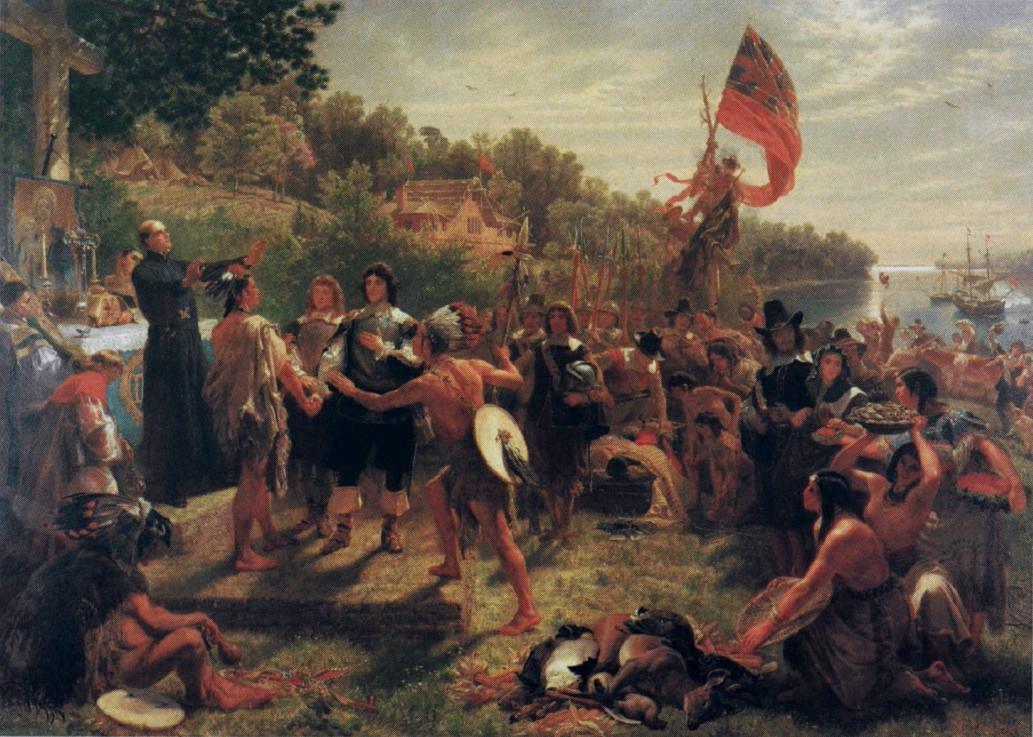
The venture, beginning with only a couple of hundred English settlers in 1634, started off smoothly, with no starving time or trouble with the local Indians.  In the area where the Marylanders first laid out a town (St. Mary's) the local Indians befriended them because they themselves were in need of allies against their own Indian enemies.  The Indians sold them the land they first settled and also corn to feed the colony.  And soon the rich Maryland soil had the Marylanders producing enough food to easily feed the colony

And Calvert was quick (1635) to grant his settlers a voice in colonial affairs with an assembly that operated much like the colonial assemblies of Virginia and New England.

Indeed, in most respects Maryland differed very little from its neighboring colony next door (Virginia).  Tobacco was the main crop, at first worked by indentured laborers – and then over time by slaves.  The colony was dominated by an aristocracy, set up from the outset by the Calverts, who gave large land grants to family members and fellow English gentry.  This, as in Virginia, created in Maryland a distinct upper class that stood socially far above the common dirt farmers who then came to Maryland as indentured workers.


THE CAROLINA COLONY

More proprietary colonies in America resulting from the Stuart Restoration.  The Restoration of the Stuart monarchy in 1660 – after the failure of the Puritan political experiment in England itself in the mid-1600s – was accompanied by shows of great gratitude by Charles II son of Charles I (the former who had been beheaded by the English Puritan army in 1649)  who simply paid his political debts, or just demonstrated the size of his gratitude, by awarding huge grants of land – full colonies actually – to various noblemen who had supported him during his exile and then his coming to the throne.  Berkeley, for instance, who had been dismissed as Virginia governor during the period of the English Puritan Commonwealth, was restored as Virginia's governor.  But there were more, many more, acts of royal gratitude.

The Carolina colony – and Shaftesbury as its cultural-spiritual leader.
 In 1663, soon after his coming to the throne, Charles II granted a group of English noblemen (which included also Berkeley) a huge section of land to the south of Virginia – in theory reaching all the way to Spanish Florida.  The land was termed "Carolina" in honor of Charles's father, Charles I (from the old Latin name from which Charles derives, Carolus).

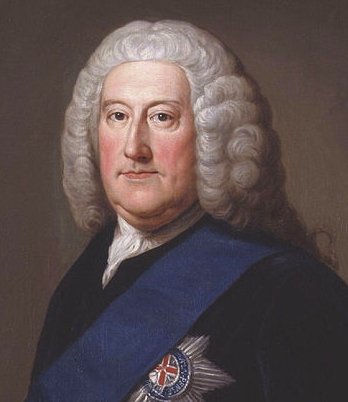
Taking the lead in this venture was another outstanding (and unusually virtuous – at a time when being virtuous could be politically very dangerous) Founding Father, Anthony Ashley Cooper, Earl of 
Shaftesbury.  Although nobly born, he was orphaned at an early age, but raised by relatives through the normal noble path, graduating from Oxford and becoming a lawyer and even (at age 18) Member of Parliament.  But he was of a cautious nature, rather realistic in his refusal to enter the intense ideological squabbles going on at the time.  Originally, he was a supporter of Charles I, until one of Charles's generals plundered a Puritan town that Cooper himself had negotiated peaceful surrender terms – shocking and grieving Cooper deeply – who at this point went into some kind of political retirement.  But Cromwell called him back to service as a member of his new Commonwealth's Council of State, where he trod cautiously the path between the contending sides, doing his best to keep the peace among the groups.  With Cromwell's death in 1568 Cooper was brought, now as "Lord Ashley," into the small group negotiating the return to the throne of the Stuarts – which brought him huge favor with King Charles II, membership on the king's Privy Council, eventually appointment as Chancellor of the Exchequer (Treasury, and second most important position on the king's cabinet), and ultimately selection as one of the proprietors of the Carolina colony.
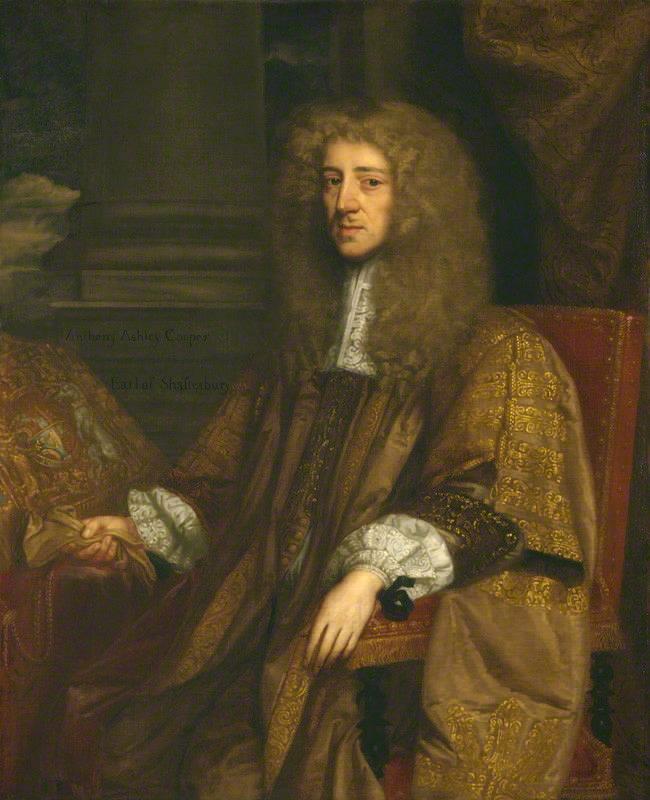
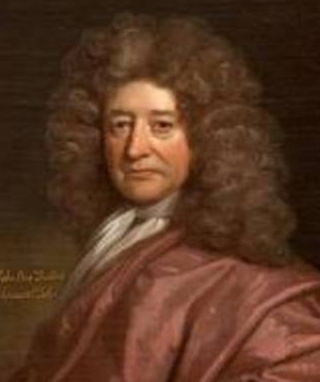
As the individual taking the lead in developing the Carolina colony so as to best serve its settlers, he enlisted the help of the famous English social philosopher and personal friend (and personal in-residence physician), John 
Locke.  He asked Locke to design a legal order for the colony, one that would make it a shining example of a society based on human reason rather than on just religious or political interests (the kinds that were tearing England apart at the time).
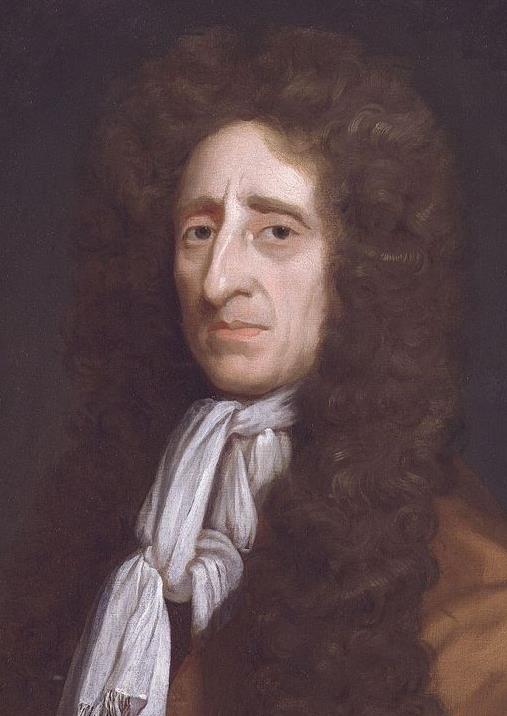
Remember, it was the second half of the 1600s and the time of the Enlightenment or "
Age of Reason," and "natural philosophers" supposed that they were coming into a full understanding of the precise mechanics of life.  Thus supposedly, with some careful investigation into the matter, they could actually construct a social system of a high degree of human perfection, while sitting at their desks simply contemplating the matter!  Thus it was that Locke mapped out a Carolina colony in which, among other things, individuals would receive a varying amount of property-rights on the basis of their social status – English philosophers such as Locke being certain that property ownership, as in feudal times, was the key to social stability and efficiency (which indeed, at least in part, it is!).

As it turned out, of course, 
Locke's design had to be scrapped when reality struck:  the varying lay of the land, the varying quality of the soil, and the problems of finding defense against highly resistant Indians, made for a reality which did not submit well to the beautiful plans of "enlightened" Idealism.<

As for 
Ashley (soon to be named as the Earl of Shaftesbury), he continued to find himself in the middle of a very bumpy political world, especially after he played a leading role in creating the Whig Party,[1] infuriating the arch-royalists – the Tories – in the process.  He would be arrested (1681), flee England (1682), and would die in Amsterdam early the following year, because this was one issue he simply could not find the path of political reconciliation to go down.

But as for the Carolina colony that he had given so much of himself to get started on solid ground, it did prosper.  The harbor at the Charleston site proved economically advantageous in its service to the rural hinterland – and individuals of all sorts of cultural background flocked there – including a good number of French Protestants (
Calvinist Huguenots) chased out of France when in 1685 King Louis XIV revoked the Edict of Nantes, the century-old promise of Protestant rights in France.

Thus Charleston became the South's first true city.


[1]Shaftesbury and his fellow Whigs precipitated the Exclusion Crisis when in 1679 they introduced into Parliament the Exclusion Bill, in the attempt to block the pro-Catholic James’s future accession to the English throne.  The Whigs were also demanding that royal authority be placed under the discipline of a written constitution, a shocking idea in the days of royal absolutism.  Opposing the Whigs were the Tories, supporters of James and defenders of the doctrine of royal absolutism.


NEW YORK AND NEW JERSEY

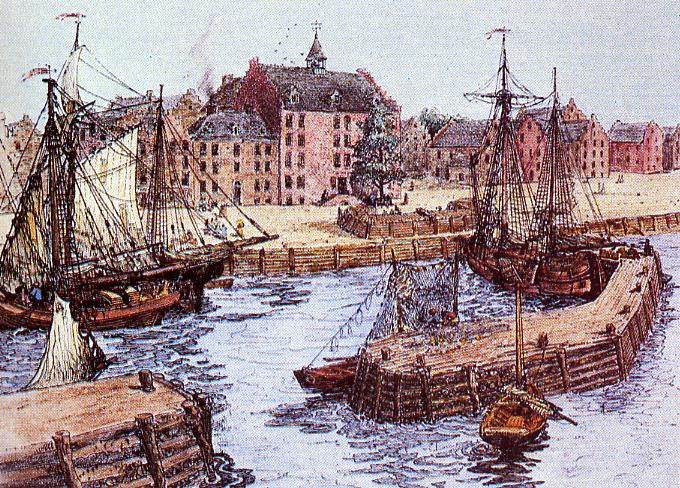
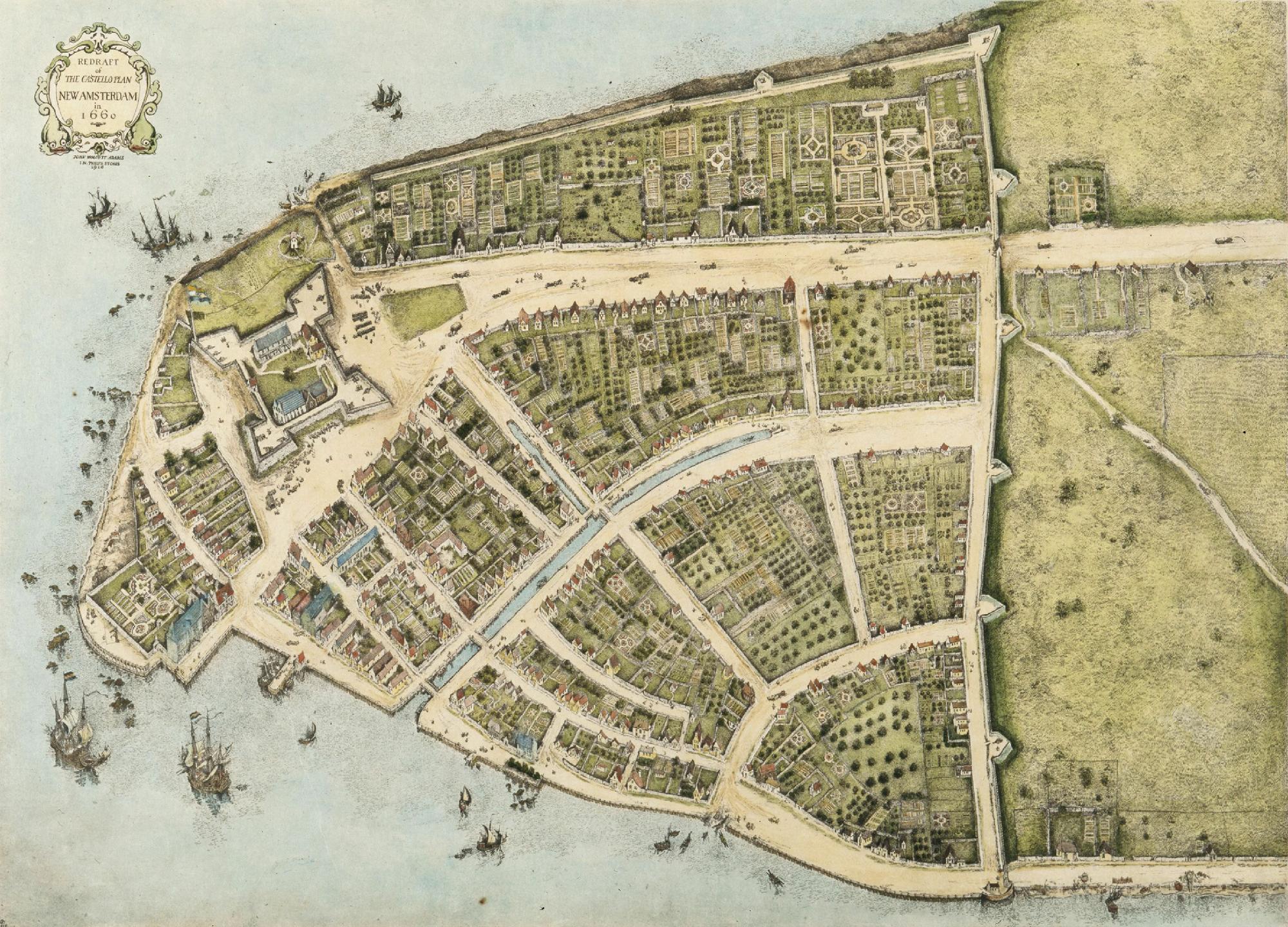
New York.  Another such proprietary colony awarded by Charles was New York – part of the former Dutch colony of New Netherland.  While the English had earlier been settling the areas of Virginia and New England, the area between these two English regions had been explored and settled in the 1620s by a Dutch commercial company which sent settlers north up the Hudson river and east across the Long Island to trade with the Indians for their wealth in fur – and to develop the region as Dutch territory.

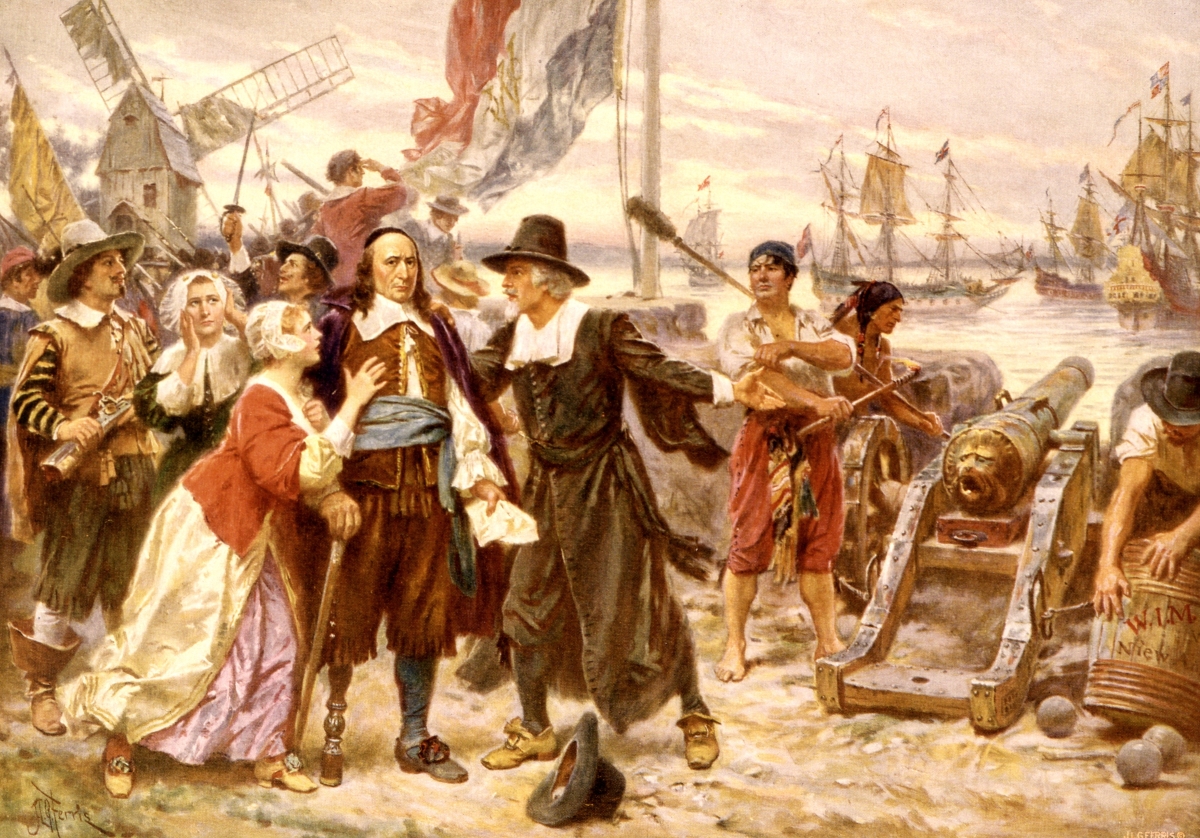
After the Stuart Restoration in 1660, the Dutch and English – though both Protestant – found themselves deeply engaged in commercial wars – and Charles II's brother 
James, Duke of York, headed the naval command that seized New Netherland from the Dutch in 1664.  For his services, Charles granted James proprietary rights to the Dutch colony – as his "New York."  However, during subsequent Anglo-Dutch wars, the Dutch colony changed hands between the English and Dutch several times.  Finally, in 1674, the colony came permanently into James's hands.

James never visited his American colony, but governed it through a series of appointed governors – and eventually (1683) an elected Assembly.  But by and large the New York colony, with strong Dutch Protestant roots and a variety of other ethnic and religious groups present in the colony, was quite diverse in its cultural makeup – giving the colony a very cosmopolitan character virtually from its founding.

New Jersey.   What came to be called New Jersey was also part of the Dutch territory awarded to James in 1664.  But he turned around and in 1665 awarded sections of this huge feudal estate to personal supporters of his own, George Carteret and Virginia Governor Berkeley's brother John (the Carterets were also involved in the development of the Carolina colony at that same time).  Ultimately William Penn also became part of the New Jersey project when Berkeley sold his shares to Penn, who was looking to provide a place of refuge for fellow Quakers (Penn was himself a recent convert to this new and quite unusual version of Christianity).  Quakers had come under considerable attack for their peculiar ways (thus the name "Quakers" – for their behavior when they became overcome by the Holy Spirit) – and like the Puritans of New England and Catholics of Maryland, they needed a place of refuge.[2]


[2]The Quaker movement was started up in the mid-1600s by an English shoemaker and shepherd, George Fox, who did not believe in original sin (nor the need for the atoning death of Jesus on the cross), but instead emphasized the divine favor awaiting any person who simply sought the “inner light” that God had placed in each and every person, letting that inner spirit lead that person to righteousness.  Clergy were unneeded in this process, only communal gatherings at which one or another person was moved to speak whenever led to do so by that inner spirit.

This approach to Christianity deeply upset many "normal" Christians, although interestingly 
Cromwell found himself sympathetic to and thus protective of the Quakers during the reign of his Commonwealth (the 1660s).  This was when Penn joined the group.  And in America, Providence colony leader Roger Williams accepted this group into his colony, where they soon came to make up half the population – the other half being mostly Baptists (Puritans opposed to the idea of infant baptism, because to the Baptists, baptism signified a quite adult decision to follow Christ).


PENNSYLVANIA

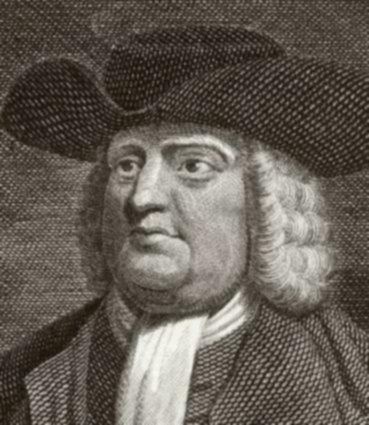
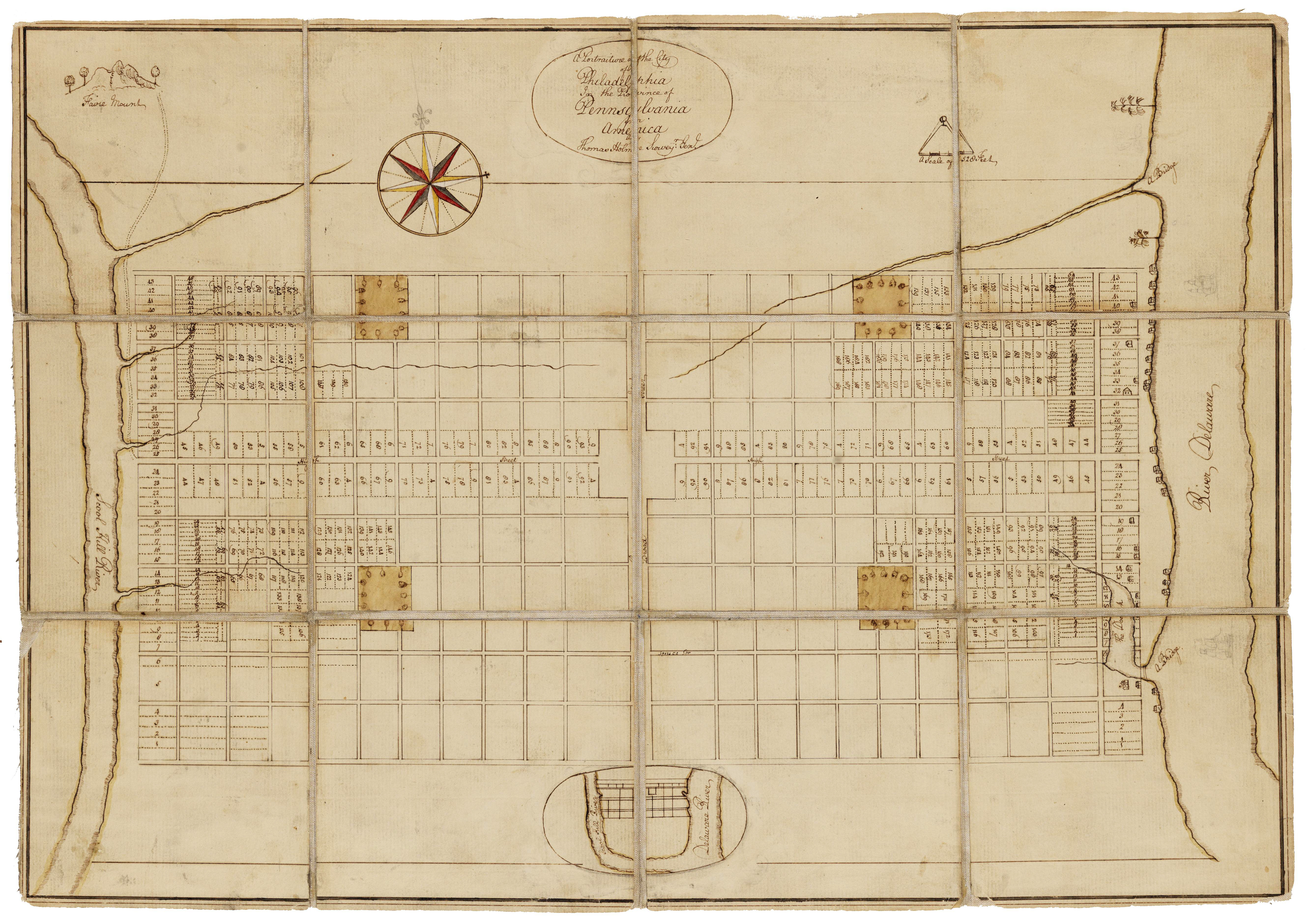
Pennsylvania ... and William Penn. The Penn family, besides having offered invaluable military support to Charles, had lent the Stuart kings a vast amount of money in getting the Stuart monarchy restored to power in 1660.  An agreement between King Charles II to pay off that debt was finally struck in 1681 when the king's brother James agreed to turn over to William Penn the vast lands west of New Jersey, a land the king himself named Pennsylvania ("Penn's Woods").  Here Penn could expand his Quaker refuge – and build an ideal city, Philadelphia, the city of "Brotherly Love."

However, Quakers were immediately outnumbered by other religious groups (Mennonites, Amish, Puritans, Presbyterians, Catholics, Jews, etc.).  But thus it was that Pennsylvania grew as a land offering religious freedom and the opportunity for people to build their own communities as they so desired.

Behind this spiritually welcoming society was the personal sensitivity of the colony's founder, William 
Penn.  As a youth Penn had shown a rather strong philosophical bent, rather than an ambition to perform great military service, of which the family was highly respected (his father was a leading admiral in the royal navy, and also one of the key agents arranging for Charles's return to the throne).  But the young Penn had a heart for serving instead the poor, especially those devastated by the return of the Plague in 1665 and the Great Fire of the following year which destroyed most of London, increasing enormously the misery of the poor.  This had led Penn to associate himself with the Quakers, who were offering help to exactly those devastated by these tragedies, bringing upon himself an eight-month prison sentence for his Quaker connections (the first of many such prison terms), despite his family's own prominence.

But two things were to keep Penn's spirits up, despite the considerable political opposition his work brought him.   On his deathbed, 
Penn's father acknowledged the remarkable integrity of his son, and told him never to betray what his conscience knew to be true.  And secondly, at this point Penn came into enormous wealth, which Penn then put to use to promote the Quaker cause, and thus his involvement in Quaker settlement in the American colonies.

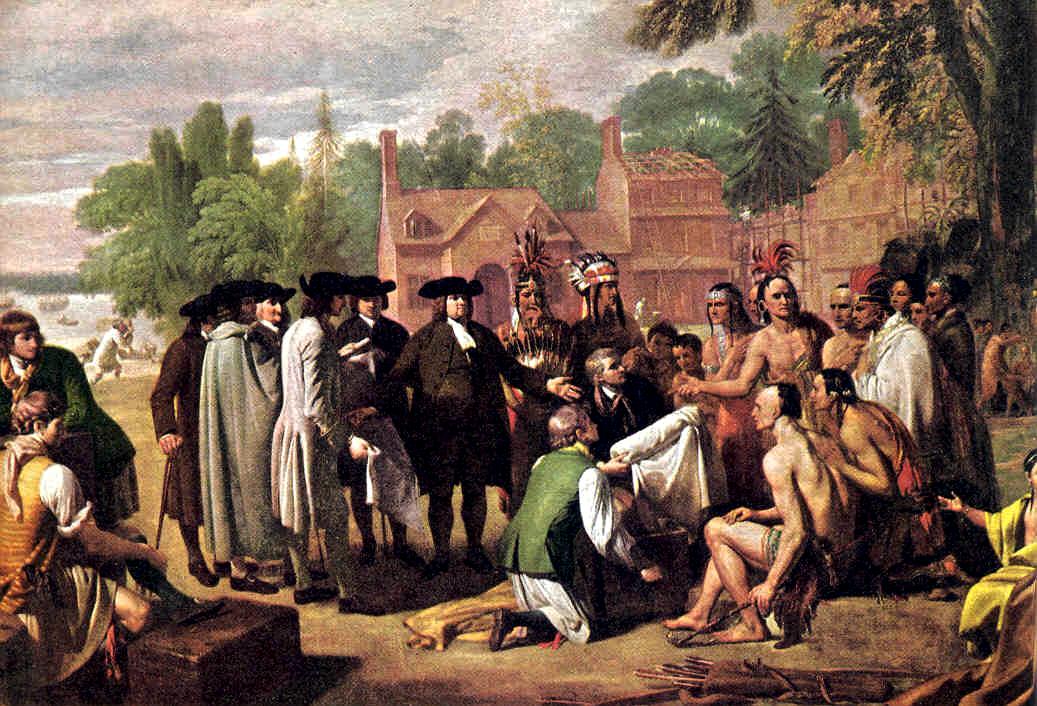
Penn would be one of the few colonial backers to actually come to his colonial holding in America to personally supervise its development, everything from the layout of his precious Philadelphia (built on a grid pattern at the junction of the Schuylkill and Delaware Rivers) to the political order (the Pennsylvania Frame of Government) which would guide the colony down its welcoming path.  And he was generous in his offer of financial compensation to the Indians for the land, blessing his colony with peace with the Indians as a result.

But sadly, the colony would not become exactly the utopia Penn had hoped for, as the Quakers could not agree among themselves as to what their religion constituted exactly, and their rivalries ultimately disrupted greatly the 
Quaker order Penn was trying to achieve.  And tragically for the kindly and idealistic William Penn himself, his Pennsylvania proprietorship bankrupted rather than rewarded him financially – largely because he did not have the heart to collect the quitrent owed him by his Pennsylvania tenants, and because his unsuspicious nature blinded him to the fact that his business manager was stealing Penn's earnings.  This would cost him time in debtor's prison on multiple occasions, and leave him penniless at his death in 1718 – Penn believing that his venture had been a huge failure.

Equally sadly, he would die not knowing how well his Philadelphia would serve as something of a national spiritual capital, uniting the various American colonies during the dark days (1770s and 1780s) of their struggle to maintain their independence from an overbearing English king.  Nor would he know how America would quickly come to honor greatly the integrity in 
Penn that the country has long understood as the very groundwork of its own existence – and its larger purpose in the world.

Thus it was that Penn's colonial venture contributed greatly to the growing notion that America was a land not of government restriction and social-cultural conformity, but of true opportunity for those willing to come and work hard to build their own world – in full cooperation with others of different political and religious ideals.  So he too helped greatly to make America a "City on a Hill," a "Light to the Nations."


GEORGIA

Georgia – the last of the major English colonies in America.  Georgia, named after England's King George II, was founded in 1732 as a proprietary colony assigned to a group of English philanthropists.  Most important among them was General James Oglethorpe, who personally had taken an interest in England's prisons and sought a colony in America that offered debtors a chance to leave prison in order to start a new life and come out of debt.  It would also serve as a military colony buffering the Carolinas from Spanish Florida.

Actually very few debtors made their way to the colony – although others came there for numerous reasons, including religious reasons (Georgia too took a very non-restrictive view on this matter of a person's religion).

However Georgia would also follow the Southern trend to build its society on the Virginia model – idealizing the lifestyle of huge rural plantations cultivating tobacco (and other farm products) by companies of African slaves, the whole thing presided over by a small, but highly privileged local aristocracy.

Yet the colony did provide the South its second city after Charleston, an Atlantic port named Savannah – located at the mouth of the Savannah River and well laid out on a beautiful grid pattern.


Go on to the next section:  Independence – and The New Republic


  Miles H. Hodges