<
7. AMERICA ENTERS THE WORLD STAGE

AMERICA ENTERS WORLD WAR ONE AS THE CHAMPION OF DEMOCRACY
CONTENTS
 Wilson – the autocratic individual
 1914 – War breaks out in Europe
 War – and stalemate – on the Western Front
 The collapse of Russia on the Eastern Front (1917)
 America jumps in (1917)
 The Russian-German Armistice
 Wilson's 14 Points
 The Germans now are forced into a deep retreat
 The air war
 "Peace" (1918)
The 1918 Spanish Flu
The textual material on this webpage is drawn directly from my work
America's Story – A Spiritual Journey © 2021, pages 209-219.
|
| WILSON – THE AUTOCRATIC INDIVIDUAL |
Then with the election of Woodrow Wilson in 1912, America was to head
even more deeply into the realm that glorified democracy, as virtually a civic
religion.
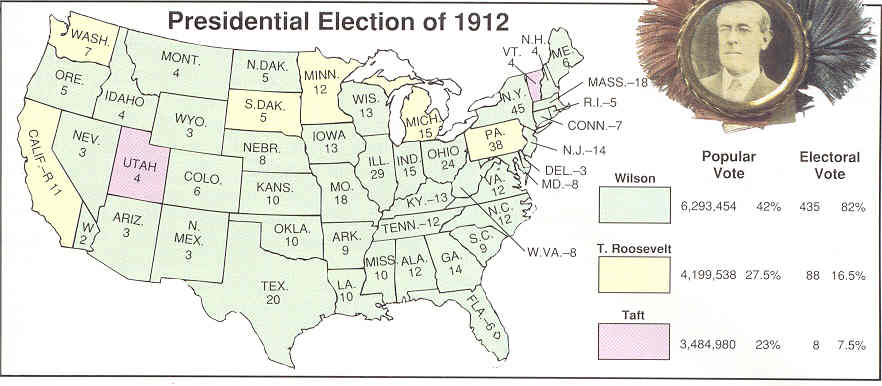
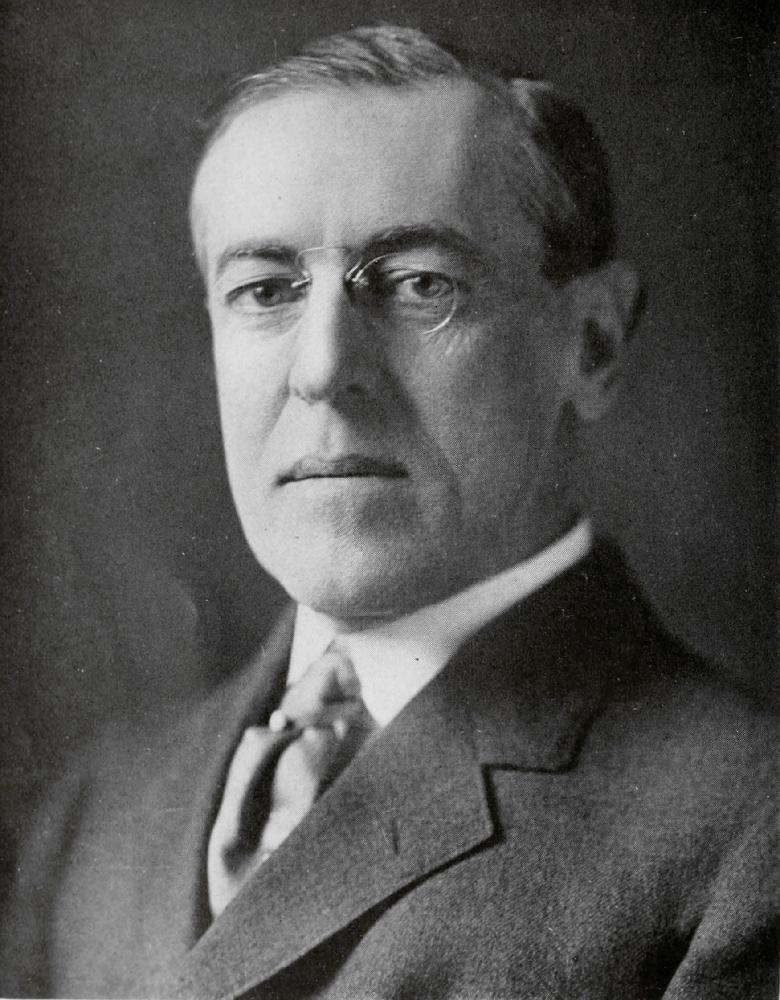
Woodrow Wilson was Southern-born (1856),
growing up in an aristocratic and originally slave-holding clerical family
headed by a father who was a co-founder and ultimately administrator of the
Southern breakaway branch of the Presbyterian denomination. As a youth, Wilson was sent north to Princeton (still largely Presbyterian in character at the
time) and after graduating from Princeton (1879) studied for the
doctorate at Johns Hopkins University (1886), went
on eventually to be a Princeton professor (1890) – and
ultimately the university's president (1902-1910).
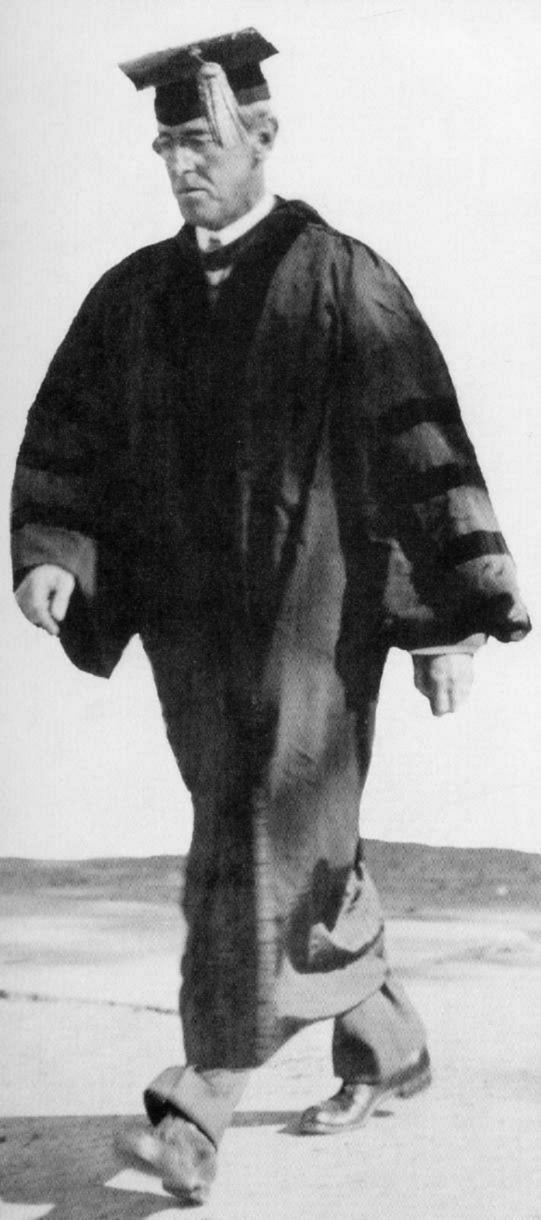
Woodrow Wilson as
President
of Princeton University – (1902-1910)
However, his autocratic (dictatorial) ways
did not sit well with the other Princeton professors – who resented
deeply his high-handed running of the university. Eventually, Wilson decided to move on to the
world of politics – when in 1910 the bosses of New Jersey invited him to run
for governor (believing that they could then control this idealistic
intellectual for their own purposes).
But in Wilson's gaining the governorship, the New Jersey bosses found
themselves up against a very determined individual – who quickly began to clean
house and rid New Jersey of some of its political corruption.
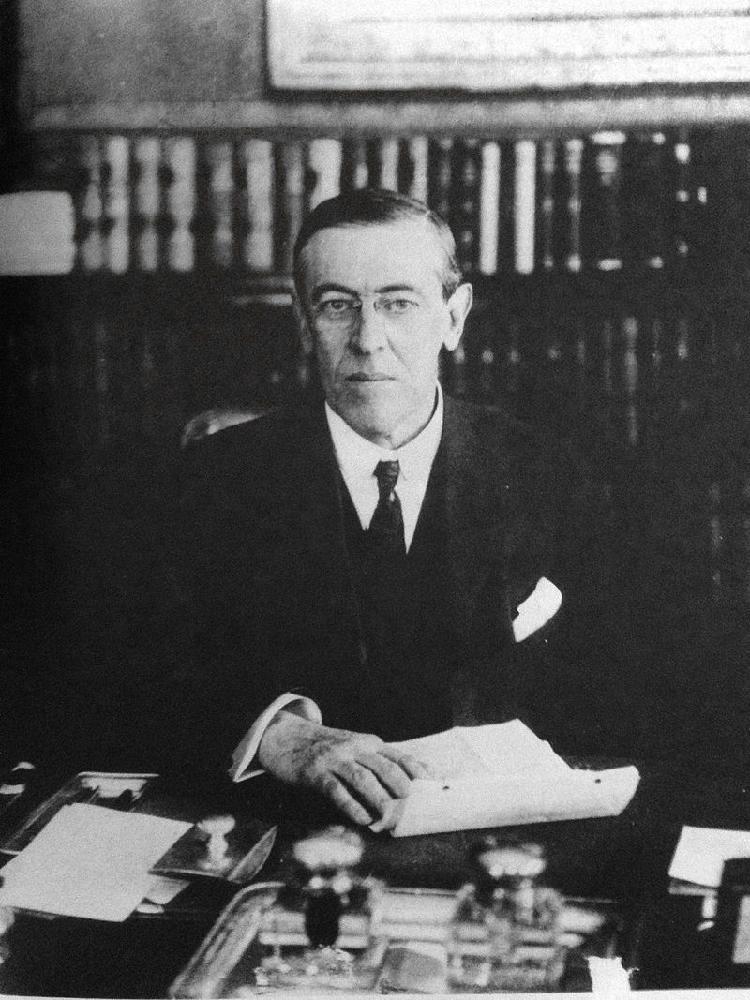
Wilson as New Jersey
Governor
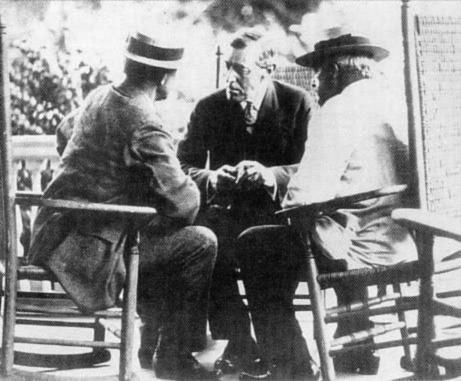
Woodrow Wilson, Governor
of New Jersey (1911-1913)
meeting at his mansion in
Sea Girt
This is what got the attention of the
Democratic Party, which decided that it needed to steal the Republican Party
thunder by appearing to be more Progressive themselves. Thus Wilson got the 1912 Democratic Party
nomination – and because of Roosevelt's third-party involvement, thus also the
U.S. Presidency.
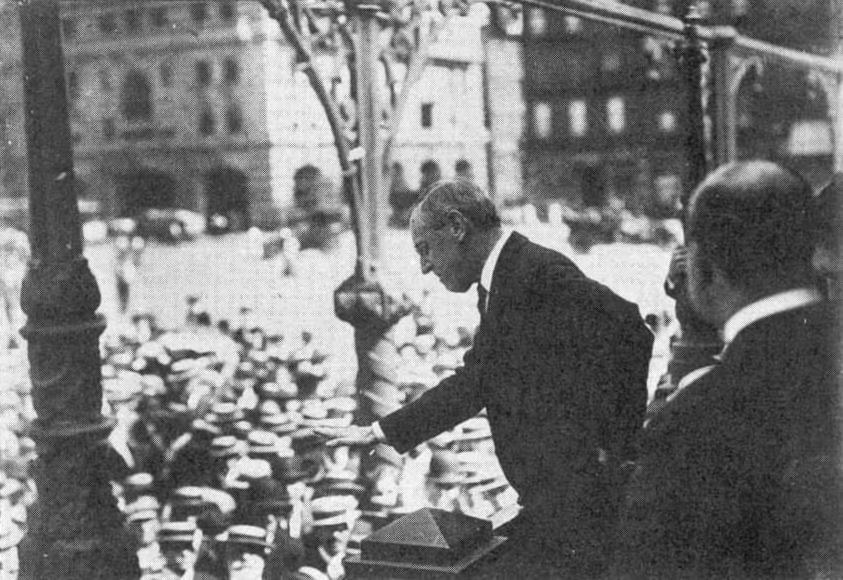
Woodrow Wilson on the presidential campaign
trail
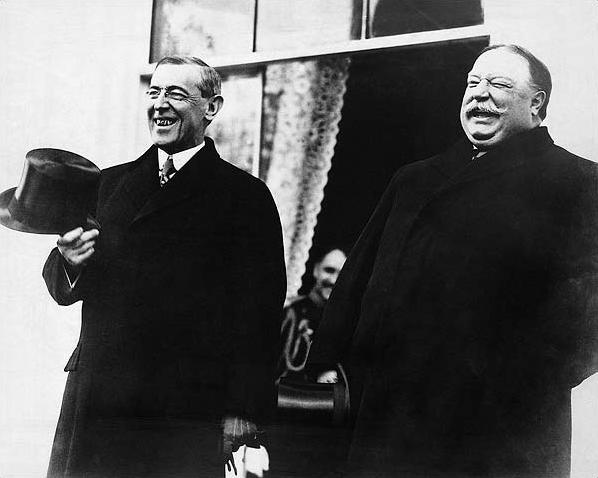
Wilson and Taft on Wilson's
inauguration day (March 1913)

Wilson and his
cabinet
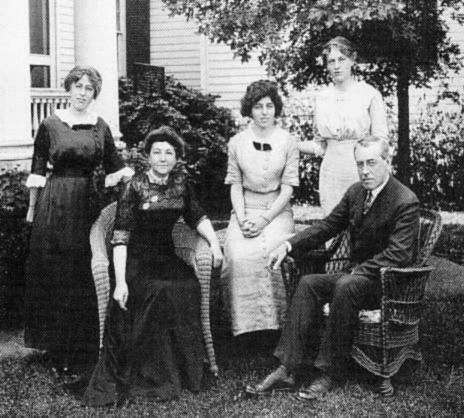
Wilson and his family
(his wife of 29 years, Ellen
Louise Axson, died in August of 1914
while he was serving as US
President)
Wilson's autocratic Humanism
dressed up as democracy. Wilson's autocratic style was well illustrated by his
doctoral dissertation[1] and his
several textbooks he published – which advocated for a stronger central
authority presiding over the nation's affairs (he preferred the more
centralized British Parliamentary model over the U.S. separation-of-powers
model) – believing that social-political reform could take place more quickly
and more efficiently under a strong hand at the head of society – certain that
this was always the best way to serve democracy – thus democracy supervised by
society's "betters" – rather than by the people themselves. This was a view that many Progressive
intellectuals were beginning to take at the time, including Lenin, the future Communist leader of Soviet Russia.
[1]He thoroughly disliked the idea of checks and balances on federal
power. In his dissertation he described
the checks and balances system as …” manifestly a radical defect in our
federal system that it parcels out power and confuses responsibility as it
does. The main purpose of the Convention of 1787 seems to have been to
accomplish this grievous mistake. The ‘literary theory’ of checks and balances
is simply a consistent account of what our Constitution makers tried to do; and
those checks and balances have proved mischievous just to the extent which they
have succeeded in establishing themselves.
| 1914 – WAR BREAKS OUT IN EUROPE |
Meanwhile, by 1914, things were growing darker in Europe, looking
with each passing month as if the continent were headed for nationalist war –
something that America wanted to have no part of. But true neutrality in the face of European
events would prove to be almost impossible for America to maintain.
Conflicting nationalisms. The problem began as a
conflict of budding nationalisms arising from the hearts of European commoners
who wanted a "place in the sun" for their own people – a voice in
their destiny, something just recently coming to the common people as politics
began to open up from being just the affairs of the aristocratic upper classes
of Europe – to the common people themselves.
Consequently, in 1860 the peoples of the Italian peninsula finally got
an Italian state and government of their own – as did Germany, ten years later
(1870). But other national groups began
to demand a similar development of their own nations: Greeks, Bulgarians,
Serbs, Czechs, Moravians, Poles, Hungarians, etc. But national boundaries really were not clear
(people lived mixed among other people groups) – and ethnic groups found
themselves disputing each other over territorial rights. Also, the empires that many of them lived
under were themselves multinational (such as the empires of the Ottoman Turks,
the Russian Romanovs and the Habsburg Austro-Hungarians) – and in no hurry to
see their subject peoples attain national independence.
The imperialist urge. Then there was the matter
of the imperial late-comers (Italy and Germany) who wanted themselves to get
into the imperialist game, only to find that the Spanish, English, French,
Dutch, and Portuguese got to most of the world ahead of them. There was not much left to build their own
imperial greatness on – mostly just pieces of Africa. When Germany tried to grab Morocco, not once
(1906) but twice (1913), the Germans came up against the opposition of the
English, French and Spanish. They almost
came to blows over this.
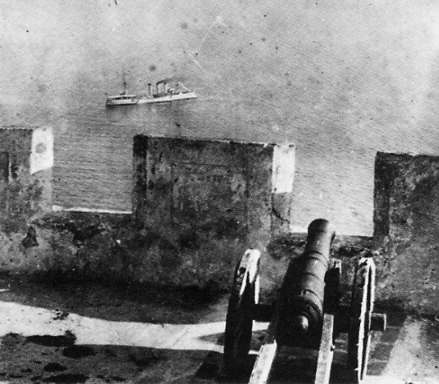
The battlements at Agadir
Morocco - with a German gunboat
Panther in the harbor (July
1911)
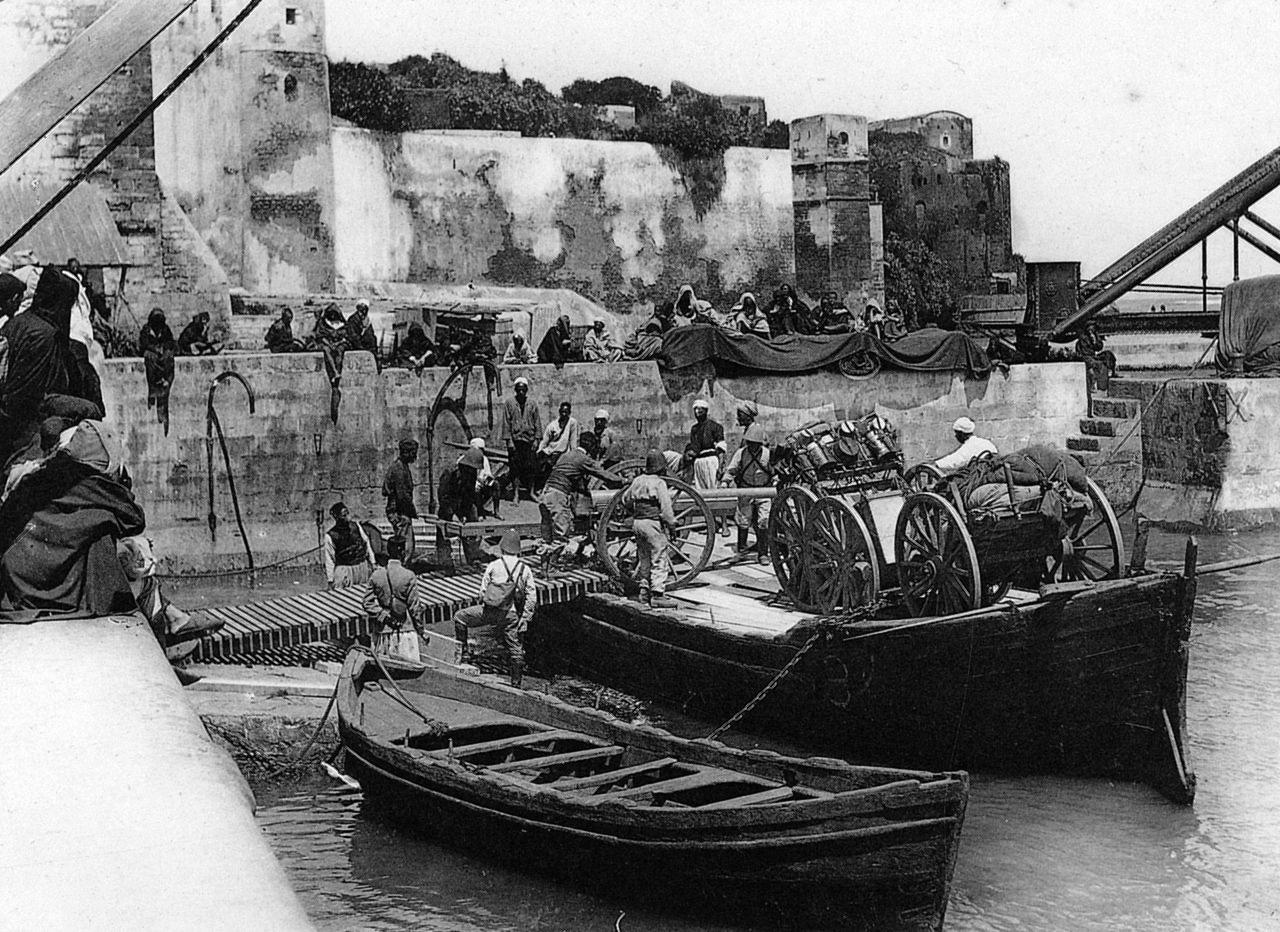
Loading of French artillery
at Rabat, Morocco - 1911
Grébert, photographer,
Casablanca Meanwhile
Austria-Hungary, which had lost to Prussia the battle to head up the German
nation, was looking for more territory in the direction of the Balkan
peninsula, where Turkish power was slipping rapidly – but where local
nationalist impulses already had the Greeks, Bulgarians and Serbs fighting over
the region.
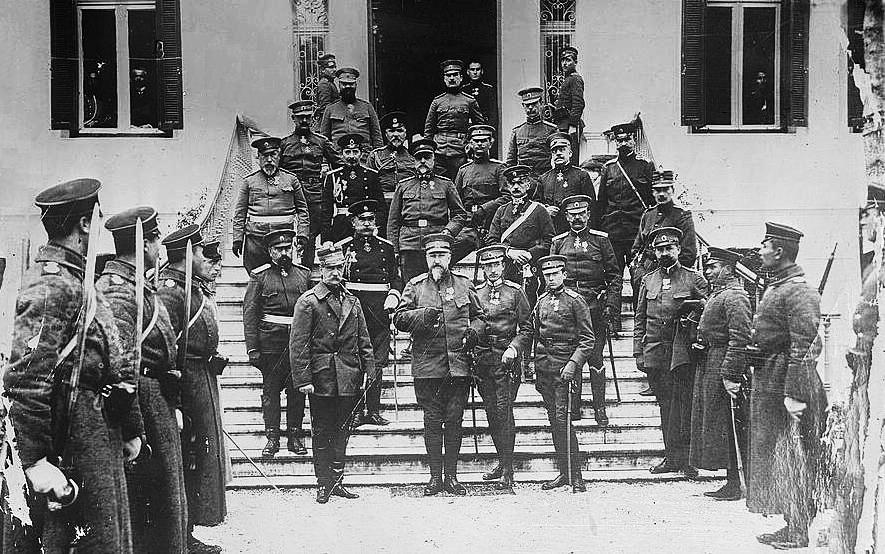
King George I of Greece visits
the Bulgarian Tsar Ferdinand
in the headquarters of the Bulgarian army in the city of
Thessaloniki
during the latter's visit there during the
First Balkan War (December 1912).
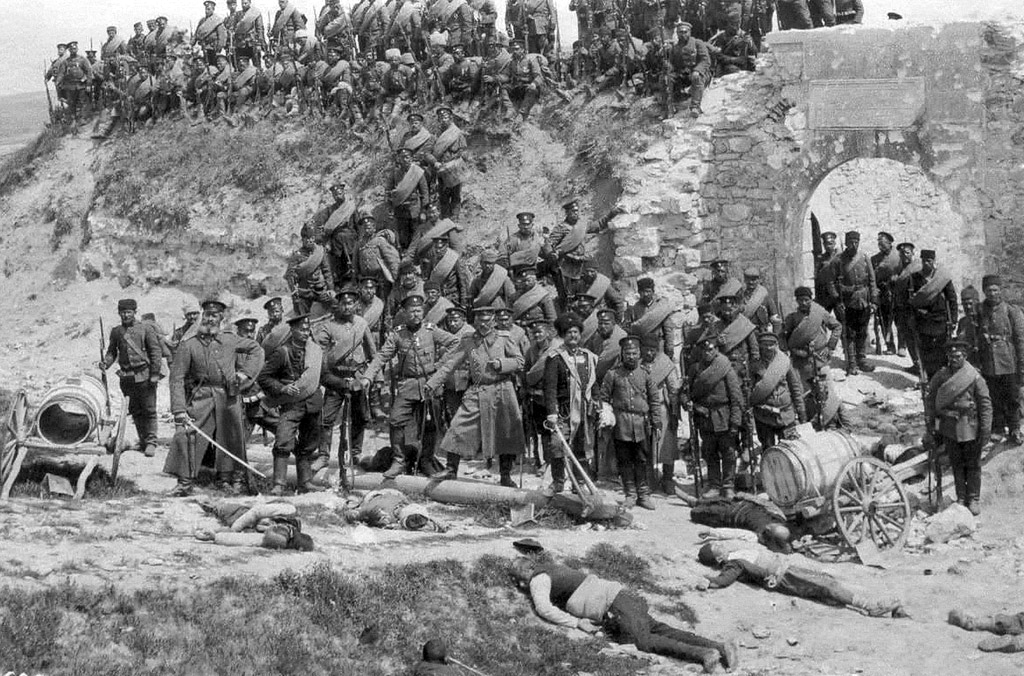
March 1913 - Bulgarian soldiers
(and Turkish dead)
at the Awaz Baba Fort outside Adrianople (Edirne)
Treaties – and more treaties. Imperial
jealousies had inspired the Russians to offer the Slavic-speaking nations of
the Balkans (notably Serbia) protection if culturally-Germanic Austria-Hungary
should make a move on them. But
Austria-Hungary had countered this arrangement with an arrangement of its own
with the new Germany, which promised German aid if Austria-Hungary should come
into conflict with Slavic Russia.
France, still smarting from the loss of territory to Germany in the
Franco-Prussian War (the war in 1870 that marched the many German states into
unity behind the leadership of Prussia), was looking for revenge – and decided
to ally with the Russians against the Germans.
Then there were the British, normally neutral in such matters – usually
waiting to see which of the continental powers was on the rise – and then
swinging support to the weaker side in order to balance and contain the growth
of a rising power in Europe. But they
had actually begun to side closely with France as the problems with Germany
seemed to grow more threatening.
America stays out. Meanwhile, America stayed far
away from all this political intrigue.
America had its own hands full dealing with problems that had arisen
along the border with Mexico. Mexico was
going through another of its revolutions and had fallen into political
chaos. America's small army under
General Pershing was trying to keep the chaos (and Mexican border raiders) from
reaching into U.S. territory.
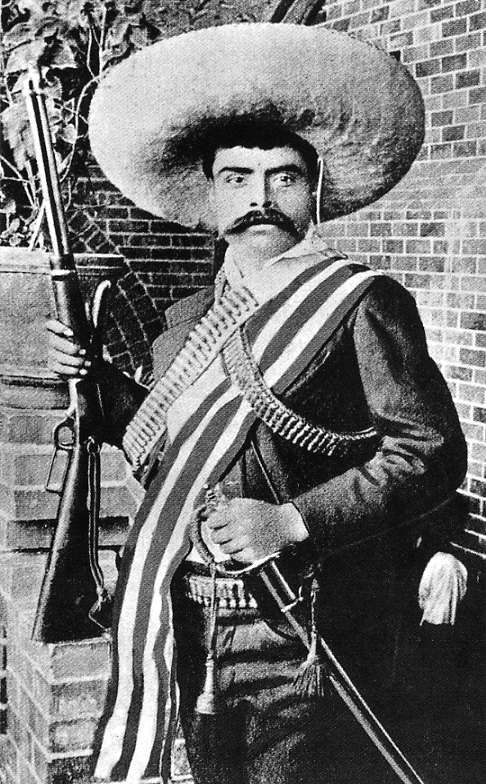
Emiliano Zapata – rebel leader
who took on the wealthy
landed gentry of
Mexico
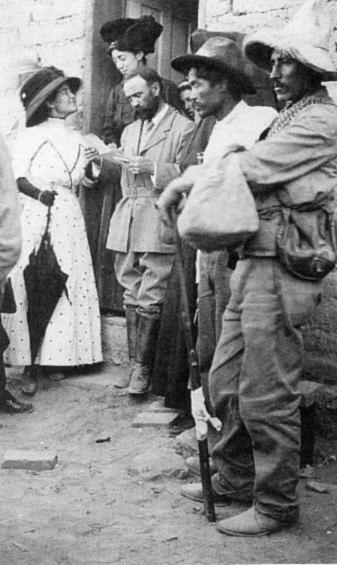
Mexican President Francisco
Madero
The first democratically
elected leader (1911) in Mexico's history.
He is announcing a plan
to transfer the wealth of Mexico
from the wealthy aristocrats
and foreigners to the Mexican
people themselves.
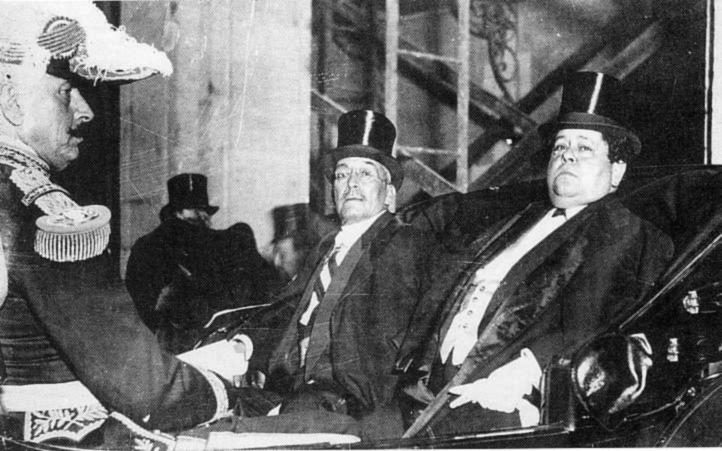
General Victoriano Huerta
(center) in early 1913
overthrew the Madero government
(murdering Madero
in the process).
Augustin Victor Casasola
/ Casasola Archive, Instituto
Nacional de Antropologia e Historia, Mexico
City
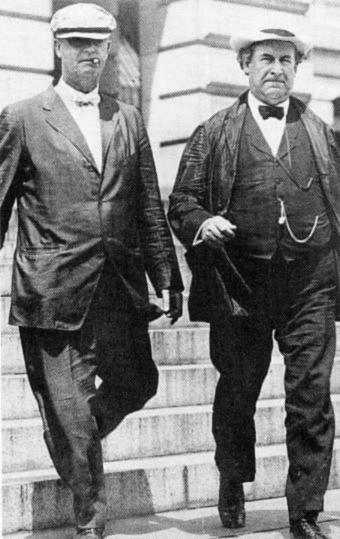
Wilson's Secretary of State,
William Jennings
Bryan (and bodyguard)
Harry Ransom Research Center,
The University of Texas at Austin
Bryan supported Wilson's idea of
forcing the Mexican
dictator Huerta out of office (a large expeditionary force
of U.S. troops landed at Veracruz in 1914 and achieved
Huerta's resignation); a year later when ranking
members
of the U.S. State Department plotted to overthrow the
new Carranza
government – and put Huerta back into
office – Bryan moved to bloc the plot.
Huerta was
seized at the Mexican border and imprisoned in Texas.
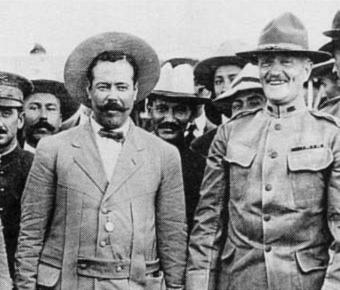
Pancho Villa and US General
John Pershing
in happier days – 1914

Pancho Villa and his rebel
army on a raid
along US-Mexican border – 1916

Headquarters of the
American forces in Colonia Dublan, Mexico.
General Pershing with his
aide Lt. Collins – 1916
photo by William Fox.

"En route with the American
Field Headquarters from El Valle
to Las Cruces, Mexico, April 10,1916. Company A,
6th Infantry,
in emergency trench which has been prepared at its camp
for Attack by
Mexicans." – photo by William Fox.
Presumably, America, under Wilson's leadership, has no intention
in getting involved in the grand disaster going on in Europe

Woodrow Wilson campaigns
for re-election in 1916
in part on the theme that he "Keeps Us Out of War"

Wilson's Re-election
Department of the
Interior
| WAR – AND STALEMATE – ON THE WESTERN FRONT |
Finally Europe moved to full-scale war when the incident of the
assassination of the heir to the Austrian-Hungarian throne in a visit to Serbia
failed to achieve diplomatic resolution – and the European powers finally
mobilized for war at the beginning of August (1914).

Austrian
Archduke Francis
Ferdinand and his wife Sophie just
before their
assassination during a visit to Serbia – June 28, 1914
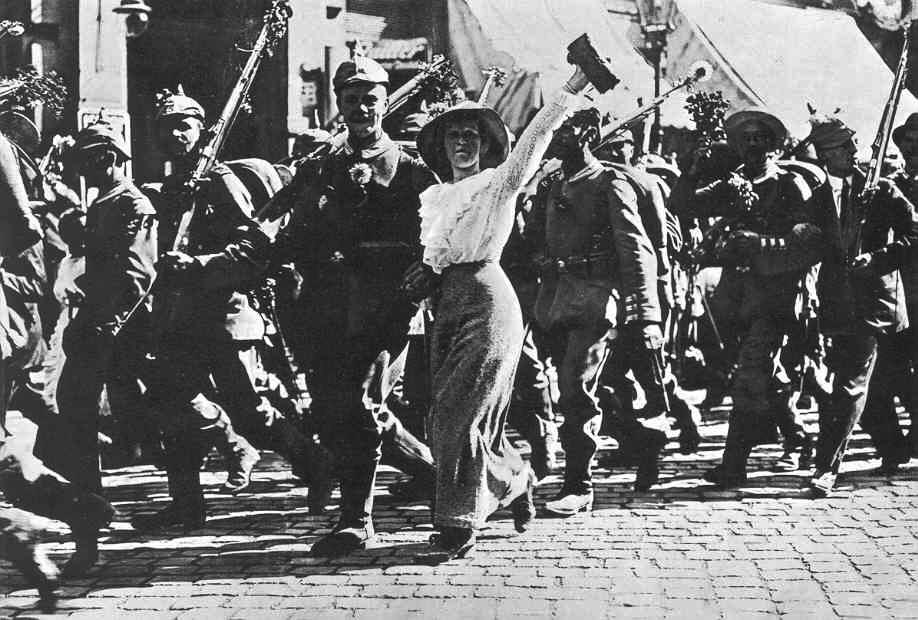
Berliners
"off to
Paris" – August 1914

von
Hotzendorf Inspects Austrian
troops
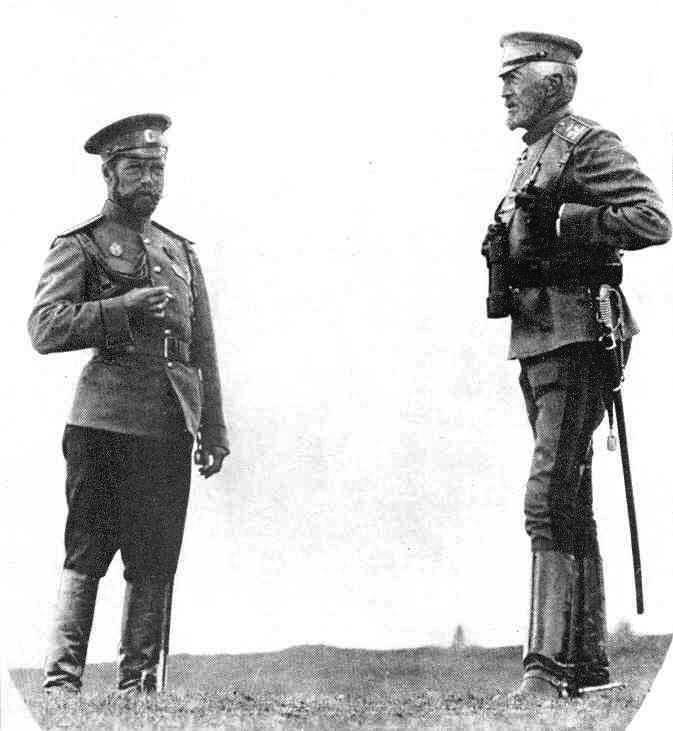
Russian Czar Nicholas
II and
the
Grand Duke Nicholas

Englishmen
lining up to join
the British military

Wartime allies: French General
Joffre, French President
Poincare, British King George
V, French General
Foch,
and
British General Haig
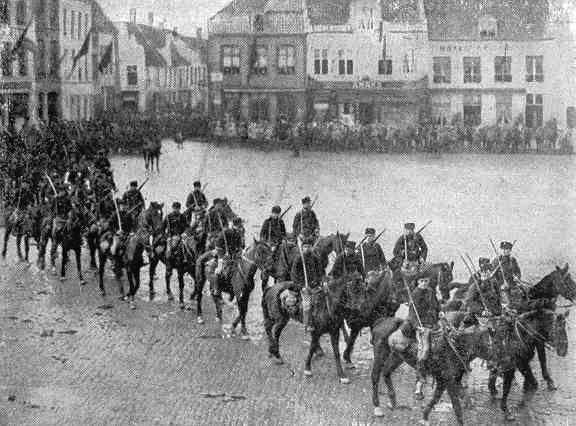
Belgian
Cavalry to the front

Belgian
refugees heading
to Brussels
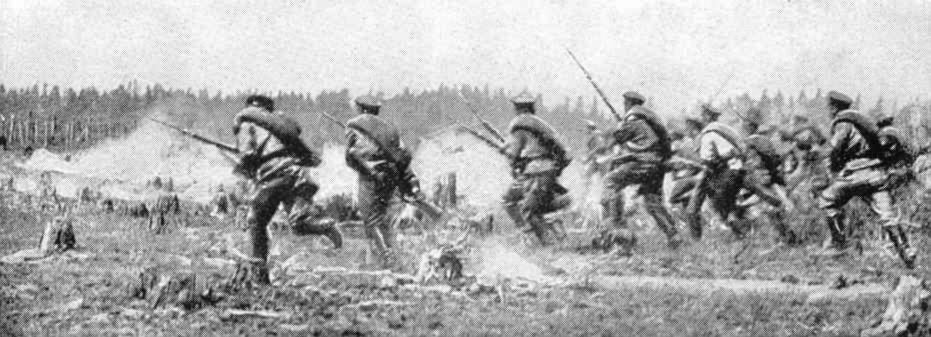
Russians charging German
positions on the Eastern Front
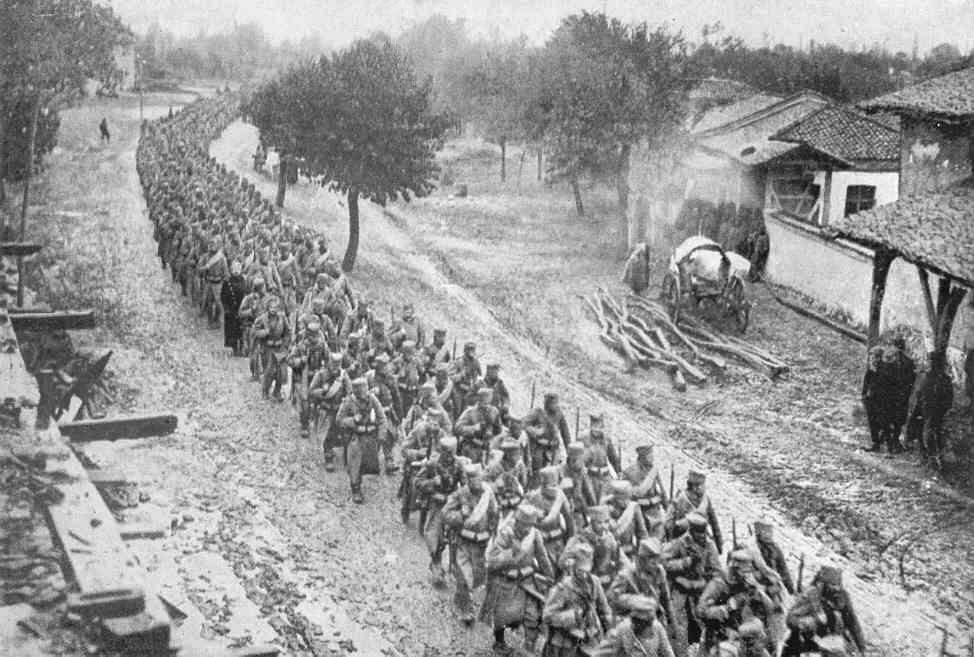
Serbian troops moving to the front against the Austro-Hungarians
But within a month, those that had happily joined the
nationalist cause, expecting to find glory at the finish of a brief conflict,
began to realize that this might be a war without any obvious outcome – much
less possible victory (France lost over 200,000 men in the first month of the
war alone).
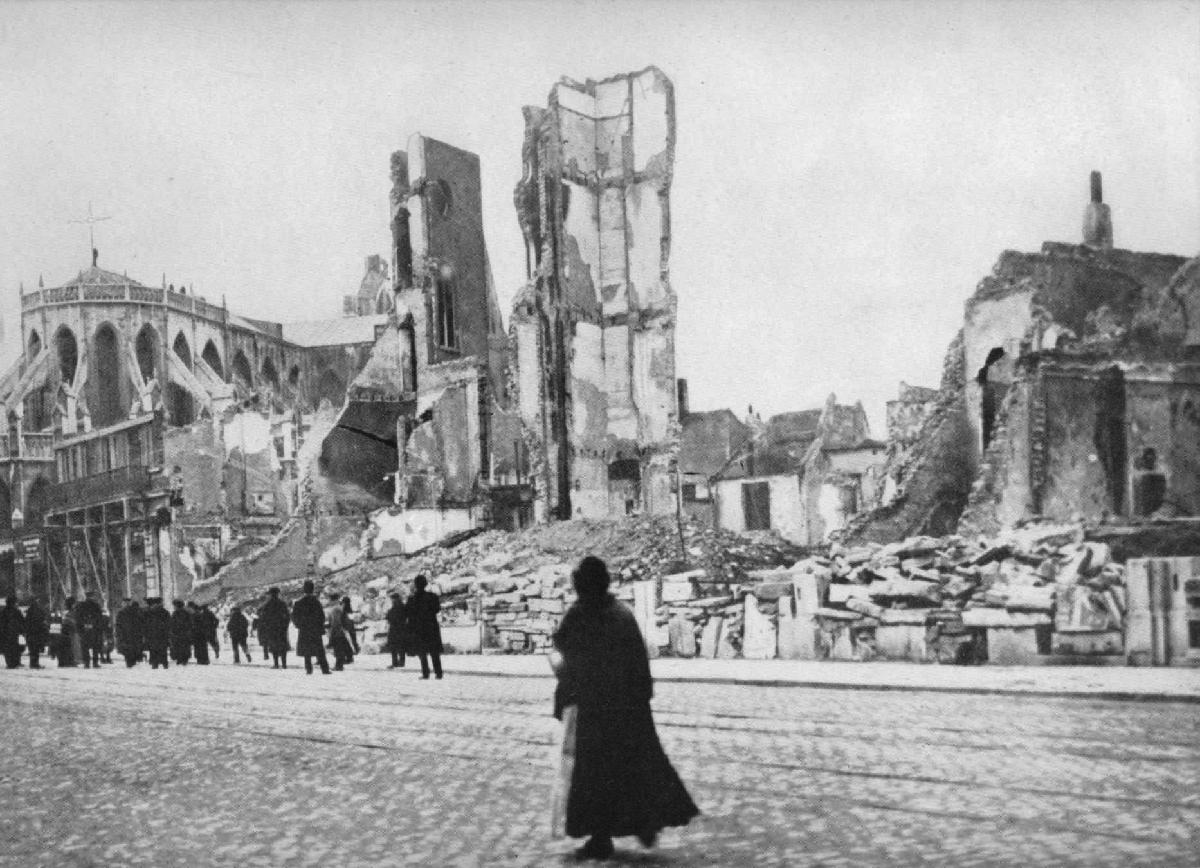 Ancient Louvain, destroyed
by the Germans in August 1914
in retaliation for civilian resistance to the German occupation

Ortelsburg,
East
Prussia – burned by the Russians in 1914

Destruction of Rheims, France,
by German bombardment –
beginning on September 18,
1914

More
Frenchmen to the front – October 1914
By October, 2 months into this war,
the glamor of war is gone.
The peasants don't even
look up from their work
as the soldiers go by.A stalemate resulted – caused by well-imbedded trenches – and
machine guns and barbed wire to defend those trenches – and artillery to empty
enemy trenches of human life (until new recruits could be brought in to replace
those slaughtered there). The war was
headed nowhere – except to the slaughter of hundreds of thousands – then
millions – of young European males. And
this would continue almost unchanged for the next four years – at least on the
Western Front running across Northern France and Western Belgium.

The
medieval Cloth Hall at Ypres beginning to be shelled
by the Germans in November
1914

"View of Ypres: Photograph
taken from a flying machine"

Austrian
troops executing
Serbian prisoners of war (POWs)
But the worst of all is
life in the Western trenches that get dug in
as the lines of war stalemate
into a permanent line
of slaughter ...
lines that will
barely move 10 miles either way despite massive
amounts of soldiers ordered to the deaths in order to move
those
lines

A
typical
French trench scene – 1916

British
troops head "over
the top"
for a skirmish with their German counterparts

A
British
infantryman hit
during a gas attack – Ypres, April 2, 1915

French
officer
machine gunned
down
in a counterattack at Verdun – 1916

A failed French attack upon
a German position
in Champagne – 1917
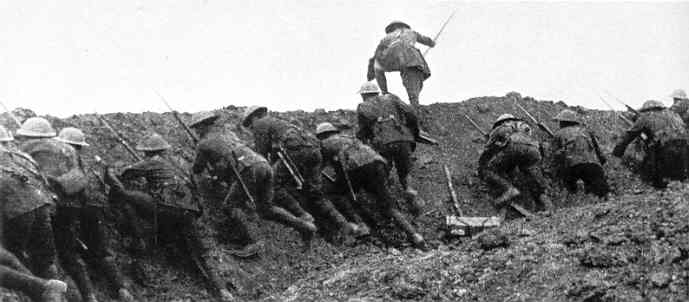
The British assault caught
on film ...
soldiers headed off to their death.
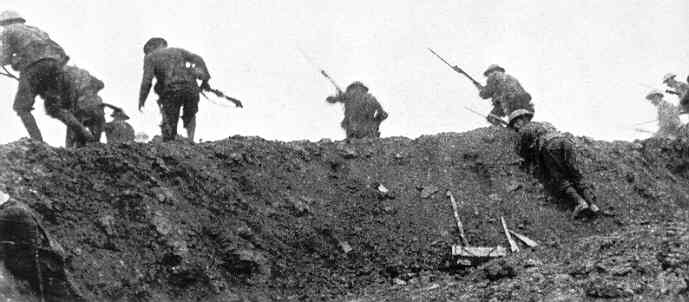
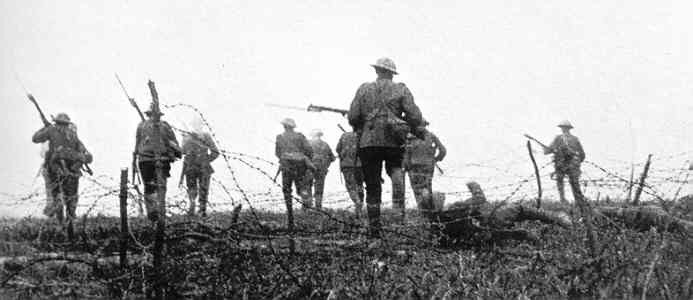
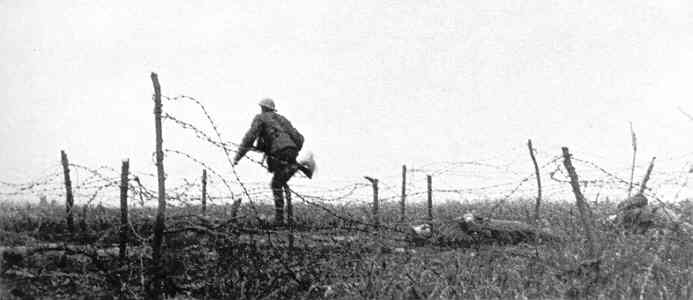
The
British
effort to take
Passchendaele Ridge in
the "Third Ypres" assault in 1917 fared no
better

Stretcher bearers mired in
mud in the Third Ypres –
August 1, 1917
Fueling all this slaughter is a massive killing industry

The
Krupp Gun Works at Essen
Women
manufacture artillery
shells in a French factory
| THE COLLAPSE OF RUSSIA ON HE EASTERN FRONT (1917) |
Despite the massive size of the Russian army in comparison to the numerically
smaller Germany army, the Russians made a very poor showing for
themselves. Arms were lacking,
leadership was lacking – especially when Tsar Nicholas took command away from
his cousin (who was doing the best that could have been expected of a very
poorly armed military) – making the military effort of the Russians even more
pathetic. Worse, families on the home
front were going hungry with the men on the lines rather than in the fields
producing crops for the nation. Morale
within the army was sagging – and by early 1917 women were in the streets
protesting the lack of even basic bread for their families.

Czar
Nicholas II blessing
the Russian troops
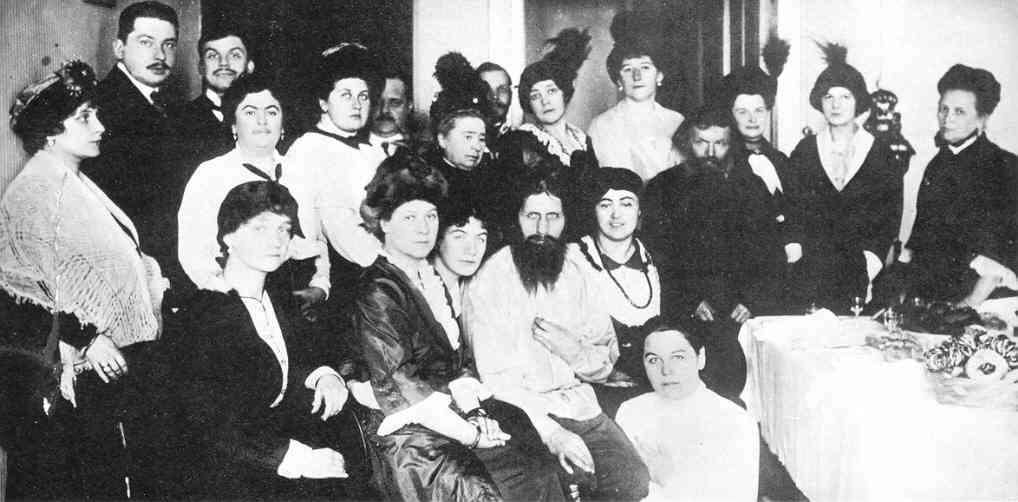
Father
Grigori Efimovich
Rasputin and adoring women of
the Russian nobility – 1916 (just prior to his
murder)

The
last glory days of the
Russian Imperial household.
From left to right, Grand
Duchess Anastasia, Grand
Duchess Olga, Tsar Nicholas II, Tsarevich
Alexei,
Grand Duchess Tatiana,
and Grand Duchess Maria,
and numerous Kuban Cossacks, ca.
1916.

Female
textile workers calling
for bread –
International Workers' Day march in Petrograd – March
1917

Troops
called in to keep
order in Petrograd as strikes
and riots erupt over shortages of bread and
coal

Soldiers
riding through the
streets of a riotous Petrograd --
March 11-12 precipitating the Tsar's
abdication
Having Cossacks gun down these street
protesters did not improve the mood any.
And when Nicholas (at the front) got news of the growing crisis, he
simply abdicated – abandoning further
responsibility for the Russian Empire.
Who at this moment was expected to take over was not clear.

Troops from the Petrograd
garrison who take over the Tsar's
Winter Palace after his abdication
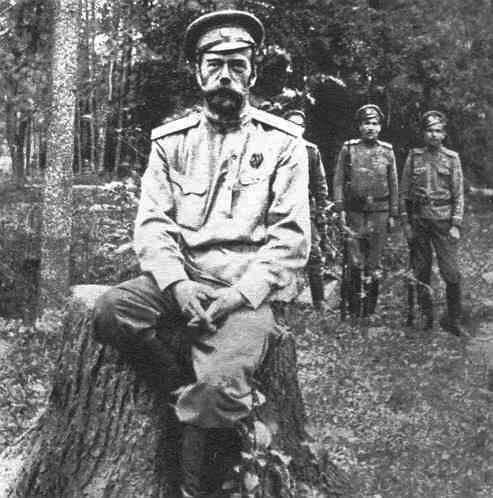
Tsar Nicholas II in detention
after his abdication in March 1917
Nonetheless, the Russian Duma (their national
legislature) announced that Russia would continue forward in the conflict under
a new Provisional Government – also promising a more democratic Russia led by
local soldiers and workers councils (Soviets).

Russia's new leader, Alexander Kerensky,
studying a war map - 1917Had
Russia suddenly become a democracy at this point? Maybe on paper – but hardly so in
reality. The people had not been
clamoring for democracy. They most
likely did not even understand what that meant – and certainly had no idea of
the personal responsibilities that accompany democracy. Besides being totally disillusioned with
their Russian leadership, they simply were tired of the war, the enormous loss
of life for a cause not entirely clear to them – and furious about the huge
disruption that the war had brought to the Russian social order.
Tragically,
the decision of the new Provisional Government to continue the "patriotic
war" indicated that it had no earthly idea of what was happening among the
Russian people themselves. Thus a huge civil war broke out at home – at the
same time that the Russians were trying to hold off the advancing Germans.

Russians,
hearing reports
that German cavalry have broken
through Russian lines, have thrown down their guns
and are in full flight – summer 1917

Soldiers
machine-gunning
down protesters on the
Nevsky Prospekt in Petrograd – mid-July
1917
America's pseudo-neutrality. From the outset,
Americans had theoretically remained neutral – although it quickly turned into
a one-sided neutrality (which of course amounts to no neutrality at all). With European men in the trenches in all the
countries involved, women were required to look after the farming – when they
weren't in the factories making war materiel.
This turned out to be a huge boon for the American farmer who found the
Europeans hungry for American food products – except that a naval blockade that
the British threw around sea access to Germany prevented American (and other
countries') farm products from reaching Germany. The Americans complained to the British about
this most unfair treatment of their rights as neutrals to ship non-military
items to all combatants. But Britain
ignored the complaints (starving Germany into submission was a key part of
their strategy of war) – and eventually America simply settled into the
position of selling food products only to England and France – making enormous
profits in the process.
A very hungry Germany developed the U-boat (submarine) to sink the
ships blockading their country – and loud complaints arose from the British
(and Americans) that somehow this was inhumane (but what part of war is not?) –
and way beyond the rules of war (whatever those might happen to be).

An
American ship hit by a
German U-boat – 1915
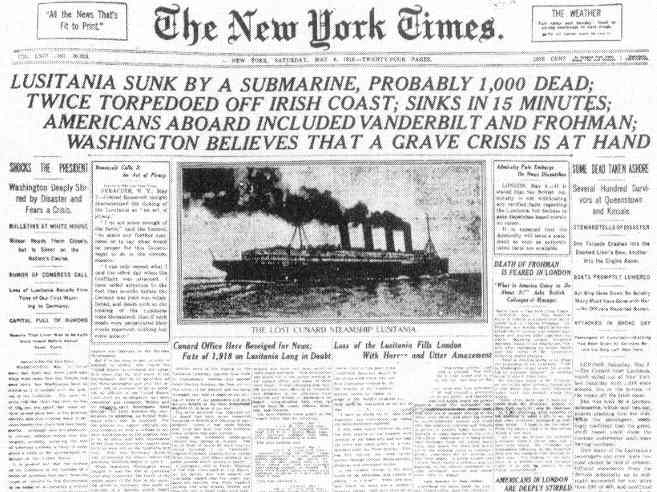
A major crisis then hit when a German U-boat
sank the passenger ship Lusitania in 1915 off the
Irish coast, killing 1200 people (128 of them American). But the ship was carrying a huge amount of
ammunition – and the Germans had issued a warning to passengers about sailing
on a boat carrying such items into a war zone patrolled by U-boats.

The
Lusitania – sunk
May 7, 1915 –
torpedoed by a German submarine
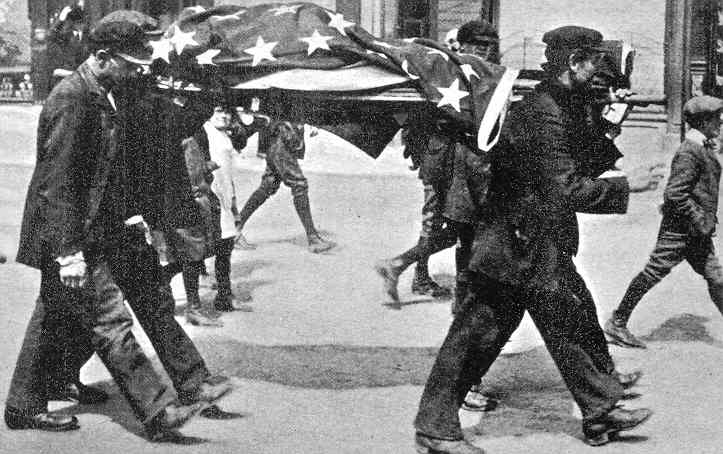
An
American Lusitania victim
being carried by Irish pallbearers
Reaction of President Wilson to the sinking of the Lusitania
was one of outrage – although his Secretary of State Bryan was upset at the inability of Wilson to understand that putting
American civilians on ships carrying war materiel was also immoral. Bryan ultimately resigned his
position when Wilson would not tone down his public
reaction.
In
any case the Germans called off such attacks for the future – that was until
early 1917 when a desperately starving Germany resumed those attacks in order
to break the British naval blockade.
Once again American shipping to Europe (England and France) found itself
in danger.
Wilson decides that it is time for
war (April 1917). Wilson had just been re-elected
President in the national elections of 1916 – in part on the boast that he had "kept
us out of war." But only one month
into his second term Wilson abruptly changed his mind –
citing in his request for Congress's declaration of war against Germany (and
its allies) this resumption of submarine attacks to be the primary cause,
blaming the German government for such barbarity that it required America to
act to restore the realm of law in the world (as if Britain were behaving any
better in respecting the rights of neutrals under international law).
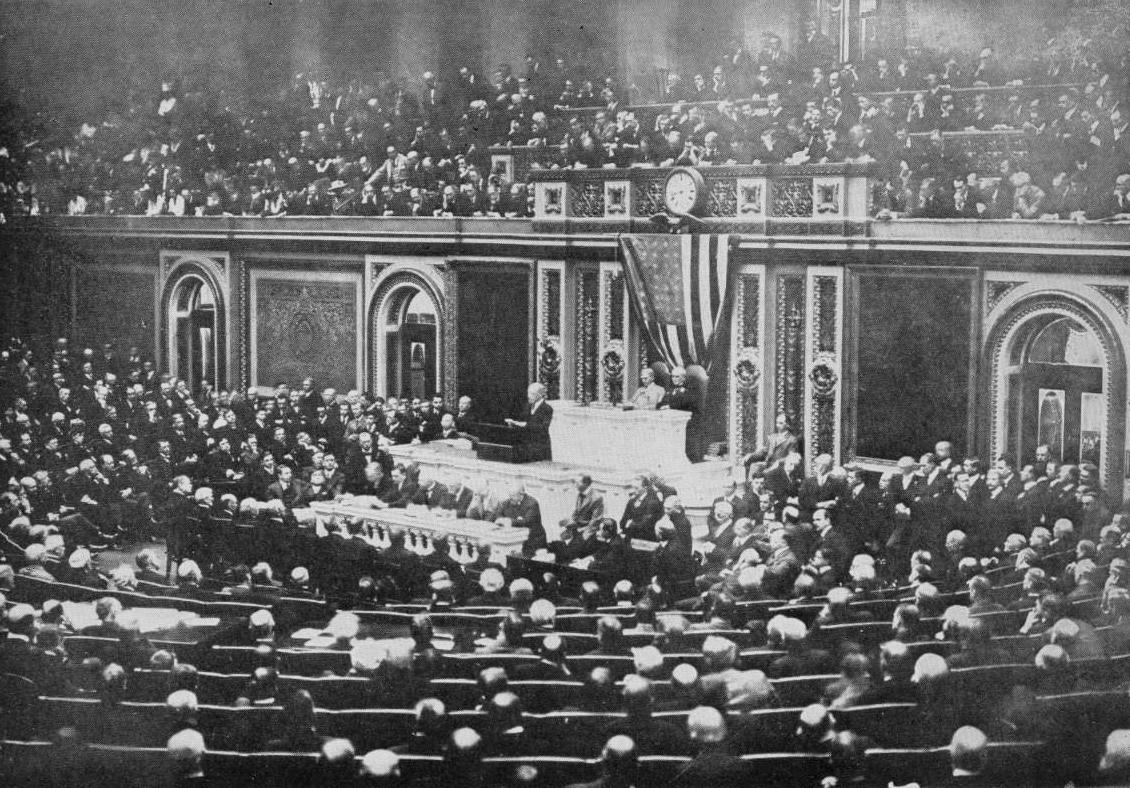
President Wilson appears
before Congress,
requesting a Declaration
of War against GermanyBut
to add moral weight to this dubious military enterprise, he also stressed how
this would advance global democracy – encouraged by how the Russians had just
freed themselves from their own autocracy in their recent advance toward
democracy. On this matter Wilson waxed eloquent (and amazingly
wrong) in his description of how recent events in Russia had finally brought
that country into the ranks of the world's "democracies:"
Does not every American feel that assurance has been added to our
hope for the future peace of the world by the wonderful and heartening things
that have been happening within the last few weeks in Russia? Russia was known
by those who knew it best to have been always in fact democratic at heart, in
all the vital habits of her thought, in all the intimate relationships of her
people that spoke their natural instinct, their habitual attitude towards life.
The autocracy that crowned the summit of her political structure, long as it
had stood and terrible as was the reality of its power, was not in fact Russian
in origin, character, or purpose; and now it has been shaken off and the great,
generous Russian people have been added in all their naive majesty and might to
the forces that are fighting for freedom in the world, for justice, and for
peace. Here is a fit partner for a league of honour.
What
he was describing to the American people was pure fiction, devised inside his
own Idealistic bubble. It was about as
far from reality as a person could dare go.
Ultimately, Wilson sought to bring America into
the war as a great moral crusade which all Americans needed to answer – "to
make the world safe for democracy."
Americans would have this great opportunity to destroy the autocrats who
stood in the way of human progress.
Bringing them down would free up the world to finally find its way to
some kind of Rousseauian bliss, some kind of natural "democracy"
based purely on the primal instincts of a truly free people.
So, lots
of American young men would soon be going to their deaths to support
democracy freed from the tyranny of autocracy.
Somehow it would all be worth the sacrifice that these young men would
be making (Americans were quite well aware by this time of the slaughter taking
place on the European battlefields to which they would be sending their
boys). Ah yes – but well worth it, or
so said the President.
There are, it may be, many months of fiery trial and sacrifice
ahead of us. It is a fearful thing to lead this great peaceful people into war,
into the most terrible and disastrous of all wars, civilization itself seeming
to be in the balance. But the right is more precious than peace, and we shall
fight for the things which we have always carried nearest our hearts – for
democracy, for the right of those who submit to authority to have a voice in
their own governments, for the rights and liberties of small nations, for a
universal dominion of right by such a concert of free peoples as shall bring
peace and safety to all nations and make the world itself at last free. To such
a task we can dedicate our lives and our fortunes, everything that we are and
everything that we have, with the pride of those who know that the day has come
when America is privileged to spend her blood and her might for the principles
that gave her birth and happiness and the peace which she has treasured. God
helping her, she can do no other.
America's "democratic" allies have a different agenda.
Tragically, Wilson's take on the war was not
exactly how America's new allies England and France saw the war. At their home front, in their national
capitals, they were indeed democracies.
But actually, Germany was no less democratic, governed by political
institutions very similar to Britain's.
And actually, both England and France were empires too, controlling vast
domains in Africa and Asia – and with clear intentions of extending their
imperial grip into the Muslim Middle East once the Ottoman Turks were knocked
out of the way.
But
they played along with Wilson. They were certainly glad to get American help
in crushing their "autocratic" enemies, and thus played along with Wilson's crusading Idealism. American assistance would likely break the
terrible stalemate that had set in on the war and finally bring their side to
victory in this long and bloody (and largely pointless) nationalist conflict.
The Americans join the fight. America's
involvement in the war was rather brief – and also rather limited in comparison
to the long and deep involvement of its French and British allies. At first there was only a very small
contribution to be made – and many men to be trained before America was ready
to get going (the spring of 1918, approximately a year after the Declaration of
War was issued).

Pershing arrives in France – June 1917

"Lafayette, we are here!"
Pershing speaking at Lafayette's
tomb outside of Paris
(actually the words were
pronounced elsewhere by
another American officer but attributed
to Pershing
because of the
censor's refusal to mention any other
US officers by name)

General Pershing meeting
with French leaders
Poincaré and Pétain
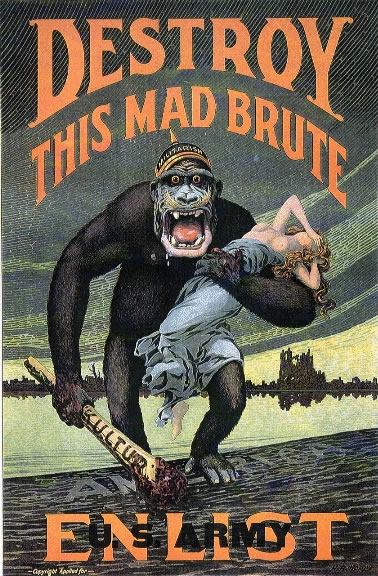
The US Public Information
Committee adopted this British
poster in an effort to stir up American
war fever

American recruits

American conscripts are sworn
in

Former President Roosevelt
addressing American trainees
at Camp Grant, Illinois

American recruits ready to
go

New York – 5th Avenue – Flag-waving
well wishers
send off the American boys to the European War

An American family saying
Goodbye
To finance the war, a major
campaign to raise money via war
loans got underway
(American incomes were not
yet taxed
directly by the Federal Government)
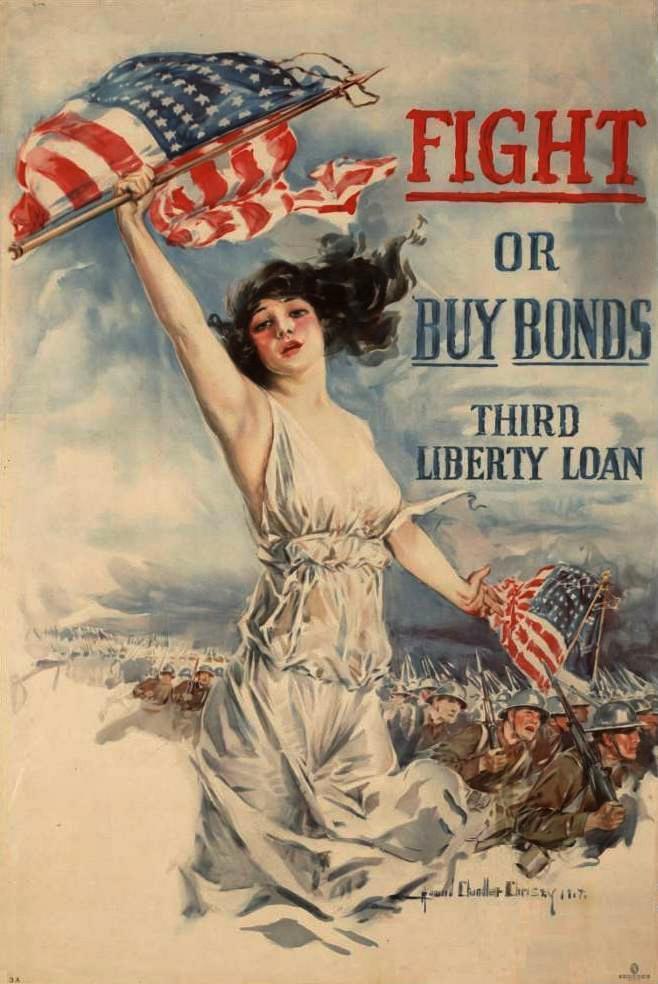
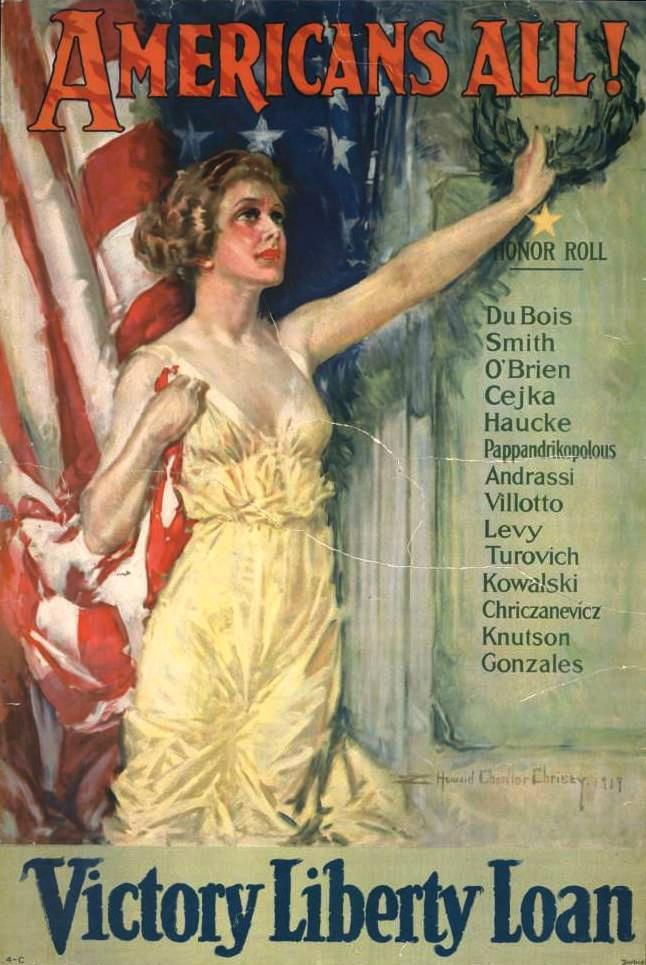
Color posters by Howard Chandler
Christy

Newly arrived American troops
marching through London
– August 1917
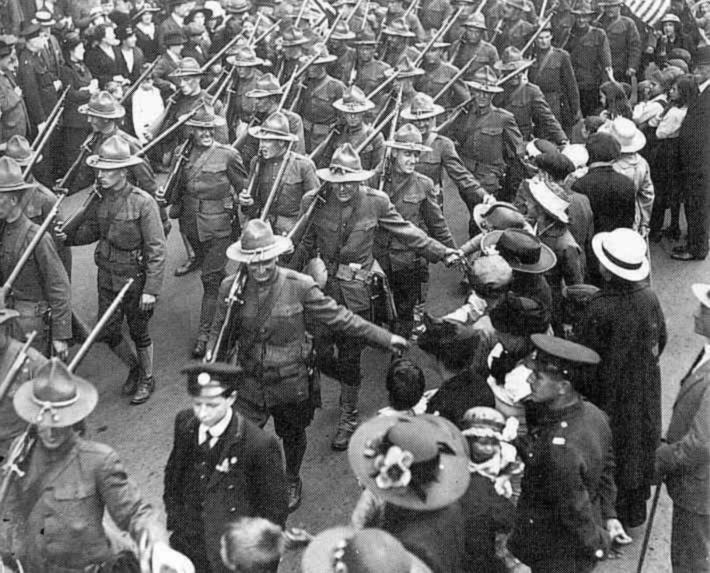
American troops welcomed
in London – 1917

Women welders at the Hog
Island shipyard near Philadelphia

Women workers in ordnance
shops, Midvale Steel and
Ordnance Co., Nicetown, Pa.
Hand chipping with pneumatic
hammers – 1918 – photo by Lt. Lubbe

American women operating
farming machinery
| THE RUSSIAN-GERMAN ARMISTICE |
In the meantime, Lenin's Communists had seized both the Russian
capital Petrograd (St. Petersburg) and the key city Moscow in the unfolding
civil war there.
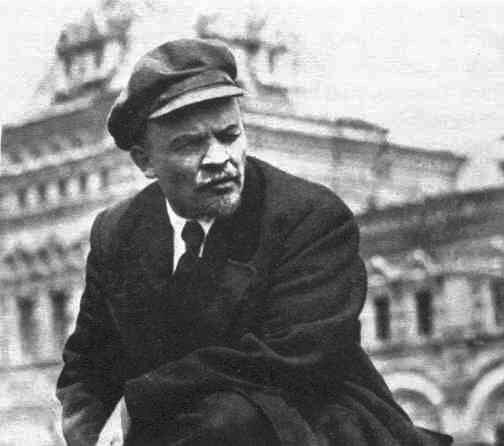
Lenin
addressing a Petrograd
crowd
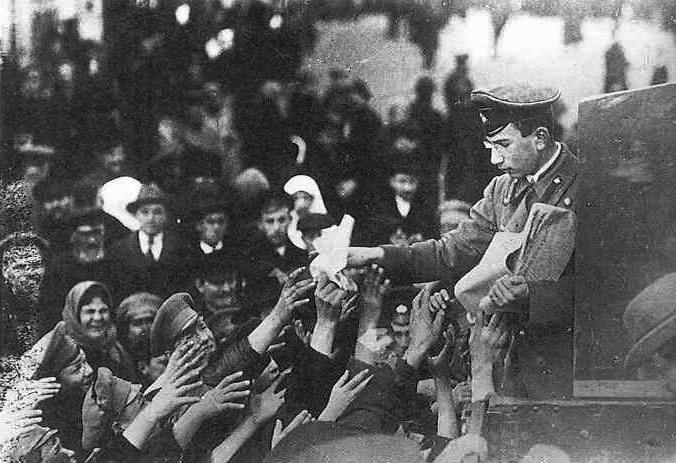
A Bolshevik
hands out Revolutionary
newspapers

Soldiers
demonstrating for
Communism
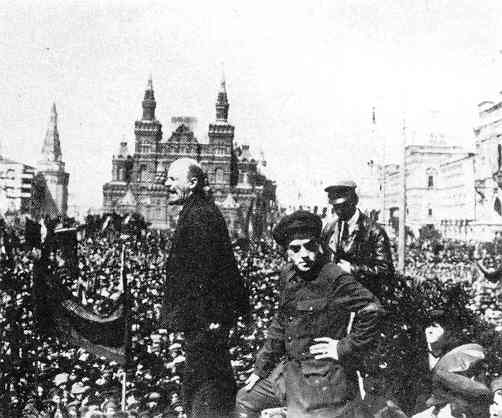
Lenin
speaking to a massive
Petrograd crowd on behalf of
the Communist
Revolution
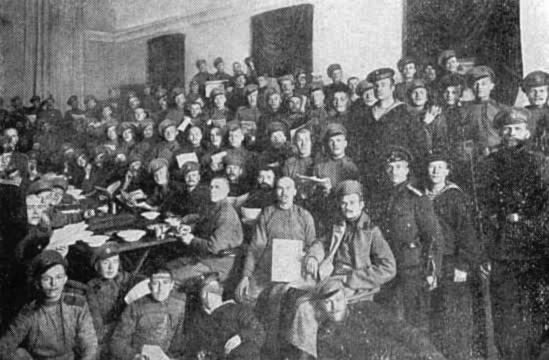
Some of the
Kronstadt sailors
and Bolsheviks who helped
overthrow the Russian Provisional
Government
Then Lenin's associate
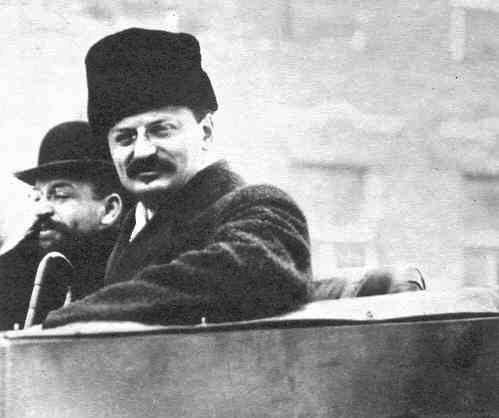
Trotsky had signed at the end of 1917 an armistice agreement with Germany
taking Russia out of the war, a very popular move with the Russian commoners at
the time – although it was actually designed to refocus the country's military
powers on helping the Bolsheviks win the Russian civil war
(which would continue for several more horrible years).

Russian and
German troops
fraternizing upon the news
of an Armistice
worked out by Trotsky with
the Germans
in December of 1917
Trotsky at
Brest-Litovsk
... to finalize peace terms –
January 1918

The signing
of the Brest-Litovsk
Treaty
The treaty took away a third of
Russia's population,
half of her industry and nine-tenths of her coal
mines.
But
it enabled the Communists to focus their full efforts
at securing their
rule over what remained of the former
Russian Empire. A huge and extremely bloody civil war
was about
to
begin.
But the Russian-German armistice also allowed
the Germans to quickly move their troops from the Eastern to the Western Front
in anticipation of the eventual arrival of the Americans in large numbers the
next spring.
Thus it was that the Germans put into operation a
huge and desperate early spring 1918 offensive on the Western Front, with the
goal of overrunning Paris before the Americans could get in position. But that failed. And now the Germans found themselves highly
exhausted.
And the Americans at that
point were beginning to arrive in large numbers – here and there along the
middle of the Western battle line.

US troops being transported
to the trenches – 1918

Pershing address U.S.
Marines – June 1918
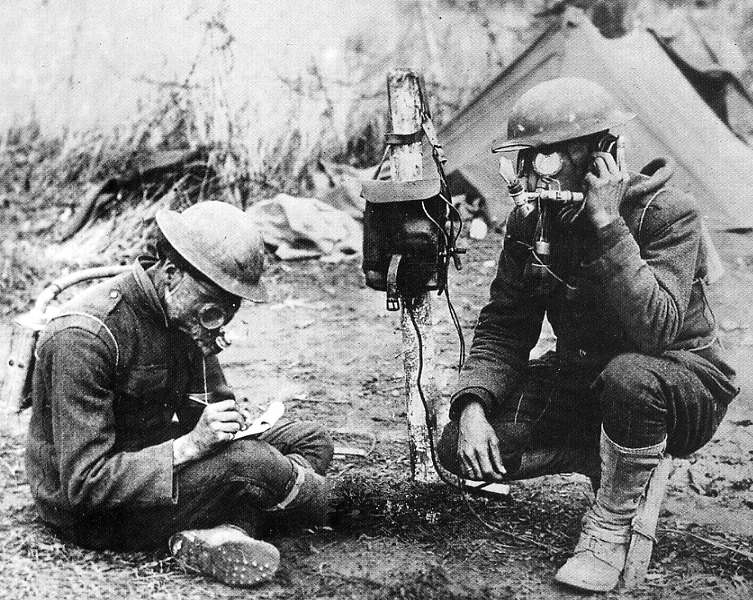
American Signal Corpsmen
donning gas masks

Marine receiving first aid
before sent to hospital in rear of trenches.
Toulon Sector, France. March
22, 1918. Sgt. Leon H. Caverly, USMC.

"Negro troops in France.
Picture shows a part of the 15th Regt.
Inf. N.Y.N.G. organized
by Col. Haywood, which has been
under fire." ca. 1918. IFS.
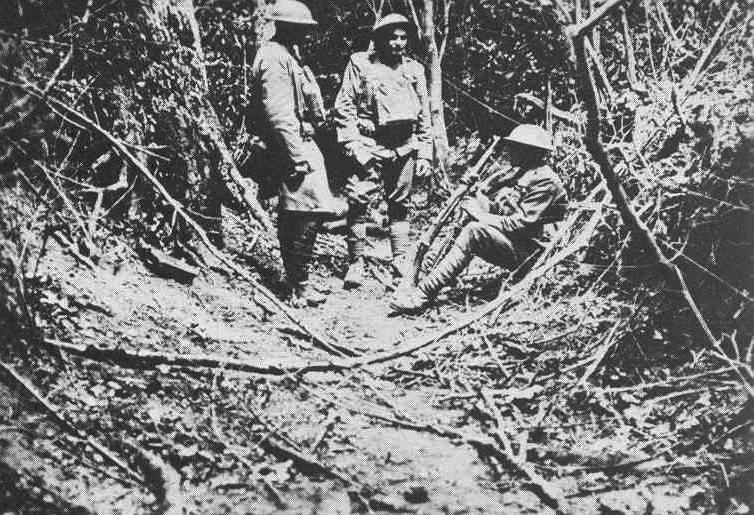
US troops resting up after
the bitter fighting at
Belleau Wood – June 1918
In the meantime (January of 1918), Wilson went before Congress to
outline what he expected to be the specific terms of the peace that America was
fighting to secure. The terms were
presented as Fourteen Points, including the end to secret treaties (which Wilson supposed were a major cause of
the war in the first place), the guarantee of full freedom of all navigation on
the high seas (a major source of American annoyance with both the Germans and
the English), the adjustment of territories such as would restore Russia,
revive Poland and return to France territory lost to Germany in 1871, the
opportunity for independence of the various nations making up the
Austro-Hungarian and Turkish Ottoman Empires.
But most important (in Wilson's eyes), was the
fourteenth: the creation of a general
association of nations empowered to defend the political independence and
territorial integrity of all states, large or small. This last point was the intellectual
foundation for what would become the first truly international diplomatic
organization: the League of Nations.
He
made it clear that even for the Germans he sought only a fair or equitable
peace – though he would negotiate such a peace with only a German delegation
representing the majority members of the Reichstag (the German National
Assembly) – and not the "military party and the men whose creed is
imperial domination." This was a
clear indication that America would not deal with the Kaiser but instead with
only a German group representing the broader or democratic interests of the
people of Germany.
THE GERMANS NOW ARE FORCED INTO A DEEP RETREAT
SEPTEMBER - NOVEMBER 1918 |

Marshall, p. 340
Americans advance against
the Germans' St. Mihiel salient
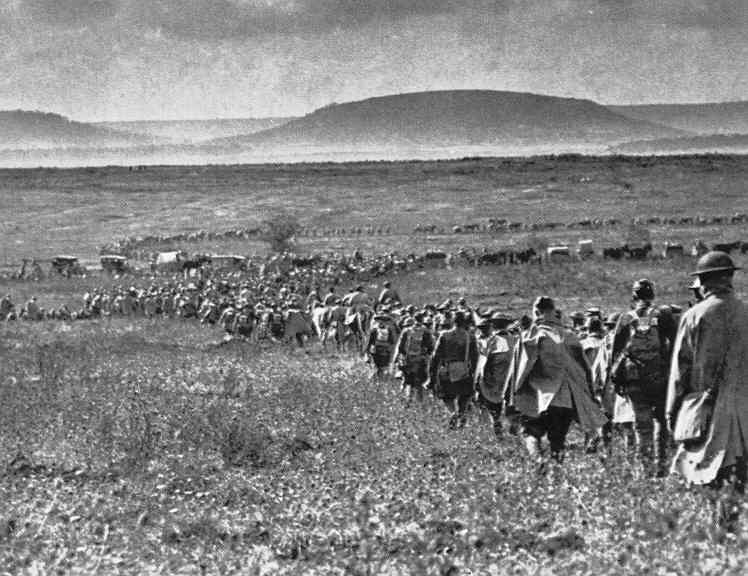
American troops moving forward
into the St.-Mihiel salient
– September

A 75-mm. American gun crew
targeting the St.-Mihiel salient

American charge against the
St.-Mihiel salient
(one doughboy has just taken
a hit from German fire)

A French couple in Brielles-sur-Bar
greeting American soldiers
who have just delivered them from four years
of German occupation
They then move into the Argonne
Forest

Because of their victory
at St-Mihiel,
American troops
head into
the Argonne Forest with spirits running high
But here the fighting proves to be vastly more difficult

American troops going forward
to the battle line
in the
Forest of Argonne
in Renault FT-17 tanks. September 26, 1918.

But the Argonne Forest affords
only a very painful inch-by-inch
advance for men of the 23rd Infantry
Machine gunners of the German
Fifth Army in the Argonne
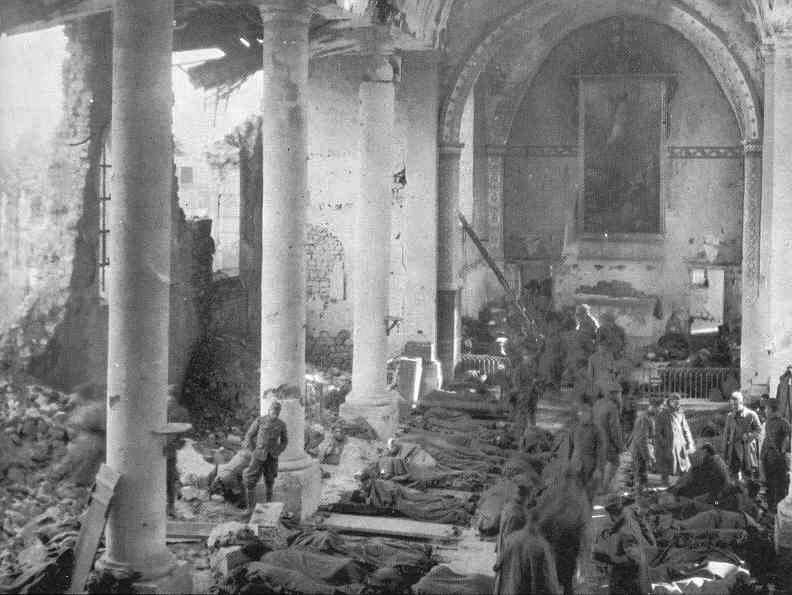
A makeshift-hospital in a
bombed-out French church
treats American wounded
from the first day's action (September 26)

American soldiers advancing
on a bunker
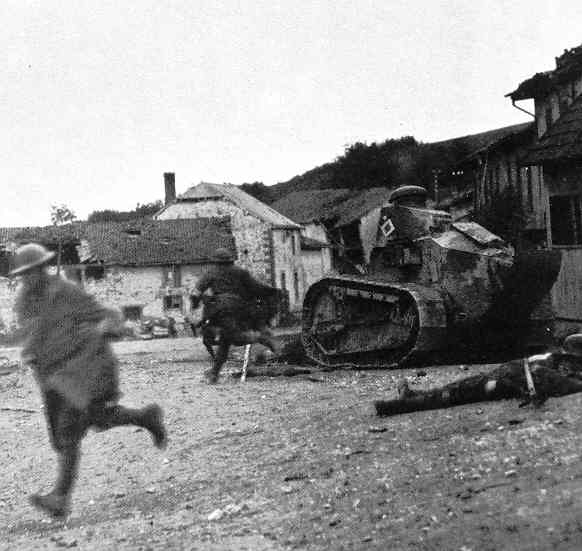
October – Fierce fighting accompanies
the American advance through
the villages of the Meuse valley
(a dead German lies next
to the tank)

Young Brigadier General Douglas
MacArthur (38) in a French manor
The number of German
prisoners now grows astronomically

A long line of German prisoners
near Amiens
escorted by a handful of Australian guards
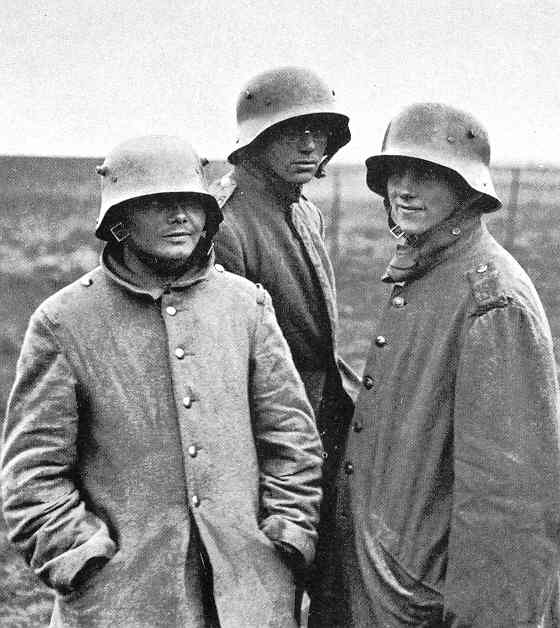
Young German prisoners seeming
relieved that the action is all over
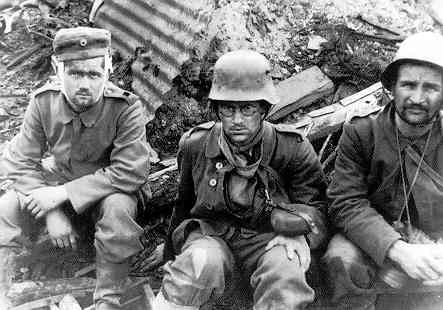
Very dis-spirited German
soldiers

German prisoners carry a
wounded comrade to
an American aid station

Wounded American soldiers
watch German prisoners file by
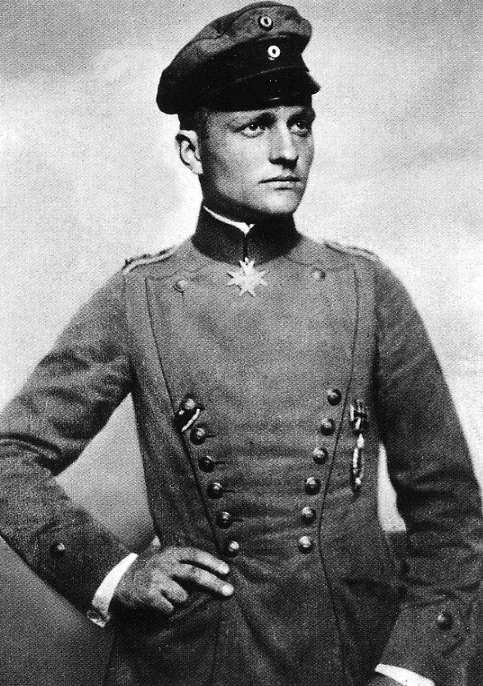
Baron Manfred von Richthofen
(26) – Germany's "Red Baron"
air ace for 20 months (80 confirmed kills). He was shot down
near Amiens on
April 21, 1918
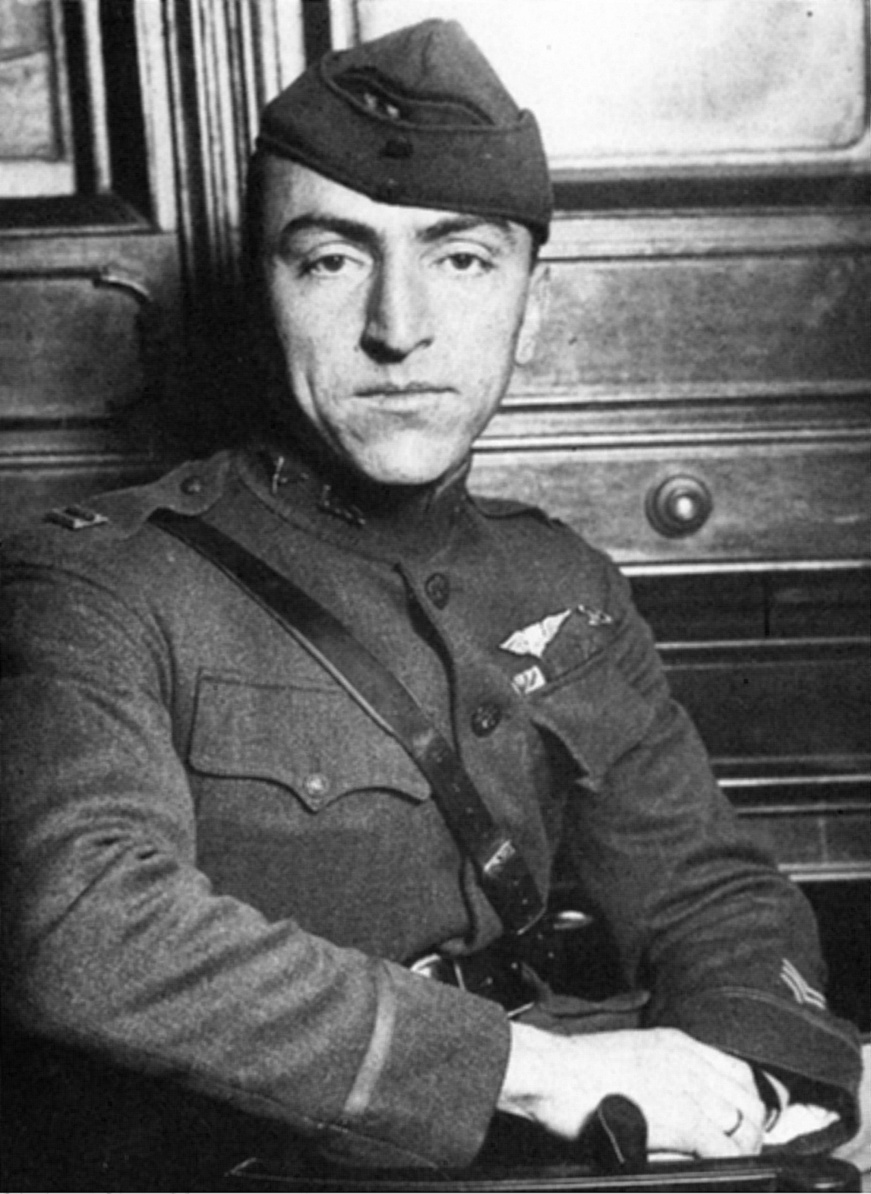
"Capt. Edward Rickenbacker,
America's premier "Ace"
officially credited with
22 enemy planes and the proud wearer
of the French War Cross
as he appeared upon his arrival
on board the Adriatic"
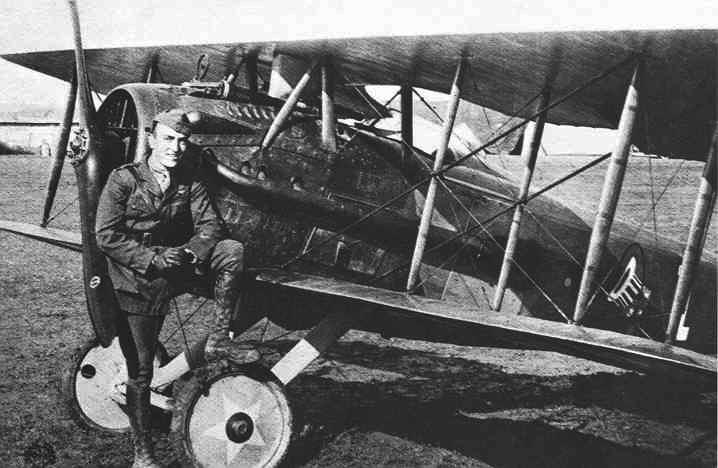
Eddie Rickenbacker – American
flying ace

Eddie Rickenbacker (27),
former race car driver –
by war's end an American air ace
The Germans are humiliated. The Germans, sick
of the war and starving at home, found themselves in rebellion – along the same
lines as what had just happened in Russia.
But they eventually were able to come under the order of a group of
political leaders determined to end the monarchy (as Wilson demanded) and form a German
Republic. German Emperor Wilhelm then
took himself off to exile in the Netherlands – and a newly assembled German
government accepted Wilson's offer of an Armistice
(November 1918).
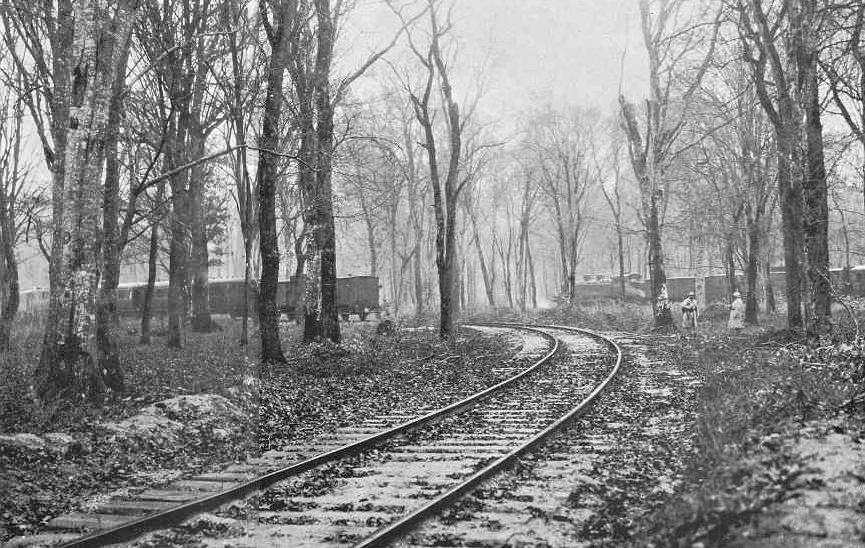
The trains which brought
the two sides together at Compiègne
for Armistice negotiations November
1918
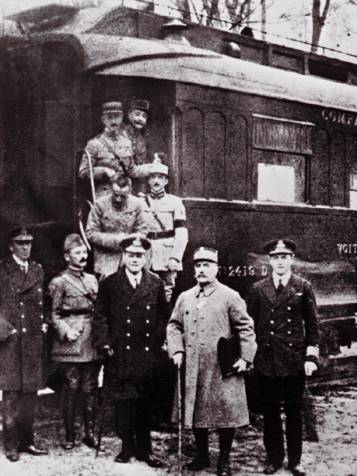
Officers in the forest of
Compiègne after reaching an agreement
for the armistice that ended World
War I.
Foch is second from the right.
President Wilson reading
the Armistice terms to Congress.
November 11, 1918.
National Archives

Londoners celebrating the
Armistice
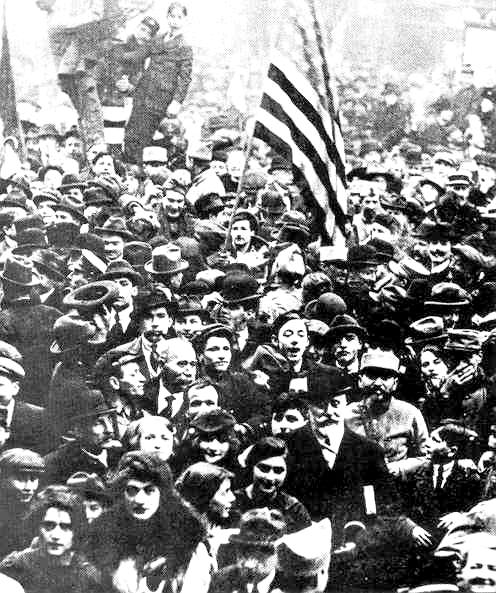
Armistice celebrations in
Paris
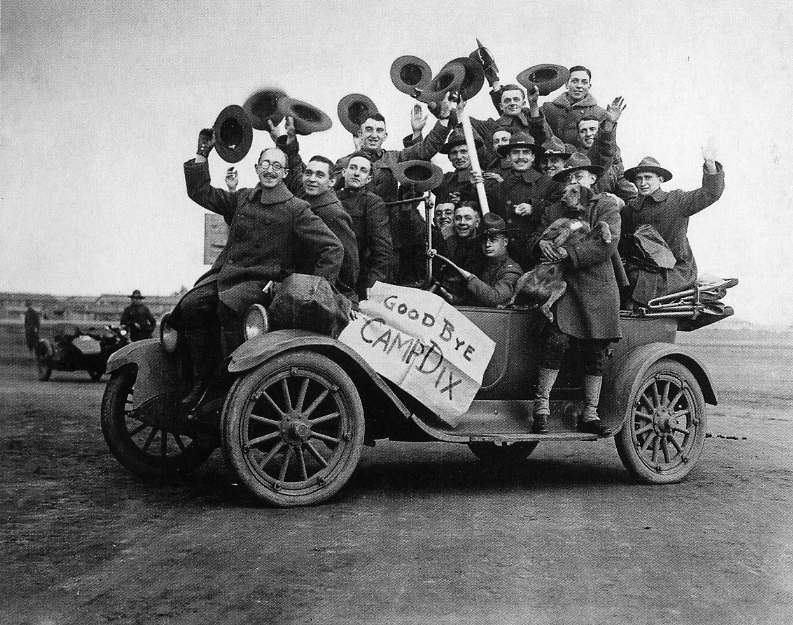
US soldiers excited to be
leaving training camp at Camp Dix,
New Jersey – late 1918 (122,500 soldiers were killed
or missing,
237,135 wounded during the war)
National Archives They then sent off to
Paris (the suburb of Versailles actually) representatives
authorized to work out a final peace agreement.
At this point the Germans still held on to a fair amount of French and
Belgian territory. No enemy had entered
Germany itself.

Woodrow Wilson leaving for
the Peace Conference in France
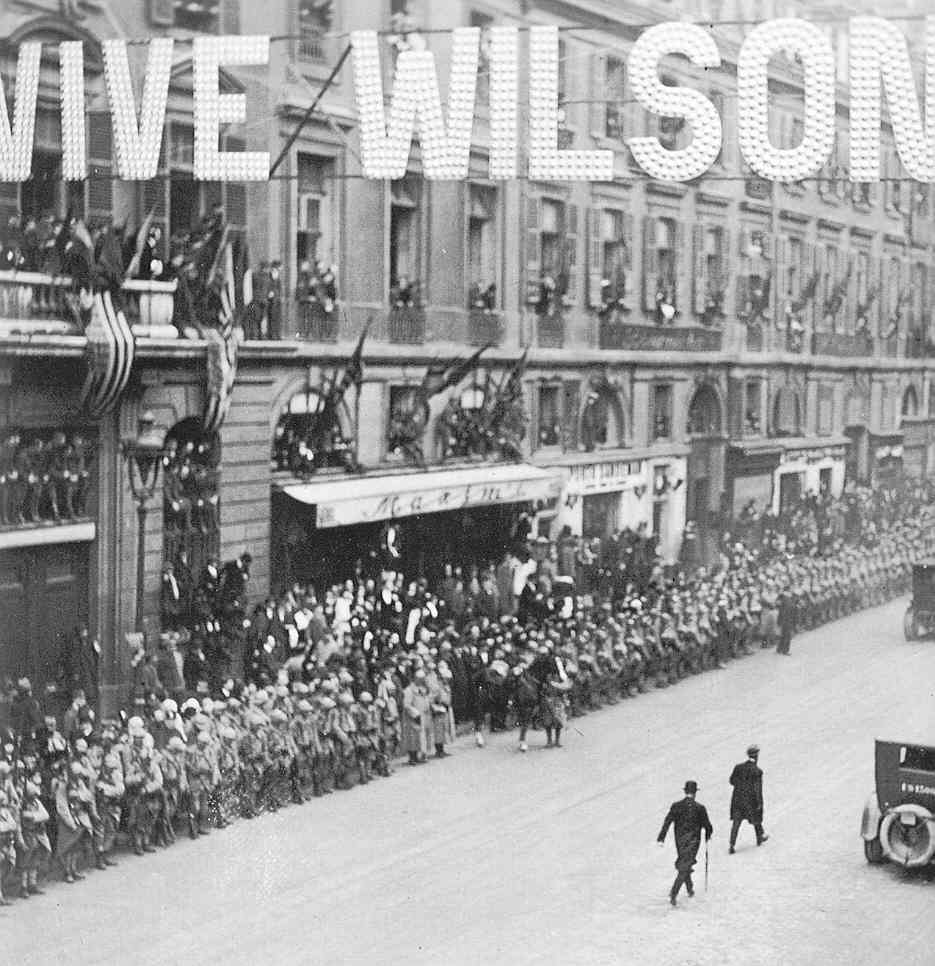
The Paris crowds waiting
for President Wilson
National Archives
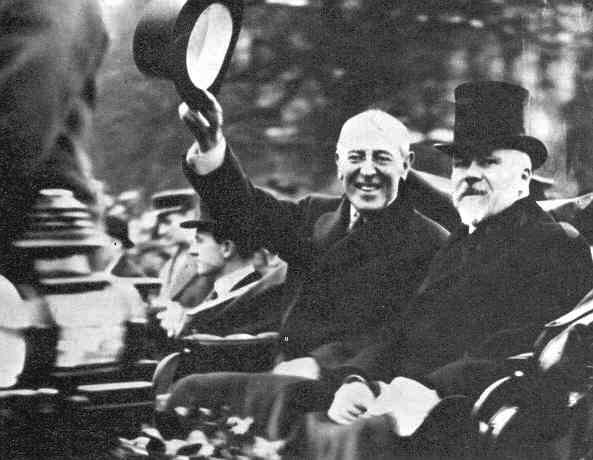
Paris – Wilson and
Poincaré
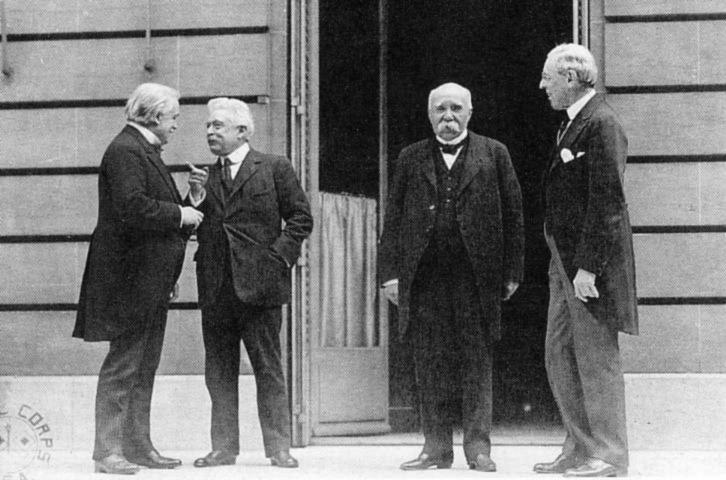
The Paris "Big Four"
David Lloyd George, Vittorio Orlando, Georges Clemenceau
and Woodrow
Wilson
National Archives
The "Phony Peace." At the peace talks
Germany was actually represented by individuals largely unknown to (and thus
only weakly supported by) the German people.
Consequently, the German negotiating hand turned out to be extremely
weak when it came time to outline a final peace settlement as a follow-up to
the Armistice or cease-fire.
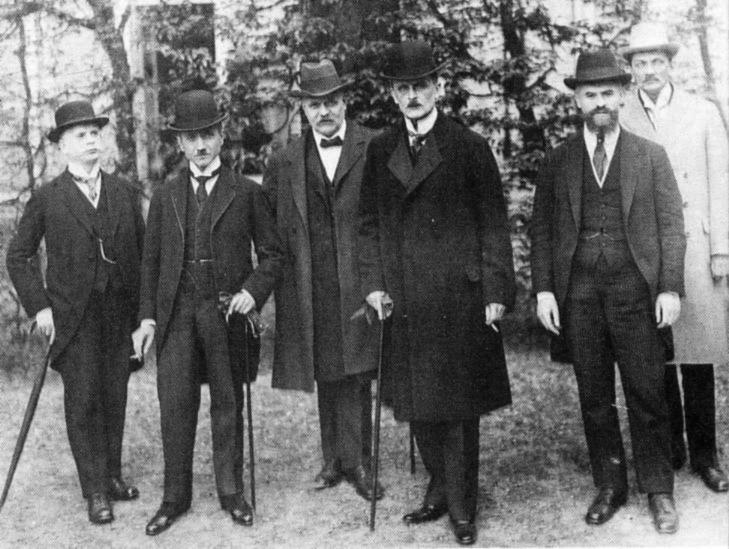
The German delegation at
Versailles – 1919
National Archives
Wilson and the American
Delegation
at Versailles – 1919
Being
the Idealistic Humanist that he was, Wilson failed to connect American
power with American diplomacy – and thus the English and French took the
opportunity to pounce upon the exhausted Germans, to wreak an expensive revenge
(including a massive indemnity payment that Germany was in no position to pay)
– despite Wilson's protests. What Wilson failed to understand was that
probably no English or French politician who failed to bring home to his people
some major exaction of retribution against the Germans would have had a
political future there. But Wilson had power he could have used
to move things more in the direction he wanted to see them go. However, caught up in his world of beautiful
ideas, he failed to see the political opportunities he actually possessed in
order to direct negotiations along the lines he had desired.
Also Wilson found himself shocked as he
discovered that the English and French were not interested at all in assisting
him in spreading his idea of the "rights of national self-determination of
people everywhere." They were not
about to do that because that would have meant having to give up their own
multi-ethnic or multinational empires.
Indeed, they were even planning to expand their imperial presence by
establishing new Arab states carved out of the defeated Turkish Empire, new
monarchies placed under French and English "protection."

The signing of the peace
treaty at the Palace of Versailles
-
June 28, 1919
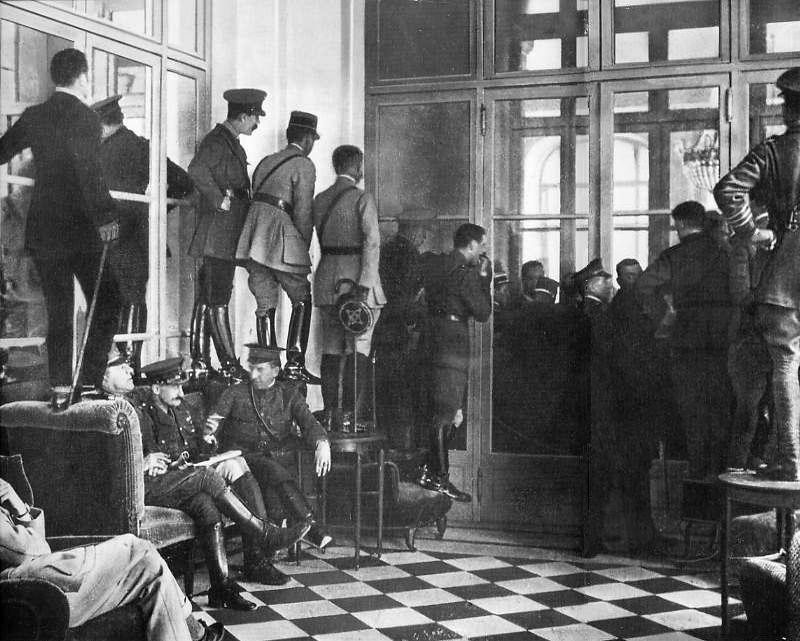
Spectators craning to see
the German signing
of the Versailles Treaty – June 28, 1919
National Archives
Also,
to Wilson's great distress, things were
not doing well in Russia – because not blissful peace and prosperity but
instead a violent civil war had accompanied Russia's move to "democracy." And this civil war had Russia's democrats
lined up on the same side with the old Russian autocrats (the Whites) in a
ferocious battle against a Marxist-Leninist Communist insurrection (the Reds).
Red troops advancing against
the Whites in the Crimea -
late 1919

Russian White soldiers standing
over the bodies
of dead Bolsheviks or Reds – 1919

American troops in Arkangelsk –
aiding the resupply of the White army.
Wilson's proposed League of Nations. On the other hand, Wilson was able to get his allies at
least to accept his idea of a world assembly (the League of Nations) where he presumed
cooler heads could eventually come together once the fever of war had subsided
– and then right the wrongs of the abominable peace treaties foisted by the
English and French on their defeated enemies.
But
ironically, the one country he could not get to sign on to his project was his
own, America. The Senate, which is
required to approve all treaties, balked at the idea that possibly America
would be giving over control of its foreign policy to the new
organization. Wilson seemed unable or unwilling to
answer their concerns on this matter – and the Senate vote ultimately fell
short of the 2/3 approval required for all treaties. Thus the United States did not join Wilson's cherished organization! Wilson was devastated.
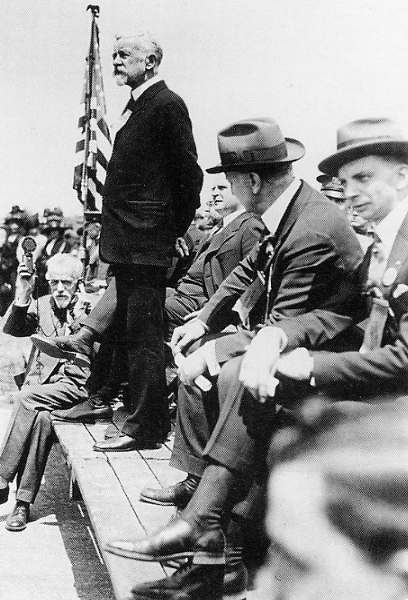
Senator Henry Cabot Lodge (Chair of the Senate Foreign
Relations Committee). Lodge was reluctant to turn American
foreign policy over to Wilson's League of Nations
Library of Congress

Isolationist Senators William
Borah (R-Idaho)
and Hiram Johnson (R-California)
Library of Congress
The German sense of betrayal. Likewise, the
betrayal of Wilson's promise of an equitable
peace, to which the Germans thought they were agreeing when they laid down
their arms, would become the source of German ideological opportunity for those
(Hitler and his Nazis) who sought to
exploit this sense of betrayal (Dolchstoss or "Stab in
the Back"). They would eventually
use this opportunity to overthrow Germany's new democracy and institute a Neuordnung
(New Order) in Germany.
In short, the Peace of 1919 merely set the scene
for a return engagement of the nation-versus-nation contest 20 years later in
the form of World War Two.
American disillusionment. Ultimately,
Americans came quickly to the conclusion that they had been deceived in taking
up arms to fight for the cause of democracy.
The results of the peace were not at all what Wilson had promised that the sacrifices of the war
would produce. Americans quickly became
cynical about Wilson's great crusade – and determined never again to
be smooth talked into getting involved in a European war.[2]
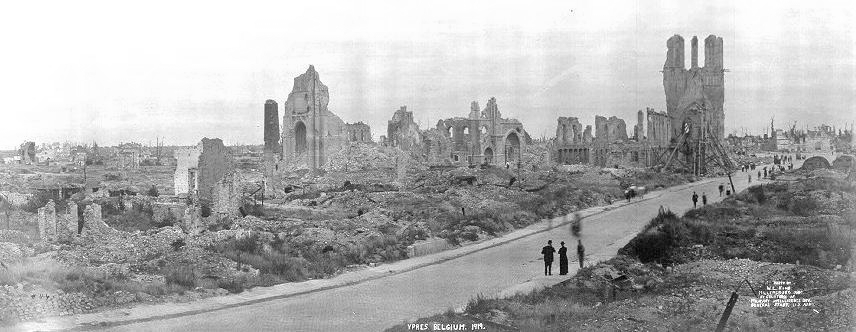
Ypres, Belgium, at War's
end – 1919
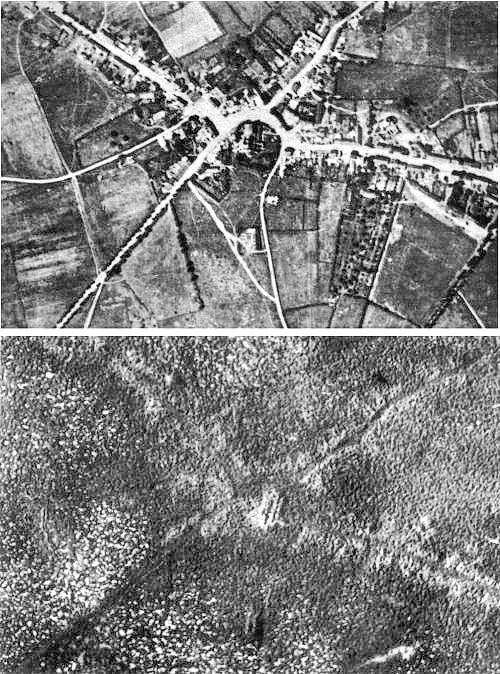
Passchendaele – before and
after the War
Imperial War
Museum
[2]This failure of his dream to come true ultimately helped break the
spirit of the President himself, and he ended his last couple of years in
office as a spiritual and physical invalid (which was never revealed at the
time to the public at large).
Wilson was paralyzed on his
left side, so his wife Edith
holds a document steady while he signs – June 1920.
Library of Congress
Then just to make the mood
of America even darker, a massive and deadly case of flu hit the country during
the fall of 1918 – just as the war was coming to an end. Americans (like the Europeans) were hit so
badly that more than half a million (675,000?) Americans died from this flu
(compared to the 53,400 American soldiers dying from combat in World War
One). And those it did not kill, it
produced permanent effects for approximately a quarter of the US
population. In a few short months it
lowered life expectancy in the US by 12 years.
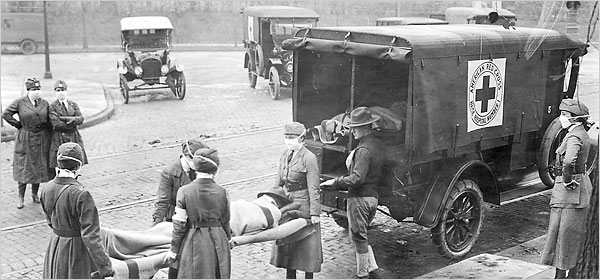
Removing the body of a soldier
killed by the influenza virus
Seattle policemen masked
against the Spanish flu
December 1918
National Archives
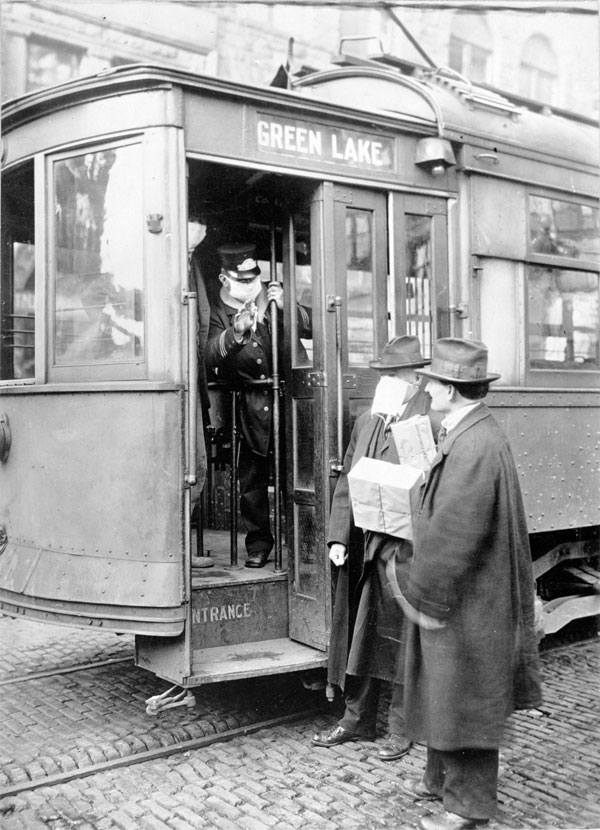
A street car conductor in Seattle
not allowing passengers
aboard without a mask. 1918
National Archives
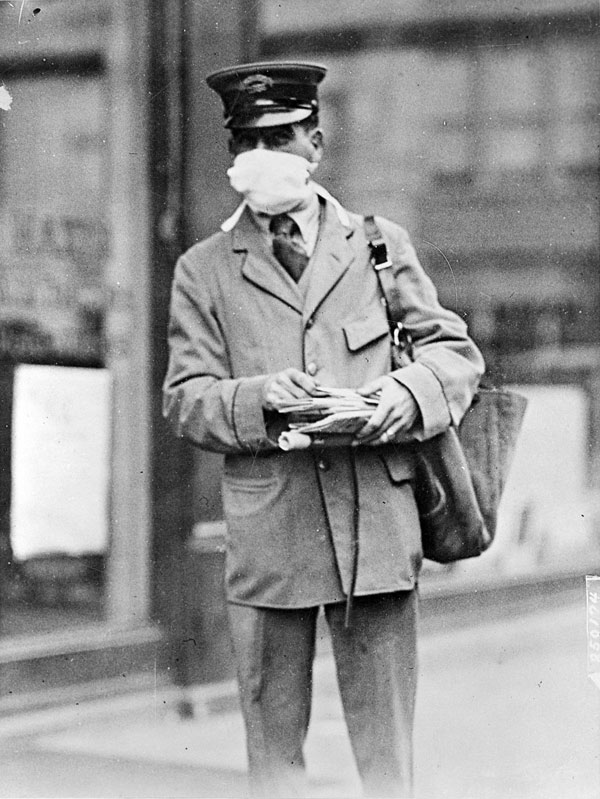
A mailman in New York
wearing mask for protection
against influenza. New York City, October 16,
1918
National Archives
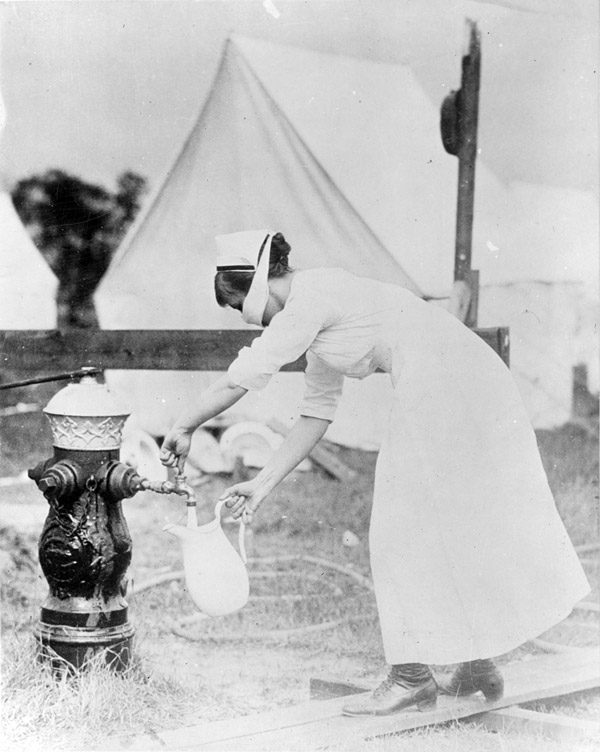
A nurse wearing a mask as
protection
against influenza
September 13, 1918
National Archives
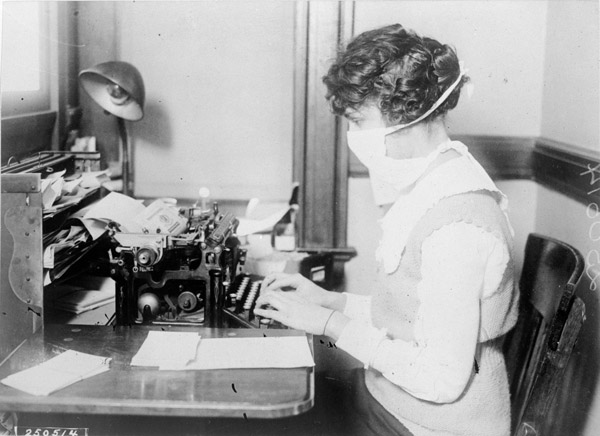
A typist wearing mask, New
York City, October 16, 1918
National Archives
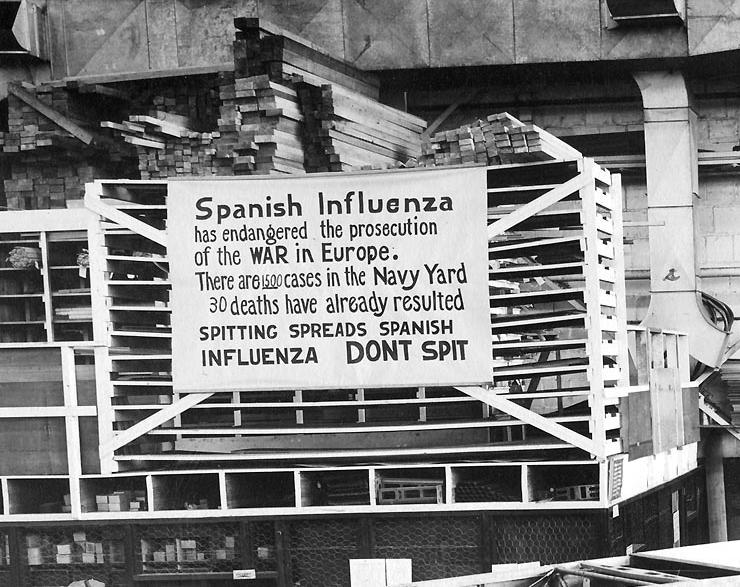
An influenza precaution sign
at the Naval Aircraft Factory,
Philadelphia October 19, 1918
National Health
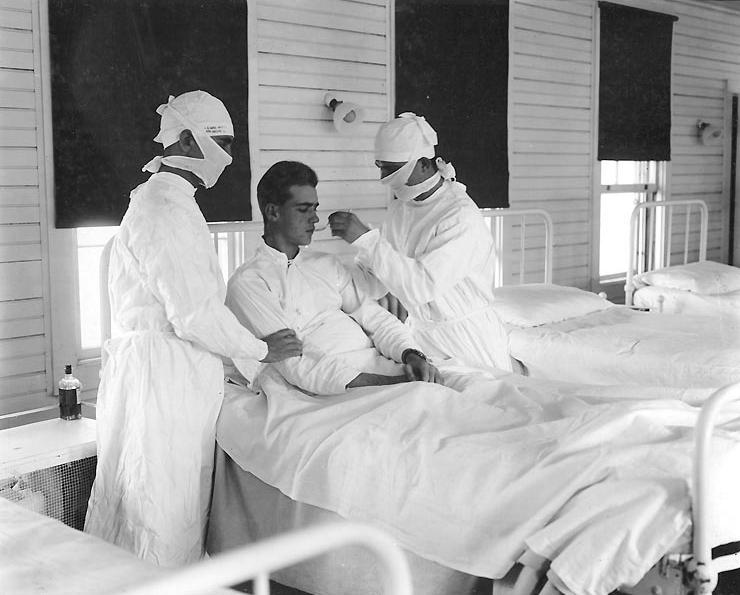
Treating an influenza patient
at Naval Hospital – New Orleans
National Health
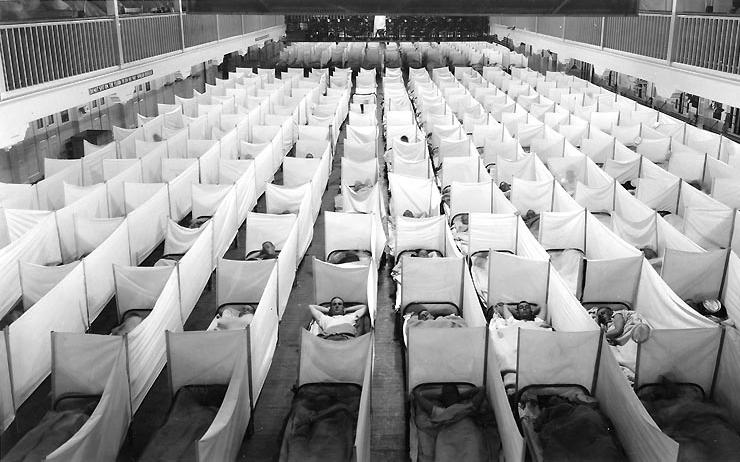
Crowded sleeping area at
Naval Training Station, San Francisco
National Health
Go on to the next section:
 Miles
H. Hodges