<


7. AMERICA ENTERS THE WORLD STAGE

THE GREAT DEPRESSION


CONTENTS

Hoover ... and the onset of the Great Depression

Roosevelt takes command

The rise of Intellectual or Secular Humanism

Problems with the Supreme Court

No ... the New Deal did not bring America out of the Depression

The Midwest "Dust Bowl"

Christianity's ongoing stuggle with Enlightened Humanism

America toughens up


The textual material on this webpage is drawn directly from my work
        America's Story – A Spiritual Journey © 2021, pages 224-237.

HOOVER ... AND THE ONSET OF THE GREAT DPRESSION

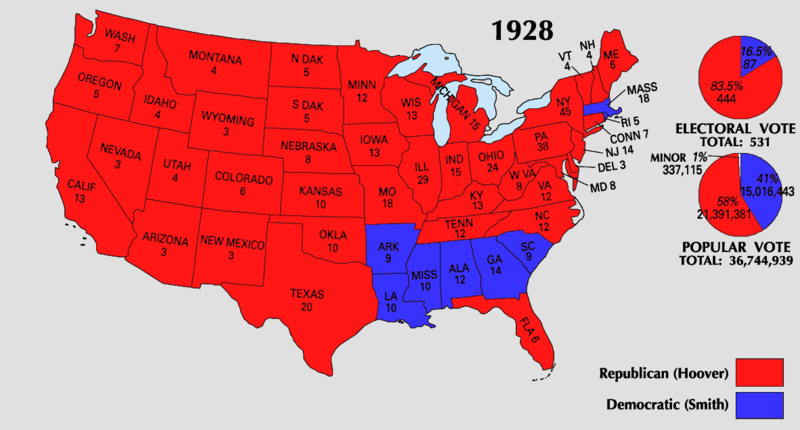
Hoover takes over (1929).  In 1928, as his term approached a close, Coolidge made it clear that he would not take on another term – although many expected him to do so.  He was tired and ready to go home. The Republicans thus chose his highly respected Secretary of Commerce, Herbert Hoover as its nominee – who then went on to easily win the Presidency.  When Hoover took office in 1929, America was expecting to see the fabulous economic journey that the country found itself embarked on expanded even more.  Little did the country realize that the very opposite was soon to occur. 

Herbert Hoover

At first, as the 20s come to a close, it appears that the material
 "Good Times"
America was experiencing was destined
to last forever

President Herbert Hoover, Henry Ford, Thomas Edison, 
and Harvey Firestone at Edison's 82nd birthday. Ft. Myers, 
Florida, February 11, 1929

... then things started going wrong

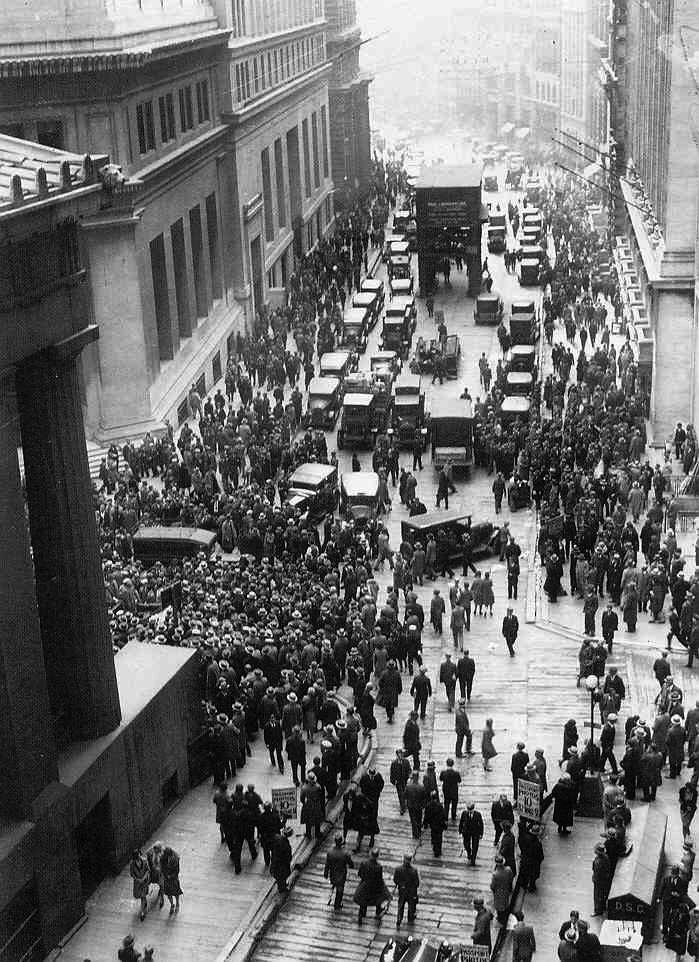
Collapse of the Wall Street Stock Market (October 1929).  The business in consumer goods during the years after the war was so hot that huge profits were being made by those investors who had come up with the funds to get these businesses up and running.  Such funds were acquired by selling shares of the company's ownership and profits on the open market – to anyone who wanted to get involved in such economic activity.  At first it was professional investors who came up with the funds to buy the shares.  But eventually American "moms and pops" got involved – sometimes using their life's savings to get in on the very profitable game – sometimes just borrowing money from banks – expecting to be able to soon repay the bank these loans when their holding of stocks quickly increased in value in this hot market.  Thus it was that, as the 1920s rolled along, such speculative fever became ever hotter.  The market rose and rose – and people saw themselves getting ever richer – on paper at least.

Market saturation.  But almost no one was paying attention to what was happening in the real world of economics.  "
Market saturation" was developing as Americans, towards the end of the 1920s, had mostly bought their cars, radios and home appliances.  The sales of the goods produced by America's companies were thus slowing up – and companies were having to cut back production (and let workers go) as well as drop their prices to stimulate new sales.   Profits and dividend payments to investors began to dry up – creating concern among some of the more knowledgeable investors.  Some of them began to back out of their investments, selling their shares at a somewhat lower price in order to find buyers.  Suddenly the value of shares on the stock market stopped climbing – and more people took the step of trying to sell off their shares.  This in turn panicked other investors – who rushed to dump their stocks before they lost even more value.  Overnight (late October of 1929) the value of stocks on the market fell away – leaving investors bankrupt because they owed banks more money than the stocks were now worth.

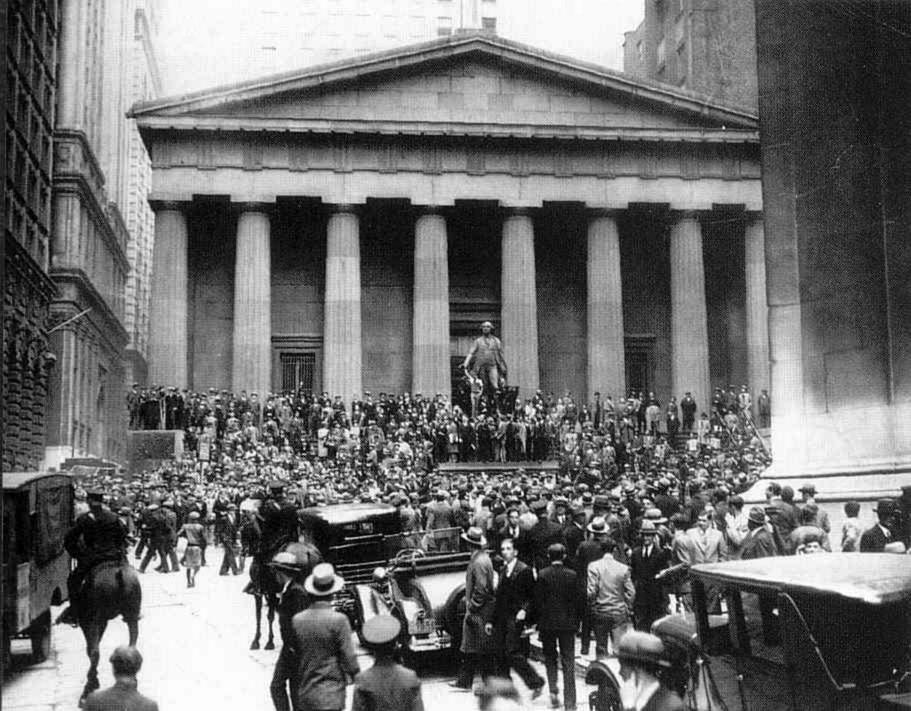
October 24, 1929 – Black Thursday on Wall Street

A crowd gathers at New York City's Federal Hall opposite 
the Stock Exchange at the news of the crash - 1929

Wall Street Stock Market Crash

Efforts were made to pump some money back into the market and for a while (April 1930) the worst seemed to be over (though by no means did the market return to a point anywhere close to where it had been previously) – then once again it began a slide downward – reaching a point of almost a total loss of all value as of July 1932.

Hoover addresses the crisis.   Hoover had absolutely no idea of how to meet this crisis.  From his point of view the matter was purely economic in nature – and the federal government had no constitutional role to play in such matters.  At first he expected that the market would simply correct itself.  This was how capitalism worked.  Weak producers were shaken out of the market during such times of crisis – leaving room for stronger producers to move more widely into the market.  It was not the government's job to get involved in this dynamic.

But by two years into his presidency, 
Hoover's Darwinian approach to market economics was clearly not seeing a turn-around in the nation's economy.  Unemployment was rampant and people were clamoring for somebody to do something.  Churches offered food lines for the unemployed – lines which were becoming longer and longer.  But otherwise nothing seemed to be bringing the country out of this catastrophe. 

Some of the 6,000 men who queued up for jobs offered by a 
New York employment agency – 1930
 (135 found jobs; by 1932 
almost 30% of the American workforce was unemployed)

A Brooklyn family evicted from their apartment

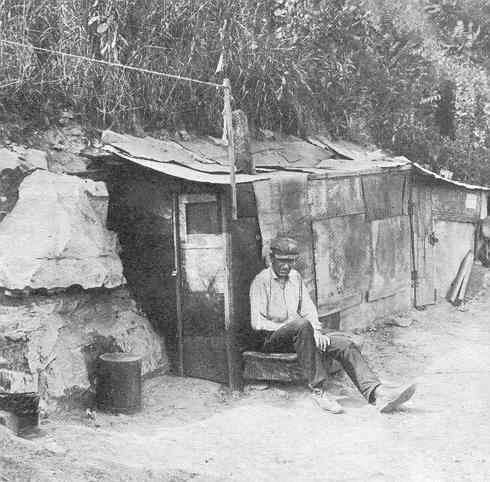
Shacks of the Seattle's "Hooverville"

A typical "Hooverville" shack built during the Depression
around cities with high unemployment

A Communist or Socialist alternative?  Much of Europe had fallen into this same state of affairs – Europeans and their banks having themselves become closely connected to the financial world of Wall Street.  But Russia – now under the Communist dictator Joseph Stalin and a country which of course was not only not involved in this commercial relationship with capitalist Wall Street, but was its dedicated enemy – seemed to be from all appearances (such as Stalin allowed to be publicized[1]) doing awesomely well in building hydroelectric dams, steel mills, industrial plants of all varieties (mostly military-related of course) – at a time when America and most of Europe lay hungry and depressed in their state of economic collapse.  Some Americans of the more Progressivist variety were even suggesting the need to look to the Soviet or Communist model as a possibility for America at this point.[2]

Hoover's belated efforts.  Finally and belatedly, as the American economy continued to fail to revive (one fourth of American workers were now unemployed), 
Hoover began to propose government measures to try to help out the worst parts of the economy.  The 1932 Emergency Relief and Construction Act attempted to start up public works programs to put the unemployed to work and to provide government-secured capital to help start up industries.  But these measures came too late to swing the country back in support of his presidency.  Besides, the Democrats smelled political victory in the coming November 1932 elections and were not in a mood to be very cooperative with the Hoover Presidency, which they were pleased to blame as the cause of the Depression – even accusing Hoover of attempting to introduce Socialism into the economy with his Emergency Act – which ironically would be exactly the path the Democrats would take soon after Roosevelt came to power in 1933!

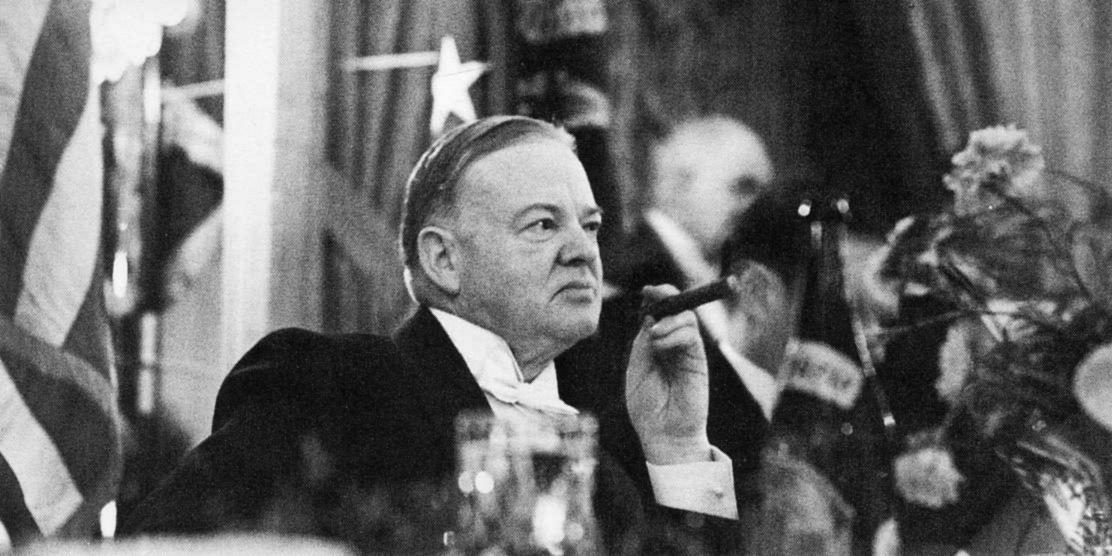
A very wearied President Hoover at a gridiron dinner – March 1932

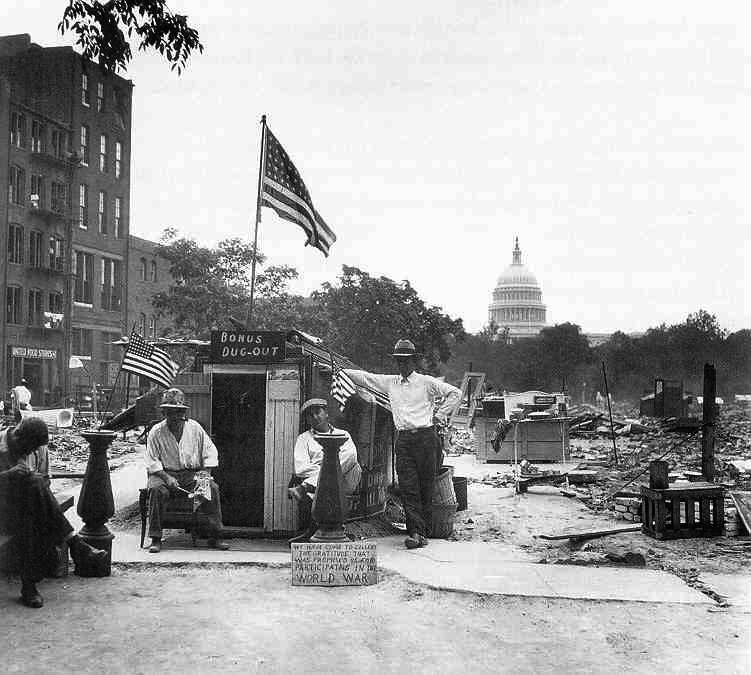
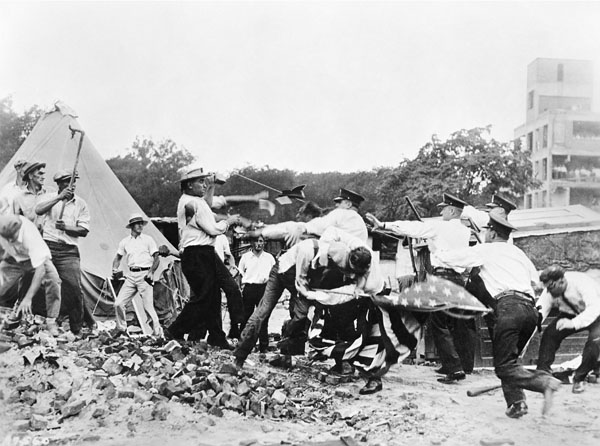
The Bonus Army.   In the upcoming presidential election (1932) there was little chance that Hoover would be re-elected – although his cause was hardly helped by turning U.S. troops on war veterans who had come and camped themselves in Washington that summer in a desperate attempt to get a promised pension or "bonus" due in 1941 paid to them now – even if in a greatly reduced form.  They needed that money now.  But ultimately they were dispersed – rather brutally.

Some of the 17,000 members of the "Bonus Army" who had 
descended on Washington, D.C. in mid 1932 vowing not to 
leave until the bonus promised them for service during 
the War was paid.

"Bonus Army" encampment in Washington, D.C. – 1932..

"Bonus Marchers" and police battle in Washington, DC.
National Archives

[1]The fact that millions of people in Soviet Russia were dying of hunger, disease or simply exhaustion (multitudes of them in Siberian work camps) – because of Stalin’s industrialization program – was carefully hidden from the view of the larger world.  In fact, idealistic American youth who traveled to Russia to see the Stalinist "wonder" typically never left Russia alive, because they saw what was really going on.

[2]During the 1950s McCarthy Era witch hunt for possible American Communist sympathizers, those same Americans would come to regret having gone on record making such a recommendation 20 years earlier in the first years of the Depression.


ROOSEVELT TAKES COMMAND

In his nomination acceptance speech at the 1932 Democratic Convention, the aristocratic – and always cheerful – Franklin Delano Roosevelt mentioned a "new deal" he would be offering Americans – connecting this promise with the song "Happy Days Are Here Again" to drive home the point.  He was all optimism – although he offered no details about what he meant by his "new deal."  Probably he himself was not sure what exactly he was going to do – evidenced in his attacks on Hoover's "extravagant spending" in order to buy the country out of the economic crisis.  It is ironic because this was the central strategy of what eventually became Roosevelt's New Deal.
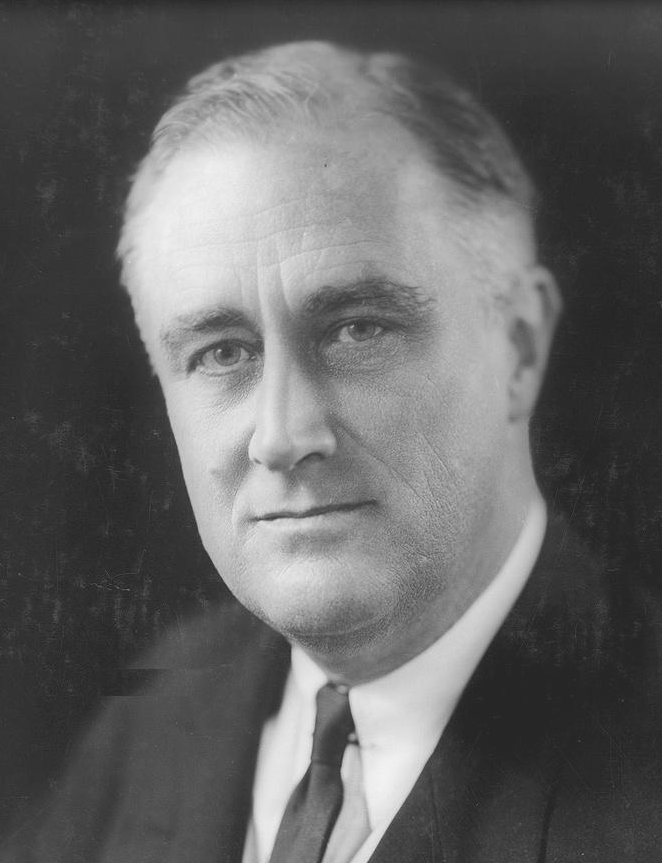
Franklin Delano Roosevelt, 1933

Actually at that point, no one was exactly sure of what needed to be done.  Capitalism had failed.  That much was clear.  And Roosevelt had campaigned repeating the understanding that Americans themselves had failed by making "obeisance to Mammon" (worshiping wealth and the providers of such wealth, the capitalists).  Roosevelt repeatedly used Christian ideals and language, drawn right out of the Social Gospel, promising that the Democratic Party would do the "Christian thing", unlike the insensitive pro-capitalist Republicans.  And in the end, it was an easy win for Roosevelt, who received 57.4 percent of the popular vote to Hoover's 39.7 percent, with the electoral college going 472 for Roosevelt and 52 for Hoover. 


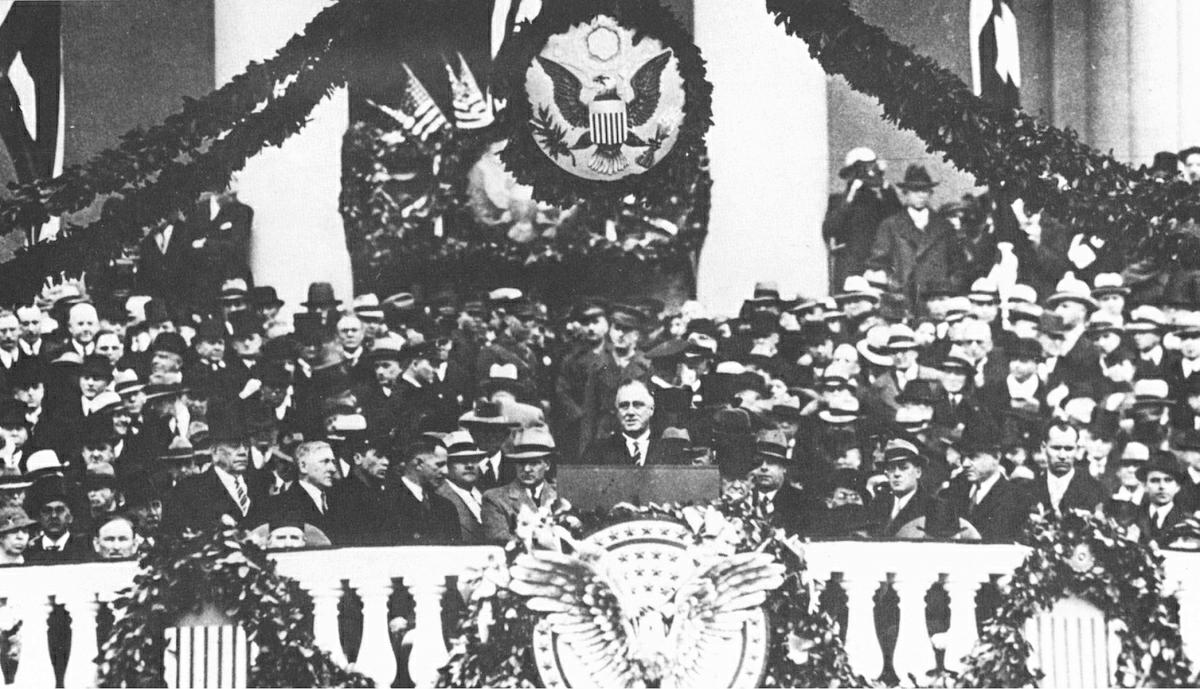
Franklin Roosevelt delivers his inaugural address, March 4, 1933

In his inauguration speech he delivered not only his famous words "the only thing we have to fear is, fear itself" but went on to continue his attack against capitalism (again using familiar Biblical terminology):

The money changers have fled from their high seats in the temple of our civilization. We may now restore that temple to the ancient truths. The measure of the restoration lies in the extent to which we apply social values more noble than mere monetary profit.

He also promised the American people that his administration would now take over the matter, and undertake action, such as capitalism had failed to do, in the face of this national tragedy.

I am prepared under my constitutional duty to recommend the measures that a stricken Nation in the midst of a stricken world may require. These measures, or such other measures as the Congress may build out of its experience and wisdom, I shall seek, within my constitutional authority, to bring to speedy adoption.

In short, Roosevelt's Washington, D.C. – not Wall Street – would bring the country back to health.  But this was unprecedented in America.  And yes Roosevelt was right to mention "within my constitutional authority" because what he proposed raised all sorts of questions about America's constitutional legacy.  What he was proposing sounded very much like what was going on in a number of European countries, such as in Russia under Stalin's state Socialism (his brand of Communism), or in Italy under Mussolini and his Fascists, or in Germany, challenged deeply by Hitler's Nazi or National Socialism.  Was America to join the world in a basically state socialist undertaking?  But "Socialism" was a taboo word to Americans.  Indeed Roosevelt never identified his program as such, but let it be termed the "New Deal."  But what exactly did that mean?  What were these "measures" that Roosevelt was going to propose to Congress to speedily adopt?  America would soon find out.

Franklin Roosevelt – the man himself.
  Roosevelt was born in 1882 in the Hudson River Valley town of Hyde Park to a very prominent New York family, was raised as an only child in considerable privilege, and was watched over carefully by a doting mother, Sara.  As a youth he attended the prestigious Groton Academy in Massachusetts and then went on to Harvard, where he proved to be in the middle ranks of both schools academically.
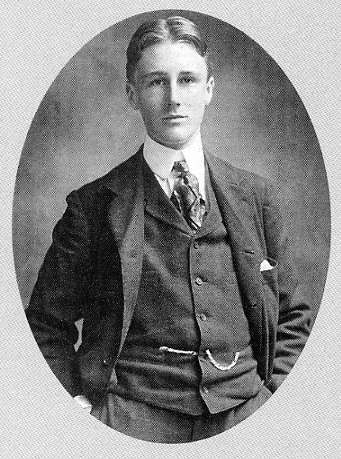
FDR as a last-year student at Groton at age 18

With the death of his father James at the end of 1900, Roosevelt's mother Sara became even more directly engaged in her son's life (she had even followed him to Boston when he was at Harvard). 
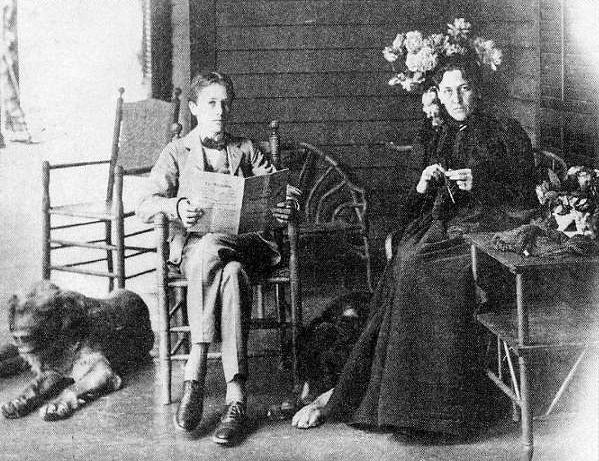
A young FDR and his mother Sara

But Franklin finally found that a relationship which developed in 1902 with Eleanor Roosevelt (Teddys niece and thus a distant cousin of Franklin's) allowed him to free himself considerably from his mother's domineering ways (Sara was very opposed to Franklin and Eleanor's relationship).
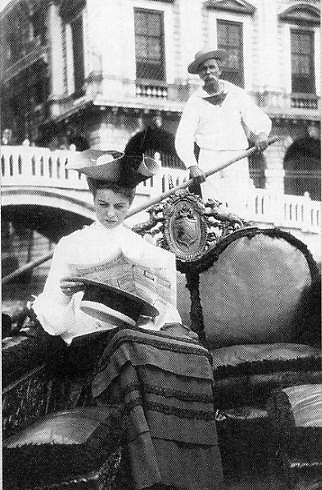
Eleanor Roosevelt in Venice

He went on to attend Columbia Law School in New York City, but dropped out after two years when he passed the bar examination, and went on to be a corporate lawyer with a Wall Street law firm.

His relationship with Eleanor meanwhile was quite mixed, the two of them having six children in fairly short order.  But he, meanwhile, was involved with other women, most notably her personal secretary, Lucy Mercer.  Rather than divorce, they settled on an agreement to continue the marriage, as long as he cut back on his womanizing (which he did not, especially that with Lucy).  Meanwhile, Eleanor would busy herself with a number of social-political activities, which brought her public attention by her own right.

The name "Roosevelt" gave him a lot of political leverage.  And the Democratic Party was very glad to have him on board, when the name was otherwise associated with the Republican Party, thanks to his uncle Teddy.  Thus Franklin became a New York state senator (being a "Progressivist" himself like his uncle), then brought on to Wilson's cabinet as assistant secretary of the navy (also like his uncle), serving as such through the years of World War One. 


Asst. Secretary of the Navy Roosevelt exhorting the crowd to buy Victory Loan bonds – 1919

After the war he was selected as the party's vice-presidential candidate, campaigning with Ohio Governor James Cox.  But the Republican Harding easily won the 1920 election and so that effort came to nothing for Roosevelt.
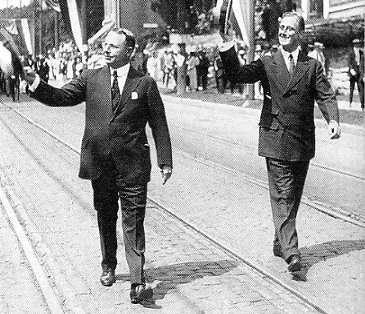
Democrat Vice-Presidential candidate FDR
with Presidential candidate 3-term Ohio Governor James Cox – 1920

Worse, the next year (1921) he contracted polio, leaving him permanently paralyzed from the waist down.  A man of iron will, he refused to admit defeat by the disease, and maintained his law practice, while at the same time attempting various therapies.  In 1926 he purchased a resort at Warm Springs, Georgia, not only for his own treatment, but for others also afflicted with the disease.  He also developed immense upper body strength and the ability to walk (short distances) with the aid of iron braces, often also leaning on the arms of an assistant – so as not to have to appear in public in a wheelchair.  Indeed, his disability was well hidden from the public, which knew little about his disability. 
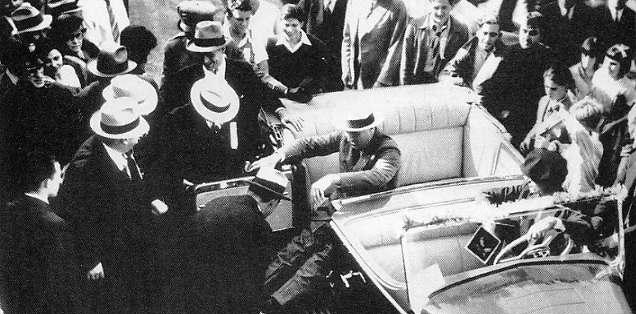
Polio-stricken FDR being helped from a car
(he contracted the debilitating disease in 1921 at age 39
 – but generally hid it from public view)

Thus he continued his career in national politics, intensely determined that his handicap not stand in the way of his desire to go to the top politically. He was a strong supporter of the Tammany Hall political machine, supporting Alfred Smith in his race for governor in 1922 and 1924 (which Smith won) and then for U.S. president in 1928 (which Smith lost).

At the same time Smith encouraged and supported Roosevelt's candidacy for New York governor in 1928, which Roosevelt won (twice) making him the state's governor from 1929 to 1932, when he chose to run for the U.S. presidency – easily becoming the Democratic Party's candidate in 1932.   And, with the country caught in the depths of the Depression, his win over his Republican opponent 
Hoover (naturally blamed for the tragedy) was also fairly easy:  Roosevelt was elected to the U.S. presidency with one of America's widest margins of victory (14 percent) over his Republican opponent.

He was an ambitious man, yet one who relied heavily on his own Christian faith, for its offerings of personal strength (rather than for its moral standards as a husband!).  He had been raised an Episcopalian, and was personally very devoted to his Groton headmaster, the strongly Episcopalian Endicott Peabody, who not only taught him the social responsibilities that fell on the shoulders of the well-born, but presided at Roosevelt's wedding with Eleanor, and then the weddings of their children as well.  And Roosevelt's polio served greatly to lead him to find his dependence on powers greater than his own, or of the surrounding society.  And he would be quite successful in conveying that same understanding and approach to life in his frequent counsel (his famous fireside chats on radio) to the nation, especially as he took America through the dark days ahead.

Roosevelt's "Brain Trust."
  And to do that he gathered around himself a team of bright advisors as visionary as he was – university professors and corporate lawyers – soon to be termed his "Brain Trust."  Together they were going to pursue a strategy of putting into action a massive set of government programs designed to provide the forward thrust economically that now-failed private capitalism had so recently offered American society.  Government investment on a massive scale would presumably do the trick of getting America back to work.
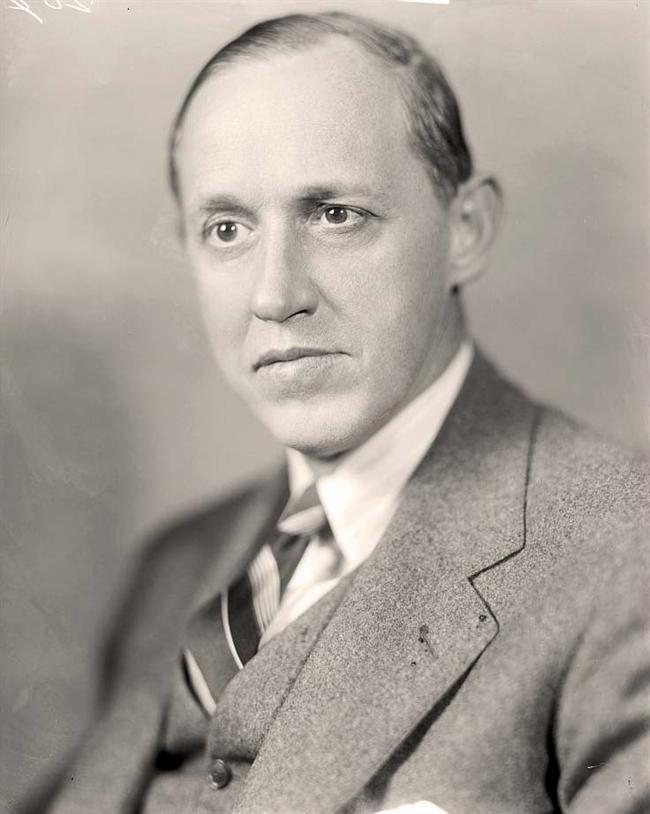
Harry L. Hopkins – Secretary of Commerce, major architect of the
New Deal ... and close personal advisor to Roosevelt
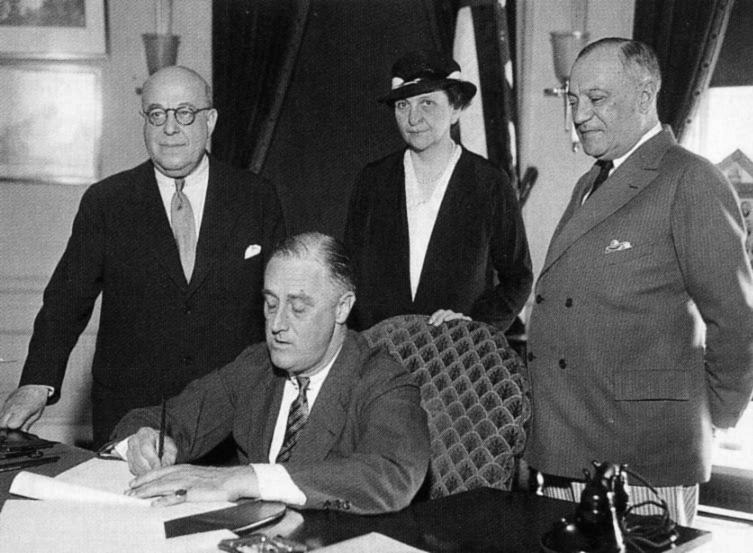
President Roosevelt confirming Frances Perkins as Secretary of
Labor
 and the first woman to sit on a presidential cabinet – 1933

Roosevelt's New Deal.  By the time he took office in March of 1933, Roosevelt was ready to go with a full barrage of such programs designed to get the U.S. economy back up and running again.  He asked businesses to join his program of setting prices, wages and services at certain levels – rewarded by being able to display a special window sticker indicating cooperation with the program (supposedly encouraging people to shop there).  He offered jobs to young family men (ultimately 3 million jobs) working on state lands planting trees and developing the areas as vacation resorts (the Civilian Conservation Corps - CCC). 
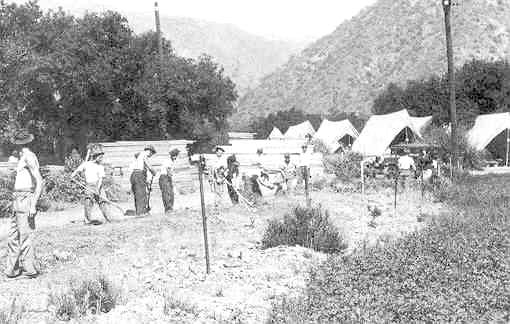
Civilian Conservation Corps work site

He set up a huge project to bring flood control, fertilizer manufacture, and electricity to the mid-South through the creation of the government corporation, the Tennessee Valley Authority (TVA).  He moved to have farmlands taken out of use in order to increase the price of farmers' grains (but making that food now more expensive for everyone else!).  And he got Congress to pass the Glass-Steagall Act giving the Federal Government certain controls over the banking industry – including a bank insurance program (Federal Deposit Insurance Corporation - FDIC) offering government insurance for bank deposits lost in bank closures, designed to help put confidence back in America's banks.  Most of this was undertaken in his first "Hundred Days" in office.

But this was just the beginning of Roosevelt's use of the Federal Government to monitor and guide the nation's economy. In 1934 he set up the Securities and Exchange Commission (SEC) to bring some government control over the speculation that crashed Wall Street – and that same year established the Federal Housing Authority (FHA) to monitor and stabilize the mortgage market.[3]  The next year (1935) he even became ever bolder as chief investor in America's infrastructure with his Works Progress Administration (WPA) – building national highways and municipal buildings across the nation, even simply employing artists to beautify public buildings with their artwork.  And that same year he established the Social Security System, a government-supervised trust-fund designed to help the elderly provide for themselves in their retirement.
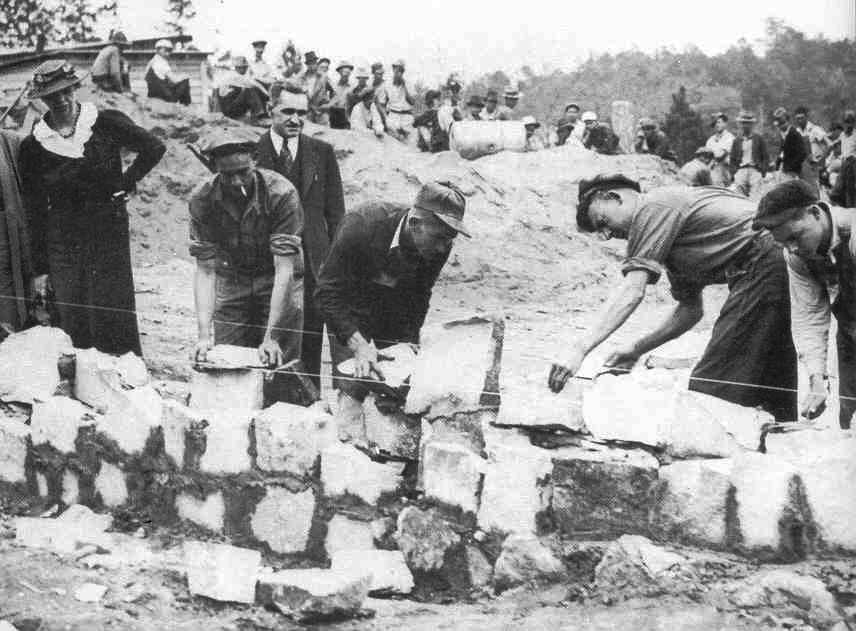
Eleanor Roosevelt visiting a Works Progress Administration
(WPA)  work site in Covington, Georgia


A WPA highway construction project
National Archives

[3]Unfortunately much of the regulatory work of the SEC and FHA was cut back by the Bush Jr. Administration in the opening years of the 2000s – helping produce through the so-called "shadow banking system" the subprime mortgage crisis which started in early 2007 and reached the level of a major financial meltdown in September of 2008.


THE RISE OF INTELLECTUAL OR SECULAR HUMANISM

The depth of the crisis that America was forced to face going into the 1930s not only changed dramatically the direction that American government and economics were taking at this point – from free-market economic foundations involving very limited federal government involvement to a government-commanded or state-socialist economy – but also to new directions culturally, intellectually and spiritually as well.  All the social certainties that seemed to have been in place during the Coolidge period (in many ways reaching back to the very founding of Puritan New England) seemed to have simply collapsed, disappeared, vanished.  It was difficult to believe in anything with any certainty at this point.  A huge moral-spiritual vacuum had taken the place of the former national self-confidence – and quite naturally a whole group of individuals we can term as intellectuals stepped into this vacuum to offer their advice as to how America should be getting out of its predicament. 

To such "forward-looking" or Progressivist American intellectuals of the early 1930s, everything America had long relied on had failed – clearly so.  Capitalism had failed.    Limited government of the Republican variety had failed.  In the estimation of these intellectuals, even Christianity had failed.  It was thus time to consider a new way of going at life, a new world view, a new social program – one designed not only to correct the errors of the past but lead the country to a bright new future.  America needed to find its way to a new Enlightenment.

The 
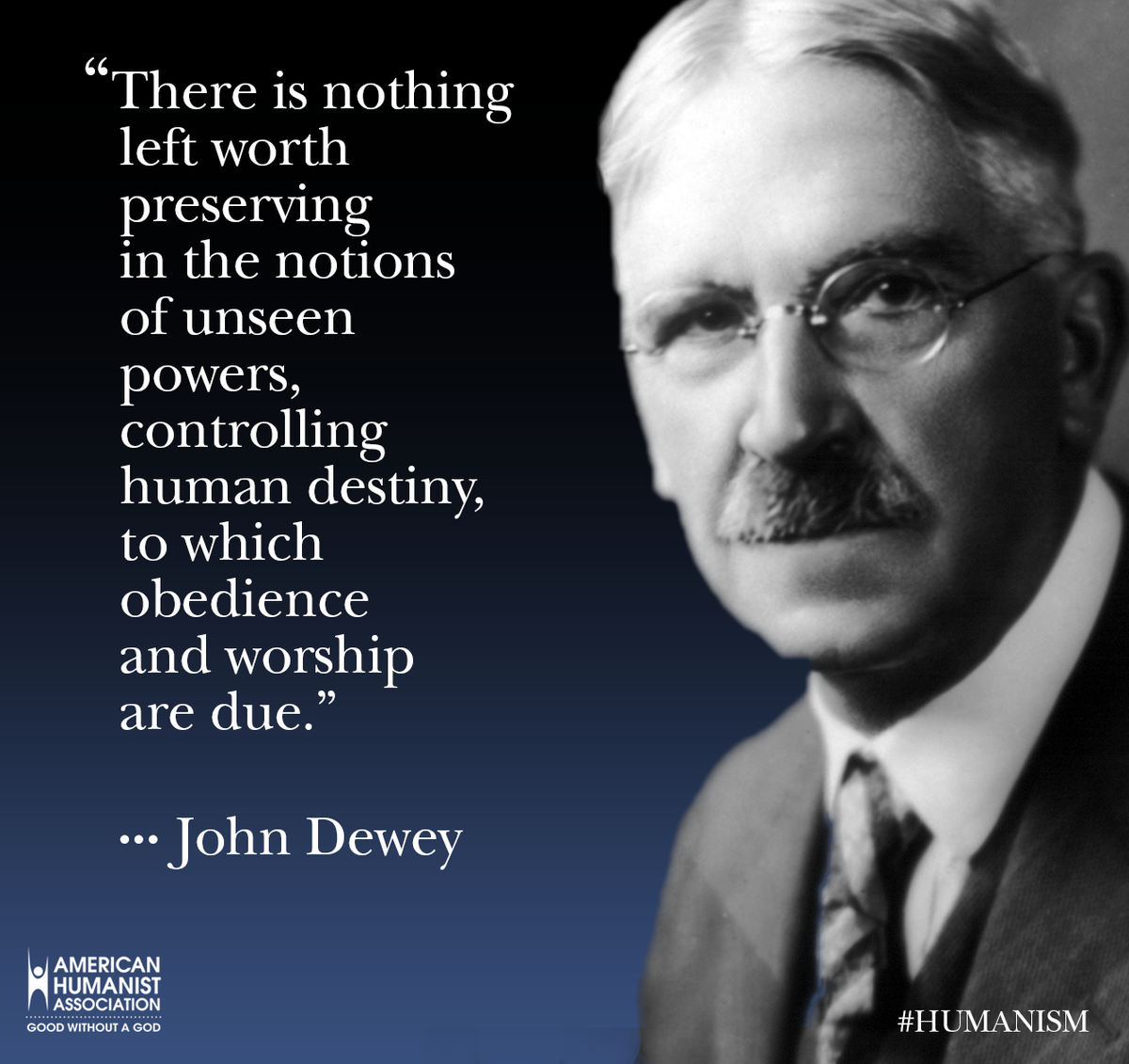
Humanist Manifesto.  Thus it was that in the early summer of 1933, self-proclaimed Humanists signed and published a Humanist Manifesto that was intended to serve as a call to head the nation in a new direction.  And this change of direction needed to be fundamentally thorough – from a change in world views – even a new religion as they themselves termed this new worldview (a religion it was indeed!) – to the particular social programs needed to put the new Humanist religion into place at the heart of the nation.  Signatories included John Dewey, a number of other university professors (Tufts, Cornell, Chicago, Illinois, Columbia, Pittsburgh, Michigan), news editors, and numerous Unitarian pastors.

The Manifesto's fifteen affirmations gave very clear explanation that in its 
Humanism it was intending to bring forward a new religion. "Religious Humanism."  For instance, its Eighth Affirmation states:

Religious Humanism considers the complete realization of human personality to be the end of man's life and seeks its development and fulfillment in the here and now. This is the explanation of the humanist's social passion.

It clearly states its new religious beliefs as: no divinely-ordained creation, but simply self-existent creation; man as an evolved natural creature; truth only through scientific study; the end to theistic (God based) religion; social concern and service to replace the self-serving profit motive of capitalism; the need to embrace life rather than flee from it (seeing traditional religion as "escapist" in nature).

Humanism claimed that it was the path to social and mental hygiene and that it discouraged sentimental and unreal hopes and wishful thinking.  However, there cannot be a philosophy that has again and again built more unreal hopes and wishful thinking on utopian dreams of a new or revolutionary society founded on human perfection.  Instead again and again, Humanism has produced horrible failures that have accompanied every such attempt, beginning with the utopian French Revolution and continuing with every utopian Marxist or Communist revolution since then.  Even German Fascism ("National Socialism") was built on what the Germans believed to be "reasonable and manly attitudes" dreamed up by a utopian rationalist named Hitler.
Admittedly, the Humanism of 1933 had not yet been permitted to see the worst of utopian Humanism of the Marxist and Fascist variety.  But the seeds of disaster were always there if you actually looked closely at the philosophy.  But the religious blindness of the Humanists caused them to fail to see that their philosophy was about the furthest thing possible from social and mental hygiene.


PROBLEMS WITH THE SUPREME COURT

Meanwhile, the U.S. Supreme Court was still under the domination of some very conservative justices.  They did not agree with the Humanist idea – or the core idea of the Rooseveltian New Deal – namely, that enlightened individuals in governmental service should take over the responsibilities of power because the people themselves obviously were not in a position any more to help themselves.  The members of the Supreme Court did not see things Roosevelt's way at all.  Thus a number of key programs in Roosevelt's New Deal were shot down in 1935, with the Supreme Court repeatedly declaring them to have no constitutional warrant.  Roosevelt's programs fell way beyond what was permitted by the Constitution – even when stretching the interstate commerce clause to its fullest extent possible.  His programs were therefore unconstitutional.

The U.S. Supreme Court - 1930

The U.S. Supreme Court in session

Roosevelt was so upset by this personal rebuff by the Supreme Court that in early 1937, just as he began his second term in office, he announced that he intended to introduce to Congress a bill designed to authorize an increase in the number of the Court's justices.  The political intent was clear to all:  through the presidential power of appointment, he was looking to pack the Court with enough new "Progressive" justices to swing the Supreme Court rulings in his favor.  But in this the reaction was very negative – among the American people in general (who looked upon these Federal judges as the very picture of legal purity) – but particularly also within Congress itself, despite its Democratic Party majority.  Debate dragged on in Congress – while Roosevelt began to lose rather than gain political ground there.

But in the meantime a switch of votes in the Supreme Court had occurred, with one of the justices changing sides from anti to pro New Deal, and another justice retiring, thus giving Roosevelt the opportunity to make a new appointment.  He now had a voting majority without having to pack the Court.  Roosevelt backed down on his court-packing scheme.  But he had lost a lot of political standing in the process.  Many Americans felt that Roosevelt was taking notes from the high-handed ways of the European dictators, Stalin, Hitler and Mussolini.  Roosevelt not only had gambled personally and lost in this contest, he had greatly weakened his ability to continue the political reforms he felt the country needed to undergo in order to get back to economic health.


NO ... THE NEW DEAL DID NOT BRING AMERICA OUT OF THE DEPRESSION

This event was also timed with another slowdown in the American economy which hit in 1937, resulting in the growth again in the number of unemployed Americans.  Roosevelt had built all the national highways needed by the country, he had put hydroelectric dams wherever there was some logic for doing so, the national parks were completed, etc.  The market for federal projects was therefore fully saturated (just like the consumer market of the late 1920s had become) – and there was very little else for the government to undertake by way of projects designed to hire unemployed Americans.

Private industry had not swung back into business with the arrival of the New Deal.  No new products to stir the interests of the American private consumer were brought to market during the 1930s.  And the stock market that funded such possible industrial growth remained idle – Americans too afraid to get involved there again. And what money the American workers did gain they "put under their mattresses" – meaning, saving rather than spending their scarce dollars – and thus providing no help to the market either.

So, yes … the New Deal put in place some much-needed social or national infrastructure items (highways, dams, national parks, etc.) that private industry would not have offered America.  Thus the New Deal was a very good thing economically (although somewhat questionable politically or constitutionally), and helped reduce some of the massive unemployment that America was suffering from – at least for a few years anyway.  But ultimately the American economy is shaped not by government decisions (as in Socialist countries) but by what the American people themselves bring to the national economy.  And during the latter 1930s, those American people were still too fearful of economic dynamics to risk their small hold on their own personal wealth to buy into an economic rebuild.


THE MIDWEST "DUST BOWL"

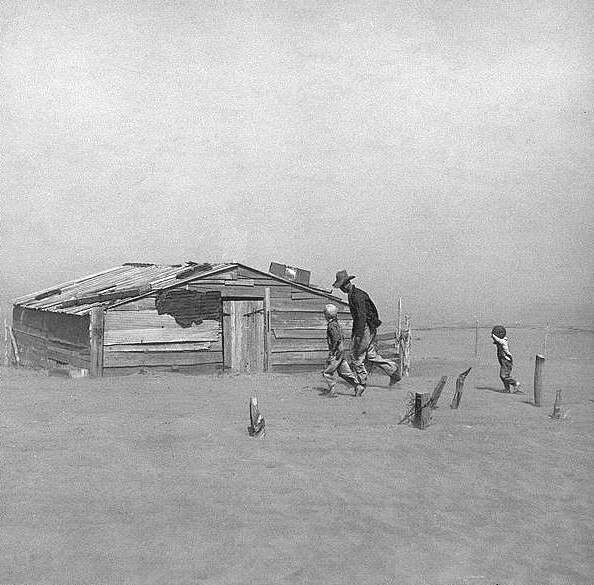
Then, just to make the 1930s even more horrible, on top of this return to economic depression a massive drought which hit the American Midwest dragged on year after year in the mid-1930s, pulling down even further the farming economies of states ranging from Texas in the south to the Dakotas in the north. 

A dust storm in Texas - 1935

A dust storm about to envelope Elkhart, Kansas – May 21, 1937
Prolonged drought throughout the 1930s reduced
the Kansas wheat fields to dust.

Library of Congress

Dust Storm – by Arthur Rothstein
Library of Congress

An abandoned farm in the South Dakota Dust Bowl – May 1936
National Archives

An abandoned farm in New Mexico hit hard by the dust storms

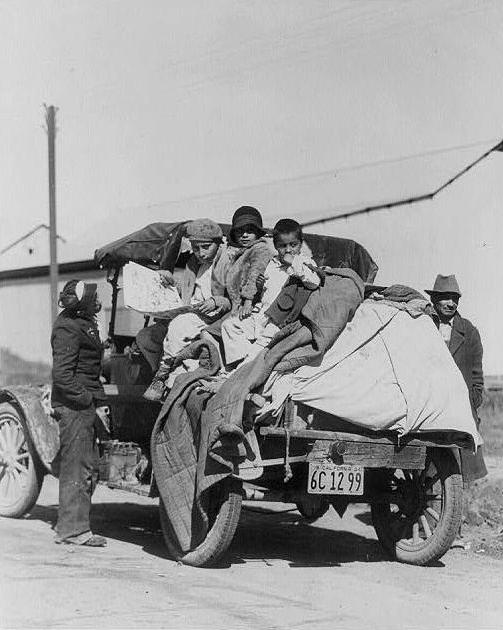
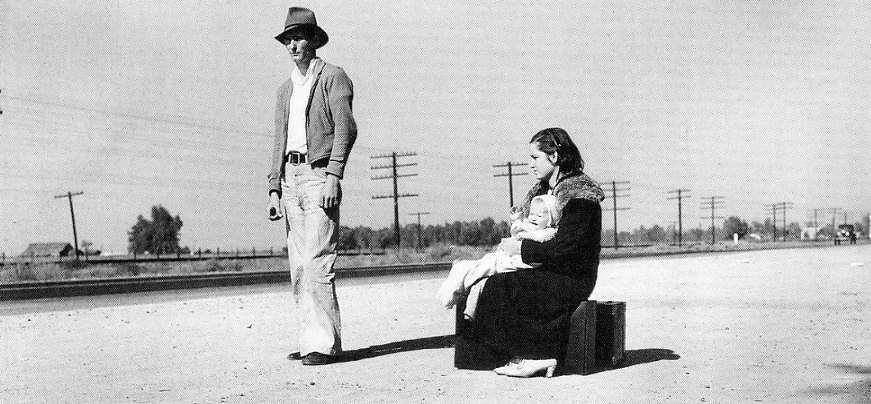
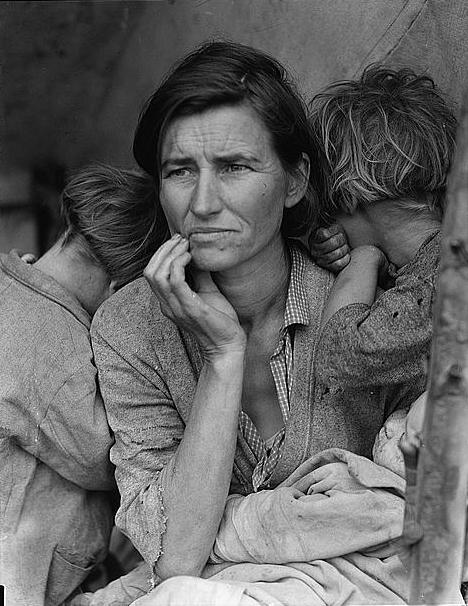
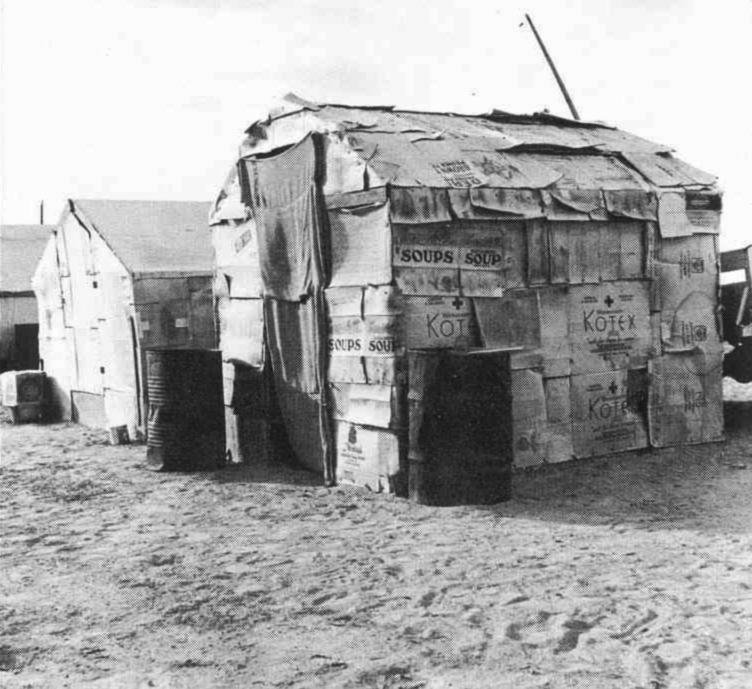
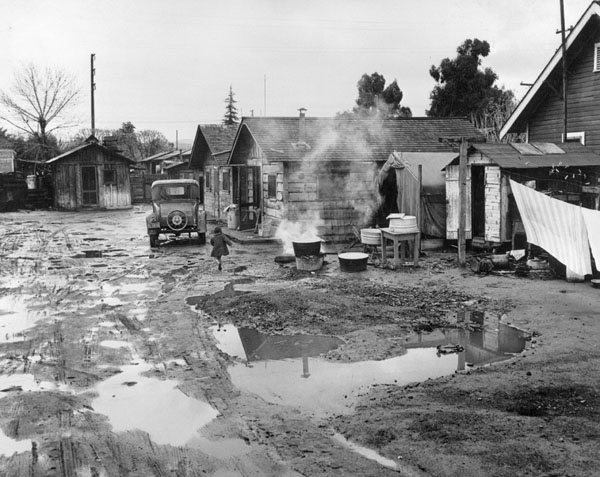
With this the American highways were filled with farm families making their way West as best they could, to find some kind of work in the California vegetable fields.  These migrants were a very sad-looking lot, reduced to living in cardboard shacks and moving from area to area as the California plantings and harvests came and went.

"Dust Bowl" families heading West
Library of Congress

Oakie Family heading West
(What's this? ... It looks like he just dropped his cell phone!!!)
   

Heading west to California in search of a better life
Library of Congres

A family living out of their flatbed truck – California
February 1935
 – Dorthea Lange
Library of Congress

A young couple who had been working the fields along Highway 99
 in California's Imperial Valley.
 Dorothea Lange, November 1936
Library of Congress

Migrant mother of Seven - Nipomo, California – March 1936
Dorthea Lange
Library of Congress


A Texas family living in a tent in Exeter, California – 1936
Library of Congress

Migrant workers' shack
Library of Congress

Thus by 1937 America was again sliding back into economic depression.  1938 was not any better economically – and 1939 saw only a very slight economic recovery.

A Federal relief worker visiting a Tennessee family in 1935

Daughters of a WPA worker and a sick mother
Library of Congress

"Cheap Auto Camp Housing for Citrus Workers"
Dorothea Lange, Tulare County, California, February 1940

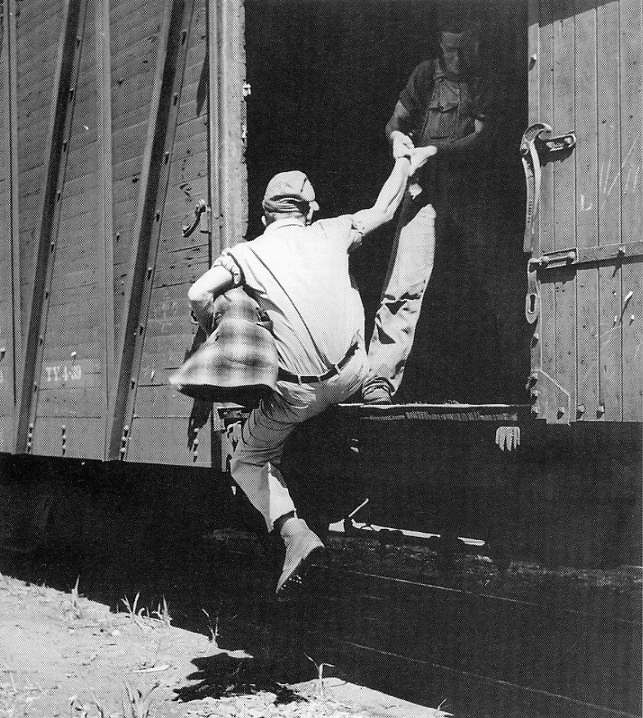
Riding the rails – Bakersfield, California 1940

So again: No … the New Deal had not brought America out of the Depression – as is so often claimed.  It would take something else to do that – something very big and quite different, namely, World War Two – and America's entry into that war.  But that was still a few years away for America.


CHRISTIANITY'S ONGOING STRUGGLE WITH ENLIGHTENED HUMANISM

We have already seen how in the late 1600s / early 1700s Christianity was losing its foundational position in Western society due to the rise of a new age (actually only just another such age) of human Enlightenment.  We saw how this humanism revived itself in the comfortable world of America during the early years of the 1800s (the Era of Good Feelings).  And now a century later, Christianity found itself again under the challenge of personal faith in God's caring hand versus social management from above by self-enlightened or "scientific" wise ones (Sophists).

And once again prominent voices even inside the Church were calling for a more "rational" faith – one based more on a logical or scientific commitment to seek social morality – or peace and social justice – rather than one based on the personal quest for personal salvation and consequent faith in God's deliverance.  Man needed to deliver himself – 
Jesus's way, of course.

At the heart of this debate (or even fight) was the huge Presbyterian denomination – caught up in a split that started at the turn into the 20th century and only deepened as the denomination headed into the 1930s.  At first Christian traditionalists or conservatives seemed to have the upper hand.  But bit by bit, the weight of Presbyterian opinion seemed to be clearly swinging away from such Christian conservatism or Fundamentalism in the direction of Christian Humanism, which recast Christianity as basically centered on social progress through programs of social improvement (the Social Gospel).  Princeton Seminary professor John Gresham Machen found his conservative views slowly being rejected by the growing trend at Princeton to take the more "Liberal" or Humanist view – until in 1929 he left the seminary and founded Westminster Seminary in nearby Philadelphia.  But the tide of Presbyterian Humanism continued to mount – and in 1933 Machen was even excommunicated from the Presbyterian denomination.

Christian Liberals felt that history and time was on their side and that soon all reasonable people would be joining them in their modernizing religious camp (just like Jefferson expected a century earlier!).  But sadly, the more churches drifted further and further in this Liberal or Humanist direction, the more they lost their strong, clear voice – once the moral bedrock of American politics.  The churches were once again fast making themselves irrelevant.  How ironic: it was their claim that by making themselves look more like the world, they would enhance their influence in the world's affairs.  But in fact the end result was quite the opposite!
In the midst of this religious transition one of America's greatest theologians, H. Richard Niebuhr, so tellingly described what was happening to the message of the American church:

A God without wrath brought men without sin into a kingdom without judgment through the ministrations of a Christ without a cross.[4] 

Fifield's Spiritual Mobilization movement.  Yet outside of the world of theological academics there was some action underway to get the country back on course with God, and away from an increasing dependence on salvation by social design coming from FDR's Washington experts.  Los Angeles Congregational pastor James W. Fifield, Jr. – who had some of the same bold instincts as did once the greatest of the American capitalists – in the mid-1930s founded Spiritual Mobilization, a grass-roots movement dedicated to getting the gospel of personal independence out to the nation through the sermons preached from the pulpits of the movement's extensive pastoral membership.  Fifield was able to gain enormous financial backing from key business leaders so as to hold conferences, bring in speakers, and publish materials to enlighten America's clergy as to the role they needed to play in bringing the country out of its drift towards Socialism and back to America's tradition of personal freedom, one that prompted personal initiative and responsibility, and ultimately personal success, something they were certain was mandated by God himself.  This broad mix of Christianity with conservative political values during the last half of the 1930s (continuing through the 1940s and into the 1950s) brought thousands of pastors (and hundreds of businessmen) to active support of Spiritual Mobilization.

Vereide's prayer breakfast movement.  On another front, and also originating in the American West, was Norwegian-born Methodist minister Abraham Vereide's City Chapel program, bringing businessmen and local political officials (across the broadest religious and political spectrum possible, although basically Protestant in character) to "breakfasts" where extensive prayer would be offered – for the local community, the nation and the world. 

Vereide had earlier founded and led the Seattle operations of Goodwill Industries, a company focused on offering employment to those who had such disabilities that they would not likely find employment elsewhere.  
Vereide proved to be an outstanding organizational leader, building up the Seattle operation to involve tens of thousands of workers and supporters.  But gradually he grew disillusioned with the failure of charity to change people's circumstances for the better, and resigned – to look for life's answers elsewhere.  He too was a strong believer in personal initiative rather than governmental dependency.

His next direction in life came when he visited San Francisco during the violent longshoremen's strike of 1934, and found himself invited to lead the local businessmen's association in prayer during those dark times.  Then when he returned to Seattle (where the strike was also ongoing) he deliberately set up an early morning breakfast prayer meeting at his City Chapel for some of Seattle's business leaders, soon joined as well by some local politicians.

These prayer breakfasts proved so encouraging to Seattle's demoralized business class that they continued their existence year after year, growing all the while.  Here too, in the early 1940s, the war would only amplify the sense of need of such prayer gatherings, spreading Vereide's movement from city to city across the nation so that they would eventually become a key part of the American national religious and political scene, eventually including the president's annual Prayer Breakfast, started up in 1952.


[4]Niebuhr, The Kingdom of God in America (New York: Harper & Bros., 1937), p. 193.


AMERICA TOUGHENS UP

The sad irony is that the Great Depression actually came as something of a blessing – for it brought America out of the silliness of the 1920s as well as the foolish intellectual idealism of the early 1930s – and readied America for a very serious challenge that was waiting for the country in the form of the highly aggressive Japanese and German Empires.  Had America attempted to answer these dangerous challenges going at them with the attitudes of ten years earlier, America would have been another of those "democratic wimps" that just was unable to muster the self-discipline and determination to go sacrificially into battle.  But by the end of the 1930s the Americans had turned themselves into a tough breed, able to face very hard times without quitting.

This is not to say that Americans thought of themselves ready to go into action.  Mostly they were quite content to stay out of the drama that was going on in Europe – although the Japanese treatment of the Chinese after their invasion of China in 1937 troubled Americans deeply, because there was among Americans a natural tendency to look to the Chinese sympathetically.  Eventually that sympathy would be turned to Japanese counter-action – which would finally bring America directly into the global conflict that was well underway as the 1930s headed toward the 1940s.


Go on to the next section:

World War Two ... and Startup of the Cold War


  Miles H. Hodges