The Panama Canal.
Early on as president, a decision of Carter's to offer the Panamanians
full possession of the Panama Canal brought bewilderment to
Americans – as Carter met with Panamanian military
dictator, General Omar Torrijos, to consummate the deal. Where did Carter's scruples about not working
with dictators go? And why was Carter giving up such a valuable
American asset? Panama as a nation was
originally a fiction of American creation, America had paid dearly in dollars
and human effort (and loss) in building that canal, and the canal was a
strategic necessity in the way it linked America's two sea coasts – and vital
to the American navy in its call to protect those coasts.
Supposedly
this was done to encourage good-will between America and Latin America. But it merely ended up making America look
weak – and in no ways improved the respect or love that the Latin neighbors had
for America.
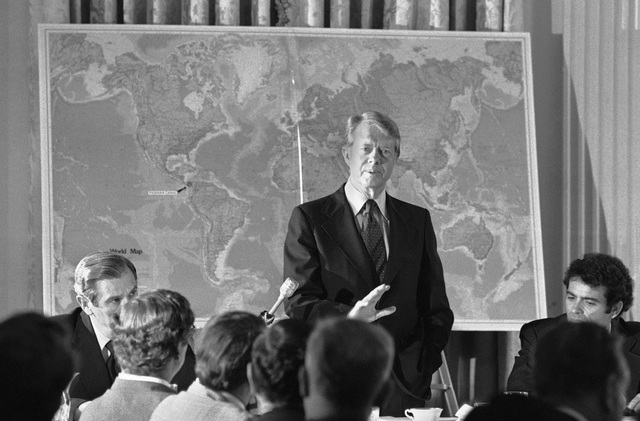
Carter explaining to
representatives of Georgia and Florida
his proposed new treaty to turn the Panama
Canal over
to Panama – August 1977
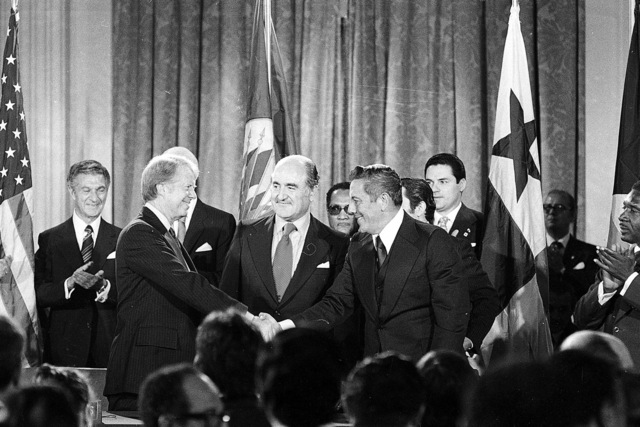
September 1977 – Jimmy Carter
agreeing with Panama's
President Omar Torrijos to surrender the Panama Canal
over to
Panama – a sign of our ending the era of American
imperialism
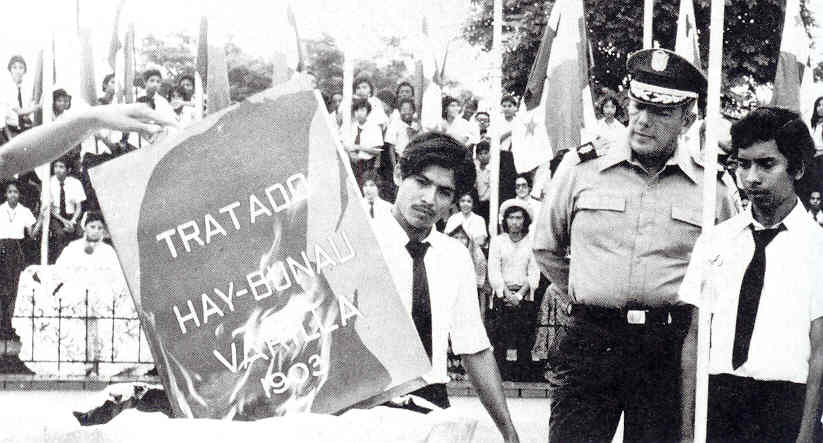
Symbolic burning of the 1903
Panama treaty –
with Panamanian President Omar Torrijos looking
on
South Korea. Carter also announced a pending
withdrawal of the American military from South Korea – as he had promised
during the campaign. But thankfully some
of his own foreign policy team convinced him that this would simply invite
another North Korean invasion – and war – similar to what happened in the early
1950s, when America pulled its troops out of South Korea. So Carter backed down on this matter.
Iran. With respect to Shah Mohammed Reza Pahlavi's Iran, here too, Carter's moral-initiative threw
confusion into the works. He threatened
the Shah with a withdrawal of American
support (sale of military items) if the Shah did not undertake a more
democratic hand in the governing of Iran.
Specifically, he wanted an end to the imprisonment of Iranians
(presumably some 3,000 individuals) simply because of their opposition to the Shah's rule. Under such a serious threat, the Shah complied – and released most of
these political adversaries.
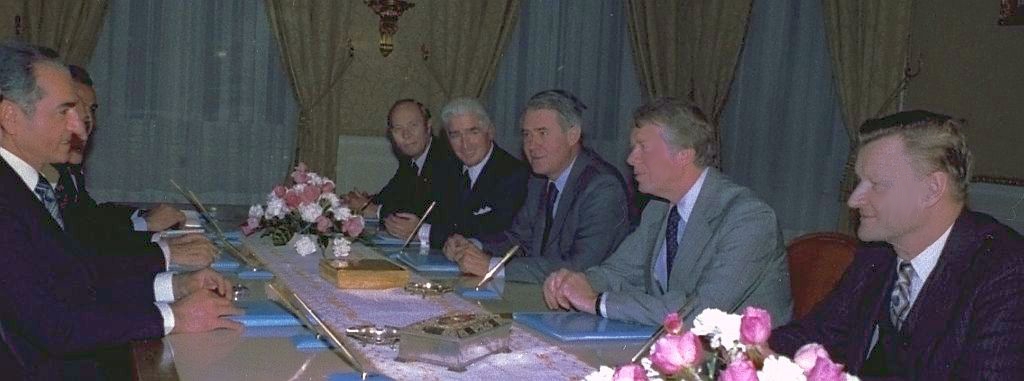
Carter and his cabinet meet
with the Shah of Iran – November
1977
(Carter, 2nd from the right ...
with his secretary of
State Cyrus Vance to his right and his National Security
Advisor
Zbigniew Brzezinski to his left ... discussing with
the Shah the political
reforms the Shah must undertake
in order to continue to enjoy American
financial support)
But
again, wise counsel got to Carter – who was reminded about what
had been going on in neighboring Afghanistan, when the Shah of Afghanistan was overthrown
and a Republic – headed by the Afghan Shah's cousin, Daoud – was
declared. The Communists had taken
advantage of the chaos – and were a rising threat to the Daoud regime – which
put the Soviets in the position to make some very serious trouble in this quite
vital part of the world (very close to the Indian Ocean and the path of the
West's oil from the oil-rich Persian Gulf region). Iran found itself in a similar situation
located where it was (right next to Afghanistan). Carter needed to tread lightly in his
"straightening up" of the Shah.
So
at the end of 1977, Carter flew off to Europe and
India. But that trip included Iran
(celebrating New Year's Eve in Tehran) as a demonstration of America's ongoing
support of Iran – Carter even publicly praising the Shah's Iran as "an island of
stability in one of the more troubled areas of the world."
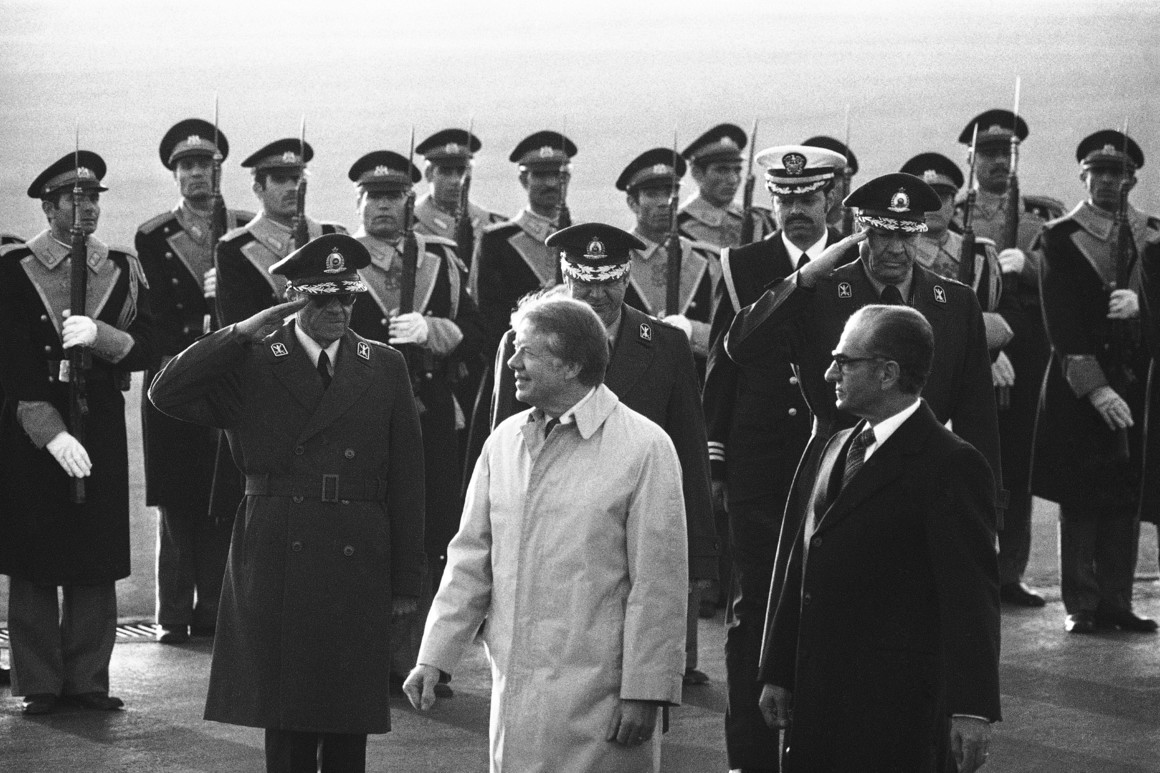
Carter arrives in Tehran in time to celebrate New Year's Eve
with the Shah (December 31, 1977)
Understanding
that he now had full American support, the Shah moved to arrest again opponents
of his regime. But he now found himself
facing a new resolve from these opponents – who were able to mobilize street
protesters in support of their anti-Shah crusade. Mostly the opponents were young Secularists –
indeed looking for an Iranian Republic, and the economic and political
advantages they saw in such a republic.
But this protest movement also allowed very traditionalist Muslims and
their religious leaders to also get into the act – to oppose the Shah's very secular culture itself
(proto-Western and pro-American) as the embodiment of pure evil.
Inflation and unemployment in Iran. Two major economic
factors drove the anger of the protesters.
The sudden wealth that had come to Iran as a result of the four-fold
increase in oil revenues had the effect of driving the price of available goods
also to new heights. But Iranian
salaries did not keep up with this increase in consumer prices – angering
multitudes of Iranians. For the Iranian
farmer, the situation was even worse because the earnings from their harvests
were pegged to the price of agricultural products globally (including American
agricultural exports) – meaning, they went up barely at all – at the same time
that the cost of fuel for their machinery and the cost of their fertilizers
rose sharply. In short, the oil bonanza
had actually made the Iranian farmer poorer – much poorer.
And
there was the problem of the multitudes of young Iranians whose families were
able to send them off to study engineering at various universities in the West
– thousands of educated young men who subsequently were to discover that Iran's
basic oil-driven economy did not need multitudes of engineers. There were no jobs for them as engineers back
in Iran.
Mounting protests. Thus it was that the Shah found himself facing mounting
bitterness and anger – over matters that he himself had little ability to alter
or improve. And prompted by a rising
Muslim voice – in particular through the cassettes of sermons sent back from
Paris to Iran by the top Muslim cleric, the Ayatollah Ruhollah Khomeini – it
seemed clearer and clearer to many Iranians that the Shah had allowed some great evil to
come in among the Iranians. And if the Shah was powerless before such evil,
then he needed to go.
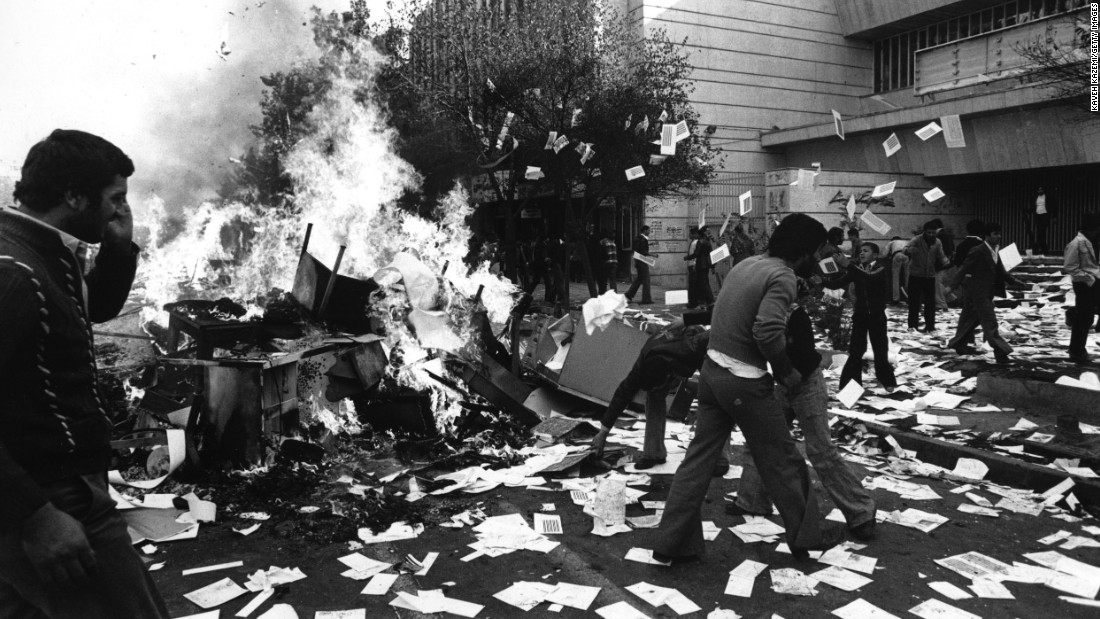
1978 – Iranian students protesting the
Shah's government
The Shah flees Iran.
As the year 1978 developed, so did the street protests – which by the
end of the summer had virtually paralyzed the country – yet somehow grew even
worse as the rest of the year unfolded.
Finally, the Shah simply fled the country early
the next year (mid-January 1979). The
streets were immediately filled with cheering crowds at the news of the Shah's departure – for Iran could now
move to the status of being a Republic.[2]
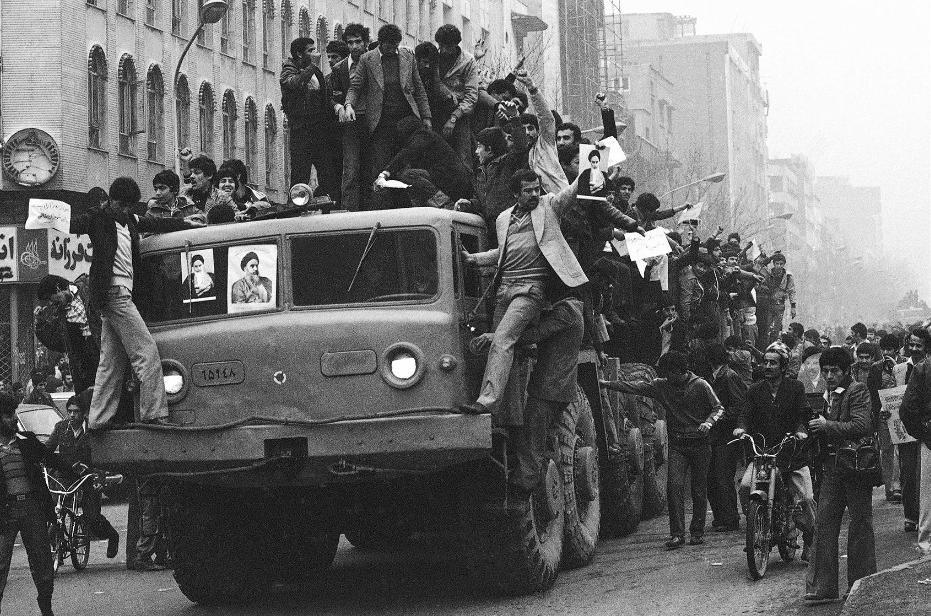
Iranians celebrating in Tehran on
January 17, 1979,
after the Shah's departure
The Islamic Republic. But almost immediately a split began to
develop in the anti-Shah ranks – between the modernizing
Secularists (Westernized youth) and the arch-traditionalist Muslims, headed up
by the Ayatollah Khomeini, who arrived from Paris at the beginning of February
– just as the last pro-Shah forces were being crushed. Employing young Muslim zealots (the
Revolutionary Guard), the Muslim faction slowly drove the Secular Iranians from
power – then suppressed all voices of dissent.
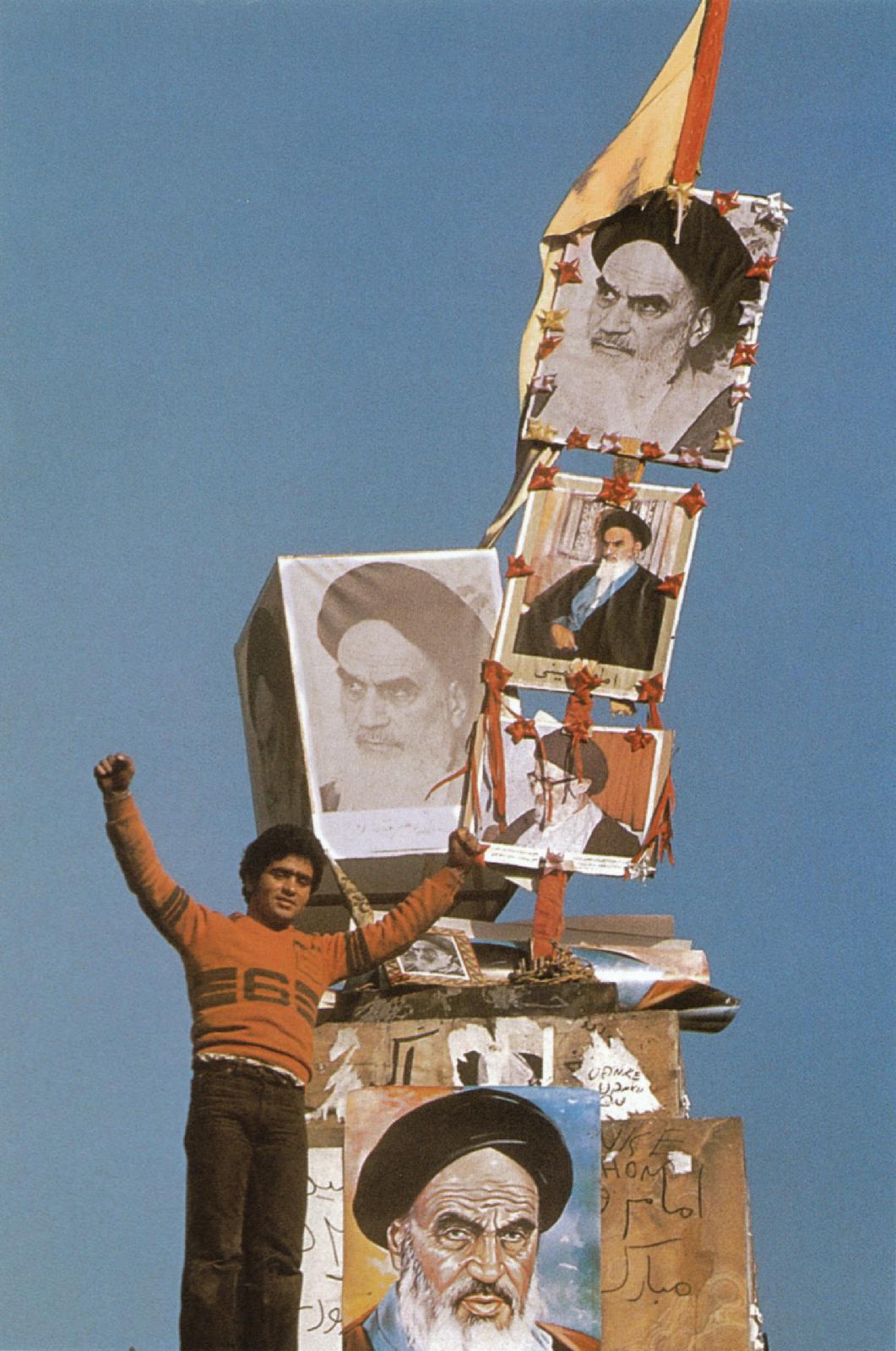
Iranian welcome the returning
Ayatollah Ruhollah Khomeini
– January 1979
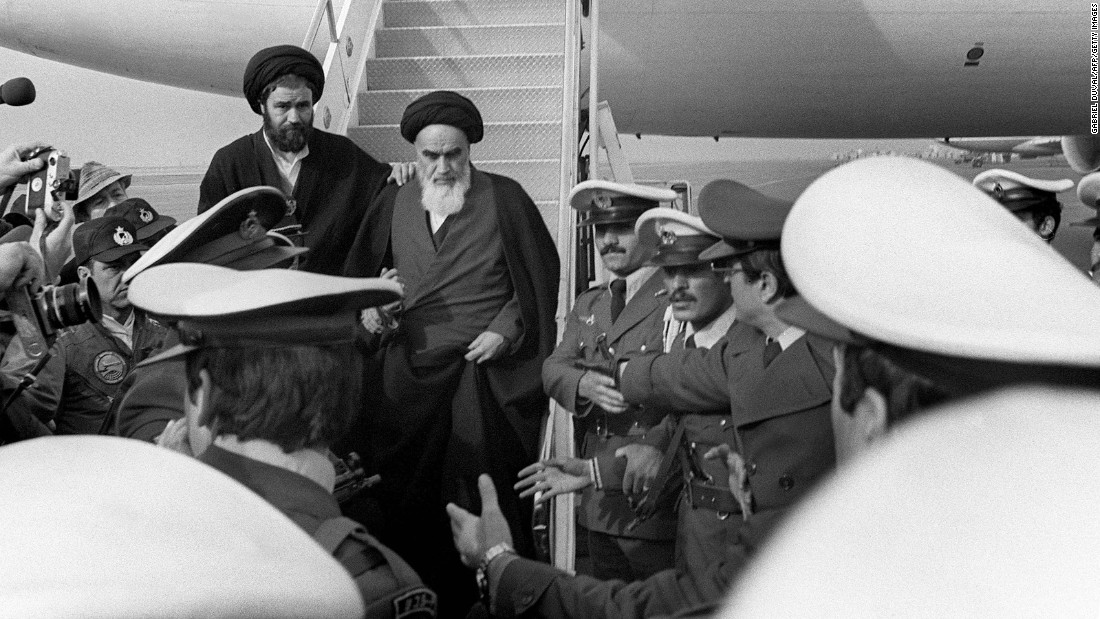
February 1, 1979 – the Ayatollah Khomeini arrives in
Iran
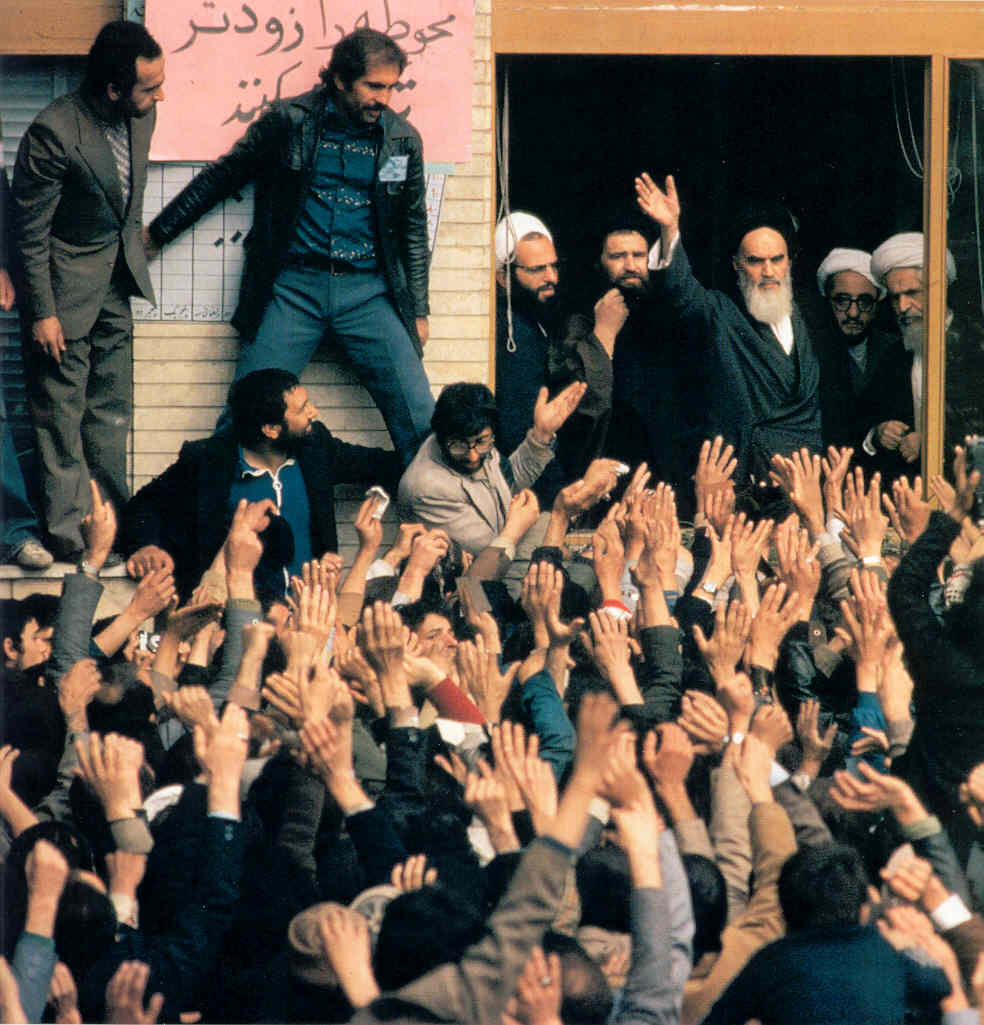
Followers of the Ayatollah
Khomeini celebrating his return to Iran
from exile
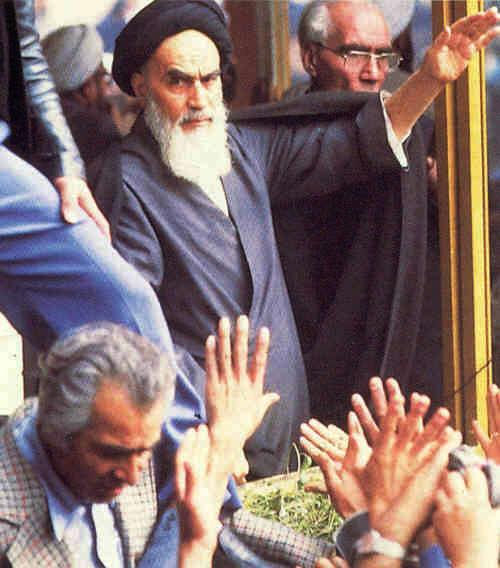
The Ayatollah Khomeini
Iran
was indeed going to be a Republic – but an Islamic Republic ... complete with an
elected national Assembly – but presided over ultimately by the Supreme Ruler,
the Ayatollah Khomeini.
Elsewhere
The Camp David Accords between Egypt and
Israel (1978). In November 1977 Egyptian President Sadat surprised the world (including Carter) by flying off to Jerusalem to
address the Israeli Knesset about the possibilities of an Egyptian-Israeli
peace. Sadat of course had secretly worked
out a deal with Israeli Prime Minister Menachem Begin – who was eager to see
a split in the Arab ranks (this action would certainly alienate Sadat from the rest of the Arab
front) and was willing to negotiate some kind of a deal over Egypt's Sinai
Peninsula (still under Israeli occupation) in order to achieve such a political
breakthrough.
Carter also believed that moral persuasion
might also bring
the Arab-Israeli crisis to a peaceful resolution. But Egyptian
President Anwar al-Sadat beat him to the
punch by flying to
Israel to offer Egyptian terms of peace with Israel.
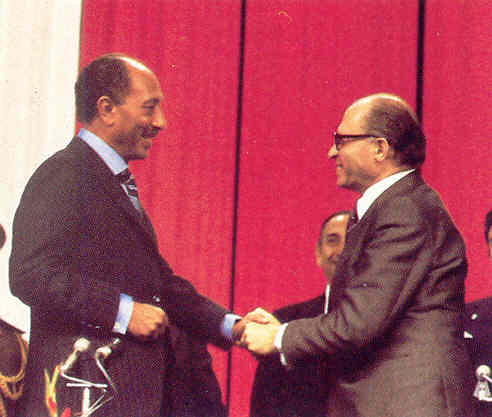
Israel's Prime Minister Menachem
Begin welcomes Egyptian
President Anwar Sadat to Jerusalem – November
1977
This
move in turn put pressure on Carter to do something to help Sadat bring some kind of fruit from
this venture – for all this also put Sadat in trouble with his own
people. Thus Carter finally invited both Sadat and Begin to come to the
presidential retreat at Camp David (September 1978) – to see what could be
worked out. But now Carter put a larger set of interests
into the discussions – demanding that the status of the Palestinian lands of
the West Bank and the Gaza Strip be included in the deal. Sadat was not all that interested in
going beyond retrieving his Sinai territory.
But Carter put the pressure on both Sadat and Begin – demanding some kind
of reward for the Palestinians as well in the deal. Finally, not wishing to come away
empty-handed from the nearly two-weeks-long talks, Begin yielded and agreed on a
withdrawal not only from the Sinai but also the Palestinian lands still
occupied by the Israelis (Syria's Golan Heights however were left out of the
deal).
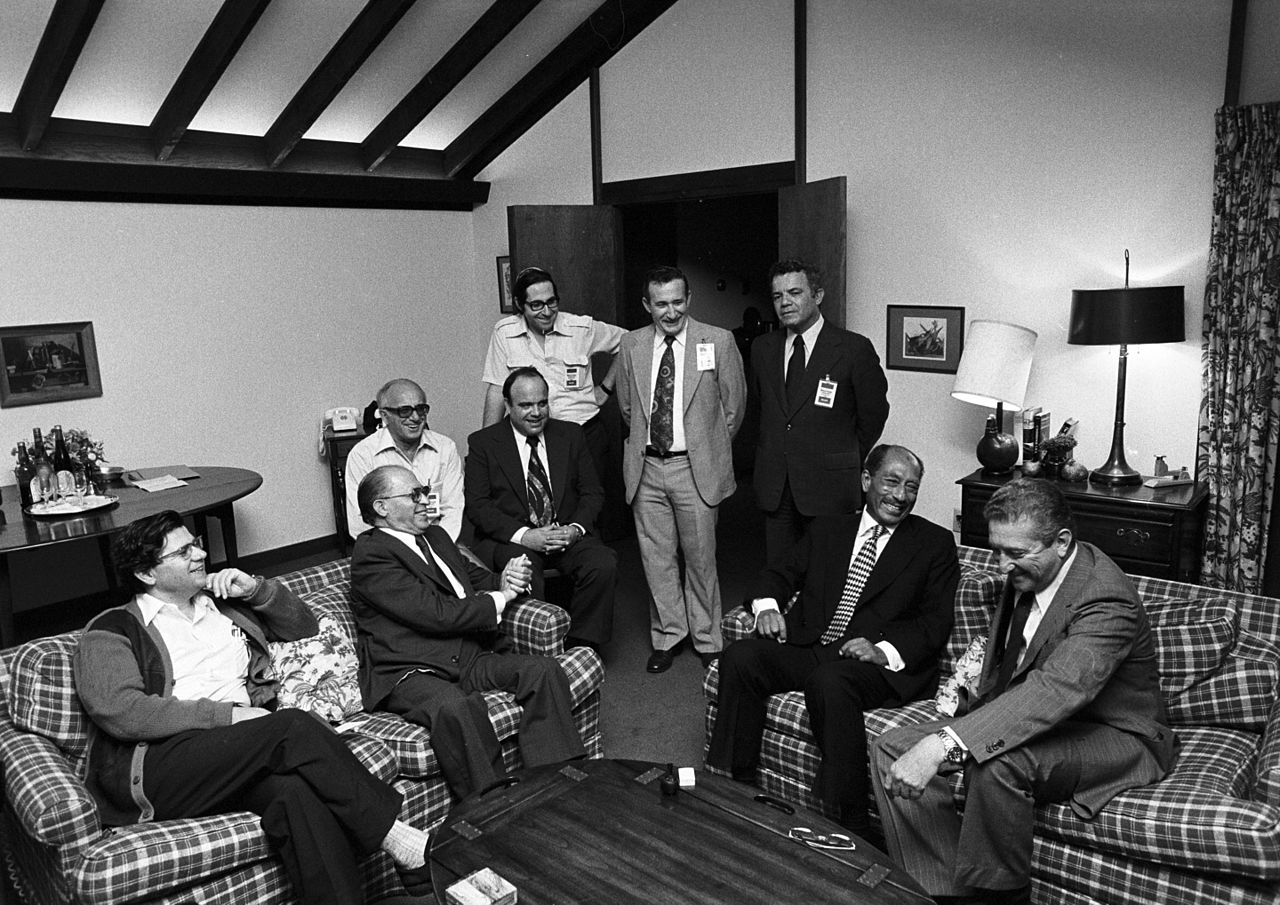
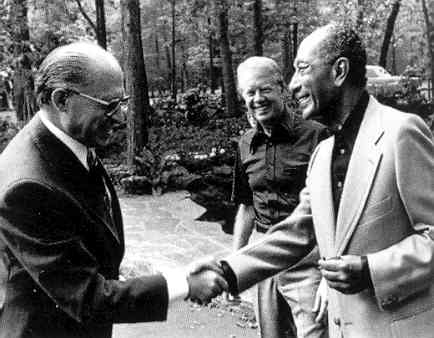
Begin, Carter and Sadat at
Camp David – September 1978
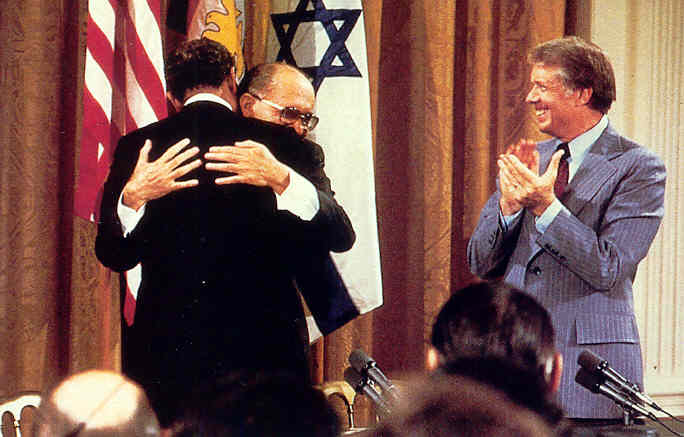
Anwar Sadat and Menachem
Begin embracing
while Jimmy Carter looks on – September 1978
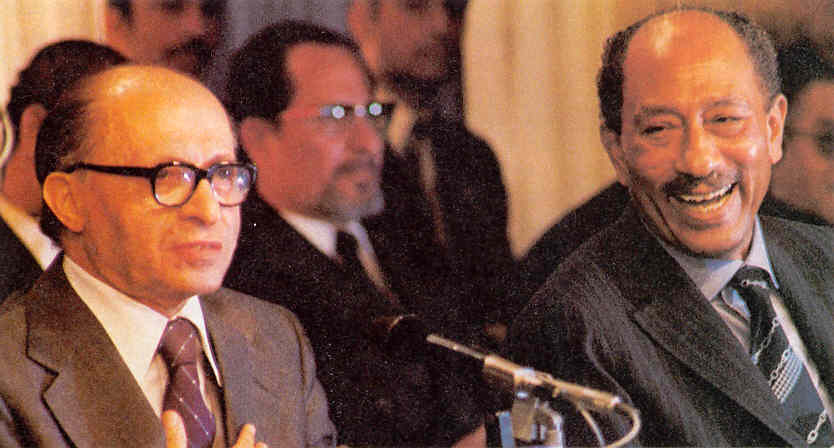
Menachem Begin and Anwar
Sadat
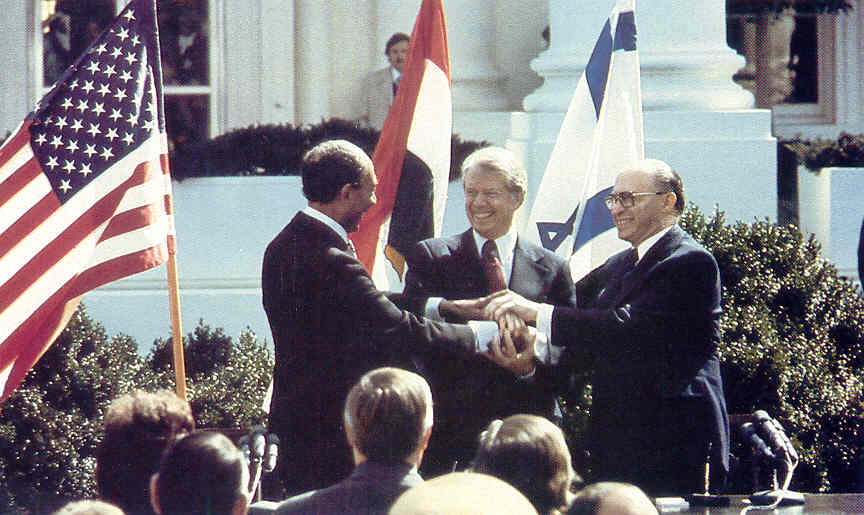
Egyptian President Anwar
Sadat, President Jimmy Carter and
Israeli Prime Minister sign the Camp David
Accords in 1978
Even though this finally brought progress in the stalled
Israeli-Arab standoff, it would not benefit Sadat very much politically. In fact it would have the opposite
result. Egypt was immediately kicked out
of the Arab League – and the United Nations announced its deep opposition to
the deal – because negotiations had not included the leaders of all the Arab
states involved (although such larger involvement would have resulted in a
continuing deadlock – in other words, no deal at all). But the Norwegian Nobel Committee was not
bothered by this widespread negative reaction – and awarded both Sadat and Begin the 1978 Nobel Peace Prize.[3]
China. At the same time, China was undergoing deep
changes since Mao's death in September of
1976. His domineering wife and three
colleagues (the Gang of Four) were arrested, and Deng Xiaoping moved up to take
control of China (although Hua Guofeng would serve as the presidential face of
China up until 1981). Deng had a very different plan for
China than Mao's zany (and lethal) socialism: he
wanted to open China up to foreign investment – and full involvement of China
in the international marketplace – in order to get China's economy finally up
and moving.
Carter certainly wanted to support
this new phase and in 1977 sent his National Security Advisor Zbigniew Brzezinski to China to explore the
possibilities of upgrading America's Liaison Office (established during Nixon's presidency) to full diplomatic
recognition – and exchange of ambassadors.
This meant having to agree on the status of Taiwan. Carter subsequently agreed to
withdraw all diplomatic recognition (and naval protection) from Taiwan in
acknowledging the island's status as merely a part of China. But he did so under the agreement with China
that America could continue to trade freely with Taiwan. Thus in January of 1979 Deng flew to Washington to meet with Carter and sign the new diplomatic
accords – followed that summer with full diplomatic recognition of Deng's Chinese regime.
Carter also makes the decision to extend formal
diplomatic
recognition to the Communist Government in
Beijing ...
confirming the fact (set in Nixon's presidency) that
America
recognized Taiwan as actually part of China ... under the
promise from Beijing that America could continue to trade
freely with Taiwan.
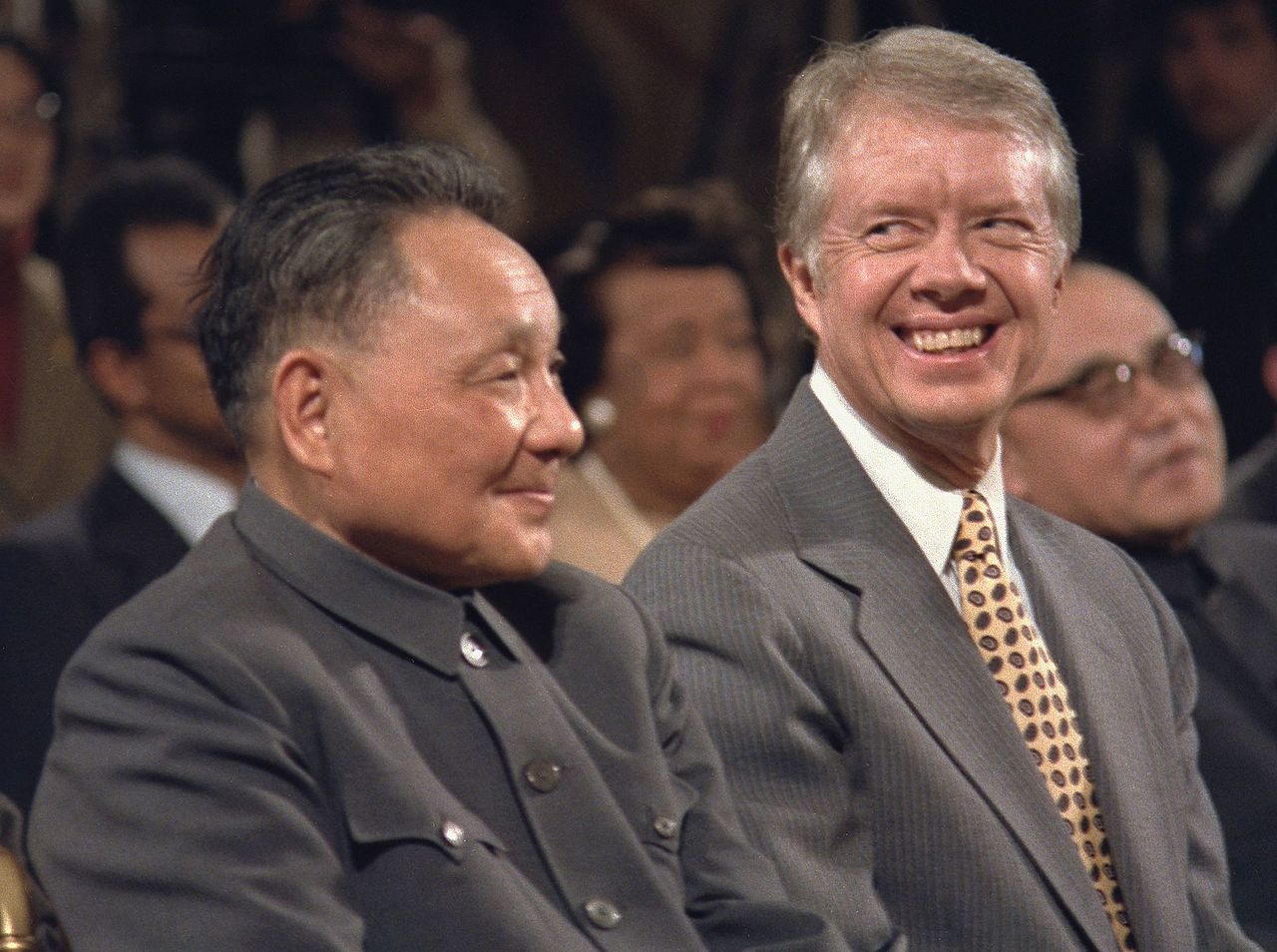
Carter receiving a visit in January of 1979
from Chinese leader Deng Xiaoping
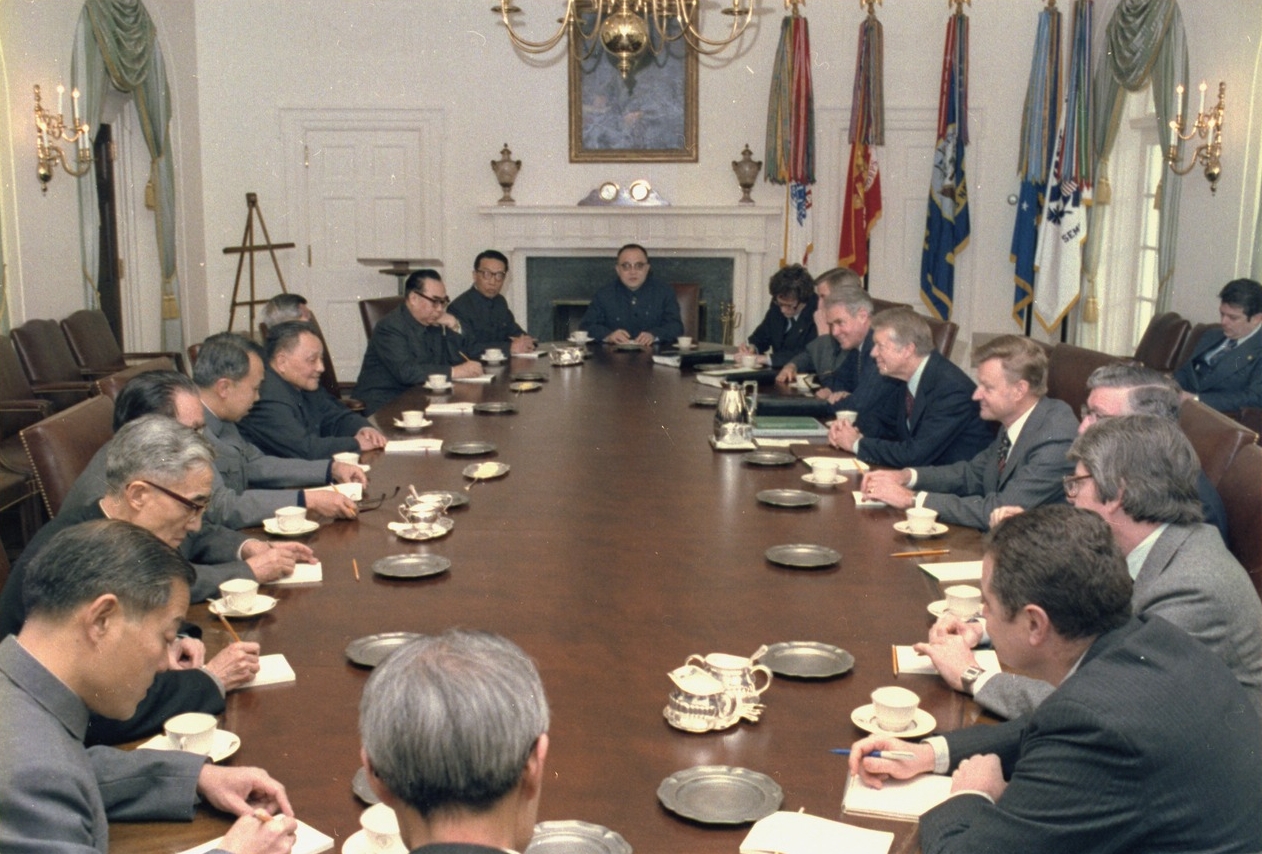
A meeting in the White House of Carter and Deng Xiaoping
and their diplomatic teams – January 1979
Carter and Soviet Premier Brezhnev's SALT II Treaty (1979).
At the same time Carter decided to balance his
eastward diplomatic offensive by bringing the Soviets into a new arrangement
concerning arms limitations. There was
growing concern that the SALT (Strategic Arms Limitation Treaty) negotiated in
1972 was not keeping up with the advances in military technology, especially
the development of MIRVs – missiles with multiple nuclear warheads – and thus
SALT I needed to be upgraded with a SALT II.
On the Russians' part, they were also interested in such an agreement,
growing nervous about America's new fondness for the Chinese – Russia's major
competitor, even opponent. Thus in June
of 1979, Carter and Soviet Premier Leonid Brezhnev met in Vienna to sign the
new SALT II document.
But
Congress balked at the vagueness of the provisions, concerned that the only
serious limitations that would come from the treaty would be on the American
side. In any case, when then in December
the Soviets invaded Afghanistan – even Carter was willing to back away from
the agreement. Thus it was never
ratified by Congress – although it did remain as something of a diplomatic
understanding in continuing Soviet-American talks over the coming years.
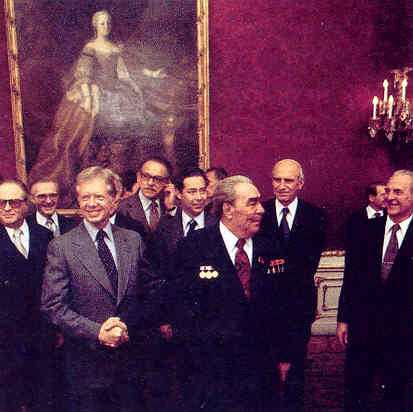
Carter and
Brezhnev
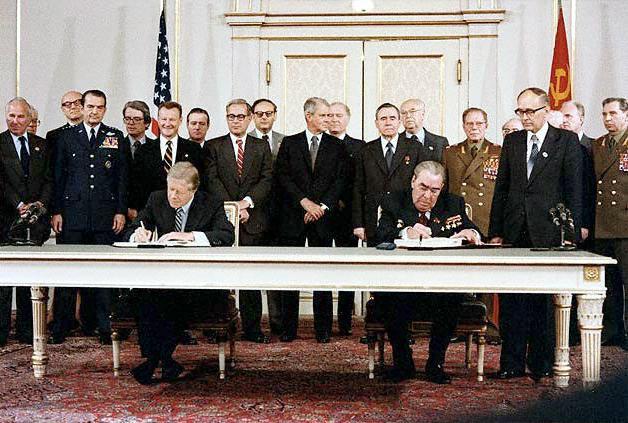
Carter and Brezhnev sign
SALT II in Vienna – June 1979
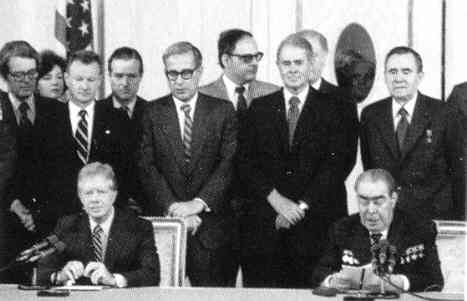
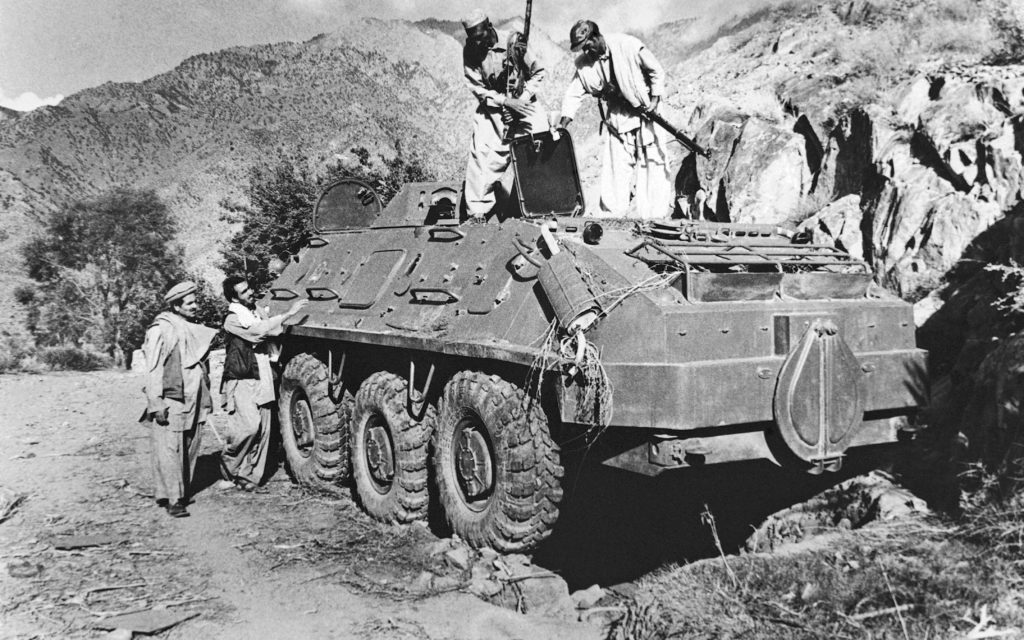
Afghanistan. As already mentioned, the Afghan King Zahir
Shah had been overthrown in 1973 by his cousin Mohammed Daoud Khan – who
attempted to construct something of a modern republic in Afghanistan. At the same time Daoud had attempted to
follow a neutral foreign policy in the Cold War – which irritated the
Soviets, who considered that part of central Asia standing between themselves
and the Indian Ocean as entirely within their sphere of influence (potentially
including also Pakistan's largely uninhabited Baluchistan desert along the
Indian Ocean just to the south of Afghanistan).
Finally, in April of 1978, Communists (under Soviet direction) made
their move against Daoud, had him assassinated, and took control of Afghanistan
under their leader Nur Mohammad Taraki.
Taraki then began to take out anti-Communist (or just Westernized)
political opponents, with possibly as many as 27,000 executed over the next
year and a half.
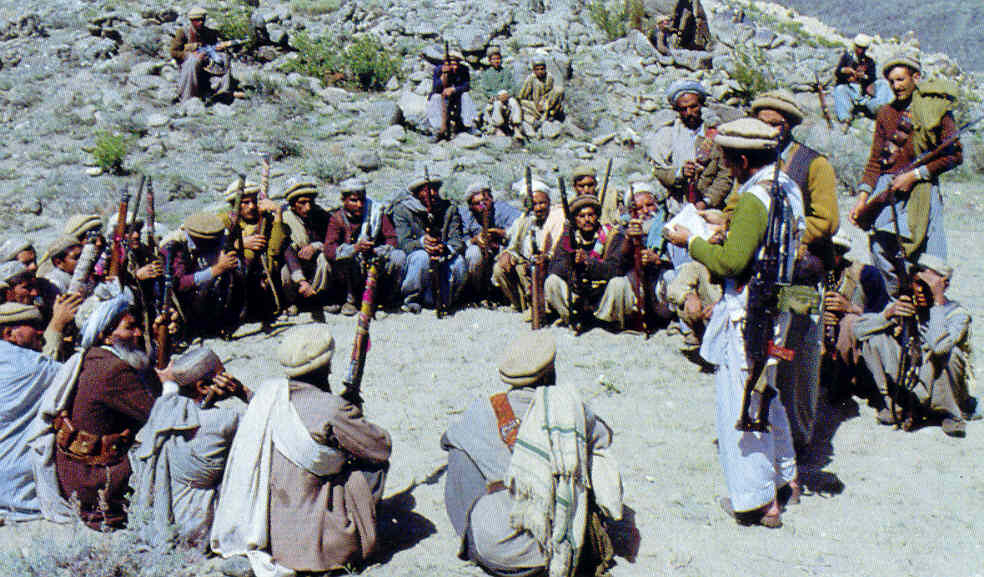
But
this merely stirred opposition all the more – and a massive rebellion broke out
later that same year – involving not only conservative Muslims but also members
even of the Afghan army.
Now
both the Soviets and the Americans got involved – with Carter sending secret aid to the
rebels (not exactly the open diplomacy he promised America!) – and the Soviets
having Taraki assassinated (October 1979) and replaced by Hafizullah Amin. But Amin was not servicing Soviet interests
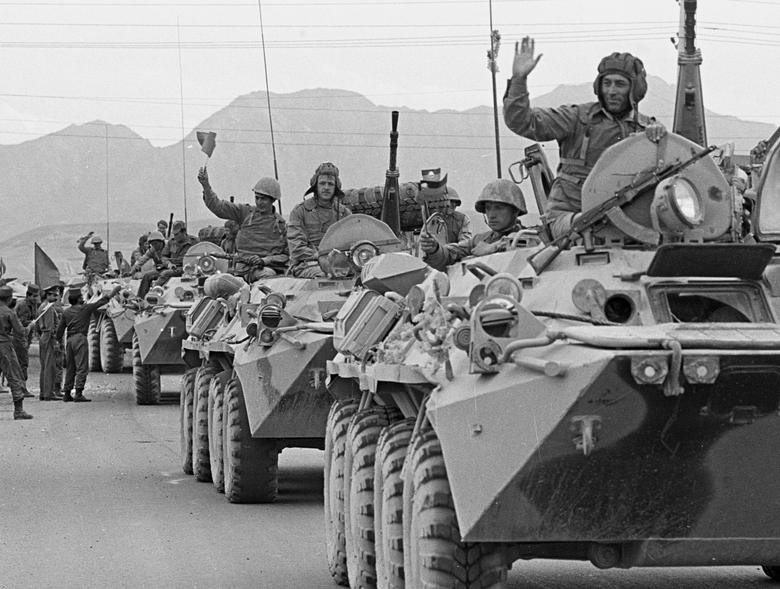
adequately either, and the Soviets then had Amin assassinated (December) and
replaced by Babrak Karmal – who immediately invited the Soviets to send troops
to restore order.
At this point the Soviets were about to discover what Vietnam felt like to the Americans.[4]
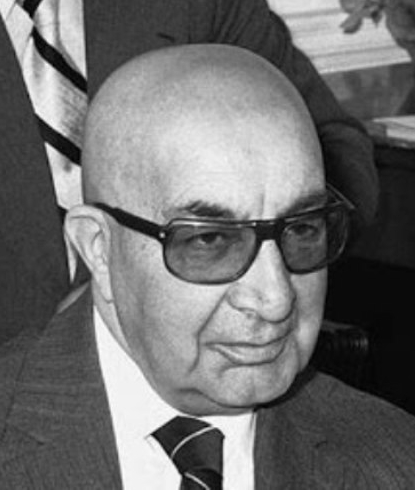 Mohammad Daoud Khan
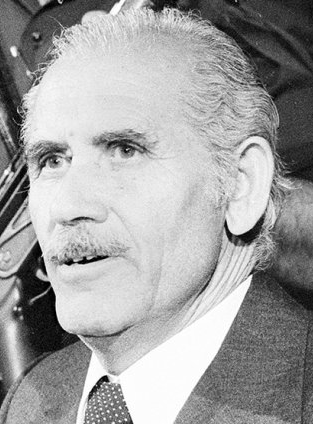 Nur Mohammad Taraki
America's further humiliation delivered by Iran.
In October of 1979 a very sick Shah of Iran was being considered by Carter for medical treatment in
America. When the Iranians got wind of
the news, they exploded in anger (or was it just clever manipulation?) and
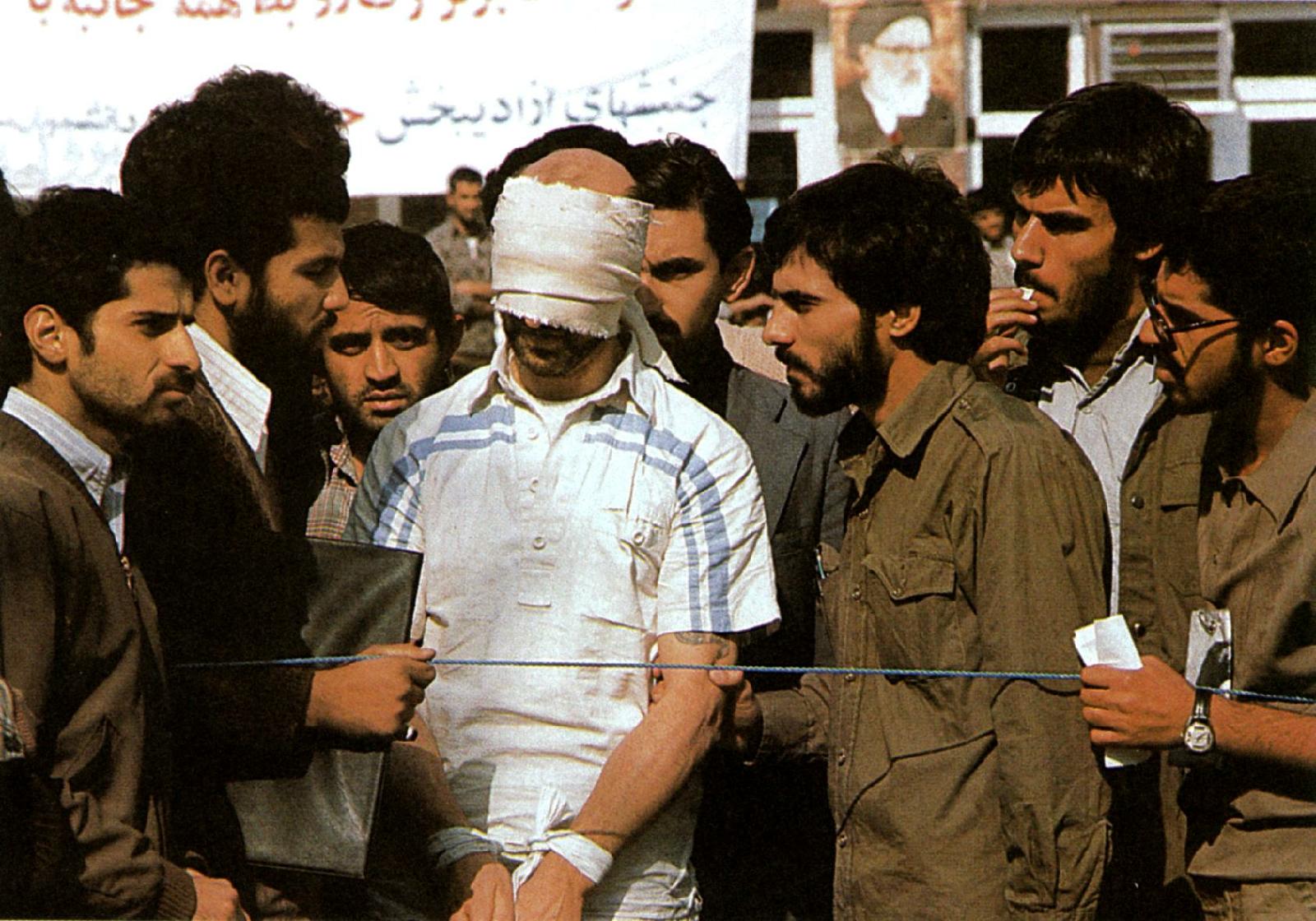
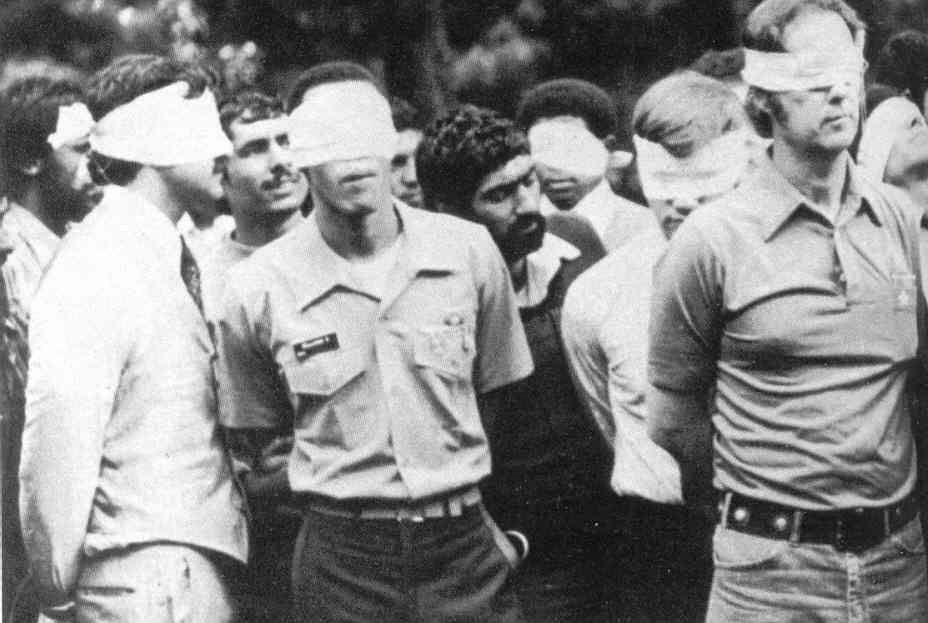
invaded the grounds of the American embassy, seized, bound and blindfolded the
staff working there – and paraded them in front of the world's camera – proud
to be able to demonstrate such contempt for the American diplomatic staff. And there was no way they were going to
release them (except for the Black employees, who were released and sent home).
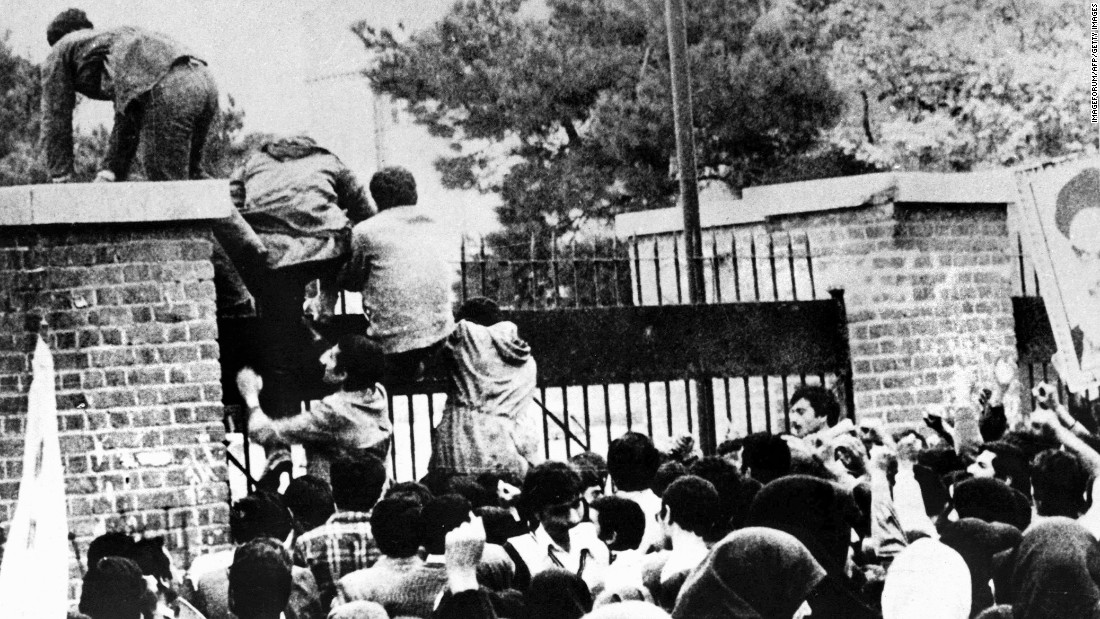
Iranian youth climbing over the wall
of the American
Embassy – November 4, 1979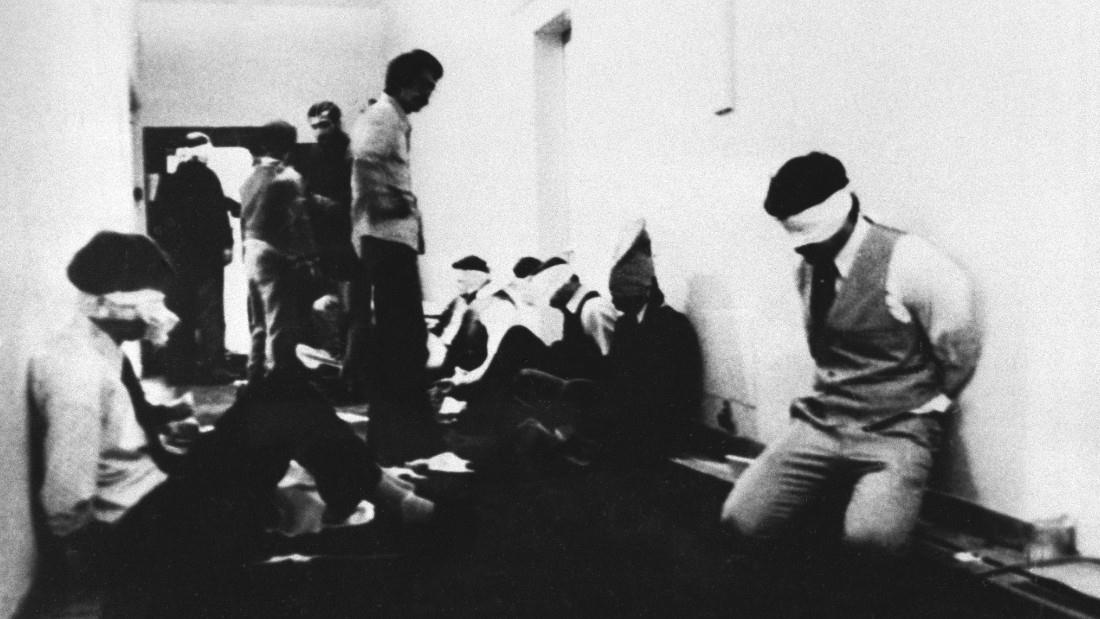
Some of the 90 hostages taken at the US
Embassy – November 4, 1979
American embassy staff taken
hostage in Tehran
by Muslim radicals – November 4, 1979
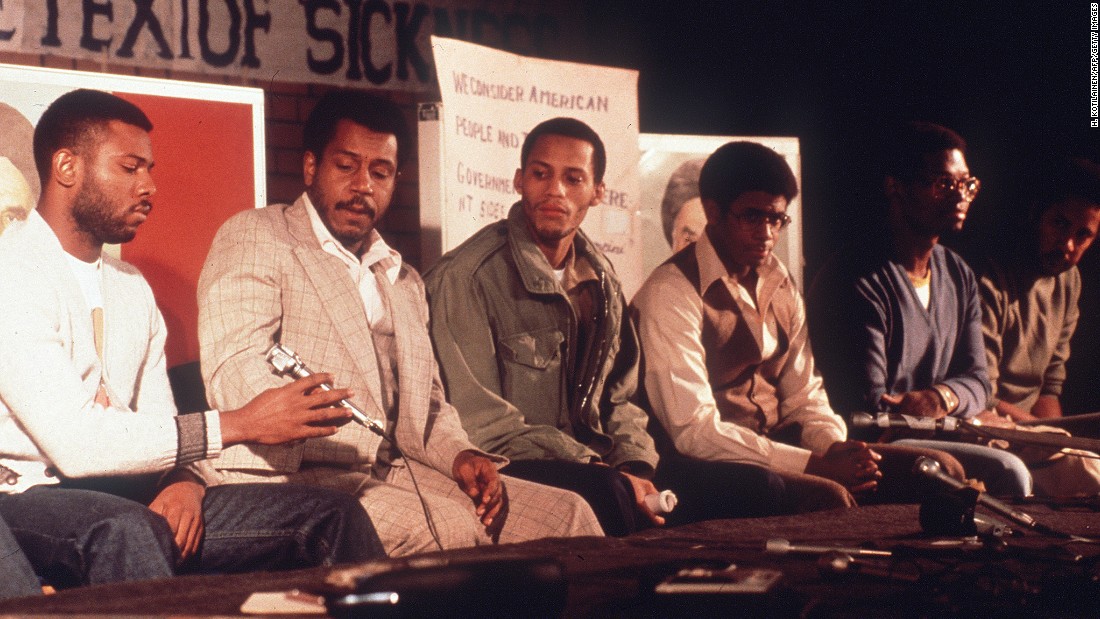
US Black hostages released by Khomeini in
November
(he also released the women hostages as
well)
Finally Carter decided to do something bold – or just
desperate – to secure the release of the American captives, when in April of
the next year (1980) he sent Special Forces for a surprise raid by night on
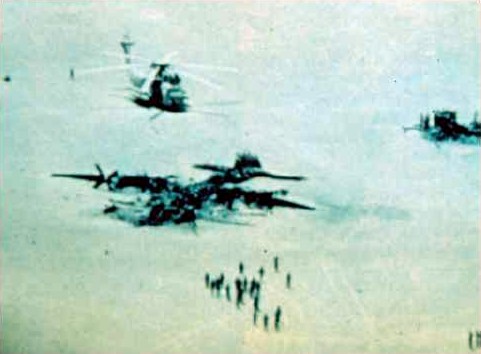
Tehran to retrieve the 52 Americans being held at the Embassy. But an early landing just inside Iran in
preparation for the final assault turned into a disaster when a sandstorm and
mechanical failure disabled three helicopters – forcing a cancellation of the
operation – but not before another helicopter collided with a C-130 transport
plane (killing 8 American troops).
Consequently, a very humiliated Carter had to go before the American press to explain
the failure of Operation Eagle Claw.
Wreckage at Desert One, Iran,
where eight Americans died
– April 24, 1980
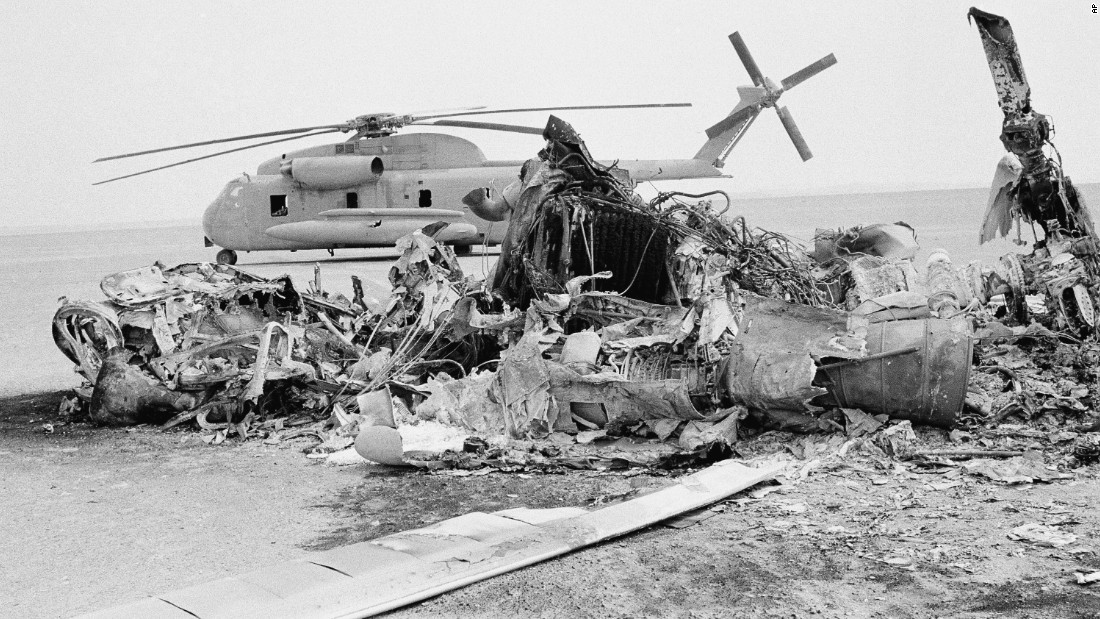
A burned-out and
abandoned US helicopter in Iran
(Operation
Eagle Claw)
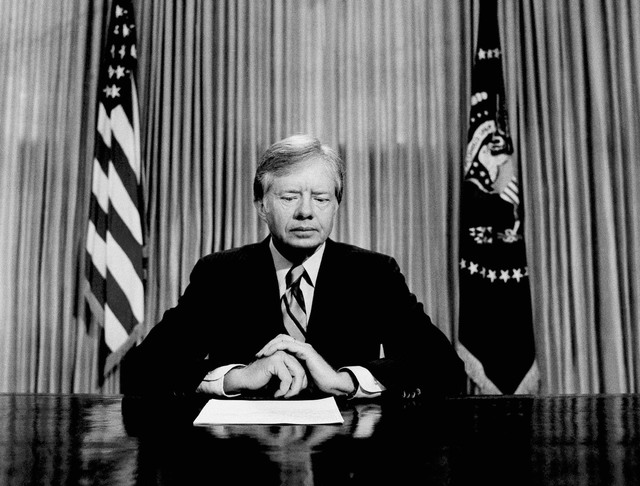
Carter ready to deliver a
nationally televised speech announcing
the failed rescue mission in
Iran (April 25, 1980)
[2]Soon after this, I had an Iranian student who had just taken my
politics of the Middle East course come to me, all excited about developments
in his home country. I didn’t want to
dampen his enthusiasm. But I did ask him
if he was also aware that Muslim traditionalists were just as anxious to gain
control over events as were the young Westernized Secularists like himself back
in Iran. He hadn’t thought of that. A year later he came to me and told me that
his parents had written to him, and told him to make no plans to return to
Iran. Developments back home had turned
in a direction under the control of the Muslim hardliners that had made life
very dangerous for the Westernized Iranians like themselves. Truly sad.
[3]Unfortunately, this deal would ultimately cost Sadat his
life, when bitter Egyptians assassinated him in 1981 during a military review
he was attending.
[4]Carter ordered the boycott of the Olympic Games held in Moscow in July
of 1980 as punishment for the Soviet invasion of Afghanistan. In the end the only ones punished by this
decision were the U.S. athletes who had trained for this grand event, but who
would now not be participating in the games.
Furthermore, when the Olympic Games were held four years later in Los
Angeles, the Russians returned the favor by not participating.
| VOLCKER MAKES AN ECONOMIC CRISIS GO FROM BAD TO TERRIBLE |

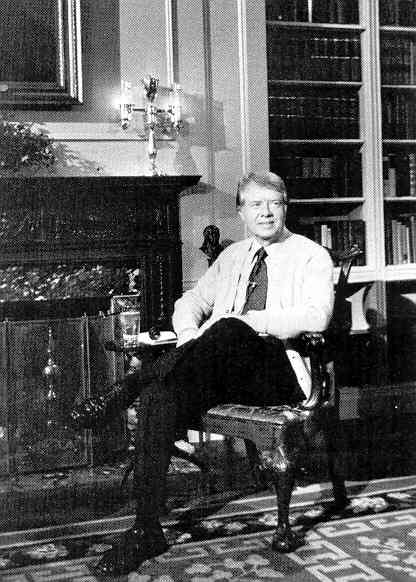
 Carter promises a "more moral" presidency
 Foreign policy issues ... Iran being the most troublesome
  Volcker makes an economic crisis go from bad to terrible
  Carter takes the hit