Since the days of the Puritans, the political foundations of
American politics had always been the family – an enormously strong social
institution able to carry the heavy responsibilities of truly democratic
governance – meaning exactly, governance by the people themselves. The family was represented in the voting for
local community officers, from city hall to the school board. The family controlled the nation's economy
through the simple device of local demand for goods and the willingness to use
family wealth to purchase these goods.
It even controlled its religion through the ability to call, by way of a
congregation's vote, their own pastors to their pulpits.
Men
worked hard in fields, factories and mines to put food on the table. Women represented the family in the larger
social context (church work, library work, sewing circles, etc.). And children were raised at an early age to
prepare to take up just those same roles.
But
now, centuries later, things were changing – dramatically. The call to family duty was being replaced by
the call to personal professionalism.
Getting married and having a family was put off so as not to interfere
with the task of achieving and developing a person's professional status –
women as well as men now. Indeed,
marriages were no longer life-time commitments – but instead divorce was
becoming rampant (as many as 50% of Boomer marriages were ending in
divorce) – thanks in part to the no-fault divorce and the prenuptial agreements
where divorce was understood to be a huge possibility even as a man and a woman
entered marriage.
Sex
was now viewed widely as a matter of recreation – not family
responsibility. Consequently, abortions
exploded in number as unwanted pregnancies multiplied dramatically in the new
age of "free sex."
Also
the role of the male became confused – as men were told to back down and let
the women advance in the professional world outside the family. Indeed, feminism even took on a distinct
anti-male quality – as men were accused of being "male chauvinist pigs"
in not letting women advance to full equality with them in the workplace. Lesbianism (what woman would come to have any
affection at all for a male chauvinist pig?) developed as women fell into each
other's arms – and male homosexuality now "came out" in huge public
displays as men simply found mutual attraction in each other's company
(expressed in a typical male fashion, to be sure).
A
classic example of how far America had moved from its 1950s idealization of the
American family is summed up in the top-rated TV series All in the Family
(which ran through the entire 1970s) in which Archie Bunker, the father, is
portrayed as the quite ignorant male chauvinist, his wife Edith as the
male-dominated (but subtly the one with something of real social sensibility)
wife, and two Boomer college-age kids – who pretty
much played out the classic Boomer roles. America did not realize
that it was laughing at the very institution that had long carried America
through hard times as well as good times.
The family now seemed overstated, ridiculous at times, and generally an
almost pointless accident as a social institution.
The widening generational
gap becomes the main theme of
a very popular TV sit-com: All in the Family

"All in the Family" – Norman
Lear Production – 1971-1978
Archie Bunker and his wife
Edith, daughter Gloria
and son-in-Law Michael ("Meathead")
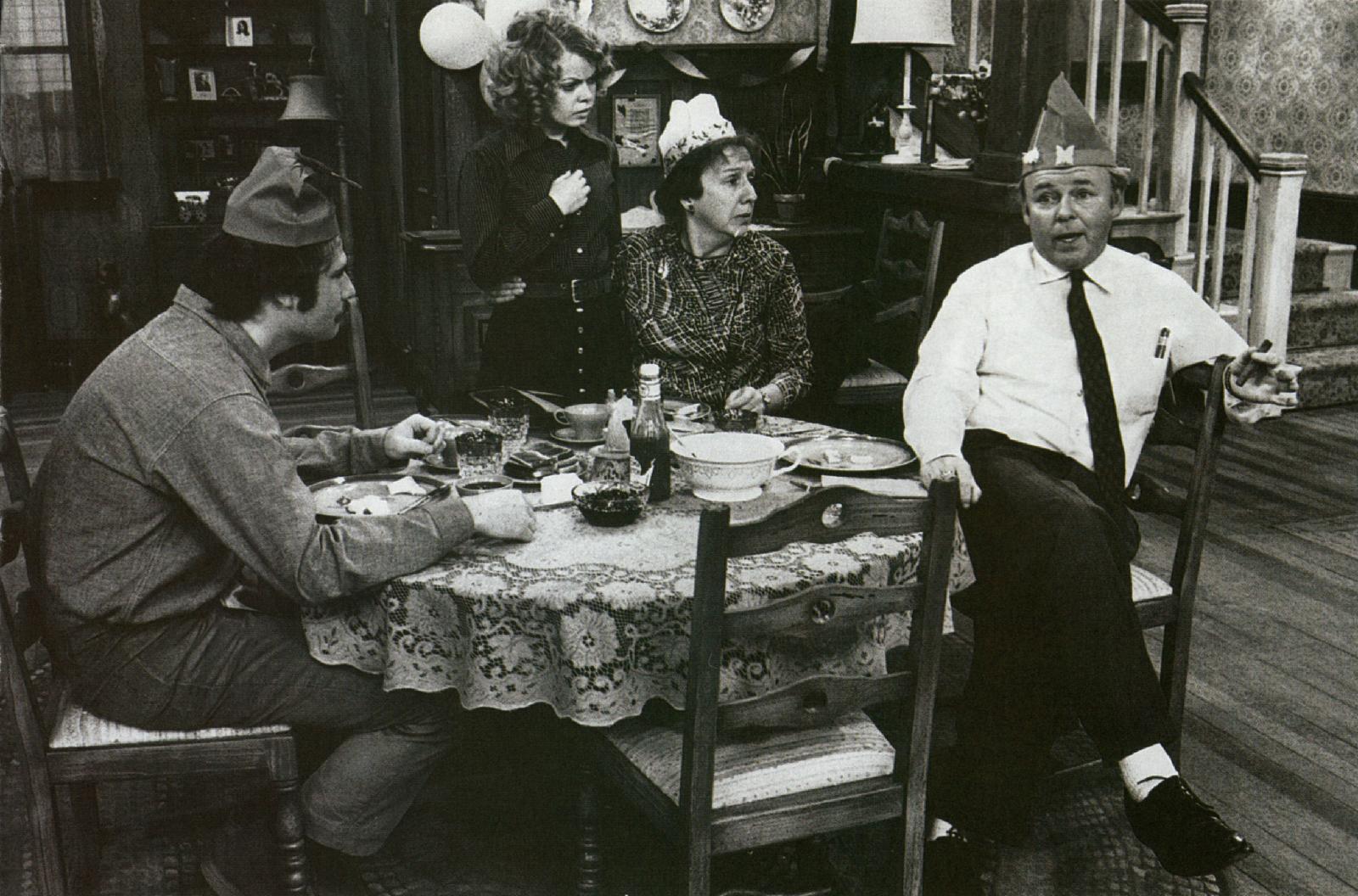
All
in the Family depicted the "White male head of the family"
Archie as a smug idiot; his wife Edith as compliant but
somewhat wise; and the kids as typical Boomers
But certainly countering the Middle-America bashing of All in
the Family was an alternate TV program, Happy Days
...
an equally popular program (running 1974- 1984) which
romanticized the glory of Middle America's 1950s and
early 1960s era
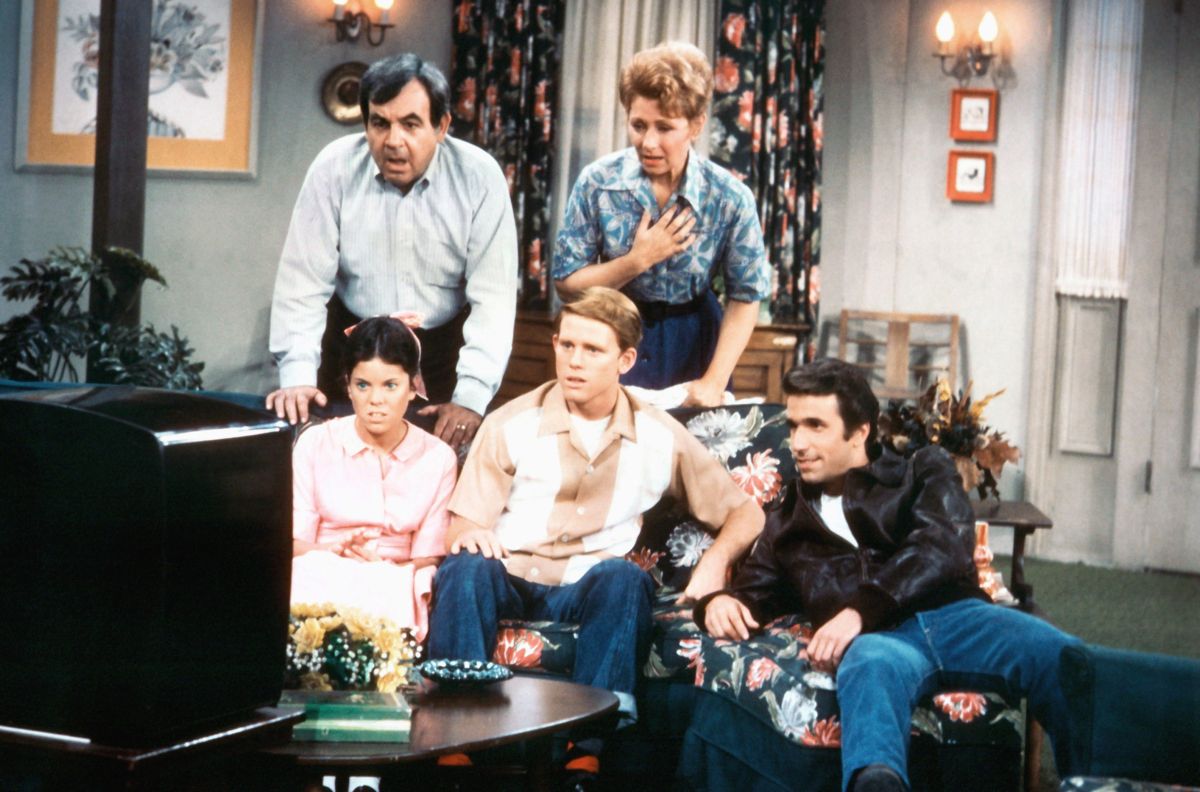
So ... which of the two got it right ...
as far as American opinion went?
Time would tell.
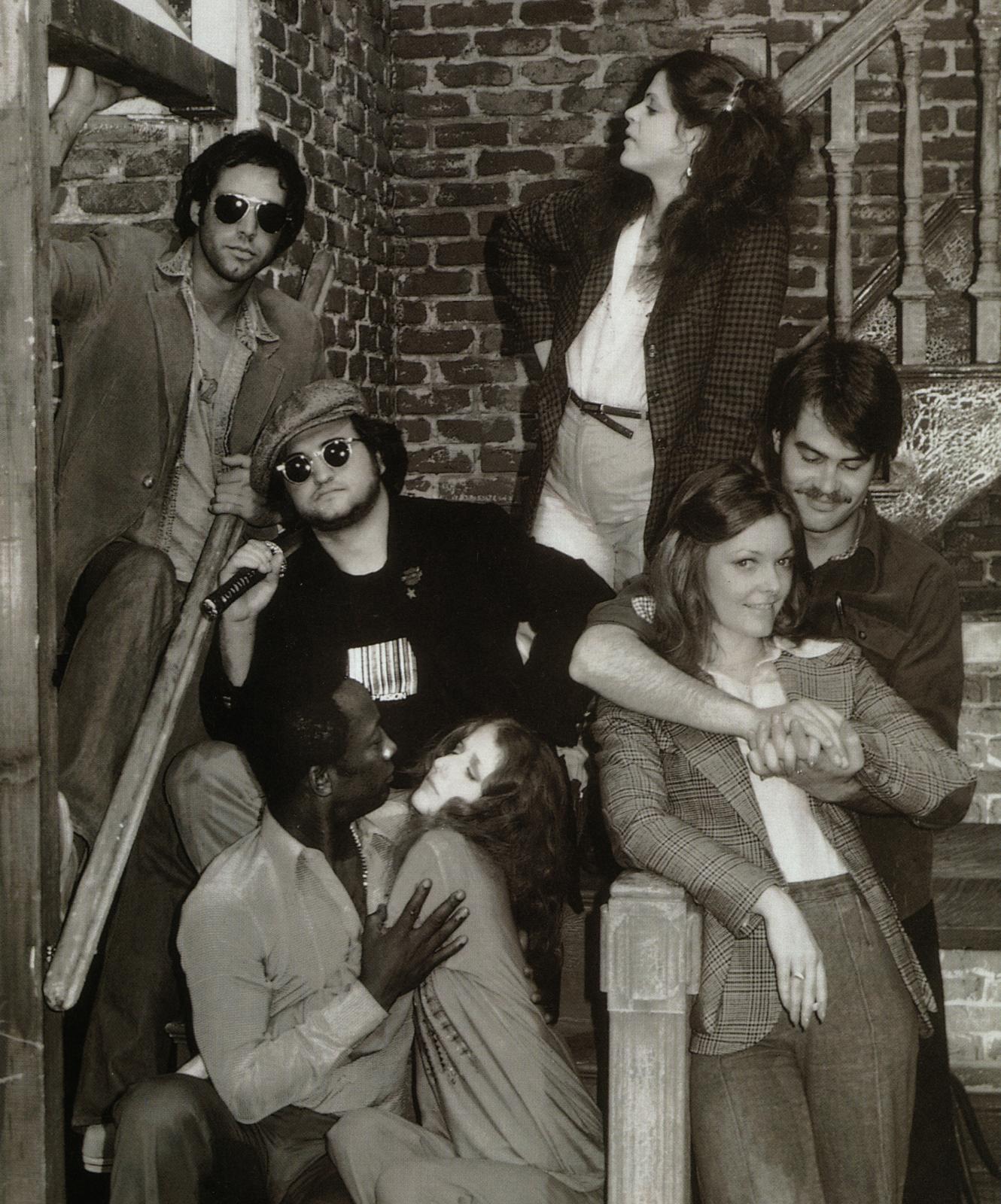
Equally quick to lampoon
American cultural and political life
– though more balanced politically
(they even made fun of
Democrats at that point!)
was Saturday Night Live
| THE RISE OF FEDERAL JUDICIAL LEGISLATION |
Since the early 1960s, "Progressive" organizations such
as the American Civil Liberties Union (ACLU) had demonstrated that the
Federal Judiciary – rather than Congress – was the place to go to get their
programs put in place as national law. A
favorable decision required only five individuals of the nine Supreme Court
judges in order to get the kinds of laws that the ACLU wanted to see direct the
country. That certainly was easier than
going through the complicated task of getting multitudes of Congressmen and
Senators (ever sensitive to the views and feelings of the American voter) –
plus a willing president – to put those laws into full effect.
Desegregation. Thus it was that federal judges – even at
the regional level of the federal circuit courts – got into the legislation
business. For instance, federal judges
took it upon themselves in a number of court cases to design exactly the
specific ways that the country was to undertake racial integration (as in the
1969 U.S. v. Montgomery County Board of Education decision) – establishing specific
racial hiring goals and various bussing programs sending specific numbers of
school children to this or that local school district – regardless of the views
of the local citizens, even when Black parents showed an interest in sending
their children to schools of their own racial character (as in the 1968 Green v. County School Board)
– all of this supported all the way up to the Supreme Court (the 1971 Swann v. Charlotte Mecklenburg
Board of Education case). This
judicially-decreed program coming from the Supreme Court would naturally
survive all political challenges over the next thirty years.[1]
Abortion. Then there was the matter of abortions –
outlawed in the majority of American states.
A Texas law prohibiting abortion made its way up to the Supreme Court in
1973 (with others much like it pending) in the case of Roe v. Wade. In a 7-2 decision, the Texas law was
overthrown, because it (according to the 14th Amendment) deprived a woman of
her right to due process. Realizing the
highly controversial nature of this ruling, the Supreme Court then set out
specific terms by 3-month periods as to when an abortion could occur, with
increasingly restrictive standards as the fetus developed into a full
child. That was simply legislation!
In
any case, feminists were overjoyed – and Christians deeply outraged, for
Christianity had always considered life from the moment of inception as
belonging to God – neither man nor woman.
To them Roe v. Wade simply amounted to court-approved
murder. But there was little that the
Christian world could do. The Supreme
Court had made it quite clear on which side of the moral issue it stood (at
least the majority of its members, anyway).
And there was no known appeal that Americans could make to block a
Supreme-Court-created law.<
[1]Did desegregation equal integration?
Not exactly, as the bitter anti-White attitudes of the Black
Panthers demonstrated, even as White America was moving strongly to desegregate
the country. Desegregation could be done under government authority, no matter
what the public feelings were on the matter.
But integration requires a change in the human heart, not something that
laws can themselves generate. That takes
inspiring leadership to develop the necessary changes in human hearts.
Right along with the middle-class family, Christianity was finding
itself losing status at the heart of American culture – for the two were
closely connected. And behind this was
again, the Supreme Court and the legal crusaders of the American Left – who
wanted to see Christianity gone from all public life. Citing the First Amendment as calling for the
separation of church and state, in case after case the Supreme Court had since
the early 1960s been invoking the "non-establishment clause" of the
Amendment as actually calling for the legal disestablishment of Christianity
whenever and wherever it should come into the ever widening realm of the state
– meaning, virtually all public life now.
Even locally, the state (local schools, town halls, public parks) could
not involve itself with the Christian religion in any way – for to do so would
be to "establish" it. The fact
that this had long been a key part of local life was no longer sufficient
reason to allow this to continue. And
all of this was done in violation of the protections of religion outlined in
the First Amendment which stated clearly
that Congress (meaning the part of the Federal system that made its laws, not
anticipating that the Supreme Court would take over supreme responsibility in
that area) was to "make no law respecting an establishment of religion, or
prohibiting the free exercise thereof."
But prohibiting the free exercise was exactly what the Supreme Court was
doing. How was it that the Supreme Court
could not find itself able to defend the very clear wording of the
Constitution?
Worse, the Supreme Court even got into the business of the "establishment
of religion" in its 1971 decision in the Lemon v. Kurtzman case. Its decision stated that only secular (or
basically non-Christian) programming could be part of the local school
program. Also, the only material that
could be brought into the classroom had to clearly serve a purely secular
purpose.
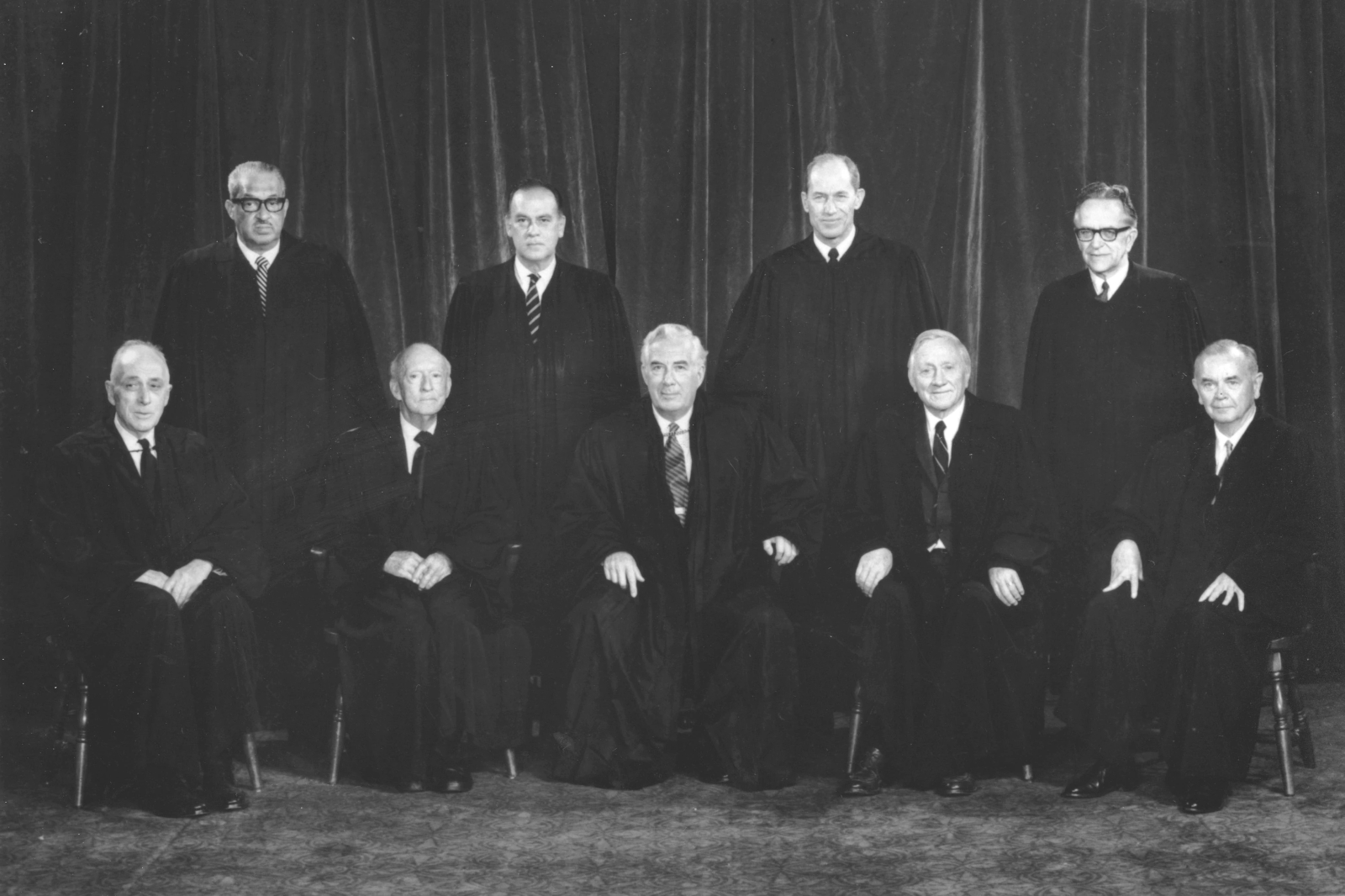
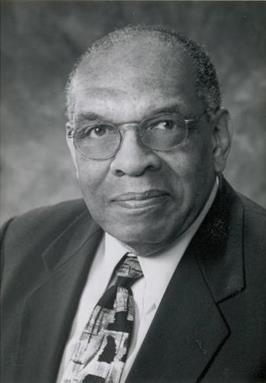
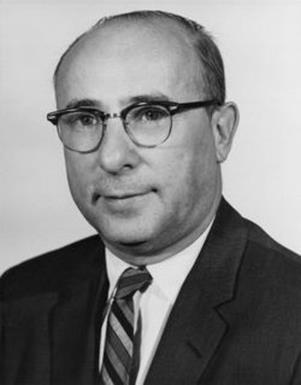
Alton Lemon (above left) was named as the leading plaintiff
in the suit against the Pennsylvania
Superintendent of Public
Instruction of Pennsylvania, David Kurtzman
for his
(actually his Office’s) support of religious schooling.
Supposedly
secularism was not a religious matter, and therefore the Supreme Court felt it
fully within its power to prescribe the Secular Worldview as the only worldview
to be presented and worked from in developing the thinking and understanding of
America's rising generations.
What
this small group of "enlightened" lawyers was doing was actually
deciding for the rest of the country the quite religious question as to the
dynamic source of life. They had made
for the country the decision that life was to be understood as being by nature
purely secular, that is, mechanical, operating only from a set of natural laws
that scientists (social and physical) have discovered – or will soon discover
anyway – which direct all existence.
And
that sense of life being purely mechanical extended also to all social as well
as material dynamics (the Humanist part of Secularism). According to Secular-Humanists, society too
operates strictly according to a set of mechanical or "natural"
social laws, which "social scientists" are working hard to
discover.
And
in any case, being purely "mechanical" in view of life and its
dynamics, Secularism cannot be considered to be "religious", because
religion is only about supernatural or "non-mechanical" causes. Or so the Secularists argued.
Therefore, anything to do with advancing a
Christian worldview, being obviously religious in nature, was supposedly
forbidden by the Constitution (which part were they actually referring
to?). Only Secularism had the right to
be established (by the Court itself) as America's fundamental worldview (in
other words, religion), the only one to be allowed legal support in America's
public life.
Wow! With that
Supreme Court decision, the people's right to determine those religious matters
themselves, one of their key freedoms – the first one to be mentioned, in fact,
in the First Amendment – just got thrown out. Religious orthodoxy was now completely in the
hands of the federal judges, the new high priests of Secularism.
Of course the American Humanist Association[2] recognized
its opportunity in the Kurtzman ruling – but also the dangers. If the original Humanist Manifesto (1933) had been brought into
the Kurtzman hearings, it would have been very clear that
what the Supreme Court was supporting was indeed a religion, not merely some
neutral Truth – because the Manifesto itself clearly confessed this to
be the case in its repeated use of the term "Religious Humanism."
Consequently, the organization came out in 1973 with the Humanist Manifesto II – in which all the
language about Humanism as being a new, more progressive religion was
dropped. Humanism was simply pure science, nothing more.
Now, according to Humanist Manifesto II,
Humanism was just
merely "science." "Religion" was now a term
that applied
only to those who believed in some kind of god.
Behind this 1973 revision of the Manifesto were Paul Kurz
(a Philosophy Professor at SUNY-Buffalo) and Edwin H. Wilson
(a Unitarian Minister who first helped publicize the 1933
version and then later draft the 1973 version of the Manifesto)
… both editors at one time or another of the Humanist magazine.
[2]The Humanist Association states in its letterhead: "Good without a
God: Advocating progressive values and equality for humanists, atheists, and
freethinkers."
| MAINLINE CHRISTIANITY IN CRISIS |
As the 1970s rolled along it became increasingly apparent that the
traditional denominations (Baptist, Methodist, Presbyterian, Lutheran,
Episcopal, etc.) were being sustained largely by an ageing Vet generation. Boomers showed little interest in
participating in, much less committing themselves to, congregational life.
To
try to reverse a persistent decline in numbers, church officials at the
national level attempted to design programs that would adjust their
denomination's agendas in a way to make them more relevant to the changing
culture around them. They proudly took
up the causes of "peace and social justice," authorizing special
seminars on the subjects – and just in general going on public record in favor
of this or that stand (mostly Leftist) similar to the progressivist world
around them. "Old-time religion"
(personal salvation and gospel missionary work among the unchurched at home and
abroad) dropped from the agenda.
But
sadly, all this did was make their churches so much like that larger, secular
culture that there was very little reason to come into church from that culture
– when culture and church offered mostly the same programs. Thus the persistent decline in Mainline
Christianity continued.
Sadly, the denominational leaders never caught on to
what was actually happening, or were so deeply committed to their religious "Liberalism" that they refused to change course.

Go on to the next section:
The World's Sole Superpower
 Miles
H. Hodges
Miles
H. Hodges

 The assault on the American family
 The rise of Federal Judicial legislation
  Christianity in trouble
  Lemon v. Kurtzman (1971)
  The Humanists respond
  Mainline Christianity in crisis