6. AMERICA COMES OF AGE
|
| "DEMOCRACY" AS THE NEW SOCIAL CURE-ALL |
Under
the rules of the Constitution, the people would have their voice in the House
of Representatives. But that voice would
have to work with – or be checked by – the U.S. Senate, where the states would
send their very best "ambassadors" to represent the interests of the
various states –individuals chosen by the state legislatures (as per the
Constitution itself). The president
would likewise be elected by representatives of the states as special electors
(not by the American people themselves) and the federal judges would be
appointed for life by the president, subject to the confirmation vote of the
Senate (not the House of Representatives) as would also be diplomats and other
executive officers. The United States
was intended to be a republic, not a democracy.
But
a Rousseauian spirit – similar to what had led the French to their suicidal
Revolution in the late 1700s – was overtaking America around the turn into the
20th century. A very Romantic
vision about the basic goodness of man – and the corruption of traditional
social orders – seemed to infect the thinking of the West's intellectuals, in
America as well as Europe. Of course
such Humanism was not new to the West –
nor to America, which had gone through waves of such "enlightenment"
already several times since its birth three centuries earlier.
Actually,
"democracy" was taking its place in American hearts as something of a
religion – closely related to the new nationalist thinking that was sweeping
hearts away in the Western world.
Democracy was a religion that believed as its central article of its
faith that "natural" man was by all instincts an angel. According to this Humanist or "democratic"
religion, traditional social orders (built on long habit) were keeping that
angelic character suppressed, forcing human behavior to become desperate ...
even criminal. Crime was a by-product of
social injustice, not just a matter of breaking the law. Society thus needed to be reformed, its
ancient laws changed, new freedoms offered to the people, and happiness would
finally reign as the angelic potential in man finally revealed itself.
This
was quite a different religion than Christianity, which believed in faith in
God, not faith in man, as the way that life took on its glory. The Puritans had built their entire social
order on that Christian belief.
But
now that belief was being replaced by the idea that man himself – not God –
would ultimately be the source of such earthly glory. All that was needed was social reform – led
importantly by those who knew how to bring the best out of the people themselves. These select reformers would supposedly not
be self-interested, scheming demagogues.
These would be the ones enlightened by the new ideas and doctrines
coming out as the world entered the 20th century, doctrines that surely had "science"
to back them up as being the ultimate Truth in life. All that was needed now was to trust fully
the Russian Bolsheviks, the German nationalists,
the Washington Progressivists, etc. who had the
people's best interests at heart as they pushed for deep social reform (even
Revolution if need be). These
enlightened ones were supposedly working out of the purest and highest of
motives as they pushed for mankind's ultimate success.
So forget tradition, change the laws (deeply if need
be), and just trust the wisdom of the reformers – who were advancing (from the
loftier heights of their writing desks) their various social theories as "democracy."
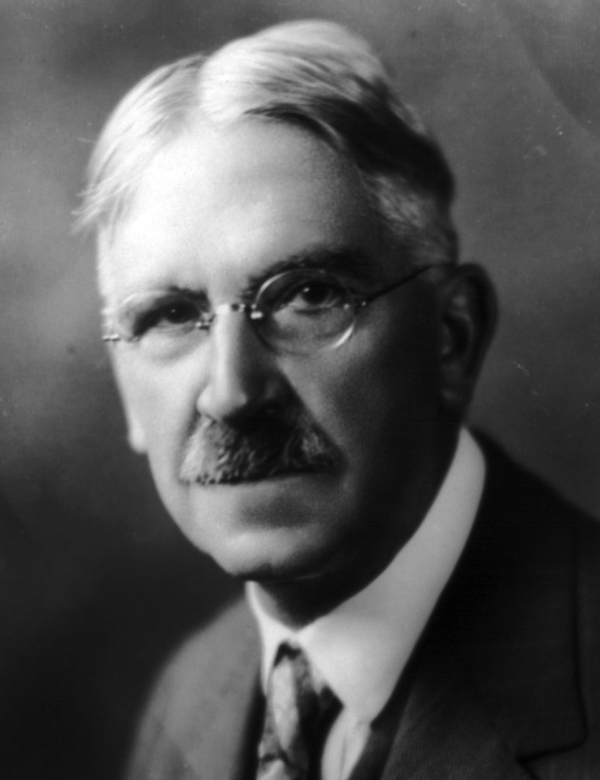
| JOHN DEWEY |
[1]Enacting deep social change by taking over the education of a future
generation is not a new thing. Back in
the 1600s, the Jesuits understood quite well the importance of taking charge of
the education of the young, in order to build a purer "Catholic"
world. And the Chinese dictator Mao Zedong
more recently (1960s) undertook deep "cultural revolution" in China
the same way.
Dewey graduated from the University
of Vermont in 1879 and found a job teaching high school in Pennsylvania for two
years before returning to Vermont to teach at a primary school there. But he recognized rather immediately that he
would rather study the philosophy of education than actually engage in it, in
the elementary/secondary classroom at least.
Thus he headed off to graduate school (Johns Hopkins University), got
his doctorate and then took a teaching position with the University of Michigan's
philosophy department. He moved on from
there to additional teaching positions, in 1889 becoming chairman of the
Department of Philosophy at the University of Chicago (1894), where he began to
write and publish his social-educational theories. In 1904 he moved on to Columbia University in
New York City, and continued to write even more extensively on education,
society, human psychology, and social ethics.
His
philosophy was standard Humanist theory: social environment determines human behavior;
reform the environment in very practical ways and you will reform human
behavior. He also, like so many
intellectuals of his generation, believed that democracy was the proper formula
for solving society's problems (though critics were quick to point out that he
never really explained how democracy was supposed to work in a mass society).
He might not have stood out from the intellectual crowd, except that his
massive number of publications made him a well-recognized leader in the rising Humanist movement underway in America
(he published some 40 books and over 700 articles in his lifetime).
After
retiring from Columbia, Dewey continued over the next twenty
years to be very active in promoting his Secular (even atheistic) Humanist philosophy, taking a
position in 1929 on the board of the Humanist Society of New York, then
being one of the composers of the 1933 Humanist Manifesto, and an avid writer and lecturer on
the subject thereafter.
And he (and his legacy) would continue after him to
help direct the country's rising Liberal intellectualism in its battle against
America's long-standing moral-spiritual foundations in the Christian faith.
AMERICAN "LIBERALISM"
[2]That is, until Vermont Senator Bernie Sanders
came along in the 2010s/2020s and ran a nearly successful campaign for the
Democratic Party presidential candidacy in 2016 on a self-proclaimed Socialist
platform!
But
where Liberalism became truly ironic was in
the way it looked increasingly to the federal state to take the lead in
changing the laws that tradition had put in place. What is interesting is that the word "Liberal"
in the European context meant almost the opposite of what it was coming to mean
in America. European Liberalism was founded on the fear of
an overly aggressive State, one that took on dictatorial powers in order to
force its political interests on its subject people. "Liberal" meant to cut back – to "liberate"
the people from, not expand – the powers of the state, an idea that the
American Framers of the Constitution understood quite well themselves back in
the 1780s after having gone through what they had experienced in their recent
war of independence against an overbearing British king.
But
now American Liberalism proposed to enhance the
powers of the federal or national state (just like Lenin's State Socialism) because the
federal state was considered by American Liberals as the country's best locus
for enlightened power, such as would be able to put into place true social
progress (the reformers' own programs, of course).
In Europe such Liberalism would go by the name of Socialism – a term
that in America would long remain taboo.[2] But under the cover of careful labeling, the
policies of both American Liberalism and European Socialism actually had/have
pretty much the same ambition: to let "enlightened"
national authorities take the reins of power (social powers taken away from not
only the states of Massachusetts, Ohio, Kansas, etc., but also local town
councils, school boards and churches, and even fathers and mothers) if you want
to see social progress truly blossom.
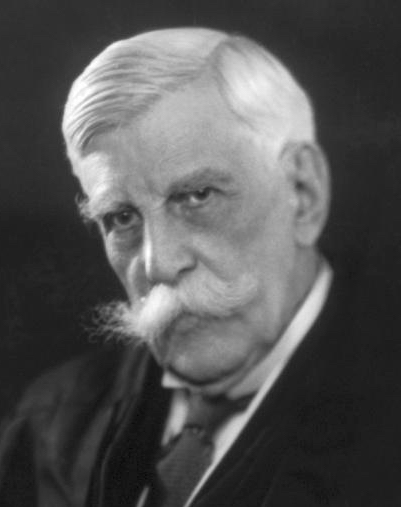
SUPREME COURT JUSTICE OLIVER WENDELL HOLMES, Jr.
[3]Actually, he had expressed this view quite clearly in an earlier
collection of his lectures and legal writing published in book form in 1881 as The
Common Law
[4]Unfortunately, such
"Realist" (or Liberal or Progressive) views as Holmes's seem quite
ignorant of the fact that there is more to goodness and truth than an
individual's – especially a very "enlightened" individual's – own
personal inclination to see things as he or she does.
Holmes
was a well-born product of a prominent Bostonian family, like his father,
Harvard educated and close friends with prominent philosopher-writers such as
the transcendentalist Emerson and the James brothers, William and Henry, Jr., and
both something of philosopher-writers themselves, father and son. But it was military duty in the Civil War –
Holmes enlisted in 1861 just as he was graduating from Harvard (and just as the
war was starting up), seeing action in numerous battles, and suffering also
numerous wounds as a result – that would shape his social-legal philosophy
deeply. As he would see things, such
sacrificial social service opened his eyes to the world of political realism
... and thus the need for the legal system to keep up with such realism. Thus he entitled his legal philosophy "Legal
Realism."
Appointed
by Roosevelt to the Supreme Court in 1902, Holmes quickly proved himself to be
strongly opposed to the idea of there being some kind of permanent, universal
set of legal standards (especially those designed by an unseen deity) that
should serve unchangingly from generation to generation.[3] He detested such Legal Idealism (or what
today would be termed Legal Originalism).
To Holmes, life
changed constantly ... and so did society's particular challenges. And it was the responsibility of the law,
even the most fundamental law, to keep up with such changes. And how was it to do so? That was the job of politicians ...
especially court judges, on whose shoulders fell the responsibility of finding
true moral legal principles – in the way they were required constantly to make
decisions on the basis of multiple facts and evolving social issues. But through dutiful training and actual
experience, such wisdom could be expected of those given such responsibility.
In
short, it was up to the wiser elements of society (like Holmes himself, for
instance) to define, or redefine, even the most fundamental law as they went
along. And so the "Liberal"
theory of "democracy from above" got a tremendous push from this very
notable 20th century legal philosopher.[4]
Too much of just such enlightenment was
the problem confronting the 55 delegates who gathered in Philadelphia in 1787
to draft a Constitution for the new American Union. Each of the delegates had his own good idea
(like Holmes) as to how things should go, and argued endlessly.
Finally, Franklin took them above their
own logic, their own reasoning, to have them put their thoughts before God, and
also to listen to each other. Then and
only then were they able to get past their personal wisdoms to find a higher
truth, one requiring them to let go of their personal takes on matters.<
What those 55 men finally secured is
incredible wisdom, wisdom of a very lasting variety.
Those that constantly want to reform
that wisdom (with their own enlightened ideas of course) threaten to undermine
that wonderful legacy. And thus
Franklin's statement, "A Republic, if you can keep it." He understood full well the dangers that
"wise men" would bring to the American Republic in their efforts to
"upgrade" that incredible constitutional achievement. As Franklin knew full well, constant effort
to upgrade the famous Roman Republic was what had finally destroyed it.
THE 16th AND 17th AMENDMENTS TO THE CONSTITUTION
The Sixteenth Amendment awarded the
federal authorities in Washington the power to tax directly the American people
– at the time thought to offer Washington authorities no more than a small
supplement to the fees, licenses, etc. that it collected in order to run its
operations. There was little
understanding at the time that this opened the door for Washington eventually
to lay huge taxes on the American people and their economy – in order to run
its various programs presumably designed to better America.
The Seventeenth Amendment also involved a huge reshaping
of the American Constitution's checks and balances system when it took the
selection of senators away from the states and put that matter in the hands of
the people. This was clearly a huge step
in the direction of "democratizing" American politics, supposedly
taking power out of the often-corrupt political machines operating in the state
capitals and placing that power, through the people, into the Washington
political arena itself – where supposedly the political doings of America's
wielders of power could be more closely watched, and checked, by an enlightened
citizenry (enlightened largely by the information put forward by a Progressivist Press corps).
POWER PROBLEMS
But
what these two Amendments did was simply to shift the scene of such grand
pursuit of power from the individual states, now to the distant offices of the
Washington politicians. And guess what? Political corruption naturally moved in that
direction as well.
Worse, handing Washington such new (and potentially
limitless) power would mean that the numerous states would find "checking"
the power of the central state (which was the big question which the
Constitution faced when seeking ratification in 1787-1788) would be nearly
impossible at this point. Then who would
place the needed checks on such power:
the Washington politicians themselves or the national press corps
looking for ways to get into the power game itself?
How
would America's citizens effectively protect themselves in this move to "democracy,"
when action "behind the scenes" would be almost impossible to detect
from Omaha or Dallas or Denver? Could
they trust the press (supposedly the eyes and ears of the people) not to get
ideologically involved in the process and thus become part of the problem
rather than its solution?
No
one raised such questions in the rush to "democratize" America in the
early 20th century.

Go on to the next section: American Christianity Responds
Miles
H. Hodges